The types of conjunctions are sorted by how they join ideas. Coordinating conjunctions join equal parts, subordinating conjunctions make one clause depend on another, and correlative conjunctions work in pairs. A fourth group, the conjunctive adverbs, links separate sentences. Each type has its own rules for punctuation and word order, and mixing them up is a main cause of comma splices and fragments.
This chapter gives the definition of each of the types of conjunctions, with conjunction examples for every type, so that types of conjunctions examples appear in every section. You will learn the FANBOYS conjunctions, the main subordinating conjunctions grouped by meaning, the correlative pairs, and how to punctuate conjunctive adverbs. It also covers starting a sentence with a conjunction, comma use, and common errors. Thirty exercises and a quiz follow.
Ideas in a text are connected: one adds to another, contrasts with it, causes it, or depends on it. Conjunctions are the words that show those connections inside a sentence.
Why it matters: If you know the type, you know the pattern. A coordinating conjunction between two clauses needs a comma before it; a subordinating one at the start of a sentence needs a comma after the clause.
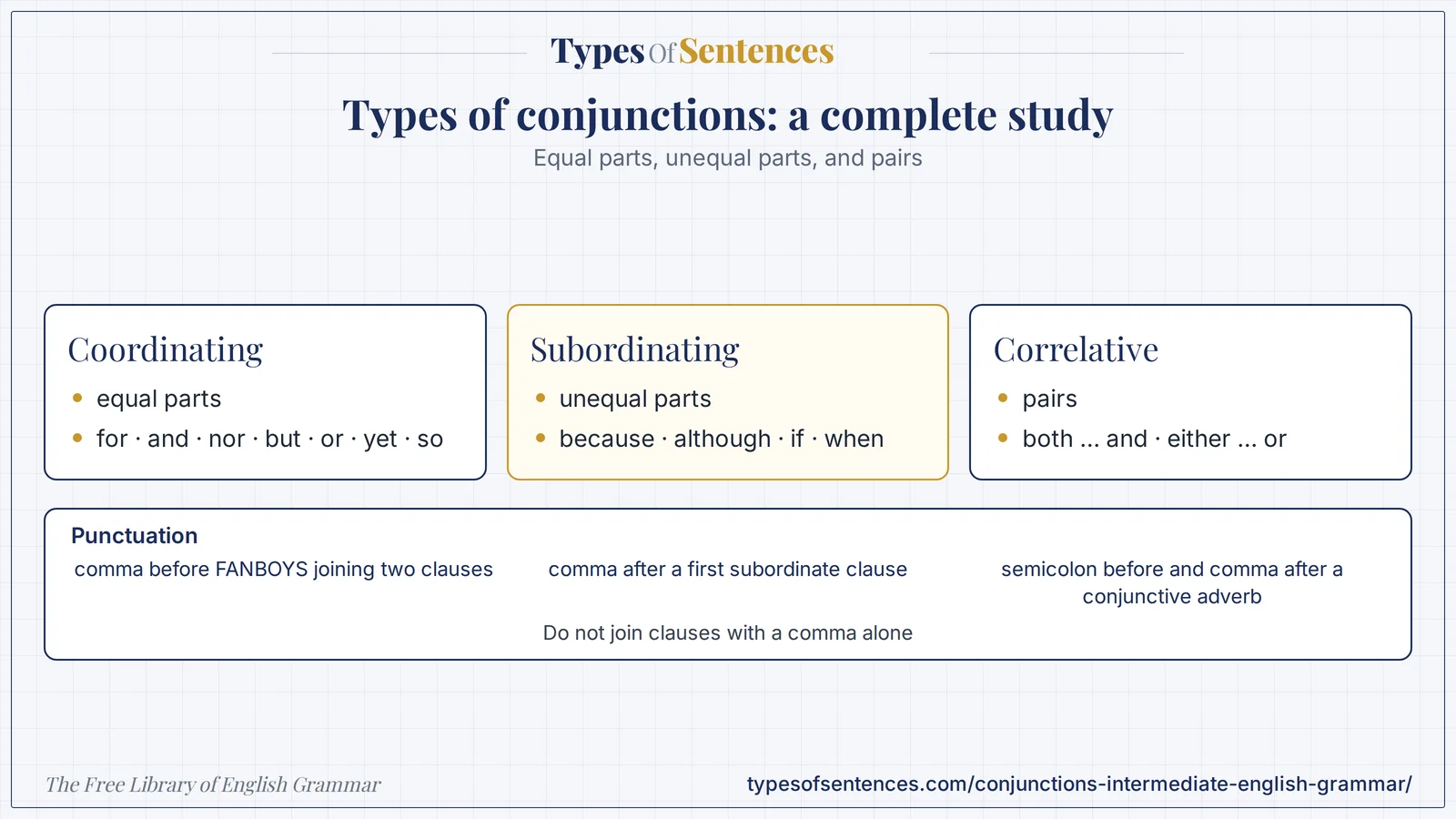
Summary: Coordinating conjunctions (for, and, nor, but, or, yet, so) join equal elements. Subordinating conjunctions (because, although, if, when) introduce a dependent clause. Correlative conjunctions come in pairs (both … and, either … or). Conjunctive adverbs (however, therefore) link independent clauses and are punctuated with a semicolon and a comma.
- Coordinating = equal parts, subordinating = unequal parts.
- Comma before FANBOYS when it joins two independent clauses.
- Comma after a subordinate clause that comes first.
- Semicolon before and comma after a conjunctive adverb between two independent clauses.
What You’ll Learn
- 1. Types of Conjunctions: What Is a Conjunction? A Review
- 2. Coordinating Conjunctions (FANBOYS)
- 3. Subordinating Conjunctions
- 4. Correlative Conjunctions
- 5. Conjunctive Adverbs
- 6. Starting Sentences with Conjunctions
- 7. Comma Usage with Conjunctions
- 8. Common Conjunction Errors
- 9. Exercises
- 10. Test Your Knowledge
- 11. Frequently Asked Questions
- 12. Conclusion
1. Types of Conjunctions: What Is a Conjunction? A Review
A conjunction is a word that joins words, phrases, or clauses. The conjunction examples below show the main jobs: adding, contrasting, giving a choice, giving a reason, and showing time.
| Job | Conjunction | Example |
|---|---|---|
| adds | and | Tom and Maria sang. |
| contrasts | but, yet, although | She is small but strong. |
| gives a choice | or, either … or | Tea or coffee? |
| gives a reason | because, since, for | We left because it rained. |
| shows a result | so, therefore | It rained, so we left. |
| shows time | when, after, before, while | Call me when you arrive. |
| sets a condition | if, unless | Come if you can. |
There are four types of conjunctions or conjunction-like linking words, and these conjunction types with examples are given in the table. Here is the types of conjunctions definition in one table, and the sections after it treat each type in turn.
| Type | Definition | Examples |
|---|---|---|
| Coordinating | joins elements of equal rank | for, and, nor, but, or, yet, so |
| Subordinating | makes one clause depend on another | because, although, if, when, while, since, unless |
| Correlative | pairs that join equal elements | both … and, either … or, neither … nor, not only … but also |
| Conjunctive adverbs | adverbs that link independent clauses | however, therefore, moreover, consequently |
2. Coordinating Conjunctions (FANBOYS)
Coordinating conjunctions join words, phrases, or clauses that are grammatically equal. There are seven, remembered as FANBOYS.
| Conjunction | Meaning | Example |
|---|---|---|
| for | reason (formal) | She stayed home, for she was ill. |
| and | addition | I like tea and coffee. |
| nor | a second negative | He neither called nor wrote. |
| but | contrast | It was cheap but good. |
| or | choice | We can walk or take the bus. |
| yet | contrast with surprise | She is old, yet energetic. |
| so | result | It rained, so we stayed in. |
- Words and phrases: tea and coffee; quickly but quietly. No comma is needed between two items.
- Independent clauses: put a comma before the conjunction: I was tired, but I kept working.
- Compound predicate: no comma when the subject is not repeated: She sang and danced.
- Nor after a negative or with inversion: He did not call, nor did he write. The helping verb comes before the subject after nor.
Two independent clauses need a conjunction after the comma. See the guide to coordinating conjunctions.
The coordinated clauses form the compound sentence; see the chapter on compound sentences.
3. Subordinating Conjunctions
A subordinating conjunction introduces a dependent (subordinate) clause and makes it depend on a main clause. The clause cannot stand alone. The main subordinating conjunctions are easiest to learn by meaning.
| Meaning | Conjunctions | Example |
|---|---|---|
| Time | after, before, when, while, as, since, until, once, as soon as | When the bell rang, we left. |
| Reason | because, since, as | We stayed home because it rained. |
| Condition | if, unless, as long as, provided that | Unless you hurry, you will miss it. |
| Contrast | although, though, even though, whereas, while | Although it rained, we walked. |
| Purpose | so that, in order that | She studied so that she could pass. |
| Result | so … that, such … that | It was so cold that we left. |
| Place | where, wherever | Sit where you like. |
| Manner and comparison | as, as if, than | He talks as if he knew everything. |
Do not use two conjunctions to join the same pair of clauses. Although already shows the contrast, so but is not needed.
The clauses these conjunctions introduce are studied in the chapter on complex sentences, and the adverb clauses in a later chapter.
4. Correlative Conjunctions
Correlative conjunctions are pairs that work together to join two equal elements.
| Pair | Meaning | Example |
|---|---|---|
| both … and | two things together | She speaks both English and Spanish. |
| either … or | a choice between two | You can either stay or leave. |
| neither … nor | neither of two | Neither Tom nor Maria came. |
| not only … but also | addition with emphasis | She is not only kind but also funny. |
| whether … or | alternatives | I don’t know whether to stay or go. |
| no sooner … than | one event right after another | No sooner had we left than it rained. |
- With either … or and neither … nor, the verb agrees with the subject nearer to it: Neither the teacher nor the students were ready.
- Do not say neither … or or either … nor; the pairs do not mix.
- With not only at the start of a sentence, the subject and the verb are inverted: Not only did she win, but she also broke the record.
See the guide to correlative conjunctions for more.
5. Conjunctive Adverbs
Conjunctive adverbs link independent clauses and show the relationship between them. They are adverbs, not true conjunctions, and they cannot join two clauses by themselves.
| Meaning | Conjunctive adverbs |
|---|---|
| addition | also, furthermore, moreover, besides |
| contrast | however, nevertheless, nonetheless, instead, otherwise |
| result | therefore, consequently, thus, hence, as a result |
| time or sequence | then, meanwhile, afterward, finally |
| example | for example, for instance |
A comma before however creates a comma splice. See the guide to conjunctive adverbs.
A conjunctive adverb can also sit inside the second clause, set off by commas: It was cheap. It broke, however, after a week.
6. Starting Sentences with Conjunctions
The old rule against beginning a sentence with and, but, or so is a myth. Many careful writers do it for emphasis and for a natural flow. Use it sparingly in formal writing, and make sure the sentence is complete.
| Acceptable | Fragment (needs a main clause) |
|---|---|
| The test was hard. But most students passed. | The test was hard. Although most students passed. |
| We waited an hour. So we left. | We left. Because it was late. |
A sentence that begins with a subordinating conjunction (Although, Because) must have a main clause too, or it is a fragment, as the sentence fragments chapter explains.
7. Comma Usage with Conjunctions
| Pattern | Comma? | Example |
|---|---|---|
| Independent clause, FANBOYS, independent clause | comma before the conjunction | I was tired, but I kept working. |
| Compound predicate | no comma | She sang and danced. |
| Subordinate clause first | comma after the clause | Because it rained, we stayed in. |
| Main clause first, essential subordinate clause | no comma | We stayed in because it rained. |
| Main clause first, contrast clause (although, whereas) | comma often used | He is tall, whereas his brother is short. |
| Correlative pairs joining two words | no comma | both tea and coffee |
| Conjunctive adverb between clauses | semicolon before, comma after | It rained; therefore, we stayed. |
8. Common Conjunction Errors
| Error | Correction | Why |
|---|---|---|
| It was late, we left. | It was late, so we left. | comma splice |
| It was cheap, however it broke. | It was cheap; however, it broke. | conjunctive adverb needs a semicolon |
| Although it rained, but we went. | Although it rained, we went. | do not double the conjunction |
| Neither Tom or Maria came. | Neither Tom nor Maria came. | neither pairs with nor |
| She is not only smart but also she is kind. | She is not only smart but also kind. | keep the pair parallel |
| Because I was late. | I ran because I was late. | a dependent clause alone is a fragment |
| I like tea, and, coffee. | I like tea and coffee. | no comma between two items |
Fix: He is both a teacher and writes books, however he is not famous.
- Both … and must join parallel elements: a teacher and writes are not parallel.
- Change to both teaches and writes books.
- However between two clauses needs a semicolon before it and a comma after it.
- Result: He both teaches and writes books; however, he is not famous.
Recap in 12 seconds
Watch the lesson build itself: Coordinating conjunctions join equal parts, subordinating conjunctions introduce dependent clauses, and correlative conjunctions come in pairs. The video has no sound.
Exercises
Part A: Name the Type (Exercises 1–6)
Exercise 1: Type: but
Show Answer
Answer: Coordinating.
Exercise 2: Type: because
Show Answer
Answer: Subordinating.
Exercise 3: Type: both … and
Show Answer
Answer: Correlative.
Exercise 4: Type: however (in It was cheap; however, it broke.)
Show Answer
Answer: Conjunctive adverb.
Exercise 5: Name the seven coordinating conjunctions.
Show Answer
Answer: For, and, nor, but, or, yet, so (FANBOYS).
Exercise 6: Which type makes one clause depend on another?
Show Answer
Answer: Subordinating conjunctions.
Part B: Coordinating Conjunctions (Exercises 7–12)
Exercise 7: Punctuate: I was tired but I kept working.
Show Answer
Answer: I was tired, but I kept working.
Exercise 8: Punctuate: She sang and danced.
Show Answer
Answer: No comma. It is a compound predicate.
Exercise 9: Fix the comma splice: It was late, we left.
Show Answer
Answer: It was late, so we left.
Exercise 10: Complete with nor: He did not call, ___ did he write.
Show Answer
Answer: nor.
Exercise 11: Choose: It rained, (so/for) we stayed in.
Show Answer
Answer: so (result). For would mean “because.”
Exercise 12: Explain why She stayed home, for she was ill. is formal.
Show Answer
Answer: For meaning “because” is a formal, somewhat literary use.
Part C: Subordinating Conjunctions (Exercises 13–18)
Exercise 13: Punctuate: Although it rained we walked.
Show Answer
Answer: Although it rained, we walked.
Exercise 14: Punctuate: We walked although it rained.
Show Answer
Answer: No comma.
Exercise 15: Choose: (Unless/Because) you hurry, you will miss it.
Show Answer
Answer: Unless.
Exercise 16: Fix it: Although it rained, but we walked.
Show Answer
Answer: Although it rained, we walked.
Exercise 17: Name the meaning of whereas.
Show Answer
Answer: Contrast.
Exercise 18: Combine with so that: She studied. She wanted to pass.
Show Answer
Answer: She studied so that she could pass.
Part D: Correlative Conjunctions (Exercises 19–23)
Exercise 19: Choose: Neither Tom (or/nor) Maria came.
Show Answer
Answer: nor.
Exercise 20: Choose the verb: Neither the teacher nor the students (was/were) ready.
Show Answer
Answer: were. It agrees with the nearer subject.
Exercise 21: Make parallel: She likes both swimming and to run.
Show Answer
Answer: She likes both swimming and running.
Exercise 22: Invert after not only: She won. She also broke the record.
Show Answer
Answer: Not only did she win, but she also broke the record.
Exercise 23: Name the correlative pair: whether … or
Show Answer
Answer: Alternatives: I don’t know whether to stay or go.
Part E: Conjunctive Adverbs and Commas (Exercises 24–27)
Exercise 24: Punctuate: It was cheap however it broke.
Show Answer
Answer: It was cheap; however, it broke.
Exercise 25: Punctuate: It rained therefore we stayed.
Show Answer
Answer: It rained; therefore, we stayed.
Exercise 26: Fix it: She was late, however she apologized.
Show Answer
Answer: She was late; however, she apologized.
Exercise 27: Place the adverb in the second clause: It was cheap. It broke after a week. (however)
Show Answer
Answer: It was cheap. It broke, however, after a week.
Part F: Errors and Edit (Exercises 28–30)
Exercise 28: Fix the fragment: Because I was late.
Show Answer
Answer: I ran because I was late.
Exercise 29: Fix it: I like tea, and, coffee.
Show Answer
Answer: I like tea and coffee.
Exercise 30: Fix it: He is both a teacher and writes books, however he is not famous.
Show Answer
Answer: He both teaches and writes books; however, he is not famous.
Test Your Knowledge
Ready to check what you learned? Answer all 10 questions, then submit. You need 80% (8 of 10) to pass. Your answers are not stored.
View correct answers and explanations
Question 1: Which type of conjunction joins equal parts?
✓ Correct Answer: A – Coordinating
Coordinating conjunctions join grammatically equal elements.
Question 2: Which is a subordinating conjunction?
✓ Correct Answer: C – although
Although introduces a dependent clause.
Question 3: Which is correct?
✓ Correct Answer: D – It was late, so we left.
A comma and a conjunction join two sentences.
Question 4: Which is correct?
✓ Correct Answer: C – It was cheap; however, it broke.
A conjunctive adverb needs a semicolon before and a comma after.
Question 5: Which is correct?
✓ Correct Answer: A – Neither Tom nor Maria came.
Neither pairs with nor.
Question 6: Which is correct?
✓ Correct Answer: C – Although it rained, we walked.
Do not double the conjunction; use a comma after the subordinate clause.
Question 7: Which is a fragment?
✓ Correct Answer: B – Because it was late.
A dependent clause alone is a fragment.
Question 8: What does whereas show?
✓ Correct Answer: D – Contrast
Whereas shows contrast.
Question 9: Which pair is parallel?
✓ Correct Answer: B – both swimming and running
The two parts must have the same form.
Question 10: Is it acceptable to start a sentence with But?
✓ Correct Answer: B – Yes, when the sentence is complete and used sparingly
The rule against it is a myth, but use it with care in formal writing.
Frequently Asked Questions
What are the types of conjunctions?
The types of conjunctions are coordinating (and, but, or), subordinating (because, although, if), and correlative (both … and, either … or). Conjunctive adverbs such as however are a fourth group of linking words.
What are some conjunction examples?
Conjunction examples include and, but, or, so (coordinating); because, although, when, if (subordinating); and both … and, not only … but also (correlative).
What are conjunction types with examples?
Coordinating: She is small but strong. Subordinating: Although it rained, we walked. Correlative: Neither Tom nor Maria came. Conjunctive adverb: It was cheap; however, it broke.
What are types of conjunctions examples for beginners?
Start with the FANBOYS conjunctions, then learn the common subordinating conjunctions by meaning (time, reason, condition, contrast). Types of conjunctions examples are easiest to learn in pairs of sentences.
What is the types of conjunctions definition?
A conjunction is a word that joins words, phrases, or clauses. Coordinating conjunctions join equal elements, subordinating conjunctions make one clause depend on another, and correlative conjunctions work in pairs.
Do I need a comma before and?
Use a comma before and when it joins two independent clauses (I was tired, and I went to bed), but not when it joins two words or a compound predicate (She sang and danced).
Is it wrong to start a sentence with because?
No, if the sentence also has a main clause (Because it rained, we stayed in). It is a fragment only when the dependent clause stands alone.
Conclusion
You now know the types of conjunctions: coordinating, subordinating, and correlative, plus the conjunctive adverbs that link independent clauses. You can punctuate each type, keep correlative pairs parallel, start a sentence with a conjunction, and avoid the common errors.
When you edit, check every comma next to a conjunction against the pattern table. Next, you will study articles in detail.
- Merriam-Webster Dictionary: conjunction: the dictionary definition of a conjunction.
- Purdue Online Writing Lab: Grammar: reference section on conjunctions.
- Quirk, Randolph, et al. A Comprehensive Grammar of the English Language. Longman, 1985.: coordination and subordination.
- Huddleston, Rodney, and Geoffrey K. Pullum. The Cambridge Grammar of the English Language. Cambridge University Press, 2002.: conjunctions and conjunctive adverbs.
Last reviewed: October 29, 2026. How it was made: drafted with AI assistance, then checked with automated tests (structure, links, answer keys, spelling) and against the sources above. A person has not yet read this chapter line by line. Found a mistake? Report it.