The definite and indefinite articles are the smallest words in English, and among the hardest to master. English has one definite article (the), two indefinite articles (a and an), and a third choice that has no word at all: the zero article. Choosing between them depends on whether the noun is specific, whether it is countable, and what the speaker and listener already know.
This chapter gives the rules for each article, shows how articles work with countable and uncountable nouns, proper nouns, and geographic names, and lists the fixed phrases that must be learned as wholes. It ends with the most common article errors. Thirty exercises and a quiz follow.
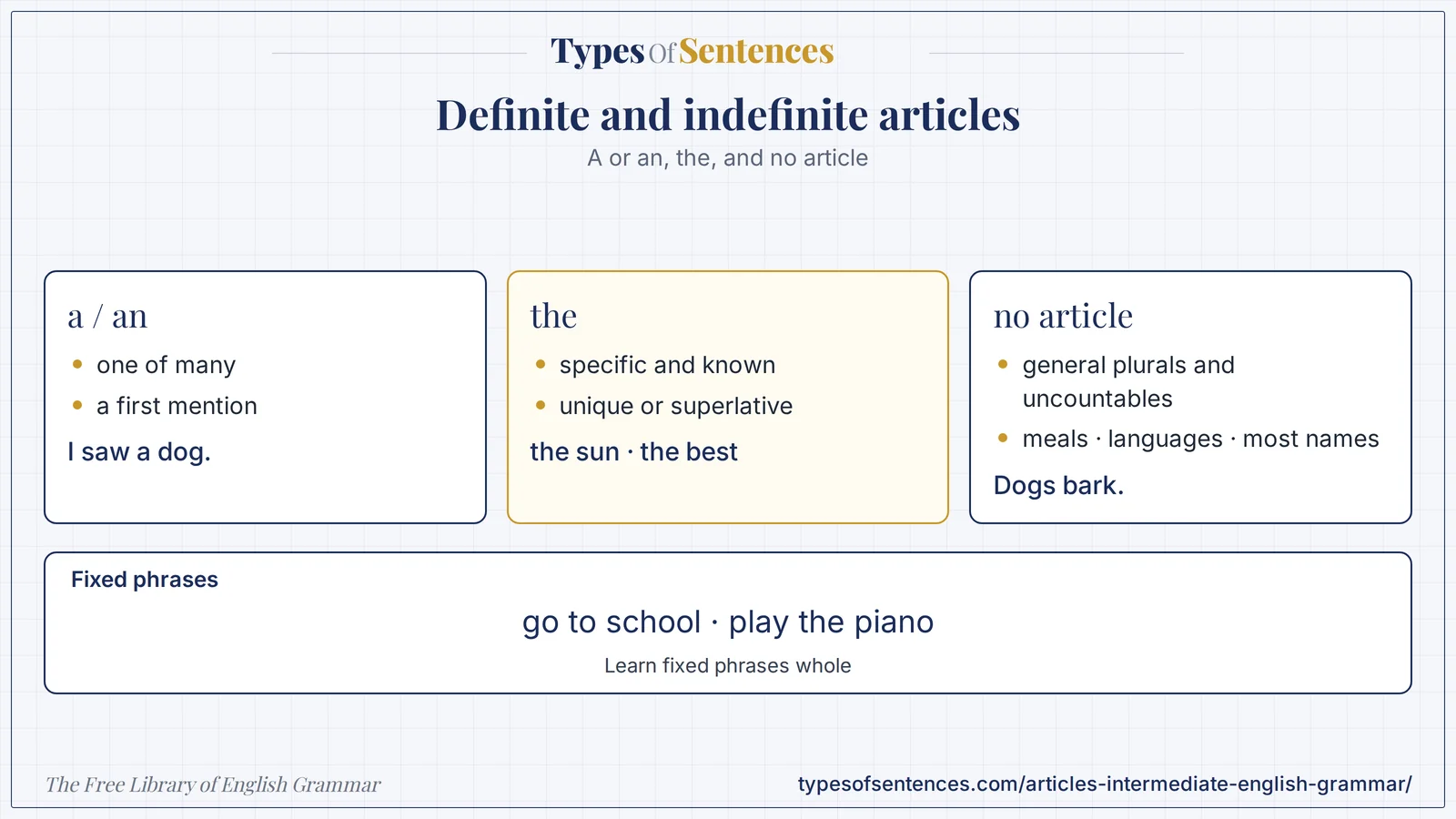
An article tells the listener how to think about the noun that follows. A dog introduces one dog among many. The dog points to a dog you both know. Dogs (with no article) talks about dogs in general.
Why it matters: Article choices carry meaning, and the wrong one can sound strange or change the sentence. These rules cover most cases.
Summary: Use a or an for one non-specific countable noun, the for a specific noun both speaker and listener can identify, and no article (the zero article) for general plural and uncountable nouns, and for most names. Use an before a vowel sound, not a vowel letter.
- A/an: one of many; first mention.
- The: specific, known, unique, or superlative.
- Zero article: general plurals and uncountables, meals, languages, most names.
- Learn fixed phrases whole: go to school, play the piano.
What You’ll Learn
- 1. Definite and Indefinite Articles: What Is an Article? A Review
- 2. Indefinite Articles (A, An): Detailed Rules
- 3. The Definite Article (The): Detailed Rules
- 4. The Zero Article (No Article)
- 5. Articles with Countable and Uncountable Nouns
- 6. Articles with Proper Nouns
- 7. Articles with Geographic Names
- 8. Fixed Phrases With and Without Articles
- 9. Generic Reference and Other Fine Points
- 10. Common Article Errors
- 11. Exercises
- 12. Test Your Knowledge
- 13. Frequently Asked Questions
- 14. Conclusion
1. Definite and Indefinite Articles: What Is an Article? A Review
An article is a word that introduces a noun and shows whether it is specific or general. Traditional grammar counts articles as adjectives; modern grammars put them in the determiner class (see the next chapter on determiners).
| Article | Type | Meaning | Example |
|---|---|---|---|
| a, an | indefinite | one of many; not specific | I saw a dog. |
| the | definite | a specific one that is known | I saw the dog you lost. |
| (no article) | zero article | general, plural or uncountable | I like dogs. I like music. |
Three questions decide the article. Is the noun specific? Do speaker and listener both know which one? Is it countable? Singular countable nouns need an article or another determiner. Is it general? General plurals and uncountables take no article.
2. Indefinite Articles (A, An): Detailed Rules
Use a or an before a singular countable noun that is not specific. The choice depends on the sound of the next word, not its letter.
| Rule | Examples |
|---|---|
| an before a vowel sound | an apple, an egg, an hour, an honest man, an MBA, an X-ray |
| a before a consonant sound | a book, a university, a European, a one-year plan, a unicorn |
Use the indefinite article:
- for a first mention: I bought a car. The car is red.
- to classify or describe: A dog is a mammal. She is a doctor.
- with numbers and rates: a hundred, a dozen, twice a week, ten dollars a kilo
- in exclamations and with such and quite: What a day! Such a surprise! Quite a crowd.
Honest begins with a vowel sound (the h is silent); university begins with a /y/ sound.
3. The Definite Article (The): Detailed Rules
Use the when the listener can identify the noun. It works with singular, plural, and uncountable nouns.
| Reason | Example |
|---|---|
| already mentioned | I saw a dog. The dog was huge. |
| clear from the situation | Please close the door. |
| unique | the sun, the moon, the equator, the internet |
| specified by a phrase or clause | the book on the table, the man who called |
| superlatives and ordinals | the best movie, the first day, the last one |
| musical instruments | She plays the piano. |
| adjectives used as groups of people | the rich, the young, the elderly |
| decades and some periods | in the 1990s, the Middle Ages |
| a whole class (generic singular) | The tiger is endangered. |
- The more you practice, the better you get. comparative pattern
- She is the tallest girl in the class. superlative
- I went to the bank. a specific, known bank
Remember that the first mention of a countable noun takes a or an, and later mentions take the. This is the rule of thumb for stories and explanations.
4. The Zero Article (No Article)
The zero article means using no article. It is correct in these cases:
| Use | Example |
|---|---|
| plural nouns in general | Dogs are loyal. |
| uncountable nouns in general | Water is essential. Honesty matters. |
| meals | We had lunch at noon. |
| languages and school subjects | She speaks French. He studies math. |
| sports and games | They play soccer and chess. |
| most names of people, cities, and countries | Maria lives in Paris. |
| means of transport with by | We traveled by train. |
| times of day with at and by | at night, by day |
When a general noun becomes specific, the appears: I like music (general) but I like the music in this film (specific). The same word changes status.
To talk about a whole class, use a plural noun with no article.
5. Articles with Countable and Uncountable Nouns
| Noun type | Non-specific | Specific | General |
|---|---|---|---|
| singular countable | a book | the book | The book is a form of communication. (generic, formal) |
| plural countable | some books | the books | Books are useful. |
| uncountable | some water | the water | Water is essential. |
For uncountable and plural nouns, the choice is some (or any) for a non-specific amount, the for a specific one, and no article for general meaning. The words for amounts are in the chapter on quantifiers.
6. Articles with Proper Nouns
Most proper nouns take no article, but several groups take the.
| No article | The |
|---|---|
| people: Maria, Mr. Rao | families: the Smiths |
| most cities: Paris, Mumbai | names with “of”: the University of Michigan, the Bank of England |
| most countries: India, France | countries with plural or “republic/kingdom” names: the Netherlands, the United States, the United Kingdom |
| streets and parks: Oak Street, Central Park | buildings and institutions in some cases: the White House, the Eiffel Tower |
| single-word names of companies: Microsoft | newspapers and many ships: The New York Times, the Titanic |
Capitalization of proper nouns is covered in the chapter on capitalization rules.
7. Articles with Geographic Names
| Type | Article | Examples |
|---|---|---|
| continents | none | Africa, Asia, Europe |
| single mountains and lakes | none | Mount Everest, Lake Superior |
| islands (single) | none | Cuba, Hawaii |
| mountain ranges | the | the Alps, the Himalayas, the Rockies |
| groups of islands | the | the Bahamas, the Philippines, the Hawaiian Islands |
| rivers, oceans, seas, canals, deserts | the | the Nile, the Pacific, the Mediterranean, the Suez Canal, the Sahara |
| regions with a descriptive word | the | the Middle East, the South, the North Pole |
8. Fixed Phrases With and Without Articles
Many expressions have a fixed article pattern that does not follow the rules above. Learn them as units.
| Without an article | With an article |
|---|---|
| go to school / church / work / bed / sea (the purpose) | go to the school (a particular building), go to the bank, the store |
| at night, by car, on foot, in bed, at home | in the morning, in the end, on the whole, by the way |
| play football, play chess | play the guitar, play the piano |
| in time (early enough), at first | on time (exactly), at the beginning |
American and British English differ in some of these. Americans say in the hospital and at the university, while British speakers often say in hospital and at university. Prepositional patterns are in the chapter on types of prepositions.
9. Generic Reference and Other Fine Points
Articles also decide whether a noun refers to one particular thing or to a whole class. There are three common ways to make a general statement about a kind of thing, and they differ slightly in tone.
| Pattern | Example | Tone |
|---|---|---|
| a/an + singular noun | A whale is a mammal. | everyday, neutral |
| the + singular noun | The whale is a mammal. | formal, scientific |
| zero article + plural noun | Whales are mammals. | the most common general statement |
| zero article + uncountable noun | Water is essential for life. | general substance or idea |
A few expressions place the article in an unexpected position. After such, what, quite, and half, the indefinite article comes after the word, not before: such a nice day, What a surprise!, quite a long time, half an hour. American English also uses a half hour. With so, too, and as, the adjective comes first: so nice a day, too long a delay. These word orders are fixed, so they are worth learning as patterns.
| Fixed pattern | Example |
|---|---|
| such + a/an + adjective + noun | such a long journey |
| what + a/an + (adjective) + noun | What a lovely garden! |
| quite + a/an + (adjective) + noun | quite a surprise |
| half + a/an + noun | half an hour |
| many + a + singular noun (formal) | many a student has made that mistake |
10. Common Article Errors
| Error | Correction | Rule |
|---|---|---|
| I have car. | I have a car. | singular countable needs a determiner |
| She is an university student. | She is a university student. | sound, not letter |
| I need an advice. | I need some advice. | uncountable: no a/an |
| The life is hard. | Life is hard. | general: no article |
| I play the football. | I play football. | sports take no article |
| She plays piano. | She plays the piano. | instruments take the |
| He is best player. | He is the best player. | superlative takes the |
| I saw dog. Dog was big. | I saw a dog. The dog was big. | first mention, then specific |
| The Mount Everest is high. | Mount Everest is high. | single mountains take no article |
Fix: I bought car yesterday. Car is red, and I love the red color.
- Car is a singular countable noun at first mention: a car.
- Second mention: The car is red.
- Red color in general sense: I love red (a general color name) or the red color of the car.
- Result: I bought a car yesterday. The car is red, and I love the color.
Article use varies in some contexts, and style and dialect play a role. For generic statements, writers choose among Dogs are loyal, The dog is loyal, and A dog is loyal; the plural form is the most common and natural.
Recap in 12 seconds
Watch the lesson build itself: A or an for one non-specific noun, the for a specific one, and the zero article for general plurals, uncountables, and most names. The video has no sound.
Exercises
Part A: A or An (Exercises 1–5)
Exercise 1: Choose: ___ hour
Show Answer
Answer: an hour.
Exercise 2: Choose: ___ university
Show Answer
Answer: a university.
Exercise 3: Choose: ___ MBA
Show Answer
Answer: an MBA. It starts with the sound “em.”
Exercise 4: Choose: ___ one-year plan
Show Answer
Answer: a one-year plan. It starts with the consonant sound “w.”
Exercise 5: Fix it: She is a honest woman.
Show Answer
Answer: She is an honest woman.
Part B: The (Exercises 6–11)
Exercise 6: Choose: I saw a dog. (A/The) dog was big.
Show Answer
Answer: The.
Exercise 7: Choose: (A/The) sun rises in the east.
Show Answer
Answer: The. It is unique.
Exercise 8: Choose: She plays (a/the) piano.
Show Answer
Answer: the.
Exercise 9: Choose: He is (a/the) best player.
Show Answer
Answer: the.
Exercise 10: Choose: (The/No article) rich are not always happy.
Show Answer
Answer: The. The rich means rich people.
Exercise 11: Choose: Please close (a/the) door.
Show Answer
Answer: the. Both people know which door.
Part C: Zero Article (Exercises 12–17)
Exercise 12: Article or none: ___ dogs are loyal.
Show Answer
Answer: None.
Exercise 13: Article or none: ___ water is essential.
Show Answer
Answer: None.
Exercise 14: Article or none: We had ___ lunch at noon.
Show Answer
Answer: None.
Exercise 15: Article or none: She speaks ___ French.
Show Answer
Answer: None.
Exercise 16: Article or none: They play ___ soccer.
Show Answer
Answer: None.
Exercise 17: Explain: I like music. and I like the music in this film.
Show Answer
Answer: The first is general (no article); the second is specific (the).
Part D: Proper and Geographic Names (Exercises 18–23)
Exercise 18: Article or none: ___ Alps
Show Answer
Answer: The Alps.
Exercise 19: Article or none: ___ Mount Everest
Show Answer
Answer: None.
Exercise 20: Article or none: ___ Nile
Show Answer
Answer: The Nile.
Exercise 21: Article or none: ___ Lake Superior
Show Answer
Answer: None.
Exercise 22: Article or none: ___ United States
Show Answer
Answer: The United States.
Exercise 23: Article or none: ___ Smiths (the family)
Show Answer
Answer: The Smiths.
Part E: Fixed Phrases (Exercises 24–26)
Exercise 24: Choose: He goes to (school/the school) every day. (as a student)
Show Answer
Answer: school.
Exercise 25: Choose: She went to (bank/the bank) to get cash.
Show Answer
Answer: the bank.
Exercise 26: Explain: in time and on time.
Show Answer
Answer: In time means early enough; on time means exactly at the planned time.
Part F: Errors (Exercises 27–30)
Exercise 27: Fix it: I have car.
Show Answer
Answer: I have a car.
Exercise 28: Fix it: I need an advice.
Show Answer
Answer: I need some advice.
Exercise 29: Fix it: I play the football.
Show Answer
Answer: I play football.
Exercise 30: Fix it: I saw dog. Dog was big.
Show Answer
Answer: I saw a dog. The dog was big.
Test Your Knowledge
Ready to check what you learned? Answer all 10 questions, then submit. You need 80% (8 of 10) to pass. Your answers are not stored.
View correct answers and explanations
Question 1: Which article means one of many?
✓ Correct Answer: B – A
A or an introduces a non-specific singular noun.
Question 2: Which is correct?
✓ Correct Answer: D – a university student
University begins with a /y/ consonant sound.
Question 3: Which is correct?
✓ Correct Answer: C – I need some advice.
Advice is uncountable.
Question 4: Which sport takes no article?
✓ Correct Answer: D – soccer
Sports take no article.
Question 5: Which is correct?
✓ Correct Answer: A – She plays the piano.
Instruments usually take the.
Question 6: Which takes the?
✓ Correct Answer: A – the Alps
Mountain ranges take the.
Question 7: Which is correct?
✓ Correct Answer: C – Dogs are loyal.
Plural nouns in general take no article.
Question 8: Which is correct?
✓ Correct Answer: C – I have a car.
A singular countable noun needs a determiner.
Question 9: Which is a zero-article use?
✓ Correct Answer: A – We had lunch at noon.
Meals take no article.
Question 10: Which phrase is fixed without an article?
✓ Correct Answer: B – go to school
Go to school means attend as a student.
Frequently Asked Questions
What are definite and indefinite articles?
The definite article is the, used for a specific noun. The indefinite articles are a and an, used for one non-specific countable noun. Plural and uncountable nouns in general use no article.
What is the a, an, the usage rule?
Use a before a consonant sound and an before a vowel sound. Use the when both speaker and listener know which one. Use no article for general plurals, uncountables, and most names. This is the basic a, an, the usage.
What are the main article rules?
Singular countable nouns need an article or another determiner. First mentions take a/an and later mentions take the. Superlatives, unique things, and instruments take the. General plurals and uncountables take none. These article rules cover most cases.
What is the zero article?
The zero article means using no article at all: Dogs are loyal, Water is essential, We had lunch. It is used for general plural and uncountable nouns, meals, languages, sports, and most names.
What are the most common article errors?
The most common article errors are omitting the article with a singular countable noun (I have car), using a before an uncountable noun (an advice), and using the in general statements (The life is hard).
Why is it an hour but a university?
The article depends on the first sound. Hour begins with a vowel sound because the h is silent, and university begins with a /y/ sound, which counts as a consonant.
Do rivers and mountains take the?
Rivers, oceans, seas, deserts, and mountain ranges take the (the Nile, the Alps). Single mountains, lakes, and continents take no article (Mount Everest, Lake Superior).
Conclusion
You now know the rules for the definite and indefinite articles: a and an by sound, the for specific, unique, and superlative nouns, and the zero article for general plurals, uncountables, and most names. You also know the patterns for geographic names, fixed phrases, and common errors.
Check every singular countable noun you write for a determiner, and ask whether each noun is specific. Next, you will study determiners, the larger class that includes articles.
- Merriam-Webster Dictionary: article: the dictionary definition of an article.
- Purdue Online Writing Lab: Grammar: reference section on articles.
- Quirk, Randolph, et al. A Comprehensive Grammar of the English Language. Longman, 1985.: the classification of article uses.
- Huddleston, Rodney, and Geoffrey K. Pullum. The Cambridge Grammar of the English Language. Cambridge University Press, 2002.: definite and indefinite determiners.
Last reviewed: October 29, 2026. How it was made: drafted with AI assistance, then checked with automated tests (structure, links, answer keys, spelling) and against the sources above. A person has not yet read this chapter line by line. Found a mistake? Report it.