A run-on sentence is two or more independent clauses that are joined without the correct punctuation or conjunction. There are two kinds: the fused sentence, where nothing separates the clauses (It rained we stayed home), and the comma splice, where only a comma does (It rained, we stayed home). A run-on sentence is not simply a long sentence; it is a sentence whose clauses are not properly joined.
This chapter explains what run-on sentences are and gives fused sentence examples and comma splice examples. You will learn five ways to fix run ons, how to choose the best fix, the common causes of run-ons, how to spot them, and when a comma splice is acceptable. Thirty exercises and a quiz follow.
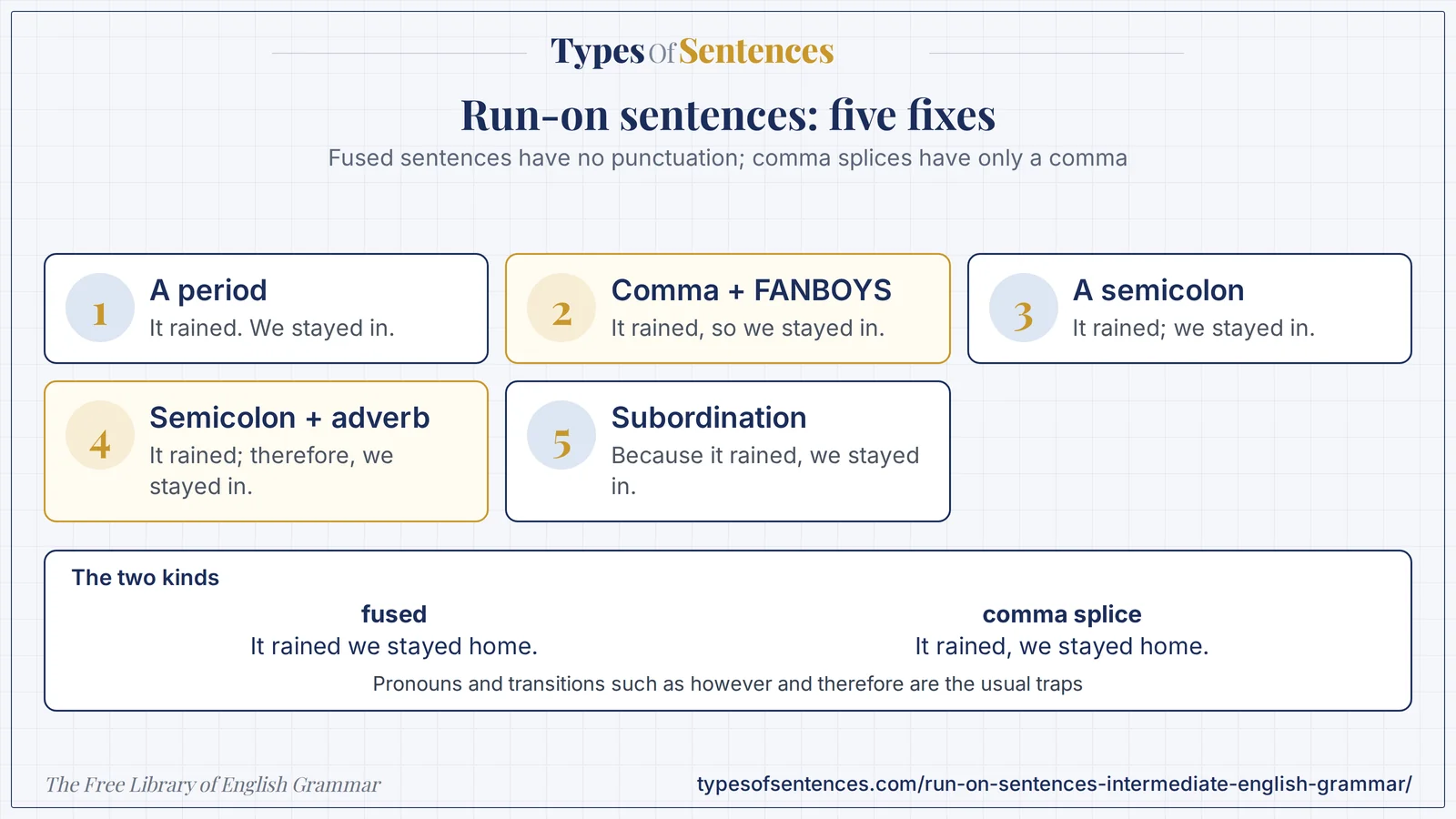
A run-on is the opposite of a fragment. A fragment gives the reader too little; a run-on gives two complete thoughts crammed together without a proper joint.
Why it matters: The fix is always the same in principle: put a correct joint between the clauses. There are five good joints, and you can choose the one that best shows how the ideas relate.
Summary: A run-on has two or more independent clauses with no proper joint. A fused sentence has no punctuation; a comma splice has only a comma. Fix it with (1) a period, (2) a comma and a coordinating conjunction, (3) a semicolon, (4) a semicolon with a conjunctive adverb, or (5) a subordinating conjunction.
- Fused: It rained we stayed home. Comma splice: It rained, we stayed home.
- Five fixes: period; comma + FANBOYS; semicolon; semicolon + adverb + comma; subordination.
- Pronouns and transitions (however, therefore) are the usual traps.
- A long sentence is not a run-on if its clauses are joined correctly.
What You’ll Learn
- 1. What Is a Run-On Sentence?
- 2. Fused Sentences
- 3. Comma Splices
- 4. Five Ways to Fix Run-Ons
- 5. Choosing the Best Fix
- 6. Common Causes of Run-Ons
- 7. How to Spot Run-Ons
- 8. When a Comma Splice Is Acceptable
- 9. Common Run-On Errors
- 10. Exercises
- 11. Test Your Knowledge
- 12. Frequently Asked Questions
- 13. Conclusion
1. What Is a Run-On Sentence?
A run-on sentence joins independent clauses without a correct joint. An independent clause has a subject and a finite verb and can stand alone; see the chapter on what clauses are. When two such clauses meet without a period, a semicolon, or a conjunction, the sentence runs on.
| Sentence | Independent clauses | Joint | Verdict |
|---|---|---|---|
| It rained. We stayed home. | 2 | period | correct (two sentences) |
| It rained, so we stayed home. | 2 | comma + conjunction | correct (compound) |
| It rained; we stayed home. | 2 | semicolon | correct (compound) |
| It rained we stayed home. | 2 | none | run-on (fused) |
| It rained, we stayed home. | 2 | comma only | run-on (comma splice) |
2. Fused Sentences
A fused sentence (also called a run-together sentence) has two independent clauses with nothing between them. Here are fused sentence examples.
| Fused sentence | The two clauses |
|---|---|
| The sun set the stars appeared. | The sun set / the stars appeared |
| I like tea my brother likes coffee. | I like tea / my brother likes coffee |
| She studied hard she passed the test. | She studied hard / she passed the test |
| It was late we went home. | It was late / we went home |
| The movie was long it was good. | The movie was long / it was good |
| He called her she did not answer. | He called her / she did not answer |
To find the break, look for a point where a new subject and verb begin without a joint. Often the second clause starts with a pronoun (she, it, they) or a noun that begins a new idea.
3. Comma Splices
A comma splice joins two independent clauses with only a comma. It is the more common run-on, because it looks correct. The full guide is in comma splice.
| Comma splice | Why it is wrong |
|---|---|
| It rained, we stayed home. | two clauses, a comma, no conjunction |
| She was late, she missed the bus. | two clauses, a comma alone |
| The test was hard, however most students passed. | however is not a conjunction |
| I like her, she is kind. | a pronoun starts the second clause |
| He was tired, therefore he went to bed. | therefore is not a conjunction |
| The food was cold, in fact it was frozen. | in fact is a transitional expression |
The words that cause the most comma splices are conjunctive adverbs (however, therefore, moreover, consequently, nevertheless, thus) and transitional expressions (in fact, for example, that is, on the other hand). They look like conjunctions, but they are not. See the guide to conjunctive adverbs.
4. Five Ways to Fix Run-Ons
Take one run-on, It rained we stayed home, and repair it in five ways.
| # | Fix | Result | When to use |
|---|---|---|---|
| 1 | period (two sentences) | It rained. We stayed home. | the ideas are separate, or you want emphasis |
| 2 | comma + coordinating conjunction | It rained, so we stayed home. | the ideas are equal and you want to show the relationship |
| 3 | semicolon | It rained; we stayed home. | the ideas are closely related and the link is obvious |
| 4 | semicolon + conjunctive adverb + comma | It rained; therefore, we stayed home. | you want to state the relationship formally |
| 5 | subordinating conjunction | Because it rained, we stayed home. | one idea depends on the other |
A sixth option is to restructure: The rain kept us at home. or to use a compound predicate when the subject is the same: She studied hard and passed the test. The coordinating conjunctions are covered in coordinating conjunctions, and the full compound pattern in the chapter on compound sentences.
5. Choosing the Best Fix
| Relationship between the clauses | Best fix | Example |
|---|---|---|
| cause or reason | subordination (because) or so | He was tired, so he went to bed. / Because he was tired, he went to bed. |
| contrast | but, yet, although | It was cheap, but it broke. / Although it was cheap, it broke. |
| equal addition | and or a semicolon | She sings, and he plays. |
| result | so; semicolon + therefore | It rained, so we stayed in. |
| alternative | or | Hurry, or you will miss it. |
| explanation | colon or dash | He had one fear: heights. |
| separate ideas | period | The meeting ended. Everyone left. |
Fix: The test was hard however most students passed they were well prepared.
- Find the clauses: The test was hard / most students passed / they were well prepared.
- Join the first two with a conjunctive adverb: The test was hard; however, most students passed.
- Make the third a dependent clause: because they were well prepared.
- Result: The test was hard; however, most students passed because they were well prepared.
6. Common Causes of Run-Ons
- Speech patterns. We chain clauses in speech without pausing: I went to the store I bought bread I came home.
- A pronoun that starts a new clause. The movie was good, it was funny.
- Conjunctive adverbs and transitions used as conjunctions. It was late, therefore we left.
- Long sentences without a plan. The writer forgets where the sentence began and keeps adding clauses.
- Two closely related ideas. The relationship feels obvious, so the writer feels no need for a joint.
- Fast drafting. In a first draft, run-ons are common, and they should be caught in editing.
7. How to Spot Run-Ons
- Underline each finite verb and mark its subject.
- If a sentence has two or more independent clauses, look at the joint between them.
- Ask: is it a period, a semicolon, a comma plus a coordinating conjunction, or a subordinating conjunction? If not, it is a run-on.
- Test each comma: replace it with a period. If both sides can stand alone and there is no conjunction after the comma, it is a splice.
- Read the sentence aloud. If you need to take a breath in the middle that the punctuation does not show, check the joint.
Test: She opened the box, inside was a letter.
- Clause 1: She opened the box (independent).
- Clause 2: inside was a letter (independent; it has its own subject and verb).
- Joint: a comma alone.
- Verdict: comma splice.
- Fix: She opened the box; inside was a letter. or She opened the box, and inside was a letter.
8. When a Comma Splice Is Acceptable
Some writers and style guides allow a comma between very short, parallel independent clauses, especially in a series: I came, I saw, I conquered. The effect is rhythm and speed. Fiction, speeches, and informal writing use this device.
| Acceptable (style) | Why |
|---|---|
| I came, I saw, I conquered. | short, parallel, in a series |
| The bigger they are, the harder they fall. | a fixed proverb pattern |
| Fresh, hot, delicious. | not clauses at all (no verbs) |
Style guides differ about comma splices, and many teachers and editors treat them as errors in all formal writing. If you are writing for a class, an exam, or a publication with a strict style, use the five fixes. Use the stylistic comma splice only in creative writing, and only when it is clearly intentional.
9. Common Run-On Errors
| Run-on | Correction | Fix used |
|---|---|---|
| I like tea my brother likes coffee. | I like tea; my brother likes coffee. | semicolon |
| It was late, we went home. | It was late, so we went home. | comma + conjunction |
| The test was hard, however most students passed. | The test was hard; however, most students passed. | semicolon + adverb |
| He was tired he went to bed. | Because he was tired, he went to bed. | subordination |
| She opened the box, inside was a letter. | She opened the box. Inside was a letter. | period |
| I went to the store I bought bread I came home. | I went to the store, bought bread, and came home. | compound predicate |
| The movie was good, it was funny. | The movie was good, and it was funny. | comma + conjunction |
Edit: Last week I visited my aunt she lives near the lake, we walked along the shore it was cold however the view was beautiful.
- Break at each new subject: I visited my aunt / she lives near the lake / we walked along the shore / it was cold / the view was beautiful.
- Make the second a relative clause: my aunt, who lives near the lake.
- Join the third and fourth: we walked along the shore although it was cold.
- Use a joint for the last: ; however, the view was beautiful.
- Result: Last week I visited my aunt, who lives near the lake. We walked along the shore although it was cold; however, the view was beautiful.
Recap in 12 seconds
Watch the lesson build itself: A run-on joins independent clauses without a proper joint; five fixes are a period, comma and FANBOYS, semicolon, semicolon and adverb, and subordination. The video has no sound.
Exercises
Part A: Run-On or Correct? (Exercises 1–8)
Exercise 1: Run-on or correct: It rained we stayed home.
Show Answer
Answer: Run-on (fused).
Exercise 2: Run-on or correct: It rained, we stayed home.
Show Answer
Answer: Run-on (comma splice).
Exercise 3: Run-on or correct: It rained, so we stayed home.
Show Answer
Answer: Correct.
Exercise 4: Run-on or correct: It rained; we stayed home.
Show Answer
Answer: Correct.
Exercise 5: Run-on or correct: The test was hard, however most students passed.
Show Answer
Answer: Run-on (comma splice with however).
Exercise 6: Run-on or correct: I came, I saw, I conquered.
Show Answer
Answer: Acceptable as a stylistic series of short parallel clauses.
Exercise 7: Run-on or correct: The tired students who had studied all night went home.
Show Answer
Answer: Correct. It is long but has one clause.
Exercise 8: Run-on or correct: She sang and danced.
Show Answer
Answer: Correct (a compound predicate).
Part B: Fixing with a Period or Semicolon (Exercises 9–14)
Exercise 9: Fix with a period: The sun set the stars appeared.
Show Answer
Answer: The sun set. The stars appeared.
Exercise 10: Fix with a semicolon: I like tea my brother likes coffee.
Show Answer
Answer: I like tea; my brother likes coffee.
Exercise 11: Fix with a semicolon: She studied hard she passed the test.
Show Answer
Answer: She studied hard; she passed the test.
Exercise 12: Fix with a period: She opened the box, inside was a letter.
Show Answer
Answer: She opened the box. Inside was a letter.
Exercise 13: Fix with a semicolon and adverb: It rained we stayed in. (therefore)
Show Answer
Answer: It rained; therefore, we stayed in.
Exercise 14: Fix with a semicolon and adverb: The test was hard, however most students passed.
Show Answer
Answer: The test was hard; however, most students passed.
Part C: Fixing with a Conjunction (Exercises 15–20)
Exercise 15: Fix with so: It was late, we went home.
Show Answer
Answer: It was late, so we went home.
Exercise 16: Fix with but: It was cheap, it broke.
Show Answer
Answer: It was cheap, but it broke.
Exercise 17: Fix with and: The movie was good, it was funny.
Show Answer
Answer: The movie was good, and it was funny.
Exercise 18: Fix with because: He was tired he went to bed.
Show Answer
Answer: Because he was tired, he went to bed.
Exercise 19: Fix with although: It rained we walked.
Show Answer
Answer: Although it rained, we walked.
Exercise 20: Fix with a compound predicate: I went to the store I bought bread.
Show Answer
Answer: I went to the store and bought bread.
Part D: Choosing the Fix (Exercises 21–25)
Exercise 21: Best fix for cause: He was tired. He went to bed.
Show Answer
Answer: Subordination or so: Because he was tired, he went to bed.
Exercise 22: Best fix for contrast: It was cheap. It broke.
Show Answer
Answer: but or although: It was cheap, but it broke.
Exercise 23: Best fix for an explanation: He had one fear. Heights.
Show Answer
Answer: A colon: He had one fear: heights.
Exercise 24: Which words cause many comma splices?
Show Answer
Answer: Conjunctive adverbs (however, therefore) and transitional expressions (in fact).
Exercise 25: Which punctuation follows a conjunctive adverb between two clauses?
Show Answer
Answer: A comma (after a semicolon).
Part E: Editing (Exercises 26–30)
Exercise 26: Edit: I went to the store I bought bread I came home.
Show Answer
Answer: I went to the store, bought bread, and came home.
Exercise 27: Edit: Last week I visited my aunt she lives near the lake.
Show Answer
Answer: Last week I visited my aunt, who lives near the lake.
Exercise 28: Edit: It was cold however the view was beautiful.
Show Answer
Answer: It was cold; however, the view was beautiful.
Exercise 29: Is a long sentence always a run-on?
Show Answer
Answer: No. A long sentence with correct joints is not a run-on.
Exercise 30: Name the two kinds of run-on.
Show Answer
Answer: Fused sentence and comma splice.
Test Your Knowledge
Ready to check what you learned? Answer all 10 questions, then submit. You need 80% (8 of 10) to pass. Your answers are not stored.
View correct answers and explanations
Question 1: What is a run-on sentence?
✓ Correct Answer: C – Independent clauses joined without a proper joint
A run-on joins independent clauses incorrectly.
Question 2: Which is a fused sentence?
✓ Correct Answer: B – It rained we stayed home.
Nothing separates the two clauses.
Question 3: Which is a comma splice?
✓ Correct Answer: A – It was late, we went home.
Two clauses joined by a comma alone.
Question 4: Which fix uses subordination?
✓ Correct Answer: D – Because it rained, we stayed.
Because makes the first clause dependent.
Question 5: Which is correct?
✓ Correct Answer: B – The test was hard; however, most passed.
A semicolon before and a comma after the conjunctive adverb.
Question 6: Which word often causes a comma splice?
✓ Correct Answer: C – therefore
Therefore is a conjunctive adverb, not a conjunction.
Question 7: Which is correct?
✓ Correct Answer: A – She sang and danced.
A compound predicate with no comma.
Question 8: Which is NOT a way to fix a run-on?
✓ Correct Answer: D – A comma alone
A comma alone is a comma splice.
Question 9: Is a long sentence always a run-on?
✓ Correct Answer: C – No, only if its clauses are not joined correctly
Length does not decide.
Question 10: Which is an acceptable stylistic comma splice?
✓ Correct Answer: B – I came, I saw, I conquered.
Short, parallel clauses in a series are an accepted device.
Frequently Asked Questions
What is a run-on sentence?
A run-on sentence is two or more independent clauses joined without the correct punctuation or conjunction. The two kinds are the fused sentence and the comma splice.
What are run-on sentences and how are they different from long sentences?
Run-on sentences have clauses that are not properly joined. A long sentence can be correct if every clause is joined with a period, a semicolon, a comma and conjunction, or a subordinating conjunction.
What are run ons?
Run ons is another way of writing run-ons, the plural of run-on. They are sentences in which independent clauses run together without a proper joint.
What are some fused sentence examples?
It rained we stayed home. I like tea my brother likes coffee. She studied hard she passed. are fused sentence examples: two independent clauses with nothing between them.
What are fused sentences and comma splices?
Fused sentences have no punctuation between independent clauses; comma splices have only a comma. Both are run-ons and are fixed in the same five ways.
How do I fix a run-on sentence?
Use a period, a comma with a coordinating conjunction, a semicolon, a semicolon with a conjunctive adverb and a comma, or a subordinating conjunction. Choose the one that shows the relationship between the ideas.
Is a comma splice ever acceptable?
Sometimes, in creative or informal writing, between very short parallel clauses such as I came, I saw, I conquered. In formal writing, treat it as an error.
Conclusion
You now know what a run-on sentence is, the two kinds (fused sentences and comma splices), the five ways to fix run ons, how to choose among the fixes, how to spot them, and when a comma splice is an acceptable stylistic choice.
Look at every comma between two clauses in your next draft and check the joint. Next, you begin the study of verb tenses with the introduction to all twelve.
- Merriam-Webster Dictionary: run-on sentence: the dictionary definition of a run-on sentence.
- Purdue Online Writing Lab: Grammar: reference section on run-ons and comma splices.
- The Chicago Manual of Style, 17th edition, chapter 6 (Punctuation): reference for commas, semicolons, and the joining of clauses.
- Quirk, Randolph, et al. A Comprehensive Grammar of the English Language. Longman, 1985.: coordination and sentence boundaries.
Last reviewed: October 29, 2026. How it was made: drafted with AI assistance, then checked with automated tests (structure, links, answer keys, spelling) and against the sources above. A person has not yet read this chapter line by line. Found a mistake? Report it.