Advanced conjunction concepts begin with a distinction that traditional lists blur. Words such as and, because, and however are all “connecting words”, but they behave differently: and must stay between the things it joins, because introduces a clause that can move, and however can appear almost anywhere. These complex conjunctions need different punctuation, different word order, and different rules for combining ideas.
You will study the four groups in depth: coordinating conjunctions (FANBOYS), subordinating conjunctions, correlative conjunctions, and conjunctive adverbs. The chapter also covers the conjunction complexities that cause the most mistakes: starting a sentence with a conjunction, comma use with each type, the difference between a conjunction and a preposition, and the errors of faulty parallelism and double conjunctions. This is the route to advanced conjunction usage and expert conjunctions. Thirty editing exercises and a quiz follow.
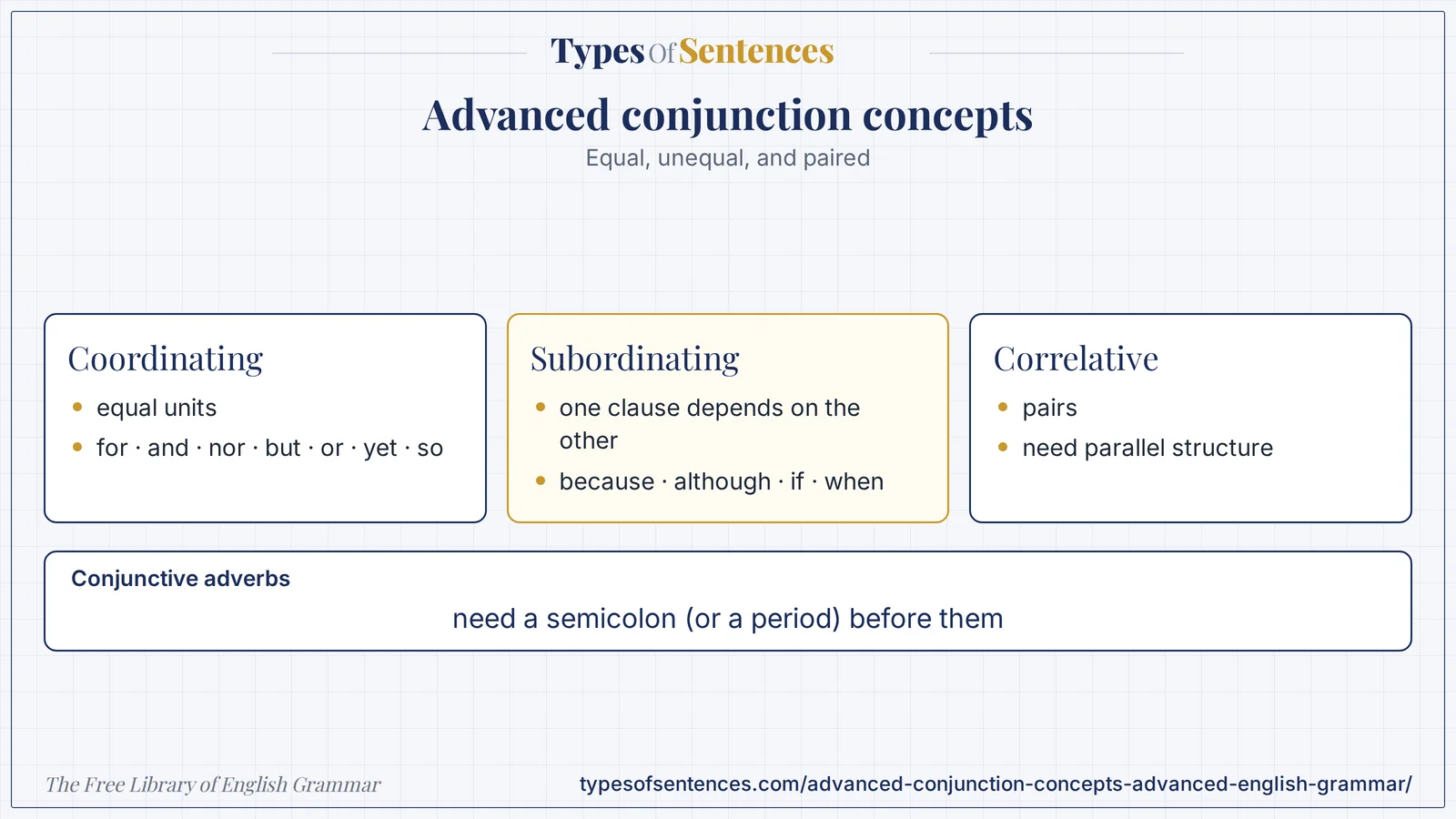
A conjunction links two pieces of language and shows how they relate: addition, contrast, reason, condition, time, and so on. The choice of conjunction decides whether the two pieces have equal weight (coordination) or one depends on the other (subordination).
Why it matters: Most conjunction errors are errors of punctuation or of structure: a comma where a semicolon is needed, a fragment that begins with because, or a pair such as not only … but that does not match.
Summary: Coordinating conjunctions (for, and, nor, but, or, yet, so) join equal units. Subordinating conjunctions (because, although, if, when) introduce a dependent clause. Correlative conjunctions (both … and, either … or, not only … but also) work in pairs and require parallel structure. Conjunctive adverbs (however, therefore) link sentences and are movable. A comma goes before a coordinator that joins two independent clauses and after an introductory dependent clause; a semicolon goes before a conjunctive adverb that joins two independent clauses.
- FANBOYS: for, and, nor, but, or, yet, so.
- Coordination = equal; subordination = one clause depends on the other.
- Correlatives need parallel structure.
- Conjunctive adverbs need a semicolon (or a period) before them, and a comma after.
What You’ll Learn
- 1. Advanced Conjunction Concepts: Four Groups and How to Tell Them Apart
- 2. Coordinating Conjunctions: FANBOYS
- 3. Complex Meanings of And, But, Or, and So
- 4. Subordinating Conjunctions: Complex Conjunctions and Their Meanings
- 5. Correlative Conjunctions and Parallelism
- 6. Conjunctive Adverbs (Conjuncts)
- 7. Starting Sentences with Conjunctions
- 8. Comma Usage with Conjunctions
- 9. Conjunctions and Prepositions, and Other Subtleties
- 10. Common Errors with Conjunctions
- 11. Exercises
- 12. Test Your Knowledge
- 13. Frequently Asked Questions
- 14. Conclusion
1. Advanced Conjunction Concepts: Four Groups and How to Tell Them Apart
A conjunction connects words, phrases, or clauses. Traditional grammar lists four groups, and reference grammars add tests to separate them.
| Group | Examples | Joins | Can it move? |
|---|---|---|---|
| coordinating | for, and, nor, but, or, yet, so | equal units (words, phrases, clauses) | no: it stays between the units |
| subordinating | because, although, if, when, since, while, unless, that, whether | a dependent clause to a main clause | the clause can move; the conjunction goes with it |
| correlative | both … and, either … or, neither … nor, not only … but also, whether … or | paired items, in parallel | the pair stays around the items |
| conjunctive adverb (conjunct) | however, therefore, moreover, nevertheless, consequently, thus | sentences or independent clauses | yes: it can move within its clause |
Two tests are useful. The movement test: a conjunctive adverb can move (It was late; however, we stayed / It was late; we stayed, however), but a coordinator cannot (*It was late; we, but, stayed). The combination test: a coordinator and a conjunctive adverb can occur together (and therefore, but nevertheless), but two coordinators in one position cannot (*and but). The coordination and subordination of clauses is treated in the chapter on coordination and subordination.
Grammarians do not all classify these words the same way. Huddleston and Pullum, for example, treat many subordinating words (because, before, since, until) as prepositions that take a clause as their complement. This course keeps the traditional four groups, since they match what most dictionaries, style guides, and exams use, and notes the difference where it matters.
2. Coordinating Conjunctions: FANBOYS
| Conjunction | Meaning | Example |
|---|---|---|
| for | reason (formal; like because) | She was tired, for she had worked all night. |
| and | addition; sequence; result; contrast | He opened the door and went in. Study and you will pass. |
| nor | a second negative | He did not call, nor did he write. |
| but | contrast; correction | It was cheap, but it broke. Not red but blue. |
| or | alternative; correction; consequence | Tea or coffee? Hurry, or you will miss it. |
| yet | contrast (stronger than but); also “still” | He is rich, yet he is unhappy. |
| so | result | It rained, so we stayed. |
The coordinators join units of the same kind, called conjoins. They can join single words (tea and coffee), phrases (in the house or in the garden), and clauses (I came, and I saw). The chapter on coordinating conjunctions lists the main rules.
| Feature | Example | Note |
|---|---|---|
| nor triggers inversion when it begins a clause | He did not call, nor did he write. | the auxiliary comes before the subject |
| for is formal and joins only clauses | She wept, for she was alone. | it is not used for phrases |
| yet can follow another coordinator | and yet, but yet | and yet is common |
| so as a coordinator | It rained, so we stayed. | so that is a subordinator of purpose |
| but as a preposition (= except) | Everyone but Tom came. nothing but trouble | but after negatives or all, everyone |
| and and or in a series | red, white, and blue; tea, coffee, or milk | the last item takes the conjunction |
I. Coordination of unlike units
Strictly, coordinators join equal categories, but unlike categories occur in real writing. She is rich and in love joins an adjective and a prepositional phrase; He is a fool and proud of it joins a noun phrase and an adjective phrase. These are acceptable in speech and informal writing but can sound careless in formal writing when the items are not truly parallel.
II. Gapping and other omissions
A coordinated clause often omits words that repeat from the first: Tom ate fish, and Mary [ate] rice (gapping); She washed [her hands] and dried her hands; He can [swim] and she can swim. Ellipsis is treated in a later chapter.
3. Complex Meanings of And, But, Or, and So
| Conjunction | Meaning | Example |
|---|---|---|
| and | addition | Maria sings and Tom plays. |
| and | sequence (then) | She picked up the phone and dialed. |
| and | result (as a result) | He dropped the glass and it broke. |
| and | contrast (informal) | She is rich and he is poor. |
| and | condition after an imperative | Study hard and you will pass. |
| and | intensity or repetition | They talked and talked. |
| or | alternative (exclusive or inclusive) | Do you want tea or coffee? You may leave early or late. |
| or | correction | He is a doctor, or rather a surgeon. |
| or | consequence after an imperative | Hurry, or you will be late. |
| but | contrast | It was cheap, but it broke. |
| but | correction (after a negative) | Not red, but blue. |
| but | concession | She is young but experienced. |
| so | result | It rained, so we stayed. |
| yet | contrast with surprise | He tried hard, yet he failed. |
Notice that or may be inclusive (one or both) or exclusive (only one). Legal and technical writers sometimes write and/or for the inclusive sense, and many style guides advise using and or or alone and adding or both where needed. The sentence You may bring a guest or a family member is ambiguous about whether you may bring both.
4. Subordinating Conjunctions: Complex Conjunctions and Their Meanings
A subordinating conjunction introduces a dependent clause and makes it part of a larger sentence. The clause cannot stand alone, and it can often change position. See the chapter on subordinating conjunctions for the full list.
| Meaning | Subordinators | Example |
|---|---|---|
| time | when, while, as, before, after, since, until, till, once, as soon as, whenever, the moment (that) | Call me when you arrive. |
| reason | because, since, as, now that, given that, seeing that, inasmuch as | Because it rained, we stayed. |
| condition | if, unless, provided (that), providing, as long as, so long as, on condition that, in case, supposing | We will go if it stops raining. |
| concession and contrast | although, though, even though, even if, whereas, while, much as | Although it rained, we went. |
| purpose | so that, in order that, lest (formal) | She left early so that she could rest. |
| result | so … that, such … that, so that | It was so cold that the lake froze. |
| manner and comparison | as, as if, as though, like (informal), than, as … as | He acts as if he owns the place. |
| place | where, wherever, anywhere | Sit where you like. |
| noun-clause introducers | that, whether, if | I know that she is right. I wonder whether it works. |
| Complex subordinator | Meaning | Example |
|---|---|---|
| as long as / so long as | condition (only if) | You can stay as long as you are quiet. |
| as soon as | time (immediately after) | Call as soon as you arrive. |
| now that | reason (because now) | Now that you are here, we can start. |
| given that / seeing that | reason (taking into account) | Given that it is late, we should go. |
| in case | precaution | Take an umbrella in case it rains. |
| so that / in order that | purpose | She spoke slowly so that everyone could follow. |
| inasmuch as / insofar as (formal) | to the extent that | Insofar as I know, it is true. |
| except that | a limit | It is perfect, except that it is expensive. |
| in that | in the respect that | It is unusual in that it has no windows. |
| Ambiguity | Example | Possible meanings |
|---|---|---|
| since | Since you left, I have been happy. | time (from the time you left) or reason (because you left) |
| as | As she was leaving, he called. | time (while) or reason (because) |
| while | While he likes tea, she prefers coffee. | contrast (whereas) or time (during the time that) |
| if | Tell me if you know. | conditional (on condition) or noun clause (whether) |
5. Correlative Conjunctions and Parallelism
Correlative conjunctions come in pairs. They emphasize a relation between two items and require both items to have the same grammatical form. The guide to correlative conjunctions lists them.
| Pair | Meaning | Example |
|---|---|---|
| both … and | addition (two items) | She is both smart and kind. |
| either … or | alternative | You can either stay or leave. |
| neither … nor | double negative | He is neither rich nor famous. |
| not only … but also | addition with emphasis | She not only sings but also dances. |
| whether … or | alternative in a noun clause | Whether you go or stay, call me. |
| not … but | correction | It was not red but blue. |
| as … as | equality | as tall as her brother |
| so … that / such … that | result | so tired that he slept |
| rather … than | preference | She would rather walk than drive. |
| no sooner … than | sequence (formal) | No sooner had he left than it rained. |
| hardly / scarcely … when | sequence (formal) | Hardly had he left when it rained. |
| Faulty | Corrected | Problem |
|---|---|---|
| She is not only smart but also has kindness. | She is not only smart but also kind. | adjective and verb phrase |
| Either you apologize or leaving. | Either you apologize or you leave. | clause and -ing form |
| He neither called nor did he write. | He neither called nor wrote. | verb and clause |
| Both the manager and the staff was late. | Both the manager and the staff were late. | both … and takes a plural verb |
| Either the manager or the staff are late. | Either the manager or the staff is late. | agree with the nearer subject (staff as a unit) |
Agreement with or, nor, either … or, and neither … nor follows the nearer subject: Neither the teacher nor the students were ready; Neither the students nor the teacher was ready. When one subject is singular and the other plural, put the plural one second to avoid awkwardness. After not only … but also, the verb also agrees with the nearer subject. When not only opens a sentence, inversion follows (Not only did she win, but she also set a record); the chapter on inversion treats this.
6. Conjunctive Adverbs (Conjuncts)
A conjunctive adverb links two independent clauses or two sentences and shows the logical relation between them. It is an adverb, not a true conjunction, and it cannot join two clauses by itself. The guide to conjunctive adverbs gives a longer list.
| Relation | Conjuncts | Example |
|---|---|---|
| addition | also, besides, furthermore, in addition, moreover, similarly, likewise | The plan is cheap; moreover, it is fast. |
| contrast | however, nevertheless, nonetheless, instead, on the other hand, in contrast, conversely, still | It was hard; however, we finished. |
| cause and result | therefore, thus, consequently, hence, as a result, accordingly, otherwise | It rained; therefore, we stayed. |
| time and sequence | then, next, afterward, meanwhile, subsequently, finally, earlier, later | She finished; then she left. |
| emphasis and example | indeed, in fact, for example, for instance, namely, in particular | Many fruits are sweet; for example, mangoes. |
| summary | in short, in conclusion, overall, to sum up | In short, the trip was a success. |
| Position | Example | Punctuation |
|---|---|---|
| between independent clauses | It was late; however, we stayed. | semicolon before; comma after |
| start of a new sentence | It was late. However, we stayed. | period before; comma after |
| inside a clause | It was late; we stayed, however. | comma before (end) or commas around (middle) |
| middle of a sentence | It was, however, a good day. | commas on both sides |
A comma alone cannot join two independent clauses before however; this is a comma splice. Use a semicolon, a period, or a coordinator such as but.
The conjuncts are part of the system of transitions, covered in a later chapter. Choose them for the logical relation they signal, and avoid heaping them up: a paragraph with however, moreover, and therefore in every sentence sounds mechanical.
7. Starting Sentences with Conjunctions
Many people learn that a sentence must not begin with and, but, or because. This is a myth. Sentences beginning with a coordinator appear in the work of established writers, and major style guides allow them.
| Starts with | Acceptable? | Example | Note |
|---|---|---|---|
| And, But, Yet, So, Or | yes, with moderation | But the plan failed. And that was only the beginning. | creates emphasis or a pause; common in good prose |
| Because (a full sentence) | yes, if a main clause follows | Because the plan failed, we started again. | no problem |
| Because alone (a fragment) | no, unless the context is informal | Because it was late. | a dependent clause alone is a fragment |
| However, Therefore, Moreover | yes | However, it failed. | a conjunct at the start of a sentence |
| Nor | yes, with inversion | Nor did he apologize. | formal and rare |
| For | rarely | For she was tired. | formal and old-fashioned |
- A sentence that begins with a coordinator should still be a complete sentence: But we kept going.
- Use sparingly: too many sentences beginning with and or but sound choppy.
- In very formal or academic writing, some editors prefer however or nevertheless to a sentence-initial but, and the choice depends on the style guide and the audience.
- A sentence beginning with because is a fragment only when it has no main clause: Because it was late. (fragment) versus Because it was late, we left. (sentence).
The rule against beginning a sentence with a conjunction has been described by usage guides as a superstition. Garner and others point to a long tradition of such sentences in English prose. If your teacher, editor, or journal forbids them, follow the house rule, and be aware that it is a convention and not a rule of grammar. Chapter 65 discusses it with other grammar myths.
8. Comma Usage with Conjunctions
| Situation | Rule | Example |
|---|---|---|
| coordinator joining two independent clauses | comma before the conjunction | It was late, so we left. |
| coordinator joining two short clauses | comma optional if very short and clear | I came and I saw. |
| coordinator joining two verbs (compound predicate) | no comma | She opened the door and walked in. |
| coordinator in a series of three or more | commas between items (serial comma recommended) | red, white, and blue |
| introductory dependent clause | comma after it | When it rains, we stay. |
| dependent clause at the end, essential | no comma | We stay when it rains. |
| dependent clause at the end, contrast or afterthought | comma before | We stayed, although it was late. |
| because clause at the end | no comma (usually) | We stayed because it was late. |
| so that (purpose) | no comma | She left early so that she could rest. |
| correlative pair joining clauses | comma between the clauses | Either you leave, or I will. |
| conjunctive adverb joining independent clauses | semicolon before; comma after | It rained; therefore, we stayed. |
| conjunctive adverb at the start of a sentence | comma after | However, we stayed. |
| Mistake | Correction | Rule |
|---|---|---|
| She opened the door, and walked in. | She opened the door and walked in. | no comma in a compound predicate |
| We left because, it was late. | We left because it was late. | no comma after a subordinator |
| It was late so we left. | It was late, so we left. | comma before the coordinator joining clauses |
| Although it rained we went. | Although it rained, we went. | comma after an introductory clause |
| We stayed, because it was late. | We stayed because it was late. | no comma before an essential because clause |
9. Conjunctions and Prepositions, and Other Subtleties
| Word | As a conjunction (with a clause) | As a preposition (with a noun phrase) |
|---|---|---|
| before | before she left | before dinner |
| after | after she left | after lunch |
| since | since she left | since Monday |
| until | until she arrives | until noon |
| as | as she walked in | as a teacher (role) |
| like | like I said (informal) | like a bird |
| than | taller than I am | taller than me (informal) / than I (formal) |
| but | I tried, but I failed. | everyone but Tom |
- Like versus as: traditional style guides prefer as before a clause (Do as I say) and like before a noun phrase (like a bird), though like before a clause is common in speech.
- While and whereas: use whereas for a clear contrast and while for time, to avoid the ambiguity noted above.
- That after verbs of saying and thinking is often omitted: I think (that) she is right. Omit it in speech and informal writing, and keep it in formal writing when it improves clarity, especially after a long subject or a verb that takes a different object.
- If and whether: use whether for alternatives (whether or not) and after prepositions (the question of whether); if is common in informal speech in indirect questions.
- Wordy subordinators: due to the fact that and in light of the fact that are usually better as because or since.
10. Common Errors with Conjunctions
| Error | Correction | Rule |
|---|---|---|
| It was late, however we stayed. | It was late; however, we stayed. | comma splice |
| Because it was late. | We left because it was late. | fragment |
| Although it rained, but we went. | Although it rained, we went. / It rained, but we went. | double conjunction |
| Because it rained, so we stayed. | Because it rained, we stayed. | double conjunction |
| The reason is because it rained. | The reason is that it rained. | reason … because is redundant |
| She is not only smart but has kindness. | She is not only smart but also kind. | faulty parallelism |
| He is neither rich or famous. | He is neither rich nor famous. | neither … nor |
| Either you leave nor I stay. | Either you leave or I stay. | either … or |
| Being that it was late, we left. | Because it was late, we left. | being that is nonstandard in formal writing |
| I like tea and also coffee. | I like tea and coffee. / I like tea and also coffee. (acceptable for emphasis) | redundant in most uses |
| Whether or not if he comes | Whether or not he comes | one conjunction |
| Both the manager and the staff was late. | Both the manager and the staff were late. | agreement |
Edit: It was late, however we stayed because, we had not finished, so we worked, and also we ate, although it was late, but we were not only tired but also had hunger, and neither the manager or the staff was ready.
- late, however we stayed: comma splice: late; however, we stayed.
- because, we: no comma: because we.
- so we worked, and also we ate: simplify: so we worked and ate.
- although it was late, but: double conjunction: although it was late, we were ….
- not only tired but also had hunger: parallel: not only tired but also hungry.
- neither … or: neither … nor; agreement: were.
- Result: It was late; however, we stayed because we had not finished, so we worked and ate, and although it was late, we were not only tired but also hungry. Neither the manager nor the staff was ready. (A better edit would split this into several sentences.)
Recap in 12 seconds
Watch the lesson build itself: Coordination joins equal units, subordination makes one clause depend on another, and correlatives need parallel structure. The video has no sound.
Exercises
Part A: Coordinators (Exercises 1–7)
Exercise 1: Name the coordinators in FANBOYS.
Show Answer
Answer: for, and, nor, but, or, yet, so.
Exercise 2: Add a comma: It was late so we left.
Show Answer
Answer: It was late, so we left.
Exercise 3: Edit: She opened the door, and walked in.
Show Answer
Answer: She opened the door and walked in.
Exercise 4: Add inversion: He did not call, nor ___ he write.
Show Answer
Answer: did.
Exercise 5: Meaning of and in Study hard and you will pass.
Show Answer
Answer: Condition (after an imperative).
Exercise 6: Meaning of or in Hurry, or you will miss it.
Show Answer
Answer: Consequence.
Exercise 7: Name the formal coordinator that means because.
Show Answer
Answer: for.
Part B: Subordinators (Exercises 8–14)
Exercise 8: Choose: (Although/Because) it rained, we went.
Show Answer
Answer: Although (concession).
Exercise 9: Punctuate: When the bell rang we left
Show Answer
Answer: When the bell rang, we left.
Exercise 10: Punctuate: We left when the bell rang
Show Answer
Answer: No comma.
Exercise 11: Name the meaning of as long as.
Show Answer
Answer: Condition (only if).
Exercise 12: Explain the ambiguity: Since you left, I have been happy.
Show Answer
Answer: Time or reason.
Exercise 13: Name the meaning of lest.
Show Answer
Answer: Purpose (to avoid something; formal).
Exercise 14: Replace the wordy form: due to the fact that
Show Answer
Answer: because.
Part C: Correlatives (Exercises 15–20)
Exercise 15: Edit: He is neither rich or famous.
Show Answer
Answer: He is neither rich nor famous.
Exercise 16: Edit: She is not only smart but has kindness.
Show Answer
Answer: She is not only smart but also kind.
Exercise 17: Edit: She likes both swimming and to run.
Show Answer
Answer: She likes both swimming and running.
Exercise 18: Choose: Either the manager or the staff (is/are) late. (staff as a unit)
Show Answer
Answer: is (the nearer subject).
Exercise 19: Invert: Not only ___ she win, but she also set a record.
Show Answer
Answer: did.
Exercise 20: Name the pair: hardly … when
Show Answer
Answer: A correlative pair of sequence (formal).
Part D: Conjunctive Adverbs (Exercises 21–25)
Exercise 21: Fix the comma splice: It was late, however we stayed.
Show Answer
Answer: It was late; however, we stayed.
Exercise 22: Punctuate: It was however a good day.
Show Answer
Answer: It was, however, a good day.
Exercise 23: Name the relation: therefore
Show Answer
Answer: Cause and result.
Exercise 24: Name the relation: moreover
Show Answer
Answer: Addition.
Exercise 25: Name the relation: nevertheless
Show Answer
Answer: Contrast.
Part E: Sentence Starts and Errors (Exercises 26–30)
Exercise 26: Is But we kept going. acceptable?
Show Answer
Answer: Yes, with moderation.
Exercise 27: Fix the fragment: Because it was late.
Show Answer
Answer: We left because it was late.
Exercise 28: Edit: Because it rained, so we stayed.
Show Answer
Answer: Because it rained, we stayed.
Exercise 29: Edit: The reason is because it rained.
Show Answer
Answer: The reason is that it rained.
Exercise 30: Edit: Although it rained, but we went.
Show Answer
Answer: Although it rained, we went.
Test Your Knowledge
Ready to check what you learned? Answer all 10 questions, then submit. You need 80% (8 of 10) to pass. Your answers are not stored.
View correct answers and explanations
Question 1: Which is a coordinating conjunction?
✓ Correct Answer: B – yet
Yet is one of FANBOYS.
Question 2: Which can move within its clause?
✓ Correct Answer: C – however
Conjunctive adverbs are movable.
Question 3: Which is correct?
✓ Correct Answer: A – It was late; however, we stayed.
Semicolon before, comma after.
Question 4: Which pair is correct?
✓ Correct Answer: D – neither … nor
Neither takes nor.
Question 5: Which is parallel?
✓ Correct Answer: C – She is not only smart but also kind.
The two items are both adjectives.
Question 6: Which is a fragment?
✓ Correct Answer: D – Because it was late.
A dependent clause alone is a fragment.
Question 7: Where is a comma needed?
✓ Correct Answer: C – It was late so we left.
A comma goes before a coordinator joining two clauses.
Question 8: Which is a subordinating conjunction?
✓ Correct Answer: A – although
Although introduces a dependent clause.
Question 9: Which pair triggers inversion at the start of a sentence?
✓ Correct Answer: B – not only … but also
Not only at the start is followed by inversion.
Question 10: Which is redundant?
✓ Correct Answer: B – Because it rained, so we stayed.
Because and so duplicate each other.
Frequently Asked Questions
What are advanced conjunction concepts?
Advanced conjunction concepts are the finer points of conjunctions: the four groups and the tests that separate them, the meanings of coordinators and subordinators, correlative pairs and parallelism, conjunctive adverbs, comma use, and starting sentences with conjunctions.
What are complex conjunctions?
Complex conjunctions are conjunctions whose use is not simple: multi-word subordinators (as long as, now that, insofar as), correlative pairs (not only … but also), and conjunctive adverbs (however).
What are conjunction complexities that cause errors?
The conjunction complexities that cause most errors are comma splices with however, fragments that begin with because, faulty correlative pairs, double conjunctions, and the confusion of conjunctions with prepositions.
What is advanced conjunction usage?
Advanced conjunction usage means choosing the conjunction that signals the right logical relation, joining equal ideas with coordinators and unequal ones with subordinators, and punctuating each correctly.
What are expert conjunctions?
Expert conjunctions are conjunctions used with full control: correct meaning, correct position, parallel structure with correlatives, and correct punctuation.
Can I start a sentence with and or but?
Yes. Major style guides allow it, and it is common in good prose, but use it sparingly. Some house styles discourage it in formal writing, so follow the guide for your field.
When do I use a semicolon before however?
Use a semicolon when however joins two independent clauses (It was late; however, we stayed). A comma alone causes a comma splice.
Conclusion
You now have a deep study of conjunctions: the four groups and how to tell them apart, the meanings of the coordinators and subordinators, correlative pairs and parallelism, conjunctive adverbs, starting sentences with conjunctions, comma rules, and the common errors. You can use conjunctions with expert control and punctuate them correctly.
When you edit, ask what relation each conjunction signals and whether the units joined are equal or unequal. Next, you will study advanced article usage.
- Huddleston, Rodney, and Geoffrey K. Pullum. The Cambridge Grammar of the English Language. Cambridge University Press, 2002.: the reference analysis of coordination and subordination.
- Quirk, Randolph, et al. A Comprehensive Grammar of the English Language. Longman, 1985.: the classic treatment of conjunctions, conjuncts, and correlatives.
- Garner, Bryan A. Garner’s Modern English Usage, 5th ed. Oxford University Press, 2022.: usage guidance on sentence-initial conjunctions and like and as.
- Biber, Douglas, et al. Longman Grammar of Spoken and Written English. Longman, 1999.: corpus evidence on conjunctions and linking adverbials.
- Purdue Online Writing Lab: Conjunctions: reference pages on conjunctions.
Last reviewed: October 29, 2026. How it was made: drafted with AI assistance, then checked with automated tests (structure, links, answer keys, spelling) and against the sources above. A person has not yet read this chapter line by line. Found a mistake? Report it.