What is the difference between fewer vs less? Use fewer with things you can count (fewer cars, fewer mistakes) and less with things you measure but do not count (less traffic, less time). In the language of grammar, fewer goes with plural count nouns and less goes with mass (uncountable) nouns. The rule has well-known exceptions: we say less than two miles and less than twenty dollars because a distance or a sum of money is treated as one amount.
Whether the question is fewer or less, less vs fewer, or less or fewer, the same test applies. This page gives the rule, shows fewer in 20 sentences and less in 20 sentences, lists the exceptions, and explains the sign ten items or less, the phrases fewer than and less than, and the common mistakes. It ends with 30 exercises and a 10-question quiz.
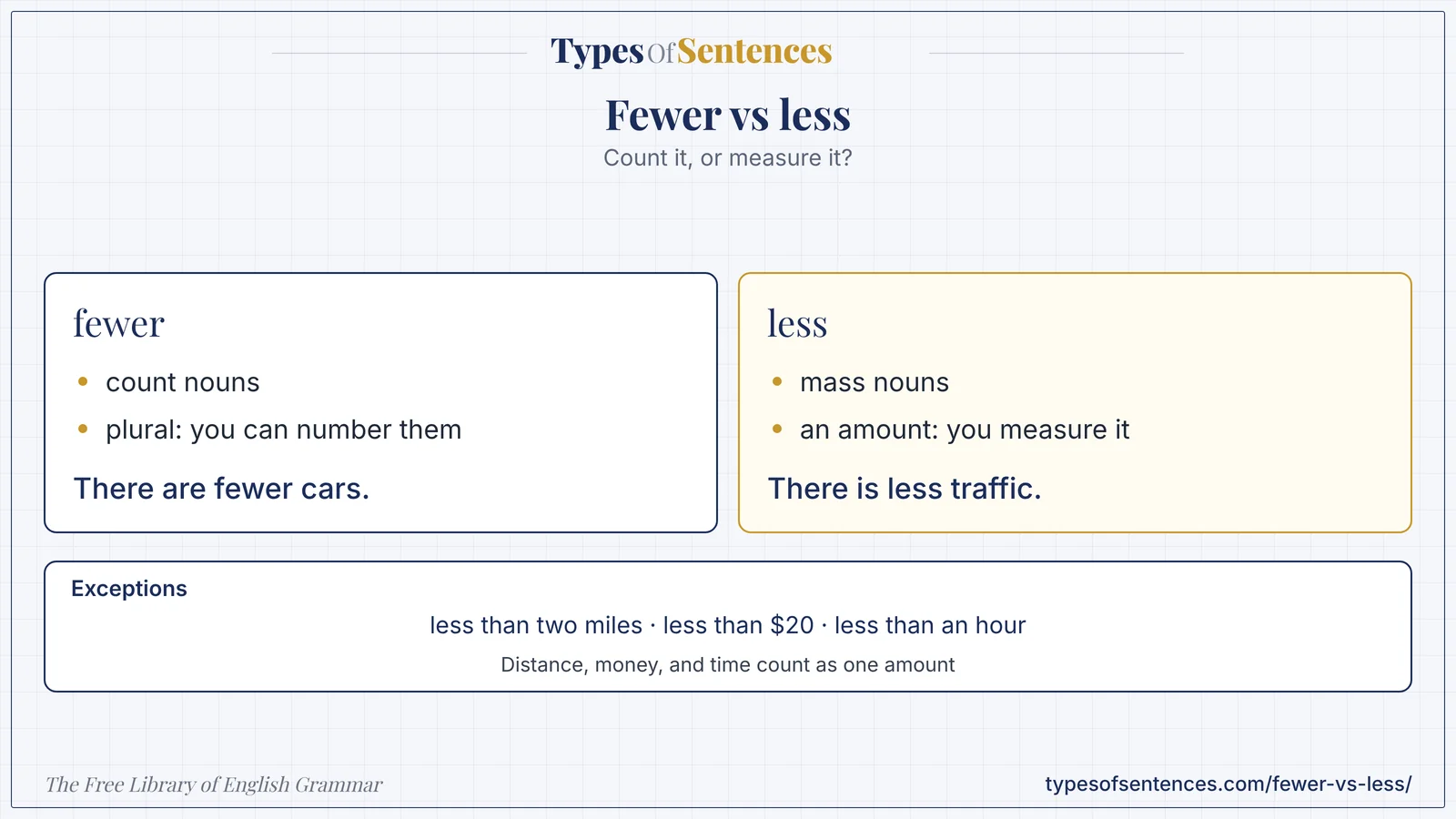
Fewer is for things you can count one by one. Less is for things you measure by amount. You can count apples (fewer apples) but not water (less water).
Why it matters: Ask: can I put a number in front of it and make it plural? If yes, use fewer. If no, use less.
Summary: Use fewer with plural count nouns: fewer cars, fewer students. Use less with mass nouns: less water, less time. Exceptions: measurements treated as one amount take less (less than two miles, less than ten dollars, less than an hour), and less is the only choice before an adjective or adverb (less likely). Careful writers use or fewer in ten items or fewer. Fewer is the comparative of few; less is the comparative of little. The test: if you can count the things, choose fewer.
- Count them: fewer.
- Measure them: less.
- Distance, time, money: less than.
- Less + adjective: less likely.
What You’ll Learn
- 1. Fewer vs Less: The Short Answer
- 2. Fewer in a Sentence: 20 Examples With Count Nouns
- 3. Less in a Sentence: 20 Examples With Mass Nouns
- 4. Fewer or Less? The Exceptions and Special Cases
- 5. Common Mistakes With Fewer and Less
- 6. Exercises
- 7. Test Your Knowledge
- 8. Frequently Asked Questions
- 9. Conclusion
1. Fewer vs Less: The Short Answer
| Word | Used with | Example | Opposite |
|---|---|---|---|
| fewer | plural count nouns | fewer cars, fewer mistakes, fewer people | more (count) |
| less | mass (uncountable) nouns | less traffic, less time, less money | more (amount) |
| Test | How it works | Example |
|---|---|---|
| the counting test | if you can count the items, use fewer | There are ___ apples. → one, two, three → fewer |
| the plural test | if the noun is plural, use fewer; if it is singular and uncountable, use less | ___ water → less |
| the many / much test | if many fits, use fewer; if much fits, use less | how many cars → fewer cars · how much time → less time |
The words are comparatives: fewer is the comparative of few and less is the comparative of little. Both words are followed by than in comparisons (fewer than ten, less than ten); the choice between than and then is explained in the guide to then vs than.
2. Fewer in a Sentence: 20 Examples With Count Nouns
In each example, fewer comes before a plural noun that can be counted, as in the Basic chapter on nouns. Each noun can have a number before it (three cars, five mistakes). The count nouns in the examples are explained in the Intermediate chapter on nouns.
| Fewer in a sentence | Count noun |
|---|---|
| There are fewer cars on the road today. | cars |
| She has fewer books than her brother. | books |
| Fewer students passed the exam this year. | students |
| We need fewer chairs for the meeting. | chairs |
| He made fewer mistakes the second time. | mistakes |
| Fewer people came than we expected. | people |
| The shop sells fewer shirts in winter. | shirts |
| There were fewer than ten players on the field. | players |
| I have fewer questions now. | questions |
| Fewer flights leave on Sundays. | flights |
| The new model has fewer parts. | parts |
| She eats fewer sweets these days. | sweets |
| Fewer trees grow at that height. | trees |
| We had fewer visitors in the rain. | visitors |
| The park has fewer benches than before. | benches |
| Fewer calls come in at night. | calls |
| He told fewer jokes this time. | jokes |
| There are fewer apples in the basket. | apples |
| The company hired fewer workers last year. | workers |
| Fewer words are needed to say the same thing. | words |
3. Less in a Sentence: 20 Examples With Mass Nouns
In each example, less comes before a mass noun: an amount that is measured, not counted. These nouns have no plural in this sense (traffic, time, water).
| Less in a sentence | Mass noun |
|---|---|
| There is less traffic today. | traffic |
| She drinks less coffee than before. | coffee |
| We have less time than we thought. | time |
| He shows less interest in sports. | interest |
| There is less snow this winter. | snow |
| I have less money than you. | money |
| The soup needs less salt. | salt |
| We had less rain in July. | rain |
| She has less patience with noise. | patience |
| The new design uses less energy. | energy |
| There was less noise after nine. | noise |
| He gave me less help than I wanted. | help |
| I feel less pressure now. | pressure |
| The city has less pollution than it did. | pollution |
| Less water flows in the dry season. | water |
| She puts less sugar in her tea. | sugar |
| The job offers less freedom. | freedom |
| There is less light in the room. | light |
| He has less confidence than he should. | confidence |
| We need less talk and more action. | talk |
A mass noun can become a count noun when it means “kinds of” or “servings of,” so that fewer becomes possible: fewer coffees (cups of coffee), fewer waters (bottles), fewer teas (varieties). The meaning decides the choice, as the advanced chapter on noun concepts explains.
4. Fewer or Less? The Exceptions and Special Cases
| Case | Example | Why |
|---|---|---|
| distance | The station is less than two miles away. | a distance is thought of as one amount |
| time | The film lasts less than two hours. | a period of time is one amount |
| money | The book costs less than twenty dollars. | a sum of money is one amount |
| weight | The bag weighs less than ten pounds. | a weight is one amount |
| percentages and fractions | Less than half of the voters came. | a share is one amount |
| one less | I have one less problem. | a fixed expression that uses less with a count noun |
| or less on signs | Ten items or less (careful style: ten items or fewer) | a common sign that many style guides correct |
| no fewer than | No fewer than fifty guests came. | stresses a surprisingly large count |
| less before an adjective or adverb | She is less tired. It is less likely. | less works as an adverb here; fewer cannot |
The sign ten items or less is the best-known case. Many style guides prefer ten items or fewer, because items are counted. A usage note like this one is a matter of style, not of an unbreakable law: less has been used with count nouns for centuries, and usage guides commonly trace the objection to an eighteenth-century remark by Robert Baker. I have not opened a dictionary entry to confirm the details, so check Merriam-Webster’s usage note if you need to cite them. For exams, school writing, and formal editing, follow the traditional rule.
| Phrase | Meaning | Example |
|---|---|---|
| fewer than + number | a smaller count | fewer than ten players |
| less than + number or measure | a smaller amount | less than ten minutes |
| the number of | goes with count nouns | The number of accidents fell, so there are fewer accidents. |
| the amount of | goes with mass nouns | The amount of rain fell, so there is less rain. |
| the fewer, the better | a fixed pair | The fewer the errors, the better the grade. |
5. Common Mistakes With Fewer and Less
| Mistake | Example | Correction |
|---|---|---|
| less with a plural count noun | *There are less cars today. | There are fewer cars today. |
| fewer with a mass noun | *There is fewer traffic today. | There is less traffic today. |
| less with people | *Less people came. | Fewer people came. |
| fewer with money as a sum | *It costs fewer than ten dollars. | It costs less than ten dollars. |
| fewer before an adjective | *It is fewer likely. | It is less likely. |
| fewer with time as a period | *It takes fewer than an hour. | It takes less than an hour. |
| lesser for less | *We have lesser time. | We have less time. |
| mixing the two in a pair | *Fewer time and less tasks | Less time and fewer tasks |
| less with a singular count noun | *Less chair is needed. | Fewer chairs are needed. |
Most errors with less vs fewer come from using less for everything. If you ask “less or fewer?” every time you write, the counting test settles it.
Fix: There are less students in the class, so we need less chairs, and the teacher gives fewer homework, which takes fewer than an hour.
- less students: students can be counted, so fewer students.
- less chairs: chairs are counted, so fewer chairs.
- fewer homework: homework is a mass noun, so less homework.
- fewer than an hour: a period of time is one amount, so less than an hour.
- Result: There are fewer students in the class, so we need fewer chairs, and the teacher gives less homework, which takes less than an hour. (the sentence is invented)
Recap in 12 seconds
Watch the lesson build itself: Use fewer with things you can count and less with amounts; distance, money, and time take less. The video has no sound.
Exercises
Part A: Choose Fewer or Less (Exercises 1–10)
Exercise 1: There are ___ cars on the road today.
Show Answer
Answer: fewer.
Exercise 2: There is ___ traffic today.
Show Answer
Answer: less.
Exercise 3: She has ___ books than her brother.
Show Answer
Answer: fewer.
Exercise 4: I drink ___ coffee than before.
Show Answer
Answer: less.
Exercise 5: ___ students passed the test.
Show Answer
Answer: Fewer.
Exercise 6: We have ___ time than we thought.
Show Answer
Answer: less.
Exercise 7: He made ___ mistakes the second time.
Show Answer
Answer: fewer.
Exercise 8: The soup needs ___ salt.
Show Answer
Answer: less.
Exercise 9: There were ___ people at the party.
Show Answer
Answer: fewer.
Exercise 10: I feel ___ pressure now.
Show Answer
Answer: less.
Part B: Count or Mass? (Exercises 11–20)
Exercise 11: Is water a count noun or a mass noun?
Show Answer
Answer: mass: less water.
Exercise 12: Is apple a count noun or a mass noun?
Show Answer
Answer: count: fewer apples.
Exercise 13: Is money a count noun or a mass noun?
Show Answer
Answer: mass: less money.
Exercise 14: Is chair a count noun or a mass noun?
Show Answer
Answer: count: fewer chairs.
Exercise 15: Is patience a count noun or a mass noun?
Show Answer
Answer: mass: less patience.
Exercise 16: Is mistake a count noun or a mass noun?
Show Answer
Answer: count: fewer mistakes.
Exercise 17: Is homework a count noun or a mass noun?
Show Answer
Answer: mass: less homework.
Exercise 18: Is friend a count noun or a mass noun?
Show Answer
Answer: count: fewer friends.
Exercise 19: Is advice a count noun or a mass noun?
Show Answer
Answer: mass: less advice.
Exercise 20: Is traffic a count noun or a mass noun?
Show Answer
Answer: mass: less traffic.
Part C: Exceptions (Exercises 21–25)
Exercise 21: The station is ___ than two miles away.
Show Answer
Answer: less (a distance).
Exercise 22: The film lasts ___ than two hours.
Show Answer
Answer: less (a period of time).
Exercise 23: The book costs ___ than twenty dollars.
Show Answer
Answer: less (a sum of money).
Exercise 24: It is ___ likely to rain.
Show Answer
Answer: less (before an adjective).
Exercise 25: Careful style prefers ten items or ___.
Show Answer
Answer: fewer.
Part D: Correct the Errors (Exercises 26–30)
Exercise 26: Correct: *There are less cars today.
Show Answer
Answer: There are fewer cars today.
Exercise 27: Correct: *There is fewer traffic today.
Show Answer
Answer: There is less traffic today.
Exercise 28: Correct: *Less people came.
Show Answer
Answer: Fewer people came.
Exercise 29: Correct: *We have lesser time.
Show Answer
Answer: We have less time.
Exercise 30: Correct: *It takes fewer than an hour.
Show Answer
Answer: It takes less than an hour.
Test Your Knowledge
Ready to check what you learned? Answer all 10 questions, then submit. You need 80% (8 of 10) to pass. Your answers are not stored.
View correct answers and explanations
Question 1: Which word goes with count nouns?
✓ Correct Answer: D – fewer
Fewer.
Question 2: There is ___ traffic today.
✓ Correct Answer: A – less
A mass noun.
Question 3: She has ___ books than her brother.
✓ Correct Answer: B – fewer
A count noun.
Question 4: The film lasts ___ than two hours.
✓ Correct Answer: C – less
A period of time.
Question 5: ___ people came.
✓ Correct Answer: D – Fewer
People are counted.
Question 6: It is ___ likely.
✓ Correct Answer: A – less
Before an adjective.
Question 7: The comparative of few is
✓ Correct Answer: B – fewer
Fewer.
Question 8: The comparative of little is
✓ Correct Answer: C – less
Less.
Question 9: Careful style prefers
✓ Correct Answer: D – ten items or fewer
Items are counted.
Question 10: The bag weighs ___ than ten pounds.
✓ Correct Answer: A – less
A weight as one amount.
Frequently Asked Questions
What is the difference between fewer vs less?
Use fewer with things that can be counted (fewer cars) and less with things that are measured as an amount (less traffic).
How do I choose between fewer or less?
Ask whether you can count the thing. If you can put a number in front of it and make it plural, use fewer. If you cannot, use less. The many / much test works too.
Is it “fewer than” or “less than”?
Use fewer than with counts (fewer than ten players) and less than with amounts (less than ten minutes). Distances, times, weights, and sums of money take less than even with a number.
Is “ten items or less” wrong?
Many style guides call it wrong, because items are counted, and prefer ten items or fewer. The sign is common in stores. Follow your exam or style guide for formal writing.
Can I say “less people”?
In careful writing, no: use fewer people. People are counted, so fewer is the traditional choice.
Why do we say “less than two miles” and not “fewer than two miles”?
A distance is treated as one amount, not as a set of separate miles. The same goes for time, money, and weight.
Is “lesser” the same as “less”?
No. Lesser is an adjective meaning “smaller in importance” (the lesser evil). Do not use it for less before a noun of amount.
Conclusion
You now know the rule for fewer vs less: fewer with count nouns, less with mass nouns, and less for measurements treated as one amount. You have seen the 20 examples of each, the exceptions, and the common mistakes.
Count the thing before you choose, and remember the exceptions for distance, time, money, and weight. Next, study the other confusable words in this series.
- Garner, Bryan A. Garner’s Modern English Usage. 5th ed. Oxford University Press, 2022.: the entry on less and fewer.
- Swan, Michael. Practical English Usage. 4th ed. Oxford University Press, 2016.: the entries on less and fewer.
- Strunk, William, Jr., and E. B. White. The Elements of Style. 4th ed. Longman, 1999.: the entry on less and fewer among the words commonly misused.
- Merriam-Webster Dictionary: fewer and less: the dictionary entries and usage notes (not opened when this page was written).
Last reviewed: October 29, 2026. How it was made: drafted with AI assistance, then checked with automated tests (structure, links, answer keys, spelling) and against the sources above. A person has not yet read this chapter line by line. Found a mistake? Report it.