Advanced noun concepts begin where the simple definition ends. A noun names a person, place, thing, or idea, but in real English the same word can be countable in one sentence and uncountable in the next (a glass, glass), a plural noun can take a singular verb (Mathematics is hard), and a verb can be turned into a noun to compress a whole clause (the failure of the plan). These complex nouns and their rules are the subject of this chapter.
This chapter studies advanced noun types and noun complexities: the real nature of countability, nouns that exist only in the plural or only in the singular form, plurals of Latin and Greek nouns, collective nouns and agreement, compound nouns and their plurals, noun adjuncts, the possessive (genitive) in all its forms, gender and case in a language that has lost most of both, and nominalization, one of the most powerful and most overused tools in expert noun usage. It ends with 30 editing exercises and a quiz.
At the advanced level, “countable” and “uncountable” are not two boxes with fixed words in each. They are two ways of seeing a thing: as separate units or as stuff. The same noun can be seen either way, and the choice changes the grammar.
Why it matters: The same flexibility explains agreement with collective nouns, the choice between ’s and of, and the effect of turning verbs into nouns.
Summary: Nouns are classified by countability, concreteness, and meaning, but the classes overlap and many nouns move between them. Some nouns have only plural form (scissors), others have plural form with singular agreement (news), and some foreign plurals are fading (data, criteria). Collective nouns take singular or plural agreement by sense (British) or usually singular (American). The genitive shows possession and many other relations. Nominalization packs verbs and adjectives into nouns, with gains and costs.
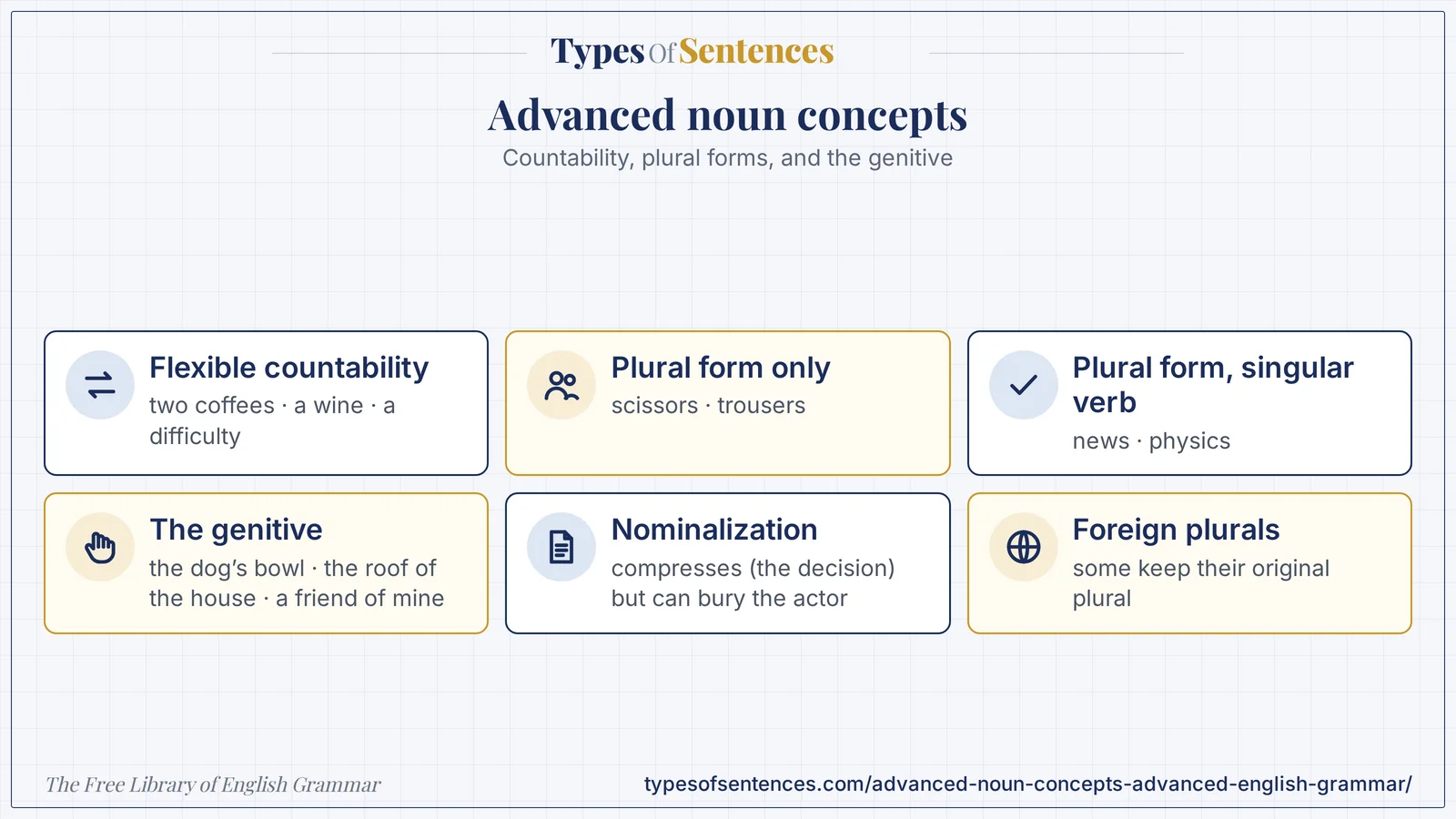
- Countability is flexible: two coffees, a wine, a difficulty.
- Pluralia tantum: scissors, trousers; singular form: news, physics.
- Genitive: the dog’s bowl, the roof of the house, a friend of mine.
- Nominalization compresses (the decision) but can bury the actor.
What You’ll Learn
- 1. Advanced Noun Concepts: Concrete and Abstract Nouns
- 2. Countable and Uncountable Nouns: A Flexible System
- 3. Plural-Only, Singular-Form, and Foreign Plural Nouns
- 4. Collective Nouns and Agreement
- 5. Compound Nouns and Noun Adjuncts
- 6. The Genitive: ’s, Of, and Other Possessive Forms
- 7. Gender and Case in Nouns
- 8. Nominalization: Turning Verbs and Adjectives into Nouns
- 9. Proper Nouns, Conversion, and Edge Cases
- 10. Common Errors with Complex Nouns
- 11. Exercises
- 12. Test Your Knowledge
- 13. Frequently Asked Questions
- 14. Conclusion
1. Advanced Noun Concepts: Concrete and Abstract Nouns
Concrete nouns name things that can be perceived by the senses (table, rain, smell), and abstract nouns name qualities, states, and ideas (freedom, honesty, speed). The distinction is a matter of degree, and many words sit between the two.
| Kind | Examples | Notes |
|---|---|---|
| concrete, countable | book, tree, teacher | can be counted and seen |
| concrete, mass | water, sand, furniture | a substance or collection; no plural in the usual sense |
| abstract, uncountable | freedom, advice, happiness | usually uncountable |
| abstract, countable | idea, problem, difficulty, kindness (an act) | count when they name instances |
| collective | committee, team, family | a group seen as one or as members |
| proper | Maria, Delhi, Microsoft | a unique name; capitalized |
Abstract nouns often have a countable use that names an instance: kindness (a quality) but a kindness (a kind act); difficulty (a state) but a difficulty (a particular problem); experience (accumulated knowledge) but an experience (an event). This is the first sign of the flexibility described next.
2. Countable and Uncountable Nouns: A Flexible System
English countability is not a property of the real world but of how the noun is used. Furniture is uncountable in English but its equivalent is countable in other languages, and many nouns have both uses with different meanings.
| Noun | Uncountable (substance, concept) | Countable (units, kinds, instances) |
|---|---|---|
| coffee | I like coffee. | Two coffees, please. (cups) |
| wine | Wine is made from grapes. | A wine for each guest. (a kind or a glass) |
| paper | Paper is made from wood. | a paper (an essay or a newspaper) |
| glass | Glass breaks easily. | a glass (a drinking vessel); glasses (spectacles) |
| room | There is no room for more. (space) | three rooms (compartments) |
| work | She has a lot of work to do. | the works of Shakespeare; works (a factory) |
| time | Time flies. | three times (occasions) |
| experience | She has experience. | an unusual experience |
| iron | Iron is a metal. | an iron (for clothes) |
| chicken | We ate chicken. (meat) | two chickens (birds) |
| Mass-noun class | Examples | Countable partitives |
|---|---|---|
| liquids and gases | water, milk, air, oil | a glass of water, a drop of oil |
| materials | wood, steel, cotton | a piece of wood, a sheet of steel |
| abstractions | advice, information, knowledge, progress, news, evidence, research | a piece of advice, an item of news, a bit of evidence |
| collective mass | furniture, luggage, equipment, mail, clothing, jewelry, traffic | a piece of furniture, an item of luggage |
| natural phenomena | weather, thunder, lightning, rain | a clap of thunder, a flash of lightning |
| activities and subjects | homework, housework, travel, music | a piece of homework, a trip, a piece of music |
Some nouns have drifted. Research is uncountable in most usage (much research), but researches appears in older and some academic writing. Evidence is uncountable (a piece of evidence), and stuff and staff have mass uses. Dictionaries label each use, and a current learner’s dictionary is the best guide for a particular word.
3. Plural-Only, Singular-Form, and Foreign Plural Nouns
| Type | Examples | Agreement and notes |
|---|---|---|
| pluralia tantum (plural form only, plural verb) | scissors, trousers, jeans, glasses, pliers, clothes, goods, belongings, savings, outskirts, thanks, congratulations | These scissors are sharp. Use a pair of to count: two pairs of scissors. |
| singular form with singular verb (names of subjects and diseases) | news, physics, mathematics, economics, politics, linguistics, measles, mumps, diabetes | The news is good. Physics is difficult. |
| plural form, either agreement | statistics, ethics, politics, acoustics, gymnastics | Statistics is a hard subject (the field) but The statistics are alarming (the figures). |
| no change in the plural | sheep, deer, fish, series, species, aircraft, offspring | One sheep, two sheep. |
| unchanged but plural in use | police, people, cattle, clergy, staff (often) | The police are here. The cattle were grazing. |
| irregular native plurals | man/men, woman/women, child/children, foot/feet, tooth/teeth, mouse/mice, ox/oxen | vowel change or old endings |
| Singular (Latin or Greek) | Plural | Note |
|---|---|---|
| criterion | criteria | the plural is often used for the singular in speech: a criteria is non-standard |
| phenomenon | phenomena | phenomenons is rare |
| datum | data | data is now commonly used as a mass noun (The data is clear) and a plural (The data are clear); style guides differ |
| medium | media, mediums | media for communication; mediums for spiritualists or sizes |
| curriculum | curricula, curriculums | both accepted |
| thesis | theses | pronounced -eez |
| analysis | analyses | pronounced -eez |
| hypothesis | hypotheses | pronounced -eez |
| appendix | appendices, appendixes | both accepted |
| index | indexes, indices | indexes for books; indices in mathematics and economics |
| formula | formulas, formulae | formulae in science, formulas in general use |
| bacterium | bacteria | bacteria is also used as a singular, which careful writers avoid |
The trend is toward English plurals (-s) for words that have become common. Scientific and formal writing keep the classical plurals longer. Follow your style guide, and use the plural form with the correct agreement: The criteria are, not The criteria is.
4. Collective Nouns and Agreement
A collective noun names a group seen as a unit: committee, team, family, audience, government, staff, jury. It can take a singular verb (the group as one) or a plural verb (the members as individuals). The choice is called notional agreement and it varies between British and American English.
| Sentence | Agreement | Meaning |
|---|---|---|
| The committee has decided. | singular | the group acts as one |
| The committee have decided. | plural | the members decided (British) |
| The team is winning. | singular | the group as a unit (American usual) |
| The team are arguing among themselves. | plural | the members acting separately |
| The audience was enthusiastic. | singular | one body of listeners |
| The audience were clapping and cheering. | plural | individuals (more British) |
| Pattern | Agreement | Example |
|---|---|---|
| a number of + plural noun | plural | A number of students were late. |
| the number of + plural noun | singular | The number of students is growing. |
| a lot of / plenty of + noun | agrees with the noun | A lot of money is wasted. A lot of people are waiting. |
| the majority of + noun | agrees with the noun | The majority of voters are young. |
| a series of / a pair of | usually singular in a pair | A pair of shoes is on the floor. |
| the police / the clergy / the people | plural | The police are investigating. |
| the staff / the crew / the faculty | either, by sense | The staff is small. The staff are on strike. |
5. Compound Nouns and Noun Adjuncts
| Type | Example | Notes |
|---|---|---|
| closed | blackboard, toothpaste, notebook | one word |
| hyphenated | mother-in-law, merry-go-round, check-in | a hyphen joins the parts |
| open | ice cream, post office, high school | two words |
| noun + noun | stone wall, student union, car park | the first noun is a modifier (adjunct) |
| gerund + noun | washing machine, swimming pool | the gerund names the purpose |
| adjective + noun | blackboard, greenhouse, hot dog | the compound has its own meaning |
| verb + particle | breakdown, takeoff, check-in | a phrasal verb turned noun |
| Rule | Example |
|---|---|
| stress: the first element is usually stressed in a compound | a BLACKboard (the classroom item) versus a black BOARD (any board that is black) |
| plural: make the head plural | toothbrushes, mothers-in-law, attorneys general, passers-by, courts-martial |
| plural of a closed compound with a particle at the end | takeoffs, breakdowns |
| plural of compounds ending in -ful | spoonfuls (or spoonsful, rare), cupfuls |
| no plural in the modifier | a shoe shop (not a shoes shop), a three-year plan (not three-years) |
| exceptions: plural modifiers in some compounds | a sports car, a customs officer, a clothes shop, an arms race |
Noun adjuncts are nouns that modify other nouns: stone wall, car park, school bus, chicken soup. The first noun is usually singular even when it names a plural idea (a shoe shop, a drug problem), and numbers with units are singular and hyphenated: a ten-minute break, a five-year-old child. Long strings of noun adjuncts are hard to read: student loan repayment plan review committee needs rewriting. See the chapter on complex noun phrases.
Spelling and hyphenation of compounds changes over time, and dictionaries disagree. Check a current dictionary, and then be consistent in your document.
6. The Genitive: ’s, Of, and Other Possessive Forms
| Form | Rule | Example |
|---|---|---|
| singular noun | add ’s | the dog’s bowl, Maria’s book |
| regular plural | add an apostrophe only | the dogs’ bowls, the students’ rooms |
| irregular plural | add ’s | the children’s toys, the men’s room |
| singular noun ending in s | ’s (Chicago) or ’ (AP) for some | Charles’s book, James’s car (Chicago); James’ car (AP often) |
| group genitive | ’s on the last word of the group | the Queen of England’s crown, my brother-in-law’s car |
| joint possession | ’s on the last name only | Tom and Maria’s house |
| separate possession | ’s on each | Tom’s and Maria’s cars |
| independent genitive (the noun is omitted) | ’s alone | at the baker’s; the Smiths’ (house); Mine is better than Tom’s |
| double genitive | of + ’s or a possessive pronoun | a friend of Maria’s, a friend of mine, that temper of his |
| of-genitive | of + noun phrase | the roof of the house, the end of the story |
| Meaning | Example | Type |
|---|---|---|
| possession | Maria’s car | possessive |
| relationship | Maria’s brother | kinship |
| subject of an action | the teacher’s explanation (the teacher explains) | subjective genitive |
| object of an action | the prisoner’s release (someone released the prisoner) | objective genitive |
| origin | the sun’s rays | origin |
| description or purpose | a women’s college, a children’s hospital | classifying genitive |
| measure | a day’s work, two weeks’ notice, a dollar’s worth | genitive of measure |
| partitive | a cup of tea, the best of friends | of-genitive |
Check whether the owner is singular or plural, and place the apostrophe accordingly. The pronoun forms its, hers, ours, yours, and theirs take no apostrophe.
7. Gender and Case in Nouns
Modern English nouns have almost no grammatical gender. Gender is natural: it follows the sex of the referent in a few pairs (actor/actress, king/queen) and in the choice of pronoun (he, she, it). Most nouns are common gender: teacher, doctor, student, friend, person.
| Type | Examples | Notes |
|---|---|---|
| masculine and feminine pairs | actor/actress, host/hostess, waiter/waitress, prince/princess | the feminine forms are in decline |
| gender-neutral replacements | actor (for all), server, chair or chairperson, firefighter, police officer, flight attendant, spokesperson | preferred in current style guides |
| common gender | teacher, doctor, parent, cousin, neighbor | no distinction in the noun |
| grammatical-gender holdovers | ships and countries (she) in older or literary use | mostly avoided in current style |
| pronoun choice | the baby … it / he / she; the pilot … he or she or they | depends on knowledge and style |
The chapter on gender-inclusive language discusses the choices in detail. Case is similarly reduced. Nouns have a common case and a genitive case (Maria’s); the subjective and objective distinctions show only in pronouns (she/her, who/whom). A noun’s function is shown by word order, not by case endings: Dogs chase cats and Cats chase dogs mean different things.
8. Nominalization: Turning Verbs and Adjectives into Nouns
Nominalization is the formation of a noun from a verb, adjective, or clause: decide → decision, fail → failure, able → ability, They announced that the plan failed → the failure of the plan. It is a main source of abstract nouns.
| Verb or adjective | Nominalization | Typical suffix |
|---|---|---|
| decide | decision | -ion |
| analyze | analysis | -sis |
| move | movement | -ment |
| arrive | arrival | -al |
| perform | performance | -ance |
| depend | dependence | -ence |
| teach | teacher | -er |
| happy | happiness | -ness |
| able | ability | -ity |
| free | freedom | -dom |
| Advantages | Costs |
|---|---|
| compresses a clause into a noun phrase: The committee’s rejection of the proposal surprised us. | hides the actor: A decision was made (by whom?) |
| allows abstract subjects and topics: Inflation affects savings. | long chains of nouns and of phrases become heavy |
| links ideas: a nominalization can refer back to an earlier clause: They rejected the plan. This rejection … | weak verbs (make a decision, conduct an investigation) replace strong ones (decide, investigate) |
| gives an impersonal, formal tone suited to academic and legal writing | too many make a text abstract and hard to follow |
| Heavy | Lighter (verb restored) |
|---|---|
| We conducted an investigation of the problem. | We investigated the problem. |
| The implementation of the policy was done by the team. | The team implemented the policy. |
| There is a need for the performance of a review. | We need to review it. |
| The reduction in costs was achieved by the introduction of automation. | Automation reduced costs. |
Writers on style, including Helen Sword, call heavy chains of nominalizations “zombie nouns”. The advice is to prefer a verb when the actor and action matter, and to keep nominalizations where abstraction helps, as in academic argument. The right balance depends on reader and genre; see the chapter on conciseness and wordiness.
9. Proper Nouns, Conversion, and Edge Cases
| Case | Example | Note |
|---|---|---|
| proper noun used as common noun | a Picasso, two Smiths, the Kennedys, a Rolls-Royce | the name stands for works or members |
| proper nouns that become common nouns | kleenex (tissue), xerox (copy), google (search) | trademarks may remain capitalized in formal writing |
| common noun used as a name | the President, Mother, the Prime Minister | capitalized as a title or name |
| plural of names | the Smiths (not the Smith’s), the Joneses | no apostrophe |
| proper noun in a possessive | the Smiths’ house, Mr. Smith’s car | plural vs singular possessive |
| nationality and place names | the English, the French, an American | nationalities can be nouns or adjectives |
| nouns from other classes | the poor, the rich, the unexpected, a run, a find | conversion; see the chapter on British and American English for regional variants |
Names of organizations take singular or plural agreement by sense, with British English more often plural: Microsoft has announced (American) and Microsoft have announced (British). Titles of works are singular: “The Chronicles of Narnia” is a series.
10. Common Errors with Complex Nouns
| Error | Correction | Rule |
|---|---|---|
| She gave me many advices. | She gave me a lot of advice. | advice is uncountable |
| I need an information. | I need some information. | information is uncountable |
| The furnitures are old. | The furniture is old. | mass noun, no plural |
| The criteria is clear. | The criteria are clear. | plural of criterion |
| The news are good. | The news is good. | singular form |
| These scissors is sharp. | These scissors are sharp. | plural-only noun |
| The team have lost their coach. (US) | The team has lost its coach. | consistent singular |
| The dogs bowl | The dog’s bowl / The dogs’ bowl | possessive |
| a three-years plan | a three-year plan | singular noun adjunct |
| The Smith’s are here. | The Smiths are here. | no apostrophe in a plural |
| the leader of the party’s speech | the speech by the party’s leader | awkward double genitive |
| We conducted an investigation of the problem and made a decision. | We investigated the problem and decided. | prefer strong verbs when the action matters |
Edit: The informations about the criteria is in the appendixes, and the staff have lost its keys to the three-years plan, which was written by Tom and Maria’s teachers.
- informations: uncountable: information.
- the criteria is: plural: the criteria are.
- appendixes: acceptable; appendices in formal writing.
- the staff have lost its: consistent: the staff has lost its (or have lost their).
- three-years plan: three-year plan.
- Result: The information about the criteria is in the appendices, and the staff has lost its keys to the three-year plan, which was written by Tom and Maria’s teachers. (The sentence is still awkward: a better edit splits it into two.)
Recap in 12 seconds
Watch the lesson build itself: Advanced noun concepts: flexible countability, special plural forms, the genitive, nominalization, and foreign plurals. The video has no sound.
Exercises
Part A: Countability (Exercises 1–7)
Exercise 1: Edit: She gave me many advices.
Show Answer
Answer: She gave me a lot of advice.
Exercise 2: Edit: I need an information.
Show Answer
Answer: I need some information.
Exercise 3: Explain: Two coffees, please.
Show Answer
Answer: Coffee is countable here: two cups.
Exercise 4: Choose: There is (much/many) furniture.
Show Answer
Answer: much.
Exercise 5: Count it: advice (use a partitive)
Show Answer
Answer: a piece of advice.
Exercise 6: Name the countable meaning of paper.
Show Answer
Answer: An essay or a newspaper.
Exercise 7: Name the uncountable meaning of time.
Show Answer
Answer: Time in general: Time flies.
Part B: Plural Forms (Exercises 8–13)
Exercise 8: Choose: These scissors (is/are) sharp.
Show Answer
Answer: are.
Exercise 9: Choose: The news (is/are) good.
Show Answer
Answer: is.
Exercise 10: Plural of criterion:
Show Answer
Answer: criteria.
Exercise 11: Plural of thesis:
Show Answer
Answer: theses.
Exercise 12: Choose: Physics (is/are) hard.
Show Answer
Answer: is.
Exercise 13: Plural of sheep:
Show Answer
Answer: sheep.
Part C: Collective Nouns and Agreement (Exercises 14–19)
Exercise 14: Edit for American usage: The team have lost their coach.
Show Answer
Answer: The team has lost its coach.
Exercise 15: Choose: The number of students (is/are) growing.
Show Answer
Answer: is.
Exercise 16: Choose: A number of students (was/were) late.
Show Answer
Answer: were.
Exercise 17: Choose: The police (is/are) here.
Show Answer
Answer: are.
Exercise 18: Choose: A pair of shoes (is/are) on the floor.
Show Answer
Answer: is.
Exercise 19: Explain notional agreement.
Show Answer
Answer: The verb agrees with the sense (group or members), not the grammatical form.
Part D: Compounds and the Genitive (Exercises 20–25)
Exercise 20: Plural of mother-in-law:
Show Answer
Answer: mothers-in-law.
Exercise 21: Edit: a three-years plan
Show Answer
Answer: a three-year plan.
Exercise 22: Edit: The dogs bowl is empty. (one dog)
Show Answer
Answer: The dog’s bowl is empty.
Exercise 23: Edit: the childrens toys
Show Answer
Answer: the children’s toys.
Exercise 24: Edit: The Smith’s are here.
Show Answer
Answer: The Smiths are here.
Exercise 25: Explain: a friend of Maria’s.
Show Answer
Answer: A double genitive: one of Maria’s friends.
Part E: Gender, Case, Nominalization (Exercises 26–30)
Exercise 26: Give a gender-neutral replacement for chairman.
Show Answer
Answer: chair (or chairperson).
Exercise 27: Give the nominalization of decide.
Show Answer
Answer: decision.
Exercise 28: Restore the verb: We conducted an investigation of the problem.
Show Answer
Answer: We investigated the problem.
Exercise 29: Restore the actor: A decision was made.
Show Answer
Answer: The board made a decision. (sample)
Exercise 30: Rewrite: The reduction in costs was achieved by automation.
Show Answer
Answer: Automation reduced costs.
Test Your Knowledge
Ready to check what you learned? Answer all 10 questions, then submit. You need 80% (8 of 10) to pass. Your answers are not stored.
View correct answers and explanations
Question 1: Which noun is uncountable?
✓ Correct Answer: C – advice
Advice has no plural.
Question 2: Which is correct?
✓ Correct Answer: D – The news is good.
News takes a singular verb.
Question 3: What is the plural of criterion?
✓ Correct Answer: B – criteria
Criteria is the plural.
Question 4: Which is correct in American English?
✓ Correct Answer: C – The team has lost its coach.
Consistent singular agreement.
Question 5: Which agrees with the number of students?
✓ Correct Answer: D – is growing
The number takes a singular verb.
Question 6: Which is correct?
✓ Correct Answer: C – a three-year plan
A noun adjunct is singular.
Question 7: Which is the plural of mother-in-law?
✓ Correct Answer: B – mothers-in-law
The head is made plural.
Question 8: Which shows joint possession?
✓ Correct Answer: A – Tom and Maria’s house
The ’s is on the last name.
Question 9: What is nominalization?
✓ Correct Answer: A – Turning a verb or adjective into a noun
It forms nouns from other classes.
Question 10: Which is a gender-neutral term?
✓ Correct Answer: B – chair
Chair is gender-neutral.
Frequently Asked Questions
What are advanced noun concepts?
Advanced noun concepts are the finer points of the noun: flexible countability, plural-only and singular-form nouns, foreign plurals, collective-noun agreement, compounds, the genitive, gender and case, and nominalization.
What are complex nouns?
Complex nouns are nouns whose behavior is not simple: nouns that are both countable and uncountable (coffee), plural nouns that take singular verbs (news), collective nouns, and compound nouns.
What are advanced noun types?
Advanced noun types include mass and count nouns, collective nouns, pluralia tantum (scissors), singular-form nouns (physics), compounds, noun adjuncts, and nominalizations.
What are noun complexities that cause errors?
The noun complexities that cause most errors are countability (advices), agreement with collective and singular-form nouns (the news are), foreign plurals (the criteria is), and possessive apostrophes.
What is expert noun usage?
Expert noun usage means choosing the right noun form for the sense and register: the right countability, agreement, possessive, and compound form, and a balance between nouns and verbs in the style.
Why is data singular or plural?
Both uses exist. In general and scientific writing, data is often a mass noun (The data is clear). Some style guides require the plural (The data are clear). Follow your style guide and be consistent.
When should I use ’s and when of?
Use ’s for people, animals, time, and organizations (the doctor’s opinion, today’s news), and of for inanimate things (the roof of the house). The of form is usually better for long noun phrases.
Conclusion
You now have a deep study of the noun: concrete and abstract nouns, the flexibility of countability, plural-only and singular-form nouns, foreign plurals, collective nouns and agreement, compounds and noun adjuncts, the genitive, gender and case, and nominalization. You can use complex nouns with expert control and avoid the usual errors.
Look at the nouns in a page you have written and ask whether each is used in the right sense and with the right agreement. Next, you will study advanced verb concepts.
- Huddleston, Rodney, and Geoffrey K. Pullum. The Cambridge Grammar of the English Language. Cambridge University Press, 2002.: the detailed analysis of nouns, countability, and number.
- Quirk, Randolph, et al. A Comprehensive Grammar of the English Language. Longman, 1985.: the classic treatment of noun classes, number, and the genitive.
- Garner, Bryan A. Garner’s Modern English Usage, 5th ed. Oxford University Press, 2022.: usage guidance on plurals, collective nouns, and possessives.
- Sword, Helen. Stylish Academic Writing. Harvard University Press, 2012.: the discussion of “zombie nouns” and nominalization.
- The Chicago Manual of Style, 17th edition, chapter 7 (Spelling, Distinctive Treatment of Words, and Compounds): conventions for plurals, possessives, and compounds.
Last reviewed: October 29, 2026. How it was made: drafted with AI assistance, then checked with automated tests (structure, links, answer keys, spelling) and against the sources above. A person has not yet read this chapter line by line. Found a mistake? Report it.