What is the difference between which vs that? In formal American English, use that to introduce information the sentence needs (a restrictive clause), and use which, with commas, to introduce extra information (a nonrestrictive clause). The book that I borrowed is overdue tells which book. The book, which I borrowed, is overdue adds a fact about a book that is already known. The commas are the signal: no commas with that, commas around which.
Whether the question is that vs which or which or that, the same test applies. This page explains the rule, shows that in 20 sentences and which in 20 sentences, and covers which after a preposition, which that refers to a whole clause, and the difference between American and British practice. It ends with 30 exercises and a 10-question quiz.
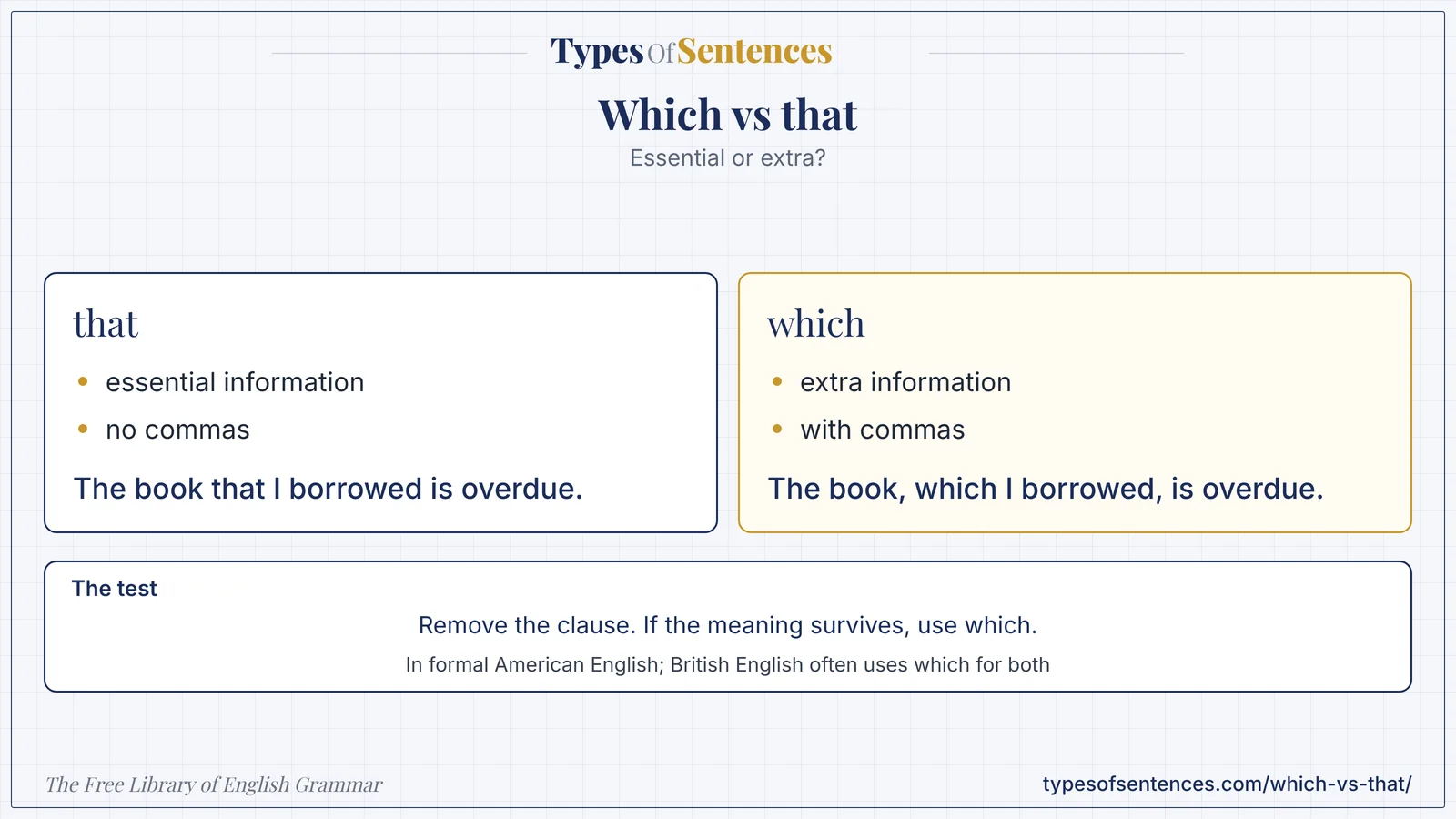
That points to the one you mean: the book that I borrowed (not another book). Which adds a bonus fact: the book, which I borrowed, is overdue.
Why it matters: Cover the clause. If the sentence loses its meaning (which one?), use that. If the sentence still makes sense, use which with commas.
Summary: A restrictive (essential) clause identifies the noun and takes that, with no commas: The car that I bought is red. A nonrestrictive (nonessential) clause adds extra information and takes which, with commas: My car, which is red, needs repairs. The omission test: if you can remove the clause without changing the main meaning, it is nonrestrictive. That cannot follow a comma or a preposition (in which, not in that); which can refer to a whole clause (She was late, which annoyed him). For people, use who or that, not which. British English often uses which for both kinds.
- That: no commas, essential.
- Which: commas, extra.
- Test: remove the clause.
- After a preposition: which.
What You’ll Learn
- 1. Which vs That: The Short Answer
- 2. That in a Sentence: 20 Examples of Restrictive Clauses
- 3. Which in a Sentence: 20 Examples of Nonrestrictive Clauses
- 4. Restrictive and Nonrestrictive Clauses: The Finer Points
- 5. Common Mistakes With Which and That
- 6. Exercises
- 7. Test Your Knowledge
- 8. Frequently Asked Questions
- 9. Conclusion
1. Which vs That: The Short Answer
| Clause type | Word | Commas? | Example |
|---|---|---|---|
| restrictive (essential) | that | no | The book that I borrowed is overdue. |
| nonrestrictive (nonessential) | which | yes | The book, which I borrowed, is overdue. |
| Test | How it works | Example |
|---|---|---|
| the omission test | remove the clause; if the main meaning survives, it is nonrestrictive and takes which | My car, ___ is red, needs repairs. → still clear → which |
| the comma test | if you would pause and write commas, use which | The lake, ___ is deep, is popular. → which |
| the identification test | if the clause tells which one, use that | The car ___ I bought is red. (which car?) → that |
| the preposition test | after a preposition use which | the house in ___ I live → which |
The words that and which are relative pronouns, and the clauses they begin are relative (adjective) clauses, described in the advanced chapter on relative clauses. For people, the pronoun is who; the choice between who and whom is explained in the guide to who vs whom.
2. That in a Sentence: 20 Examples of Restrictive Clauses
In each example, the clause with that is needed to identify the noun. If you remove it, the sentence no longer says which one is meant. No commas are used. In many of these sentences that can be dropped when it is the object of the clause (The book I borrowed is overdue).
| That in a sentence | Note |
|---|---|
| The book that I borrowed is overdue. | tells which book |
| The car that I bought last year is red. | tells which car |
| The plan that she made worked. | tells which plan |
| This is the house that Jack built. | tells which house |
| The song that she sang was beautiful. | tells which song |
| The bag that I left on the bus was missing. | tells which bag |
| Everything that he said was true. | after everything |
| The only thing that matters is time. | after only |
| It was the best film that I have seen. | after a superlative |
| The shirts that are on sale are blue. | tells which shirts |
| The report that you sent was clear. | tells which report |
| All that glitters is not gold. | after all |
| The idea that she proposed was simple. | tells which idea |
| The road that leads to the lake is closed. | tells which road |
| I lost the keys that you gave me. | tells which keys |
| The computer that crashed is old. | tells which computer |
| The cake that she baked vanished. | tells which cake |
| The letter that came today is for you. | tells which letter |
| The tree that fell blocked the road. | tells which tree |
| The movie that we watched was long. | tells which movie |
3. Which in a Sentence: 20 Examples of Nonrestrictive Clauses
In each example, the clause with which adds extra information about a noun that is already clear. Commas (or a comma before the final clause) mark it off. The comma rules for such clauses are covered in the Basic chapter on the comma.
| Which in a sentence | Note |
|---|---|
| The book, which I borrowed, is overdue. | extra information |
| My car, which is red, needs repairs. | extra information |
| The lake, which is very deep, is popular. | extra information |
| Paris, which is the capital of France, is large. | extra information |
| The film, which lasts three hours, won an award. | extra information |
| Our school, which was built in 1950, is old. | extra information |
| The report, which she wrote in a day, was clear. | extra information |
| The store, which opens at nine, is near here. | extra information |
| The bridge, which crosses the river, is closed. | extra information |
| Her phone, which was new, broke. | extra information |
| He passed the test, which surprised everyone. | refers to the whole clause |
| She was late, which annoyed her boss. | refers to the whole clause |
| The village in which I grew up is small. | after a preposition |
| The pen with which he signed was gold. | after a preposition |
| The books, most of which are old, are on sale. | after a quantifier |
| The garden, which she planted, is lovely. | extra information |
| The machine, which is old, still works. | extra information |
| The course, which is free, starts today. | extra information |
| The coffee, which was cold, tasted bitter. | extra information |
| The museum, which I visited twice, is huge. | extra information |
When which comes after a comma at the end of a sentence, it often refers to the whole idea before it (She was late, which annoyed her boss). Some editors ask writers to name the thing that annoyed the boss (Her lateness annoyed her boss) when the reference could be unclear.
4. Restrictive and Nonrestrictive Clauses: The Finer Points
| Point | Rule | Example |
|---|---|---|
| that after a comma | not used; use which with the commas | *The lake, that is deep, is popular. → The lake, which is deep, is popular. |
| which without commas | mostly avoided in American formal writing | *The book which I borrowed is overdue. → The book that I borrowed is overdue. |
| that after a preposition | not used | *the house in that I live → the house in which I live (or the house that I live in) |
| people | who or that, not which | The man who called is my uncle. |
| animals and things | that or which | The dog that barked is mine. |
| that as the object | may be dropped | The book (that) I borrowed is overdue. |
| that as the subject | cannot be dropped | The book that is on the table is mine. |
| a whole idea | which with a comma | He passed, which surprised us. |
| proper names | almost always nonrestrictive, so which | Paris, which I love, is crowded. |
| American usage | British usage |
|---|---|
| that for restrictive clauses, which for nonrestrictive clauses (a formal convention) | which is often used for both kinds |
| the convention is taught in many style guides | the convention is less strict |
| an editor may change which to that | an editor may leave which |
The which/that distinction is a convention that many American style guides recommend, not a rule that all writers have always followed, and good writers have used which restrictively. I have not checked each dictionary for the exact historical record, so treat the history as general background. For exams, school writing, and American business writing, follow the convention. For the SAT and ACT, the convention is the one to apply; the commas around the clause are the clue.
5. Common Mistakes With Which and That
| Mistake | Example | Correction |
|---|---|---|
| which with no commas for an essential clause | *The report which I wrote is on your desk. | The report that I wrote is on your desk. |
| that after a comma | *My car, that is red, needs repairs. | My car, which is red, needs repairs. |
| that after a preposition | *the pen with that he signed | the pen with which he signed |
| which for people | *The woman which called is my aunt. | The woman who called is my aunt. |
| commas around a that clause | *The book, that I borrowed, is overdue. | The book that I borrowed is overdue. |
| no comma before a nonrestrictive which | *My car which is red needs repairs. | My car, which is red, needs repairs. |
| only one comma | *My car, which is red needs repairs. | My car, which is red, needs repairs. |
| unclear which after a clause | *She sold the car, which was a mistake. (the car or the sale?) | She sold the car, and that was a mistake. (or Selling the car was a mistake.) |
| which for a whole idea without a comma | *He passed which surprised us. | He passed, which surprised us. |
Fix: The bridge which crosses the river, that is closed today, was built in 1950 which makes it very old.
- The bridge which crosses the river: the clause identifies the bridge, so that crosses the river (or, if the bridge is already known, , which crosses the river,).
- , that is closed today,: after a comma, which.
- was built in 1950 which makes: which refers to the whole idea, so , which.
- Result (one version): The bridge that crosses the river, which is closed today, was built in 1950, which makes it very old. (the sentence is invented)
Recap in 12 seconds
Watch the lesson build itself: In formal American English, that introduces essential information with no commas and which introduces extra information with commas. The video has no sound.
Exercises
Part A: Choose That or Which (Exercises 1–10)
Exercise 1: The book ___ I borrowed is overdue. (which book?)
Show Answer
Answer: that.
Exercise 2: My car, ___ is red, needs repairs.
Show Answer
Answer: which.
Exercise 3: The lake, ___ is very deep, is popular.
Show Answer
Answer: which.
Exercise 4: The song ___ she sang was beautiful.
Show Answer
Answer: that.
Exercise 5: Paris, ___ is the capital of France, is large.
Show Answer
Answer: which.
Exercise 6: The report ___ you sent was clear.
Show Answer
Answer: that.
Exercise 7: He passed the test, ___ surprised everyone.
Show Answer
Answer: which.
Exercise 8: Everything ___ he said was true.
Show Answer
Answer: that.
Exercise 9: The house in ___ I grew up is small.
Show Answer
Answer: which.
Exercise 10: The road ___ leads to the lake is closed.
Show Answer
Answer: that.
Part B: Restrictive or Nonrestrictive? (Exercises 11–20)
Exercise 11: The car that I bought is red.
Show Answer
Answer: restrictive (which car?).
Exercise 12: My car, which is red, needs repairs.
Show Answer
Answer: nonrestrictive.
Exercise 13: The students who study improve.
Show Answer
Answer: restrictive.
Exercise 14: My brother, who lives in Delhi, is a doctor.
Show Answer
Answer: nonrestrictive (a name or one known person).
Exercise 15: The film that we watched was long.
Show Answer
Answer: restrictive.
Exercise 16: The film, which we watched, was long.
Show Answer
Answer: nonrestrictive.
Exercise 17: Which version needs commas: The tree that fell or The tree, which fell?
Show Answer
Answer: The tree, which fell.
Exercise 18: Can you drop the pronoun in The book that I borrowed?
Show Answer
Answer: Yes: The book I borrowed (it is the object).
Exercise 19: Can you drop the pronoun in The book that is on the table?
Show Answer
Answer: No (it is the subject).
Exercise 20: Which pronoun follows a preposition: that or which?
Show Answer
Answer: which.
Part C: People, Things, and Whole Ideas (Exercises 21–25)
Exercise 21: Choose for a person: The man (who / which) called is my uncle.
Show Answer
Answer: who.
Exercise 22: Choose for a whole idea: She was late, (which / that) annoyed her boss.
Show Answer
Answer: which.
Exercise 23: Which can follow a comma: that or which?
Show Answer
Answer: which.
Exercise 24: Is I think that he is right a relative clause?
Show Answer
Answer: No: this that is a conjunction.
Exercise 25: In American formal writing, which clause takes commas: restrictive or nonrestrictive?
Show Answer
Answer: nonrestrictive.
Part D: Correct the Errors (Exercises 26–30)
Exercise 26: Correct: *The report which I wrote is on your desk.
Show Answer
Answer: The report that I wrote is on your desk.
Exercise 27: Correct: *My car, that is red, needs repairs.
Show Answer
Answer: My car, which is red, needs repairs.
Exercise 28: Correct: *the pen with that he signed
Show Answer
Answer: the pen with which he signed
Exercise 29: Correct: *The woman which called is my aunt.
Show Answer
Answer: The woman who called is my aunt.
Exercise 30: Correct: *My car which is red needs repairs.
Show Answer
Answer: My car, which is red, needs repairs.
Test Your Knowledge
Ready to check what you learned? Answer all 10 questions, then submit. You need 80% (8 of 10) to pass. Your answers are not stored.
View correct answers and explanations
Question 1: In formal American English, which clause takes that?
✓ Correct Answer: A – restrictive
Restrictive.
Question 2: My car, ___ is red, needs repairs.
✓ Correct Answer: B – which
Extra information with commas.
Question 3: The book ___ I borrowed is overdue. (which book?)
✓ Correct Answer: C – that
Essential.
Question 4: After a preposition, use
✓ Correct Answer: D – which
In which.
Question 5: For people, use
✓ Correct Answer: A – who or that
Not which.
Question 6: A nonrestrictive clause is set off by
✓ Correct Answer: B – commas
Commas.
Question 7: He passed, ___ surprised us.
✓ Correct Answer: C – which
Whole idea.
Question 8: The omission test removes
✓ Correct Answer: D – the clause
If meaning survives, use which.
Question 9: The house in ___ I live is old.
✓ Correct Answer: A – which
After a preposition.
Question 10: British English often uses which for
✓ Correct Answer: B – both kinds of clauses
Both.
Frequently Asked Questions
What is the difference between which vs that?
In formal American English, that introduces an essential (restrictive) clause and takes no commas. Which introduces an extra (nonrestrictive) clause and takes commas.
How do I know whether to use that or which?
Remove the clause. If the sentence loses its meaning (you no longer know which one), use that. If the sentence still makes sense, use which with commas.
Can I use which without commas?
In British English and informal writing, often yes. In American formal writing, which without commas is usually changed to that.
Can I use that after a comma?
No. After a comma, use which for things (and who for people).
Do I use which or that for people?
Use who, whom, or whose for people. That is common in speech for people (the man that called) and is accepted by many writers, but which is not used for people.
Is “which” ever correct without a comma?
Yes, after a preposition (the house in which I live) and in the structure which one (Which one do you want?). The comma rule is for relative clauses.
Why does the SAT test which and that?
The SAT and ACT test the rules of standard American English, including the choice of relative pronoun and the commas that go with it.
Conclusion
You now know the rule for which vs that: that for essential information with no commas, which for extra information with commas, and which after a preposition or for a whole idea. You have seen 20 examples of each and the common mistakes.
Cover the clause before you choose, and look at the commas; that habit settles that vs which every time. Next, study the other confusable words in this series.
- Garner, Bryan A. Garner’s Modern English Usage. 5th ed. Oxford University Press, 2022.: the entry on that and which.
- Strunk, William, Jr., and E. B. White. The Elements of Style. 4th ed. Longman, 1999.: the entry on that and which.
- Swan, Michael. Practical English Usage. 4th ed. Oxford University Press, 2016.: the entries on relative clauses.
- Merriam-Webster Dictionary: which and that: the dictionary entries and usage notes (not opened when this page was written).
Last reviewed: October 29, 2026. How it was made: drafted with AI assistance, then checked with automated tests (structure, links, answer keys, spelling) and against the sources above. A person has not yet read this chapter line by line. Found a mistake? Report it.