Quantifiers in English are the words and phrases that say how much or how many: much, many, few, little, some, any, enough, a lot of. They belong to the determiner class, and the right choice depends on one question: is the noun countable or uncountable?
This chapter sets out the quantifiers grammar rules: which quantifiers go with countable nouns, which go with uncountable nouns, and which go with both. You will see how few and a few differ in meaning, when to use some and any, and how to avoid the common errors with much, many, fewer, and less. Thirty exercises and a quiz follow.
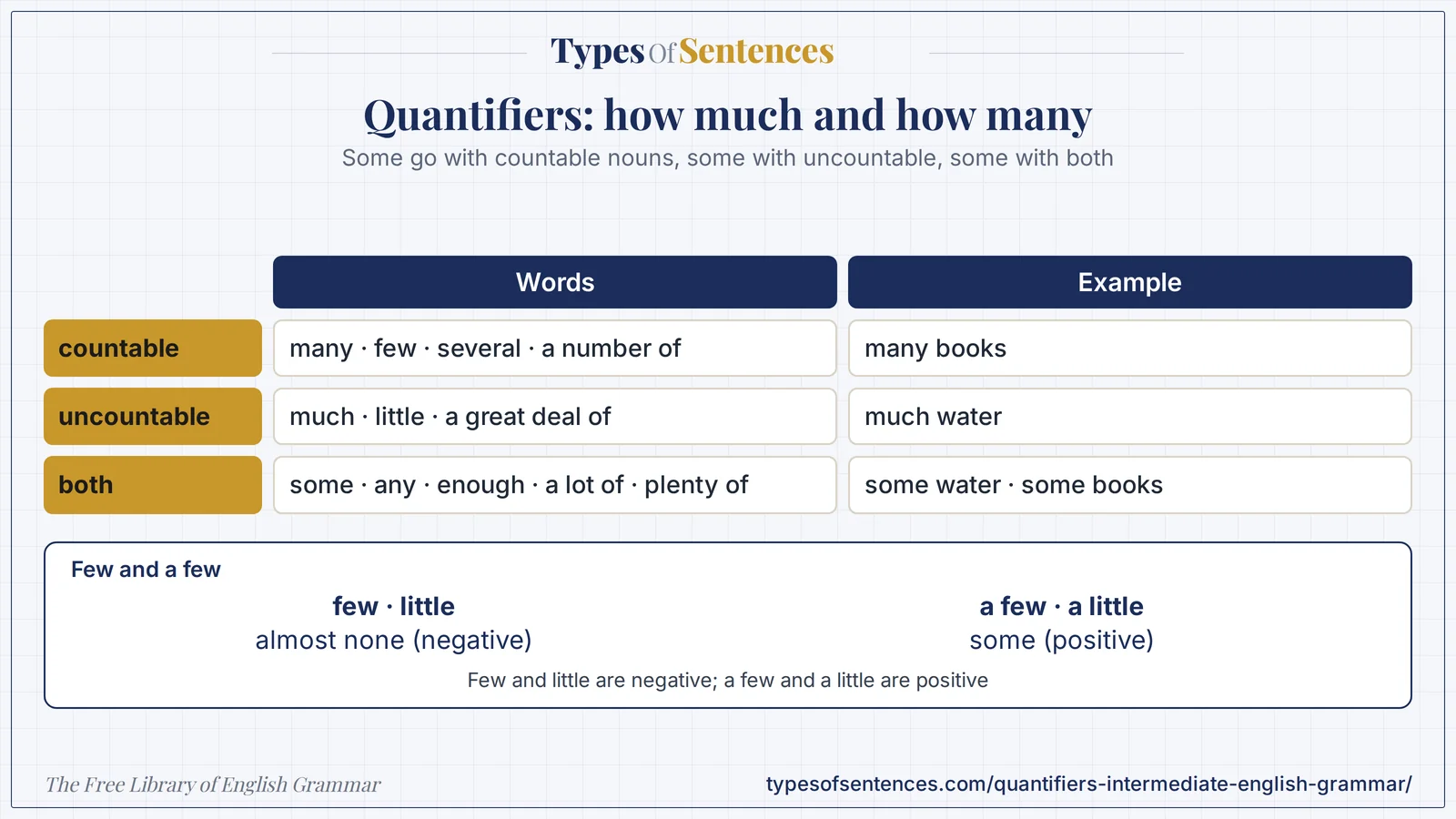
A quantifier tells the reader the size of a group or the amount of a substance, without giving an exact number. Many books, much water, some time: each word fits one kind of noun.
Why it matters: If you decide first whether the noun can be counted, the quantifier almost chooses itself. That is the single rule that solves most errors.
Summary: Use many, few, several, and a number of with countable nouns, and much, little, and a great deal of with uncountable nouns. Some, any, enough, a lot of, plenty of, most, all, and no go with both.
- Countable: many books, few ideas, several chairs.
- Uncountable: much water, little time, a great deal of money.
- Both: some, any, enough, a lot of, plenty of.
- Few and little are negative (almost none); a few and a little are positive (some).
What You’ll Learn
- 1. Quantifiers in English: What Are Quantifiers? Purpose and Position
- 2. Countable and Uncountable Quantifiers
- 3. With Countable Nouns: Many, Few, Several, a Number Of
- 4. With Uncountable Nouns: Much, Little, a Bit Of, a Great Deal Of
- 5. Few vs. A Few, Little vs. A Little
- 6. Used with Both: Some, Any, Enough, Plenty Of, and More
- 7. Agreement with Quantifier Phrases
- 8. Register and Style with Quantifiers
- 9. Common Quantifier Errors
- 10. Exercises
- 11. Test Your Knowledge
- 12. Frequently Asked Questions
- 13. Conclusion
1. Quantifiers in English: What Are Quantifiers? Purpose and Position
A quantifier tells how much or how many of something there is. It comes before the noun, in the determiner position, and it can also stand alone as a pronoun: Many students came and Many came.
| Position | Example |
|---|---|
| before a noun | Many students came. We have some time. |
| before of + determiner + noun | Most of the students came. Some of my friends called. |
| alone (pronoun use) | Few know the answer. Several left early. |
Quantifiers are one type of determiner, covered together with the other types in the chapter on determiners. They are different from numbers, which give an exact amount (three, ten). The first step in choosing one is to decide whether the noun is countable, as explained in the chapter on nouns.
2. Countable and Uncountable Quantifiers
| With countable nouns (plural) | With uncountable nouns | With both |
|---|---|---|
| many | much | some |
| few, a few, fewer | little, a little, less | any |
| several | a bit of | enough |
| a number of, a couple of | a great deal of, a good deal of | plenty of |
| a large number of | a large amount of | a lot of, lots of |
| both, several, various | — | most, all, no, none, half |
Use the table as a map. If you can say one and two before the noun (one book, two books), choose from the first column. If you cannot (one water? no), choose from the second.
Money is uncountable, so much or a lot of is needed. Friends is countable, so many fits.
3. With Countable Nouns: Many, Few, Several, a Number Of
These quantifiers go with plural countable nouns.
| Quantifier | Meaning | Example |
|---|---|---|
| many | a large number | There are many restaurants here. |
| a lot of, lots of | a large number (informal) | There are a lot of restaurants here. |
| several | more than two but not many | Several people left early. |
| a number of | several or many | A number of students were absent. |
| a couple of | about two | I bought a couple of books. |
| few | almost none (negative) | Few people know the answer. |
| a few | some (positive) | A few people know the answer. |
| fewer | a smaller number | There are fewer cars today. |
4. With Uncountable Nouns: Much, Little, a Bit Of, a Great Deal Of
These quantifiers go with uncountable nouns.
| Quantifier | Meaning | Example |
|---|---|---|
| much | a large amount | There isn’t much water. |
| a lot of, lots of | a large amount (informal) | We have a lot of time. |
| a great deal of, a good deal of | a large amount (formal) | She has a great deal of experience. |
| a large amount of | a large amount | They spent a large amount of money. |
| little | almost none (negative) | There is little hope. |
| a little, a bit of | some (positive) | Add a little sugar. I need a bit of help. |
| less | a smaller amount | Drink less coffee. |
- Much is mainly used in questions and negatives (How much money do you have? I don’t have much time). In affirmative sentences, a lot of sounds more natural: We have a lot of time, not We have much time.
- Too much, so much, and as much are used in affirmative sentences: She talks too much.
- Many follows the same pattern: Many people came is formal, but a lot of people came is more common in speech.
5. Few vs. A Few, Little vs. A Little
The article a changes the meaning. Without it, the quantifier is negative; with it, positive.
| Without a (negative) | With a (positive) |
|---|---|
| Few people came. (almost nobody; disappointing) | A few people came. (some; enough) |
| Little money is left. (almost none) | A little money is left. (some) |
| There is little time to waste. | Take a little time to think. |
Add quite or only to change the effect: quite a few means many, and only a few means not many. Fewer is the comparative of few (countable) and less is the comparative of little (uncountable): fewer mistakes, less water.
People is countable, so use fewer. Everyday speech often uses less, but careful writing keeps the distinction.
6. Used with Both: Some, Any, Enough, Plenty Of, and More
I. Some and any
| Quantifier | Use | Example |
|---|---|---|
| some | affirmative statements | I bought some apples. We need some water. |
| some | questions expecting yes, offers, requests | Would you like some tea? Can I have some water? |
| any | questions and negatives | Do you have any money? I don’t have any time. |
| any | conditionals | If you have any questions, ask. |
| any | affirmative: no matter which | Any day is fine. Take any book you like. |
No means not any: I have no time (= I don’t have any time). Do not use two negatives: I don’t have no time is non-standard. The word none is the pronoun: I have none.
II. Enough, plenty of, a lot of, most, all
| Quantifier | Meaning and pattern | Example |
|---|---|---|
| enough | as much or as many as needed; before a noun, after an adjective or adverb | We have enough chairs. It is warm enough. |
| plenty of | more than enough | There is plenty of food. |
| a lot of, lots of | a large number or amount | A lot of people came. |
| most (of) | the majority | Most students passed. Most of the students passed. |
| all (of) | everything or everyone | All the students passed. All of them passed. |
| half (of) | 50 percent | Half the cake is gone. |
| no / none | not any | No students failed. None of them failed. |
Before a determiner or pronoun, a quantifier takes of (most of the students, some of them); before a bare noun, it does not (most students, some books). The articles and pronouns that follow are in the chapters on articles and pronouns.
7. Agreement with Quantifier Phrases
| Phrase | Verb agrees with | Example |
|---|---|---|
| a lot of / plenty of / most of / all of + noun | the noun | A lot of people are here. A lot of water is needed. |
| a number of + plural noun | plural | A number of students are absent. |
| the number of + plural noun | singular | The number of students is small. |
| each, every, either, neither + noun | singular | Every student has a book. |
| none of + plural noun | singular or plural | None of them was late. (formal) None of them were late. |
| both, several, few, many + noun | plural | Both answers are correct. |
With none of and phrases such as a lot of, the verb is a matter of the noun and sometimes of style. None of the cake is left (uncountable, singular) and None of the cakes are/is left (plural; both forms are used). When the style matters, choose the form your style guide prefers and be consistent.
8. Register and Style with Quantifiers
The same quantity can be expressed in several ways, and the choice depends on the register. A lot of and lots of are common in speech and ordinary writing. In formal writing, a great deal of (uncountable) and a large number of (countable) are often preferred.
| Meaning | Informal | Neutral | Formal |
|---|---|---|---|
| a large quantity (countable) | loads of books | a lot of books | a large number of books |
| a large quantity (uncountable) | tons of money | a lot of money | a great deal of money |
| a small quantity (countable) | a couple of books | a few books | a small number of books |
| a small quantity (uncountable) | a bit of time | a little time | a small amount of time |
- Much is mainly used in negatives and questions (We don’t have much time. Is there much left?); in affirmative sentences it sounds formal, so people usually say a lot of.
- Many is common in both affirmative and negative sentences (Many people agree), and in formal writing.
- Quantifier + of + determiner: use of before the, these, my, or a pronoun (most of the students, some of them); omit of before a bare noun (most students).
- No is a determiner (no time), and none is a pronoun (none of the time).
Numbers of items can also be expressed with partitive phrases that name a unit: a piece of advice, a glass of water, an item of news, a bit of information. These phrases make uncountable nouns countable without changing the noun itself.
9. Common Quantifier Errors
| Error | Correction | Rule |
|---|---|---|
| many money | a lot of money / much money | money is uncountable |
| much people | many people | people is countable |
| a few water | a little water | countable vs uncountable |
| informations | a lot of information | information is uncountable |
| She has much friends. | She has many friends. | countable plural |
| We have much time. (affirmative, informal) | We have a lot of time. | much is mainly for questions and negatives |
| I don’t have no money. | I don’t have any money. / I have no money. | double negative |
| less people | fewer people | countable |
| a lots of | a lot of / lots of | a lot is a fixed phrase |
Fix: There are too much people here, and we have few time.
- People is countable plural: too many people.
- Time is uncountable. Few is for countables: little time.
- Result: There are too many people here, and we have little time.
Recap in 12 seconds
Watch the lesson build itself: Quantifiers for countable nouns, uncountable nouns, and both, and the difference between few and a few. The video has no sound.
Exercises
Part A: Countable or Uncountable? (Exercises 1–6)
Exercise 1: Choose: How (many/much) books do you have?
Show Answer
Answer: many.
Exercise 2: Choose: How (many/much) money do you have?
Show Answer
Answer: much.
Exercise 3: Choose: There are (a few/a little) chairs.
Show Answer
Answer: a few.
Exercise 4: Choose: There is (a few/a little) milk.
Show Answer
Answer: a little.
Exercise 5: Choose: We have (fewer/less) cars today.
Show Answer
Answer: fewer.
Exercise 6: Choose: Drink (fewer/less) coffee.
Show Answer
Answer: less.
Part B: Few and A Few (Exercises 7–11)
Exercise 7: Which is negative: few or a few?
Show Answer
Answer: Few.
Exercise 8: Which is positive: little or a little?
Show Answer
Answer: A little.
Exercise 9: Explain: Few people came. and A few people came.
Show Answer
Answer: The first means almost nobody came; the second means some came.
Exercise 10: What does quite a few mean?
Show Answer
Answer: Many.
Exercise 11: Choose: There is (little/a little) time to waste. (almost none)
Show Answer
Answer: little.
Part C: Some and Any (Exercises 12–17)
Exercise 12: Choose: I bought (some/any) apples.
Show Answer
Answer: some.
Exercise 13: Choose: I don’t have (some/any) time.
Show Answer
Answer: any.
Exercise 14: Choose: Would you like (some/any) tea?
Show Answer
Answer: some. It is an offer.
Exercise 15: Choose: Do you have (some/any) questions?
Show Answer
Answer: any.
Exercise 16: Rewrite with no: I don’t have any time.
Show Answer
Answer: I have no time.
Exercise 17: Fix it: I don’t have no time.
Show Answer
Answer: I don’t have any time. (or I have no time.)
Part D: Enough and Others (Exercises 18–23)
Exercise 18: Place enough: It is warm.
Show Answer
Answer: It is warm enough.
Exercise 19: Place enough: We have chairs.
Show Answer
Answer: We have enough chairs.
Exercise 20: Choose: (Most/Most of) students passed.
Show Answer
Answer: Most.
Exercise 21: Choose: (Most/Most of) the students passed.
Show Answer
Answer: Most of. A determiner follows.
Exercise 22: Choose: (All/All of) them passed.
Show Answer
Answer: All of. A pronoun follows.
Exercise 23: Choose: There is (plenty/plenty of) food.
Show Answer
Answer: plenty of.
Part E: Agreement (Exercises 24–27)
Exercise 24: Choose: A number of students (is/are) absent.
Show Answer
Answer: are.
Exercise 25: Choose: The number of students (is/are) small.
Show Answer
Answer: is.
Exercise 26: Choose: A lot of water (is/are) needed.
Show Answer
Answer: is.
Exercise 27: Choose: Every student (has/have) a book.
Show Answer
Answer: has.
Part F: Errors (Exercises 28–30)
Exercise 28: Fix it: She has many money.
Show Answer
Answer: She has a lot of money. (or much money in a negative or question)
Exercise 29: Fix it: We have less people than last year.
Show Answer
Answer: We have fewer people than last year.
Exercise 30: Fix it: There are too much people here, and we have few time.
Show Answer
Answer: There are too many people here, and we have little time.
Test Your Knowledge
Ready to check what you learned? Answer all 10 questions, then submit. You need 80% (8 of 10) to pass. Your answers are not stored.
View correct answers and explanations
Question 1: Which quantifier goes with a countable noun?
✓ Correct Answer: C – many
Many goes with plural countable nouns.
Question 2: Which goes with an uncountable noun?
✓ Correct Answer: B – much
Much goes with uncountable nouns.
Question 3: Which means almost none?
✓ Correct Answer: D – few
Few without a is negative: almost none.
Question 4: Which is correct?
✓ Correct Answer: A – fewer people
People is countable, so use fewer.
Question 5: Which is correct?
✓ Correct Answer: C – I don’t have any time.
Use any in negatives; avoid double negatives.
Question 6: Which fits an offer?
✓ Correct Answer: B – Would you like some tea?
Some is used in offers and requests.
Question 7: Where does enough go with an adjective?
✓ Correct Answer: D – warm enough
Enough follows an adjective.
Question 8: Which is correct?
✓ Correct Answer: C – The number of students is small.
The number of takes a singular verb.
Question 9: Which is correct?
✓ Correct Answer: B – a lot of
A lot of is the fixed phrase.
Question 10: Which is correct for a countable noun in an affirmative sentence?
✓ Correct Answer: A – We have many friends.
Many goes with plural countable nouns.
Frequently Asked Questions
What are quantifiers in English?
Quantifiers in English are words and phrases that say how much or how many, such as many, much, few, little, some, any, enough, and a lot of. They are a kind of determiner.
What are the quantifiers grammar rules?
The quantifiers grammar rules start with the noun type: many, few, and several go with countable nouns; much and little go with uncountable nouns; some, any, enough, and a lot of go with both.
What is the difference between much, many, few, little?
Many and few go with countable nouns; much and little go with uncountable nouns. Few and little mean almost none, while a few and a little mean some.
What are countable and uncountable quantifiers?
Countable quantifiers (many, few, several, a number of) go with plural nouns, and uncountable quantifiers (much, little, a great deal of) go with nouns such as water and advice.
When do I use some, any?
Use some in affirmative statements and in offers and requests (Would you like some tea?). Use any in questions, negatives, and conditionals (I don’t have any time).
Is it fewer or less?
Use fewer with countable nouns (fewer people) and less with uncountable nouns (less water). Everyday speech often uses less with countable nouns, but careful writing keeps the difference.
Why not say much people?
People is a countable plural, so it takes many. Much is only for uncountable nouns, as in much money.
Conclusion
You now know the quantifiers in English: which go with countable nouns, which with uncountable nouns, and which with both. You can tell few from a few, use some and any, agree the verb with quantifier phrases, and avoid the common errors.
Decide whether the noun is countable before you choose a quantifier, and the choice will follow. Next, you begin the study of clauses.
- Merriam-Webster Dictionary: quantifier: the dictionary definition of a quantifier.
- Purdue Online Writing Lab: Grammar: reference section on nouns and quantity words.
- Quirk, Randolph, et al. A Comprehensive Grammar of the English Language. Longman, 1985.: quantifiers and the count/mass distinction.
- Huddleston, Rodney, and Geoffrey K. Pullum. The Cambridge Grammar of the English Language. Cambridge University Press, 2002.: quantification and determiners.
Last reviewed: October 29, 2026. How it was made: drafted with AI assistance, then checked with automated tests (structure, links, answer keys, spelling) and against the sources above. A person has not yet read this chapter line by line. Found a mistake? Report it.