What is the forward slash? The forward slash (/) is a punctuation mark and keyboard symbol that leans to the right, from bottom left to top right. In everyday speech it is usually just called the slash. You meet the forward slash in web addresses (example.com/grammar), in dates (4/3/2024), in fractions (1/2), in abbreviations (n/a, c/o), and in the pair and/or. It is on almost every keyboard, and it is easy to confuse with its mirror image, the backslash (\).
This page explains the forward slash symbol from the ground up: its names, where it came from, how it is used in writing and in computing, how it differs from the backslash (the question behind the common search slash vs backslash), how to find the forward slash on keyboard layouts of every kind, and the rules of style for spacing and for and/or. It ends with 30 exercises and a 10-question quiz.
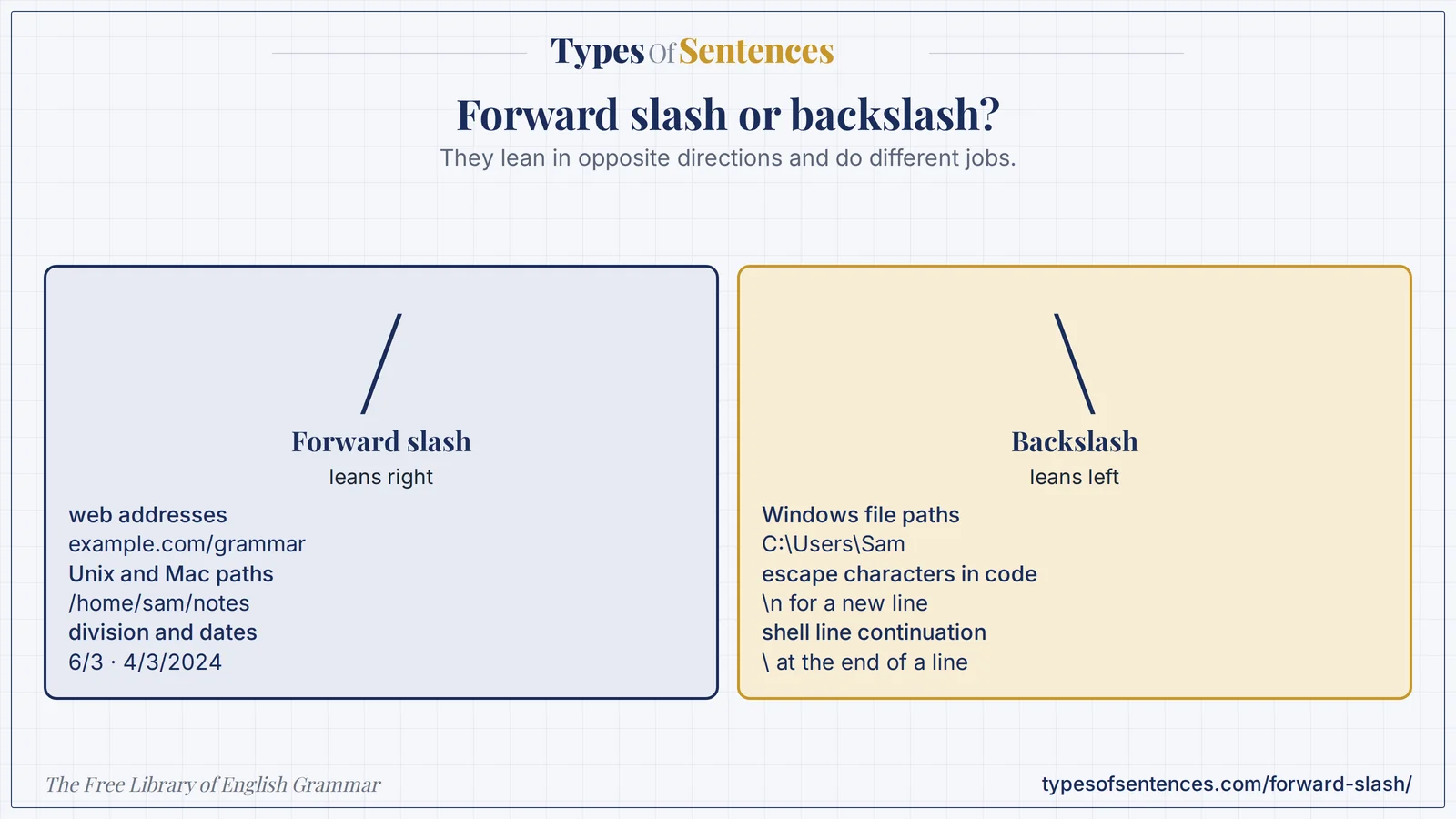
The forward slash is the / mark. It leans forward, to the right. The backslash is the \ mark, which leans back. Web addresses use the forward slash; Windows file paths use the backslash.
Why it matters: Most people never need to think about the slash until they have to type a web address, read a file path, or write a date. Knowing which slash is which saves a lot of confusion.
Summary: The forward slash (/), also called the slash, solidus, virgule, or oblique, is ASCII character 47 (Unicode U+002F). It separates parts of web addresses and Unix-style file paths, marks alternatives (and/or, he/she), appears in dates, fractions, and abbreviations, and divides in programming. It is typed with the key next to the right Shift key on a US keyboard. The backslash (\) is a different character used in Windows paths and as an escape character.
- Names: forward slash, slash, solidus, virgule, oblique (British: stroke).
- Web addresses and Unix-style paths use /; Windows paths use \.
- In prose, use it without spaces (n/a); avoid and/or in formal writing.
- US keyboard: the key beside the right Shift key; Alt code: Alt + 47.
What You’ll Learn
- 1. What Is the Forward Slash? Names and Appearance
- 2. History and Origin of the Slash
- 3. Uses of the Forward Slash in Writing
- 4. Uses in Computing, Web Addresses, and Mathematics
- 5. How to Type the Forward Slash on a Keyboard
- 6. Style Rules: Spacing, Formality, and What to Write Instead
- 7. Common Mistakes with the Forward Slash
- 8. Exercises
- 9. Test Your Knowledge
- 10. Frequently Asked Questions
- 11. Conclusion
1. What Is the Forward Slash? Names and Appearance
| Property | Forward slash |
|---|---|
| symbol | / |
| common names | forward slash, slash |
| formal and historical names | solidus, virgule, oblique, stroke (British), slant |
| Unicode name and code | SOLIDUS, U+002F |
| ASCII code | 47 (hexadecimal 2F) |
| HTML entity | / or / |
| direction | leans right: bottom left to top right |
| opposite | the backslash (\), also called the reverse solidus (U+005C) |
| read aloud as | slash (in web addresses, forward slash is also said) |
| keyboard | on the same key as the question mark on a US keyboard |
The word solidus and the word virgule are the names that typographers and dictionaries use, and oblique is the usual British term in typography. In ordinary use, slash is enough. Forward slash became common in computing because it had to be told apart from the backslash, which also has a common name, back slash. If you are looking at a web address, you are looking at forward slashes.
| Easily confused with | What it is | How to tell them apart |
|---|---|---|
| backslash (\) | the mirror image, used in Windows file paths and as an escape character | it leans the other way |
| vertical bar or pipe (|) | a straight vertical line | it is upright |
| fraction slash (⁄, U+2044) | a typographic slash used to build fractions such as 3⁄4 | it is lower and more sloped, and is rarely typed |
| division slash (∕, U+2215) | a mathematical division symbol | it looks like the slash but is a different character |
| capital I and lowercase l | letters that can look like a vertical stroke | they are upright and have no lean |
2. History and Origin of the Slash
The slash has been used for centuries. In medieval manuscripts, scribes used a slanting stroke as a comma, a mark that told the reader where to pause, and the name virgule comes from the Latin virgula, meaning a little rod or twig. The name solidus comes from the Roman gold coin, because the same stroke was used as the sign for shillings in the old British money system, in which a price of twelve shillings and six pence could be written 12/6. In 1960s computing, the slash was included in the ASCII character set as code 47, and it took on the roles that it has in computing today.
| Period | Use of the slash |
|---|---|
| Middle Ages | a mark of pause (like a comma) in manuscripts; the virgule |
| early modern English | the sign for shillings (12/6); abbreviations of the form c/o (care of) |
| nineteenth century | fractions written on one line, such as 3/4, in printing and handwriting |
| twentieth century | included in ASCII (1963 and later); used in Unix as the separator of file paths (1970s) |
| 1990s | chosen for web addresses (URLs) by the creators of the World Wide Web |
| today | used in dates, fractions, abbreviations, paths, URLs, programming, and as a mark of alternatives |
Some of these details, such as the exact origin of the slash in Unix and the web, are well documented in the history of computing; the early history of the stroke in manuscripts is more varied, and sources differ on details.
3. Uses of the Forward Slash in Writing
| Use | Example | Notes |
|---|---|---|
| alternatives | and/or; yes/no; pass/fail | means or; no spaces |
| and/or | Bring a pen and/or a pencil. | avoid in formal writing; Chicago and many legal drafters advise writing A, B, or both |
| gendered pronouns | he/she, s/he | often avoided today; see the chapter on gender-inclusive language |
| per (rates) | km/h, mg/dL, $5/hour | means per |
| fractions | 1/2, 3/4 | spell out in running text: one-half |
| dates | 4/3/2024 | ambiguous across countries; write 4 March 2024 or 2024-03-04 |
| fiscal and academic years | 2024/25 | Chicago prefers an en dash (2024–25) for ranges of years |
| abbreviations | n/a, c/o, w/ (with), w/o (without), b/w (between), a/c (air conditioning, account) | informal; avoid in formal prose |
| two linked terms | the teacher/student relationship, the Pune/Mumbai route | an en dash is often better for a relationship between the two (see the chapter on advanced punctuation) |
| lines of verse in running text | Shall I compare thee to a summer’s day? / Thou art more lovely and more temperate | Chicago and MLA put a space before and after the slash to mark a line break |
| ratios | 1/3 cup | spell out where possible |
| time and place | 9/11 as a short name for an event | a name, not a date |
| proofreading | / to mark an insertion or deletion in the margin | a proofreader’s mark |
Style guides differ in details, but they agree on one point: in formal prose, a slash can be ambiguous, because it does not say whether it means and, or, or both. The teacher/student relationship is clear because the two are linked; the student/teacher should submit the form is not. In those cases, write the words. The marks that do the same job with more precision are covered in the chapters on advanced punctuation and on typography and grammar.
4. Uses in Computing, Web Addresses, and Mathematics
| Context | Use | Example |
|---|---|---|
| web addresses (URLs) | separates the parts of the address; // follows the protocol |
https://www.example.com/grammar/nouns |
| Unix, Linux, and macOS file paths | separates folders; the root is / | /home/user/documents/report.txt |
| Windows file paths | Windows uses the backslash, but many programs and the web accept the forward slash | C:\Users\Sam versus C:/Users/Sam |
| commands | options in some systems | dir /w (Windows command prompt) |
| division in programming and spreadsheets | / divides |
=A1/B1 |
| comments in code | // starts a line comment in C, Java, and JavaScript; /* … */ marks a block comment |
// this is a comment |
| regular expressions | delimiters of a pattern in some languages | /ab+c/ |
| XML and HTML | closing tags and self-closing tags | </p> |
| email and web forms | used in dates and in paths | — |
| mathematics | fractions and division; the division slash | 3/4 |
| units | per | m/s (meters per second) |
| version control and package names | separate parts of a name | owner/repository |
| social media and chat | a separator or a tone marker | /s to mark sarcasm (see the chapter on social media) |
| Forward slash | Backslash |
|---|---|
| leans right (/) | leans left (\) |
| URLs and web paths | Windows paths and escape sequences |
| Unix, Linux, macOS paths | Windows paths |
| division | escape character in many programming languages (\n for a new line) |
| next to the right Shift key on a US keyboard | above the Enter key on a US keyboard |
| ASCII 47 | ASCII 92 |
| Unicode SOLIDUS (U+002F) | Unicode REVERSE SOLIDUS (U+005C) |
When you type a web address, use forward slashes. If a link fails because you typed backslashes, replace them with forward slashes. The full story of the other slash, including why it is on the same key as the pipe on many keyboards, is on the backslash page, and the grammar of web addresses and technology terms is treated in the chapter on grammar and technology.
5. How to Type the Forward Slash on a Keyboard
| Device or system | How to type / (the forward slash) |
|---|---|
| Windows, US keyboard | press the key to the left of the right Shift key (the / ? key) |
| Mac, US keyboard | the same key (/ ?), to the left of the right Shift key |
| numeric keypad | the / key at the top of the keypad (division) |
| Windows Alt code | hold Alt and type 47 on the numeric keypad (with Num Lock on) |
| iPhone and iPad | tap 123 to switch to numbers and symbols, then tap / |
| Android | tap ?123 and then / (it is on the symbol row) |
| US International and many European layouts | the key may be in a different place; on a German keyboard, press Shift + 7; check the printed key caps on others |
| UK keyboard | the key beside the right Shift key (as on the US keyboard) |
| Indian English keyboards | follow the US or UK layout; on Hindi (Devanagari) or InScript layouts, switch to the English layout to type / |
| web pages (HTML) | write / or / to show a slash |
| Word or Google Docs | type the key; no special setting is needed |
| screen readers | read the slash aloud as slash (or forward slash) |
| If you cannot find the key | What to try |
|---|---|
| the key is not where you expect | check the layout: your keyboard may be set to another language |
| pressing the key gives another character | switch the input language (on Windows: Windows + Space; on Mac: Control + Space or the menu bar) |
| the key is broken | use the Alt code (Windows), copy and paste the character, or use the on-screen keyboard |
| you need the slash on a tablet with a Bluetooth keyboard | use the key beside the right Shift key, or the on-screen symbol page |
| you are typing a path and the slash will not appear | check whether you need the backslash instead (see the backslash page) |
| you want to copy it | select this character: / |
6. Style Rules: Spacing, Formality, and What to Write Instead
| Question | Guidance |
|---|---|
| Spaces around the slash? | no spaces in and/or, dates, fractions, rates, and abbreviations; a space on each side when the slash separates lines of poetry or longer phrases |
| Is and/or acceptable? | common in speech and business writing; avoided in formal and legal writing because it is ambiguous; write A, B, or both |
| he/she? | many guides now prefer they or a rewrite; see the chapter on gender-inclusive language |
| Dates with slashes? | acceptable in informal use and forms; ambiguous between countries; for international readers write 4 March 2024 |
| Fractions? | spell out in running text (one-half); use figures with a slash in recipes and tables (1/2 cup) |
| Abbreviations like w/? | fine in notes; spell out in formal writing |
| Slash or hyphen or dash? | use a hyphen for compound words, an en dash for ranges and connections, and a slash for alternatives |
| Slash in headings? | acceptable for alternatives (Pass/Fail); avoid overuse |
| Slash in numbers? | a slash in a fraction is not the same as a division sign in typesetting; for printing, a true fraction can be set |
| Slash and web addresses at the end of a sentence? | avoid ending a sentence with a long URL; the period after a URL can be mistaken for part of it |
A good test is to read the sentence aloud. If you would say or, write or; if you would say and, write and; if you would say per, a slash is fine. If you would not know what to say, the slash is hiding an ambiguity. The rules for dates and numbers are in the chapter on numbers in writing.
7. Common Mistakes with the Forward Slash
| Mistake | Example | Better |
|---|---|---|
| using a backslash in a web address | *https:\\example.com\page | https://example.com/page |
| spaces around the slash in and/or | *and / or | and/or |
| using and/or in a formal contract | *the buyer and/or the seller | the buyer, the seller, or both |
| an ambiguous date | *3/4/2024 (March 4 or April 3?) | 3 April 2024 |
| a slash for a range | *pages 10/20 | pages 10–20 |
| a slash for a fraction in running text | *1/2 of the class | half of the class |
| a slash for a relationship where an en dash is better | *the Delhi/Mumbai flight | the Delhi–Mumbai flight |
| mixing slash and backslash in one path | *C:/Users\Sam | pick one style |
| a slash at the end of a sentence | *We offer tea/coffee. | We offer tea or coffee. |
| the wrong key on a non-US keyboard | — | check the layout |
Fix: Please send your name / address and/or phone number to the office\\team by 4/3/24.
- name / address: spaces around a slash that joins single words; better to list the items: your name, address, and phone number.
- and/or: ambiguous in an instruction; if one item is enough, say or; if all are needed, and.
- office\\team: backslashes where a slash (or a word) is intended; use the office team.
- 4/3/24: an ambiguous date: 4 March 2024 (or the date you mean).
- Result: Please send your name, address, and phone number to the office team by 4 March 2024. (the instruction is invented)
Recap in 12 seconds
Watch the lesson build itself: The forward slash and the backslash, with their main uses. The video has no sound.
Exercises
Part A: Names and Appearance (Exercises 1–6)
Exercise 1: Which way does the forward slash lean?
Show Answer
Answer: To the right, from bottom left to top right.
Exercise 2: Name three other names for the forward slash.
Show Answer
Answer: Slash, solidus, virgule, oblique (stroke in British use).
Exercise 3: What is the Unicode code of the forward slash?
Show Answer
Answer: U+002F (SOLIDUS).
Exercise 4: What is the ASCII code of the forward slash?
Show Answer
Answer: 47.
Exercise 5: Which symbol is the mirror image of the forward slash?
Show Answer
Answer: The backslash (\).
Exercise 6: Is the symbol | a slash?
Show Answer
Answer: No; it is the vertical bar or pipe.
Part B: Uses in Writing (Exercises 7–14)
Exercise 7: What does the slash mean in km/h?
Show Answer
Answer: Per (kilometers per hour).
Exercise 8: What does n/a stand for?
Show Answer
Answer: Not applicable (or not available).
Exercise 9: What does c/o mean in an address?
Show Answer
Answer: Care of.
Exercise 10: Should you put spaces in and/or?
Show Answer
Answer: No.
Exercise 11: Why avoid and/or in formal writing?
Show Answer
Answer: It is ambiguous; write A, B, or both.
Exercise 12: How do you mark a line break in poetry quoted in running text?
Show Answer
Answer: With a slash, with a space on each side.
Exercise 13: Rewrite for clarity: 3/4/2024.
Show Answer
Answer: 3 April 2024 or 4 March 2024, whichever is meant.
Exercise 14: Write 1/2 in words.
Show Answer
Answer: One-half (or half).
Part C: Computing (Exercises 15–20)
Exercise 15: Which slash is used in web addresses?
Show Answer
Answer: The forward slash.
Exercise 16: Which slash is used in Windows file paths?
Show Answer
Answer: The backslash.
Exercise 17: What do two slashes (//) do at the start of a line in JavaScript?
Show Answer
Answer: They start a comment.
Exercise 18: What does =A1/B1 do in a spreadsheet?
Show Answer
Answer: Divides the value of A1 by the value of B1.
Exercise 19: What does /s mean in some online writing?
Show Answer
Answer: Sarcasm.
Exercise 20: What follows https: in a web address?
Show Answer
Answer: Two forward slashes (//).
Part D: Typing (Exercises 21–26)
Exercise 21: Where is the forward slash on a US keyboard?
Show Answer
Answer: On the key to the left of the right Shift key (the / ? key).
Exercise 22: What is the Windows Alt code for the slash?
Show Answer
Answer: Alt + 47 on the numeric keypad.
Exercise 23: How do you type the slash on an iPhone?
Show Answer
Answer: Switch to the numbers and symbols keyboard (123) and tap /.
Exercise 24: What HTML entity shows a slash?
Show Answer
Answer: / (or /).
Exercise 25: Why might the slash key give a different character?
Show Answer
Answer: The keyboard layout or input language is set to another language.
Exercise 26: What if the key is broken?
Show Answer
Answer: Use the Alt code, copy and paste, or the on-screen keyboard.
Part E: Style and Correction (Exercises 27–30)
Exercise 27: Correct: *https:\\example.com
Show Answer
Answer: https://example.com
Exercise 28: Correct: *the Delhi/Mumbai flight (a connection)
Show Answer
Answer: the Delhi–Mumbai flight (an en dash).
Exercise 29: Correct: *pages 10/20
Show Answer
Answer: pages 10–20.
Exercise 30: Correct: *We offer tea/coffee. (formal)
Show Answer
Answer: We offer tea or coffee.
Test Your Knowledge
Ready to check what you learned? Answer all 10 questions, then submit. You need 80% (8 of 10) to pass. Your answers are not stored.
View correct answers and explanations
Question 1: Which way does the forward slash lean?
✓ Correct Answer: A – to the right (/)
Forward = to the right.
Question 2: Which slash do web addresses use?
✓ Correct Answer: B – the forward slash
URLs use the forward slash.
Question 3: What does km/h mean?
✓ Correct Answer: C – kilometers per hour
The slash means per.
Question 4: What is the ASCII code of the forward slash?
✓ Correct Answer: D – 47
47.
Question 5: Where is the slash on a US keyboard?
✓ Correct Answer: C – beside the right Shift key
The / ? key.
Question 6: Which is better in a formal contract?
✓ Correct Answer: A – the buyer, the seller, or both
Write A, B, or both.
Question 7: The symbol / in // at the start of a JavaScript line starts
✓ Correct Answer: D – a comment
A line comment.
Question 8: Which date format is least ambiguous?
✓ Correct Answer: C – 3 April 2024
Write the month in words.
Question 9: Which Windows Alt code types the slash?
✓ Correct Answer: B – Alt + 47
Alt + 47.
Question 10: How is a line break in poetry marked in running text?
✓ Correct Answer: D – / with a space on each side
A spaced slash.
Frequently Asked Questions
What is the forward slash?
The forward slash (/) is a punctuation mark and keyboard symbol that leans to the right. It is used in web addresses, dates, fractions, abbreviations, and as a mark of alternatives, and it is also called the slash or the solidus.
What is the forward slash symbol used for?
The forward slash symbol separates the parts of web addresses and Unix-style file paths, divides in programming, means per in rates (km/h), joins alternatives (yes/no), and appears in dates and fractions.
Where is the forward slash on keyboard layouts?
On a US or UK keyboard, it is the key to the left of the right Shift key (shared with the question mark). On other layouts, it may be on a number key with Shift, as on a German keyboard (Shift + 7).
What is the slash symbol called in British English?
The forward slash is often called the oblique or the stroke in British typography and speech.
What is the difference in slash vs backslash?
The forward slash leans right and is used in web addresses and Unix-style paths. The backslash leans left and is used in Windows paths and as an escape character in programming.
Should I use and/or in writing?
It is common in informal writing but avoided in formal and legal writing because it is ambiguous. Write the alternatives in words, such as A, B, or both.
Should I put spaces around a slash?
Usually not. Use no spaces in and/or, dates, fractions, and rates. Put a space on each side when the slash separates lines of verse or longer phrases.
Conclusion
You now know what the forward slash is, where it came from, how it is used in writing and in computing, how to type it on different keyboards, and how to avoid the common mistakes with it, including the difference between the slash and the backslash.
When you write, ask whether a slash says exactly what you mean; when you type, check which slash the system expects. Next in the series is the pipe symbol.
- The Unicode Consortium. The Unicode Standard. Basic Latin block (U+0000 to U+007F).: the character names and code points.
- The Chicago Manual of Style. University of Chicago Press. (check the current edition): the slash, and/or, and line breaks in poetry.
- Bringhurst, Robert. The Elements of Typographic Style. 4th ed. Hartley and Marks, 2012.: the typography of the solidus and the virgule.
- Berners-Lee, Tim, Roy Fielding, and Larry Masinter. RFC 3986: Uniform Resource Identifier (URI): Generic Syntax. 2005.: the use of the slash in web addresses.
- Merriam-Webster Dictionary: solidus: the dictionary entry.
Last reviewed: October 29, 2026. How it was made: drafted with AI assistance, then checked with automated tests (structure, links, answer keys, spelling) and against the sources above. A person has not yet read this chapter line by line. Found a mistake? Report it.