Abbreviations and acronyms are shortened forms that save space and time: Dr. for Doctor, FBI for Federal Bureau of Investigation, NASA for National Aeronautics and Space Administration, can’t for cannot. Used well, they make writing compact and familiar to its readers; used badly, they make it cryptic. A paragraph full of unexplained initials excludes everyone who is not already in the group, and the same string of letters can mean different things in different fields: PM may be a prime minister, an afternoon, a project manager, or a private message.
This chapter covers the proper use of abbreviations. You will study the types of shortened forms (contractions, initialisms, acronyms, and truncations), the rules for punctuation with abbreviations and the differences among styles, plural abbreviations (PhDs, MBAs), apostrophes and possessives, the choice of a or an before an abbreviation (an MBA, a UFO), formal and informal use, and the common Latin abbreviations (e.g., i.e., etc.). The aim is correct and considerate use: the rules for using abbreviations, the grammar of abbreviations, and the judgment to know when shortened forms help the reader and when they do not. Thirty exercises and a quiz follow.
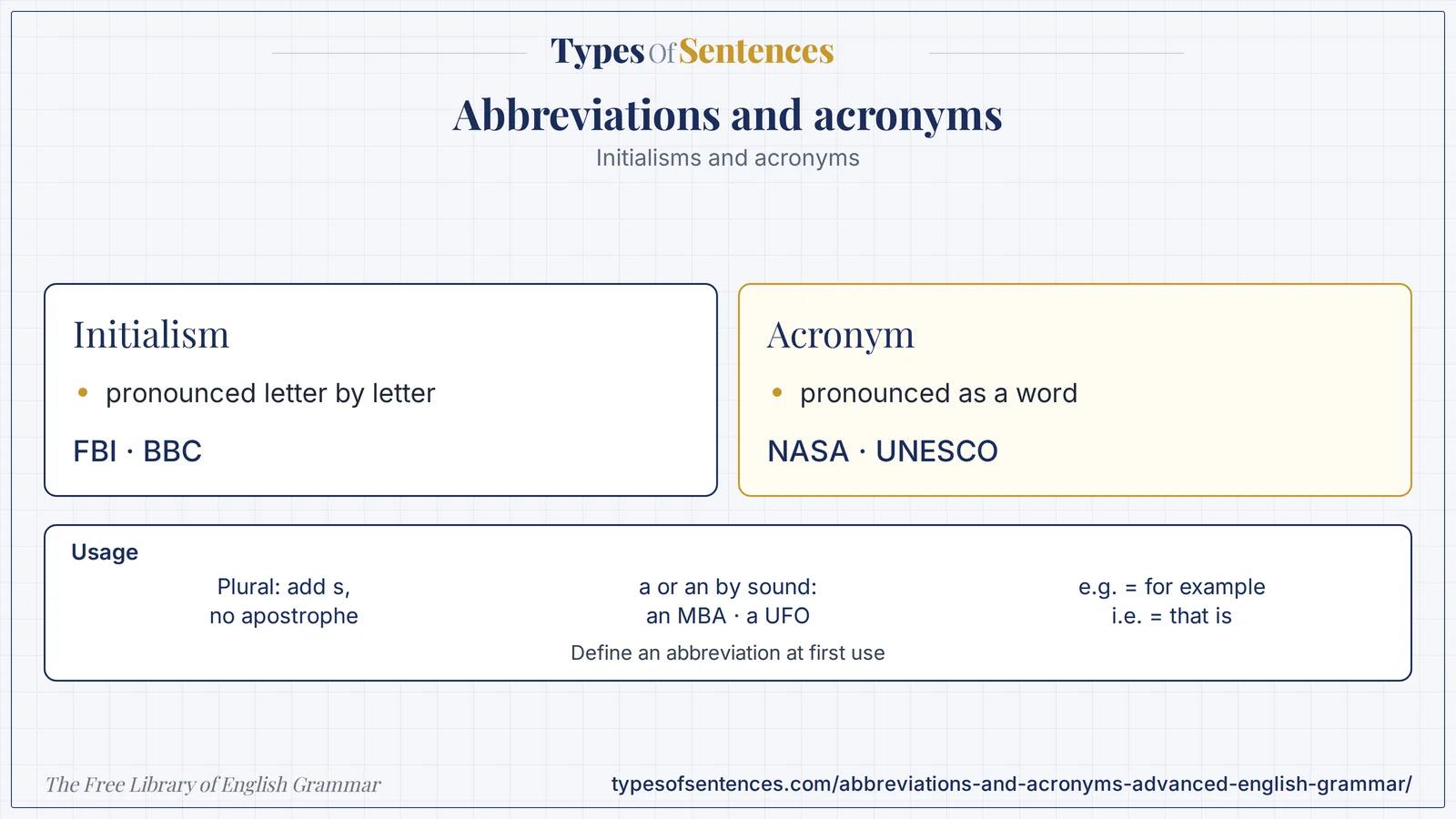
An abbreviation is a shorter way of writing a word or phrase. An acronym is one that you can say as a word (NASA), and an initialism is one you say letter by letter (FBI). Most readers need to be told what an abbreviation means the first time it appears.
Why it matters: Plurals take an s without an apostrophe (PhDs), the choice of a or an depends on how you say the first letter (an MBA, a UFO), and Latin abbreviations such as e.g. (for example) and i.e. (that is) mean different things.
Summary: Shortened forms include contractions (can’t), truncations or clippings (info, Prof.), initialisms pronounced letter by letter (FBI, BBC), and acronyms pronounced as words (NASA, UNESCO), some of which have become ordinary words (laser, radar). Periods are used in many abbreviations in American style (Dr., a.m., U.S.) and omitted in British style after contractions (Dr, Mr) and in most initialisms and acronyms. Plurals add s without an apostrophe (PhDs, CDs, 1990s); possessives add ’s (the CEO’s office). The article depends on the pronunciation of the first letter (an MBA, an FBI agent, a UFO, a URL). Define abbreviations at first use for a general readership, avoid unexplained abbreviations and texting forms in formal writing, and use Latin abbreviations correctly: e.g. means for example, i.e. means that is, etc. means and so on, et al. means and others.
- Initialism: letter by letter; acronym: as a word.
- Plural: add s, no apostrophe.
- a/an by sound: an MBA, a UFO.
- e.g. = for example; i.e. = that is; define at first use.
What You’ll Learn
- 1. Abbreviations and Acronyms: Types of Shortened Forms
- 2. Punctuation with Abbreviations: Periods and Variations
- 3. Plural Abbreviations: PhDs, MBAs, and Other Forms
- 4. Apostrophes with Abbreviations: Possessives and Contractions
- 5. Articles with Abbreviations: A or An, and The
- 6. Formal vs Informal: When Abbreviations Are Appropriate
- 7. Common Latin Abbreviations: e.g., i.e., etc., and Others
- 8. Common Errors and a Worked Example
- 9. Exercises
- 10. Test Your Knowledge
- 11. Frequently Asked Questions
- 12. Conclusion
1. Abbreviations and Acronyms: Types of Shortened Forms
| Type | Definition | Examples | Note |
|---|---|---|---|
| contraction (with an apostrophe) | two words or a word and a part joined, with an apostrophe for the missing letters | can’t, don’t, it’s, I’m, we’ll, o’clock, ma’am | in American usage, a contraction is a word shortened with an apostrophe; see the note on British usage below |
| abbreviation (truncation) | the end of a word is cut off | Prof., approx., Jan., Mon., St., Ave., etc., p., vol. | usually takes a period in American style |
| contraction in the British sense | an abbreviation that keeps the first and last letters | Dr, Mr, St, Mrs, Ltd | British style omits the period |
| initialism | the initial letters of a phrase, said letter by letter | FBI, BBC, CBI, UN, USA, PhD, ATM, DVD, UPSC, CBSE, GST, IIT, IIM, SLA, KPI | also called alphabetism |
| acronym | initial letters (or parts) pronounced as a word | NASA, NATO, UNESCO, ISRO, DRDO, OPEC, AIDS, FAQ (as “fak”) | pronounced as a word |
| acronym that became a common word | written in lowercase | laser, radar, scuba, sonar, snafu, awol, yuppie | few people know they were acronyms |
| syllabic abbreviation | syllables of the phrase combined | Interpol, Benelux, Pakistan (according to a popular account) | some etymologies are debated |
| clipping | a shortened everyday word | phone, exam, info, gym, flu, ad, fridge, lab, math, maths | not an abbreviation in the strict sense |
| blend (portmanteau) | parts of two words joined | brunch, smog, motel, Brexit | see the chapter on language change |
| letter-number combinations | letters with numerals | B2B, Y2K, 4G, MP3, i18n | — |
| symbols | characters standing for words | %, &, @, #, ₹ | not abbreviations |
| abbreviations of units | symbols that never take periods or plurals | kg, km, cm, ml, Hz, kW, GB | follow the SI system |
| abbreviations of titles | before names | Mr., Mrs., Ms., Dr., Prof., Rev., Hon., Sri, Smt. | periods in American style |
| abbreviations of days and months | calendar shorthand | Mon., Tue., Jan., Feb. | spelled out in formal prose |
| postal and state abbreviations | codes for states | CA, NY, TX (US postal); KA, MH (Indian vehicle and state codes) | codes without periods |
| abbreviations of Latin phrases | — | e.g., i.e., etc., et al., cf., viz., a.m., p.m. | see the last section |
| initialisms in business and IT (examples of fields) | — | CEO, CFO, HR, KPI, SLA, RCA, NOC, API, URL, HTML, FAQ, ROI | define on first use for a general audience |
| abbreviations in Indian use | — | IAS, IPS, IFS, RBI, SEBI, UPI, PAN, EPF, GST, RTI, CBSE, ICSE | explain for international readers |
| Initialism or acronym? (the debated line) | Explanation |
|---|---|
| pronounced letter by letter | initialism (FBI, BBC, IIT) |
| pronounced as a word | acronym (NASA, NATO, ISRO) |
| both pronunciations | FAQ (letters or “fak”); SQL (letters or “sequel”); URL (letters or “earl”) |
| some letters spoken as letters and the rest as a word | JPEG (“jay-peg”), CD-ROM, IUPAC |
| dictionary practice | many dictionaries use acronym for both kinds; the stricter distinction is common in style guides |
| backronym | a phrase invented to fit an existing word or acronym |
| recursive or humorous forms | — |
The terms are used differently by different authorities. In this chapter an initialism is said letter by letter and an acronym is said as a word, which is the distinction that most style guides make; a dictionary may use acronym for both. For word-formation processes in general, see the chapter on language change in modern English.
2. Punctuation with Abbreviations: Periods and Variations
| Case | American style | British style | Note |
|---|---|---|---|
| titles before names | Mr., Mrs., Ms., Dr., Prof. | Mr, Mrs, Ms, Dr, Prof | British omits the period after contractions (keeping the last letter) |
| truncations | Prof., approx., Jan., etc., Inc. | Prof., approx., Jan., etc. (period when cut) | a period when the end is cut off |
| initialisms | FBI, UN, BBC, PhD | same | no periods in modern usage |
| initialisms with periods | U.S., U.K., U.N. (older, AP uses U.S.) | — | AP and some others retain periods for U.S. and U.K.; Chicago prefers US and UK |
| acronyms | NASA, NATO | same | never periods |
| degrees | PhD, MA, BSc (Chicago) or Ph.D., M.A. | PhD, MA, BSc | follow your style guide |
| times | a.m., p.m. (or AM, PM, or small caps) | am, pm or a.m., p.m. | lowercase with or without periods |
| units | kg, km, cm, ml (no periods) | same | except in. for inch |
| postal state codes | CA, NY, TX | — | no periods |
| abbreviation at the end of a sentence | one period only: We arrived at 5 p.m. | same | the abbreviation’s period also ends the sentence |
| abbreviation followed by a question mark | Did you arrive at 5 p.m.? | same | both marks appear |
| abbreviation followed by a comma | He lives in Washington, D.C., now. | — | a comma follows if the sentence requires it |
| spaces in an abbreviation | a.m. no space; U.S. no space; Ph.D. no space | same | no spaces within |
| spaces before units | 25 kg (a space) | same | a non-breaking space |
| dates and eras | AD 2024, 500 BC; or CE and BCE | — | AD before the year; BC after |
| personal initials | J. K. Rowling or J.K. Rowling | same | style-dependent spacing |
| company suffixes | Inc., Ltd., Co., Corp. | Ltd, Co. | British omits periods after contractions |
| street and direction abbreviations | St., Ave., Blvd.; N., S. | St, Ave | only in addresses and tables |
| all capitals and small caps | small caps for a.m. and AD (typographic) | — | typographic convention |
| abbreviations in headlines | — | — | see the chapter on title capitalization |
The main variation is between American and British practice, described in the chapter on British vs American English; news style (AP) has its own rules, described in the chapter on journalistic writing.
- Follow one style guide for periods in abbreviations; the main variation is American versus British.
- Do not use periods in acronyms and most initialisms.
- Do not double the period at the end of a sentence.
- Use no spaces inside an abbreviation (p.m., not p. m.).
- Do not pluralize units (5 kg, not 5 kgs).
- Be consistent within a document: PhD or Ph.D., not both.
3. Plural Abbreviations: PhDs, MBAs, and Other Forms
| Type | Rule | Example |
|---|---|---|
| initialisms and acronyms | add a lowercase s with no apostrophe | PhDs, MBAs, CEOs, DVDs, FAQs, NGOs, SMEs |
| abbreviations with periods | add s after the last period | Ph.D.s, M.A.s |
| numbers and dates | add s with no apostrophe | the 1990s, in her 30s |
| single letters (to avoid confusion) | an apostrophe is used with lowercase letters and some capitals | mind your p’s and q’s; straight A’s |
| truncations that take a period | add s before or after the period according to the form | eds. (editors), vols., pp. (pages), nos. |
| units | the abbreviation does not change | 5 kg, 10 km, 3 ml |
| titles with plural | a doubled letter or s | Drs. Rao and Shah; Messrs. Rao and Shah; Mmes |
| et al. | already plural | — |
| acronym plural in running text | add s | three NGOs; two SLAs |
| abbreviations of plural phrases | may be the same in singular and plural | the NCERT, the IITs |
| institutional abbreviations | the plural refers to the institutions | the IITs, the IIMs, the NITs |
| symbols | no plural | 10 % |
| with an apostrophe (old style) | not recommended: CD’s, PhD’s | use CDs, PhDs |
| abbreviation as a verb | add an ending as needed | to DM someone (DMed, DMing); to FAQ (rare) |
| hyphenated compounds | the plural goes on the main noun when the abbreviation is a modifier | MBA graduates; CEO-designates |
| alternative with a spelled-out noun | — | several PhD holders; four SMS messages |
| modifier use | no plural on a modifier | a three-CD set, a two-MB file |
| number–letter forms | add s | the B2Bs; 4Gs (rare) |
| Q&A plural | Q&As | — |
The simple rule is to add a lowercase s with no apostrophe; the apostrophe is kept only where its absence would confuse the reader (lowercase single letters, as in p’s and q’s). The mistake *PhD’s or *CD’s for a plural is among the commonest errors of punctuation, and is discussed with other apostrophe errors in the chapter on advanced punctuation.
4. Apostrophes with Abbreviations: Possessives and Contractions
| Case | Rule | Example |
|---|---|---|
| possessive singular | add ’s | the CEO’s office; NASA’s budget; the UN’s resolution; the BBC’s news |
| possessive plural (plural already ends in s) | add an apostrophe only | the CEOs’ meeting; the NGOs’ reports; the IITs’ admissions |
| possessive of an abbreviation ending in a period | add ’s after the period | the Ph.D.’s thesis; Inc.’s policy |
| possessive of a title and name | follows the name | Dr. Rao’s clinic |
| plural title possessive | — | the Drs.’ offices |
| possessive of an acronym with a final s | add ’s (or an apostrophe, per style) | the NGOs’ plan; USAID’s mission |
| contraction with an abbreviation | — | The CEO’s coming tomorrow. (CEO is) |
| possessive versus plural confusion | compare the CEO’s (possessive) and the CEOs (plural) | — |
| abbreviations used as modifiers | no apostrophe when the abbreviation is a modifier of a noun | an IIT graduate; a UN delegate |
| company names with an apostrophe | follow the official name | McDonald’s |
| years and decades | no apostrophe for plurals; an apostrophe for omitted digits | the 1990s; the ’90s |
| lower-case letters as letters | an apostrophe in the plural | dot your i’s |
| abbreviation of a name with a possessive | — | J. K. Rowling’s books |
| the possessive in a title | — | Alice’s Adventures in Wonderland |
| missing letters in informal forms | an apostrophe | ’cause, ’em, rock ’n’ roll |
| o’clock | a contraction of of the clock | five o’clock |
| informal contractions with abbreviations | — | IMO, it’s fine (avoid in formal writing) |
| possessive pronouns versus contractions | its (possessive) versus it’s (it is) | — |
| apostrophe never used for a plural abbreviation | — | *FAQ’s, *DVD’s |
| acronym as a modifier in a possessive | — | NATO’s expansion |
5. Articles with Abbreviations: A or An, and The
The choice between a and an depends on the sound of the first letter as it is said, not on its spelling. An initialism read letter by letter begins with the sound of the first letter’s name; an acronym read as a word begins with the sound of that word.
| Abbreviation (as said) | Article | Reason | Example |
|---|---|---|---|
| MBA (em-bee-ay) | an | the first sound is a vowel (em) | an MBA |
| UFO (you-eff-oh) | a | the first sound is /j/ (you) | a UFO |
| FBI (eff-bee-eye) | an | vowel sound (eff) | an FBI agent |
| NASA (as a word) | a | consonant sound /n/ | a NASA scientist |
| URL (you-ar-el) | a | /j/ sound | a URL |
| SMS (ess-em-ess) | an | vowel sound | an SMS |
| HTML (aitch-tee-em-el) | an | the name of the letter begins with a vowel sound | an HTML page |
| HR (aitch-ar) | an | — | an HR manager |
| IIT (eye-eye-tee) | an | vowel sound | an IIT graduate |
| IAS (eye-ay-ess) | an | vowel sound | an IAS officer |
| UPSC (you-pee-ess-see) | a | /j/ sound | a UPSC exam |
| CBSE (see-bee-ess-ee) | a | consonant sound | a CBSE school |
| NOC (en-oh-see) | an | vowel sound | an NOC engineer |
| SLA (ess-el-ay) | an | vowel sound | an SLA breach |
| KPI (kay-pee-eye) | a | consonant sound | a KPI report |
| RCA (ar-see-ay) | an | vowel sound | an RCA document |
| API (ay-pee-eye) | an | vowel sound | an API call |
| CEO (see-ee-oh) | a | consonant sound | a CEO |
| PhD (pee-aitch-dee) | a | consonant sound | a PhD |
| LCD (el-see-dee) | an | vowel sound | an LCD screen |
| ATM (ay-tee-em) | an | vowel sound | an ATM |
| UN (you-en) | a | /j/ sound | a UN delegate |
| NGO (en-jee-oh) | an | vowel sound | an NGO |
| SQL (ess-cue-el or sequel) | an or a | depends on how you say it | an SQL query / a SQL query |
| GST (jee-ess-tee) | a | consonant sound | a GST invoice |
| OTP (oh-tee-pee) | an | vowel sound | an OTP |
| PIN (as a word) | a | consonant sound | a PIN |
| USB (you-ess-bee) | a | /j/ sound | a USB drive |
| X-ray | an | /ɛ/ sound (ex) | an X-ray |
| 8K, 5G (numbers and letters) | an or a by the spoken first sound | eight, five | an 8K display; a 5G network |
| The with abbreviations | Rule | Example |
|---|---|---|
| initialisms of organizations | usually take the | the UN, the FBI, the BBC, the RBI, the IITs |
| acronyms of organizations pronounced as words | often take no article | NASA, NATO, UNESCO, ISRO, UNICEF |
| countries and unions | mostly the with initialisms of unions of states | the US, the UK, the UAE, the EU (but India, Pakistan) |
| an abbreviation used as a modifier | no article before the abbreviation | IIT Madras; BBC News |
| abbreviations for exams and degrees | — | the CBSE exam; an MBA |
| abbreviations as common nouns | follow the noun’s rule | an ATM, the ATM near my house |
| brand names | follow the name | Wi-Fi |
| the in front of an acronym used as a name of a document | — | the FAQ, the PDF |
| when the full name has the | the abbreviation keeps the | the World Bank → the WB (rare) |
| when the full name has no the | the abbreviation has none | Interpol |
| exceptions | — | the Netherlands vs NL (no article for codes) |
Readers differ in how they pronounce some abbreviations, so there may be two correct choices; the key is to choose according to the way you say it. The sounds of letters and the effect on a or an are the same as for ordinary words (an hour, a university), as the chapter on articles explains.
6. Formal vs Informal: When Abbreviations Are Appropriate
| Context | Guidance | Example |
|---|---|---|
| first use for a general readership | spell out, then give the abbreviation in parentheses | the World Health Organization (WHO) |
| later uses | use the abbreviation | WHO reported … |
| an abbreviation used only once or twice | do not introduce it | write the full name |
| a document with many abbreviations | add a glossary or list of abbreviations | a technical report |
| a very familiar abbreviation | may be used without definition | Mr., Dr., a.m., TV, USA |
| specialist readers | may know field abbreviations | SLA, KPI, RCA for IT service managers |
| international readers | avoid local abbreviations or define them | explain lakh and crore, GST |
| a title or heading | avoid unexplained abbreviations | — |
| a formal letter or essay | avoid texting abbreviations and clipped forms | write as soon as possible, not ASAP, in a formal letter |
| an email to colleagues | common business abbreviations are acceptable | FYI, ETA, EOD (check the culture of your workplace) |
| a text message | informal abbreviations are normal | BRB, TBH (see the chapter on email and digital communication) |
| legal and contractual writing | define each abbreviation precisely | the “Company” |
| academic writing | define at first use; limit the number | — |
| journalism | follow the house style: AP style limits abbreviations in headlines and the first reference | — |
| dictation and speech | say the abbreviation as people say it | — |
| scientific and medical writing | standard abbreviations; define the rest | — |
| accessibility | screen readers may read letters or words oddly; define and avoid ambiguity | — |
| numbers and units | symbols are standard in technical writing | 5 kg |
| addresses | abbreviations allowed in addresses and tables | St., Rd. |
| running text | spell out Street, Road, percent in prose styles | — |
| ambiguity | one abbreviation with several meanings | PM, AI, ID, CD |
| acronym overload | too many abbreviations in a paragraph | “acronym soup” |
| informal clipping in formal writing | info, photo, phone are standard; others are not | — |
| abbreviations in titles | capitalized as in the title style | — |
| abbreviation of names of people | avoid for readers who do not know them | — |
| internal company terms | do not assume outsiders know them | — |
| abbreviations as nouns in sentences | a sentence should not depend on an abbreviation for its basic meaning | — |
| a source that uses its own abbreviation | spell out for readers | — |
| changing an abbreviation within a document | avoid; keep one form | — |
| multilingual documents | abbreviations differ by language (UN versus ONU) | — |
| Ambiguous abbreviation | Possible meanings |
|---|---|
| PM | prime minister; afternoon (p.m.); project manager; private message; Prime Minister’s office |
| AI | artificial intelligence; artificial insemination; Amnesty International |
| ID | identification; identity; Idaho |
| CD | compact disc; certificate of deposit; Civil Defense |
| MS | multiple sclerosis; Microsoft; master of science; manuscript; Mississippi |
| ER | emergency room; Elizabeth Regina |
| DC | District of Columbia; direct current; Detective Constable |
| SLA | service level agreement; Student Loans Association (unlikely in IT); a place name |
| AM | morning; amplitude modulation; Master of Arts (in some universities) |
| IT | information technology; the pronoun it |
The expectations of business readers are discussed in the chapter on business writing; in every genre the test is whether the reader can understand the abbreviation without help.
- Know your reader. An abbreviation that is obvious to one group is a barrier to another.
- Define at first use, with the abbreviation in parentheses after the full name.
- Use the abbreviation consistently after defining it.
- Do not define an abbreviation that you will not use again.
- Avoid more than a few new abbreviations in a short text.
- Check for ambiguity in the context.
- In formal writing, prefer spelling out.
7. Common Latin Abbreviations: e.g., i.e., etc., and Others
| Abbreviation | Latin | Meaning | Example and note |
|---|---|---|---|
| e.g. | exempli gratia | for example | Bring a snack (e.g., fruit or nuts). The list is not complete. |
| i.e. | id est | that is; in other words | He is a polyglot, i.e., he speaks many languages. A restatement, not an example. |
| etc. | et cetera | and so on; and the rest | Bring pens, paper, etc. Do not write and etc. |
| et al. | et alii | and others (people) | Smith et al. (2019). The period is after al. only. |
| cf. | confer | compare | cf. Chapter 3 |
| viz. | videlicet | namely | three colors, viz. red, blue, and green. (rare; prefer namely) |
| ibid. | ibidem | in the same place | used in older notes; discouraged in current Chicago style |
| op. cit. | opere citato | in the work cited | obsolete in most styles |
| N.B. | nota bene | note well | N.B. The office closes at five. |
| a.m. | ante meridiem | before noon | 9 a.m. |
| p.m. | post meridiem | after noon | 3 p.m. |
| c. or ca. | circa | about (dates) | c. 1500 |
| vs. or v. | versus | against | Brown v. Board of Education (legal); vs. in general |
| P.S. | post scriptum | postscript | P.S. See you soon. |
| q.v. | quod vide | which see | (q.v.) |
| AD | anno Domini | in the year of the Lord | AD 2024 (before the year) |
| BC | before Christ (English) | before the common era | 500 BC (after the year) |
| CE / BCE | common era / before the common era | neutral terms | 500 BCE |
| ad lib. | ad libitum | at one’s pleasure | — |
| i.a. | inter alia | among other things | used in law and academic text |
| per cent / per annum | per centum, per annum | by the hundred; yearly | 8% per annum |
| re | in re | regarding | Re: your order |
| sic | sic | thus (the error is in the original) | not an abbreviation |
| s.v. | sub verbo | under the word | in dictionaries |
| et seq. | et sequentes | and the following | legal citations |
| ff. | folio, folios | and the following pages | pp. 10ff. |
| pp. | pagina, pages | pages | pp. 10–20 |
| ed. / eds. | — | editor / editors; edition | — |
| no. | numero | number | no. 5 |
| & | — | and (the ampersand) | Smith & Sons |
| Q.E.D. | quod erat demonstrandum | which was to be demonstrated | end of a proof |
| M.O. | modus operandi | method of operation | — |
| e.g. versus i.e. | e.g. | i.e. |
|---|---|---|
| meaning | for example | that is |
| introduces | one or more examples (not complete) | an explanation or a restatement (complete) |
| test | could you replace it with for example? | could you replace it with that is or in other words? |
| example | She likes citrus fruits, e.g., lemons and limes. | She likes citrus fruits, i.e., oranges, lemons, and limes. (the list is all) |
| punctuation (American) | a comma after: e.g., | a comma after: i.e., |
| punctuation (British) | often no comma after | often no comma after |
| in parentheses | (e.g., fruit) | (i.e., the lead author) |
| avoid | e.g. … etc. (redundant) | i.e. … etc. (redundant) |
- Use Latin abbreviations in parentheses and notes, and spell out the English equivalent in running prose where it reads better (for example, that is, and so on).
- Do not mix e.g. and i.e. They mean different things.
- Do not write and etc.: et already means and.
- Do not use etc. after such as or including: they already signal an incomplete list.
- Use et al. for three or more authors as your citation style requires.
- Italicize Latin abbreviations only if your style requires: most styles set them roman.
8. Common Errors and a Worked Example
| Error | Example | Correction |
|---|---|---|
| apostrophe in a plural | *CD’s, *PhD’s, *1990’s | CDs, PhDs, 1990s |
| wrong article | *a MBA; *an UFO; *a FBI agent | an MBA; a UFO; an FBI agent |
| period in an acronym | *N.A.S.A. | NASA |
| space in a time abbreviation | *5 p. m. | 5 p.m. |
| double period | *We arrived at 5 p.m.. | We arrived at 5 p.m. |
| wrong plural of a unit | *5 kgs; *10 kms | 5 kg; 10 km |
| and etc. | *pens, paper and etc. | pens, paper, etc. |
| etc. after such as | *such as pens, paper, etc. | such as pens and paper |
| e.g. for i.e. | *She wanted one thing, e.g., peace. | She wanted one thing, i.e., peace. |
| i.e. for e.g. | *fruits, i.e., apples and pears (a partial list) | fruits, e.g., apples and pears |
| undefined abbreviation | *The SLA was breached. | The service level agreement (SLA) was breached. |
| a redundant abbreviation | *the PIN number; *the ATM machine | the PIN; the ATM |
| ambiguous abbreviation | *Send it to PM. | Send it to the project manager. |
| texting abbreviation in a formal letter | *Pls revert ASAP. Thx. | Please reply as soon as possible. Thank you. |
| inconsistent form | *PhD in one line and Ph.D. in the next | choose one |
| abbreviation at the start of a sentence in lowercase | *approx. 10 people came. | About 10 people came. |
| using an abbreviation for a term used once | *the Municipal Corporation (MC) approved it | the Municipal Corporation approved it |
| abbreviation of a month in a full date | *4 Mar. 2024 (in formal text) | 4 March 2024 |
| possessive confusion | *the CEO’s meeting (several CEOs) | the CEOs’ meeting |
| AD after the year | *2024 AD | AD 2024 |
Edit: The M.B.A.’s from the I.I.T.s and an UFO club met at 5 p. m. to discuss the S.L.A. breach, e.g. the delays, i.e. late delivery, pens, paper and etc. A FBI agent said that the P.M. should revert ASAP and that the CEO’s should send 10 kgs of CD’s.
- M.B.A.’s: an apostrophe in a plural: MBAs.
- I.I.T.s: periods in an initialism: IITs.
- an UFO: a UFO (you-eff-oh).
- 5 p. m.: 5 p.m.
- S.L.A. breach: periods and no definition: The service level agreement (SLA) breach.
- e.g. the delays, i.e. late delivery, pens, paper and etc.: confusion: if the delays are an example: e.g., the delays; late delivery is the explanation of the delays: i.e., late delivery; the rest (pens, paper and etc.) is unrelated: pens, paper, etc. (no and).
- A FBI agent: An FBI agent.
- the P.M.: ambiguous: the project manager.
- revert ASAP: reply as soon as possible.
- the CEO’s should send: apostrophe in a plural: the CEOs should send.
- 10 kgs of CD’s: 10 kg of CDs.
- Result: The MBAs from the IITs and a UFO club met at 5 p.m. to discuss the service level agreement (SLA) breach, e.g., the delays, i.e., late delivery. Bring pens, paper, etc. An FBI agent said that the project manager should reply as soon as possible and that the CEOs should send 10 kg of CDs. (the passage is invented and deliberately nonsensical; the point is the corrections)
Recap in 12 seconds
Watch the lesson build itself: Initialisms are said letter by letter and acronyms as words; plurals take s without an apostrophe, and a or an follows the sound. The video has no sound.
Exercises
Part A: Types (Exercises 1–6)
Exercise 1: Initialism or acronym: FBI.
Show Answer
Answer: Initialism (said letter by letter).
Exercise 2: Initialism or acronym: NASA.
Show Answer
Answer: Acronym (said as a word).
Exercise 3: Name an acronym that became a word.
Show Answer
Answer: laser, radar, scuba, sonar.
Exercise 4: What is a truncation?
Show Answer
Answer: A word cut short (Prof., approx.).
Exercise 5: Is can’t an abbreviation or a contraction?
Show Answer
Answer: A contraction (an apostrophe replaces letters).
Exercise 6: Name a unit abbreviation.
Show Answer
Answer: kg, km, cm, ml.
Part B: Punctuation and Plurals (Exercises 7–14)
Exercise 7: Correct: *N.A.S.A.
Show Answer
Answer: NASA.
Exercise 8: Correct: *She arrived at 5 p. m.
Show Answer
Answer: She arrived at 5 p.m.
Exercise 9: Plural: PhD.
Show Answer
Answer: PhDs.
Exercise 10: Plural: MBA.
Show Answer
Answer: MBAs.
Exercise 11: Plural: the 1990 decade.
Show Answer
Answer: the 1990s.
Exercise 12: Plural: 5 kilograms.
Show Answer
Answer: 5 kg (no s).
Exercise 13: Correct: *CD’s (plural).
Show Answer
Answer: CDs.
Exercise 14: Does a unit abbreviation take a period?
Show Answer
Answer: No (except in. for inch).
Part C: Apostrophes and Articles (Exercises 15–22)
Exercise 15: Possessive of CEO.
Show Answer
Answer: the CEO’s office.
Exercise 16: Possessive plural of CEO.
Show Answer
Answer: the CEOs’ meeting.
Exercise 17: Article: ___ MBA.
Show Answer
Answer: an MBA.
Exercise 18: Article: ___ UFO.
Show Answer
Answer: a UFO.
Exercise 19: Article: ___ FBI agent.
Show Answer
Answer: an FBI agent.
Exercise 20: Article: ___ URL.
Show Answer
Answer: a URL.
Exercise 21: Article: ___ NASA scientist.
Show Answer
Answer: a NASA scientist.
Exercise 22: Article: ___ IIT graduate.
Show Answer
Answer: an IIT graduate.
Part D: Formal and Informal Use (Exercises 23–26)
Exercise 23: How do you introduce an abbreviation at first use?
Show Answer
Answer: Spell out the full name and put the abbreviation in parentheses.
Exercise 24: Should you define an abbreviation used only once?
Show Answer
Answer: No.
Exercise 25: Name an ambiguous abbreviation.
Show Answer
Answer: PM, AI, ID, CD, MS.
Exercise 26: Replace in a formal letter: ASAP.
Show Answer
Answer: as soon as possible.
Part E: Latin Abbreviations (Exercises 27–30)
Exercise 27: What does e.g. mean?
Show Answer
Answer: For example.
Exercise 28: What does i.e. mean?
Show Answer
Answer: That is (in other words).
Exercise 29: What does et al. mean?
Show Answer
Answer: And others.
Exercise 30: Correct: *pens, paper and etc.
Show Answer
Answer: pens, paper, etc.
Test Your Knowledge
Ready to check what you learned? Answer all 10 questions, then submit. You need 80% (8 of 10) to pass. Your answers are not stored.
View correct answers and explanations
Question 1: Which is an initialism?
✓ Correct Answer: A – FBI
Said letter by letter.
Question 2: Which is an acronym pronounced as a word?
✓ Correct Answer: B – NASA
NASA.
Question 3: What is the plural of PhD?
✓ Correct Answer: C – PhDs
Add s, no apostrophe.
Question 4: Which article fits before MBA?
✓ Correct Answer: D – an
An (em-bee-ay).
Question 5: Which article fits before UFO?
✓ Correct Answer: C – a
A (you-eff-oh).
Question 6: What does e.g. mean?
✓ Correct Answer: A – for example
For example.
Question 7: What does i.e. mean?
✓ Correct Answer: D – that is
That is.
Question 8: What does et al. mean?
✓ Correct Answer: C – and others
And others.
Question 9: When should an abbreviation be defined for a general readership?
✓ Correct Answer: B – at its first use
At first use.
Question 10: Which is the possessive of CEO?
✓ Correct Answer: B – CEO’s
CEO’s.
Frequently Asked Questions
What are abbreviations and acronyms?
Abbreviations are shortened forms of words or phrases; acronyms are abbreviations formed from initial letters and pronounced as words, such as NASA. Abbreviations and acronyms save space but must be used with care.
What are the rules for using abbreviations?
Define them at first use, use them consistently, follow one style for periods, avoid them in formal writing unless standard, and check for ambiguity. Using abbreviations well means considering the reader.
What are the acronym rules?
Acronyms take no periods, form plurals with a lowercase s and no apostrophe (NGOs), and take a or an according to the pronunciation. These acronym rules apply to initialisms too.
What is abbreviation grammar?
Abbreviation grammar covers plural forms, possessives, articles, and punctuation of abbreviations: PhDs, the CEO’s office, an MBA, a UFO. Abbreviation grammar follows the pronunciation of the abbreviation.
What are shortened forms?
Shortened forms are words or phrases made shorter: contractions, clippings, abbreviations, initialisms, and acronyms. Shortened forms differ in formality.
What is the difference between e.g. and i.e.?
E.g. means for example and introduces examples; i.e. means that is and introduces a restatement or explanation.
Should I use periods in abbreviations?
In American style, periods are used in many abbreviations (Dr., a.m., U.S. in AP), but not in acronyms and most initialisms; British style omits periods after contractions such as Dr and Mr. Follow your style guide.
Conclusion
You now have a guide to abbreviations and acronyms: types, punctuation, plurals, apostrophes, articles, formal and informal use, and the Latin abbreviations. You can use shortened forms correctly and considerately.
When you use an abbreviation, ask whether your reader knows it, and whether the full form would serve better. Next, you will study numbers in writing.
- The Chicago Manual of Style. University of Chicago Press. (check the current edition): abbreviations, plurals, and possessives.
- The Associated Press Stylebook. Associated Press. (updated regularly): abbreviations in news writing.
- Garner, Bryan A. Garner’s Modern English Usage. 5th ed. Oxford University Press, 2022.: usage of abbreviations and Latin terms.
- Crystal, David. The Cambridge Encyclopedia of the English Language. 3rd ed. Cambridge University Press, 2019.: abbreviations and word formation.
- Merriam-Webster Dictionary: abbreviation: the dictionary entry.
Last reviewed: October 29, 2026. How it was made: drafted with AI assistance, then checked with automated tests (structure, links, answer keys, spelling) and against the sources above. A person has not yet read this chapter line by line. Found a mistake? Report it.