A gerund phrase is a phrase that begins with a gerund (the -ing form of a verb used as a noun) and includes its objects and modifiers: swimming in the lake, reading a good book, working hard. The whole phrase does the job of a noun, so it can be a subject, an object, a complement, or the object of a preposition.
This chapter covers gerund phrase functions, with gerund phrase examples for each. You will see the gerund as subject and object, gerunds after prepositions, the choice between a gerund and an infinitive, the possessive before a gerund, and the common patterns that take -ing. Thirty exercises and a quiz follow.
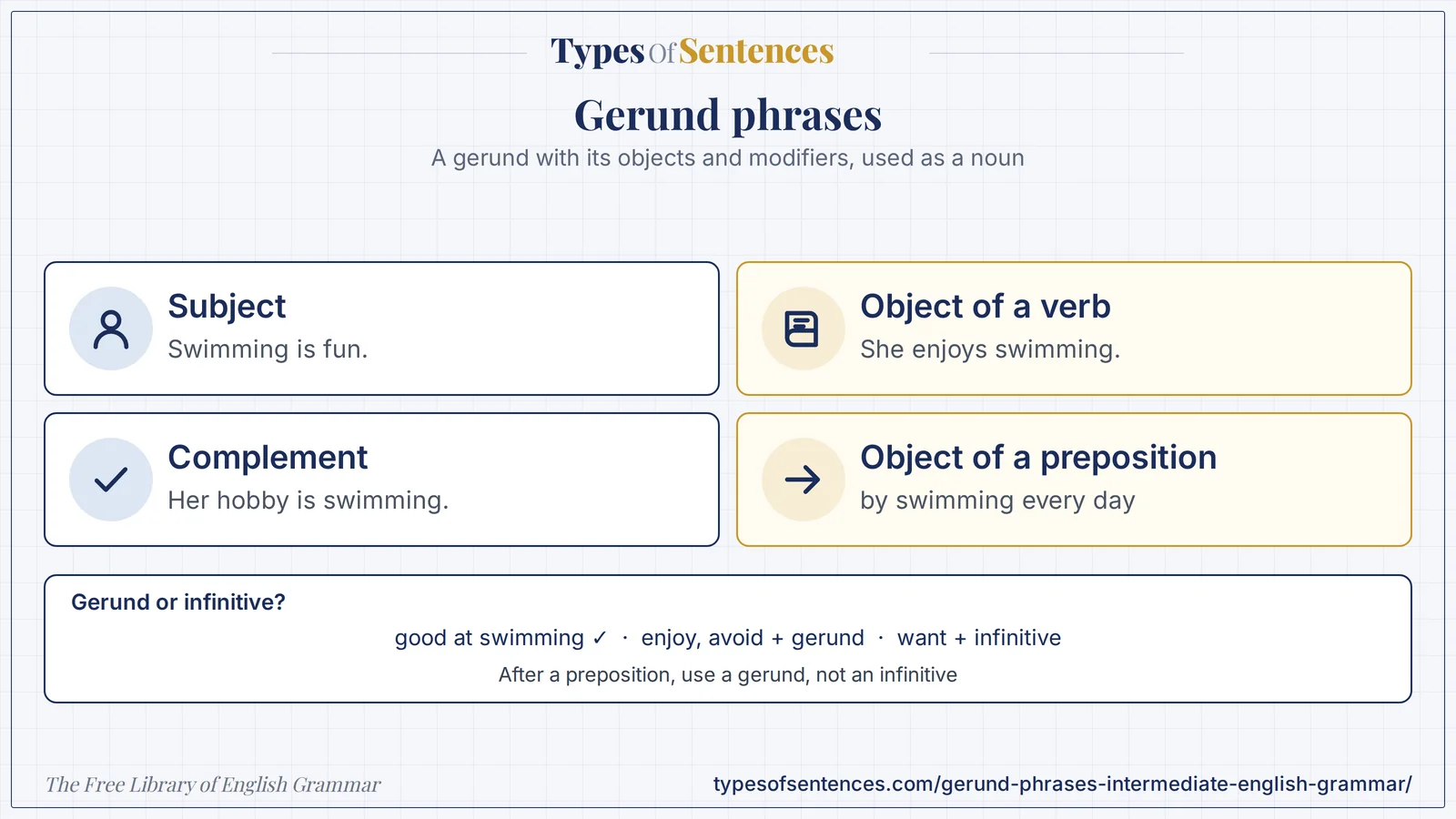
A gerund turns an action into a thing you can talk about. Swim is something you do; swimming is the activity as a topic: Swimming is fun.
Why it matters: A gerund phrase adds the details of the action: Swimming in the lake every morning is fun. The phrase works as one noun.
Summary: A gerund phrase = gerund + objects and modifiers, acting as a noun. It can be the subject (Swimming is fun), the object of a verb (She enjoys swimming), a complement (Her hobby is swimming), or the object of a preposition (by swimming). The gerund is not the same as a participle, which works as an adjective.
- Gerund = -ing acting as a noun.
- After a preposition, use a gerund, not an infinitive: good at swimming.
- Some verbs take a gerund (enjoy, avoid), some an infinitive (want, hope).
- A possessive can come before a gerund: I appreciate your helping.
What You’ll Learn
- 1. What Is a Gerund Phrase?
- 2. Gerund Phrases as Subjects
- 3. Gerund Phrases as Objects
- 4. Gerund Phrases as Complements and Appositives
- 5. Gerunds After Prepositions
- 6. Gerund vs. Infinitive
- 7. Possessive Before Gerunds
- 8. Perfect and Passive Forms, and Style
- 9. Common Gerund Patterns
- 10. Gerund Phrase or Participial Phrase?
- 11. Exercises
- 12. Test Your Knowledge
- 13. Frequently Asked Questions
- 14. Conclusion
1. What Is a Gerund Phrase?
A gerund is the -ing form of a verb used as a noun. A gerund phrase is the gerund with its objects, complements, and modifiers. The complete study of the form is in the chapter on gerunds; this chapter concentrates on the phrase.
| Gerund | Gerund phrase | Elements |
|---|---|---|
| swimming | swimming in the lake | gerund + prepositional phrase |
| reading | reading a good book | gerund + object |
| working | working hard every day | gerund + adverbs |
| being | being late again | gerund + complement |
Because the whole phrase acts as a noun, it can be replaced by a pronoun: Swimming in the lake is fun becomes It is fun. This is the simplest test for a gerund phrase.
2. Gerund Phrases as Subjects
A gerund phrase can be the subject of a sentence (the gerund as subject, object or complement is a basic noun job). It takes a singular verb, even when the phrase contains a plural noun.
| Sentence | Gerund phrase |
|---|---|
| Swimming is good exercise. | Swimming |
| Swimming in the lake every morning keeps her fit. | Swimming in the lake every morning |
| Learning new words takes time. | Learning new words |
| Lying to your friends is wrong. | Lying to your friends |
The subject is the gerund phrase as a whole, which is singular. The plural noun words is its object and does not control the verb.
3. Gerund Phrases as Objects
A gerund phrase can be the direct object of a verb. Certain verbs are followed by a gerund and not an infinitive.
| Verbs followed by a gerund | Examples |
|---|---|
| enjoy, mind, appreciate | She enjoys swimming. I don’t mind waiting. |
| avoid, risk, deny, admit | He avoided answering the question. |
| finish, quit, give up, stop | They finished painting the room. |
| keep, practice, consider, suggest | We considered moving to Texas. |
| postpone, delay, put off | She postponed leaving. |
The verbs followed by an infinitive (want, hope, decide) are in the previous chapter on infinitive phrases; the lists of both kinds are in the chapters on gerunds and infinitives.
4. Gerund Phrases as Complements and Appositives
| Job | Example |
|---|---|
| Subject complement (after be) | My hobby is collecting stamps. Her job is teaching English. |
| Subject complement | Seeing is believing. |
| Appositive | His favorite activity, hiking in the mountains, takes all day. |
A gerund complement renames the subject: Her job is teaching means Her job = teaching. If the verb after be shows an action in progress, it is a continuous verb and not a gerund: She is teaching (verb phrase) is different from Her job is teaching (gerund complement).
5. Gerunds After Prepositions
A gerund phrase is the only verb form that can follow a preposition. An infinitive cannot.
| Correct | Incorrect |
|---|---|
| She is good at drawing. | She is good at to draw. |
| He left without saying goodbye. | He left without to say goodbye. |
| By working hard, she passed. | By to work hard, she passed. |
| I am interested in learning Spanish. | I am interested in to learn Spanish. |
| I look forward to seeing you. | I look forward to see you. |
Prepositions and their objects are covered in the chapter on types of prepositions.
6. Gerund vs. Infinitive
Verbs fall into three groups: those followed only by a gerund, those followed only by an infinitive, and those that accept both.
| Group | Verbs | Example |
|---|---|---|
| gerund only | enjoy, avoid, finish, mind, suggest, consider, keep | She enjoys swimming. |
| infinitive only | want, hope, decide, plan, agree, refuse, promise | She wants to swim. |
| either, same meaning | like, love, hate, start, begin, continue, prefer | She likes swimming. / She likes to swim. |
| either, different meaning | stop, remember, forget, try, regret | He stopped smoking. / He stopped to smoke. |
| Verb | Gerund meaning | Infinitive meaning |
|---|---|---|
| stop | quit the activity: She stopped talking. | pause in order to do something: She stopped to talk. |
| remember | recall a past action: I remember locking the door. | not forget to do: Remember to lock the door. |
| forget | forget a past action: I’ll never forget meeting her. | fail to do: Don’t forget to call. |
| try | experiment: Try restarting the computer. | make an effort: I tried to restart it. |
7. Possessive Before Gerunds
In formal English, a possessive form is used before a gerund to show who does the action.
| Formal (possessive) | Informal (object) |
|---|---|
| I appreciate your helping me. | I appreciate you helping me. |
| Tom’s leaving surprised us. | Tom leaving surprised us. |
| She dislikes his driving. | She dislikes him driving. |
The possessive form signals that the gerund phrase, not the person, is the object of the verb: I appreciate your helping means that I appreciate the helping. The informal form is common in speech and accepted by many writers, but formal writing keeps the possessive. Note the difference in meaning: I saw him running (I saw him) and I disliked his running (I disliked the running).
Usage guides disagree on how strictly to apply the possessive before gerunds. Many accept the object form when the word is a noun with a long modifier (I remember the man in the hat leaving). Choose the formal possessive when the sentence is formal and the form is easy.
8. Perfect and Passive Forms, and Style
Gerunds have more forms than the plain -ing word. The perfect and passive forms let a gerund show time and voice, which is useful in formal writing.
| Form | Pattern | Example |
|---|---|---|
| simple | verb + -ing | She likes singing. |
| perfect | having + past participle | He admitted having made a mistake. |
| passive | being + past participle | I dislike being interrupted. |
| perfect passive | having been + past participle | She was proud of having been chosen. |
| negative | not + -ing | Not knowing the answer is no disgrace. |
A gerund subject takes a singular verb: Learning new words takes time. When several gerunds are listed, keep them in the same form: She enjoys hiking, swimming, and cycling, not She enjoys hiking, to swim, and cycling. Parallel forms make a sentence easy to read.
| Problem | Example | Fix |
|---|---|---|
| mixed forms in a list | She likes to read, writing, and to swim. | She likes reading, writing, and swimming. |
| dangling gerund | After reading the report, the meeting began. | After reading the report, we began the meeting. |
| missing possessive in formal writing | I appreciate you helping. | I appreciate your helping. (formal) |
| wrong form after a preposition | She insisted on to pay. | She insisted on paying. |
- Learning to cook takes patience. subject
- She loves baking bread on Sundays. direct object
- His hobby is collecting old maps. subject complement
- He is good at fixing bicycles. object of a preposition
In each sentence the -ing word keeps its verb powers: it can take an object (collecting old maps) and be modified by an adverb or a prepositional phrase (baking bread on Sundays), while the whole group fills a noun slot in the sentence.
9. Common Gerund Patterns
| Pattern | Examples |
|---|---|
| go + gerund (activities) | go swimming, go shopping, go fishing, go hiking |
| spend / waste + time + gerund | She spent two hours studying. Don’t waste time complaining. |
| have difficulty / trouble + gerund | He has trouble sleeping. |
| busy + gerund | She is busy cooking. |
| it’s no use / no good / worth + gerund | It is no use crying. It is worth trying. |
| can’t help / can’t stand + gerund | I can’t help laughing. |
| how about / what about + gerund | How about going out? |
The gerund also appears in many nouns and names: building, wedding, swimming pool, waiting room. In a swimming pool the first word is a gerund describing the purpose of the pool, and is different from the participle in a swimming child.
10. Gerund Phrase or Participial Phrase?
| Gerund phrase (noun) | Participial phrase (adjective) |
|---|---|
| Swimming in the lake is fun. | Swimming in the lake, she felt free. |
| She enjoys reading novels. | The girl reading novels is my sister. |
| Walking home takes ten minutes. | Walking home, I met Tom. |
Test: replace the phrase with it. If the sentence still works (It is fun), it is a gerund phrase. If the phrase modifies a noun (she, girl, I), it is a participial phrase. See the chapter on participial phrases.
After a preposition, always use the gerund.
Recap in 12 seconds
Watch the lesson build itself: A gerund phrase works as a subject, an object, a complement, or the object of a preposition. The video has no sound.
Exercises
Part A: Recognizing Gerund Phrases (Exercises 1–6)
Exercise 1: Find the gerund phrase: Swimming in the lake is fun.
Show Answer
Answer: Swimming in the lake.
Exercise 2: Find the gerund phrase: She enjoys reading novels.
Show Answer
Answer: reading novels.
Exercise 3: Find the gerund phrase: By working hard, she passed.
Show Answer
Answer: working hard (the object of by).
Exercise 4: Replace with a pronoun: Learning new words takes time.
Show Answer
Answer: It takes time.
Exercise 5: Gerund or participle: Walking home takes ten minutes.
Show Answer
Answer: Gerund phrase.
Exercise 6: Gerund or participle: Walking home, I met Tom.
Show Answer
Answer: Participial phrase.
Part B: Subjects and Objects (Exercises 7–12)
Exercise 7: Choose: Learning new words (is/are) difficult.
Show Answer
Answer: is.
Exercise 8: Choose: She enjoys (to swim/swimming).
Show Answer
Answer: swimming.
Exercise 9: Choose: He avoided (to answer/answering) the question.
Show Answer
Answer: answering.
Exercise 10: Choose: They finished (to paint/painting) the room.
Show Answer
Answer: painting.
Exercise 11: Choose: She wants (to swim/swimming).
Show Answer
Answer: to swim.
Exercise 12: Choose: We considered (to move/moving) to Texas.
Show Answer
Answer: moving.
Part C: Complements (Exercises 13–15)
Exercise 13: Find the gerund phrase complement: My hobby is collecting stamps.
Show Answer
Answer: collecting stamps.
Exercise 14: Gerund or verb: Her job is teaching.
Show Answer
Answer: Gerund (a complement).
Exercise 15: Gerund or verb: She is teaching.
Show Answer
Answer: Verb (a continuous form).
Part D: After Prepositions (Exercises 16–21)
Exercise 16: Choose: She is good at (draw/drawing/to draw).
Show Answer
Answer: drawing.
Exercise 17: Choose: He left without (say/saying/to say) goodbye.
Show Answer
Answer: saying.
Exercise 18: Fix it: I am interested in to learn Spanish.
Show Answer
Answer: I am interested in learning Spanish.
Exercise 19: Fix it: I look forward to see you.
Show Answer
Answer: I look forward to seeing you.
Exercise 20: Is to a preposition in I am used to waking early?
Show Answer
Answer: Yes. A gerund follows.
Exercise 21: Test: I look forward to the party. What does it show?
Show Answer
Answer: That to is a preposition, because a noun can follow it.
Part E: Gerund vs Infinitive (Exercises 22–26)
Exercise 22: Explain: She stopped talking. and She stopped to talk.
Show Answer
Answer: The first means she quit talking; the second means she paused in order to talk.
Exercise 23: Explain: Remember locking the door. and Remember to lock the door.
Show Answer
Answer: The first is recall (past); the second is a reminder (future).
Exercise 24: Choose: Try (restarting/to restart) the computer. (experiment)
Show Answer
Answer: restarting.
Exercise 25: Choose: I tried (calling/to call), but he did not answer. (effort)
Show Answer
Answer: to call.
Exercise 26: Give a verb that takes either with the same meaning.
Show Answer
Answer: like (also love, start, begin).
Part F: Possessives and Patterns (Exercises 27–30)
Exercise 27: Choose (formal): I appreciate (you/your) helping me.
Show Answer
Answer: your.
Exercise 28: Choose (formal): She dislikes (him/his) driving.
Show Answer
Answer: his.
Exercise 29: Complete: It is no use ___. (cry)
Show Answer
Answer: crying.
Exercise 30: Complete: She spent two hours ___. (study)
Show Answer
Answer: studying.
Test Your Knowledge
Ready to check what you learned? Answer all 10 questions, then submit. You need 80% (8 of 10) to pass. Your answers are not stored.
View correct answers and explanations
Question 1: What does a gerund phrase work as?
✓ Correct Answer: B – A noun
A gerund phrase acts as a noun.
Question 2: Which is a gerund phrase?
✓ Correct Answer: C – swimming in the lake
It begins with an -ing form acting as a noun.
Question 3: Which is correct?
✓ Correct Answer: D – Learning new words is hard.
A gerund phrase subject is singular.
Question 4: Which verb takes a gerund?
✓ Correct Answer: C – enjoy
Enjoy is followed by a gerund.
Question 5: Which is correct?
✓ Correct Answer: D – She is good at drawing.
Use a gerund after a preposition.
Question 6: Which is correct?
✓ Correct Answer: C – I look forward to seeing you.
To is a preposition here.
Question 7: Which means she quit talking?
✓ Correct Answer: A – She stopped talking.
Stop + gerund means quit.
Question 8: Which is the formal form?
✓ Correct Answer: B – I appreciate your helping me.
The possessive precedes a gerund in formal English.
Question 9: Which is a gerund complement?
✓ Correct Answer: A – Her job is teaching.
Teaching renames the subject job.
Question 10: How can you test a gerund phrase?
✓ Correct Answer: A – Replace it with it
A gerund phrase can be replaced by a pronoun.
Frequently Asked Questions
What is a gerund phrase?
A gerund phrase is a phrase that begins with a gerund (the -ing form used as a noun) and includes its objects and modifiers, such as swimming in the lake. It works as a noun.
What are gerund phrases?
Gerund phrases are noun phrases built around an -ing verb form. They can be subjects, objects, complements, or objects of prepositions.
What are gerund phrase functions?
The gerund phrase functions are subject (Swimming is fun), direct object (She enjoys swimming), subject complement (Her hobby is swimming), object of a preposition (by swimming), and appositive.
What are some gerund phrase examples?
Swimming in the lake, reading a good book, working hard every day, collecting stamps, and learning new words are gerund phrase examples.
What is the gerund as subject, object?
As a subject, a gerund phrase takes a singular verb (Learning words takes time). As an object, it follows verbs such as enjoy, avoid, and finish (She enjoys swimming).
How do I choose between a gerund and an infinitive?
Learn which verbs take which: enjoy and avoid take a gerund; want and hope take an infinitive; like and start take either; stop, remember, and try change meaning.
Why do I say look forward to seeing?
In look forward to, the word to is a preposition, and a preposition is followed by a gerund, not by an infinitive.
Conclusion
You now know how to use a gerund phrase. You can recognize its form, use it as a subject, object, complement, or object of a preposition, choose between a gerund and an infinitive, use the possessive before a gerund, and avoid the common errors.
Notice every -ing word you read and ask whether it is a noun, an adjective, or part of a verb phrase. Next, you will study appositive phrases.
- Merriam-Webster Dictionary: gerund: the dictionary definition of a gerund.
- Purdue Online Writing Lab: Grammar: reference section on verbals.
- Quirk, Randolph, et al. A Comprehensive Grammar of the English Language. Longman, 1985.: -ing clauses and verb complementation.
- Huddleston, Rodney, and Geoffrey K. Pullum. The Cambridge Grammar of the English Language. Cambridge University Press, 2002.: gerund-participles.
Last reviewed: October 29, 2026. How it was made: drafted with AI assistance, then checked with automated tests (structure, links, answer keys, spelling) and against the sources above. A person has not yet read this chapter line by line. Found a mistake? Report it.