A noun phrase is a head noun together with everything that goes with it: determiners, adjectives, and other modifiers before the noun, and phrases or clauses after it. The tall oak tree in the old garden is a noun phrase; its head noun is tree. Noun phrases are the most common kind of phrase, and almost every sentence contains at least one.
This chapter shows noun phrase structure, with noun phrase examples for every part. You will learn what comes before the head noun (pre-modifiers), what can come after it (post-modifiers), how head noun modifiers are ordered, what jobs noun phrases do, and how complex noun phrases are built. It ends with the usual errors. Thirty exercises and a quiz follow.
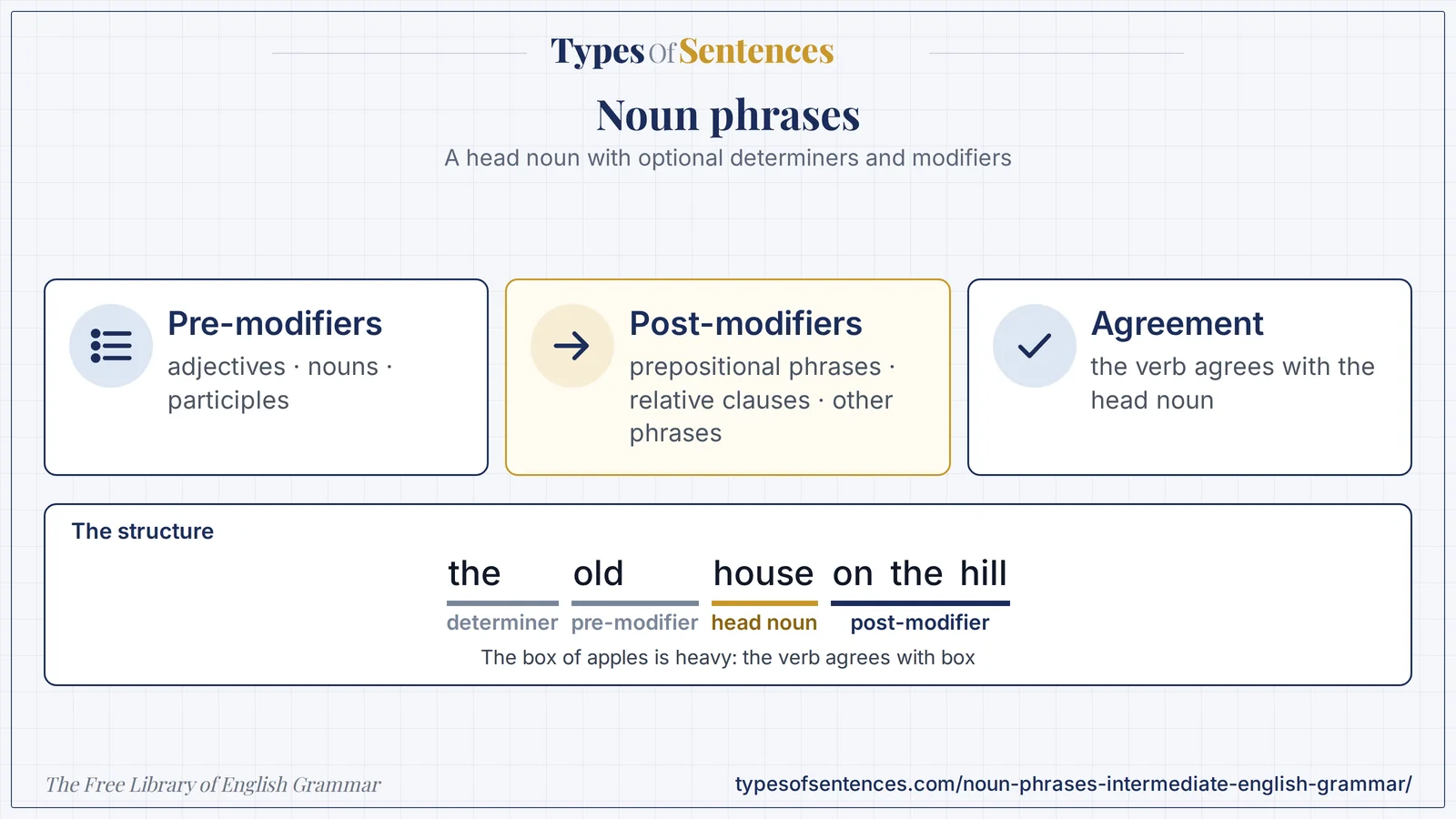
Think of the noun phrase as a noun with its friends. The head noun is the main word; the friends tell you which one, how many, what kind, and where.
Why it matters: The noun phrase is where most of the detail in a sentence lives. Knowing its parts helps you write precise sentences and avoid ambiguity.
Summary: A noun phrase has a head noun and optional determiners, pre-modifiers, and post-modifiers. Pre-modifiers include adjectives, nouns, and participles. Post-modifiers include prepositional phrases, relative clauses, participial and infinitive phrases, and appositives. A noun phrase can be a subject, object, complement, or object of a preposition.
- Structure: (determiner) + (pre-modifiers) + head noun + (post-modifiers).
- The verb agrees with the head noun: The box of apples is heavy.
- Noun phrases can be replaced by pronouns: the tall tree → it.
- Long noun phrases can be ambiguous; place modifiers close to the noun they modify.
What You’ll Learn
- 1. What Is a Noun Phrase?
- 2. Structure of Noun Phrases
- 3. Pre-Modifiers (Before the Head Noun)
- 4. Post-Modifiers (After the Head Noun)
- 5. The Head Noun and Agreement
- 6. Functions of Noun Phrases
- 7. Complex Noun Phrases
- 8. Ambiguity and Misplaced Modifiers
- 9. Noun Phrase vs. Noun Clause
- 10. Common Noun Phrase Errors
- 11. Exercises
- 12. Test Your Knowledge
- 13. Frequently Asked Questions
- 14. Conclusion
1. What Is a Noun Phrase?
A noun phrase is a group of words whose head is a noun or a pronoun. It names a person, place, thing, or idea, and it fills the same roles as a single noun: subject, object, complement, and object of a preposition.
| Noun phrase | Head noun | What the rest does |
|---|---|---|
| teachers | teachers | one word; the head alone |
| the teacher | teacher | a determiner |
| the new teacher | teacher | a determiner and an adjective |
| the new math teacher from Boston | teacher | determiner, adjective, noun modifier, prepositional phrase |
| the teacher who called me | teacher | determiner and a relative clause |
Even a single pronoun is a noun phrase: She in She left. A noun phrase can be replaced by a pronoun, which is a useful test: the new math teacher from Boston → she.
2. Structure of Noun Phrases
A full noun phrase has up to six positions. Only the head is required.
| Predeterminer | Determiner | Postdeterminer | Pre-modifiers | HEAD NOUN | Post-modifiers |
|---|---|---|---|---|---|
| all | the | three | young | teachers | from Boston |
| both | my | — | new | shoes | that I bought |
| half | a | — | — | hour | left |
| — | these | last | two | exams | in math |
| — | — | — | old stone | bridges | over the river |
This is the noun phrase structure. The positions before the head are the subject of the chapter on determiners and of the pre-modifiers below. The positions after the head are the post-modifiers. Each position can be filled by a word, a phrase, or a clause.
3. Pre-Modifiers (Before the Head Noun)
Pre-modifiers come between the determiner and the head noun. They give detail about the noun.
| Pre-modifier | Example | Note |
|---|---|---|
| Adjective | a tall tree | follow the order opinion, size, age, shape, color, origin, material |
| Several adjectives | a lovely old wooden table | see the chapter on adjective types |
| Noun (noun adjunct) | a stone wall; a school bus | the noun modifier is singular: a shoe store, not a shoes store |
| Present participle | running water; a sleeping baby | active, ongoing |
| Past participle | a broken window; fried rice | passive, completed |
| Possessive | Tom’s new car | may replace the determiner |
| Adverb + adjective | a very old house; an extremely easy test | the adverb modifies the adjective |
| Compound modifier | a well-known author; a five-year-old child | hyphenated before the noun |
A noun that modifies another noun stays singular: a shoe store, a ten-minute walk, a book club.
Order matters: a small wooden box, not a wooden small box. When two modifiers are equal in rank, separate them with a comma: a long, thin road.
4. Post-Modifiers (After the Head Noun)
Post-modifiers follow the head noun. They are usually longer and more informative than pre-modifiers.
| Post-modifier | Example |
|---|---|
| Prepositional phrase | the book on the table; a man with a hat |
| Relative clause | the girl who called; the book that I read |
| Participial phrase | the man talking to Tom; the letter written by Maria |
| Infinitive phrase | a place to rest; the first student to arrive |
| Appositive | my friend Tom; Paris, the capital of France |
| Adverb | the people here; the day before |
| Complement clause | the fact that she left; the idea of leaving early |
Relative clauses are studied in the chapter on adjective clauses, and participial phrases in the chapter on participial phrases. The same noun can have several post-modifiers: the book on the table that I borrowed from Maria.
- the report on climate change by a team of scientists head: report; two prepositional phrases
- the man standing by the door who asked for you head: man; a participial phrase and a relative clause
5. The Head Noun and Agreement
The head noun controls agreement. The verb and any pronoun that refers back to the phrase agree with the head, not with the nearest noun.
| Phrase | Head | Correct sentence |
|---|---|---|
| the box of apples | box | The box of apples is heavy. |
| the students in the class | students | The students in the class are late. |
| a list of names | list | A list of names was posted. |
| the cost of the repairs | cost | The cost of the repairs is high. |
| one of the boys | one | One of the boys is late. |
The head noun is box. The prepositional phrase of apples is a post-modifier, and it does not control the verb.
The same rule explains a number of students are (the phrase acts as a quantifier) and the number of students is; see the chapter on quantifiers.
6. Functions of Noun Phrases
| Function | Example | Noun phrase |
|---|---|---|
| Subject | The new teacher arrived. | the new teacher |
| Direct object | She read the long report. | the long report |
| Indirect object | He gave his sister a gift. | his sister |
| Subject complement | Tom is a very good cook. | a very good cook |
| Object complement | They elected her the new president. | the new president |
| Object of a preposition | We talked about the plan for next week. | the plan for next week |
| Appositive | Tom, my oldest friend, called. | my oldest friend |
| Adverbial | She left this morning. We met every Friday. | this morning; every Friday |
| Possessive modifier | the teacher’s desk | the teacher’s |
The roles of objects and complements are in the chapters on direct and indirect objects and subject and object complements. Not every phrase that looks like a noun phrase is a noun phrase in every sense; this morning acts as an adverbial even though it has the form of one.
7. Complex Noun Phrases
A complex noun phrase has several modifiers, often with another phrase or clause inside. Formal and academic writing uses them to carry a lot of information in a short space.
| Simple | Complex |
|---|---|
| The decision was difficult. | The committee’s decision to delay the project until next year was difficult. |
| The students passed. | The students who studied hard for the entrance test passed. |
| She wrote a report. | She wrote a detailed report on the effects of climate change on coastal cities. |
Analyze: the committee’s decision to delay the project until next year
- Head noun: decision.
- Possessive determiner phrase: the committee’s.
- Post-modifier (an infinitive phrase): to delay the project until next year.
- Inside it, the project is a noun phrase (object) and until next year is a prepositional phrase.
Long noun phrases can be hard to read. Two cautions: do not stack more than about three nouns before a head noun (student loan debt relief program is hard to decode), and put the key information near the head noun so that the reader finds it. Advanced noun phrases are covered at the Advanced level.
8. Ambiguity and Misplaced Modifiers
A post-modifier should come right after the noun it modifies. When it does not, the sentence can be ambiguous or absurd.
| Ambiguous | Clear |
|---|---|
| I saw the man with a telescope. | I saw the man who had a telescope. / Through a telescope, I saw the man. |
| the old men and women | the men and women, all old / the old men and the women |
| She served cake to the children on paper plates. | She served cake on paper plates to the children. |
| The teacher gave a book to the student that was torn. | The teacher gave the student a book that was torn. |
9. Noun Phrase vs. Noun Clause
A noun phrase has a noun as its head. A noun clause is a dependent clause that does the same job as a noun phrase. Both can be subjects and objects.
| Noun phrase | Noun clause |
|---|---|
| I know the answer. | I know that she is right. |
| Her decision surprised us. | What she decided surprised us. |
| We discussed the plan. | We discussed how we could finish. |
The noun clause has its own subject and finite verb. See the chapter on noun clauses for the full study.
10. Common Noun Phrase Errors
| Error | Correction | Rule |
|---|---|---|
| a shoes store | a shoe store | noun modifiers stay singular |
| a ten-years-old boy | a ten-year-old boy | number-noun compound is singular |
| The box of apples are heavy. | The box of apples is heavy. | agree with the head noun |
| a wooden small box | a small wooden box | order of pre-modifiers |
| student loan debt relief program (a stack of five nouns) | a program that relieves student loan debt | avoid long noun stacks |
| I have friend. | I have a friend. | singular countable noun needs a determiner |
| the news are good | the news is good | news is uncountable and singular |
Find the head noun and the verb that agrees: The cost of the repairs (is/are) high.
Reveal answer
cost; is. The head is cost, which is singular.
Recap in 12 seconds
Watch the lesson build itself: A noun phrase has a head noun, optional determiners, pre-modifiers, and post-modifiers, and the verb agrees with the head. The video has no sound.
Exercises
Part A: Finding the Head Noun (Exercises 1–6)
Exercise 1: Head noun: the tall oak tree in the old garden
Show Answer
Answer: tree.
Exercise 2: Head noun: a list of names
Show Answer
Answer: list.
Exercise 3: Head noun: the students in the class
Show Answer
Answer: students.
Exercise 4: Head noun: my friend Tom
Show Answer
Answer: friend. Tom is an appositive.
Exercise 5: Replace with a pronoun: the new math teacher from Boston
Show Answer
Answer: she (or he).
Exercise 6: Is She a noun phrase?
Show Answer
Answer: Yes. A pronoun alone can be a noun phrase.
Part B: Pre-Modifiers (Exercises 7–12)
Exercise 7: Fix it: a shoes store
Show Answer
Answer: a shoe store.
Exercise 8: Order: wooden / small / a / box
Show Answer
Answer: a small wooden box.
Exercise 9: Fix it: a ten-years-old boy
Show Answer
Answer: a ten-year-old boy.
Exercise 10: Type of pre-modifier: running in running water
Show Answer
Answer: Present participle.
Exercise 11: Type of pre-modifier: stone in a stone wall
Show Answer
Answer: Noun (noun adjunct).
Exercise 12: Add a comma if needed: a long thin road
Show Answer
Answer: a long, thin road.
Part C: Post-Modifiers (Exercises 13–18)
Exercise 13: Name the post-modifier: the book on the table
Show Answer
Answer: on the table (prepositional phrase).
Exercise 14: Name the post-modifier: the girl who called
Show Answer
Answer: who called (relative clause).
Exercise 15: Name the post-modifier: a place to rest
Show Answer
Answer: to rest (infinitive phrase).
Exercise 16: Name the post-modifier: the man talking to Tom
Show Answer
Answer: talking to Tom (participial phrase).
Exercise 17: Name the post-modifier: Paris, the capital of France
Show Answer
Answer: the capital of France (appositive).
Exercise 18: Name the post-modifier: the fact that she left
Show Answer
Answer: that she left (complement clause).
Part D: Agreement (Exercises 19–23)
Exercise 19: Choose: The box of apples (is/are) heavy.
Show Answer
Answer: is.
Exercise 20: Choose: The students in the class (is/are) late.
Show Answer
Answer: are.
Exercise 21: Choose: A list of names (was/were) posted.
Show Answer
Answer: was.
Exercise 22: Choose: One of the boys (is/are) late.
Show Answer
Answer: is.
Exercise 23: Choose: The news (is/are) good.
Show Answer
Answer: is.
Part E: Functions (Exercises 24–27)
Exercise 24: Function of the long report in She read the long report.
Show Answer
Answer: Direct object.
Exercise 25: Function of his sister in He gave his sister a gift.
Show Answer
Answer: Indirect object.
Exercise 26: Function of a very good cook in Tom is a very good cook.
Show Answer
Answer: Subject complement.
Exercise 27: Function of this morning in She left this morning.
Show Answer
Answer: Adverbial.
Part F: Ambiguity and Errors (Exercises 28–30)
Exercise 28: Rewrite clearly: I saw the man with a telescope. (the man had it)
Show Answer
Answer: I saw the man who had a telescope.
Exercise 29: Rewrite: student loan debt relief program
Show Answer
Answer: a program that relieves student loan debt.
Exercise 30: Fix it: I have friend.
Show Answer
Answer: I have a friend.
Test Your Knowledge
Ready to check what you learned? Answer all 10 questions, then submit. You need 80% (8 of 10) to pass. Your answers are not stored.
View correct answers and explanations
Question 1: What is the head of a noun phrase?
✓ Correct Answer: C – A noun or pronoun
The head noun is the main word of the phrase.
Question 2: Which is a noun phrase?
✓ Correct Answer: A – the tall tree in the garden
The head is the noun tree.
Question 3: Which is correct?
✓ Correct Answer: D – a shoe store
A noun modifier stays singular.
Question 4: Which is correct?
✓ Correct Answer: B – a small wooden box
Size comes before material.
Question 5: Which verb agrees: The box of apples ___ heavy.
✓ Correct Answer: C – is
The head noun is box.
Question 6: Which is a post-modifier?
✓ Correct Answer: B – on the table
On the table follows the head noun.
Question 7: Which is an appositive?
✓ Correct Answer: A – Tom, my brother, called.
My brother renames Tom.
Question 8: Which is a relative clause post-modifier?
✓ Correct Answer: D – the book that I read
That I read is a relative clause.
Question 9: What can replace a noun phrase?
✓ Correct Answer: A – A pronoun
A pronoun stands for a noun phrase.
Question 10: Which is a long noun stack to avoid?
✓ Correct Answer: D – student loan debt relief program
Too many nouns before the head make it hard to read.
Frequently Asked Questions
What are noun phrases?
Noun phrases are groups of words with a noun or pronoun as head. They can include determiners, adjectives, and other modifiers before the noun and phrases or clauses after it.
What is a head noun?
The head noun is the main word of a noun phrase, the one that all the other words modify. In the tall oak tree in the garden, the head noun is tree.
What is noun phrase structure?
Noun phrase structure is the order of parts: predeterminer, determiner, postdeterminer, pre-modifiers, head noun, and post-modifiers. Only the head is required.
What are some noun phrase examples?
The teacher, a small wooden box, the book on the table, the girl who called, my friend Tom, and the fact that she left are noun phrase examples.
What are head noun modifiers?
Head noun modifiers are the words and phrases that describe or limit the head noun. They include adjectives, noun modifiers, and participles before it, and prepositional phrases, clauses, and appositives after it.
What jobs can a noun phrase do?
A noun phrase can be a subject, a direct or indirect object, a subject or object complement, the object of a preposition, an appositive, or an adverbial such as this morning.
How do I avoid ambiguous noun phrases?
Place each modifier next to the word it modifies, avoid long strings of nouns, and rewrite any phrase that can be read two ways.
Conclusion
You now know how a noun phrase is built: a head noun with determiners and pre-modifiers before it and post-modifiers after it. You can find the head, make the verb agree with it, name the parts, identify the jobs a noun phrase can do, and avoid ambiguity and noun stacks.
Practice by taking a long noun phrase and naming each part. Next, you will study verb phrases.
- Merriam-Webster Dictionary: noun phrase: the dictionary definition of a noun phrase.
- Purdue Online Writing Lab: Grammar: reference section on phrases.
- Quirk, Randolph, et al. A Comprehensive Grammar of the English Language. Longman, 1985.: the structure of the noun phrase.
- Huddleston, Rodney, and Geoffrey K. Pullum. The Cambridge Grammar of the English Language. Cambridge University Press, 2002.: noun phrases, heads, and dependents.
Last reviewed: October 29, 2026. How it was made: drafted with AI assistance, then checked with automated tests (structure, links, answer keys, spelling) and against the sources above. A person has not yet read this chapter line by line. Found a mistake? Report it.