What are SAT modifier questions? SAT modifier questions are the items on the digital SAT whose answer choices begin with different words after a comma, so that a different noun follows an opening phrase: Walking home, the rain began versus Walking home, she felt the rain begin. They test the rule that a modifier must sit next to the word it modifies. The SAT dangling modifier is one that has no noun in the sentence to describe; the SAT misplaced modifier is one that is placed so far from its noun that it seems to describe something else. Modifier items belong to the Form, Structure, and Sense skill of the Standard English Conventions domain, which the College Board describes as about 26 percent of the Reading and Writing section (11 to 15 of its 54 questions).
This page explains what a modifier is, the dangling modifier and the misplaced modifier with many examples, the opening-phrase rule, the common modifier patterns, relative clauses, the placement of only, the two ways to fix every error, and a method for every SAT modifier question. It gives 30 original practice items (not taken from the College Board) and a 10-question quiz.
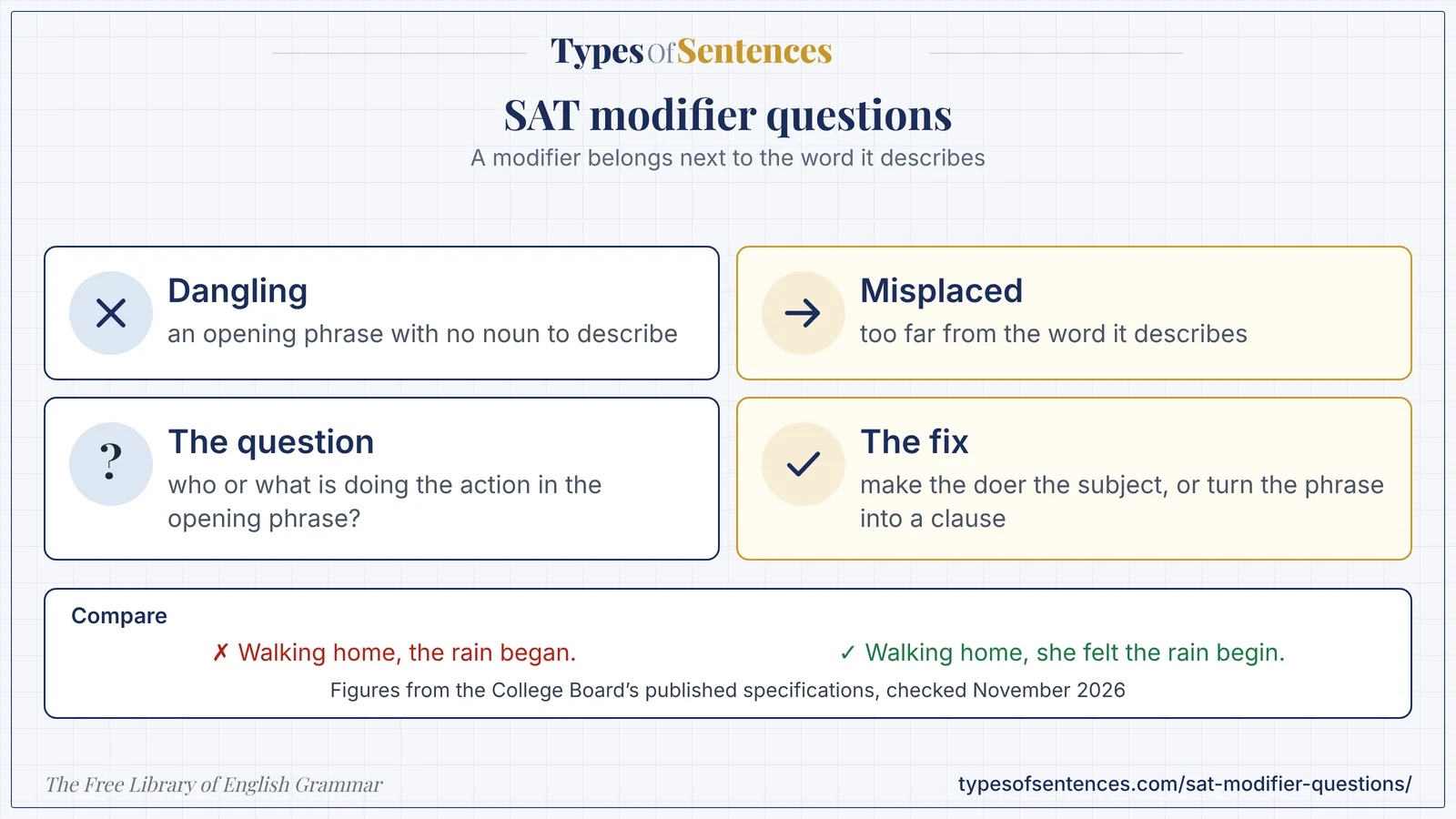
A modifier is a word or phrase that describes something else. The describing phrase needs a partner: the noun it describes. When the phrase comes first, the noun it describes must come right after the comma.
Why it matters: Ask “who or what is doing this?” about the opening phrase. If the next noun is not the answer, the modifier is dangling.
Summary: A modifier is a word, phrase, or clause that describes another word. A misplaced modifier is too far from the word it describes, so it seems to describe something else (She almost drove her children to school every day). A dangling modifier has no word in the sentence to describe (Walking home, the rain began). The opening-phrase rule: an introductory phrase that ends in a comma must be followed by the noun it describes (Walking home, she felt the rain begin). The fixes are to rewrite the main clause so that it begins with the right noun, or to turn the modifier into a full clause (As she walked home, the rain began). The relative clause goes next to the noun it modifies, and limiting words such as only go before the word they limit.
- Opening phrase + comma: the next noun must be the doer.
- Misplaced: too far from its noun.
- Dangling: no noun to describe.
- Fix: change the subject or make it a clause.
What You’ll Learn
- 1. SAT Modifier Questions: The Short Answer
- 2. What Is a Modifier? The Types and the Placement Rule
- 3. The SAT Dangling Modifier: Opening Phrases With No Noun to Describe
- 4. The SAT Misplaced Modifier: Modifiers Too Far From Their Nouns
- 5. Modifier Patterns That the SAT Uses
- 6. A Five-Step Method for SAT Modifier Questions
- 7. Common Mistakes on SAT Modifier Questions
- 8. Exercises
- 9. Test Your Knowledge
- 10. Frequently Asked Questions
- 11. Conclusion
1. SAT Modifier Questions: The Short Answer
| Fact | Detail |
|---|---|
| where | the Standard English Conventions domain of the digital SAT Reading and Writing section |
| skill | Form, Structure, and Sense (agreement, verb tense and form, pronouns, modifiers, possessives, parallelism) |
| share | Standard English Conventions is about 26 percent of the section, or 11 to 15 of 54 questions |
| format | a short text with a blank, and four choices that begin with different words |
| clue | the choices differ in the noun that follows an opening phrase |
| official practice | the College Board’s Bluebook app and Student Question Bank |
| Error | What it is | Example | Fix |
|---|---|---|---|
| dangling modifier | an opening phrase with no noun to describe | *Walking home, the rain began. | Walking home, she felt the rain begin. |
| misplaced modifier | a modifier too far from its noun | *She served sandwiches to the guests on paper plates. | She served sandwiches on paper plates to the guests. |
| squinting modifier | a modifier that could describe the word before or after | *Students who study rarely fail. | Students who rarely study fail. or Students who study seldom fail. (choose one meaning) |
The College Board figures were taken from its published specifications and checked in November 2026; the College Board can change the test, so check satsuite.collegeboard.org before you rely on them.
2. What Is a Modifier? The Types and the Placement Rule
| Type of modifier | What it does | Example |
|---|---|---|
| adjective | describes a noun | a tall tree |
| adverb | describes a verb, adjective, or adverb | ran quickly |
| prepositional phrase | works as an adjective or an adverb | the book on the table |
| participial phrase | describes a noun | The man waiting at the door is my uncle. |
| infinitive phrase | describes a noun or a verb | To win the race, she trained daily. |
| appositive phrase | renames a noun | My brother, a doctor, called. |
| relative clause | describes a noun | The book that I read was long. |
| Rule | Correct | Error |
|---|---|---|
| an opening modifier must be followed by the noun it describes | Tired after the trip, the travelers slept. | *Tired after the trip, the beds were welcome. |
| a modifier should be next to its noun | The man with the hat who called is here. | *The man is here who called with the hat. |
| a limiting word goes before the word it limits | She only eats fish. (she does nothing else with fish) | — |
| a relative clause follows its noun | the book that I read | *the book was long that I read |
3. The SAT Dangling Modifier: Opening Phrases With No Noun to Describe
The most common SAT modifier question uses an opening phrase that ends in a comma. The noun that comes next is the one that the phrase describes, whether or not the writer meant it.
| Dangling modifier (error) | What it seems to say | Correct version |
|---|---|---|
| *Walking home, the rain began. | the rain was walking | Walking home, she felt the rain begin. |
| *Having finished the test, the bell rang. | the bell finished the test | Having finished the test, the students heard the bell. |
| *After eating dinner, the dishes were washed. | the dishes ate dinner | After eating dinner, we washed the dishes. |
| *To win the race, training is essential. | training wants to win | To win the race, a runner needs training. |
| *Exhausted from the trip, the bed looked inviting. | the bed was exhausted | Exhausted from the trip, she found the bed inviting. |
| *Reading the report, several errors appeared. | the errors read the report | Reading the report, I noticed several errors. |
| *While waiting for the bus, my phone rang. | the phone was waiting | While I was waiting for the bus, my phone rang. |
| *Painted bright blue, the artist loved the house. | the artist was painted | Painted bright blue, the house delighted the artist. |
| Two ways to fix a dangling modifier | Example |
|---|---|
| 1 change the subject of the main clause to the doer | Walking home, she felt the rain begin. |
| 2 turn the modifier into a full clause with its own subject | As she walked home, the rain began. |
The participial phrases that cause most of these errors are described in the Intermediate chapter on participial phrases.
4. The SAT Misplaced Modifier: Modifiers Too Far From Their Nouns
| Misplaced modifier (error) | What it seems to say | Correct version |
|---|---|---|
| *She served sandwiches to the guests on paper plates. | the guests were on paper plates | She served sandwiches on paper plates to the guests. |
| *I saw a dog walking to school with a long tail. | the school had a long tail | Walking to school, I saw a dog with a long tail. |
| *The teacher gave a test to the students that was very difficult. | the students were difficult | The teacher gave the students a test that was very difficult. |
| *We watched the film with popcorn. | the film had popcorn | With popcorn, we watched the film. |
| *He nearly drove for ten hours. | he almost started to drive | He drove for nearly ten hours. |
| *The shop sells shirts for men with stripes. | the men have stripes | The shop sells striped shirts for men. |
| *She almost ate the whole pizza. | she nearly ate it (did not eat it) | She ate almost the whole pizza. |
| *They found the keys in the garden that were lost. | the garden was lost | They found the lost keys in the garden. |
| Rule | Example |
|---|---|
| put a prepositional phrase next to the noun it describes | the book on the shelf with the red cover (two phrases; the order matters) |
| put a relative clause right after its noun | The student who studied hard passed. |
| put only, almost, nearly directly before the word they limit | She ate almost the whole pizza. |
5. Modifier Patterns That the SAT Uses
| Pattern | Correct example | Error |
|---|---|---|
| participial phrase (-ing) + comma | Opening the box, he found a note. | *Opening the box, a note fell out. |
| participial phrase (-ed) + comma | Worried about the test, she studied all night. | *Worried about the test, the night was long. |
| infinitive phrase + comma | To finish on time, she worked fast. | *To finish on time, the work was fast. |
| prepositional phrase + comma | In the morning, she runs. | *In the morning, the run is long for her. (acceptable; the phrase describes the time) |
| appositive + comma | A skilled painter, she sold her work. | *A skilled painter, the work sold. |
| adjective phrase + comma | Tired and hungry, we stopped. | *Tired and hungry, the inn welcomed us. |
| absolute phrase + comma (allowed) | The work finished, we left. | — |
| a dependent clause + comma (allowed) | When she walked home, the rain began. | — |
Not every opening phrase is a problem: a prepositional phrase of time or place, an absolute phrase (The work finished, we left), and a dependent clause with its own subject are all correct. The adjective clauses are explained in the Intermediate chapter on adjective clauses. For other structures that the same questions test, see the advanced chapters on parallel structure and complex noun phrases.
6. A Five-Step Method for SAT Modifier Questions
| Step | Do this | Why |
|---|---|---|
| 1 spot the opening phrase | look for a phrase that ends in a comma at the start of the sentence | this is the setup of most modifier questions |
| 2 ask who or what | ask who or what is doing the action in the phrase | the next noun must be the answer |
| 3 compare the choices | look at the first words after the comma in each choice | the correct choice names the doer |
| 4 test the meaning | read each choice and check that it makes sense literally | a wrong choice makes a silly picture |
| 5 check agreement | make sure the rest of the sentence still works | the new subject may need a different verb |
| Trap | What it looks like | The cure |
|---|---|---|
| the plausible noun | a noun that could do the action but did not | read the sentence literally |
| the passive rescue | a passive clause that hides the doer | name the doer in the main clause |
| the long noun phrase | a noun phrase that begins with a noun that is not the doer | find the head noun |
| the misplaced only | only before the wrong word | put it before the word it limits |
| the wrong fix | a choice that adds a comma but keeps the same subject | change the subject, not the punctuation |
Which choice is correct? Hoping to avoid the traffic, ___ (A) the highway was crowded all morning. (B) a different route seemed sensible to the commuters. (C) the commuters chose a different route. (D) the traffic was avoided by a different route.
- Spot the opening phrase: Hoping to avoid the traffic.
- Ask who is hoping: the commuters, not the highway, the route, or the traffic.
- Compare the choices: (C) is the only one that begins with the doer.
- Test the meaning: Hoping to avoid the traffic, the commuters chose a different route makes sense.
- Answer: (C). (The item is an original practice item, not taken from the College Board.)
7. Common Mistakes on SAT Modifier Questions
| Mistake | What happens | Better habit |
|---|---|---|
| choosing the choice that sounds smoothest | a dangling modifier is chosen | ask who or what is doing the action |
| adding a comma to “fix” a modifier | the subject is still wrong | change the subject, not the punctuation |
| ignoring the first words of the choices | the doer is missed | compare the words after the comma |
| treating every opening phrase as an error | a correct sentence is changed | a prepositional phrase of time or place is usually fine |
| overlooking only and almost | the limiting word is misplaced | put it before the word it limits |
| reading too fast | a silly meaning is missed | read each choice literally |
| forgetting verb agreement after the fix | the new subject needs a different verb | check agreement after changing the subject |
| putting a relative clause far from its noun | the clause modifies the wrong noun | keep it next to the noun |
Recap in 12 seconds
Watch the lesson build itself: SAT modifier questions test that an opening phrase is followed by the noun it describes, and that modifiers are not misplaced. The video has no sound.
Exercises
Part A: Spot the Error (Exercises 1–10)
Exercise 1: Which has a dangling modifier? (A) Walking home, she felt the rain begin. (B) Walking home, the rain began.
Show Answer
Answer: (B): the rain was not walking.
Exercise 2: Which has a dangling modifier? (A) After eating dinner, we washed the dishes. (B) After eating dinner, the dishes were washed.
Show Answer
Answer: (B).
Exercise 3: Which is correct? (A) To win the race, a runner needs training. (B) To win the race, training is essential.
Show Answer
Answer: (A).
Exercise 4: Which is correct? (A) Exhausted from the trip, she found the bed inviting. (B) Exhausted from the trip, the bed looked inviting.
Show Answer
Answer: (A).
Exercise 5: Which is correct? (A) Reading the report, I noticed several errors. (B) Reading the report, several errors appeared.
Show Answer
Answer: (A).
Exercise 6: Which is correct? (A) Having finished the test, the bell rang. (B) Having finished the test, the students heard the bell.
Show Answer
Answer: (B).
Exercise 7: Which is correct? (A) While I was waiting for the bus, my phone rang. (B) While waiting for the bus, my phone rang.
Show Answer
Answer: (A): a full clause with its own subject.
Exercise 8: Which is correct? (A) The work finished, we left. (B) The work finishing, we left.
Show Answer
Answer: (A): an absolute phrase.
Exercise 9: Which is correct? (A) Tired and hungry, we stopped. (B) Tired and hungry, the inn welcomed us.
Show Answer
Answer: (A).
Exercise 10: Which is correct? (A) Painted bright blue, the house delighted the artist. (B) Painted bright blue, the artist loved the house.
Show Answer
Answer: (A).
Part B: Misplaced Modifiers (Exercises 11–20)
Exercise 11: Choose: (A) She served sandwiches on paper plates to the guests. (B) She served sandwiches to the guests on paper plates.
Show Answer
Answer: (A).
Exercise 12: Choose: (A) He drove for nearly ten hours. (B) He nearly drove for ten hours.
Show Answer
Answer: (A).
Exercise 13: Choose: (A) She ate almost the whole pizza. (B) She almost ate the whole pizza.
Show Answer
Answer: (A) (the intended meaning is that she ate most of it).
Exercise 14: Choose: (A) The shop sells striped shirts for men. (B) The shop sells shirts for men with stripes.
Show Answer
Answer: (A).
Exercise 15: Choose: (A) They found the lost keys in the garden. (B) They found the keys in the garden that were lost.
Show Answer
Answer: (A).
Exercise 16: Choose: (A) The teacher gave the students a test that was very difficult. (B) The teacher gave a test to the students that was very difficult.
Show Answer
Answer: (A).
Exercise 17: Choose: (A) The student who studied hard passed. (B) The student passed who studied hard.
Show Answer
Answer: (A).
Exercise 18: Choose: (A) With popcorn, we watched the film. (B) We watched the film with popcorn.
Show Answer
Answer: (A) (if the popcorn belongs to us).
Exercise 19: Choose: (A) She only eats fish on Fridays. (B) She eats only fish on Fridays.
Show Answer
Answer: Both are grammatical but mean different things: (A) means that on Fridays she does nothing with fish except eat it; (B) means that fish is the only food she eats on Fridays. The placement of only decides the meaning.
Exercise 20: Choose: (A) I saw a dog with a long tail walking to school. (B) I saw a dog walking to school with a long tail.
Show Answer
Answer: (A).
Part C: Fix the Sentence (Exercises 21–26)
Exercise 21: Fix: *Walking to class, the bus passed me.
Show Answer
Answer: Walking to class, I watched the bus pass me. (or As I walked to class, the bus passed me.)
Exercise 22: Fix: *Opening the box, a note fell out.
Show Answer
Answer: Opening the box, she found a note.
Exercise 23: Fix: *Worried about the test, the night was long.
Show Answer
Answer: Worried about the test, she found the night long.
Exercise 24: Fix: *To finish on time, the work was fast.
Show Answer
Answer: To finish on time, she worked fast.
Exercise 25: Fix: *A skilled painter, the work sold quickly.
Show Answer
Answer: A skilled painter, she sold her work quickly.
Exercise 26: Fix: *Tired after the trip, the beds were welcome.
Show Answer
Answer: Tired after the trip, the travelers welcomed the beds.
Part D: Explain (Exercises 27–30)
Exercise 27: Why is As she walked home, the rain began correct?
Show Answer
Answer: It is a full clause with its own subject (she), so nothing dangles.
Exercise 28: Why is a prepositional phrase of time such as In the morning, she runs usually fine?
Show Answer
Answer: It describes the time of the action and needs no noun partner.
Exercise 29: What question should you ask about an opening participial phrase?
Show Answer
Answer: Who or what is doing the action?
Exercise 30: What are the two ways to fix a dangling modifier?
Show Answer
Answer: Change the subject of the main clause to the doer, or turn the modifier into a full clause.
Test Your Knowledge
Ready to check what you learned? Answer all 10 questions, then submit. You need 80% (8 of 10) to pass. Your answers are not stored.
View correct answers and explanations
Question 1: A dangling modifier has
✓ Correct Answer: A – no noun to describe
No noun to describe.
Question 2: An opening phrase with a comma must be followed by
✓ Correct Answer: B – the noun it describes
The doer.
Question 3: Which is the dangling modifier?
✓ Correct Answer: C – Walking home, the rain began.
The rain was not walking.
Question 4: A misplaced modifier is
✓ Correct Answer: D – too far from its noun
Too far.
Question 5: One fix is to
✓ Correct Answer: A – change the subject of the main clause
Name the doer.
Question 6: A relative clause should be
✓ Correct Answer: B – next to its noun
Next to its noun.
Question 7: Which is correct?
✓ Correct Answer: C – He drove for nearly ten hours.
Limiting word before its target.
Question 8: The question to ask about an opening phrase is
✓ Correct Answer: D – who or what is doing the action?
The doer.
Question 9: SAT modifier questions belong to
✓ Correct Answer: A – Form, Structure, and Sense
The conventions domain.
Question 10: Official digital SAT practice is available in
✓ Correct Answer: B – the Bluebook app
College Board’s app.
Frequently Asked Questions
What are SAT modifier questions?
They are the digital SAT items whose answer choices begin with different words after an opening phrase, testing whether a modifier sits next to the word it describes. They belong to Form, Structure, and Sense in the Standard English Conventions domain.
What is an SAT dangling modifier?
It is an opening phrase with no noun to describe, such as Walking home, the rain began. The noun that follows the comma seems to do the action, so the sentence says something silly.
What is an SAT misplaced modifier?
It is a modifier placed so far from the word it describes that it seems to describe something else, such as She served sandwiches to the guests on paper plates.
How do I fix a dangling modifier?
Either make the doer the subject of the main clause (Walking home, she felt the rain begin) or turn the modifier into a clause with its own subject (As she walked home, the rain began).
What is a dangling modifier in plain words?
A dangling modifier describes something that is not in the sentence. A misplaced modifier describes something that is in the sentence but is far from the modifier.
Where does only go in a sentence?
Directly before the word it limits. She only eats fish and She eats only fish mean different things, so place it carefully.
Are the practice items on this page from the College Board?
No. They are original items written for this page and are not taken from the College Board. For official practice use the Bluebook app and Student Question Bank.
Conclusion
You now know how SAT modifier questions are built: the opening-phrase rule, the dangling modifier and the misplaced modifier, the patterns that the SAT uses, the placement of relative clauses and limiting words, and the two ways to fix every error. You have also seen a method and the traps, and practiced with original items.
Ask who or what is doing the action, compare the first words of the choices, and change the subject, not the punctuation. You have now covered the SAT’s verb, agreement, pronoun, punctuation, and modifier questions in this series.
- College Board. Digital SAT Suite of Assessments: Reading and Writing Content Specifications. satsuite.collegeboard.org.: the domains, the skills, and the question counts (checked November 2026; the College Board can change them).
- College Board. Bluebook app and Student Question Bank. satsuite.collegeboard.org.: official practice for the digital SAT.
- Garner, Bryan A. Garner’s Modern English Usage. 5th ed. Oxford University Press, 2022.: the entries on dangling modifiers, misplaced modifiers, and only.
- Strunk, William, Jr., and E. B. White. The Elements of Style. 4th ed. Longman, 1999.: the rule on participial phrases at the beginning of a sentence.
- Swan, Michael. Practical English Usage. 4th ed. Oxford University Press, 2016.: the position of adverbs and modifiers.
Last reviewed: October 29, 2026. How it was made: drafted with AI assistance, then checked with automated tests (structure, links, answer keys, spelling) and against the sources above. A person has not yet read this chapter line by line. Found a mistake? Report it.