Besides if, English has many other ways to state a condition. Conditional patterns with unless, provided that, as long as, in case, suppose, and even if give the condition a more exact meaning: an exception, a requirement, a precaution, or an imagined case. There are also conditional variations without if at all, such as inverted should and were, and the imperative with and or or.
This chapter studies each pattern: unless, provided that, and providing that; as long as; in case; suppose and supposing; even if and only if; but for and if it weren’t for; should and were to; and implied conditions. You will learn the exact meaning of each, the verb forms that follow, the differences between similar words, and the common errors. Thirty exercises and a quiz follow.
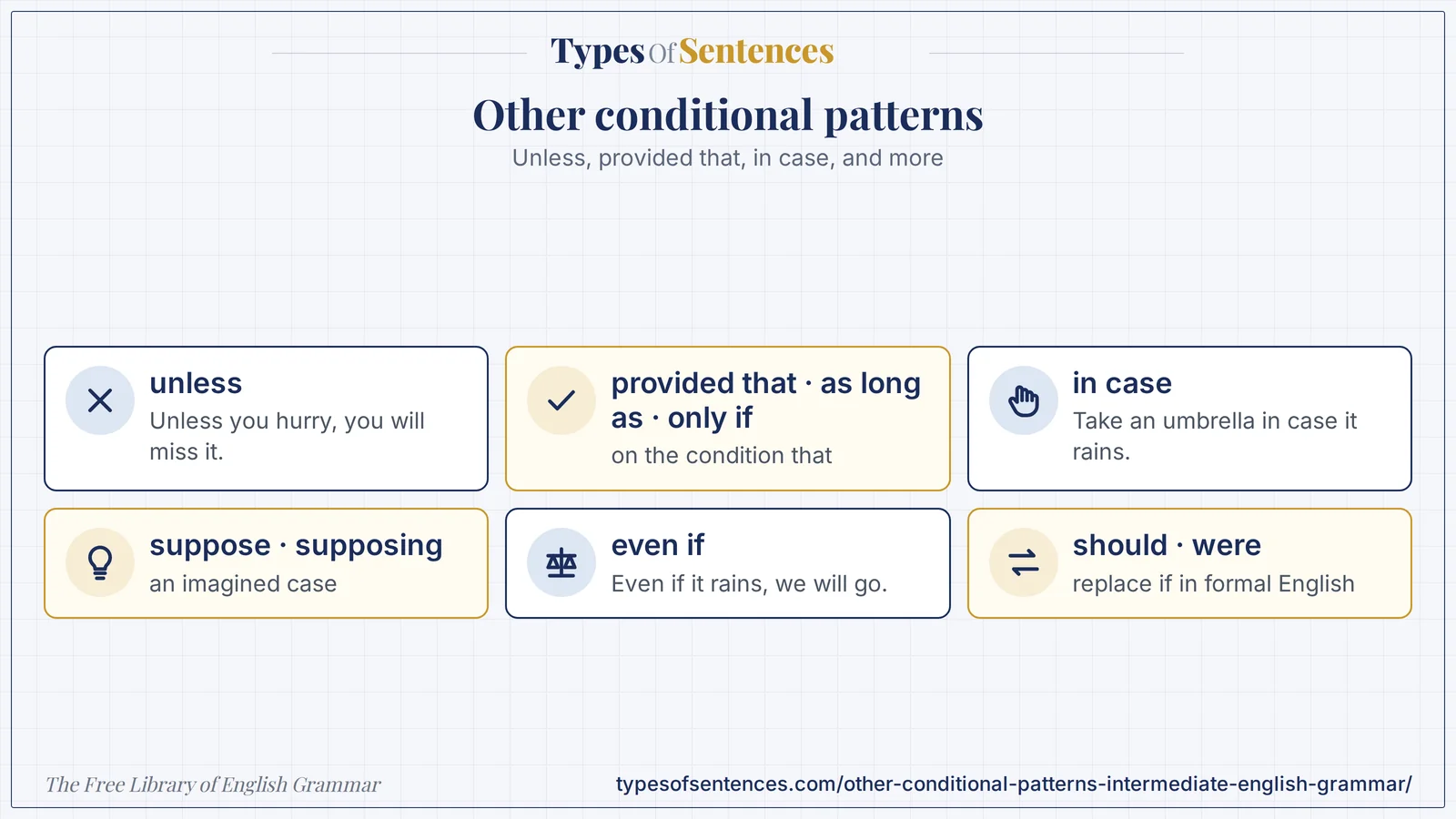
The word if is the most general way to start a condition. The other words are more precise: unless excludes one case, provided that sets a requirement, in case gives a reason for a precaution.
Why it matters: Most of these words follow the same tense rules as if: a present simple for a real future condition, and no will in the condition clause.
Summary: Unless = if not. Provided that, providing that, as long as, and only if = on the condition that. In case = as a precaution because something may happen. Suppose and supposing introduce an imagined case. Even if = whether or not. Should and were can replace if by inversion.
- Unless you hurry, you will miss it. (= If you do not hurry …)
- You may go provided that you are back by ten.
- Take an umbrella in case it rains. (precaution)
- Even if it rains, we will go.
What You’ll Learn
- 1. Conditional Patterns: Unless (If Not)
- 2. Unless, Provided That: Providing That
- 3. As Long As and So Long As
- 4. In Case
- 5. Suppose and Supposing
- 6. Even If, Only If, and Whether
- 7. But For, Without, and If It Weren’t For
- 8. Should and Were To: Inverted Conditionals
- 9. Implied Conditions and Other Variations
- 10. Summary of Conditional Words
- 11. Common Errors with Conditional Patterns
- 12. Exercises
- 13. Test Your Knowledge
- 14. Frequently Asked Questions
- 15. Conclusion
1. Conditional Patterns: Unless (If Not)
Unless means if … not or except if. It introduces the one case in which the main clause will not happen. It is a subordinating conjunction, described in the guide to subordinating conjunctions.
| With unless | With if … not |
|---|---|
| We will go unless it rains. | We will go if it does not rain. |
| Unless you hurry, you will miss the train. | If you do not hurry, you will miss the train. |
| I won’t go unless you come. | I won’t go if you don’t come. |
| Mistake | Correction |
|---|---|
| Unless you don’t hurry, you will miss it. | Unless you hurry, you will miss it. |
| Unless it will rain, we will go. | Unless it rains, we will go. |
| Unless I had known, I would have called. (unreal) | If I hadn’t known, I would not have called. (use if … not) |
2. Unless, Provided That: Providing That
Provided that and providing that mean only if. They state a requirement or a condition that must be met. They are formal; the word that can be omitted.
| Pattern | Example |
|---|---|
| provided (that) | You may leave early provided that you finish your work. |
| providing (that) | I will lend you the car providing you drive carefully. |
| on condition that (formal) | I will sign on condition that the price is lowered. |
| as long as (informal) | You can go as long as you are back by ten. |
| so long as | So long as you are polite, you are welcome. |
The tense is a present simple for a real future condition, as in the first conditional; see the chapter on zero and first conditionals. Compare If you finish your work, you may leave (a neutral condition) with You may leave provided that you finish your work (a requirement).
3. As Long As and So Long As
As long as has two meanings. It can mean only if (a condition), and it can mean for the whole time that (a duration).
| Meaning | Example |
|---|---|
| only if (a condition) | You can borrow my car as long as you drive carefully. |
| for the whole time that (a duration) | I will love you as long as I live. We can stay as long as you like. |
| only if (informal; same meaning as provided that) | As long as you are happy, I’m happy. |
| Pattern | Note |
|---|---|
| as long as + present simple (future meaning) | As long as it doesn’t rain, we will go. |
| as long as + past simple (unreal) | I would help as long as I had time. |
| no will after as long as | As long as you will be here is wrong; use As long as you are here |
4. In Case
In case means because something might happen. It gives the reason for a precaution. It is not the same as if.
| With in case | With if |
|---|---|
| Take an umbrella in case it rains. (rain may come; take it now) | Take an umbrella if it rains. (take it only after the rain starts, or only when it rains) |
| I’ll leave a key in case you come home early. | I’ll leave a key if you come home early. |
| Write it down in case you forget. | Write it down if you forget. (odd) |
- Use the present simple after in case for the future: in case it rains.
- Use the past simple for a precaution in the past: I took a key in case I needed it.
- In case of + noun means if there is: In case of fire, use the stairs.
- In American English, in case can also mean if in some contexts: In case you see him, tell him I called. Careful writers keep the precaution meaning.
5. Suppose and Supposing
Suppose and supposing introduce an imagined case, usually in a question. They mean what if. They can start a first-conditional or second-conditional pattern.
| Pattern | Example | Type |
|---|---|---|
| suppose / supposing + present simple | Suppose it rains tomorrow, what will we do? | real, first conditional |
| suppose / supposing + past simple | Suppose you won the lottery, what would you do? | unreal, second conditional |
| suppose / supposing + past perfect | Suppose you had missed the train, what would you have done? | unreal, third conditional |
| what if + present or past | What if it rains? What if I fail? | worry or suggestion |
| imagine (that) + clause | Imagine you were famous; how would you feel? | unreal |
These forms follow the same tense rules as the matching conditional types: see the chapters on the second conditional and the third conditional. A suggestion can use the same pattern: Suppose we ask her?
6. Even If, Only If, and Whether
| Word | Meaning | Example |
|---|---|---|
| even if | in spite of the condition; whether or not | I will go even if it rains. (rain makes no difference) |
| even though (not a condition) | in spite of a fact | I will go even though it is raining. (it is raining) |
| only if | and in no other case | You can go only if you finish your homework. |
| only if (inverted) | formal emphasis | Only if you finish will you be allowed to go. |
| whether … or not | in either case | I will go whether it rains or not. |
| if only | a strong wish (not a condition) | If only I had more time! |
7. But For, Without, and If It Weren’t For
Some patterns replace the if clause with a noun phrase. They express a condition that is contrary to fact.
| Pattern | Example | Meaning |
|---|---|---|
| if it weren’t for + noun (present) | If it weren’t for your help, I would be in trouble. | but you are helping |
| if it hadn’t been for + noun (past) | If it hadn’t been for your help, I would have failed. | but you helped |
| but for + noun (formal) | But for the rain, we would have gone. | except for the rain |
| without + noun | Without your help, I would have failed. | if I had not had your help |
| were it not for / had it not been for (inverted) | Were it not for the rain, we would go. Had it not been for you, I would have failed. | very formal |
8. Should and Were To: Inverted Conditionals
In formal English, should, were, and had can begin a conditional sentence in place of if. The subject follows the verb.
| With if | Inverted (formal) | Use |
|---|---|---|
| If you should need help, call me. | Should you need help, call me. | a small chance; polite instruction |
| If I were to win, I would be delighted. | Were I to win, I would be delighted. | an unlikely event |
| If she had known, she would have called. | Had she known, she would have called. | the unreal past |
| If it were not for you, I would be lost. | Were it not for you, I would be lost. | but for |
| If they should call, tell them I’m out. | Should they call, tell them I’m out. | a formal request |
The inverted forms are common in business letters and formal writing: Should you have any questions, please contact us. The main clause can contain a command, will, or would. They are covered in depth at the Advanced level.
9. Implied Conditions and Other Variations
| Pattern | Example | Meaning |
|---|---|---|
| imperative + and | Study hard and you will pass. | if you study hard, you will pass |
| imperative + or / otherwise | Hurry, or you will miss the train. | if you do not hurry, you will miss it |
| noun phrase + would | A wise man would have stayed. | if he had been wise |
| with + noun | With a little luck, we will win. | if we have a little luck |
| to-infinitive | To hear him talk, you would think he was rich. | if you heard him talk |
| otherwise / or else | Take the medicine; otherwise you will not get better. | if you do not take it |
| if any / if ever | Few, if any, people came. She rarely, if ever, complains. | a minimal or almost zero amount |
| if and when | If and when she calls, tell her I’m out. | if she calls, and at the time she does |
These conditional variations show that a condition can be expressed without an if clause. The reader supplies the missing condition from the context. For the unreal past and mixed forms, see the chapter on the third conditional, and for the overview, the chapter on conditional sentences.
10. Summary of Conditional Words
| Word | Meaning | Example |
|---|---|---|
| if | a general condition | If it rains, we stay. |
| unless | if … not | Unless it rains, we go. |
| provided / providing (that) | only if (a requirement) | You may go provided that you finish. |
| as long as / so long as | only if (informal); for the time that | As long as you are quiet, you can stay. |
| in case | as a precaution | Take an umbrella in case it rains. |
| suppose / supposing | imagine | Suppose you won, what would you do? |
| even if | whether or not | Even if it rains, we will go. |
| only if | and no other case | Only if you finish can you go. |
| but for / without | if it were not for | But for you, I would have failed. |
| should / were / had (inverted) | formal if | Should you need help, call me. |
Choose the best word: I will lend you the car ___ you drive carefully, ___ you promise to be home by ten, and I’ll give you a spare key ___ you lose the first one.
- A requirement: provided that (or as long as).
- A second requirement: as long as (or if).
- A precaution: in case.
- Result: I will lend you the car provided that you drive carefully, as long as you promise to be home by ten, and I’ll give you a spare key in case you lose the first one.
11. Common Errors with Conditional Patterns
| Error | Correction | Rule |
|---|---|---|
| Unless you don’t hurry, you will miss it. | Unless you hurry, you will miss it. | no negative after unless |
| Take an umbrella if it will rain. | Take an umbrella in case it rains. | precaution: in case; no will |
| As long as it will not rain, we go. | As long as it doesn’t rain, we will go. | present simple after as long as |
| Provided you will come, I’ll be glad. | Provided you come, I’ll be glad. | present simple |
| Even though it rains, we will go. (hypothetical) | Even if it rains, we will go. | even if for a hypothetical |
| Unless I had known, I would have called. | If I hadn’t known, I wouldn’t have called. | no unless with unreal conditions |
| In case you will need it, take it. | In case you need it, take it. | present simple after in case |
| Suppose it will rain, what will we do? | Suppose it rains, what will we do? | present simple after suppose |
| Should you will need help, call me. | Should you need help, call me. | base verb after inverted should |
| I would go only if I will have time. | I would go only if I had time. | tense follows the conditional type |
Fix: Unless you don’t hurry, you will miss the train, so take a coat if it will be cold, provided you will not forget your ticket, even though it rains tomorrow.
- Unless you don’t hurry: Unless you hurry.
- take a coat if it will be cold: a precaution: in case it is cold.
- provided you will not forget: provided you do not forget.
- even though it rains tomorrow: a hypothetical case: even if it rains tomorrow.
- Result: Unless you hurry, you will miss the train, so take a coat in case it is cold, provided you do not forget your ticket, even if it rains tomorrow.
Recap in 12 seconds
Watch the lesson build itself: Unless means if not; provided that, in case, even if, and should or were give other conditional meanings. The video has no sound.
Exercises
Part A: Unless (Exercises 1–6)
Exercise 1: Rewrite with unless: If you don’t hurry, you will miss it.
Show Answer
Answer: Unless you hurry, you will miss it.
Exercise 2: Rewrite with if: Unless it rains, we will go.
Show Answer
Answer: If it doesn’t rain, we will go.
Exercise 3: Fix it: Unless you don’t hurry, you will miss it.
Show Answer
Answer: Unless you hurry, you will miss it.
Exercise 4: Fix it: Unless it will rain, we will go.
Show Answer
Answer: Unless it rains, we will go.
Exercise 5: Can unless be used in the third conditional?
Show Answer
Answer: No. Use if … not.
Exercise 6: Meaning of unless:
Show Answer
Answer: If … not; except if.
Part B: Provided That and As Long As (Exercises 7–12)
Exercise 7: Complete: You may go ___ that you finish your work.
Show Answer
Answer: provided.
Exercise 8: Replace provided that with an informal phrase: You may go provided that you are back by ten.
Show Answer
Answer: …as long as you are back by ten.
Exercise 9: Meaning of as long as in I will love you as long as I live:
Show Answer
Answer: For the whole time that.
Exercise 10: Fix it: As long as you will be here, you can use it.
Show Answer
Answer: As long as you are here, you can use it.
Exercise 11: Formal phrase for only if:
Show Answer
Answer: on condition that.
Exercise 12: Fix it: Provided you will come, I’ll be glad.
Show Answer
Answer: Provided you come, I’ll be glad.
Part C: In Case (Exercises 13–17)
Exercise 13: Choose: Take an umbrella (if/in case) it rains. (take it now)
Show Answer
Answer: in case.
Exercise 14: Choose: I’ll leave a key (if/in case) you come home early.
Show Answer
Answer: in case.
Exercise 15: Fix it: In case you will need it, take it.
Show Answer
Answer: In case you need it, take it.
Exercise 16: Meaning of in case of fire:
Show Answer
Answer: If there is a fire.
Exercise 17: Past precaution: I took a key in case I (need) it.
Show Answer
Answer: needed.
Part D: Suppose, Even If, Only If (Exercises 18–23)
Exercise 18: Complete: Suppose you (win) the lottery, what would you do?
Show Answer
Answer: won.
Exercise 19: Complete: Suppose it (rain) tomorrow, what will we do?
Show Answer
Answer: rains.
Exercise 20: Choose: I will go (even if/even though) it rains. (it might rain)
Show Answer
Answer: even if.
Exercise 21: Choose: I will go (even if/even though) it is raining. (it is raining now)
Show Answer
Answer: even though.
Exercise 22: Meaning of only if:
Show Answer
Answer: And in no other case.
Exercise 23: Meaning of whether … or not:
Show Answer
Answer: In either case.
Part E: But For and Inversion (Exercises 24–28)
Exercise 24: Rewrite: If it hadn’t been for your help, I would have failed. (but for)
Show Answer
Answer: But for your help, I would have failed.
Exercise 25: Invert: If you should need help, call me.
Show Answer
Answer: Should you need help, call me.
Exercise 26: Invert: If I were to win, I would be delighted.
Show Answer
Answer: Were I to win, I would be delighted.
Exercise 27: Invert: If she had known, she would have called.
Show Answer
Answer: Had she known, she would have called.
Exercise 28: Rewrite with without: If I had not had your help, I would have failed.
Show Answer
Answer: Without your help, I would have failed.
Part F: Implied and Errors (Exercises 29–30)
Exercise 29: Rewrite as a conditional: Study hard and you will pass.
Show Answer
Answer: If you study hard, you will pass.
Exercise 30: Fix it: Take an umbrella if it will rain.
Show Answer
Answer: Take an umbrella in case it rains.
Test Your Knowledge
Ready to check what you learned? Answer all 10 questions, then submit. You need 80% (8 of 10) to pass. Your answers are not stored.
View correct answers and explanations
Question 1: What does unless mean?
✓ Correct Answer: A – if not
Unless means if not.
Question 2: Which is correct?
✓ Correct Answer: B – Unless you hurry, you will miss it.
No negative after unless.
Question 3: Which means only if?
✓ Correct Answer: D – provided that
Provided that means only if.
Question 4: Which gives a reason for a precaution?
✓ Correct Answer: C – in case
In case gives a precaution.
Question 5: Which is correct?
✓ Correct Answer: C – Take an umbrella in case it rains.
In case + present simple.
Question 6: Which means whether or not?
✓ Correct Answer: C – even if
Even if means whether or not.
Question 7: Which is the inverted form of If you should need help?
✓ Correct Answer: A – Should you need help
Should + subject + base verb.
Question 8: Which is a formal pattern?
✓ Correct Answer: D – But for your help, I would have failed.
But for is a formal conditional.
Question 9: Which is an implied condition?
✓ Correct Answer: B – Study hard and you will pass.
Imperative + and implies a condition.
Question 10: Which is correct?
✓ Correct Answer: B – As long as it doesn’t rain, we will go.
Present simple after as long as.
Frequently Asked Questions
What are conditional patterns?
Conditional patterns are the ways of stating a condition other than a plain if clause: unless, provided that, as long as, in case, suppose, even if, but for, and the inverted should, were, and had.
What is unless, provided that?
Unless means if not (Unless you hurry, you will miss it). Provided that means only if (You may go provided that you finish). The two give the condition an exact meaning.
What does as long as mean?
As long as means only if (a condition) or for the whole time that (a duration). You can go as long as you are back by ten is a condition.
What is the difference between in case and if?
In case gives the reason for a precaution (Take an umbrella in case it rains). If states a condition for an action (Take an umbrella if it rains).
What are conditional variations?
Conditional variations are the forms that state a condition without a normal if clause, such as the imperative with and (Study hard and you will pass), with + noun, and inverted should.
What is the difference between even if and even though?
Even if introduces a hypothetical condition (Even if it rains, we will go). Even though introduces a real fact (Even though it is raining, we will go).
Can I use unless in the second or third conditional?
No. In unreal conditionals, use if … not: If I hadn’t seen it, I wouldn’t have believed it.
Conclusion
You now know the other conditional patterns: unless, provided that, as long as, in case, suppose, even if, but for, inverted should and were, and the implied conditions. You can choose the exact word, use the right tense, and avoid the common errors.
Check whether you want to state an exception, a requirement, or a precaution, and choose the word that says it. Next, you begin the study of the non-finite verbs with gerunds.
- Merriam-Webster Dictionary: unless: the dictionary entry for unless.
- Purdue Online Writing Lab: Grammar: reference section on conjunctions and clauses.
- Quirk, Randolph, et al. A Comprehensive Grammar of the English Language. Longman, 1985.: conditional and concessive clauses.
- Huddleston, Rodney, and Geoffrey K. Pullum. The Cambridge Grammar of the English Language. Cambridge University Press, 2002.: conditional clauses and subordinators.
Last reviewed: October 29, 2026. How it was made: drafted with AI assistance, then checked with automated tests (structure, links, answer keys, spelling) and against the sources above. A person has not yet read this chapter line by line. Found a mistake? Report it.