The third conditional talks about the past as it might have been: If I had studied, I would have passed. The if clause uses the past perfect, and the main clause uses would have plus the past participle. Because the past cannot be changed, the situation is impossible: I did not study, and I did not pass. The third conditional is the conditional of the unreal past and of past regrets.
This chapter gives the structure of the third conditional, with third conditional examples for each use. You will see how it expresses regrets, criticism, relief, and excuses, how other modals change the meaning, how the negative forms work, how the third conditional compares with the second, and how mixed conditionals combine a past condition with a present result. It ends with inversion and the common errors. Thirty exercises and a quiz follow.
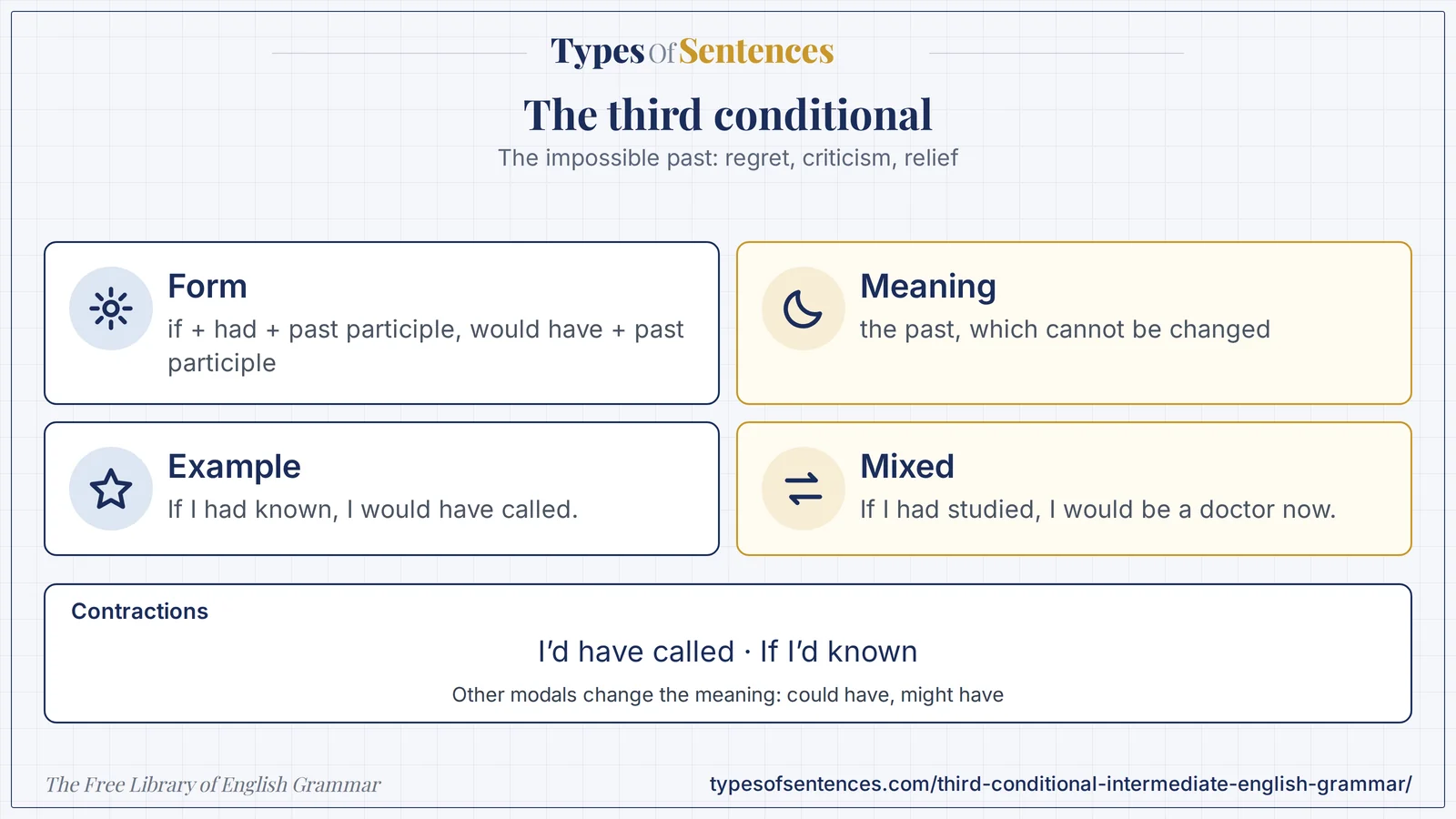
The third conditional looks back and imagines a different past. It says what would have happened if something else had happened, and both things are over.
Why it matters: The two verb forms are easy to remember: had + past participle in the if clause, and would have + past participle in the main clause.
Summary: Third conditional: if + past perfect, would have + past participle. It describes an impossible past situation and its imaginary result (If I had known, I would have called), regrets, criticism, and relief. Other modals (could have, might have) change the certainty. Mixed conditionals combine a past condition with a present result. Never use would have in the if clause.
- Form: if + had + past participle, would have + past participle.
- Meaning: the past, impossible to change; regret or criticism.
- Contractions: I’d have (would have), If I’d known (had known).
- Mixed: If I had studied, I would be a doctor now.
What You’ll Learn
- 1. Third Conditional Structure
- 2. Uses of the Third Conditional
- 3. Other Modals in the Third Conditional
- 4. Negative Forms and Contractions
- 5. Third vs. Second Conditional
- 6. Mixed Conditionals
- 7. Inversion and Related Patterns
- 8. Common Errors with the Third Conditional
- 9. Exercises
- 10. Test Your Knowledge
- 11. Frequently Asked Questions
- 12. Conclusion
1. Third Conditional Structure
The third conditional uses the past perfect in the if clause and would have plus the past participle in the main clause. The past perfect is described in the chapter on the past tenses.
| Pattern | Example |
|---|---|
| if + past perfect, would have + past participle | If I had studied, I would have passed. |
| would have + past participle + if + past perfect | I would have passed if I had studied. |
| negative if clause | If I hadn’t missed the bus, I wouldn’t have been late. |
| negative result | If I had known, I wouldn’t have gone. |
| question | What would you have done if you had lost your job? |
| contractions | If I’d known, I’d have called. |
This is the if past perfect would have pattern. It is the third of the four types in the overview chapter on conditional sentences. The past participles of irregular verbs are in the guide to irregular verbs.
| Fact (what happened) | Third conditional (what did not happen) |
|---|---|
| I did not study. I failed. | If I had studied, I would have passed. |
| She missed the bus. She was late. | If she had caught the bus, she would not have been late. |
| They did not listen. They got lost. | If they had listened, they would not have got lost. |
| The weather was bad. We stayed home. | If the weather had been good, we would have gone out. |
2. Uses of the Third Conditional
| Use | Example |
|---|---|
| regret about the past | If I had known, I would have called. If only I had listened! |
| criticism or blame | If you had been more careful, the accident wouldn’t have happened. |
| relief (a bad thing did not happen) | If I had missed the train, I would have lost my job. (but I caught it) |
| an excuse or explanation | If the traffic hadn’t been so bad, I would have arrived on time. |
| speculation about history | If the king had not died, the war would not have started. |
| a hypothetical comparison | If she had trained harder, she would have won the race. |
In every case the condition did not happen, so the result is imaginary. Notice that the third conditional can express both a negative feeling (regret, blame) and a positive one (relief): If I had taken that flight, I would have been in the crash.
3. Other Modals in the Third Conditional
In the main clause, could have and might have can replace would have. The modals are in the chapter on modal verbs.
| Modal | Meaning | Example |
|---|---|---|
| would have | the sure result of the imaginary condition | If I had studied, I would have passed. |
| could have | the ability or chance of the result | If I had studied, I could have passed. (I had the chance) |
| might have | a possible result | If I had studied, I might have passed. (perhaps) |
| should have | what was advisable | If you had been ill, you should have stayed home. |
| must have | a logical result (rare) | If he had left at six, he must have arrived by now. |
| Statement | Meaning |
|---|---|
| If I had studied, I would have passed. | I would certainly have passed. |
| If I had studied, I could have passed. | It would have been possible to pass. |
| If I had studied, I might have passed. | Perhaps I would have passed. |
The perfect modal forms are explained in the chapters on modals of deduction and modals of obligation (should have). The third conditional is a way of using them to talk about the unreal past.
4. Negative Forms and Contractions
| Form | Example |
|---|---|
| negative if clause | If I hadn’t forgotten my keys, I wouldn’t have been late. |
| negative result | If I had seen him, I wouldn’t have stopped. |
| both negative | If I hadn’t seen him, I wouldn’t have stopped. |
| contraction of had | If I’d known, I’d have called. |
| contraction of would | I’d have called if I’d known. |
| spoken form (not written) | I’d’ve (I would have) |
Do not use would in the if clause, and write would have, not would of. The form of comes from the way ’ve sounds in speech.
5. Third vs. Second Conditional
| Second | Third | |
|---|---|---|
| form | if + past, would + base | if + past perfect, would have + past participle |
| time | present or future | past |
| example | If I had time, I would help. | If I had had time, I would have helped. |
| meaning | I have no time now. | I had no time then. |
| changeable? | possibly, in principle | no; the past is fixed |
- If I were rich, I would travel. (now)
- If I had been rich, I would have traveled. (then)
- If she studied, she would pass. (an unlikely future)
- If she had studied, she would have passed. (what happened)
The second conditional is studied in the previous chapter. Do not mix the two forms in one pair: If I had known, I would go is a mistake; say If I had known, I would have gone.
6. Mixed Conditionals
A mixed conditional combines a third-conditional if clause with a second-conditional main clause, or the other way round. It is used when the time of the condition differs from the time of the result.
| Type | Pattern | Example |
|---|---|---|
| past condition, present result | if + past perfect, would + base verb | If I had studied harder, I would have a better job now. |
| past condition, present result | if + past perfect, would + base verb | If she had taken the medicine, she would be well now. |
| present condition, past result | if + past simple, would have + past participle | If I weren’t so shy, I would have asked her out last year. |
| present condition, past result | if + past simple, would have + past participle | If he were more careful, he wouldn’t have crashed the car. |
| Time line | Example | Meaning |
|---|---|---|
| past → present | If I had married her, I would be happy now. | I did not marry her; I am not happy now. |
| present → past | If I were braver, I would have said yes. | I am not brave; I did not say yes. |
Mixed conditionals are a natural extension of the third conditional. They show that the unreal past still affects the present. More patterns are in the next chapter, on other conditional patterns.
7. Inversion and Related Patterns
| With if | Inverted (formal) |
|---|---|
| If I had known, I would have called. | Had I known, I would have called. |
| If she had been there, she would have helped. | Had she been there, she would have helped. |
| If he had not left, he would have seen it. | Had he not left, he would have seen it. |
| Pattern | Example | Note |
|---|---|---|
| If it hadn’t been for + noun | If it hadn’t been for your help, I would have failed. | because of you |
| But for + noun (formal) | But for your help, I would have failed. | formal |
| I wish + past perfect | I wish I had studied. | a regret about the past |
| If only + past perfect | If only I had listened! | a stronger regret |
| as if + past perfect | He looked as if he had seen a ghost. | an unreal comparison |
Inverted conditionals are formal and common in writing; they are studied at the Advanced level. The wish forms use the same unreal past perfect.
8. Common Errors with the Third Conditional
| Error | Correction | Rule |
|---|---|---|
| If I would have known, I would have called. | If I had known, I would have called. | no would in the if clause |
| If I had known, I would of called. | If I had known, I would have called. | would have, not would of |
| If I knew, I would have called. | If I had known, I would have called. | past perfect in the if clause |
| If I had known, I would call. | If I had known, I would have called. | would have in the main clause |
| If I had knew, I would have called. | If I had known, I would have called. | past participle after had |
| If I have known, I would have called. | If I had known, I would have called. | had, not have |
| If she had studied, she would have passed. (comma missing) | If she had studied, she would have passed. | comma after the if clause |
| If I had been him, I would not have went. | If I had been him, I would not have gone. | past participle after have |
| If it wouldn’t have rained, we would have gone. | If it hadn’t rained, we would have gone. | negative with hadn’t |
| I wish I would have studied. | I wish I had studied. | past perfect after wish |
Fix: If I would have known about the test, I would of studied, and if I studied, I would pass, but if it wouldn’t have been for my friend, I fail.
- If I would have known: If I had known.
- would of studied: would have studied.
- if I studied, I would pass: the past: if I had studied, I would have passed.
- if it wouldn’t have been … I fail: if it hadn’t been for my friend, I would have failed.
- Result: If I had known about the test, I would have studied, and if I had studied, I would have passed, but if it hadn’t been for my friend, I would have failed.
Recap in 12 seconds
Watch the lesson build itself: The third conditional pairs if and had plus a past participle with would have plus a past participle. The video has no sound.
Exercises
Part A: Form (Exercises 1–7)
Exercise 1: Complete: If I (study), I would have passed.
Show Answer
Answer: had studied.
Exercise 2: Complete: If she had caught the bus, she (not be) late.
Show Answer
Answer: would not have been.
Exercise 3: Make negative: If I had known, I would have gone.
Show Answer
Answer: If I hadn’t known, I wouldn’t have gone. (or: If I had known, I wouldn’t have gone.)
Exercise 4: Contract: If I had known, I would have called.
Show Answer
Answer: If I’d known, I’d have called.
Exercise 5: Question: You would have lost your job. (if)
Show Answer
Answer: What would you have done if you had lost your job?
Exercise 6: Fix it: If I would have known, I would have called.
Show Answer
Answer: If I had known, I would have called.
Exercise 7: Fix it: I would of called.
Show Answer
Answer: I would have called.
Part B: Uses (Exercises 8–13)
Exercise 8: Use: If I had known, I would have called.
Show Answer
Answer: Regret.
Exercise 9: Use: If you had been careful, the accident wouldn’t have happened.
Show Answer
Answer: Criticism or blame.
Exercise 10: Use: If I had missed the train, I would have lost my job.
Show Answer
Answer: Relief.
Exercise 11: Use: If the traffic hadn’t been so bad, I would have arrived on time.
Show Answer
Answer: An excuse.
Exercise 12: Did the person in If I had studied, I would have passed study?
Show Answer
Answer: No.
Exercise 13: Can the past in a third conditional be changed?
Show Answer
Answer: No.
Part C: Other Modals (Exercises 14–18)
Exercise 14: Possible result: If I had studied, I (pass). (might)
Show Answer
Answer: might have passed.
Exercise 15: Chance: If I had studied, I (pass). (could)
Show Answer
Answer: could have passed.
Exercise 16: Meaning: If I had studied, I could have passed.
Show Answer
Answer: It would have been possible to pass.
Exercise 17: Advice about the past: If you had been ill, you ___ stayed home.
Show Answer
Answer: should have.
Exercise 18: Fix it: If I had known, I would call.
Show Answer
Answer: If I had known, I would have called.
Part D: Second vs Third and Mixed (Exercises 19–24)
Exercise 19: Type: If I were rich, I would travel.
Show Answer
Answer: Second (present).
Exercise 20: Type: If I had been rich, I would have traveled.
Show Answer
Answer: Third (past).
Exercise 21: Mixed: If I (study) harder, I would have a better job now.
Show Answer
Answer: had studied.
Exercise 22: Mixed: If I (be) braver, I would have said yes.
Show Answer
Answer: were.
Exercise 23: Fix it: If I knew, I would have called.
Show Answer
Answer: If I had known, I would have called.
Exercise 24: Meaning of If I had married her, I would be happy now.
Show Answer
Answer: I did not marry her, and I am not happy now.
Part E: Inversion and Related (Exercises 25–28)
Exercise 25: Invert: If I had known, I would have called.
Show Answer
Answer: Had I known, I would have called.
Exercise 26: Invert: If she had not left, she would have seen it.
Show Answer
Answer: Had she not left, she would have seen it.
Exercise 27: Rewrite with if it hadn’t been for: Because of your help, I did not fail.
Show Answer
Answer: If it hadn’t been for your help, I would have failed.
Exercise 28: Wish: I wish I (study) harder. (past regret)
Show Answer
Answer: had studied.
Part F: Errors (Exercises 29–30)
Exercise 29: Fix it: If I had knew, I would have called.
Show Answer
Answer: If I had known, I would have called.
Exercise 30: Fix it: I wish I would have studied.
Show Answer
Answer: I wish I had studied.
Test Your Knowledge
Ready to check what you learned? Answer all 10 questions, then submit. You need 80% (8 of 10) to pass. Your answers are not stored.
View correct answers and explanations
Question 1: What does the third conditional express?
✓ Correct Answer: D – An unreal past
The third conditional is about the unreal past.
Question 2: Which is the third conditional?
✓ Correct Answer: C – If I had known, I would have called.
If + past perfect, would have + past participle.
Question 3: Which is correct?
✓ Correct Answer: B – If I had known, I would have called.
Past perfect in the if clause.
Question 4: Which is correct?
✓ Correct Answer: C – I would have called.
Write would have, not would of.
Question 5: What does If I had studied, I would have passed mean?
✓ Correct Answer: B – I did not study and did not pass
The situation is unreal: I did not study.
Question 6: Which is a mixed conditional?
✓ Correct Answer: A – If I had studied, I would have a better job now.
A past condition with a present result.
Question 7: Which is the inverted form?
✓ Correct Answer: A – Had I known, I would have called.
Had + subject replaces if.
Question 8: Which modal shows a possible result?
✓ Correct Answer: C – might have
Might have shows a possible result.
Question 9: Which expresses relief?
✓ Correct Answer: D – If I had missed the train, I would have lost my job.
A bad thing did not happen.
Question 10: Which is correct with wish?
✓ Correct Answer: B – I wish I had studied.
Wish + past perfect for a past regret.
Frequently Asked Questions
What is the third conditional?
The third conditional uses if + past perfect and would have + past participle. It describes an imaginary or impossible past situation and its result: If I had studied, I would have passed.
What are some third conditional examples?
If I had known, I would have called. If she had caught the bus, she would not have been late. If it hadn’t rained, we would have gone out. are third conditional examples.
What is the if past perfect would have pattern?
The if past perfect would have pattern is the third conditional: if + had + past participle, would have + past participle. It looks back at the past.
What is the unreal past?
The unreal past is a past situation that did not happen and cannot change. The third conditional is the main way to describe it, and the past perfect marks the unreality.
How do I talk about past regrets?
Use the third conditional (If I had known, I would have called), I wish + past perfect (I wish I had studied), or If only + past perfect (If only I had listened) to talk about past regrets.
What is the difference between the second and third conditional?
The second conditional (If I had time, I would help) is about the present or future. The third (If I had had time, I would have helped) is about the past and cannot be changed.
Why is would of wrong?
Would of comes from the sound of would’ve in speech. The correct written form is would have.
Conclusion
You now know the third conditional: if + past perfect, would have + past participle for the unreal past. You can express regret, criticism, relief, and excuses, vary the modal, handle negatives and contractions, combine times in mixed conditionals, use inversion, and avoid the common errors.
Think of the third conditional as looking back at the past that did not happen. Next, you will study other conditional patterns.
- Merriam-Webster Dictionary: counterfactual: the dictionary definition of counterfactual.
- Purdue Online Writing Lab: Grammar: reference section on verbs and conditionals.
- Quirk, Randolph, et al. A Comprehensive Grammar of the English Language. Longman, 1985.: hypothetical past conditions.
- Huddleston, Rodney, and Geoffrey K. Pullum. The Cambridge Grammar of the English Language. Cambridge University Press, 2002.: closed conditions in the past.
Last reviewed: October 29, 2026. How it was made: drafted with AI assistance, then checked with automated tests (structure, links, answer keys, spelling) and against the sources above. A person has not yet read this chapter line by line. Found a mistake? Report it.