Advanced conditionals go beyond the four “types” that you learned at the Intermediate level. In real English, the condition and the result do not always share the same time frame: If I had studied medicine, I would be a doctor now links a past condition to a present result. Conditions can be implied without if (Without your help, we would have failed), formed by inversion (Had I known, I would have come), or introduced by words such as provided, supposing, and given that. Conditionals also do work in argument and negotiation that has nothing to do with the real or unreal world.
You will study the logic of the system, mixed conditionals with all combinations of time frames, were to and should conditionals, implied conditions, inverted conditionals, alternative conditional words, the functions of complex conditionals in discourse, register, and the errors that learners and native speakers make. This is the path to conditional structures advanced writers use with control. Thirty editing exercises and a quiz follow.
A conditional sentence links a condition to a result: If it rains, we will stay home. The verb forms show how likely the speaker thinks the condition is. Real or open conditions use ordinary tenses; unreal or unlikely ones use the past forms, which signal remoteness from reality.
Why it matters: Mixed conditionals simply mix the time frames: the condition is in one time (often the past) and the result in another (often the present). Once you think of the verb forms as marking time and reality separately, mixing them is natural.
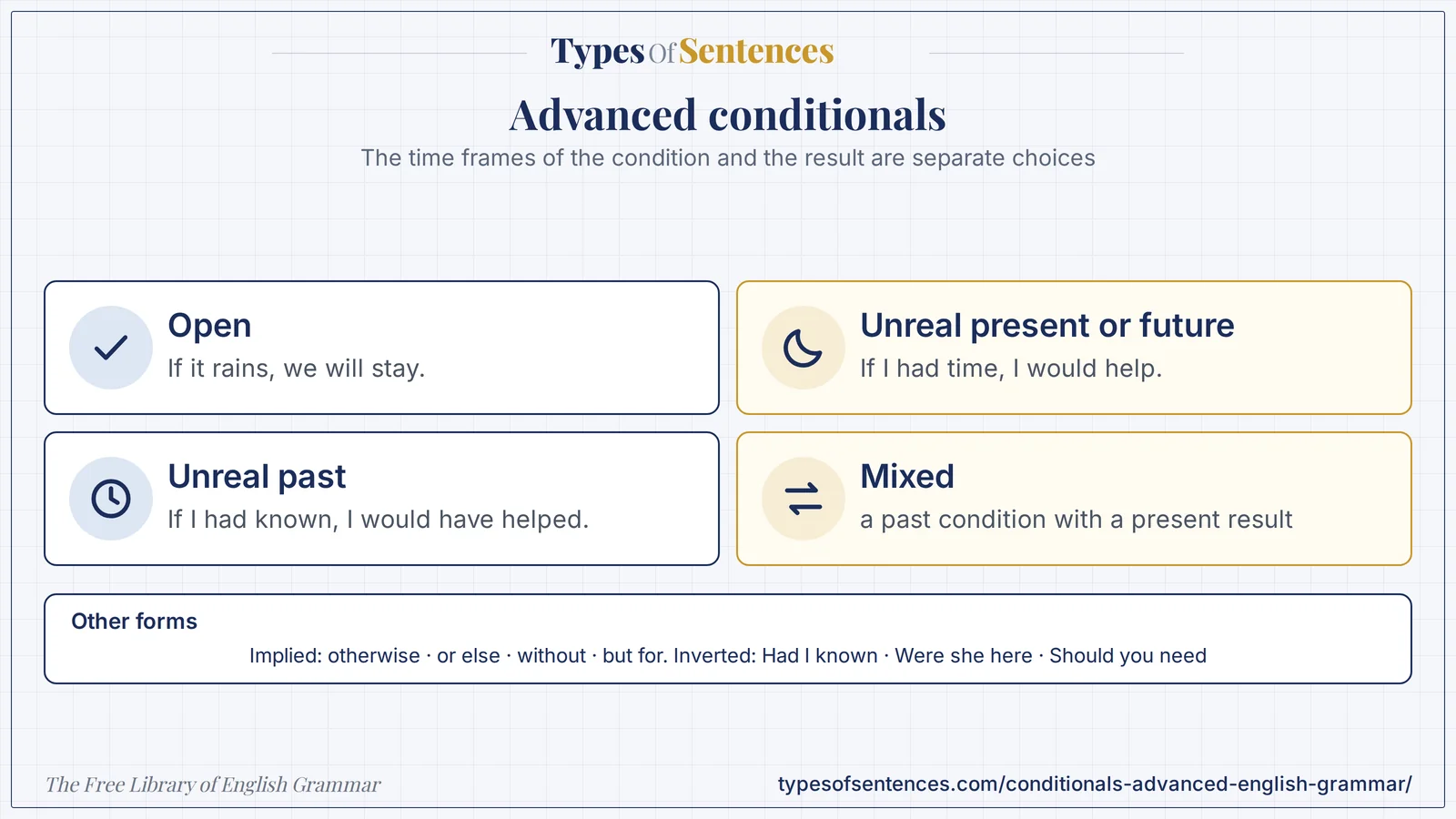
Summary: Open conditions use present tenses for future time (If it rains, we will stay). Unreal present or future conditions use the past (If I had time, I would help); unreal past conditions use the past perfect (If I had known, I would have come). Mixed conditionals combine the two (If I had studied medicine, I would be a doctor now). Conditions can be implied (otherwise, without), formed by inversion (Had I known), or introduced by provided, supposing, as long as, given that. In discourse, conditionals argue, bargain, advise, and threaten.
- Time frame of the condition and the result are separate choices.
- Mixed: past condition + present result; present state + past result.
- Implied: otherwise, or else, without, but for.
- Inverted: Had I known, Were she here, Should you need.
What You’ll Learn
- 1. Advanced Conditionals: The Logic of Open and Remote Conditions
- 2. Mixed Conditionals: All Combinations
- 3. Implied Conditions: Otherwise, Or Else, and Without
- 4. Inverted Conditionals
- 5. Alternative Conditional Words and Phrases
- 6. Conditionals in Discourse: Argument, Negotiation, and Speech Acts
- 7. Conditionals in Different Registers
- 8. Tense and Modal Choices in Conditionals
- 9. Common Errors with Conditionals
- 10. Exercises
- 11. Test Your Knowledge
- 12. Frequently Asked Questions
- 13. Conclusion
1. Advanced Conditionals: The Logic of Open and Remote Conditions
| Type | Time and reality | Condition | Result | Example |
|---|---|---|---|---|
| zero | general truth | present simple | present simple | If you heat ice, it melts. |
| first (open future) | a real possibility | present simple | will / imperative / modal | If it rains, we will stay home. |
| second (remote present or future) | unreal or unlikely | past simple (were) | would / could / might + base | If I had time, I would help. |
| third (unreal past) | contrary to fact | past perfect | would have + -en | If I had known, I would have come. |
| mixed | different time frames | either | either | If I had studied medicine, I would be a doctor now. |
The past forms in the second and third conditionals do not refer to past time in the same way. In If I had time, the past tense is a marker of remoteness from reality, not of time; in If I had known, the past perfect marks remoteness in the past. This is the same logic as in the chapter on modality. The relation of tense to time is treated in the chapter on tense and aspect. Seen this way, the four “types” are combinations of two independent choices: the time frame (past, present, future) and the degree of reality (open or remote).
| open (real) | remote (unreal) | |
|---|---|---|
| present or future time | If it rains, we will stay. | If it rained, we would stay. |
| past time | If he left early, he missed it. (a real past possibility) | If he had left early, he would have missed it. |
2. Mixed Conditionals: All Combinations
| Condition (time) | Result (time) | Pattern | Example |
|---|---|---|---|
| unreal past | unreal present | If + past perfect, would + base | If I had studied medicine, I would be a doctor now. |
| unreal past | unreal present (state) | — | If she hadn’t missed the train, she would be here now. |
| unreal present or permanent state | unreal past | If + past simple, would have + -en | If she were more careful, she wouldn’t have made that mistake. |
| unreal present | unreal past | — | If he weren’t so shy, he would have asked her to dance. |
| unreal past | unreal future | If + past perfect, would + base | If I had taken the job, I would be moving to Paris next month. |
| unreal present | unreal future | If + past simple, would + base | If I were a better swimmer, I would enter the race next week. (ordinary second conditional) |
| with could or might | — | If + past perfect, could / might + base | If you had told me, I could be helping you now. If he had listened, he might be better off. |
| Question to ask | Answer | Form |
|---|---|---|
| Is the condition about the past? | yes | past perfect (had done) |
| Is the condition a present state or permanent characteristic? | yes | past simple (were, did) |
| Is the result about now? | yes | would + base |
| Is the result about the past? | yes | would have + -en |
| Is the result in the future? | yes | would + base (with a future time word) |
The two most common mixed patterns are: (1) a past event and a present result (If I hadn’t missed the train, I would be there now); (2) a present or permanent condition and a past result (If she were more careful, she wouldn’t have made that mistake, meaning that she is not a careful person). Other combinations follow from the two choices. The test is whether the time frames of the condition and the result differ; if they do, the sentence is mixed.
| Related forms | Example | Notes |
|---|---|---|
| were to (formal, tentative future) | If you were to ask, she would help. Were you to ask, … | a hypothetical future event |
| should (a slight possibility) | If you should see her, tell her. Should you see her, … | unlikely but possible |
| happen to | If you happen to see her, tell her. | by chance |
| was going to | If she was going to leave, she would have said so. | an intention |
| if only, wish | If only I had known! I wish I had known. | regret; see below |
| would in the if-clause (politeness) | If you would sit down, I will call him. | willingness: “be so kind as to” |
In informal English, If I was you is common, while formal English uses the subjunctive If I were you. Some speakers also use would have in the if-clause (If I would have known, I would have come). This is common in speech in American English but is not accepted in standard written English; use had known.
3. Implied Conditions: Otherwise, Or Else, and Without
A condition can be understood without an if-clause. The conditional meaning comes from an adverb, a conjunction, a preposition, or the context.
| Device | Example | Paraphrase with if |
|---|---|---|
| otherwise | Take a coat; otherwise you will be cold. | If you don’t take a coat, you will be cold. |
| or (else) | Hurry, or you will miss the train. Hurry up or else! | If you don’t hurry, you will miss the train. |
| and after an imperative | Study hard, and you will pass. | If you study hard, you will pass. |
| without | Without your help, we would have failed. | If we hadn’t had your help, we would have failed. |
| but for | But for the rain, we would have gone. | If it hadn’t been for the rain, … |
| with | With a little luck, we will win. | If we have a little luck, we will win. |
| in that case, then | You are tired. In that case, rest. | If you are tired, rest. |
| if so, if not | If so, call me. If not, we’ll wait. | replaces a previous clause |
| participle clause | Left alone, he would have wept. | If he had been left alone, … |
| given, granted | Given time, she will succeed. | If she is given time, … |
| noun phrase as subject | A better plan would have succeeded. | If there had been a better plan, it would have succeeded. |
| another + noun | Another day and we would have won. | If we had had another day, … |
| infinitive | To hear her speak, you would think she was an expert. | If you heard her speak, you would think … |
| implied in the main clause only | I wouldn’t do that. | (if I were you) |
The word otherwise is a good test: it can replace a negative condition (otherwise = if not). You must apply by Friday; otherwise, your application will be rejected means If you don’t apply by Friday, your application will be rejected. Implied conditions are common in instructions, warnings, and advice.
4. Inverted Conditionals
| With if | Inverted | Time |
|---|---|---|
| If I had known, I would have come. | Had I known, I would have come. | unreal past |
| If she were here, she would help. | Were she here, she would help. | unreal present |
| If you should need help, call me. | Should you need help, call me. | unlikely future |
| If you were to ask, she would help. | Were you to ask, she would help. | hypothetical future |
| If it were not for your help, I would fail. | Were it not for your help, I would fail. | “but for” (present) |
| If it had not been for your help, I would have failed. | Had it not been for your help, I would have failed. | “but for” (past) |
| If she had not left, she would have seen it. | Had she not left, she would have seen it. | negative: not follows the subject |
Inversion is formal. It is limited to had, were, and should, and the negative takes the form Had she not left (never Hadn’t she left). The inverted conditional is treated in the chapter on inversion, and the conditional clause in the chapter on advanced adverbial clauses. The sentences are usually written, in legal documents, in formal letters, and in literary prose.
5. Alternative Conditional Words and Phrases
| Word | Meaning | Example | Notes |
|---|---|---|---|
| unless | if … not (an exception) | We will go unless it rains. | not for emotional reactions: I’ll be sad if he doesn’t come (not unless) |
| provided (that), providing (that) | only if (a condition) | You can go provided that you finish. | formal; providing is slightly less formal |
| as long as, so long as | on the condition that; for as long as | You may stay as long as you are quiet. | also a time: as long as you live |
| on condition that | a strict condition | She agreed on condition that he paid. | formal |
| suppose, supposing | what if (a hypothesis) | Suppose you won the lottery; what would you do? | questions and hypotheses |
| imagine | a hypothesis | Imagine you could fly. | — |
| assuming (that) | taking as true | Assuming that it rains, what will we do? | — |
| given (that) | taking into account | Given that it is late, we should go. | a reason as much as a condition |
| in case | as a precaution | Take an umbrella in case it rains. | not the same as if |
| in the event that, in the event of | if (formal) | In the event that it rains, the match will be postponed. | legal and official |
| even if | whether or not | I will go even if it rains. | a concession |
| only if | and no other condition | You may go only if you finish. | — |
| whether … or (not) | in either case | Whether it rains or not, we go. | — |
| what if | a question about a possibility | What if she says no? | — |
| say (informal) | suppose | Say you win, what then? | informal |
| if only | a wish; regret | If only I had known! | — |
| Reduced if phrases | Example |
|---|---|
| if possible | Call me if possible. |
| if necessary | We will leave early if necessary. |
| if any | Correct the errors, if any. |
| if ever, if at all | She rarely, if ever, complains. |
| if not | It is good, if not excellent. |
| if so | Do you have a ticket? If so, show it. |
| if anything | If anything, it is too long. |
If is also used in non-conditional senses: concession (The house is comfortable, if a little small), polite requests (If you could help me, I’d be grateful), and indirect questions (I wonder if she knows, where it means whether). Do not confuse these with conditionals.
6. Conditionals in Discourse: Argument, Negotiation, and Speech Acts
| Function | Example | Notes |
|---|---|---|
| argument and reasoning (premises) | If prices rise, demand will fall. If demand falls, producers will cut output. | a chain of conditions |
| reductio ad absurdum | If that were true, we would see more cases. | a counterfactual that shows the premise to be false |
| concession and hypothesis | Even if she is right, the plan is too costly. | — |
| negotiation (offering) | If you can lower the price, we could place a larger order. | could and would hedge the offer |
| negotiation (bargaining) | If we agree to this, will you agree to that? | — |
| promise | If you help me, I will help you. | a commitment |
| threat | If you do that again, I will call the police. | a warning |
| advice | If I were you, I would apologize. | soft advice with remoteness |
| polite request | If you could pass the salt, that would be great. | — |
| speech-act (“biscuit”) conditional | If you’re hungry, there’s pizza in the fridge. | the condition is on relevance, not on truth |
| comment | If you ask me, it’s a mistake. If I may say so, you are wrong. | a speech-act hedge |
| question | What if she says no? Would you go if I asked? | a hypothesis |
A conditional is a tool of reasoning. In argument, it states the premise from which a conclusion follows, and the writer can then test the premise by the counterfactual (If this were true …). In negotiation, the main clause with would or could makes an offer tentative, which allows the other side to respond without losing face. The role of such forms in politeness is treated in a later chapter.
7. Conditionals in Different Registers
| Register | Typical forms | Example |
|---|---|---|
| formal and legal | provided that, in the event that, subject to, inverted conditionals | Provided that the tenant gives notice, the lease may be terminated. Should the tenant default, … |
| academic | if … then, were … to, would in hypotheses, if anything | If these results were replicated, the theory would be supported. |
| instructions | zero conditional; imperative | If the light is red, stop. If the problem persists, call us. |
| spoken, informal | if I was, if I’d have, supposing, say, what if | If I was you, I’d go. What if it rains? |
| literary | inversion, were to, participle clauses | Had she known, she would have wept. |
| business | conditional offers, would in the main clause | If you could confirm by Friday, we would be able to proceed. |
| Form | Standard (written) | Nonstandard or informal |
|---|---|---|
| unreal present with be | If I were you … | If I was you … |
| unreal past | If I had known … | If I would have known … |
| will in the if-clause | If it rains … (present) | If it will rain … (error) |
| wish | I wish I had known. I wish I were taller. | I wish I would have known. I wish I was taller. |
8. Tense and Modal Choices in Conditionals
| Condition | Main clause | Example |
|---|---|---|
| present simple | will, imperative, can, may, should | If you see her, tell her. If it rains, we may stay. |
| past simple | would, could, might | If I won, I would celebrate. If it rained, we might stay. |
| past perfect | would have, could have, might have | If she had come, we would have met. |
| past progressive | would + base | If it were raining, we would stay. |
| past perfect progressive | would have been + -ing | If she had been working, she would have missed it. |
9. Common Errors with Conditionals
| Error | Correction | Rule |
|---|---|---|
| If it will rain, we will stay. | If it rains, we will stay. | no will in the if-clause |
| If I would have known, I would have come. | If I had known, I would have come. | past perfect in the if-clause |
| If I knew, I would have come. | If I had known, I would have come. / If I knew, I would come. | keep the time frames consistent (unless intentionally mixed) |
| If I am you, I would go. | If I were you, I would go. | unreal present |
| Unless it doesn’t rain, we will go. | Unless it rains, we will go. / If it doesn’t rain, we will go. | no double negative with unless |
| I wish I would have known. | I wish I had known. | a wish takes the past perfect |
| If I had time, I will help. | If I had time, I would help. | match the result form |
| If she would be here, she would help. | If she were here, she would help. | were |
| Hadn’t she left, she would have seen it. | Had she not left, she would have seen it. | negative inversion |
| Provided that doesn’t rain, we will go. | Provided that it doesn’t rain, we will go. | a subject is needed |
| In case it will rain, take an umbrella. | In case it rains, take an umbrella. | no will after in case |
| I’ll be sad unless he doesn’t come. | I’ll be sad if he doesn’t come. | unless not after emotion |
Edit: If it will rain, we will stay, and if I would have known, I would have come, and if I am you, I would go, so unless it doesn’t rain we will go, and I wish I would have known, and hadn’t she left, she would have seen it, and take an umbrella in case it will rain.
- If it will rain: If it rains.
- if I would have known: if I had known.
- if I am you: if I were you.
- unless it doesn’t rain: unless it rains.
- I wish I would have known: I wish I had known.
- hadn’t she left: had she not left.
- in case it will rain: in case it rains.
- Result: If it rains, we will stay, and if I had known, I would have come, and if I were you, I would go, so unless it rains we will go, and I wish I had known, and had she not left, she would have seen it, and take an umbrella in case it rains.
Recap in 12 seconds
Watch the lesson build itself: Open, unreal, and mixed conditionals, with implied and inverted forms. The video has no sound.
Exercises
Part A: The Logic (Exercises 1–6)
Exercise 1: Name the type: If you heat ice, it melts.
Show Answer
Answer: Zero conditional.
Exercise 2: Name the type: If it rains, we will stay.
Show Answer
Answer: First (open future).
Exercise 3: Name the type: If I had time, I would help.
Show Answer
Answer: Second (remote present).
Exercise 4: Name the type: If I had known, I would have come.
Show Answer
Answer: Third (unreal past).
Exercise 5: What does the past tense in If I had time mark?
Show Answer
Answer: Remoteness from reality, not past time.
Exercise 6: Edit: If it will rain, we will stay.
Show Answer
Answer: If it rains, we will stay.
Part B: Mixed Conditionals (Exercises 7–14)
Exercise 7: Complete (past condition, present result): If I ___ (study) medicine, I ___ (be) a doctor now.
Show Answer
Answer: had studied … would be.
Exercise 8: Complete (present state, past result): If she ___ (be) more careful, she ___ (make) that mistake.
Show Answer
Answer: were … wouldn’t have made.
Exercise 9: Complete: If he ___ (not be) so shy, he ___ (ask) her to dance. (past result)
Show Answer
Answer: weren’t … would have asked.
Exercise 10: Complete: If I ___ (miss) the train, I ___ (be) there now. (negative condition: hadn’t)
Show Answer
Answer: hadn’t missed … would be.
Exercise 11: Is this mixed: If I had known, I would have come.?
Show Answer
Answer: No (both past).
Exercise 12: Is this mixed: If you had told me, I could be helping you now.?
Show Answer
Answer: Yes (past condition, present result).
Exercise 13: Edit: If I would have known, I would have come.
Show Answer
Answer: If I had known, I would have come.
Exercise 14: Edit: If I am you, I would go.
Show Answer
Answer: If I were you, I would go.
Part C: Implied and Inverted (Exercises 15–21)
Exercise 15: Paraphrase with if: Take a coat; otherwise you will be cold.
Show Answer
Answer: If you don’t take a coat, you will be cold.
Exercise 16: Paraphrase with if: Without your help, we would have failed.
Show Answer
Answer: If we hadn’t had your help, we would have failed.
Exercise 17: Paraphrase with if: Study hard, and you will pass.
Show Answer
Answer: If you study hard, you will pass.
Exercise 18: Invert: If I had known, I would have come.
Show Answer
Answer: Had I known, I would have come.
Exercise 19: Invert: If it were not for your help, I would fail.
Show Answer
Answer: Were it not for your help, I would fail.
Exercise 20: Invert: If you should need help, call me.
Show Answer
Answer: Should you need help, call me.
Exercise 21: Edit: Hadn’t she left, she would have seen it.
Show Answer
Answer: Had she not left, she would have seen it.
Part D: Alternative Words (Exercises 22–26)
Exercise 22: Choose: We will go (if/unless) it rains. (a condition for not going)
Show Answer
Answer: unless (we will go unless it rains).
Exercise 23: Choose: I will be sad (unless/if) he doesn’t come.
Show Answer
Answer: if.
Exercise 24: Edit: In case it will rain, take an umbrella.
Show Answer
Answer: In case it rains, take an umbrella.
Exercise 25: Name the meaning of provided that.
Show Answer
Answer: Only if.
Exercise 26: Name the meaning of suppose in Suppose you won the lottery.
Show Answer
Answer: A hypothesis (what if).
Part E: Discourse and Register (Exercises 27–30)
Exercise 27: Name the function: If you’re hungry, there’s pizza in the fridge.
Show Answer
Answer: A speech-act (relevance) conditional.
Exercise 28: Name the function: If that were true, we would see more cases.
Show Answer
Answer: Reductio ad absurdum (a counterfactual argument).
Exercise 29: Which is the standard written form: If I was you or If I were you?
Show Answer
Answer: If I were you.
Exercise 30: Edit: I wish I would have known.
Show Answer
Answer: I wish I had known.
Test Your Knowledge
Ready to check what you learned? Answer all 10 questions, then submit. You need 80% (8 of 10) to pass. Your answers are not stored.
View correct answers and explanations
Question 1: Which is a mixed conditional?
✓ Correct Answer: A – If I had studied medicine, I would be a doctor now.
Past condition, present result.
Question 2: Which is correct?
✓ Correct Answer: B – If it rains, we will stay.
No will in the if-clause.
Question 3: Which is correct?
✓ Correct Answer: C – If I had known, I would have come.
Past perfect in the if-clause.
Question 4: Which is the inverted form of If I had known?
✓ Correct Answer: D – Had I known
Had + subject.
Question 5: Which means “if not”?
✓ Correct Answer: C – unless
Unless = if not.
Question 6: Which is an implied condition?
✓ Correct Answer: D – Take a coat; otherwise you will be cold.
Otherwise = if not.
Question 7: Which is the standard form?
✓ Correct Answer: B – If I were you, I would go.
The subjunctive were.
Question 8: Which is a speech-act conditional?
✓ Correct Answer: C – If you’re hungry, there’s pizza in the fridge.
The condition is on relevance.
Question 9: Which is correct?
✓ Correct Answer: A – I wish I had known.
Wish takes the past perfect.
Question 10: Which is correct?
✓ Correct Answer: B – In case it rains, take an umbrella.
No will after in case.
Frequently Asked Questions
What are advanced conditionals?
Advanced conditionals are the finer points of conditional sentences: mixed time frames, implied conditions, inversion, alternative conditional words, discourse functions, and register.
What are complex conditionals?
Complex conditionals are conditionals that go beyond the four basic types: mixed conditionals, conditionals with were to and should, implied and inverted conditions, and conditionals with provided or supposing.
What are mixed conditionals?
Mixed conditionals combine different time frames in the condition and the result: If I had studied medicine, I would be a doctor now (past condition, present result).
What are inverted conditionals?
Inverted conditionals drop if and put the auxiliary before the subject: Had I known, Were she here, Should you need help. They are formal.
What are conditional structures advanced learners should know?
The conditional structures advanced learners should know are mixed conditionals, implied conditions (otherwise, without), inversion, were to, alternative words such as provided, and the conditionals of argument and negotiation.
What is the difference between if and unless?
Unless means if … not and introduces an exception: We will go unless it rains. Use if … not for emotional reactions and for unreal conditions.
Can I use would in the if-clause?
Not normally. It is possible for willingness in a polite request (If you would wait), but If I would have known is nonstandard; use If I had known.
Conclusion
You now have a deep study of conditionals: the logic of open and remote conditions, mixed conditionals, were to and should, implied conditions, inverted conditionals, alternative conditional words, the uses of conditionals in argument and negotiation, register, and the common errors. You can use conditionals with expert control.
When you write a conditional, decide the time frame of the condition and of the result separately, and then choose the forms. Next, you will study non-finite verbs.
- Huddleston, Rodney, and Geoffrey K. Pullum. The Cambridge Grammar of the English Language. Cambridge University Press, 2002.: the reference analysis of conditional clauses, remote and open conditions.
- Quirk, Randolph, et al. A Comprehensive Grammar of the English Language. Longman, 1985.: the classic treatment of conditional and concessive clauses.
- Biber, Douglas, et al. Longman Grammar of Spoken and Written English. Longman, 1999.: corpus evidence on conditional clauses.
- Garner, Bryan A. Garner’s Modern English Usage, 5th ed. Oxford University Press, 2022.: usage guidance on unless, if I were, and would have in the if-clause.
- Merriam-Webster Dictionary: conditional: the dictionary entry.
Last reviewed: October 29, 2026. How it was made: drafted with AI assistance, then checked with automated tests (structure, links, answer keys, spelling) and against the sources above. A person has not yet read this chapter line by line. Found a mistake? Report it.