Paragraph writing is the skill of building a group of sentences around one main idea. A paragraph has a topic sentence that states the idea, supporting sentences that explain or prove it, and a concluding sentence that closes it. A strong paragraph has unity (everything belongs) and coherence (everything connects), and it is long enough to develop its point.
This chapter is a guide to writing paragraphs at the Intermediate level. You will review the parts of a paragraph, write strong topic sentences, achieve unity and coherence, use transition words, choose a development pattern, add supporting details, and close with a concluding sentence. You will also see the 5-sentence paragraph as a model, how many sentences in a paragraph are enough, and how to use paragraph organization. Thirty exercises and a quiz follow.
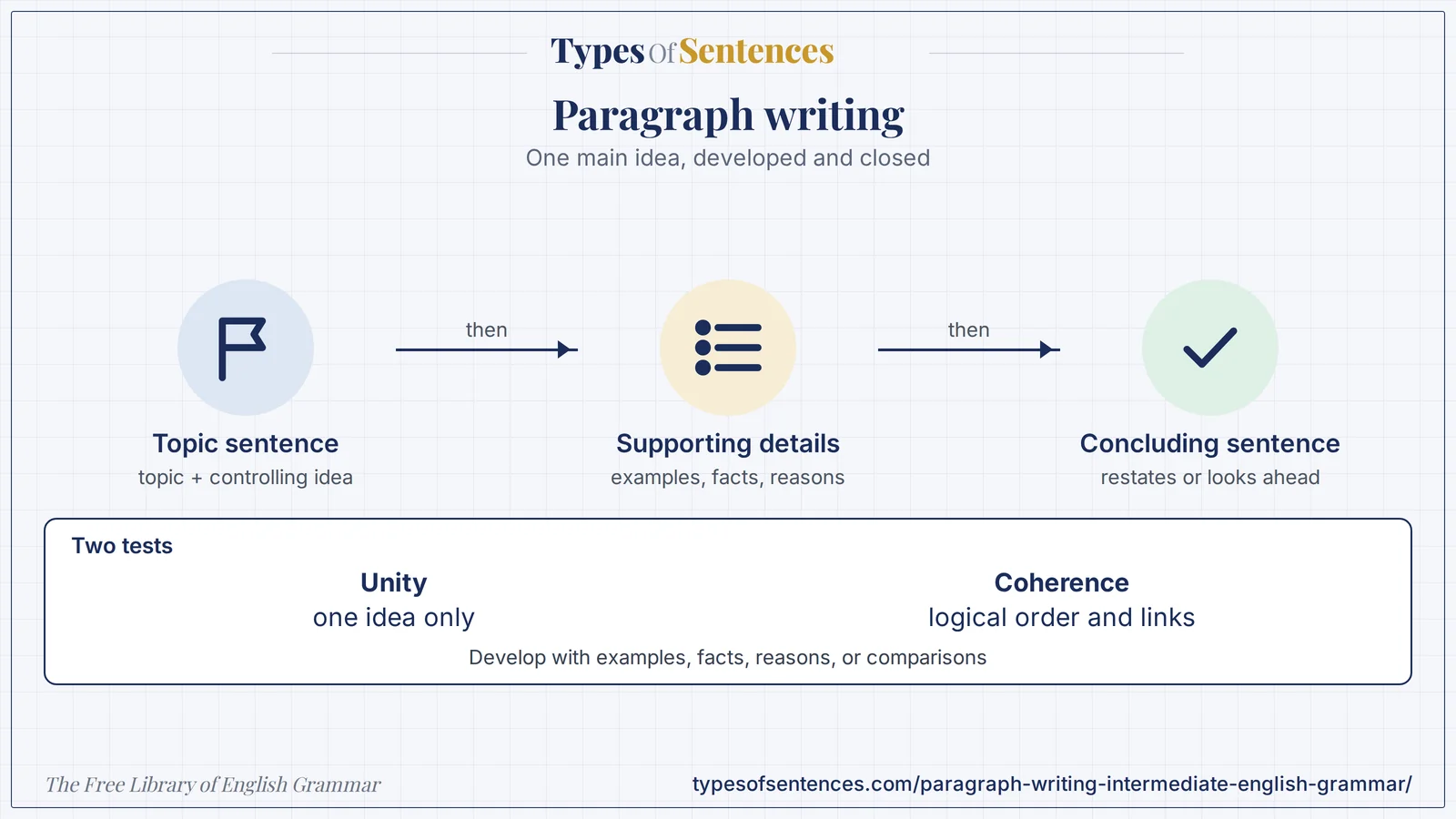
A paragraph is a small essay about one idea. The first sentence tells the reader what the idea is, the middle sentences give the evidence and the explanation, and the last sentence ties it up.
Why it matters: Readers use paragraph breaks to rest and to find their way. If a paragraph stays on one idea and moves in a clear order, the reader can follow it easily.
Summary: A paragraph states one main idea in a topic sentence, develops it with supporting details (examples, facts, reasons), and ends with a concluding sentence. Unity means every sentence supports the main idea; coherence means the sentences are in a clear order and connected by transitions, pronouns, and repeated key words. A typical paragraph has five to eight sentences.
- Topic sentence = topic + controlling idea.
- Unity: one idea only. Coherence: logical order and links.
- Develop with examples, facts, reasons, or comparisons.
- Close with a concluding sentence that restates or looks ahead.
What You’ll Learn
- 1. Paragraph Writing: What Is a Paragraph?
- 2. Strong Topic Sentences
- 3. Unity in Paragraphs
- 4. Coherence
- 5. Transition Words
- 6. Development Patterns
- 7. Supporting Details
- 8. Concluding Sentences
- 9. Paragraph Length: Sentences in a Paragraph
- 10. Paragraph Organization
- 11. A Revision Checklist and Sample Paragraph
- 12. Common Paragraph Errors
- 13. Exercises
- 14. Test Your Knowledge
- 15. Frequently Asked Questions
- 16. Conclusion
1. Paragraph Writing: What Is a Paragraph?
A paragraph is a block of sentences about one idea, set apart from the text before and after it by a new line or an indent. In an essay, each paragraph covers one point of the argument.
| Part | Job | Example |
|---|---|---|
| topic sentence | states the main idea | Regular exercise improves both physical and mental health. |
| supporting sentences | give reasons, facts, and examples | It strengthens the heart. A study of 1,000 adults found that walkers slept better. |
| concluding sentence | closes the paragraph | For these reasons, a daily walk is a simple way to feel better. |
The Basic chapter introduced the three parts. At the Intermediate level, you refine each part and learn to check that the whole paragraph works.
2. Strong Topic Sentences
A topic sentence has two parts: the topic (what the paragraph is about) and the controlling idea (what you will say about it). The controlling idea limits and directs the paragraph. See the guide to the topic sentence for more.
| Topic sentence | Topic | Controlling idea |
|---|---|---|
| Learning to swim has three clear benefits. | learning to swim | three benefits |
| Online shopping has changed how people buy clothes. | online shopping | changed how people buy clothes |
| Public libraries remain important because they offer free access to information. | public libraries | free access to information |
| Too broad | Too narrow | Strong |
|---|---|---|
| Sports are good. | I played soccer last Tuesday. | Team sports teach young people to cooperate. |
| Technology is everywhere. | My phone has 64 GB. | Smartphones have changed how students study. |
| Food is important. | I ate rice yesterday. | Eating breakfast helps students concentrate in class. |
- Make a claim that you can explain in one paragraph.
- Include a clear controlling idea (a number of reasons, an effect, a change, a comparison).
- Put the topic sentence first in most academic paragraphs. It can come later when you lead with an example, but the reader should never have to guess.
3. Unity in Paragraphs
A paragraph has unity when every sentence supports the topic sentence. A sentence that wanders to another idea breaks unity.
Check unity: Libraries are valuable community resources. They offer free books and computers. Many libraries also run reading programs for children. I like to read mystery novels. Libraries give everyone equal access to information.
- The topic: libraries as valuable community resources.
- Sentences 2, 3, and 5 support it.
- Sentence 4 (I like to read mystery novels) is about the writer’s taste, not about the value of libraries.
- Fix: delete it, or connect it: Libraries even let me borrow the mystery novels I love for free.
4. Coherence
Coherence means that the ideas are in a logical order and linked so that the reader moves smoothly from one to the next. Four tools create coherence.
| Tool | What it does | Example |
|---|---|---|
| logical order | arranges the sentences in a sensible sequence | first, then, finally; most to least important |
| transitions | link sentences and ideas | However, In addition, As a result |
| pronouns | refer back without repeating the noun | The library opened in 1990. It now has 50,000 books. |
| repeated key words and synonyms | keep the topic in view | library … the library … the building … this resource |
The tools of connection are studied in the chapter on cohesion in writing. A coherent paragraph reads like one connected thought; an incoherent one reads like a list of unrelated facts.
5. Transition Words
| Function | Transition words | Example |
|---|---|---|
| addition | also, in addition, moreover, furthermore, besides | It is cheap. Moreover, it is reliable. |
| contrast | however, but, on the other hand, in contrast, nevertheless | The plan is good. However, it costs too much. |
| cause and effect | therefore, as a result, consequently, because, so | It rained. As a result, the match was canceled. |
| example | for example, for instance, such as, to illustrate | Many fruits are sweet, for example, mangoes. |
| sequence | first, second, next, then, finally, afterward | First, mix the flour. Next, add the eggs. |
| time | meanwhile, later, soon, at the same time | Meanwhile, the guests arrived. |
| summary or conclusion | in conclusion, in short, to sum up, overall | In short, exercise pays off. |
The punctuation of conjunctive adverbs is in the guide to conjunctive adverbs. Do not overuse transitions: a transition that does not show a real relationship adds clutter. Often a pronoun or a repeated key word links the sentences better.
6. Development Patterns
A paragraph can be developed in several ways, depending on the point it makes.
| Pattern | Best for | Signal words |
|---|---|---|
| example or illustration | proving a general claim with specifics | for example, for instance |
| definition | explaining a term | is, means, refers to |
| comparison and contrast | showing similarities and differences | similarly, whereas, unlike |
| cause and effect | explaining reasons or results | because, therefore, as a result |
| process | explaining how something is done | first, next, then, finally |
| description | creating a picture | sensory words, spatial words |
| narration | telling what happened | then, after, when |
| classification | sorting into groups | types of, kinds of, categories |
| problem and solution | proposing a fix | the problem is, one solution is |
A cause-and-effect paragraph: Lack of sleep harms students in several ways. First, tired students struggle to concentrate, so they miss important points in class. Second, poor sleep weakens memory; as a result, students forget what they studied. Finally, exhausted students are more likely to be ill, and illness means absences. Therefore, schools should start classes later.
- Topic sentence: Lack of sleep harms students in several ways.
- Supporting sentences: three effects, each with a reason.
- Transitions: First, Second, Finally, as a result, Therefore.
- Concluding sentence: a recommendation: Therefore, schools should start classes later.
7. Supporting Details
| Kind | Example |
|---|---|
| facts and statistics | Sleep experts recommend eight to ten hours for teenagers. |
| examples | For example, one school that started at 9 a.m. saw attendance rise. |
| reasons | Because the brain consolidates memory during sleep, rested students learn more. |
| quotations from experts | As one researcher put it, “Sleep is the foundation of learning.” |
| anecdotes or personal experience | When I slept five hours, I could not follow my teacher. |
| comparisons | Sleep is to the brain what charging is to a phone. |
Facts and figures in a paragraph should come from sources that you can name and check. This chapter’s examples are invented to illustrate the pattern. When you write for school or publication, cite real sources.
8. Concluding Sentences
| Type | Example |
|---|---|
| restate the main idea in new words | In short, regular exercise benefits both body and mind. |
| summarize the main points | Exercise strengthens the heart, improves sleep, and lifts the mood. |
| give a recommendation or call to action | Everyone should find time for a daily walk. |
| predict a result | Schools that start later will see better grades. |
| link to the next paragraph | These benefits are only part of the story: the costs are also important. |
A concluding sentence closes the idea. It should not introduce a new topic or apologize.
9. Paragraph Length: Sentences in a Paragraph
How many sentences in a paragraph? There is no fixed number. A paragraph needs enough sentences to develop its idea, and no more.
| Context | Typical length |
|---|---|
| school exercise or short answer | five to eight sentences |
| academic essay paragraph | six to ten sentences (about 100 to 200 words) |
| business email | two to four sentences |
| web writing | two to four short sentences |
| narrative or description | varies; may be longer |
The 5-sentence paragraph is a good model for beginners: one topic sentence, three supporting sentences, and one concluding sentence. Aim for a mix of sentence types, simple, compound, and complex, so that the paragraph does not sound choppy; see the chapters on compound sentences and complex sentences.
- Topic: Cycling is a healthy way to travel. sentence 1
- It exercises the heart and legs. sentence 2 (support)
- It produces no pollution. sentence 3 (support)
- It also saves money on fuel. sentence 4 (support)
- For these reasons, cycling is better than driving for short trips. sentence 5 (conclusion)
10. Paragraph Organization
| Order | Use | Example |
|---|---|---|
| chronological (time) | narratives and processes | First … then … finally |
| spatial (place) | descriptions | from left to right; from top to bottom |
| order of importance | arguments | the least important reason first, the most important last |
| general to specific | explanations | a claim, then examples |
| specific to general | conclusions | examples, then a general claim |
| comparison point by point | comparing two things | price, quality, service for each |
Choose the order that fits your purpose, and use transitions that signal it. Revise by reading the paragraph aloud: if you stumble, the order or the links may need work.
11. A Revision Checklist and Sample Paragraph
- Does the topic sentence state a clear topic and controlling idea?
- Does every sentence support it (unity)?
- Are the sentences in a logical order with transitions (coherence)?
- Are there specific details (examples, facts, reasons)?
- Does the concluding sentence close the idea?
- Is the paragraph neither too short nor too long?
- Have I checked grammar, punctuation, and capitalization?
Improve this paragraph: Dogs are good. My dog is brown. Dogs bark. Cats are also nice. I like pizza.
- The first sentence is too broad, and the other sentences do not support one idea.
- Choose a controlling idea: dogs are loyal companions.
- Rewrite with details: Dogs make loyal companions. They greet their owners with joy, even after a short absence. Many dogs also protect their homes by barking at strangers. For example, my neighbor’s dog warned the family about a fire. For these reasons, dogs are among the best pets for families.
12. Common Paragraph Errors
| Error | Fix |
|---|---|
| no topic sentence | begin with a clear statement of the main idea |
| more than one main idea | split into two paragraphs |
| a topic sentence that is too broad or too narrow | add a controlling idea or widen it |
| a list of facts with no explanation | explain why each fact matters |
| sentences out of order | reorganize chronologically or by importance |
| no transitions, or too many | use transitions only where they show a relationship |
| one very short paragraph | develop with examples and reasons |
| a concluding sentence that adds a new topic | close the idea, or link to the next paragraph |
| repetition of the same word or structure | vary words and sentence patterns |
Recap in 12 seconds
Watch the lesson build itself: A paragraph has a topic sentence, supporting details, and a concluding sentence, and it needs unity and coherence. The video has no sound.
Exercises
Part A: Parts of a Paragraph (Exercises 1–5)
Exercise 1: Name the three parts of a paragraph.
Show Answer
Answer: Topic sentence, supporting sentences, concluding sentence.
Exercise 2: What does the topic sentence state?
Show Answer
Answer: The main idea (topic and controlling idea).
Exercise 3: What do the supporting sentences do?
Show Answer
Answer: Give reasons, facts, and examples.
Exercise 4: What does the concluding sentence do?
Show Answer
Answer: Closes the paragraph.
Exercise 5: Define unity.
Show Answer
Answer: Every sentence supports the main idea.
Part B: Topic Sentences (Exercises 6–11)
Exercise 6: Find the controlling idea: Online shopping has changed how people buy clothes.
Show Answer
Answer: changed how people buy clothes.
Exercise 7: Too broad or strong: Sports are good.
Show Answer
Answer: Too broad.
Exercise 8: Too narrow or strong: I played soccer last Tuesday.
Show Answer
Answer: Too narrow.
Exercise 9: Improve: Food is important.
Show Answer
Answer: Eating breakfast helps students concentrate in class. (sample)
Exercise 10: Write a topic sentence about cycling with a controlling idea.
Show Answer
Answer: Sample: Cycling is a healthy and economical way to travel.
Exercise 11: Where does a topic sentence usually go in an academic paragraph?
Show Answer
Answer: First.
Part C: Unity and Coherence (Exercises 12–17)
Exercise 12: Which sentence breaks unity: Libraries offer free books. I like pizza. Libraries run reading programs.
Show Answer
Answer: I like pizza.
Exercise 13: Name four tools of coherence.
Show Answer
Answer: Logical order, transitions, pronouns, repeated key words.
Exercise 14: Replace the noun with a pronoun: The library opened in 1990. The library has 50,000 books.
Show Answer
Answer: …It has 50,000 books.
Exercise 15: Choose a transition for contrast: It is cheap. ___, it breaks easily.
Show Answer
Answer: However.
Exercise 16: Choose a transition for a result: It rained. ___, the match was canceled.
Show Answer
Answer: As a result.
Exercise 17: Choose a transition for an example: Many fruits are sweet. ___, mangoes.
Show Answer
Answer: For example.
Part D: Development and Details (Exercises 18–23)
Exercise 18: Pattern for explaining how something is done:
Show Answer
Answer: Process.
Exercise 19: Pattern for showing reasons and results:
Show Answer
Answer: Cause and effect.
Exercise 20: Which is more specific: A lot of students are tired or In a survey of 500 students, 60 percent slept less than seven hours?
Show Answer
Answer: The second.
Exercise 21: What does PIE stand for?
Show Answer
Answer: Point, illustration, explanation.
Exercise 22: Name two kinds of supporting detail.
Show Answer
Answer: Facts and examples (also reasons, quotations, anecdotes).
Exercise 23: Give a signal word for comparison.
Show Answer
Answer: similarly (or whereas, unlike).
Part E: Conclusions and Length (Exercises 24–27)
Exercise 24: Write a concluding sentence about exercise.
Show Answer
Answer: Sample: For these reasons, a daily walk is worth the time.
Exercise 25: Which concluding type gives advice?
Show Answer
Answer: A recommendation or call to action.
Exercise 26: How many sentences are in a 5-sentence paragraph model?
Show Answer
Answer: Five: one topic, three supporting, one concluding.
Exercise 27: Typical length of an academic essay paragraph:
Show Answer
Answer: Six to ten sentences (about 100 to 200 words).
Part F: Organization and Revision (Exercises 28–30)
Exercise 28: Which order for a narrative?
Show Answer
Answer: Chronological.
Exercise 29: Which order for an argument that builds to the strongest reason?
Show Answer
Answer: Order of importance (least to most important).
Exercise 30: Name the first step of the revision checklist.
Show Answer
Answer: Check that the topic sentence states a clear topic and controlling idea.
Test Your Knowledge
Ready to check what you learned? Answer all 10 questions, then submit. You need 80% (8 of 10) to pass. Your answers are not stored.
View correct answers and explanations
Question 1: What is the purpose of a topic sentence?
✓ Correct Answer: B – To state the main idea
The topic sentence states the main idea.
Question 2: What is unity in a paragraph?
✓ Correct Answer: A – Every sentence supports the main idea
Unity means everything supports the main idea.
Question 3: What creates coherence?
✓ Correct Answer: D – Logical order and links between sentences
Order and links create coherence.
Question 4: Which is a strong topic sentence?
✓ Correct Answer: C – Team sports teach young people to cooperate.
It has a topic and a controlling idea.
Question 5: Which transition shows contrast?
✓ Correct Answer: B – however
However shows contrast.
Question 6: Which transition shows a result?
✓ Correct Answer: C – as a result
As a result shows effect.
Question 7: What does PIE stand for?
✓ Correct Answer: B – Point, illustration, explanation
Point, illustration, explanation.
Question 8: Which is a concluding sentence?
✓ Correct Answer: D – For these reasons, a daily walk is worth the time.
It closes the idea.
Question 9: How many sentences are in a typical 5-sentence paragraph model?
✓ Correct Answer: C – Five
Five.
Question 10: Which pattern explains how something is done?
✓ Correct Answer: A – Process
A process paragraph explains how.
Frequently Asked Questions
What is paragraph writing?
Paragraph writing is the skill of building a group of sentences around one main idea, with a topic sentence, supporting details, and a concluding sentence.
What is a 5-sentence paragraph?
A 5-sentence paragraph is a model with one topic sentence, three supporting sentences, and one concluding sentence. It is a good starting form for beginners.
How many sentences in a paragraph are enough?
Enough sentences to develop the idea: usually five to eight in school writing and six to ten in an academic essay. Business and web paragraphs are shorter, two to four sentences.
What are the steps for writing paragraphs?
For writing paragraphs: plan one main idea, write a topic sentence with a controlling idea, add supporting details, link them with transitions and pronouns, close with a concluding sentence, and revise for unity and coherence.
What is paragraph organization?
Paragraph organization is the order of the sentences: chronological, spatial, order of importance, general to specific, or comparison point by point. The order should fit the purpose.
What is the difference between unity and coherence?
Unity means every sentence supports the main idea. Coherence means the sentences are in a logical order and linked by transitions, pronouns, and repeated key words.
When do I start a new paragraph?
Start a new paragraph when you begin a new main idea, a new speaker in dialogue, a new time or place in a narrative, or when a paragraph becomes too long to follow.
Conclusion
You now have a guide to paragraph writing: the parts of a paragraph, strong topic sentences, unity, coherence, transition words, development patterns, supporting details, concluding sentences, paragraph length and organization, and a revision checklist. You can build a clear paragraph around one idea.
Write a 5-sentence paragraph on a topic you know, and check it against the checklist. Next, you will study essay structure.
- Purdue Online Writing Lab: Paragraphs and Paragraphing: reference pages on paragraph unity, coherence, and structure.
- Purdue Online Writing Lab: General Writing: reference pages on writing processes.
- Strunk, William, Jr., and E. B. White. The Elements of Style. 4th ed. Longman, 2000.: the rule that a paragraph is a unit of thought.
- Quirk, Randolph, et al. A Comprehensive Grammar of the English Language. Longman, 1985.: sentence connection in text.
Last reviewed: October 29, 2026. How it was made: drafted with AI assistance, then checked with automated tests (structure, links, answer keys, spelling) and against the sources above. A person has not yet read this chapter line by line. Found a mistake? Report it.