The second conditional talks about situations that are unreal, imaginary, or unlikely now or in the future: If I had a million dollars, I would travel the world. The if clause uses the past simple, and the main clause uses would plus the base verb. The past form here does not refer to past time. It shows that the situation is not real, which is why this is called an unreal conditional.
This chapter shows the structure of the second conditional, with second conditional examples for each use. You will see how it expresses hypothetical situations, why were is used with all subjects, how to give advice with If I were you, how other modals vary the pattern, and how the second conditional differs from the first. It ends with the common errors. Thirty exercises and a quiz follow.
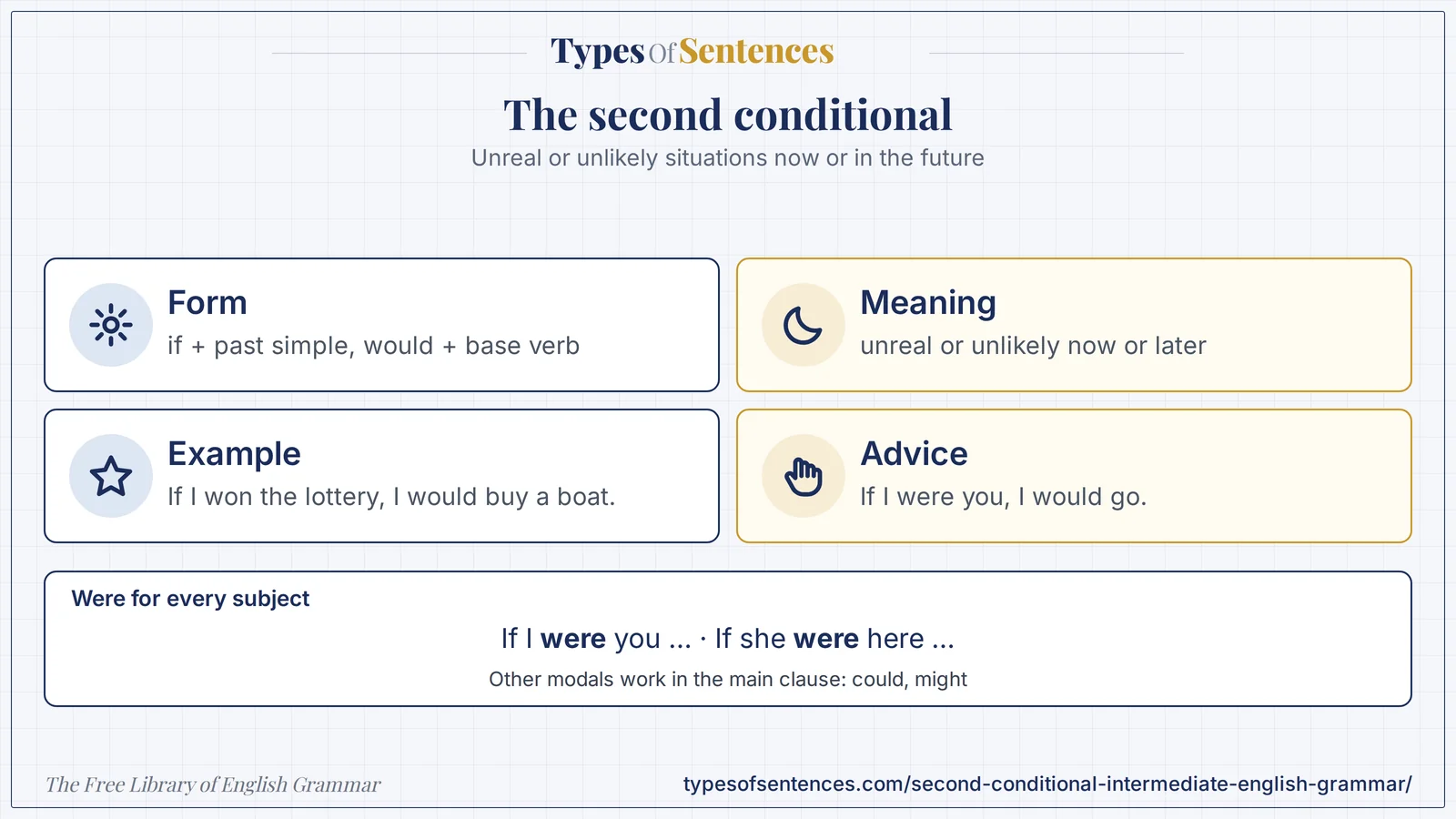
The second conditional is for imagining. You describe something that is not true now, or is unlikely ever to happen, and say what would follow if it were true.
Why it matters: The past tense in the if clause is a signal of unreality, not of time. If I had a car means that I do not have a car now.
Summary: Second conditional: if + past simple, would + base verb. It expresses an unreal or unlikely situation in the present or future (If I won the lottery, I would buy a boat), advice (If I were you, I would go), and polite suggestions. Use were for all persons in formal English. Never use would in the if clause.
- Form: if + past simple, would + base verb.
- Meaning: unreal or unlikely now or in the future.
- Were for all subjects: If I were you …
- Other modals: could, might in the main clause.
What You’ll Learn
- 1. Second Conditional Structure
- 2. Uses of the Second Conditional
- 3. “Were” with All Subjects
- 4. Advice with If I Were You
- 5. Other Modals in the Second Conditional
- 6. Second vs. First Conditional
- 7. Punctuation, Wishes, and Related Patterns
- 8. Common Errors with the Second Conditional
- 9. Exercises
- 10. Test Your Knowledge
- 11. Frequently Asked Questions
- 12. Conclusion
1. Second Conditional Structure
The second conditional has two clauses: an if clause in the past simple and a main clause with would and the base form of the verb. It is one of the four types introduced in the chapter on conditional sentences.
| Pattern | Example |
|---|---|
| if + past simple, would + base verb | If I had a million dollars, I would travel the world. |
| would + base verb + if + past simple | I would travel the world if I had a million dollars. |
| negative | If I didn’t have to work, I would stay home. I wouldn’t go if I were you. |
| question | What would you do if you won the lottery? Would you quit your job if you were rich? |
| contraction | If I had money, I’d buy a house. |
The pattern is often summarized as if + past, would. The if past would pattern is used even though the situation is in the present or the future. The past tense is a grammatical device for unreality; see the chapter on the past tenses for the tense itself.
2. Uses of the Second Conditional
| Use | Example |
|---|---|
| an unreal present situation (not true now) | If I were rich, I would help everyone. (I am not rich.) |
| an unlikely future situation | If I won the lottery, I would buy a boat. (It is unlikely.) |
| an imaginary or impossible situation | If I could fly, I would visit every country. If dogs could talk, they would complain. |
| advice (with If I were you) | If I were you, I would apologize. |
| a polite request or suggestion | It would be great if you could help me. Would you mind if I opened the window? |
| a refusal to believe or a wish about the present | If only I had more time! |
| what is possible but not real in a comparison | If he worked harder, he would pass. |
These are hypothetical situations: events that exist in the mind, not in fact. The result is a guess about what would happen. Compare the unreal If I had time, I would help (I have no time) with the real If I have time, I will help (maybe I will).
| Real (first) | Unreal (second) |
|---|---|
| If I have time, I will help you. | If I had time, I would help you. |
| If it rains, we will stay. | If it rained, we would stay. |
| If you study, you will pass. | If you studied, you would pass. |
3. “Were” with All Subjects
In formal English, the verb be in the if clause of the second conditional is were for all persons, including I, he, she, and it. This is a remnant of the subjunctive mood.
| Formal | Informal |
|---|---|
| If I were rich, I would travel. | If I was rich, I would travel. |
| If she were here, she would help. | If she was here, she would help. |
| If it were possible, I would do it. | If it was possible, I would do it. |
| If I were you, I would apologize. | (If I was you, I would apologize. is common in speech) |
| Pattern | Example | Note |
|---|---|---|
| If + subject + were to + base verb | If I were to win, I would be delighted. | formal and tentative; the future is unlikely |
| Were + subject + to + base verb (inverted) | Were I to win, I would be delighted. | very formal |
4. Advice with If I Were You
The most common use of the second conditional is to give advice. The speaker imagines being in the listener’s position and says what he or she would do.
| Advice | Meaning |
|---|---|
| If I were you, I would apologize. | I advise you to apologize. |
| If I were you, I wouldn’t buy that car. | I advise you not to buy it. |
| I would take the job if I were you. | I advise you to take it. |
| What would you do if you were me? | Asking for advice. |
Compare other advice forms in the chapter on modals: You should apologize and You had better apologize (a warning); see the chapter on uses of modal verbs. The second conditional is softer and more polite because it puts the speaker in the listener’s shoes.
5. Other Modals in the Second Conditional
In the main clause, could and might can replace would to change the meaning. The modals are described in the chapter on modal verbs.
| Modal | Meaning | Example |
|---|---|---|
| would | the sure result of the imaginary condition | If I had time, I would travel. |
| could | the ability or possibility of the result | If I had time, I could travel. (I would be able to) |
| might | a possible result | If I had time, I might travel. (perhaps) |
| should | advice or expectation | If you were ill, you should see a doctor. |
The if clause can also contain could (ability): If I could swim, I would join you, or were able to: If I were able to come, I would.
Do not use would in the if clause of the second conditional. Use the past simple. The exception is the polite request: I would be grateful if you would help.
6. Second vs. First Conditional
| First | Second | |
|---|---|---|
| form | if + present, will + base | if + past, would + base |
| likelihood | real or likely | unreal or unlikely |
| time | a future possibility | present or future, imaginary |
| example | If I win, I will buy a boat. (I may win) | If I won, I would buy a boat. (I probably will not win) |
| speaker’s attitude | a real chance | doubt or impossibility |
- If I have time, I will call. (I might have time.)
- If I had time, I would call. (I do not have time.)
- If it rains, we will stay. (It may rain.)
- If it rained, we would stay. (It is unlikely to rain.)
Choose the type: If I (be) you, I (not buy) that car, but if the price (drop) tomorrow, I (consider) it.
- If I were you: unreal, advice: second conditional: If I were you, I would not buy that car.
- the price drops tomorrow: a real possibility: first conditional: if the price drops tomorrow, I will consider it.
- Result: If I were you, I wouldn’t buy that car, but if the price drops tomorrow, I will consider it.
7. Punctuation, Wishes, and Related Patterns
A comma follows an if clause that comes first: If I had money, I would buy a house. No comma is used when the if clause follows: I would buy a house if I had money.
| Pattern | Example | Note |
|---|---|---|
| I wish + past simple | I wish I had more time. | a wish about the present |
| If only + past simple | If only I had more time! | a stronger wish |
| as if / as though + past | He talks as if he knew everything. | an unreal comparison |
| It’s time + past | It’s time you went to bed. | something should happen now |
| would rather + subject + past | I’d rather you stayed. | a preference about someone else |
These patterns use the same unreal past. The wish forms are also covered with the preferences in the modal chapters. They show that the past tense can express unreality, not only past time.
8. Common Errors with the Second Conditional
| Error | Correction | Rule |
|---|---|---|
| If I would have money, I would travel. | If I had money, I would travel. | no would in the if clause |
| If I will be rich, I would travel. | If I were rich, I would travel. | past simple in the if clause |
| If I was you, I would go. (formal) | If I were you, I would go. | were in formal English |
| If I had money, I will travel. | If I had money, I would travel. | would in the main clause |
| If I would be you, I would go. | If I were you, I would go. | no would in the if clause |
| If he studied, he will pass. | If he studied, he would pass. | keep the type consistent |
| If I had known, I would go. | If I knew, I would go. / If I had known, I would have gone. | do not mix second and third |
| I would go if I would have time. | I would go if I had time. | past simple, not would have |
| What will you do if you won? | What would you do if you won? | would in the question |
| If I had money I would travel. | If I had money, I would travel. | comma after the if clause |
Fix: If I would have more money, I will buy a house, and if I was you, I will not wait.
- If I would have more money: If I had more money.
- I will buy: unreal, so I would buy.
- if I was you: formal: if I were you.
- I will not wait: I would not wait.
- Result: If I had more money, I would buy a house, and if I were you, I would not wait.
Recap in 12 seconds
Watch the lesson build itself: The second conditional uses if with the past simple and would with the base verb for unreal or unlikely situations. The video has no sound.
Exercises
Part A: Form (Exercises 1–7)
Exercise 1: Complete: If I (have) a million dollars, I would travel.
Show Answer
Answer: had.
Exercise 2: Complete: If I won the lottery, I (buy) a boat.
Show Answer
Answer: would buy.
Exercise 3: Make negative: I would go if I were you.
Show Answer
Answer: I wouldn’t go if I were you.
Exercise 4: Make a question: You would quit if you were rich.
Show Answer
Answer: Would you quit if you were rich?
Exercise 5: Contract: If I had money, I would buy a house.
Show Answer
Answer: If I had money, I’d buy a house.
Exercise 6: Fix it: If I would have money, I would travel.
Show Answer
Answer: If I had money, I would travel.
Exercise 7: Does the past tense in the if clause mean past time?
Show Answer
Answer: No. It signals unreality.
Part B: Uses (Exercises 8–13)
Exercise 8: Use: If I could fly, I would visit every country.
Show Answer
Answer: An imaginary situation.
Exercise 9: Use: If I were you, I would apologize.
Show Answer
Answer: Advice.
Exercise 10: Use: If I won the lottery, I would buy a boat.
Show Answer
Answer: An unlikely future situation.
Exercise 11: Use: If I were rich, I would help everyone.
Show Answer
Answer: An unreal present situation.
Exercise 12: Which is a polite request: It would be great if you could help me.?
Show Answer
Answer: Yes.
Exercise 13: Meaning: If only I had more time!
Show Answer
Answer: A wish: I do not have enough time.
Part C: Were and Advice (Exercises 14–19)
Exercise 14: Formal: If I (was/were) rich, I would travel.
Show Answer
Answer: were.
Exercise 15: Formal: If she (was/were) here, she would help.
Show Answer
Answer: were.
Exercise 16: Give advice: You should apologize. (with If I were you)
Show Answer
Answer: If I were you, I would apologize.
Exercise 17: Ask for advice: What would you do if you ___ me?
Show Answer
Answer: were.
Exercise 18: Complete: If I ___ to win, I would be delighted. (formal)
Show Answer
Answer: were.
Exercise 19: Fix it: If I would be you, I would go.
Show Answer
Answer: If I were you, I would go.
Part D: Other Modals (Exercises 20–23)
Exercise 20: Possible result: If I had time, I (travel). (might)
Show Answer
Answer: might travel.
Exercise 21: Ability: If I had time, I (travel). (could)
Show Answer
Answer: could travel.
Exercise 22: Meaning of If I could swim, I would join you.
Show Answer
Answer: I cannot swim.
Exercise 23: Fix it: If I had money, I will travel.
Show Answer
Answer: If I had money, I would travel.
Part E: Second vs First (Exercises 24–28)
Exercise 24: Choose: If I (have/had) time, I will call. (a real possibility)
Show Answer
Answer: have.
Exercise 25: Choose: If I (have/had) time, I would call. (I have no time)
Show Answer
Answer: had.
Exercise 26: Type: If it rains, we will stay.
Show Answer
Answer: First.
Exercise 27: Type: If it rained, we would stay.
Show Answer
Answer: Second.
Exercise 28: Which is more likely: If I win … or If I won …?
Show Answer
Answer: If I win … (first conditional).
Part F: Related Patterns (Exercises 29–30)
Exercise 29: Wish: I wish I (have) more time.
Show Answer
Answer: had.
Exercise 30: Complete: He talks as if he ___ everything. (unreal)
Show Answer
Answer: knew.
Test Your Knowledge
Ready to check what you learned? Answer all 10 questions, then submit. You need 80% (8 of 10) to pass. Your answers are not stored.
View correct answers and explanations
Question 1: What does the second conditional express?
✓ Correct Answer: C – An unreal or unlikely situation
The second conditional is unreal or unlikely.
Question 2: Which is the second conditional?
✓ Correct Answer: C – If I had money, I would travel.
If + past simple, would + base verb.
Question 3: Which is correct?
✓ Correct Answer: B – If I had money, I would travel.
Past simple in the if clause.
Question 4: Which is formal for be?
✓ Correct Answer: D – If I were you
Were is the formal form.
Question 5: Which gives advice?
✓ Correct Answer: A – If I were you, I would apologize.
If I were you … gives advice.
Question 6: Which is more likely to happen?
✓ Correct Answer: C – If I win the lottery …
The first conditional is a real possibility.
Question 7: Which modal shows a possible result?
✓ Correct Answer: D – might
Might shows a possible result.
Question 8: Which is correct?
✓ Correct Answer: B – I would go if I had time.
Past simple in the if clause.
Question 9: Which is a wish about the present?
✓ Correct Answer: A – I wish I had more time.
Wish + past simple.
Question 10: What does the past tense in the if clause show?
✓ Correct Answer: B – Unreality
It signals unreality.
Frequently Asked Questions
What is the second conditional?
The second conditional uses if + past simple and would + base verb. It describes an unreal or unlikely situation in the present or future: If I had a million dollars, I would travel.
What are some second conditional examples?
If I won the lottery, I would buy a boat. If I were you, I would apologize. If dogs could talk, they would complain. are second conditional examples.
What is the if past would pattern?
The if past would pattern is the second conditional: if + past simple, would + base verb. Remember that the past tense shows unreality, not past time.
What is an unreal conditional?
An unreal conditional describes a situation that is imaginary or not true: the second conditional (unreal present or future) and the third conditional (unreal past).
What are hypothetical situations?
Hypothetical situations are imagined situations that are not real or are unlikely, such as If I could fly …. The second conditional is the main way to talk about them.
Should I say if I was or if I were?
In formal English, use were for all persons (If I were rich), and always in If I were you. Was is common in informal speech.
What is the difference between the first and second conditional?
The first conditional (If I win, I will buy a boat) is a real possibility. The second (If I won, I would buy a boat) is unlikely or imaginary.
Conclusion
You now know the second conditional: if + past simple, would + base verb for unreal or unlikely situations. You can use were with all subjects, give advice with If I were you, vary the modal, tell the second from the first conditional, and avoid the common errors.
Ask whether you are imagining something that is not real, and use the unreal past. Next, you will study the third conditional.
- Merriam-Webster Dictionary: subjunctive: the dictionary definition of the subjunctive mood.
- Purdue Online Writing Lab: Grammar: reference section on verbs and conditionals.
- Quirk, Randolph, et al. A Comprehensive Grammar of the English Language. Longman, 1985.: hypothetical conditions and the subjunctive were.
- Huddleston, Rodney, and Geoffrey K. Pullum. The Cambridge Grammar of the English Language. Cambridge University Press, 2002.: the irrealis were and closed conditionals.
Last reviewed: October 29, 2026. How it was made: drafted with AI assistance, then checked with automated tests (structure, links, answer keys, spelling) and against the sources above. A person has not yet read this chapter line by line. Found a mistake? Report it.