The zero and first conditionals are the two real conditionals. They describe conditions that are true, possible, or likely, as opposed to imaginary. The zero conditional states a general truth: If you heat ice, it melts. The first conditional describes a real possibility in the future: If it rains, we will stay home. Both use the present simple in the if clause.
This chapter studies the zero conditional and the first conditional in turn. You will learn the form of each (if + present, present, and if + present, will + base verb), their uses, the variations with other tenses and modals, the difference between if and when, and how to choose between the two. It ends with the common errors. Thirty exercises and a quiz follow.
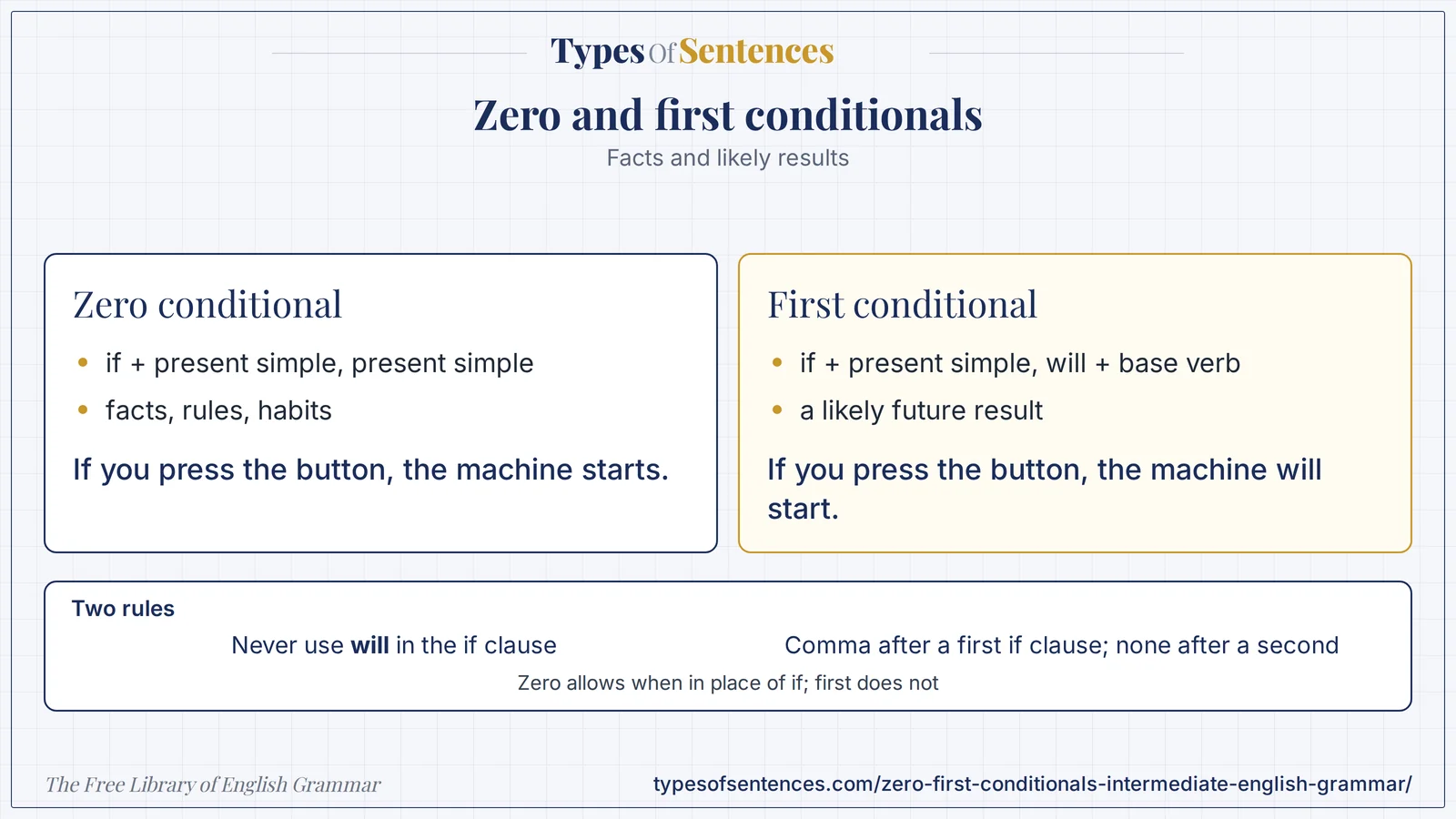
The real conditionals deal with things that can actually happen. If something is always true, use the zero conditional. If something is likely to happen in the future, use the first.
Why it matters: Both keep the present tense in the if clause. The difference is in the main clause: the present for a general truth, will for a future result.
Summary: Zero conditional: if + present simple, present simple (facts, rules, habits). First conditional: if + present simple, will + base verb (a likely future result). Never use will in the if clause. Other tenses and modals can vary the pattern: present perfect or continuous in the if clause, imperative or modal in the main clause.
- Zero: If you press the button, the machine starts.
- First: If you press the button, the machine will start.
- Zero allows when in place of if; first does not.
- Comma after a first if clause; none after a second.
What You’ll Learn
- 1. Zero and First Conditionals: The Zero Conditional
- 2. Variations of the Zero Conditional
- 3. The First Conditional
- 4. Variations of the First Conditional
- 5. If vs. When
- 6. Zero vs. First Conditional
- 7. Punctuation and Word Order
- 8. Common Errors with the Zero and First Conditionals
- 9. Exercises
- 10. Test Your Knowledge
- 11. Frequently Asked Questions
- 12. Conclusion
1. Zero and First Conditionals: The Zero Conditional
The zero conditional is formed with the present simple in both clauses. The result always follows the condition, so if means the same as whenever or when.
| Pattern | Example |
|---|---|
| if + present simple, present simple | If you heat ice, it melts. |
| present simple + if + present simple | Plants die if they do not get water. |
| negative | If you don’t water plants, they die. |
| question | What happens if you mix red and blue? |
| Use | Example |
|---|---|
| scientific facts and general truths | If water reaches 100 degrees, it boils. |
| rules and laws | If you are under eighteen, you cannot vote. |
| habits and routines | If I wake up early, I go for a run. |
| instructions and procedures | If the light is red, stop. |
| things that are always the result of an action | If you press the button, the machine starts. |
Because the result is certain, if and when are interchangeable in the zero conditional: If / When you heat ice, it melts. This is the first of the four conditional types introduced in the previous chapter on conditional sentences.
2. Variations of the Zero Conditional
| Variation | Example |
|---|---|
| imperative main clause (instruction) | If the light is red, stop. If you need help, call me. |
| modal in the main clause | If you feel ill, you should rest. If it is cold, you can wear a coat. |
| present continuous in the if clause (temporary situation) | If you are waiting for the bus, you can sit here. |
| present perfect in the if clause | If you have finished, you can leave. |
| past tense in both clauses (past habit) | If I was late, my father was angry. |
Do not use will in the if clause of a zero conditional.
3. The First Conditional
The first conditional follows the if present will pattern. It is formed with the present simple in the if clause and will plus the base verb in the main clause. It is about a real, possible, or likely future event.
| Pattern | Example |
|---|---|
| if + present simple, will + base verb | If it rains, we will stay home. |
| will + base verb + if + present simple | We will stay home if it rains. |
| negative | If you don’t hurry, you will miss the train. |
| question | What will you do if you lose your job? |
| contraction | If she calls, I’ll tell her. |
| Use | Example |
|---|---|
| a likely future result | If you study, you will pass the exam. |
| a promise | If you help me, I will help you. |
| a warning or threat | If you touch that, you will get hurt. |
| an offer | If you need a ride, I will drive you. |
| a suggestion | If you are tired, we will go home. |
| a prediction | If it snows, the roads will be icy. |
The future form in the main clause is the simple future with will, described in the chapter on the future tenses. Do not use will in the if clause, for the same reason that it is not used in a time clause: the present simple stands for the future after if, when, before, and after.
4. Variations of the First Conditional
| Variation | Example |
|---|---|
| present perfect in the if clause (completed first) | If you have finished your homework, you can go out. |
| present continuous in the if clause | If you are looking for Tom, he is in the garden. |
| modal in the main clause (can, may, might, must, should) | If it rains, we may stay home. If you study, you can pass. If you want, you should call. |
| imperative main clause | If you see Tom, tell him I called. |
| going to in the main clause | If you don’t study, you are going to fail. |
| should in the if clause (formal, unlikely) | If you should see him, tell him I called. |
| will in the if clause (willingness, polite request) | If you will wait here, I’ll call him. If you’ll help me, I’ll be grateful. |
| unless instead of if … not | Unless you hurry, you will miss the train. |
The modals are in the chapter on modal verbs. The last two variations show the exceptions to the rule about will: in If you will wait, will means are willing to, not future time.
5. If vs. When
| If | When | |
|---|---|---|
| meaning | the event may or may not happen | the event will happen (or always happens) |
| first conditional | If it rains tomorrow, we will stay home. (uncertain) | When it rains, we stay home. (a habit, zero) |
| future event | If I see him, I will tell him. (maybe) | When I see him, I will tell him. (I will see him) |
| zero conditional | both work | both work |
- If I get the job, I’ll move. (I am not sure I will get it.)
- When I get the job, I’ll move. (I expect to get it.)
- Call me if you need help. (maybe you will)
- Call me when you arrive. (you will arrive)
Use if for something uncertain and when for something that you expect to happen. In a time clause with when, the present simple also stands for the future; see the chapter on adverb clauses.
6. Zero vs. First Conditional
| Zero | First | |
|---|---|---|
| form | if + present, present | if + present, will + base |
| meaning | always true, general | a specific, likely future event |
| time | any time; no particular occasion | a particular future occasion |
| if or when | either | if (uncertain) or when (expected) |
| example | If you mix red and blue, you get purple. | If you mix the paint, you will get purple. |
Choose: If you (freeze) water, it (turn) into ice. If it (be) cold tomorrow, the lake (freeze).
- The first sentence is a general truth: zero conditional: If you freeze water, it turns into ice.
- The second is a specific future possibility: first conditional: If it is cold tomorrow, the lake will freeze.
- Result: If you freeze water, it turns into ice. If it is cold tomorrow, the lake will freeze.
7. Punctuation and Word Order
| Order | Example | Comma? |
|---|---|---|
| if clause first | If it rains, we will stay home. | comma after the if clause |
| main clause first | We will stay home if it rains. | no comma |
| question, if clause second | What will you do if you lose your job? | no comma |
The if clause is an adverb clause of condition and follows the same punctuation rule as other adverb clauses, as in the earlier chapter on adverb clauses. Do not put a comma between a main clause and a following if clause unless it is an afterthought.
8. Common Errors with the Zero and First Conditionals
| Error | Correction | Rule |
|---|---|---|
| If it will rain, we will stay. | If it rains, we will stay. | no will in the if clause |
| If you heat ice, it will melt. (general truth) | If you heat ice, it melts. | zero conditional for general truths |
| If it rains we will stay. | If it rains, we will stay. | comma after the if clause |
| If I will see him, I will tell him. | If I see him, I will tell him. | present simple in the if clause |
| If you will study, you pass. | If you study, you pass. / If you study, you will pass. | keep the types consistent |
| Unless you don’t hurry, you will miss it. | Unless you hurry, you will miss it. | double negative |
| If I will have time, I will help. | If I have time, I will help. | no will in the if clause |
| When I will see him, I’ll tell him. | When I see him, I’ll tell him. | present simple in a time clause |
| If you are free tomorrow, we go out. | If you are free tomorrow, we will go out. | a specific future needs will |
| If it rained tomorrow, we will stay. | If it rains tomorrow, we will stay. | present, not past, for a real future |
Fix: If it will rain tomorrow we stay home, and if you will heat ice, it will melt, unless you don’t hurry.
- If it will rain tomorrow we stay: a specific future: If it rains tomorrow, we will stay home.
- if you will heat ice, it will melt: a general truth: if you heat ice, it melts.
- unless you don’t hurry: unless you hurry.
- Result: If it rains tomorrow, we will stay home, and if you heat ice, it melts, unless you hurry. (Better to split it into two sentences.)
Recap in 12 seconds
Watch the lesson build itself: The zero conditional states facts and the first conditional a likely future result; neither takes will in the if clause. The video has no sound.
Exercises
Part A: Zero Conditional (Exercises 1–7)
Exercise 1: Complete: If you heat ice, it (melt).
Show Answer
Answer: melts.
Exercise 2: Complete: If you (not water) plants, they die.
Show Answer
Answer: don’t water.
Exercise 3: Replace if with when: If you heat ice, it melts.
Show Answer
Answer: When you heat ice, it melts.
Exercise 4: Which use: If the light is red, stop.
Show Answer
Answer: An instruction.
Exercise 5: Which use: If water reaches 100 degrees, it boils.
Show Answer
Answer: A scientific fact.
Exercise 6: Fix it: If you will heat ice, it melts.
Show Answer
Answer: If you heat ice, it melts.
Exercise 7: Make a question: If you mix red and blue, you get purple.
Show Answer
Answer: What happens if you mix red and blue?
Part B: First Conditional (Exercises 8–14)
Exercise 8: Complete: If it rains, we (stay) home.
Show Answer
Answer: will stay.
Exercise 9: Complete: If you (not hurry), you will miss the train.
Show Answer
Answer: don’t hurry.
Exercise 10: Complete: We will stay home if it (rain).
Show Answer
Answer: rains.
Exercise 11: Question: What (you do) if you lose your job?
Show Answer
Answer: will you do.
Exercise 12: Name the use: If you touch that, you will get hurt.
Show Answer
Answer: A warning.
Exercise 13: Name the use: If you need a ride, I will drive you.
Show Answer
Answer: An offer.
Exercise 14: Fix it: If it will rain, we will stay.
Show Answer
Answer: If it rains, we will stay.
Part C: Variations (Exercises 15–20)
Exercise 15: Add a modal (possibility): If it rains, we (stay) home. (may)
Show Answer
Answer: may stay.
Exercise 16: Add an imperative: If you see Tom, ___ him I called.
Show Answer
Answer: tell.
Exercise 17: Present perfect: If you (finish), you can go out.
Show Answer
Answer: have finished.
Exercise 18: Replace if … not with unless: If you don’t hurry, you will miss it.
Show Answer
Answer: Unless you hurry, you will miss it.
Exercise 19: Polite will: If you ___ wait here, I’ll call him.
Show Answer
Answer: will.
Exercise 20: Fix it: Unless you don’t hurry, you will miss it.
Show Answer
Answer: Unless you hurry, you will miss it.
Part D: If vs When (Exercises 21–24)
Exercise 21: Choose: (If/When) I get the job, I’ll move. (I am not sure)
Show Answer
Answer: If.
Exercise 22: Choose: (If/When) I get home, I’ll call you. (I will get home)
Show Answer
Answer: When.
Exercise 23: Choose: Call me (if/when) you need help.
Show Answer
Answer: if.
Exercise 24: Fix it: When I will see him, I’ll tell him.
Show Answer
Answer: When I see him, I’ll tell him.
Part E: Zero or First? (Exercises 25–28)
Exercise 25: Type: If you mix red and blue, you get purple.
Show Answer
Answer: Zero.
Exercise 26: Type: If it is cold tomorrow, the lake will freeze.
Show Answer
Answer: First.
Exercise 27: Type: If I wake up early, I go for a run.
Show Answer
Answer: Zero (habit).
Exercise 28: Type: If you study, you will pass.
Show Answer
Answer: First.
Part F: Punctuation (Exercises 29–30)
Exercise 29: Punctuate: If it rains we will stay home.
Show Answer
Answer: If it rains, we will stay home.
Exercise 30: Punctuate: We will stay home if it rains.
Show Answer
Answer: No comma.
Test Your Knowledge
Ready to check what you learned? Answer all 10 questions, then submit. You need 80% (8 of 10) to pass. Your answers are not stored.
View correct answers and explanations
Question 1: Which conditional states a general truth?
✓ Correct Answer: A – Zero
The zero conditional states general truths.
Question 2: Which is the first conditional?
✓ Correct Answer: B – If it rains, we will stay home.
If + present simple, will + base verb.
Question 3: Which is correct?
✓ Correct Answer: C – If it rains, we will stay.
Present simple in the if clause.
Question 4: Which tense is in the if clause of both?
✓ Correct Answer: D – Present simple
Both real conditionals use the present simple.
Question 5: Which word can replace if in the zero conditional?
✓ Correct Answer: A – when
If and when are interchangeable.
Question 6: Which is a promise?
✓ Correct Answer: C – If you help me, I will help you.
The first conditional can express a promise.
Question 7: Which is correct?
✓ Correct Answer: B – Unless you hurry, you will miss it.
Unless already means if not.
Question 8: Which is a polite exception?
✓ Correct Answer: D – If you will wait, I’ll call him.
Will means are willing to.
Question 9: Where does the comma go?
✓ Correct Answer: B – If it rains, we will stay.
A comma follows a first if clause.
Question 10: Which is a zero conditional?
✓ Correct Answer: A – If I wake up early, I go for a run.
Present simple in both clauses.
Frequently Asked Questions
What are the zero and first conditionals?
The zero and first conditionals are the two real conditionals. The zero conditional (If you heat ice, it melts) states a general truth, and the first conditional (If it rains, we will stay home) describes a likely future event.
What is the zero conditional?
The zero conditional uses the present simple in both clauses: if + present simple, present simple. It expresses facts, rules, habits, and instructions, and if can be replaced by when.
What is the first conditional?
The first conditional uses if + present simple in the if clause and will + base verb in the main clause. It describes a real or likely future event, a promise, a warning, or an offer.
What are real conditionals?
Real conditionals are the zero and first conditionals, which talk about conditions that are true or possible. They are contrasted with unreal conditionals (second and third), which talk about imaginary situations.
What is the if present will pattern?
The if present will pattern is the first conditional: if + present simple, will + base verb. Remember that will is never in the if clause.
What is the difference between if and when?
Use if when an event is uncertain (If I get the job, I’ll move) and when when it is expected (When I get home, I’ll call you).
Can I use will in the if clause?
Not for the future: say If it rains, not If it will rain. The exception is polite willingness: If you will wait here, I’ll call him.
Conclusion
You now know the zero and first conditionals: the zero for facts, rules, and habits, and the first for likely future events, promises, warnings, and offers. You can form each with the present simple, vary them with modals and other tenses, choose between if and when, and avoid the common errors.
Ask whether the condition is general or a specific future possibility. Next, you will study the second conditional.
- Merriam-Webster Dictionary: conditional: the dictionary definition of conditional.
- Purdue Online Writing Lab: Grammar: reference section on verbs and conditionals.
- Quirk, Randolph, et al. A Comprehensive Grammar of the English Language. Longman, 1985.: open and hypothetical conditions.
- Huddleston, Rodney, and Geoffrey K. Pullum. The Cambridge Grammar of the English Language. Cambridge University Press, 2002.: open and closed conditionals.
Last reviewed: October 29, 2026. How it was made: drafted with AI assistance, then checked with automated tests (structure, links, answer keys, spelling) and against the sources above. A person has not yet read this chapter line by line. Found a mistake? Report it.