What is a phrasal verbs list? A phrasal verb is a verb combined with a small word called a particle (an adverb or a preposition) that gives it a new meaning: give up means to stop trying, look after means to take care of, and turn down means to refuse. This phrasal verbs list gives 100 of the most common phrasal verbs, grouped by the main verb (get, take, put, turn, and so on), each with its meaning, its grammar, and an example.
It also explains the one rule that causes most mistakes (separable phrasal verbs take a pronoun in the middle), the difference between a phrasal verb and a prepositional verb, the three-word phrasal verbs, and the formal one-word equivalents. Many learners search for phrasal verbs examples, common phrasal verbs, and phrasal verbs with get, so each of those has its own table. It ends with 30 exercises and a 10-question quiz.
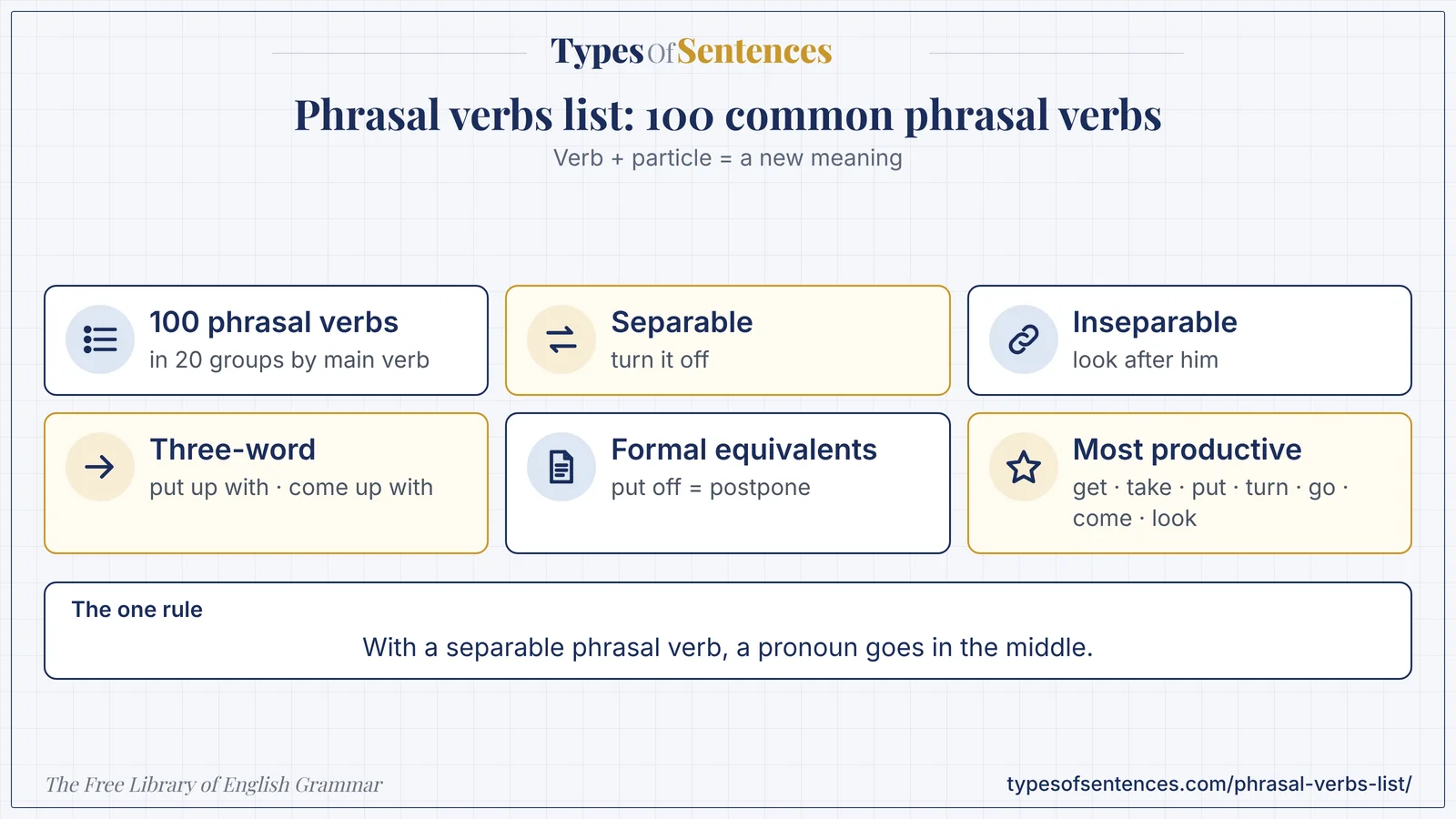
A phrasal verb is two or three words that work as one verb. You cannot guess the meaning from the parts: give up is not about giving.
Why it matters: Learn them in sentences, with their groups, and notice whether the object can go in the middle. That one habit prevents most mistakes.
Summary: A phrasal verb is a verb plus a particle with a special meaning (give up, look after). Some take no object (The car broke down), some are inseparable (look after the baby, look after him), and some are separable (turn the light off, turn it off). With a separable phrasal verb, a pronoun object must go in the middle (turn it off, not turn off it). Three-word phrasal verbs (put up with, come up with, look forward to) are inseparable. Many phrasal verbs have a more formal one-word equivalent (put off = postpone).
- Verb + particle = new meaning.
- Separable: pronoun goes in the middle.
- Three-word phrasal verbs are inseparable.
- Learn them in groups, in sentences.
What You’ll Learn
- 1. Phrasal Verbs List: The Short Answer
- 2. The Phrasal Verbs List: 100 Common Phrasal Verbs in 20 Groups
- 3. Phrasal Verbs With Get: Why Get Has the Most
- 4. Separable Phrasal Verbs: Where the Object Goes
- 5. Phrasal Verbs and Prepositional Verbs: The Difference
- 6. Formal Equivalents of Common Phrasal Verbs
- 7. Common Mistakes With Phrasal Verbs
- 8. Exercises
- 9. Test Your Knowledge
- 10. Frequently Asked Questions
- 11. Conclusion
1. Phrasal Verbs List: The Short Answer
| Type | What it means | Example | Rule |
|---|---|---|---|
| no object (intransitive) | the phrasal verb has no object | The car broke down. | nothing follows |
| inseparable | the object must come after the particle | She looks after her brother. | looks after him (not looks him after) |
| separable | the object can go in the middle or after | Turn the light off. · Turn off the light. | a pronoun must go in the middle: Turn it off. |
| three-word | verb + adverb + preposition | I look forward to seeing you. | always inseparable |
| Part | Name | Example |
|---|---|---|
| give | main verb | give up |
| up | particle (adverb) | give up |
| give up | phrasal verb | means stop trying |
2. The Phrasal Verbs List: 100 Common Phrasal Verbs in 20 Groups
Each group has the same main verb; the particle changes the meaning. The column “grammar” shows whether the phrasal verb is separable, inseparable, or takes no object.
| Phrasal verbs with get | Meaning | Grammar | Phrasal verbs examples |
|---|---|---|---|
| get up | rise from bed | no object | I get up at six. |
| get along | have a good relationship | no object | They get along well. |
| get over | recover from | inseparable | She got over the flu. |
| get by | manage with little | no object | We get by on a small income. |
| get away | escape | no object | The thief got away. |
| get back | return | no object | When did you get back? |
| get on | board; make progress | inseparable | Get on the bus. |
| get out | leave | no object | Get out of the car. |
| Phrasal verbs with take | Meaning | Grammar | Phrasal verbs examples |
|---|---|---|---|
| take off | leave the ground; remove | separable | The plane takes off at six. |
| take after | resemble | inseparable | She takes after her mother. |
| take up | begin a hobby | separable | He took up painting. |
| take over | assume control of | separable | She took over the company. |
| take back | return; withdraw | separable | I take it back. |
| take in | absorb; deceive | separable | She took in every word. |
| take out | remove; go out with | separable | Take out the trash. |
| take on | accept a task | separable | He took on extra work. |
| Phrasal verbs with put | Meaning | Grammar | Phrasal verbs examples |
|---|---|---|---|
| put off | delay | separable | Do not put off the test. |
| put on | wear | separable | Put on your coat. |
| put out | extinguish | separable | Put out the fire. |
| put up with | tolerate | inseparable | I cannot put up with the noise. |
| put away | store | separable | Put away your toys. |
| put down | set down; insult | separable | Put the bag down. |
| put together | assemble | separable | We put together a plan. |
| Phrasal verbs with turn | Meaning | Grammar | Phrasal verbs examples |
|---|---|---|---|
| turn on | start a device | separable | Turn on the light. |
| turn off | stop a device | separable | Turn off the TV. |
| turn up | arrive; increase | separable | Turn up the volume. |
| turn down | refuse; reduce | separable | She turned down the offer. |
| turn out | prove to be | no object | It turned out well. |
| turn into | become | inseparable | The frog turned into a prince. |
| Phrasal verbs with go | Meaning | Grammar | Phrasal verbs examples |
|---|---|---|---|
| go on | continue | no object | Go on, please. |
| go off | explode; ring; spoil | no object | The alarm went off. |
| go over | review | inseparable | Let us go over the notes. |
| go out | leave home; stop burning | no object | The lights went out. |
| go through | experience; examine | inseparable | She went through a hard time. |
| go ahead | proceed | no object | Go ahead and start. |
| Phrasal verbs with come | Meaning | Grammar | Phrasal verbs examples |
|---|---|---|---|
| come across | find by chance | inseparable | I came across an old photo. |
| come up with | think of | inseparable | She came up with a plan. |
| come back | return | no object | Come back soon. |
| come in | enter | no object | Come in, please. |
| come over | visit | no object | Come over tonight. |
| come down with | become ill with | inseparable | He came down with the flu. |
| Phrasal verbs with look | Meaning | Grammar | Phrasal verbs examples |
|---|---|---|---|
| look after | take care of | inseparable | She looks after her brother. |
| look for | search for | inseparable | I am looking for my keys. |
| look up | search in a reference | separable | Look up the word. |
| look into | investigate | inseparable | The police are looking into it. |
| look out | be careful | no object | Look out! |
| look forward to | anticipate with pleasure | inseparable | I look forward to seeing you. |
| look down on | regard as inferior | inseparable | He looks down on beginners. |
| Phrasal verbs with give | Meaning | Grammar | Phrasal verbs examples |
|---|---|---|---|
| give up | stop trying | separable | Do not give up. |
| give in | surrender | no object | He finally gave in. |
| give away | donate; reveal | separable | She gave away her old clothes. |
| give back | return | separable | Give back the book. |
| give out | distribute | separable | The teacher gave out the tests. |
| Phrasal verbs with set | Meaning | Grammar | Phrasal verbs examples |
|---|---|---|---|
| set up | arrange; establish | separable | They set up a company. |
| set off | begin a journey | no object | We set off at dawn. |
| set out | begin; arrange | no object | He set out to win. |
| set aside | reserve | separable | Set aside an hour. |
| set back | delay | separable | The rain set us back. |
| Phrasal verbs with break | Meaning | Grammar | Phrasal verbs examples |
|---|---|---|---|
| break down | stop working; collapse | no object | The car broke down. |
| break up | end a relationship | no object | They broke up. |
| break in | enter by force; interrupt | no object | Thieves broke in. |
| break out | begin suddenly; escape | no object | War broke out. |
| break into | enter by force | inseparable | Someone broke into the house. |
| Phrasal verbs with bring | Meaning | Grammar | Phrasal verbs examples |
|---|---|---|---|
| bring up | raise a topic or a child | separable | Do not bring up politics. |
| bring back | return; recall | separable | Bring back the book. |
| bring about | cause | separable | The law brought about change. |
| bring in | introduce; earn | separable | She brings in good money. |
| bring out | release; reveal | separable | The company brought out a new phone. |
| Phrasal verbs with call | Meaning | Grammar | Phrasal verbs examples |
|---|---|---|---|
| call off | cancel | separable | They called off the game. |
| call back | return a phone call | separable | I will call you back. |
| call on | visit; ask | inseparable | The teacher called on me. |
| call up | telephone | separable | He called me up. |
| Phrasal verbs with run | Meaning | Grammar | Phrasal verbs examples |
|---|---|---|---|
| run into | meet by chance | inseparable | I ran into an old friend. |
| run out of | use all of | inseparable | We ran out of milk. |
| run away | flee | no object | The child ran away. |
| run over | hit with a vehicle; review | separable | The car ran over a cat. |
| run down | criticize; lose power | separable | The battery ran down. |
| Phrasal verbs with pick | Meaning | Grammar | Phrasal verbs examples |
|---|---|---|---|
| pick up | lift; collect; learn | separable | Pick up your toys. |
| pick out | choose | separable | She picked out a dress. |
| pick on | bully | inseparable | Do not pick on him. |
| Phrasal verbs with make | Meaning | Grammar | Phrasal verbs examples |
|---|---|---|---|
| make up | invent; reconcile | separable | He made up a story. |
| make out | see or hear with difficulty | separable | I cannot make out the words. |
| make for | move toward | inseparable | We made for the exit. |
| make up for | compensate | inseparable | She made up for lost time. |
| Phrasal verbs with work | Meaning | Grammar | Phrasal verbs examples |
|---|---|---|---|
| work out | exercise; solve | separable | She works out daily. |
| work on | try to improve | inseparable | He is working on his essay. |
| work up | develop | separable | I worked up an appetite. |
| Phrasal verbs with hold | Meaning | Grammar | Phrasal verbs examples |
|---|---|---|---|
| hold on | wait; grip | no object | Hold on a moment. |
| hold up | delay; rob; support | separable | The traffic held us up. |
| hold back | restrain | separable | She held back her tears. |
| Phrasal verbs with keep | Meaning | Grammar | Phrasal verbs examples |
|---|---|---|---|
| keep on | continue | inseparable | Keep on walking. |
| keep up | maintain | separable | Keep up the good work. |
| keep out | not enter | no object | Keep out. |
| keep away | stay at a distance | no object | Keep away from the fire. |
| Phrasal verbs with cut | Meaning | Grammar | Phrasal verbs examples |
|---|---|---|---|
| cut off | remove; interrupt | separable | The phone line was cut off. |
| cut down on | reduce | inseparable | Cut down on sugar. |
| cut out | remove; stop | separable | Cut out the pictures. |
| Phrasal verbs with pull | Meaning | Grammar | Phrasal verbs examples |
|---|---|---|---|
| pull over | stop at the roadside | no object | Pull over here. |
| pull off | succeed in doing | separable | She pulled off a surprise. |
| pull through | survive | no object | He pulled through. |
3. Phrasal Verbs With Get: Why Get Has the Most
The verb get forms more phrasal verbs than almost any other, and each has a different meaning. The table collects the eight in the list above and adds the common three-word get away with and get on with.
| Phrasal verbs with get | Meaning | Example |
|---|---|---|
| get up | rise from bed | I get up at six. |
| get along | have a good relationship | They get along well. |
| get over | recover from | She got over the flu. |
| get by | manage with little | We get by on a small income. |
| get away | escape | The thief got away. |
| get back | return | When did you get back? |
| get on | board; make progress | Get on the bus. |
| get out | leave | Get out of the car. |
| get away with | escape punishment for | He got away with the mistake. |
| get on with | continue; have a good relationship with | Get on with your work. |
The other very productive verbs are take, put, turn, look, come, and go. These common phrasal verbs are the first ones to learn.
4. Separable Phrasal Verbs: Where the Object Goes
| Object | Separable (turn off) | Inseparable (look after) |
|---|---|---|
| a noun | Turn off the light. · Turn the light off. | Look after the baby. (not Look the baby after.) |
| a long noun phrase | Turn off the light in the hall. (prefer after the particle) | Look after the baby in the next room. |
| a pronoun | Turn it off. (required) | Look after her. (required) |
| no object | — | The car broke down. |
| Rule | Correct | Error |
|---|---|---|
| a pronoun goes between the verb and a separable particle | Turn it off. | *Turn off it. |
| an inseparable phrasal verb keeps the particle next to the verb | Look after him. | *Look him after. |
| three-word phrasal verbs are inseparable | I can’t put up with it. | *I can’t put it up with. |
| a long object goes after the particle | She put away all the toys in the room. | *She put all the toys in the room away. (awkward) |
The separable phrasal verbs are the ones whose object can be a noun or a pronoun; the full list in the table above marks each as separable. The objects themselves are described in the chapter on direct and indirect objects.
5. Phrasal Verbs and Prepositional Verbs: The Difference
| Feature | Phrasal verb | Prepositional verb |
|---|---|---|
| particle | an adverb (or adverb + preposition) | a preposition |
| meaning | often not literal: give up | usually literal: look at, listen to |
| object | may be separable | always follows the preposition |
| stress | the particle is often stressed | the verb is stressed |
| pronoun | Turn it off. | Look at it. |
| test | can the particle move after the object? | no, it stays with the object |
A particle in a phrasal verb is not a true preposition because it has no complement of its own; the distinction is covered in the advanced chapter on prepositions and particles. For the prepositions that begin a phrase, see the Basic chapter on prepositions.
6. Formal Equivalents of Common Phrasal Verbs
| Phrasal verb | Formal one-word equivalent | Example |
|---|---|---|
| put off | postpone | postpone the meeting |
| give up | abandon; quit | abandon the plan |
| find out | discover | discover the truth |
| look into | investigate | investigate the claim |
| call off | cancel | cancel the game |
| turn down | reject | reject the offer |
| come up with | devise | devise a plan |
| get over | recover from | recover from an illness |
| run out of | exhaust | exhaust the supply |
| carry on | continue | continue working |
| set up | establish | establish a company |
| go on | continue | continue speaking |
| bring about | cause | cause a change |
| take part in | participate in | participate in a contest |
| get away with | escape punishment for | escape punishment for a crime |
Phrasal verbs are natural in speech and informal writing. Many formal and academic texts prefer the one-word equivalents; the choice is a matter of register, discussed in the guide to diction.
7. Common Mistakes With Phrasal Verbs
| Mistake | Example | Correction |
|---|---|---|
| pronoun after the particle | *Turn off it. | Turn it off. |
| splitting an inseparable verb | *Look the baby after. | Look after the baby. |
| splitting a three-word verb | *Put it up with. | Put up with it. |
| wrong particle | *She looks up to the baby. (meaning take care of) | She looks after the baby. |
| an object after an intransitive one | *The car broke down the road. | The car broke down on the road. |
| missing particle | *I am looking my keys. | I am looking for my keys. |
| a literal reading | *Give up means give up the cake. | give up = stop trying |
| wrong register | *The committee will put off the vote. (in a formal report) | The committee will postpone the vote. |
| an extra preposition | *Pick up it from the floor. | Pick it up from the floor. |
| a phrasal verb in the passive with a pronoun | *It was turned off it. | It was turned off. |
Fix: I looked up the word, but I could not figure out it, so I gave up it and put off the test.
- looked up the word: separable with a noun; correct.
- figure out it: a pronoun must go in the middle, so figure it out.
- gave up it: also separable; use gave it up.
- put off the test: correct.
- Result: I looked up the word, but I could not figure it out, so I gave it up and put off the test. (the sentence is invented)
Recap in 12 seconds
Watch the lesson build itself: A list of 100 common phrasal verbs in 20 groups, with the rules for separable, inseparable, and three-word phrasal verbs. The video has no sound.
Exercises
Part A: Meanings (Exercises 1–10)
Exercise 1: give up means
Show Answer
Answer: stop trying.
Exercise 2: look after means
Show Answer
Answer: take care of.
Exercise 3: turn down (an offer) means
Show Answer
Answer: refuse.
Exercise 4: put off means
Show Answer
Answer: delay.
Exercise 5: come up with means
Show Answer
Answer: think of.
Exercise 6: run out of means
Show Answer
Answer: use all of.
Exercise 7: get along means
Show Answer
Answer: have a good relationship.
Exercise 8: call off means
Show Answer
Answer: cancel.
Exercise 9: take after means
Show Answer
Answer: resemble.
Exercise 10: break down (a car) means
Show Answer
Answer: stop working.
Part B: Place the Pronoun (Exercises 11–18)
Exercise 11: Rewrite with a pronoun: Turn off the light.
Show Answer
Answer: Turn it off.
Exercise 12: Rewrite with a pronoun: Put on your coat.
Show Answer
Answer: Put it on.
Exercise 13: Rewrite with a pronoun: Look after the baby.
Show Answer
Answer: Look after him/her/it. (inseparable)
Exercise 14: Rewrite with a pronoun: Pick up the toys.
Show Answer
Answer: Pick them up.
Exercise 15: Rewrite with a pronoun: She called off the game.
Show Answer
Answer: She called it off.
Exercise 16: Rewrite with a pronoun: I can put up with the noise.
Show Answer
Answer: I can put up with it.
Exercise 17: Rewrite with a pronoun: Give up the plan.
Show Answer
Answer: Give it up.
Exercise 18: Rewrite with a pronoun: Look up the word.
Show Answer
Answer: Look it up.
Part C: Choose the Right Particle (Exercises 19–24)
Exercise 19: Choose: The car broke (down/up).
Show Answer
Answer: down.
Exercise 20: Choose: Please turn (on/in) the light.
Show Answer
Answer: on.
Exercise 21: Choose: We ran (out/over) of milk.
Show Answer
Answer: out (run out of).
Exercise 22: Choose: She came (up/over) with a plan.
Show Answer
Answer: up (come up with).
Exercise 23: Choose: I am looking (for/at) my keys.
Show Answer
Answer: for (search).
Exercise 24: Choose: They set (off/in) at dawn.
Show Answer
Answer: off.
Part D: Correct the Errors (Exercises 25–30)
Exercise 25: Correct: *Turn off it.
Show Answer
Answer: Turn it off.
Exercise 26: Correct: *Look the baby after.
Show Answer
Answer: Look after the baby.
Exercise 27: Correct: *I am looking my keys.
Show Answer
Answer: I am looking for my keys.
Exercise 28: Correct: *Put it up with.
Show Answer
Answer: Put up with it.
Exercise 29: Correct: *Pick up it from the floor.
Show Answer
Answer: Pick it up from the floor.
Exercise 30: Correct: *The committee will put off the vote. (formal)
Show Answer
Answer: The committee will postpone the vote.
Test Your Knowledge
Ready to check what you learned? Answer all 10 questions, then submit. You need 80% (8 of 10) to pass. Your answers are not stored.
View correct answers and explanations
Question 1: A phrasal verb is a verb plus a
✓ Correct Answer: A – particle
Verb plus particle.
Question 2: Turn ___ off. (the light)
✓ Correct Answer: B – it
A pronoun goes in the middle.
Question 3: Look after is
✓ Correct Answer: C – inseparable
The object stays after.
Question 4: Put up with is a
✓ Correct Answer: D – three-word phrasal verb
Verb + adverb + preposition.
Question 5: The formal equivalent of put off is
✓ Correct Answer: A – postpone
Postpone.
Question 6: Give up means
✓ Correct Answer: B – stop trying
Stop trying.
Question 7: Which main verb forms the most phrasal verbs on this list?
✓ Correct Answer: C – get
Get is very productive.
Question 8: Which is correct?
✓ Correct Answer: D – Pick it up.
The pronoun goes between.
Question 9: The car broke down. The phrasal verb has
✓ Correct Answer: A – no object
Intransitive.
Question 10: Call off means
✓ Correct Answer: B – cancel
Cancel.
Frequently Asked Questions
What is a phrasal verbs list?
A phrasal verbs list is a reference list of the verbs that combine with a particle to make a new meaning, such as give up and look after. This page lists 100 of the most common, each with its meaning, grammar, and an example.
What are some phrasal verbs examples?
Get up (rise from bed), turn off (stop a device), look after (take care of), give up (stop trying), and put up with (tolerate) are phrasal verbs examples. The tables above give a sentence for each of 100.
What are the most common phrasal verbs?
The most common phrasal verbs are built on get, take, put, turn, go, come, and look. This page’s selection is a teaching list of common phrasal verbs, not a ranking from a corpus.
What are separable phrasal verbs?
Separable phrasal verbs are those whose object can come between the verb and the particle: turn the light off. If the object is a pronoun it must go in the middle: turn it off.
What are phrasal verbs with get?
Get up, get along, get over, get by, get away, get back, get on, get out, and the three-word get away with and get on with are common phrasal verbs with get.
Are phrasal verbs formal or informal?
Many are informal or neutral and are natural in speech. Formal and academic writing often prefers a one-word equivalent: postpone for put off, investigate for look into.
What is the difference between a phrasal verb and a prepositional verb?
In a phrasal verb the particle is an adverb and often changes the meaning (give up); in a prepositional verb the preposition keeps its meaning and always comes before its object (look at, listen to).
Conclusion
You now have a phrasal verbs list for reference: 100 phrasal verbs with meanings, grammar, and examples, the rule for separable phrasal verbs, the difference from prepositional verbs, the phrasal verbs with get, and the formal equivalents.
Learn them in groups and in sentences, and check the object whenever you are unsure. Next, study the pronoun forms that the separable rule depends on, in the pronouns list.
- Swan, Michael. Practical English Usage. 4th ed. Oxford University Press, 2016.: phrasal verbs and verb + preposition combinations.
- Quirk, Randolph, Sidney Greenbaum, Geoffrey Leech, and Jan Svartvik. A Comprehensive Grammar of the English Language. Longman, 1985.: multi-word verbs (chapter 16).
- Huddleston, Rodney, and Geoffrey K. Pullum. The Cambridge Grammar of the English Language. Cambridge University Press, 2002.: verb + particle constructions.
- McCarthy, Michael, and Felicity O’Dell. English Phrasal Verbs in Use. Cambridge University Press.: a graded collection of phrasal verbs for learners (check the current edition).
- Merriam-Webster Dictionary: phrasal verb: the dictionary entry (not opened when this page was written).
Last reviewed: October 29, 2026. How it was made: drafted with AI assistance, then checked with automated tests (structure, links, answer keys, spelling) and against the sources above. A person has not yet read this chapter line by line. Found a mistake? Report it.