What are irregular verbs? Irregular verbs are verbs that do not form their simple past and past participle by adding -ed. Regular verbs follow one rule: walk, walked, walked. Irregular verbs follow no single rule: go, went, gone; sing, sang, sung; cut, cut, cut. English has a few hundred of them, and they include some of the most common verbs in the language (be, have, do, go, say, make, take, see, come), which is why learners must know them well.
This page gives the irregular verbs list in full: 220 verbs with all three irregular verb forms (the base form, the simple past, and the past participle), in American spelling with the British variants noted. It explains the five patterns, the past tense of irregular verbs and how to use the forms in the simple past, the perfect tenses, and the passive, the verbs that have both regular and irregular forms, tips for learning the irregular verbs in the past tense, and the common mistakes. It ends with 30 exercises and a 10-question quiz.
Every English verb has three main forms: the base form (go), the simple past (went), and the past participle (gone). For regular verbs, the second and third are the same and end in -ed. For irregular verbs, you have to learn them.
Why it matters: Use the simple past alone (She went home.), and the past participle after have or be (She has gone. The door was broken.). Mixing them up (*She has went) is the most common error.
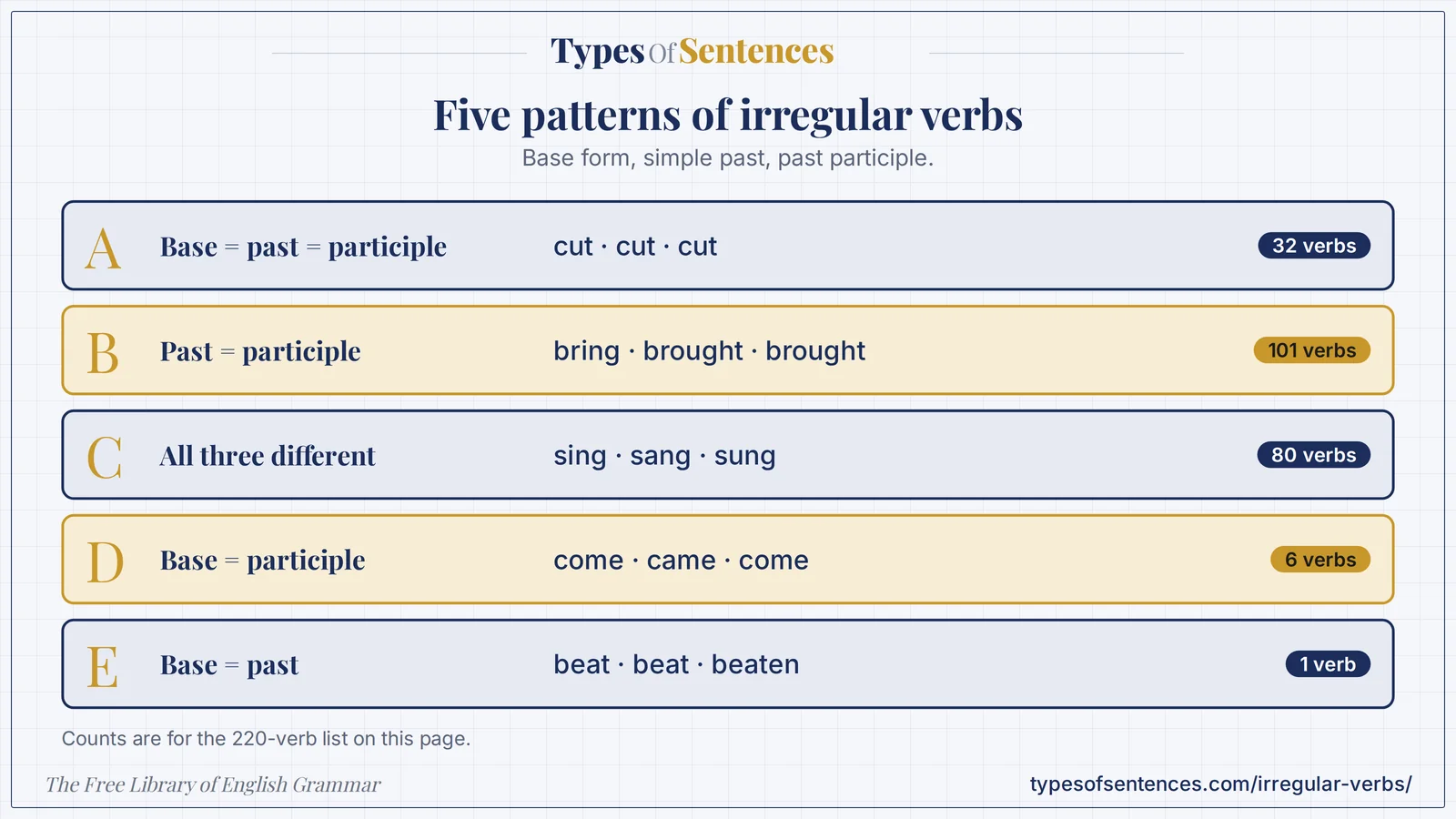
Summary: Irregular verbs do not take -ed in the simple past and the past participle. This page lists 220 of them in three forms. The patterns are: all three forms the same (cut, cut, cut; 32 verbs here); past and participle the same (bring, brought, brought; 101); all three different (sing, sang, sung; 80); base and participle the same (come, came, come; 6); and base and past the same (beat, beat, beaten; 1). Use the simple past without an auxiliary and the past participle with have (perfect tenses) or be (passive). American and British English differ for some verbs (learned/learnt, gotten/got, dived/dove).
- Three forms: base, simple past, past participle.
- Five patterns; the participle is the form after have and be.
- Some verbs have regular and irregular forms: US vs UK.
- Common error: has went (correct: has gone).
What You’ll Learn
- 1. What Are Irregular Verbs? The Three Forms
- 2. The Five Patterns of Irregular Verbs
- 3. The Irregular Verbs List: 220 Irregular Verb Forms From A to Z
- 4. American and British Forms of Irregular Verbs
- 5. Using the Three Forms: The Simple Past, the Perfect, and the Passive
- 6. How to Learn the Past Tense of Irregular Verbs
- 7. Common Mistakes With Irregular Verbs
- 8. Exercises
- 9. Test Your Knowledge
- 10. Frequently Asked Questions
- 11. Conclusion
1. What Are Irregular Verbs? The Three Forms
| Kind of verb | Base form | Simple past | Past participle | Rule |
|---|---|---|---|---|
| regular | walk | walked | walked | add -ed (or -d) |
| regular | play | played | played | add -ed |
| irregular | go | went | gone | no rule |
| irregular | sing | sang | sung | a vowel change |
| irregular | bring | brought | brought | a different ending |
| irregular | cut | cut | cut | no change |
| irregular | come | came | come | the participle is the base form |
| Form | Used for | Example |
|---|---|---|
| base form | the present tense (except he, she, it), the infinitive, after modals, the imperative | I go. She can go. Go! |
| simple past | a finished action in the past | She went home yesterday. |
| past participle | the perfect tenses, the passive, adjectives, participial phrases | She has gone. The cake was eaten. a broken window |
The word irregular is a matter of the history of the language. Most of these verbs are the survivors of the strong verbs of Old English, which changed their vowels (sing, sang, sung) instead of adding an ending. When English later adopted a regular ending for new verbs, the old ones kept their forms, and they are among the most frequent words in the language, which is why they have survived. The past participle itself is the subject of the next chapter, and the verb forms are compared in the chapter on finite and non-finite verbs.
2. The Five Patterns of Irregular Verbs
| Pattern | Description | Examples | How many in the list below |
|---|---|---|---|
| A: base = past = participle | no change at all | cut, cut, cut; put, put, put; hit, hit, hit; set, set, set | 32 |
| B: past = participle | one new form for both | bring, brought, brought; buy, bought, bought; keep, kept, kept; make, made, made | 101 |
| C: all three different | three separate forms | sing, sang, sung; take, took, taken; go, went, gone; write, wrote, written | 80 |
| D: base = participle | the past is different | come, came, come; run, ran, run; become, became, become | 6 |
| E: base = past | the participle is different | beat, beat, beaten | 1 |
| Family (by sound) | Verbs | Pattern |
|---|---|---|
| -ing, -ang, -ung | sing, ring, swim (swam, swum), begin, drink, sink, shrink, spring, stink | i – a – u |
| -ought, -aught | bring, buy, catch, fight, seek, teach, think | one form for past and participle |
| -ew, -own | blow, grow, know, throw, fly (flew, flown), draw (drew, drawn) | base – -ew – -own |
| -oke, -oken | break, speak, wake, steal (stole, stolen), freeze (froze, frozen), choose (chose, chosen) | base – o – o + -en |
| -ore, -orn | swear, tear, wear, bear | base – -ore – -orn |
| -ode, -idden | ride, drive (drove, driven), rise (rose, risen), write (wrote, written), bite (bit, bitten), hide (hid, hidden) | long i to o and -en |
| -ept | keep, sleep, sweep, weep, creep | vowel shortened + t |
| -ent | bend, lend, send, spend | d changes to t |
| no change | cut, hit, hurt, let, put, set, shut, split, spread, cost, quit | all three the same |
| -ound | find, bind, grind, wind | vowel change to ou |
| -eld, -old, -ood | hold (held), sell (sold), tell (told), stand (stood) | one form for past and participle |
3. The Irregular Verbs List: 220 Irregular Verb Forms From A to Z
The list gives American forms first and notes the common variants. Verbs with the same base and a different meaning have their meaning in brackets (lie to recline, lie to tell an untruth is regular: lied). Prefix verbs follow their base verb (undo follows do; mistake follows take). Some verbs on the list are mainly regular and have an irregular variant (for example dream and learn); they are included because the irregular forms are common in British English.
I. Irregular Verbs A to D
| Base form | Simple past | Past participle | Notes |
|---|---|---|---|
| arise | arose | arisen | — |
| awake | awoke | awoken | also awaked |
| be | was / were | been | — |
| bear | bore | borne | born for birth |
| beat | beat | beaten | — |
| become | became | become | — |
| beget | begot | begotten | — |
| begin | began | begun | — |
| behold | beheld | beheld | — |
| bend | bent | bent | — |
| beset | beset | beset | — |
| bet | bet | bet | also betted |
| bid (offer) | bid | bid | — |
| bind | bound | bound | — |
| bite | bit | bitten | — |
| bleed | bled | bled | — |
| blow | blew | blown | — |
| break | broke | broken | — |
| breed | bred | bred | — |
| bring | brought | brought | — |
| broadcast | broadcast | broadcast | also broadcasted (rare) |
| build | built | built | — |
| burn | burned | burned | burnt in British use |
| burst | burst | burst | — |
| buy | bought | bought | — |
| cast | cast | cast | — |
| catch | caught | caught | — |
| choose | chose | chosen | — |
| cling | clung | clung | — |
| come | came | come | — |
| cost | cost | cost | — |
| creep | crept | crept | — |
| cut | cut | cut | — |
| deal | dealt | dealt | — |
| dig | dug | dug | — |
| dive | dived | dived | dove is common in American use for the past |
| do | did | done | — |
| draw | drew | drawn | — |
| dream | dreamed | dreamed | dreamt in British use |
| drink | drank | drunk | — |
| drive | drove | driven | — |
| dwell | dwelt | dwelt | dwelled is also used |
II. Irregular Verbs E to L
| Base form | Simple past | Past participle | Notes |
|---|---|---|---|
| eat | ate | eaten | — |
| fall | fell | fallen | — |
| feed | fed | fed | — |
| feel | felt | felt | — |
| fight | fought | fought | — |
| find | found | found | — |
| fit | fit | fit | fitted in British use |
| flee | fled | fled | — |
| fling | flung | flung | — |
| fly | flew | flown | — |
| forbid | forbade | forbidden | also forbad |
| forecast | forecast | forecast | also forecasted |
| foresee | foresaw | foreseen | — |
| foretell | foretold | foretold | — |
| forget | forgot | forgotten | — |
| forgive | forgave | forgiven | — |
| forgo | forwent | forgone | — |
| forsake | forsook | forsaken | — |
| freeze | froze | frozen | — |
| get | got | gotten | got in British use |
| give | gave | given | — |
| go | went | gone | — |
| grind | ground | ground | — |
| grow | grew | grown | — |
| hang (a picture) | hung | hung | hanged for an execution |
| have | had | had | — |
| hear | heard | heard | — |
| hew | hewed | hewn | also hewed |
| hide | hid | hidden | — |
| hit | hit | hit | — |
| hold | held | held | — |
| hurt | hurt | hurt | — |
| input | input | input | also inputted |
| keep | kept | kept | — |
| kneel | knelt | knelt | kneeled is also used |
| knit | knit | knit | knitted is also used |
| know | knew | known | — |
| lay | laid | laid | — |
| lead | led | led | — |
| lean | leaned | leaned | leant in British use |
| leap | leaped | leaped | leapt in British use |
| learn | learned | learned | learnt in British use |
| leave | left | left | — |
| lend | lent | lent | — |
| let | let | let | — |
| lie (recline) | lay | lain | — |
| light | lit | lit | lighted is also used |
| lose | lost | lost | — |
III. Irregular Verbs M to R
| Base form | Simple past | Past participle | Notes |
|---|---|---|---|
| make | made | made | — |
| mean | meant | meant | — |
| meet | met | met | — |
| mislay | mislaid | mislaid | — |
| mislead | misled | misled | — |
| misread | misread | misread | — |
| mistake | mistook | mistaken | — |
| misunderstand | misunderstood | misunderstood | — |
| mow | mowed | mown | also mowed |
| offset | offset | offset | — |
| outbid | outbid | outbid | — |
| outdo | outdid | outdone | — |
| outgrow | outgrew | outgrown | — |
| outrun | outran | outrun | — |
| overcome | overcame | overcome | — |
| overdo | overdid | overdone | — |
| overeat | overate | overeaten | — |
| overhear | overheard | overheard | — |
| overpay | overpaid | overpaid | — |
| override | overrode | overridden | — |
| overrun | overran | overrun | — |
| oversee | oversaw | overseen | — |
| oversleep | overslept | overslept | — |
| overtake | overtook | overtaken | — |
| overthrow | overthrew | overthrown | — |
| partake | partook | partaken | — |
| pay | paid | paid | — |
| plead | pleaded | pleaded | pled in some American legal use |
| prove | proved | proved | proven is also used |
| put | put | put | — |
| quit | quit | quit | — |
| read | read | read | pronounced like red |
| rebuild | rebuilt | rebuilt | — |
| redo | redid | redone | — |
| remake | remade | remade | — |
| repay | repaid | repaid | — |
| resell | resold | resold | — |
| retake | retook | retaken | — |
| retell | retold | retold | — |
| rethink | rethought | rethought | — |
| rewind | rewound | rewound | — |
| rewrite | rewrote | rewritten | — |
| rid | rid | rid | — |
| ride | rode | ridden | — |
| ring | rang | rung | — |
| rise | rose | risen | — |
| run | ran | run | — |
IV. Irregular Verbs S to Z
| Base form | Simple past | Past participle | Notes |
|---|---|---|---|
| saw | sawed | sawed | sawn is also used |
| say | said | said | — |
| see | saw | seen | — |
| seek | sought | sought | — |
| sell | sold | sold | — |
| send | sent | sent | — |
| set | set | set | — |
| sew | sewed | sewn | also sewed |
| shake | shook | shaken | — |
| shave | shaved | shaved | shaven as an adjective |
| shear | sheared | shorn | also sheared |
| shed | shed | shed | — |
| shine (give light) | shone | shone | shined for polishing |
| shoot | shot | shot | — |
| show | showed | shown | also showed |
| shrink | shrank | shrunk | shrunk is also used for the past |
| shut | shut | shut | — |
| sing | sang | sung | — |
| sink | sank | sunk | — |
| sit | sat | sat | — |
| slay | slew | slain | — |
| sleep | slept | slept | — |
| slide | slid | slid | — |
| sling | slung | slung | — |
| slink | slunk | slunk | — |
| slit | slit | slit | — |
| smell | smelled | smelled | smelt in British use |
| sneak | sneaked | sneaked | snuck is common in informal American use |
| sow | sowed | sown | also sowed |
| speak | spoke | spoken | — |
| speed | sped | sped | speeded for some senses |
| spell | spelled | spelled | spelt in British use |
| spend | spent | spent | — |
| spill | spilled | spilled | spilt in British use |
| spin | spun | spun | — |
| spit | spat | spat | spit is also used in American English |
| split | split | split | — |
| spoil | spoiled | spoiled | spoilt in British use |
| spread | spread | spread | — |
| spring | sprang | sprung | — |
| stand | stood | stood | — |
| steal | stole | stolen | — |
| stick | stuck | stuck | — |
| sting | stung | stung | — |
| stink | stank | stunk | stunk is also used for the past |
| stride | strode | stridden | rare |
| strike | struck | struck | stricken in some senses |
| string | strung | strung | — |
| strive | strove | striven | strived is also used |
| sublet | sublet | sublet | — |
| swear | swore | sworn | — |
| sweep | swept | swept | — |
| swell | swelled | swollen | also swelled |
| swim | swam | swum | — |
| swing | swung | swung | — |
| take | took | taken | — |
| teach | taught | taught | — |
| tear | tore | torn | — |
| tell | told | told | — |
| think | thought | thought | — |
| thrive | thrived | thrived | throve is rare |
| throw | threw | thrown | — |
| thrust | thrust | thrust | — |
| tread | trod | trodden | also trod |
| undergo | underwent | undergone | — |
| understand | understood | understood | — |
| undertake | undertook | undertaken | — |
| undo | undid | undone | — |
| unwind | unwound | unwound | — |
| uphold | upheld | upheld | — |
| upset | upset | upset | — |
| wake | woke | woken | also waked |
| wear | wore | worn | — |
| weave | wove | woven | — |
| weep | wept | wept | — |
| wet | wet | wet | wetted is also used |
| win | won | won | — |
| wind | wound | wound | — |
| withdraw | withdrew | withdrawn | — |
| withhold | withheld | withheld | — |
| withstand | withstood | withstood | — |
| wring | wrung | wrung | — |
| write | wrote | written | — |
4. American and British Forms of Irregular Verbs
| Verb | American English | British English | Note |
|---|---|---|---|
| burn | burned | burnt (also burned) | adjective: burnt toast in both |
| dream | dreamed | dreamt (also dreamed) | — |
| learn | learned | learnt (also learned) | — |
| spell | spelled | spelt (also spelled) | — |
| smell | smelled | smelt (also smelled) | — |
| spill | spilled | spilt (also spilled) | — |
| spoil | spoiled | spoilt (also spoiled) | — |
| lean | leaned | leant (also leaned) | — |
| leap | leaped | leapt (also leaped) | — |
| get (participle) | gotten (and got for possession) | got | She has gotten better (US); She has got better (UK) |
| dive | dived (dove is also used) | dived | — |
| fit | fit (also fitted) | fitted | — |
| sneak | sneaked (snuck is informal) | sneaked | — |
| prove (participle) | proved or proven | proved (proven in some uses) | — |
| shine | shone; shined for polishing | shone | — |
| wet | wet or wetted | wetted (also wet) | — |
| plead | pleaded (pled in some legal use) | pleaded | — |
Both varieties are correct in their own region, and a writer should be consistent within a text. The differences are part of the wider differences between American and British English, which are treated in the chapters on varieties of English.
5. Using the Three Forms: The Simple Past, the Perfect, and the Passive
| Use | Form needed | Example | Mistake |
|---|---|---|---|
| a finished action in the past | simple past | She wrote a letter yesterday. | *She has written a letter yesterday. |
| present perfect | has/have + past participle | She has written three letters. | *She has wrote three letters. |
| past perfect | had + past participle | She had gone before I arrived. | *She had went. |
| future perfect | will have + past participle | She will have finished by noon. | — |
| passive voice | be + past participle | The window was broken. The song was sung. | *The window was broke. |
| an adjective | past participle | a broken window; a frozen lake; a written test | — |
| a participial phrase | past participle at the start | Written in 1900, the book is still popular. | — |
| questions and negatives (simple past) | did + base form | Did she go? She did not go. | *Did she went? |
| Pair often confused | Simple past | Past participle | Example |
|---|---|---|---|
| go | went | gone | She went. She has gone. |
| see | saw | seen | I saw it. I have seen it. |
| do | did | done | I did it. I have done it. |
| write | wrote | written | He wrote. He has written. |
| take | took | taken | She took it. It was taken. |
| begin | began | begun | It began. It has begun. |
| drink | drank | drunk | I drank tea. I have drunk tea. |
| swim | swam | swum | He swam. He has swum. |
| break | broke | broken | It broke. It is broken. |
| eat | ate | eaten | I ate. I have eaten. |
The perfect tenses and the passive are explained in the chapters on active and passive voice and on the tenses. The verbs that carry the auxiliaries (be, have, do) are described in the chapter on helping verbs.
6. How to Learn the Past Tense of Irregular Verbs
| Tip | How | Example |
|---|---|---|
| learn in families | group verbs by sound | sing, ring, drink, sink |
| learn the three forms together | say them as a chant | go, went, gone |
| start with the most common | the top thirty cover most use | be, have, do, go, say, make, take, see, come, get |
| write sentences | use the simple past and the participle in separate sentences | I wrote it. I have written it. |
| use flashcards with spaced review | base on one side; the other two on the back | — |
| read and listen | notice the forms in real texts | — |
| test yourself in the perfect tense | use have + participle | I have ____ it. |
| keep an error log | record the forms you miss | — |
| check a dictionary | it lists the forms | — |
| use a pattern chart | as a reference, not a substitute for use | — |
7. Common Mistakes With Irregular Verbs
| Mistake | Example | Correction |
|---|---|---|
| participle for the past | *I seen him yesterday. | I saw him yesterday. |
| past for the participle | *She has went home. | She has gone home. |
| adding -ed | *He buyed a car. | He bought a car. |
| wrong participle | *The window was broke. | The window was broken. |
| did with a past form | *Did she went? | Did she go? |
| done for did | *I done it. | I did it. |
| should of | *I should of gone. | I should have gone. |
| brung and drug (nonstandard) | *She brung it. *He drug it. | She brought it. He dragged it. |
| lay and lie confused | *I laid down yesterday. | I lay down yesterday. |
| hung and hanged | *They hung the prisoner. | They hanged the prisoner. They hung the picture. |
| sank and sunk | *The ship has sank. | The ship has sunk. |
| drank and drunk | *I have drank tea. | I have drunk tea. |
Fix: Yesterday I seen a man who has swam across the lake. He had drank water, and the boat was sank, and then I runned home and telled my brother.
- I seen: the simple past of see is saw.
- has swam: the participle of swim is swum: has swum.
- had drank: the participle of drink is drunk: had drunk.
- was sank: the passive needs the participle: was sunk (the boat sank is the active).
- runned and telled: irregular verbs: ran and told.
- Result: Yesterday I saw a man who had swum across the lake. He had drunk water, and the boat sank, and then I ran home and told my brother. (the passage is invented)
Recap in 12 seconds
Watch the lesson build itself: The five patterns of irregular verbs, with an example and a count of each in the 220-verb list. The video has no sound.
Exercises
Part A: Simple Past (Exercises 1–8)
Exercise 1: Simple past of go.
Show Answer
Answer: went.
Exercise 2: Simple past of see.
Show Answer
Answer: saw.
Exercise 3: Simple past of write.
Show Answer
Answer: wrote.
Exercise 4: Simple past of buy.
Show Answer
Answer: bought.
Exercise 5: Simple past of take.
Show Answer
Answer: took.
Exercise 6: Simple past of cut.
Show Answer
Answer: cut.
Exercise 7: Simple past of swim.
Show Answer
Answer: swam.
Exercise 8: Simple past of teach.
Show Answer
Answer: taught.
Part B: Past Participle (Exercises 9–16)
Exercise 9: Past participle of go.
Show Answer
Answer: gone.
Exercise 10: Past participle of see.
Show Answer
Answer: seen.
Exercise 11: Past participle of write.
Show Answer
Answer: written.
Exercise 12: Past participle of drink.
Show Answer
Answer: drunk.
Exercise 13: Past participle of begin.
Show Answer
Answer: begun.
Exercise 14: Past participle of break.
Show Answer
Answer: broken.
Exercise 15: Past participle of come.
Show Answer
Answer: come.
Exercise 16: Past participle of forget (American).
Show Answer
Answer: forgotten.
Part C: Choosing the Form (Exercises 17–24)
Exercise 17: Choose: She (went/gone) home.
Show Answer
Answer: went.
Exercise 18: Choose: She has (went/gone) home.
Show Answer
Answer: gone.
Exercise 19: Choose: I (saw/seen) him yesterday.
Show Answer
Answer: saw.
Exercise 20: Choose: I have (saw/seen) him.
Show Answer
Answer: seen.
Exercise 21: Choose: The window was (broke/broken).
Show Answer
Answer: broken.
Exercise 22: Choose: He (drank/drunk) the tea.
Show Answer
Answer: drank.
Exercise 23: Choose: They have (swam/swum) across.
Show Answer
Answer: swum.
Exercise 24: Choose: The ship has (sank/sunk).
Show Answer
Answer: sunk.
Part D: Patterns and Variants (Exercises 25–28)
Exercise 25: Which pattern: put, put, put?
Show Answer
Answer: All three the same.
Exercise 26: Which pattern: bring, brought, brought?
Show Answer
Answer: Past and participle the same.
Exercise 27: American or British: learnt?
Show Answer
Answer: British (American: learned).
Exercise 28: Which form do Americans use for get in the present perfect?
Show Answer
Answer: gotten.
Part E: Correcting Errors (Exercises 29–30)
Exercise 29: Correct: *She has went home.
Show Answer
Answer: She has gone home.
Exercise 30: Correct: *I done my homework.
Show Answer
Answer: I did my homework.
Test Your Knowledge
Ready to check what you learned? Answer all 10 questions, then submit. You need 80% (8 of 10) to pass. Your answers are not stored.
View correct answers and explanations
Question 1: What is the simple past of go?
✓ Correct Answer: B – went
Went.
Question 2: What is the past participle of write?
✓ Correct Answer: C – written
Written.
Question 3: Which is correct?
✓ Correct Answer: D – She has gone.
Has + participle.
Question 4: Which is correct?
✓ Correct Answer: A – I saw him.
The simple past of see is saw.
Question 5: Which verb has three identical forms?
✓ Correct Answer: B – cut
Cut, cut, cut.
Question 6: What is the past participle of drink?
✓ Correct Answer: C – drunk
Drunk.
Question 7: Which is correct?
✓ Correct Answer: A – The window was broken.
Passive: be + participle.
Question 8: Which form is British for learned?
✓ Correct Answer: D – learnt
Learnt.
Question 9: Which is a regular verb?
✓ Correct Answer: C – walk
Walk, walked, walked.
Question 10: Did she went? should be
✓ Correct Answer: B – Did she go?
Did + base form.
Frequently Asked Questions
What are irregular verbs?
Irregular verbs are verbs that do not form the simple past and the past participle by adding -ed, such as go, went, gone and sing, sang, sung.
Where can I find a complete irregular verbs list?
The irregular verbs list on this page gives 220 verbs with all three forms, from arise to write, in American spelling with the British variants noted.
What are the irregular verb forms?
The irregular verb forms are the base form (go), the simple past (went), and the past participle (gone). Learn the three together.
What is the past tense of irregular verbs?
The past tense of irregular verbs has no rule: it can be a vowel change (sang), a new ending (brought), or no change at all (cut). The simple past is used without an auxiliary.
How do I use irregular verbs in past tenses?
Use irregular verbs in the past as the simple past alone (She went) and as the past participle after have or be (She has gone, It was broken). The irregular verbs in past tenses are the most frequent errors in writing.
Is it gotten or got?
American English uses gotten as the past participle of get for most senses (She has gotten better) and got for possession (I have got a car); British English uses got for both.
How many irregular verbs are there in English?
Sources differ on the count and on what counts as irregular; the list here has 220 verbs, including prefix verbs and verbs with both regular and irregular forms, and the number of really common ones is about one hundred.
Conclusion
You now have a complete irregular verbs list of 220 verbs with their three forms, the five patterns that they follow, the American and British differences, the ways to use the forms in the simple past, the perfect tenses, and the passive, tips for learning them, and the common mistakes.
Learn the verbs in families, check the form after have and be, and review a few each day. Next, you will study the past participle in detail.
- Huddleston, Rodney, and Geoffrey K. Pullum. The Cambridge Grammar of the English Language. Cambridge University Press, 2002.: the inflection of verbs and the irregular verbs.
- Swan, Michael. Practical English Usage. 4th ed. Oxford University Press, 2016.: the list of irregular verbs and American and British forms.
- Quirk, Randolph, Sidney Greenbaum, Geoffrey Leech, and Jan Svartvik. A Comprehensive Grammar of the English Language. Longman, 1985.: irregular verbs.
- Garner, Bryan A. Garner’s Modern English Usage. 5th ed. Oxford University Press, 2022.: entries on gotten, dived/dove, and proved/proven.
- Merriam-Webster Dictionary: irregular verb: the dictionary entry.
Last reviewed: October 29, 2026. How it was made: drafted with AI assistance, then checked with automated tests (structure, links, answer keys, spelling) and against the sources above. A person has not yet read this chapter line by line. Found a mistake? Report it.