What is a linking verb? A linking verb does not show action. It joins the subject to a word that describes it or renames it: The soup is hot. She became a doctor. The cake tastes wonderful. The word that follows (hot, a doctor, wonderful) is the subject complement. The most common linking verb is be, and the others include become, seem, appear, remain, stay, and the sense verbs look, sound, smell, taste, and feel.
This page is a linking verbs list with 100 linking verb examples, each with the complement named. It gives the to be verbs list, the verbs of becoming and remaining, twelve verbs that can be linking or action, the grammar term copular verb and the school label state of being verb, tests for spotting a linking verb, and the common mistakes. It ends with 30 exercises and a 10-question quiz.
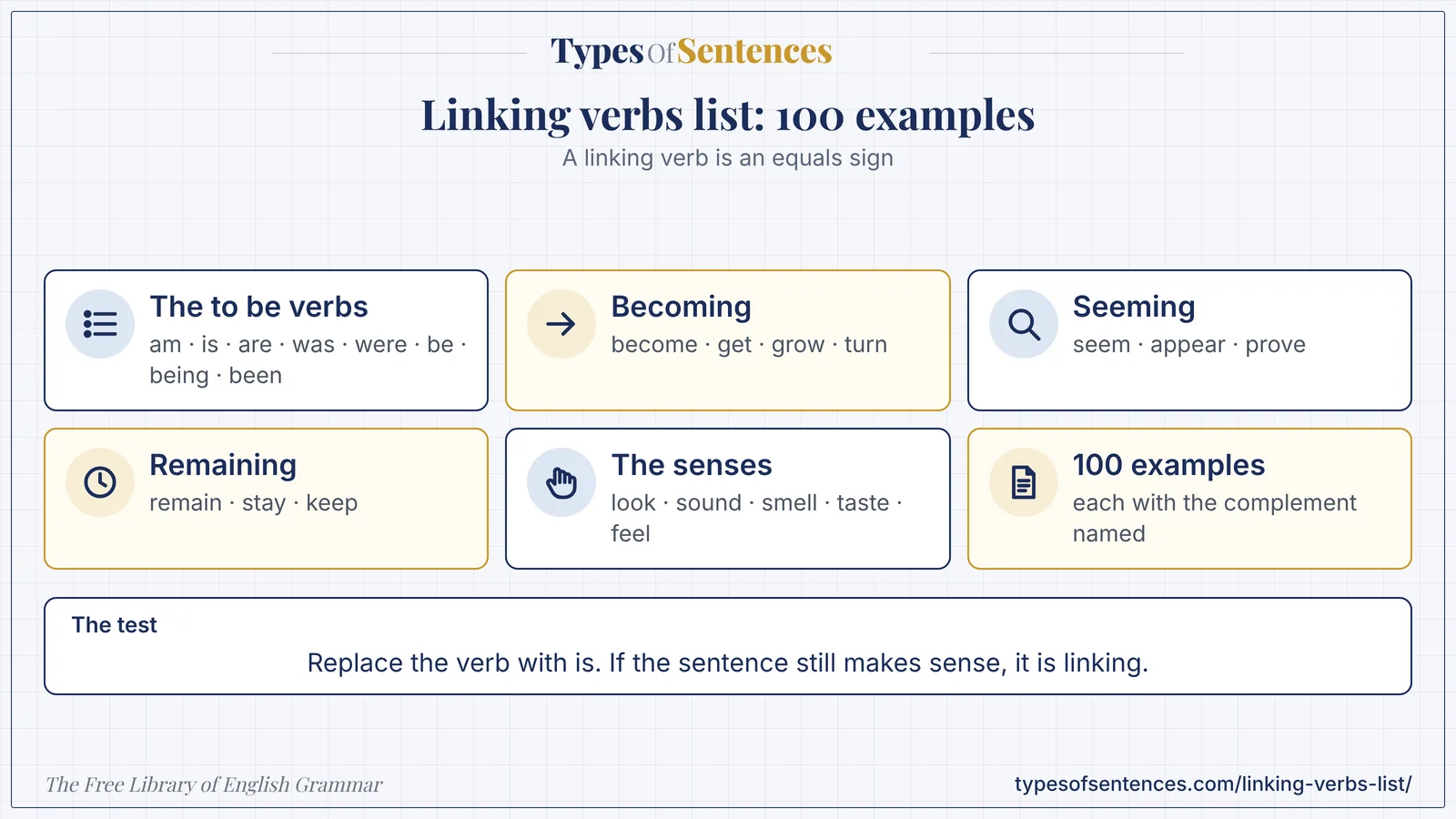
A linking verb works like an equals sign: The soup = hot. She = a doctor. It does not tell what anyone does; it tells what the subject is, seems, or becomes.
Why it matters: If you can replace the verb with is or are and the sentence still makes sense, the verb is linking.
Summary: A linking verb joins a subject to a subject complement (an adjective or a noun). The main linking verb is be (the to be verbs list: am, is, are, was, were, be, being, been). Others are become, seem, appear, remain, stay, keep, grow, turn, get, prove, and the sense verbs look, sound, smell, taste, and feel. Many of these can also be action verbs, so the test is to replace the verb with is. In grammar, a linking verb is a copular verb, and school books often call the to be verbs the state of being verbs. After a linking verb use an adjective, not an adverb (I feel bad, not badly).
- Linking verb = equals sign.
- Main one: be; many others.
- Test: replace with is.
- Use an adjective after it.
What You’ll Learn
- 1. Linking Verbs List: The Short Answer
- 2. The To Be Verbs List and the State of Being Verb
- 3. Linking Verb Examples: 100 Sentences With the Complement Named
- 4. Verbs That Can Be Linking or Action
- 5. Copular Verb: The Grammar Term
- 6. After a Linking Verb: Adjective, Not Adverb
- 7. Common Mistakes With Linking Verbs
- 8. Exercises
- 9. Test Your Knowledge
- 10. Frequently Asked Questions
- 11. Conclusion
1. Linking Verbs List: The Short Answer
| Group | Linking verbs | Example |
|---|---|---|
| to be verbs (the verb be) | am, is, are, was, were, be, being, been | The soup is hot. |
| becoming | become, get, grow, turn, go, come | The sky became dark. |
| seeming | seem, appear, prove | He seems tired. |
| remaining | remain, stay, keep | She remained calm. |
| the senses | look, sound, smell, taste, feel | The cake tastes wonderful. |
| Part of the sentence | Name | Example |
|---|---|---|
| subject | what the sentence is about | The soup |
| linking verb | joins subject and complement | is |
| subject complement | describes or renames the subject | hot (adjective) or a doctor (noun) |
2. The To Be Verbs List and the State of Being Verb
The to be verbs list has eight forms. School grammars often call these the state of being verb because they say that something exists or is in a state, rather than doing anything.
| Form | Use | Example (linking) |
|---|---|---|
| am | I (present) | I am a student. |
| is | he, she, it, a singular noun (present) | She is a doctor. |
| are | you, we, they, plural nouns (present) | They are ready. |
| was | I, he, she, it (past) | The soup was hot. |
| were | you, we, they (past) | We were late. |
| be | the base form, infinitive, and after a modal | It will be difficult. |
| being | the -ing form | Being honest is important. |
| been | the past participle (after have) | He has been sick. |
| When is be NOT a linking verb? | Pattern | Example |
|---|---|---|
| as a helping verb with an -ing form | be + verb-ing | It is raining. |
| as a helping verb in the passive | be + past participle | The door was closed. |
| meaning exist or be located (some analyses) | be + place | The keys are on the table. |
The other helping verbs are listed in the guide to the list of verbs.
3. Linking Verb Examples: 100 Sentences With the Complement Named
In each of these 100 linking verb examples the verb is in bold in your mind and the complement is named in the last column. Notice that most complements are adjectives; some are nouns, and a few are adverbs of time or place after be.
| Verb | Linking verb examples | Linking verb as used | Complement |
|---|---|---|---|
| be | I am a student. | am | noun |
| be | She is a doctor. | is | noun |
| be | They are ready. | are | adjective |
| be | The soup was hot. | was | adjective |
| be | We were late. | were | adjective |
| be | He has been sick. | been | adjective |
| be | Being honest is important. | being | adjective |
| be | I want to be happy. | be | adjective |
| be | It is raining. | is | (helping verb here) |
| be | The answer is no. | is | adverb as complement |
| be | My favorite color is blue. | is | adjective |
| be | The meeting was yesterday. | was | adverb as complement |
| be | You are my friend. | are | noun |
| be | The children were tired. | were | adjective |
| be | Tom is the captain. | is | noun |
| be | The weather is cold. | is | adjective |
| be | Her job is teaching. | is | gerund |
| be | They have been friends for years. | been | noun |
| be | The exam will be difficult. | be | adjective |
| be | Your idea is brilliant. | is | adjective |
| become | She became a doctor. | became | noun |
| become | He became angry. | became | adjective |
| become | The sky became dark. | became | adjective |
| become | They became friends. | became | noun |
| become | The water became warm. | became | adjective |
| become | The problem became worse. | became | adjective |
| become | It has become clear. | become | adjective |
| become | He will become a pilot. | become | noun |
| seem | She seems happy. | seems | adjective |
| seem | He seems tired. | seems | adjective |
| seem | The plan seems easy. | seems | adjective |
| seem | They seem friendly. | seem | adjective |
| seem | It seems a good idea. | seems | noun |
| seem | The room seemed empty. | seemed | adjective |
| seem | He seemed a nice person. | seemed | noun |
| seem | You seem upset. | seem | adjective |
| appear | The man appears nervous. | appears | adjective |
| appear | She appeared happy. | appeared | adjective |
| appear | The task appears simple. | appears | adjective |
| appear | He appeared the perfect host. | appeared | noun |
| appear | The sky appeared clear. | appeared | adjective |
| appear | They appear tired. | appear | adjective |
| remain | He remained calm. | remained | adjective |
| remain | The door remained open. | remained | adjective |
| remain | She remains my best friend. | remains | noun |
| remain | The question remains unanswered. | remains | adjective |
| remain | We remained silent. | remained | adjective |
| remain | The price remains high. | remains | adjective |
| stay | Stay calm. | stay | adjective |
| stay | He stayed quiet. | stayed | adjective |
| stay | The shop stays open late. | stays | adjective |
| stay | We stayed friends. | stayed | noun |
| stay | The food stayed warm. | stayed | adjective |
| stay | Please stay seated. | stay | adjective |
| look | She looks happy. | looks | adjective |
| look | The cake looks delicious. | looks | adjective |
| look | You look tired. | look | adjective |
| look | He looked angry. | looked | adjective |
| look | The room looks clean. | looks | adjective |
| look | They looked ready. | looked | adjective |
| sound | That sounds great. | sounds | adjective |
| sound | The plan sounds good. | sounds | adjective |
| sound | He sounds tired. | sounds | adjective |
| sound | The music sounded loud. | sounded | adjective |
| sound | You sound happy. | sound | adjective |
| sound | It sounds like rain. | sounds | phrase |
| smell | The soup smells delicious. | smells | adjective |
| smell | The flowers smell sweet. | smell | adjective |
| smell | The room smells fresh. | smells | adjective |
| smell | Your perfume smells nice. | smells | adjective |
| smell | The milk smells sour. | smells | adjective |
| taste | The soup tastes salty. | tastes | adjective |
| taste | The cake tastes wonderful. | tastes | adjective |
| taste | This tea tastes bitter. | tastes | adjective |
| taste | The fruit tasted sweet. | tasted | adjective |
| taste | It tastes like chicken. | tastes | phrase |
| feel | I feel tired. | feel | adjective |
| feel | She felt happy. | felt | adjective |
| feel | The fabric feels soft. | feels | adjective |
| feel | He feels better today. | feels | adjective |
| feel | The water felt cold. | felt | adjective |
| feel | We feel safe here. | feel | adjective |
| feel | The air feels fresh. | feels | adjective |
| grow | It grew dark. | grew | adjective |
| grow | The noise grew louder. | grew | adjective |
| grow | She grew tired of waiting. | grew | adjective |
| grow | The days are growing longer. | growing | adjective |
| grow | He grew old. | grew | adjective |
| turn | The leaves turned red. | turned | adjective |
| turn | The milk turned sour. | turned | adjective |
| turn | She turned pale. | turned | adjective |
| turn | The weather turned cold. | turned | adjective |
| turn | He turned traitor. | turned | noun |
| get | It got dark. | got | adjective |
| get | He got angry. | got | adjective |
| get | She is getting better. | getting | adjective |
| get | The food got cold. | got | adjective |
| get | We got lost. | got | adjective |
| get | It gets easier with practice. | gets | adjective |
| prove | The plan proved successful. | proved | adjective |
The complements themselves are described in the Intermediate chapter on subject and object complements, and the sentence pattern that they form (subject, verb, complement) is the fourth of the complementation patterns.
4. Verbs That Can Be Linking or Action
Many verbs are linking in one sentence and action in another. The same word can be a copular verb or an action verb depending on whether it describes the subject or shows what the subject does.
| Verb | As an action verb | As a linking verb |
|---|---|---|
| look | She looked at the picture. (action) | She looks happy. (linking) |
| smell | He smelled the flowers. (action) | The flowers smell sweet. (linking) |
| taste | She tasted the soup. (action) | The soup tastes good. (linking) |
| feel | He felt the fabric. (action) | The fabric feels soft. (linking) |
| sound | The guard sounded the alarm. (action) | The alarm sounds loud. (linking) |
| grow | Farmers grow rice. (action) | The noise grew louder. (linking) |
| turn | He turned the key. (action) | The milk turned sour. (linking) |
| get | She got a letter. (action) | She got angry. (linking) |
| appear | A face appeared at the window. (action: came into view) | He appears nervous. (linking: seems) |
| remain | Few remain here. (action-like: be left) | He remained calm. (linking) |
| stay | We stayed at a hotel. (action) | We stayed friends. (linking) |
| prove | She proved the theorem. (action) | The rumor proved false. (linking) |
| Test | How it works | Example |
|---|---|---|
| 1 the “is” test | replace the verb with is or are; if the sentence still makes sense, the verb is linking | The soup tastes good. → The soup is good. ✓ (linking) |
| 2 the object test | an action verb can have a direct object; a linking verb cannot | She tasted the soup. (object: soup) |
| 3 the adjective test | if an adjective (not an adverb) follows, it is linking | The room looks clean. |
| 4 the adverb test | an adverb after the verb usually shows an action verb | He looked carefully. (action) |
5. Copular Verb: The Grammar Term
| Term | Meaning | Where used |
|---|---|---|
| copular verb | a verb that links a subject to a complement; from Latin copula, a link | modern reference grammars |
| linking verb | the school term for the same thing | school grammars and tests |
| state of being verb | school label for the forms of be | school grammars |
| copula | the verb be in this use | linguistics |
| subject complement | the word that follows the verb | all of them |
The name copular verb is used in most modern reference grammars. It is defined in the grammar glossary, where the term appears in the A to C part.
6. After a Linking Verb: Adjective, Not Adverb
| Rule | Correct | Error |
|---|---|---|
| use an adjective after a linking verb | I feel bad about it. | *I feel badly about it. (poor sense of touch) |
| use an adjective for the senses | The soup smells good. | *The soup smells well. |
| use an adverb after an action verb | She plays well. | *She plays good. |
| well as an adjective for health | I feel well. (healthy) | — |
| adjective after become, grow, get, turn | The sky turned dark. | *The sky turned darkly. |
Adjectives and adverbs are explained in the Basic chapters on adjectives and on adverbs. The rule is the one that the ACT and SAT test most often with linking verbs.
7. Common Mistakes With Linking Verbs
| Mistake | Example | Correction |
|---|---|---|
| adverb after a linking verb | *The cake tastes wonderfully. | The cake tastes wonderful. |
| badly for feelings | *I feel badly. | I feel bad. |
| good after an action verb | *She sings good. | She sings well. |
| an object after a linking verb | *She seems a good idea. (wrong pairing) | The idea seems good. |
| treating all be forms as linking | *In “It is raining”, is is a linking verb. | here is is a helping verb |
| being as a finite verb | *She being a doctor. | She is a doctor. |
| wrong complement form | *He became anger. | He became angry. |
| look with an adverb | *She looks happily. | She looks happy. |
| sound and seem with an adverb | *It sounds greatly. | It sounds great. |
| grow for cultivate vs become | *The flowers grew beauty. | The flowers grew beautiful. or The flowers grew in beauty. |
Fix: The soup smells deliciously, and I feel badly that the guests seem hungrily.
- smells deliciously: smell is linking here, so use the adjective delicious.
- feel badly: feel is linking, so feel bad.
- seem hungrily: seem is always linking, so seem hungry.
- Result: The soup smells delicious, and I feel bad that the guests seem hungry. (the sentence is invented)
Recap in 12 seconds
Watch the lesson build itself: The linking verbs: the to be verbs, verbs of becoming, seeming, and remaining, and the sense verbs, with 100 examples and the is test. The video has no sound.
Exercises
Part A: Is the Verb Linking? (Exercises 1–10)
Exercise 1: The soup is hot. Linking or action?
Show Answer
Answer: linking.
Exercise 2: She runs every day. Linking or action?
Show Answer
Answer: action.
Exercise 3: The cake tastes wonderful. Linking or action?
Show Answer
Answer: linking.
Exercise 4: She tasted the cake. Linking or action?
Show Answer
Answer: action (it has an object).
Exercise 5: He became a doctor. Linking or action?
Show Answer
Answer: linking.
Exercise 6: The leaves turned red. Linking or action?
Show Answer
Answer: linking.
Exercise 7: He turned the key. Linking or action?
Show Answer
Answer: action.
Exercise 8: The room looks clean. Linking or action?
Show Answer
Answer: linking.
Exercise 9: She looked at the sky. Linking or action?
Show Answer
Answer: action.
Exercise 10: It is raining. Is is linking?
Show Answer
Answer: no: it is a helping verb.
Part B: Name the Complement (Exercises 11–18)
Exercise 11: She is a doctor. Complement?
Show Answer
Answer: a doctor (a noun).
Exercise 12: The sky became dark. Complement?
Show Answer
Answer: dark (an adjective).
Exercise 13: He seems tired. Complement?
Show Answer
Answer: tired.
Exercise 14: They remained friends. Complement?
Show Answer
Answer: friends (a noun).
Exercise 15: The meeting was yesterday. Complement?
Show Answer
Answer: yesterday (an adverb of time).
Exercise 16: The rumor proved false. Complement?
Show Answer
Answer: false.
Exercise 17: My favorite color is blue. Complement?
Show Answer
Answer: blue.
Exercise 18: The plan sounds good. Complement?
Show Answer
Answer: good.
Part C: To Be Verbs and Terms (Exercises 19–24)
Exercise 19: List the eight to be verbs.
Show Answer
Answer: am, is, are, was, were, be, being, been.
Exercise 20: What is the grammar term for a linking verb?
Show Answer
Answer: copular verb.
Exercise 21: What do school books call the to be verbs?
Show Answer
Answer: state of being verbs.
Exercise 22: Which is the main linking verb?
Show Answer
Answer: be.
Exercise 23: Name the five sense linking verbs.
Show Answer
Answer: look, sound, smell, taste, feel.
Exercise 24: Name three verbs of becoming.
Show Answer
Answer: become, get, grow, turn (any three).
Part D: Correct the Errors (Exercises 25–30)
Exercise 25: Correct: *I feel badly.
Show Answer
Answer: I feel bad.
Exercise 26: Correct: *The soup smells deliciously.
Show Answer
Answer: The soup smells delicious.
Exercise 27: Correct: *She looks happily.
Show Answer
Answer: She looks happy.
Exercise 28: Correct: *She sings good.
Show Answer
Answer: She sings well.
Exercise 29: Correct: *He became anger.
Show Answer
Answer: He became angry.
Exercise 30: Correct: *The sky turned darkly.
Show Answer
Answer: The sky turned dark.
Test Your Knowledge
Ready to check what you learned? Answer all 10 questions, then submit. You need 80% (8 of 10) to pass. Your answers are not stored.
View correct answers and explanations
Question 1: A linking verb joins a subject to a
✓ Correct Answer: A – complement
A subject complement.
Question 2: Which is a linking verb?
✓ Correct Answer: B – seem
Seem.
Question 3: The soup ___ delicious.
✓ Correct Answer: C – smells
A linking use.
Question 4: I feel ___.
✓ Correct Answer: D – bad
An adjective after a linking verb.
Question 5: The to be verbs list has how many forms?
✓ Correct Answer: A – eight
Am, is, are, was, were, be, being, been.
Question 6: Another term for a linking verb is a
✓ Correct Answer: B – copular verb
Copular.
Question 7: Which test works for a linking verb?
✓ Correct Answer: C – replace with is
The is test.
Question 8: She tasted the soup. The verb is
✓ Correct Answer: D – an action verb
It has an object.
Question 9: It is raining. The word is is
✓ Correct Answer: A – a helping verb
Helping verb.
Question 10: The leaves turned ___.
✓ Correct Answer: B – red
An adjective complement.
Frequently Asked Questions
What is a linking verbs list?
A linking verbs list gathers the verbs that join a subject to a word that describes or renames it. The main one is be; the others include become, seem, appear, remain, stay, look, sound, smell, taste, and feel. This page has 100 examples.
What are the linking verb examples?
The soup is hot. She became a doctor. He seems tired. The cake tastes wonderful. They remained friends. In each one the verb links the subject to a complement.
What is the to be verbs list?
The forms of be: am, is, are, was, were, be, being, and been. When they link a subject to a complement they are linking verbs; when they help another verb (is raining) they are helping verbs.
What is a state of being verb?
It is the school label for the forms of be, because they tell about a state of being rather than an action. In modern grammar they are linking (copular) verbs.
What is a copular verb?
A copular verb is a linking verb. The term comes from the Latin copula, meaning a link. The verb be is the main copular verb in English.
Is it feel bad or feel badly?
It is feel bad. Feel is a linking verb in this sense, and a linking verb takes an adjective. Feel badly would mean that your sense of touch is poor.
How can I tell a linking verb from an action verb?
Replace the verb with is. If the sentence still makes sense (The soup tastes good → The soup is good), the verb is linking. If the verb takes a direct object (She tasted the soup), it is an action verb.
Conclusion
You now have a linking verbs list for reference: the to be verbs list, the verbs of becoming, seeming, and remaining, the sense verbs, and 100 linking verb examples with the complement named. You have also seen the grammar term copular verb, the school label state of being verb, tests for spotting a linking verb, and the common mistakes.
Use the is test whenever a verb could go either way. Next, study the list of phrasal verbs, another reference list that learners need.
- Quirk, Randolph, Sidney Greenbaum, Geoffrey Leech, and Jan Svartvik. A Comprehensive Grammar of the English Language. Longman, 1985.: copular verbs and subject complements (chapters 3 and 10).
- Huddleston, Rodney, and Geoffrey K. Pullum. The Cambridge Grammar of the English Language. Cambridge University Press, 2002.: copular and other complement-taking verbs.
- Swan, Michael. Practical English Usage. 4th ed. Oxford University Press, 2016.: the verbs be, become, seem, look, and the senses.
- Garner, Bryan A. Garner’s Modern English Usage. 5th ed. Oxford University Press, 2022.: the entries on feel bad, badly, and linking verbs.
- Merriam-Webster Dictionary: linking verb: the dictionary entry (not opened when this page was written).
Last reviewed: October 29, 2026. How it was made: drafted with AI assistance, then checked with automated tests (structure, links, answer keys, spelling) and against the sources above. A person has not yet read this chapter line by line. Found a mistake? Report it.