Advanced verb concepts cover everything that makes the verb the most complex word class in English. A verb has only five forms, yet it can be an action, a state, a link, or a helper; it may or may not take an object; it can be finite or non-finite; and it can combine with auxiliaries in a long chain. This chapter treats those complex verbs, their forms, and the patterns that decide how each behaves.
You will study the five verb forms and the irregular verb classes, advanced verb types such as the primary verbs and the modals, the NICE properties that separate auxiliaries from lexical verbs, transitivity patterns, the difference between action and stative verbs, linking verbs, light verbs, causatives, phrasal and prepositional verbs, and mood. The chapter ends with the order of the elements in the verb phrase and 30 editing exercises. Expert verb usage depends on seeing these patterns.
A verb is not only “a doing word”. It is the center of the clause, and its meaning decides what else the clause needs: an object, a complement, a preposition, or nothing at all.
Why it matters: Most verb errors in advanced writing come from not knowing which pattern a verb takes, or from using a verb in a sense that it does not have. Learning the patterns by verb type removes most of them.
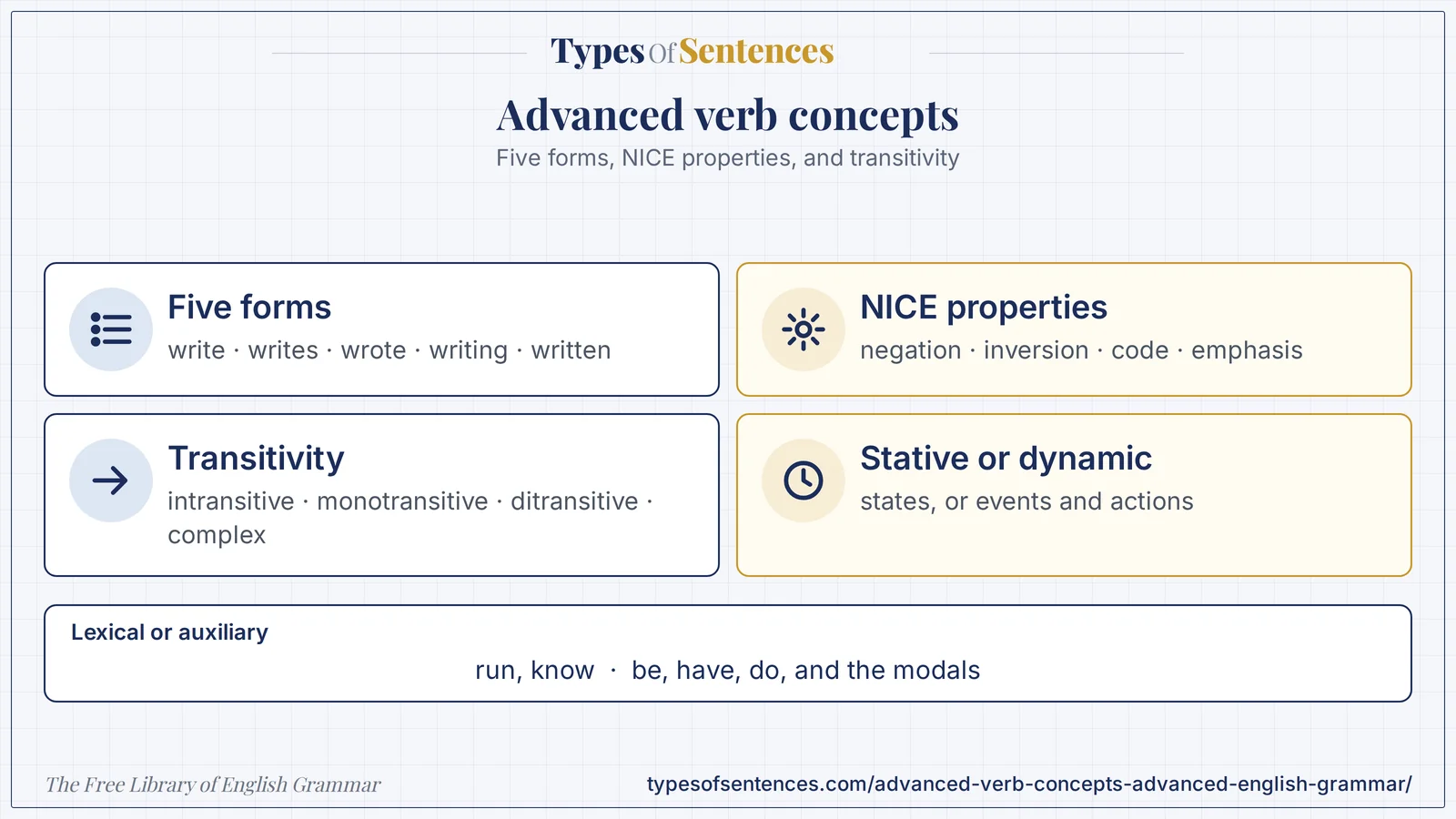
Summary: English verbs have five forms (base, third-person singular, past, -ing participle, -en participle). Verbs are lexical (run, know) or auxiliary (be, have, do, and the modals). Lexical verbs are intransitive, transitive, ditransitive, or linking, and many are used in more than one pattern. Stative verbs describe states and resist the progressive; some verbs have both stative and dynamic senses. Mood expresses the status of the verb: indicative, imperative, or subjunctive.
- Five forms: write, writes, wrote, writing, written.
- NICE properties: negation, inversion, code, emphasis show an auxiliary.
- Transitivity: intransitive, monotransitive, ditransitive, complex-transitive, copular.
- Stative verbs describe states; dynamic verbs describe events and actions.
What You’ll Learn
- 1. Advanced Verb Concepts: The Five Verb Forms
- 2. Irregular Verbs and Variants
- 3. Complex Verbs: Primary Verbs, Auxiliaries, and the NICE Properties
- 4. Transitive vs. Intransitive Verbs and Patterns of Complementation
- 5. Action Verbs vs. Stative Verbs
- 6. Linking (Copular) Verbs
- 7. Light Verbs, Causatives, and Phrasal Verbs
- 8. Mood: Indicative, Imperative, and Subjunctive
- 9. The Order of Elements in the Verb Phrase
- 10. Common Errors with Complex Verbs
- 11. Exercises
- 12. Test Your Knowledge
- 13. Frequently Asked Questions
- 14. Conclusion
1. Advanced Verb Concepts: The Five Verb Forms
Every English verb except be has five forms. The forms are the building blocks of every tense, every non-finite construction, and every passive.
| Form | Name | write | walk | Use |
|---|---|---|---|---|
| 1 | base form | write | walk | present (except third person singular), imperative, infinitive, subjunctive, after modals |
| 2 | third-person singular (-s form) | writes | walks | present tense with he, she, it |
| 3 | past form (preterite) | wrote | walked | simple past |
| 4 | -ing form (present participle, gerund) | writing | walking | progressive; participle; gerund |
| 5 | -en form (past participle) | written | walked | perfect; passive; adjective |
Regular verbs have the same form for 3 and 5 (walked). Irregular verbs may differ, as in write–wrote–written, or have only two distinct forms, as in cut–cut–cut. The verb be has eight forms: be, am, is, are, was, were, being, been. The past participle is described further in the guide to the past participle.
2. Irregular Verbs and Variants
| Class | Pattern | Examples |
|---|---|---|
| no change | base = past = participle | put, cut, set, hit, let, shut, cost, hurt |
| change of vowel (three forms) | i–a–u | sing–sang–sung, begin–began–begun, drink–drank–drunk, swim–swam–swum |
| change of vowel (past = participle) | vowel change | sit–sat–sat, find–found–found, win–won–won, stand–stood–stood |
| -t / -d ending | past and participle end in -t or -d | build–built–built, send–sent–sent, lend–lent–lent, spend–spent–spent |
| -en participle | participle ends in -n or -en | break–broke–broken, speak–spoke–spoken, choose–chose–chosen, take–took–taken |
| participle = base | base = participle | come–came–come, run–ran–run, become–became–become |
| suppletive | different roots | go–went–gone, be–was–been |
| Verb | American | British | Note |
|---|---|---|---|
| learn | learned | learned or learnt | both accepted in British English |
| burn, dream, spell, spill | -ed forms usual | -ed or a form ending in -t | the -t forms are more British and are listed in British dictionaries |
| get | got, gotten (US) | got | gotten means obtained or become in American English |
| prove | proved, proven | proved, proven | both accepted as participles; proven is common before a noun |
| dive | dived, dove | dived | dove is common in American speech |
| sneak | sneaked, snuck | sneaked | snuck is informal and widely used in American English |
| light | lit, lighted | lit, lighted | lit is usual as a verb |
| hang | hung; hanged (a person) | hung; hanged | the legal sense keeps hanged |
| Pair | Forms | Meaning |
|---|---|---|
| lie / lay | lie–lay–lain / lay–laid–laid | lie (recline) is intransitive; lay (put) is transitive |
| sit / set | sit–sat–sat / set–set–set | sit intransitive; set transitive |
| rise / raise | rise–rose–risen / raise–raised–raised | rise intransitive; raise transitive |
| lend / loan | lend–lent–lent / loan (verb, American) | loan as a verb is common in American English |
The full list of irregular verbs is in the guide to irregular verbs. In formal writing, check an unfamiliar form in a dictionary, because speakers vary.
3. Complex Verbs: Primary Verbs, Auxiliaries, and the NICE Properties
The verbs be, have, and do are the primary verbs. Each can be a lexical (main) verb or an auxiliary (helping) verb. The modals (can, will, must, and so on) are always auxiliaries. The guide to auxiliary verbs lists them.
| Verb | As main verb | As auxiliary |
|---|---|---|
| be | She is a doctor. | She is working. It was written. |
| have | He has a car. | She has finished. |
| do | They do their homework. | Do you know? I don’t know. |
| modal (always auxiliary) | — | She can swim. It may rain. |
What makes a verb an auxiliary? Four grammatical properties, known as the NICE properties (from the work of Huddleston and others), are the test. Auxiliaries have all four without do; lexical verbs need do-support.
| Property | Auxiliary | Lexical verb (with do) |
|---|---|---|
| Negation (n’t or not after the verb) | She can’t swim. He has not gone. | She doesn’t swim. |
| Inversion (the verb before the subject in questions) | Can she swim? Has he gone? | Does she swim? |
| Code (the verb stands for the whole predicate) | She can swim, and I can too. | She swims, and I do too. |
| Emphasis (the verb is stressed to affirm) | She CAN swim. | She DOES swim. |
The verb have shows the difference between American and British English. As a lexical verb of possession, British English often treats it as an auxiliary (Have you a pen? I haven’t a clue), while American English uses do-support (Do you have a pen? I don’t have a clue). Both are acceptable, and the American form is increasingly common in both varieties.
| Group | Verbs | Properties |
|---|---|---|
| core modals | can, could, may, might, shall, should, will, would, must | no -s, no non-finite forms, followed by the base form; all NICE properties |
| marginal modals | dare, need, ought to, used to | some auxiliary and some lexical properties; ought takes to |
| semi-modals (modal idioms) | have to, be going to, be able to, had better, would rather, be supposed to | multi-word, with modal-like meanings and ordinary verb inflection |
The meanings of the modals are studied in the chapter on modality. The structure of long verb groups, with several auxiliaries, is in the chapter on complex verb phrases.
4. Transitive vs. Intransitive Verbs and Patterns of Complementation
Transitivity is the relation between a verb and the elements that follow it. The chapter on complementation patterns studies the patterns in detail; here are the main types.
| Pattern | Structure | Example |
|---|---|---|
| intransitive | S + V | The baby slept. Prices fell. |
| monotransitive | S + V + O | She wrote a letter. |
| ditransitive | S + V + IO + DO | She gave him a book. (or: She gave a book to him.) |
| complex-transitive (object + complement) | S + V + O + C | They made her president. We found it difficult. |
| complex-transitive (object + adverbial) | S + V + O + A | He put the book on the table. |
| copular (linking) | S + V + C | She seems tired. He became a doctor. |
| prepositional | S + V + prep + O | She looked at the picture. |
Many verbs fit more than one pattern, and the pattern changes the meaning. They are called ambitransitive verbs.
| Type | Intransitive use | Transitive use |
|---|---|---|
| object can be omitted (the action is the point) | She reads every night. | She reads novels. |
| object becomes the subject (ergative or labile) | The door opened. The ice melted. | She opened the door. The sun melted the ice. |
| middle construction (the subject is the affected thing) | This book sells well. The fabric washes easily. | They sell this book. |
| cognate object (the noun repeats the verb) | She sang. | She sang a song. He lived a good life. They dreamed a dream. |
5. Action Verbs vs. Stative Verbs
Dynamic verbs describe events, actions, and processes (run, build, read) and can take the progressive (She is running). Stative verbs describe states (know, belong, resemble) and normally do not (*She is knowing).
| Group | Stative verbs | Example |
|---|---|---|
| being and relation | be, seem, appear, belong, contain, consist, resemble, equal, exist | The box contains ten items. |
| mental state | know, believe, understand, doubt, remember, realize, suppose | I understand the problem. |
| emotion and attitude | love, hate, like, prefer, want, need, mind, care | She wants a rest. |
| involuntary perception | see, hear, smell, taste, feel, sound, notice | I hear a noise. |
| possession | have (possess), own, possess, lack | He owns a boat. |
| measure | weigh, cost, measure, last | The bag weighs five kilos. |
Many verbs have both a stative and a dynamic sense, and the progressive signals the dynamic one. This is a favorite test of advanced usage.
| Verb | Stative (simple form) | Dynamic (progressive possible) |
|---|---|---|
| think | I think it is wrong. (an opinion) | I am thinking about it. (a mental process) |
| have | She has a car. (possess) | She is having lunch. (eating) |
| see | I see the problem. (understand or perceive) | I’m seeing the doctor. (meeting) |
| taste | The soup tastes salty. (has a taste) | She is tasting the soup. (an action) |
| weigh | It weighs 5 kilos. (has weight) | He is weighing the flour. (an action) |
| be | He is rude. (a trait) | He is being rude. (behaving, temporarily) |
| look | She looks tired. (appears) | She is looking at it. (an action) |
| love | I love it. (a state) | I’m loving it. (an informal, emphatic use, common in advertising) |
The progressive with a stative verb is increasingly common in informal English (I’m loving this, I’m wanting a change), which shows that the “rule” is a strong tendency, not an absolute. Formal writing keeps the simple form for states.
6. Linking (Copular) Verbs
A linking verb connects the subject to a complement that describes or identifies it. The complement is an adjective or a noun phrase, never an adverb.
| Group | Verbs | Example |
|---|---|---|
| being and becoming | be, become, get, grow, turn, go, come, fall | She became angry. The milk went sour. The dream came true. He fell asleep. |
| seeming | seem, appear, look, sound | It seems fine. That sounds good. |
| remaining | remain, stay, keep | He stayed calm. |
| sensing | feel, taste, smell, look, sound | The soup smells good. She feels tired. |
| proving | prove, turn out | The plan proved successful. |
| Verb | Linking (adjective follows) | Not linking (adverb follows) |
|---|---|---|
| look | She looks happy. | She looked carefully. |
| feel | I feel bad. | I feel strongly about it. |
| smell | The flowers smell sweet. | He smelled the soup carefully. |
| grow | The days grew short. | The plant grew quickly. |
| turn | The leaves turned red. | She turned quickly. |
7. Light Verbs, Causatives, and Phrasal Verbs
I. Light verbs
A light (or support) verb has little meaning of its own, and the noun that follows carries the meaning: take a walk, make a decision, have a look, give a talk, do a favor. They are common in speech and are a kind of nominalization.
| Light-verb phrase | Single verb |
|---|---|
| make a decision | decide |
| take a look at | look at |
| have a discussion | discuss |
| give an explanation | explain |
| do a review of | review |
II. Causative verbs
| Verb | Pattern | Example |
|---|---|---|
| make | make + object + base verb | She made him wait. (force) |
| let | let + object + base verb | She let him go. (allow) |
| have | have + object + base verb; have + object + past participle | I had him check it. I had my car repaired. |
| get | get + object + to-infinitive; get + object + past participle | I got him to check it. I got my car repaired. |
| help | help + object + (to) base verb | She helped him (to) finish. |
| force, cause, enable | verb + object + to-infinitive | They forced him to leave. |
III. Phrasal and prepositional verbs
| Type | Pattern | Example | Test |
|---|---|---|---|
| phrasal verb (separable) | V + particle + O or V + O + particle | She looked up the word. She looked the word up. She looked it up. | a pronoun object goes before the particle |
| phrasal verb (inseparable) | V + particle + O | They ran into trouble. | not separable |
| prepositional verb | V + prep + O | She looked at the picture. *She looked the picture at. | the preposition stays with its object |
| phrasal-prepositional verb | V + particle + prep + O | They put up with the noise. | two particles |
Phrasal verbs often have idiomatic meanings (give up = quit), and the particle is stressed. Later chapters cover more patterns.
8. Mood: Indicative, Imperative, and Subjunctive
| Mood | Use | Example |
|---|---|---|
| indicative | statements and questions about what is or is not the case | She is here. Is she here? |
| imperative | commands, requests, and instructions; base form; the subject is usually omitted | Close the door. Please sit. |
| subjunctive (mandative) | after verbs, adjectives, and nouns of demand and recommendation; base form for all persons | I insist that he be present. It is essential that she arrive on time. |
| subjunctive (were) | hypothetical or unreal conditions | If I were you … I wish it were Friday. |
| formulaic subjunctive | fixed expressions | Long live the king. So be it. God save the queen. Far be it from me. |
The mandative subjunctive uses the base form after expressions of demand: I suggest that he go, not that he goes. British English often uses should instead (I suggest that he should go) or the indicative. The were subjunctive appears in the conditionals studied at the Intermediate level.
9. The Order of Elements in the Verb Phrase
A verb phrase can contain up to five elements, always in the same order. Each auxiliary determines the form of the one that follows.
| Position | Element | Form of the next element |
|---|---|---|
| 1 | modal (may, will) | base form |
| 2 | perfect have | -en participle |
| 3 | progressive be | -ing participle |
| 4 | passive be | -en participle |
| 5 | main verb | — |
| Verb phrase | Elements |
|---|---|
| She wrote. | main verb |
| She will write. | modal + main |
| She has written. | have + -en |
| She is writing. | be + -ing |
| The letter was written. | passive be + -en |
| She might have been writing. | modal + have + be + main |
| The letter may have been being written. | modal + have + be (progressive) + be (passive) + main (rare, awkward) |
Four or five auxiliaries are possible in principle but rare in practice, and long strings are often rewritten: The letter may have been in the process of being written or simply She may have been writing the letter. The finite verb is the first element, and it carries tense and agreement. The twelve tenses are examined in the chapter on tense and aspect.
10. Common Errors with Complex Verbs
| Error | Correction | Rule |
|---|---|---|
| I have went there. | I have gone there. | past participle, not past form |
| She has wrote it. | She has written it. | past participle |
| He lay the book on the table. (placed) | He laid the book on the table. | lay is transitive; laid past |
| I am knowing the answer. | I know the answer. | stative verb |
| The accident was happened. | The accident happened. | intransitive verbs have no passive |
| She made him to wait. | She made him wait. | bare infinitive after make |
| I suggest that he goes. | I suggest that he go. | mandative subjunctive (American usual) |
| If I was you, I would go. | If I were you, I would go. | were subjunctive in formal writing |
| She feels badly about it. | She feels bad about it. | linking verb takes an adjective |
| She looked the picture at. | She looked at the picture. | prepositional verb |
| I didn’t knew. | I didn’t know. | base form after do-support |
| She can to swim. | She can swim. | bare infinitive after a modal |
Edit: I have went to the office, and I am wanting to lay down, but my boss suggests that I goes home and had my car repair, because it was happened yesterday.
- have went: have gone.
- am wanting: stative: want.
- lay down (recline): lie down.
- suggests that I goes: suggests that I go.
- had my car repair: had my car repaired.
- it was happened: it happened.
- Result: I have gone to the office, and I want to lie down, but my boss suggests that I go home and have my car repaired, because it happened yesterday.
Recap in 12 seconds
Watch the lesson build itself: Verbs have five forms, are lexical or auxiliary, and differ in transitivity and in stative or dynamic meaning. The video has no sound.
Exercises
Part A: Forms and Irregular Verbs (Exercises 1–7)
Exercise 1: Edit: I have went there.
Show Answer
Answer: I have gone there.
Exercise 2: Edit: She has wrote it.
Show Answer
Answer: She has written it.
Exercise 3: Give the five forms of take.
Show Answer
Answer: take, takes, took, taking, taken.
Exercise 4: Name the eight forms of be.
Show Answer
Answer: be, am, is, are, was, were, being, been.
Exercise 5: Choose: He (lay/laid) the book on the table.
Show Answer
Answer: laid.
Exercise 6: Choose: She wants to (lie/lay) down.
Show Answer
Answer: lie.
Exercise 7: American variant of learnt:
Show Answer
Answer: learned.
Part B: Auxiliaries and Modals (Exercises 8–13)
Exercise 8: Which NICE property: Can she swim?
Show Answer
Answer: Inversion.
Exercise 9: Which NICE property: She CAN swim.
Show Answer
Answer: Emphasis.
Exercise 10: Add do-support: She swims. (negative)
Show Answer
Answer: She doesn’t swim.
Exercise 11: Edit: She can to swim.
Show Answer
Answer: She can swim.
Exercise 12: Is ought to a core modal?
Show Answer
Answer: No. It is a marginal modal.
Exercise 13: Name a semi-modal.
Show Answer
Answer: have to (or be going to, had better).
Part C: Transitivity (Exercises 14–19)
Exercise 14: Intransitive or transitive: The baby slept.
Show Answer
Answer: Intransitive.
Exercise 15: Name the pattern: She gave him a book.
Show Answer
Answer: Ditransitive (S V IO DO).
Exercise 16: Name the pattern: They made her president.
Show Answer
Answer: Complex-transitive (S V O C).
Exercise 17: Edit: The accident was happened.
Show Answer
Answer: The accident happened.
Exercise 18: Name the construction: The door opened. and She opened the door.
Show Answer
Answer: An ergative (labile) verb.
Exercise 19: Name the construction: She sang a song.
Show Answer
Answer: Cognate object.
Part D: Stative, Linking, Causative (Exercises 20–26)
Exercise 20: Edit: I am knowing the answer.
Show Answer
Answer: I know the answer.
Exercise 21: Explain: He is being rude.
Show Answer
Answer: He is behaving rudely (a temporary action).
Exercise 22: Choose: The soup smells (good/well).
Show Answer
Answer: good.
Exercise 23: Choose: She feels (bad/badly) about it.
Show Answer
Answer: bad.
Exercise 24: Edit: She made him to wait.
Show Answer
Answer: She made him wait.
Exercise 25: Complete: I had my car (repair).
Show Answer
Answer: repaired.
Exercise 26: Replace the light verb: make a decision
Show Answer
Answer: decide.
Part E: Mood and Verb Phrase (Exercises 27–30)
Exercise 27: Edit: I suggest that he goes. (American formal)
Show Answer
Answer: I suggest that he go.
Exercise 28: Edit: If I was you, I would go. (formal)
Show Answer
Answer: If I were you, I would go.
Exercise 29: Order the elements: been, might, writing, have
Show Answer
Answer: might have been writing.
Exercise 30: Name the form after a modal:
Show Answer
Answer: The base form.
Test Your Knowledge
Ready to check what you learned? Answer all 10 questions, then submit. You need 80% (8 of 10) to pass. Your answers are not stored.
View correct answers and explanations
Question 1: How many distinct forms does a regular verb like walk have?
✓ Correct Answer: B – Four
Walk, walks, walked, walking: four distinct forms.
Question 2: Which is the past participle of write?
✓ Correct Answer: C – written
Written is the participle.
Question 3: Which NICE property does Can she swim? show?
✓ Correct Answer: D – Inversion
The verb comes before the subject.
Question 4: Which verb is stative?
✓ Correct Answer: C – know
Know is a stative verb.
Question 5: Which is correct?
✓ Correct Answer: D – I know the answer.
Stative verbs usually take the simple form.
Question 6: Which verb is intransitive?
✓ Correct Answer: A – arrive
Arrive takes no object.
Question 7: Which is correct?
✓ Correct Answer: C – She made him wait.
Make takes the bare infinitive.
Question 8: Which is a linking verb in The soup smells good?
✓ Correct Answer: B – smells
Smells links the subject to good.
Question 9: Which uses the mandative subjunctive?
✓ Correct Answer: A – I suggest that he go.
Base form after a verb of recommendation.
Question 10: Which is the correct order of auxiliaries?
✓ Correct Answer: B – might have been
Modal, then perfect have, then be.
Frequently Asked Questions
What are advanced verb concepts?
Advanced verb concepts are the finer points of the verb: the five forms, irregular classes, auxiliaries and the NICE properties, transitivity, stative and dynamic verbs, linking verbs, causatives, phrasal verbs, and mood.
What are complex verbs?
Complex verbs are verbs whose behavior depends on pattern or sense: ambitransitive verbs (open), verbs with stative and dynamic senses (think), linking verbs (seem), light verbs (take a walk), and phrasal verbs (give up).
What are verb complexities that learners find hard?
Verb complexities that cause the most difficulty are irregular forms, the choice between simple and progressive for stative verbs, the transitive and intransitive pairs (lie/lay), phrasal verbs, and the subjunctive.
What are advanced verb types?
Advanced verb types include primary verbs, modal and marginal auxiliaries, semi-modals, linking (copular) verbs, light verbs, causative verbs, and phrasal and prepositional verbs.
What is expert verb usage?
Expert verb usage is choosing the right form, pattern, and sense of a verb for the context: the correct participle, the right complement, the simple or progressive form, and the strong verb in place of a weak phrase.
What are the NICE properties?
The NICE properties are Negation, Inversion, Code, and Emphasis. Auxiliary verbs can show all four without do; lexical verbs need do-support.
Why can’t I say “I am knowing”?
Know is a stative verb, and stative verbs describe states, which usually do not take the progressive. Say I know.
Conclusion
You now have a deep study of the verb: the five forms, irregular classes and variants, auxiliaries and the NICE properties, transitivity, stative and dynamic senses, linking verbs, light verbs, causatives, phrasal verbs, mood, and the order of the verb phrase. You can use complex verbs with expert control and avoid the usual errors.
When a verb gives you trouble, ask what pattern it takes and what sense it has. Next, you will study advanced pronoun concepts.
- Huddleston, Rodney, and Geoffrey K. Pullum. The Cambridge Grammar of the English Language. Cambridge University Press, 2002.: the reference analysis of verbs, auxiliaries, and the NICE properties.
- Quirk, Randolph, et al. A Comprehensive Grammar of the English Language. Longman, 1985.: the classic treatment of verb forms, transitivity, and mood.
- Biber, Douglas, et al. Longman Grammar of Spoken and Written English. Longman, 1999.: corpus evidence on verb use.
- Garner, Bryan A. Garner’s Modern English Usage, 5th ed. Oxford University Press, 2022.: usage guidance on irregular verbs and the subjunctive.
- Merriam-Webster Dictionary: auxiliary verb: the dictionary definition.
Last reviewed: October 29, 2026. How it was made: drafted with AI assistance, then checked with automated tests (structure, links, answer keys, spelling) and against the sources above. A person has not yet read this chapter line by line. Found a mistake? Report it.