Advanced preposition concepts start with a reminder that prepositions are small words with large problems. English has about seventy simple prepositions and many more complex ones (in spite of, with regard to), and the choice between in, on, and at often depends on convention, not logic. Verbs, adjectives, and nouns also select prepositions of their own (depend on, afraid of, a reason for), and the rule against ending a sentence with a preposition has caused more worry than it deserves.
This chapter treats the complex prepositions and the preposition complexities that learners and writers meet: comprehensive lists, time, place, and movement in detail, prepositional phrases and where they attach, dependent prepositions, the difference between a preposition and an adverb, the choice between stranding and pied-piping, and the common errors. The aim is expert prepositions and advanced preposition usage for any register. Thirty editing exercises and a quiz follow.
A preposition links a noun phrase to the rest of the clause and shows a relation: place, time, direction, cause, means, and many others. Most of the relations are abstract, which is why the choice of preposition cannot be worked out from meaning alone.
Why it matters: The practical approach is to learn the patterns by group (time, place, movement) and to learn the dependent prepositions as part of the word they follow.
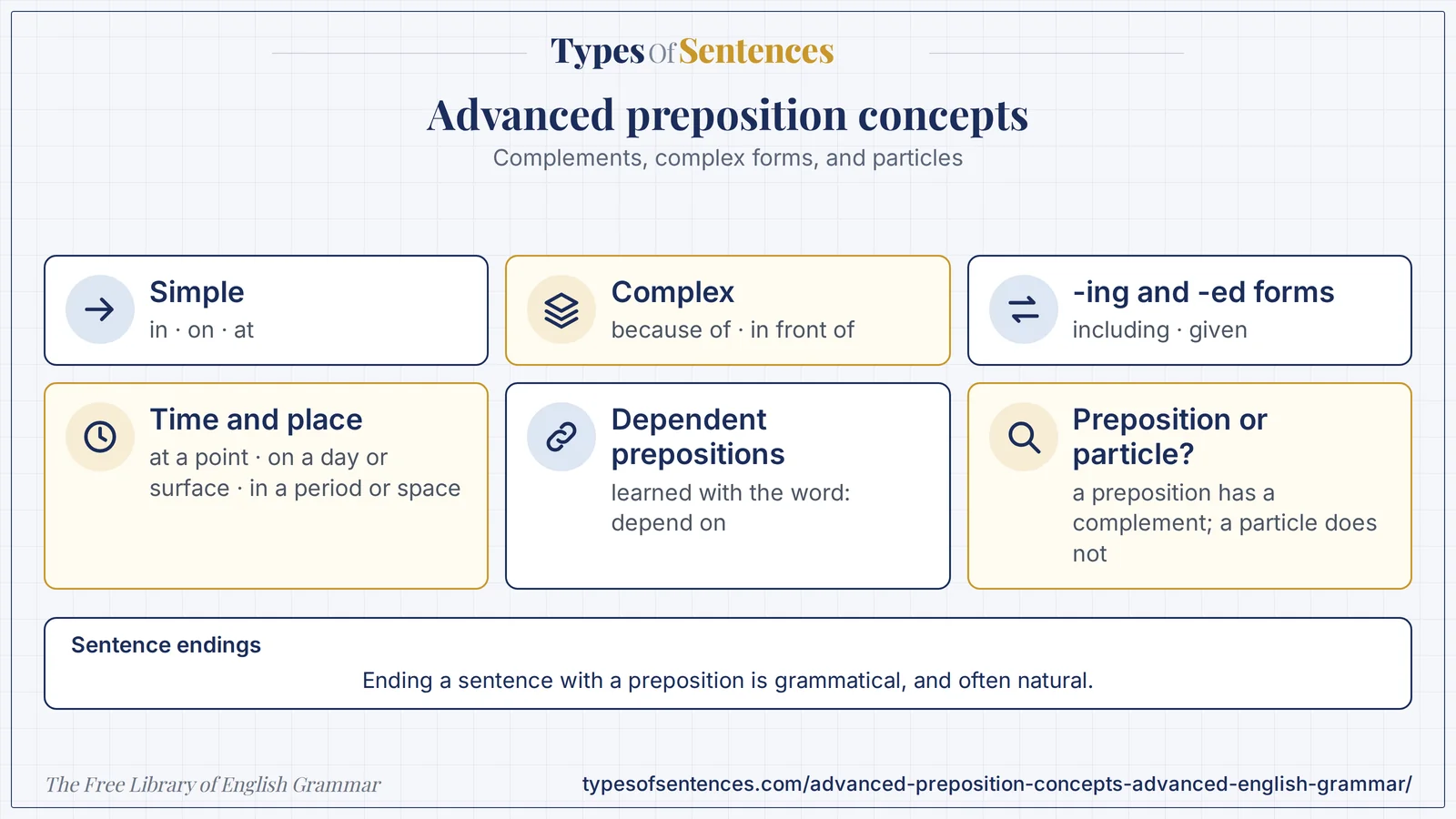
Summary: A preposition takes a complement (usually a noun phrase) and forms a prepositional phrase. Simple prepositions are one word (in, on, at); complex ones have several words (because of, in front of); some end in -ing or -ed (including, given). Time and place prepositions follow patterns (at a point, on a day or surface, in a period or enclosure). Verbs, adjectives, and nouns require specific prepositions. A preposition can end a clause (stranding), and in many sentences that is the natural choice.
- At a point, on a day or surface, in a period or enclosed space.
- Dependent prepositions must be learned with the word: depend on, afraid of.
- A preposition has a complement; an adverbial particle does not.
- Ending a sentence with a preposition is grammatical and often better.
What You’ll Learn
- 1. Advanced Preposition Concepts: Structure and Classification
- 2. Prepositions of Time in Detail
- 3. Prepositions of Place in Detail
- 4. Prepositions of Movement and Direction
- 5. Prepositional Phrases and Attachment
- 6. Dependent Prepositions
- 7. Preposition, Adverb, or Conjunction?
- 8. Ending a Sentence with a Preposition: Stranding and Pied-Piping
- 9. Zero Prepositions, Fixed Phrases, and Abstract Relations
- 10. Common Errors with Prepositions
- 11. Exercises
- 12. Test Your Knowledge
- 13. Frequently Asked Questions
- 14. Conclusion
1. Advanced Preposition Concepts: Structure and Classification
A preposition is a word that precedes a complement, most often a noun phrase, and forms a prepositional phrase that functions as an adjunct, a complement, or a modifier. The complement is not always a noun phrase.
| Complement | Example |
|---|---|
| noun phrase | in the garden, with her sister |
| gerund or -ing clause | without leaving, by working hard, after finishing |
| wh-clause | I am curious about what happened. |
| adjective | at best, in short, for sure |
| adverb | until recently, since then, from here |
| prepositional phrase | from under the bed, until after lunch |
| (none, stranded) | Who did you speak to? |
| Type | Description | Examples |
|---|---|---|
| simple | one word | in, on, at, by, for, from, of, to, with, under, over, between, through |
| complex (compound) | two or three words | because of, in spite of, in front of, on behalf of, with regard to, according to, as for, due to, instead of, out of, by means of, in addition to |
| participial and -ing | from verbs | including, excluding, regarding, concerning, considering, given, pending, following, during, granted |
| conditional and concessive | express a condition or contrast | but for (But for your help, I would have failed), despite, in spite of, apart from, except for, barring |
Complex prepositions behave as a unit: in spite of is followed by a noun phrase or gerund (in spite of the rain, in spite of being late), and the pattern is in spite of or despite, never despite of. The final test of a preposition is that it has a complement or could have one; a similar word without one is an adverb, as shown below.
2. Prepositions of Time in Detail
| Preposition | Used with | Examples |
|---|---|---|
| at | clock times, points, meal times, festivals | at 6 o’clock, at noon, at midnight, at lunch, at night, at the weekend (British), at Christmas, at the moment |
| on | days, dates, and parts of a specific day | on Monday, on June 5, on my birthday, on Friday morning, on Christmas Day, on the weekend (American) |
| in | months, seasons, years, centuries, parts of the day, longer periods | in June, in winter, in 2025, in the twentieth century, in the morning, in the 1990s |
| no preposition | with last, next, this, every, each, all, some, one, tomorrow, yesterday, today | last week, next year, this morning, every day, all night, tomorrow afternoon |
| Contrast | Rule | Examples |
|---|---|---|
| for and during and while | for + length of time; during + a noun naming an event or period; while + a clause | for two hours; during the film; while we were eating |
| since and for | since + a starting point; for + a length (with the perfect) | since Monday; for three days |
| by and until | by: no later than (a deadline); until: continuing up to | Finish by Friday. Stay until Friday. |
| in and within | in: at the end of a period; within: no later than the end | I’ll be back in two hours. Reply within two hours. |
| from … to and from … until | start and end | from 9 to 5; from May until July |
| ago and before | ago: back from now; before: back from another time | two days ago; two days before the exam |
| in time and on time | in time: soon enough; on time: punctual | We arrived in time for dinner. The train left on time. |
| at the end and in the end | at the end of + noun; in the end = finally | at the end of the film; In the end, she agreed. |
Regional differences: American English uses on the weekend and British English at the weekend; American English says on Monday and may omit the preposition in informal speech (See you Monday). British English has at Christmas where American English also uses at Christmas and on Christmas Day. These differences are treated in the chapter on British and American English.
3. Prepositions of Place in Detail
| Preposition | Meaning | Examples |
|---|---|---|
| at | a point or a place seen as a location | at the door, at the station, at school, at work, at home, at the corner, at a party, at the top of the page |
| in | inside an enclosed space or area | in the box, in the room, in a city, in the country, in the newspaper, in the corner (of a room), in a car, in a taxi |
| on | on a surface or a line; on a means of public transport | on the table, on the wall, on the floor, on the corner (of the street), on a bus, on a train, on a plane, on Main Street (American) |
| above, over | higher than; over also covers or crosses | a picture above the sofa; a bridge over the river; a blanket over the child |
| below, under, beneath, underneath | lower than; under may touch; beneath is literary | below the surface; under the table; beneath the stars |
| between, among, amid | between: two or specific items; among: a group | between the two houses; among the trees; amid the noise |
| by, beside, next to, near, close to | next to or at the side of | by the window; beside the road; next to the bank |
| in front of, behind, opposite, across from | relative position | in front of the school; behind the house; opposite the park (British); across from the park (American) |
| inside, outside | within or beyond a boundary | inside the building; outside the gate |
4. Prepositions of Movement and Direction
| Preposition | Meaning | Examples |
|---|---|---|
| to | toward a destination | She went to Paris. |
| into, onto | entering a space or reaching a surface | He walked into the room. The cat jumped onto the table. |
| toward, towards | in the direction of (without necessarily arriving) | She walked toward the door. (towards is more British) |
| from | the starting point | They came from Spain. |
| out of, off | leaving a space or a surface | She got out of the car. He fell off the ladder. |
| through | inside a space or volume | They drove through the tunnel. |
| across | from one side to the other of a surface | She swam across the lake. |
| over | above and across; on the far side | He jumped over the fence. |
| along | following a line | They walked along the river. |
| past | by, without stopping | She drove past the school. |
| around (British also round) | in a circle or on the other side | They walked around the lake. |
| up, down | along a slope or line | He ran up the hill. She walked down the street. |
| via | by way of | a flight to Delhi via Dubai |
| Contrast | Difference |
|---|---|
| to versus into | She went to the room (to the door); She went into the room (inside) |
| in versus into | in: location; into: movement to the inside (He is in the room. He walked into the room.) |
| through versus across versus over | through (a tunnel, a forest), across (a field, a lake), over (a wall) |
5. Prepositional Phrases and Attachment
A prepositional phrase can modify a noun (an adjectival use) or a verb or clause (an adverbial use), and it can complement a verb, an adjective, or a noun. The chapter on prepositional phrases introduced the types.
| Function | Example |
|---|---|
| postmodifier of a noun | the book on the table; a man with a hat |
| adjunct (adverbial) | She left after lunch. |
| complement of a verb | She looked at the picture. |
| complement of an adjective | afraid of heights |
| complement of a noun | a reason for the delay |
A prepositional phrase can attach to more than one word, producing ambiguity: I saw the man with the telescope (who had the telescope?). Good writing avoids such ambiguity by moving the phrase next to what it modifies, or by rewriting: Using a telescope, I saw the man, or I saw the man who had the telescope. Strings of prepositional phrases, as in the report on the results of the analysis of the data from the survey of the schools, are heavy and are better broken up.
6. Dependent Prepositions
Many verbs, adjectives, and nouns require a particular preposition. These dependent prepositions are partly arbitrary and must be learned with the word. They are collocations; see the chapter on collocation.
| Word class | Examples |
|---|---|
| verb + preposition | depend on, rely on, count on, believe in, consist of, result in, result from, apologize for, agree with (a person), agree to (a plan), belong to, insist on, object to, participate in, succeed in, suffer from, wait for, worry about, look at, listen to, ask for, search for, think of, dream of, approve of, complain about, concentrate on, differ from, specialize in |
| adjective + preposition | afraid of, aware of, good at, interested in, proud of, responsible for, similar to, different from, fond of, keen on, tired of, familiar with, capable of, jealous of, married to, satisfied with, typical of |
| noun + preposition | reason for, solution to, demand for, increase in, decrease in, interest in, difference between, access to, need for, advantage of (having), advantage over, cause of, attitude to(ward), influence on, effect on, answer to |
| Word | Common choices | Notes |
|---|---|---|
| different | from (standard), than (American, with a clause), to (British) | different from the others; different than I expected |
| agree | with a person or opinion; to a proposal; on a matter | agree with her, agree to the plan, agree on a price |
| angry | at a thing, with a person, about a matter | angry at the delay, angry with him |
| compare | to (liken), with (examine similarities and differences) | compare life to a journey; compare this year’s sales with last year’s |
| interested | in | interested in music |
| married | to | married to Tom |
7. Preposition, Adverb, or Conjunction?
Many words can be prepositions, adverbs, or conjunctions. The test is the complement: a preposition has one; an adverb does not.
| Word | Preposition (with a complement) | Adverb (no complement) | Conjunction (with a clause) |
|---|---|---|---|
| in | She is in the house. | She came in. | — |
| up | He ran up the hill. | He looked up. | — |
| off | Get off the bus. | Switch it off. | — |
| before | before dinner | I have seen it before. | before she left |
| after | after lunch | They came soon after. | after she left |
| since | since Monday | We haven’t met since. | since she left |
| until | until noon | — | until she arrives |
| as | She works as a nurse. (role) | — | as she walked in |
| like | a house like ours | — | (informal) like I said |
| near | near the station | Come near. | — |
| but | everyone but Tom (except) | — | I tried, but I failed. |
| Pair | Rule | Examples |
|---|---|---|
| like and as | like + noun phrase (similar to); as + noun phrase (in the role of) or + clause | She sings like a bird. She works as a teacher. Do as I say. |
| despite and although | despite + noun phrase or gerund; although + clause | Despite the rain, we went. Although it rained, we went. |
| during and while | during + noun; while + clause | during the meeting; while we talked |
| because of and because | because of + noun; because + clause | because of the rain; because it rained |
Particles in phrasal verbs (give up, turn off) look like prepositions but do not have a complement of their own. The distinction matters for word order: turn the light off and turn it off, but only look at it.
8. Ending a Sentence with a Preposition: Stranding and Pied-Piping
Preposition stranding leaves the preposition at the end of its clause (Who did you speak to?). Pied-piping moves it forward with its complement (To whom did you speak?). Both are grammatical.
| Stranded | Pied-piped | Register |
|---|---|---|
| Who did you speak to? | To whom did you speak? | stranded: neutral and informal; pied-piped: formal |
| the house I live in | the house in which I live | stranded: natural; pied-piped: formal |
| the man you were talking about | the man about whom you were talking | stranded: natural |
| What are you looking at? | At what are you looking? | pied-piped sounds stilted |
| This is easy to talk about. | (not possible) | stranding is required in some constructions |
| the person to talk to | (not possible) | infinitive relative clauses strand |
The rule against ending a sentence with a preposition is usually traced to attempts in the seventeenth century to model English on Latin, in which a preposition cannot be stranded. Major usage guides and grammars today do not support it. A story of Winston Churchill’s mocking reply (“This is the sort of English up with which I will not put”) is probably not authentic, but it makes the point that avoiding the final preposition can produce a worse sentence. Formal writers sometimes prefer pied-piping with whom and which; the chapter on grammar myths and controversies returns to the point.
9. Zero Prepositions, Fixed Phrases, and Abstract Relations
| Pattern | Examples | Notes |
|---|---|---|
| verbs that take no preposition | discuss the plan, enter the room, reach the station, attend the meeting, mention the problem, marry her, resemble her, approach the door, answer the question | not *discuss about, *enter into the room (for ordinary entering), *marry with |
| verbs with a preposition in other languages | reply to (not *reply the letter), listen to (not *listen the music), wait for (not *wait the bus) | check a dictionary |
| no preposition with some time and place words | last night, next week, this morning, every day, here, there, home (go home) | to home is not standard |
| arrive | arrive at (a place: station, airport), in (a city or country) | arrive at the station; arrive in Delhi |
| means of transport | by car, by bus, by train; on foot; on a bus (inside) but by bus (means) | by without a determiner |
| Fixed phrase | Meaning | Contrast |
|---|---|---|
| in time / on time | soon enough / punctual | arrive in time for the show; the train left on time |
| at last / in the end / at the end | after a wait / finally / the final part | at last she arrived; In the end, they agreed; at the end of the book |
| on purpose / by accident / by mistake | deliberately / unintentionally | He did it on purpose. She sent it by mistake. |
| in charge of / on behalf of | responsible for / for someone | in charge of the team; on behalf of the school |
| in cash / by check / on credit | forms of payment | pay in cash; pay by check |
| in the whole / on the whole | in total / generally | on the whole, I agree |
| at risk / in danger / out of danger | exposed to harm | children at risk; in danger; out of danger |
| in writing / in person / in advance | in written form / present / beforehand | confirm in writing; apply in person |
| Preposition | Abstract relations | Examples |
|---|---|---|
| of | possession, part, material, content, source | a friend of mine, a piece of cake, made of wood, a cup of tea |
| by | agent, means, measure, deadline | written by Maria, travel by train, win by two points, finish by noon |
| with | instrument, accompaniment, having, manner | cut with a knife, come with me, a girl with red hair, with great care |
| for | purpose, beneficiary, duration, reason | a gift for you, wait for an hour, famous for its cheese |
| about / on | topic | a book about / on grammar (on is more formal or technical) |
| from / of | material (change vs no change) | made from grapes (changed); made of steel (not changed) |
10. Common Errors with Prepositions
| Error | Correction | Rule |
|---|---|---|
| We discussed about the plan. | We discussed the plan. | discuss takes no preposition |
| She is married with Tom. | She is married to Tom. | married to |
| It depends of the weather. | It depends on the weather. | depend on |
| I arrived to the station. | I arrived at the station. | arrive at/in |
| She is good in math. | She is good at math. | good at |
| Despite of the rain, we went. | Despite the rain, we went. / In spite of the rain, we went. | despite takes no of |
| I look forward to see you. | I look forward to seeing you. | to is a preposition |
| I’m interested on art. | I’m interested in art. | interested in |
| He is different to me. (American) | He is different from me. | different from |
| She listened the music. | She listened to the music. | listen to |
| on the weekend (formal British) | at the weekend | regional variation |
| Between the five students | Among the five students | among for a group |
Edit: I arrived to the airport on Monday at the morning, and we discussed about the plan, which depends of the weather, despite of the fact that I am not good in planning, and I look forward to meet the team.
- arrived to the airport: arrived at the airport.
- on Monday at the morning: on Monday morning.
- discussed about: discussed.
- depends of: depends on.
- despite of the fact: despite the fact.
- good in planning: good at planning.
- look forward to meet: look forward to meeting.
- Result: I arrived at the airport on Monday morning, and we discussed the plan, which depends on the weather, despite the fact that I am not good at planning, and I look forward to meeting the team.
Recap in 12 seconds
Watch the lesson build itself: Prepositions take complements and may be simple, complex, or -ing and -ed forms; a particle has no complement. The video has no sound.
Exercises
Part A: Structure and Classification (Exercises 1–6)
Exercise 1: Name the complement: without leaving
Show Answer
Answer: A gerund (-ing) clause.
Exercise 2: Name the type: because of
Show Answer
Answer: A complex (compound) preposition.
Exercise 3: Name the type: including
Show Answer
Answer: A participial preposition.
Exercise 4: Edit: Despite of the rain, we went.
Show Answer
Answer: Despite the rain, we went.
Exercise 5: Is in a preposition or an adverb in She came in.?
Show Answer
Answer: Adverb (no complement).
Exercise 6: Is before a conjunction in before she left?
Show Answer
Answer: Yes. It is followed by a clause.
Part B: Time (Exercises 7–13)
Exercise 7: Choose: at/on/in: ___ Monday
Show Answer
Answer: on.
Exercise 8: Choose: at/on/in: ___ June
Show Answer
Answer: in.
Exercise 9: Choose: at/on/in: ___ noon
Show Answer
Answer: at.
Exercise 10: Choose: for/during/while: ___ the film
Show Answer
Answer: during.
Exercise 11: Choose: by/until: Finish ___ Friday. (deadline)
Show Answer
Answer: by.
Exercise 12: Choose: in time/on time: The train left ___. (punctual)
Show Answer
Answer: on time.
Exercise 13: Edit: on Monday at the morning
Show Answer
Answer: on Monday morning.
Part C: Place and Movement (Exercises 14–19)
Exercise 14: Choose: at/in/on: ___ the table
Show Answer
Answer: on.
Exercise 15: Choose: at/in/on: ___ a taxi
Show Answer
Answer: in.
Exercise 16: Choose: at/in/on: ___ a bus
Show Answer
Answer: on.
Exercise 17: Choose: between/among: ___ the trees
Show Answer
Answer: among.
Exercise 18: Choose: into/in: He walked ___ the room.
Show Answer
Answer: into.
Exercise 19: Choose: through/across: They swam ___ the lake.
Show Answer
Answer: across.
Part D: Dependent Prepositions (Exercises 20–25)
Exercise 20: Edit: It depends of the weather.
Show Answer
Answer: It depends on the weather.
Exercise 21: Edit: She is married with Tom.
Show Answer
Answer: She is married to Tom.
Exercise 22: Edit: We discussed about the plan.
Show Answer
Answer: We discussed the plan.
Exercise 23: Edit: I look forward to see you.
Show Answer
Answer: I look forward to seeing you.
Exercise 24: Complete: She is good ___ math.
Show Answer
Answer: at.
Exercise 25: Edit: I arrived to the station.
Show Answer
Answer: I arrived at the station.
Part E: Stranding and Fixed Phrases (Exercises 26–30)
Exercise 26: Pied-pipe: Who did you speak to?
Show Answer
Answer: To whom did you speak?
Exercise 27: Strand: the house in which I live
Show Answer
Answer: the house I live in.
Exercise 28: Is it grammatical to end a sentence with a preposition?
Show Answer
Answer: Yes. Often it is the natural choice.
Exercise 29: Choose: by mistake/on purpose: He did it ___. (deliberately)
Show Answer
Answer: on purpose.
Exercise 30: Choose: in the end/at the end: ___ of the film (the final part)
Show Answer
Answer: At the end.
Test Your Knowledge
Ready to check what you learned? Answer all 10 questions, then submit. You need 80% (8 of 10) to pass. Your answers are not stored.
View correct answers and explanations
Question 1: Which is a complex preposition?
✓ Correct Answer: B – because of
Because of is a multi-word preposition.
Question 2: Which is correct?
✓ Correct Answer: C – Despite the rain
Despite takes no of.
Question 3: Which is correct?
✓ Correct Answer: D – on Monday
On with days.
Question 4: Which is correct?
✓ Correct Answer: C – on a bus
On with public transport.
Question 5: Which is correct?
✓ Correct Answer: D – We discussed it.
Discuss takes no preposition.
Question 6: Which is correct?
✓ Correct Answer: C – It depends on the weather.
Depend on.
Question 7: Which is a preposition?
✓ Correct Answer: A – in the house
It has a complement.
Question 8: Which is grammatical?
✓ Correct Answer: A – Who did you speak to?
Stranding is grammatical.
Question 9: Which means a deadline?
✓ Correct Answer: B – by Friday
By means no later than.
Question 10: Which is correct?
✓ Correct Answer: B – I look forward to seeing you.
To is a preposition.
Frequently Asked Questions
What are advanced preposition concepts?
Advanced preposition concepts are the finer points of the preposition: complex and participial prepositions, time, place, and movement, prepositional phrases, dependent prepositions, the preposition-adverb distinction, stranding, and fixed phrases.
What are complex prepositions?
Complex prepositions are multi-word prepositions such as because of, in spite of, in front of, with regard to, and according to. They act as one unit before a noun phrase.
What are preposition complexities that cause errors?
The main preposition complexities are the choice among at, in, and on, dependent prepositions (depend on), verbs that take no preposition (discuss), and the gerund after to in look forward to.
What is advanced preposition usage?
Advanced preposition usage means choosing the right preposition for the relation and the word that selects it, knowing the fixed phrases, and choosing between stranding and pied-piping for the register.
What are expert prepositions?
Expert prepositions are prepositions used with full control: accurate time, place, and movement forms, the correct dependent prepositions, and no unnecessary or missing prepositions.
Can I end a sentence with a preposition?
Yes. The rule against it is a myth. A stranded preposition is grammatical and often natural: Who did you speak to?
How do I choose between at, in, and on?
Use at for a point, on for a day, date, or surface, and in for a period or an enclosed space. For fixed phrases and dependent prepositions, check a dictionary.
Conclusion
You now have a deep study of the preposition: structure and classification, time, place, and movement in detail, prepositional phrases and attachment, dependent prepositions, preposition or adverb, stranding and pied-piping, zero prepositions, fixed phrases, and the common errors. You can use prepositions with expert control.
Keep a list of the dependent prepositions that give you trouble, and check each one in a dictionary. Next, you will study advanced conjunction concepts.
- Huddleston, Rodney, and Geoffrey K. Pullum. The Cambridge Grammar of the English Language. Cambridge University Press, 2002.: the reference analysis of prepositions, which treats many traditional adverbs and conjunctions as prepositions.
- Quirk, Randolph, et al. A Comprehensive Grammar of the English Language. Longman, 1985.: the classic treatment of simple and complex prepositions.
- Garner, Bryan A. Garner’s Modern English Usage, 5th ed. Oxford University Press, 2022.: usage guidance on stranded prepositions and dependent prepositions.
- Biber, Douglas, et al. Longman Grammar of Spoken and Written English. Longman, 1999.: corpus evidence on prepositions.
- Purdue Online Writing Lab: Prepositions: reference pages on prepositions.
Last reviewed: October 29, 2026. How it was made: drafted with AI assistance, then checked with automated tests (structure, links, answer keys, spelling) and against the sources above. A person has not yet read this chapter line by line. Found a mistake? Report it.