What is the tilde symbol? The tilde (~) is a wavy line that sits at the top left of a US keyboard. As a symbol on its own, it often means approximately (~5 km), it stands for the home folder in Unix-style systems (cd ~), and in logic and programming it can mean not. As a mark above a letter, it forms characters such as ñ in Spanish and ã in Portuguese. The same word covers both uses, and the tilde meaning depends on where you meet it.
This page explains the tilde from the start: its names and origin, its meaning in writing, mathematics, linguistics, and dictionaries, its uses in computing, how to find the tilde key and how to type the tilde on keyboard layouts of different countries, how to type letters such as ñ, and the rules of style for using it in prose. It ends with 30 exercises and a 10-question quiz.
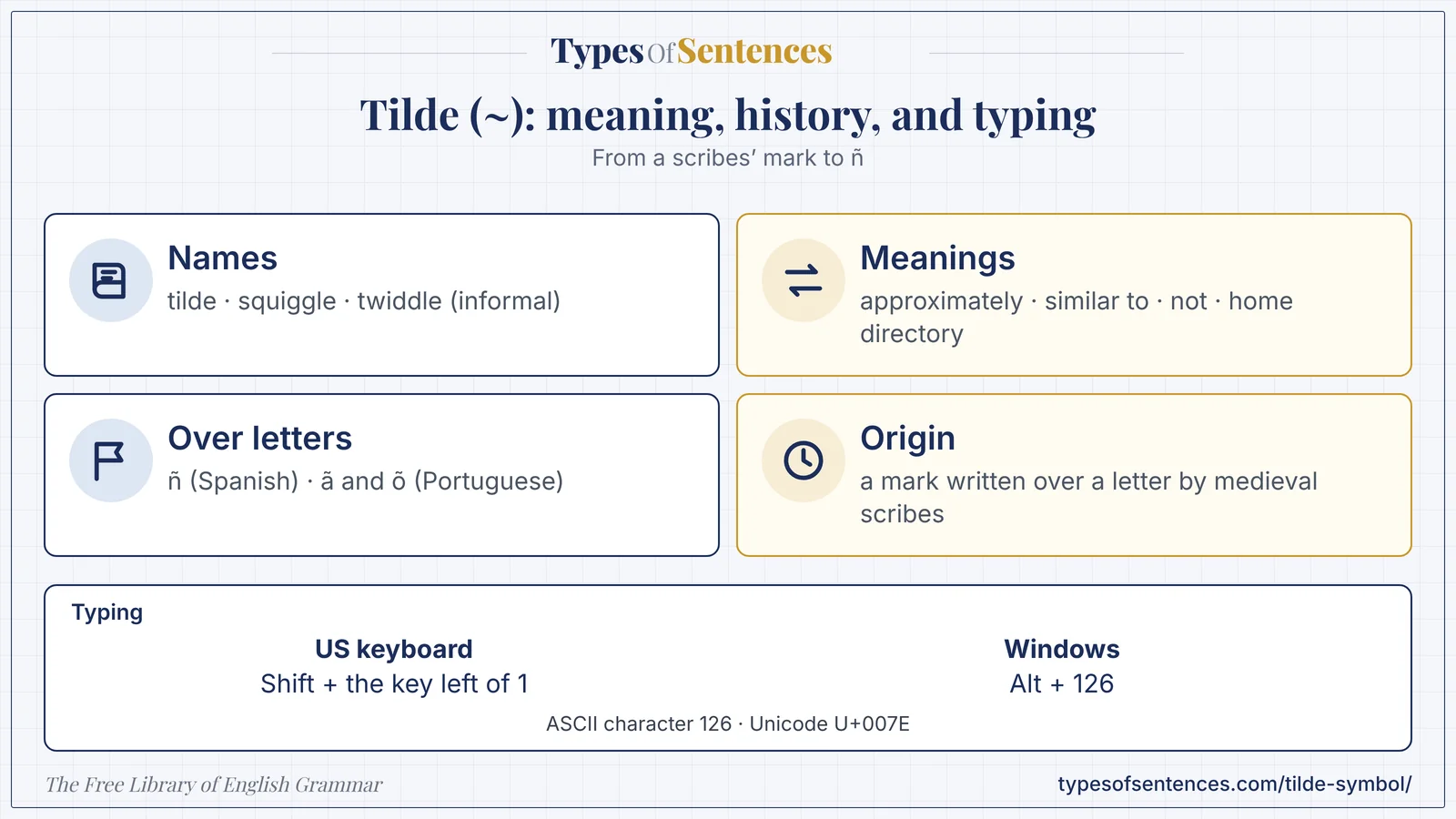
The tilde is the wavy line ~. By itself it usually means about or similar to. On top of a letter, as in ñ, it changes the sound or the spelling of the letter.
Why it matters: On a US keyboard you type it by holding Shift and pressing the key to the left of the number 1.
Summary: The tilde (~) is ASCII character 126 (Unicode U+007E). It began as a small mark written over a letter by medieval scribes as an abbreviation, which is the source of the Spanish ñ and the Portuguese ã. As a stand-alone symbol it means approximately in informal writing, similar to or alternates with in mathematics and linguistics, and not in some logic notations and programming languages; in Unix-style systems, it stands for the home directory. On a US keyboard, type it with Shift + the key left of 1.
- Names: tilde, squiggle, twiddle (informal); from Latin titulus.
- Meanings: approximately, similar to, not, home directory.
- Over letters: ñ (Spanish), ã and õ (Portuguese).
- US keyboard: Shift + the key left of 1; Windows Alt code: Alt + 126.
What You’ll Learn
- 1. What Is the Tilde Symbol? Names and Appearance
- 2. History: From Scribes’ Mark to Keyboard Key
- 3. Tilde Meaning in Writing, Mathematics, and Linguistics
- 4. Uses of the Tilde in Computing and Programming
- 5. How to Type the Tilde: Finding the Tilde Key on a Keyboard
- 6. Style Rules: Using the Tilde in Writing
- 7. Common Mistakes with the Tilde
- 8. Exercises
- 9. Test Your Knowledge
- 10. Frequently Asked Questions
- 11. Conclusion
1. What Is the Tilde Symbol? Names and Appearance
| Property | Tilde symbol |
|---|---|
| symbol | ~ |
| common names | tilde; informally, squiggle, twiddle, wavy line |
| origin of the word | Spanish tilde, from Latin titulus (a title or a superscript mark) |
| Unicode name and code | TILDE, U+007E |
| ASCII code | 126 (hexadecimal 7E) |
| HTML entity for the keyboard tilde | ~ (note that ˜ in HTML shows a different, small tilde) |
| key on a US keyboard | the key to the left of 1, typed with Shift |
| read aloud as | tilde; squiggle |
| Related character | Code | Use |
|---|---|---|
| tilde (~) | U+007E | the keyboard character |
| small tilde (˜) | U+02DC | a spacing accent mark |
| combining tilde (◌̃) | U+0303 | placed over a letter, as in ñ |
| tilde operator (∼) | U+223C | similarity in mathematics |
| almost equal to (≈) | U+2248 | approximate equality |
| wave dash (〜) and fullwidth tilde (~) | U+301C and U+FF5E | used in East Asian typing for ranges |
| negation sign (¬) | U+00AC | not, in logic |
| swung dash (⁓) | U+2053 | a typographic mark that stands for a repeated word |
The same word tilde names two things that look alike: a character that stands alone on the keyboard (the symbol ~) and a mark that sits above a letter (the diacritic). In Unicode they are separate characters with separate code points. The keyboard tilde is what this page is mostly about; the mark above letters is described in the section on letters.
2. History: From Scribes’ Mark to Keyboard Key
The tilde began as a scribe’s shortcut. In medieval manuscripts, writers saved space and effort by writing a small mark above a letter to show that a letter was omitted. A small n or a wavy line over a vowel could stand for a missing nasal letter. In Spanish, the letter ñ grew out of a doubled nn in which the second n was written as a small mark above the first. In Portuguese, the mark over a vowel (ã, õ) shows nasalization after the loss of a nasal consonant. When computers were developed, the tilde was included in the ASCII character set as a stand-alone character at code 126, and programmers gave it many jobs.
| Period | Development |
|---|---|
| medieval manuscripts | a small mark above a letter abbreviates a missing letter |
| Old Spanish and Portuguese | the mark settles into ñ, ã, and õ |
| early twentieth century | the tilde appears in logic (for example in Principia Mathematica, 1910) as a symbol of negation (~p) and in mathematics as similarity |
| ASCII and Unix era | the tilde is a keyboard character; it becomes the shorthand of the home directory in Unix shells |
| 1990s and 2000s | ~ in web addresses for personal pages; Windows short file names; temporary files |
| today | approximately in informal writing; strikethrough in Markdown (~~text~~); wave dash in East Asian text |
Sources agree on the broad story; the details of how particular spellings developed in each language are matters for historical linguists.
3. Tilde Meaning in Writing, Mathematics, and Linguistics
| Use | Example | Notes |
|---|---|---|
| approximately | The trip took ~5 hours. | informal; in formal prose write about or approximately |
| similar to or equivalent to | A ∼ B (with the tilde operator) | mathematics |
| negation | ~p (not p) | older logic notation; ¬ is the modern form |
| proportional to | y ∼ x | statistics |
| distributed as | X ∼ N(0, 1) | statistics: X follows a normal distribution |
| alternates with | /ɪ/ ~ /i/ | linguistics: two forms that vary freely |
| allomorphs | a ~ an | linguistics: two forms of one unit |
| replaces the headword in a dictionary example | run: ~ away | many dictionaries |
| range in East Asian typing | 5~10 | the wave dash; in English use an en dash (5–10) |
| emphasis or tone in chat | See you soon~ | informal, playful |
| a mark over a letter | ñ, ã, õ | see the section on letters |
| Language | Letter with a tilde | Example | What it does |
|---|---|---|---|
| Spanish | ñ | año (year), niño (child) | a separate letter of the alphabet; the sound /ɲ/ |
| Portuguese | ã, õ | mãe (mother), põe (puts) | nasalization of the vowel |
| Estonian | õ | õu (yard) | a separate letter for a vowel |
| Basque and Galician | ñ | mañana | as in Spanish |
| Vietnamese | ã, ẽ, ĩ, õ, ũ, ỹ and others | mã (tomb), nữ (female) | a tone mark |
| Tagalog and Filipino | ñ in Spanish-derived names | Niño, Muñoz | from Spanish |
In English, the tilde over a letter is not part of the spelling, but it is kept in words and names borrowed from Spanish and Portuguese (piñata, jalapeño, São Paulo), and many style guides keep it. In running English text, the stand-alone tilde is informal. For general rules on marks and on borrowed letters, see the chapters on advanced punctuation and on typography and grammar; for numbers and approximations, see the chapter on numbers in writing.
4. Uses of the Tilde in Computing and Programming
| Context | Use | Example |
|---|---|---|
| Unix, Linux, and macOS shells | stands for the current user’s home directory | cd ~; ~/Documents |
| another user’s home | ~name |
~sam |
| web addresses | a personal page of a user on a server | example.edu/~sam/ |
| bitwise NOT | C, C++, Java, JavaScript, Python | ~x |
| regular expression match | Perl and Ruby | $s =~ /cat/ |
| R formulas | separates the response from the predictors | y ~ x |
| MATLAB | logical NOT | ~isempty(x) |
| Windows short file names | a shortened name with a number | PROGRA~1 |
| Microsoft Office temporary files | a file starting with ~$ |
~$report.docx |
| Emacs and other editors | backup files end with a tilde | notes.txt~ |
| Markdown (GitHub style) | two tildes make strikethrough | ~~old~~ |
| wiki signatures | four tildes insert a signature | ~~~~ |
| CSS and other languages | the general sibling selector | h2 ~ p |
The tilde appears in many more contexts, and the meaning varies by program. The safest habit is to read the documentation of the language or program that you are using. The grammar of technology terms is treated in the chapter on grammar and technology.
5. How to Type the Tilde: Finding the Tilde Key on a Keyboard
| Device or system | How to type ~ (the tilde) |
|---|---|
| Windows or Mac, US keyboard | hold Shift and press the key to the left of 1 (the ` ~ key) |
| UK keyboard | hold Shift and press the key to the left of Enter (marked # ~) |
| Windows Alt code | hold Alt and type 126 on the numeric keypad (with Num Lock on) |
| German keyboard | hold AltGr and press the + key |
| French AZERTY keyboard | hold AltGr and press 2 |
| Spanish keyboard | hold AltGr and press 4 |
| iPhone and iPad | tap 123, then #+=, then ~ |
| Android | tap ?123, then the second symbols page, then ~ |
| Indian English keyboards | follow the US or UK layout |
| web pages (HTML) | write ~ |
| Letter | Windows (Alt code) | Mac | Other methods |
|---|---|---|---|
| ñ | Alt + 0241 (or Alt + 164) | Option + N, then n | on iPhone, hold n and slide to ñ; HTML ñ |
| Ñ | Alt + 0209 (or Alt + 165) | Option + N, then Shift + n | HTML Ñ |
| ã | Alt + 0227 | Option + N, then a | HTML ã |
| õ | Alt + 0245 | Option + N, then o | HTML õ |
| If you cannot find the key | What to try |
|---|---|
| Shift + the key gives another character | check the input language and layout |
| the key acts as a dead key (it waits for a letter) | on some layouts, the tilde appears only after you press the space bar; this is how ñ is formed |
| the key is missing on a small keyboard | use the Alt code, an on-screen keyboard, or copy and paste |
| you want to copy it | select this character: ~ |
6. Style Rules: Using the Tilde in Writing
| Question | Guidance |
|---|---|
| Is ~5 acceptable for about 5? | in informal writing, notes, and technical text; in formal prose, write about or approximately |
| Space after the tilde? | no space in ~5; a space is acceptable in a few contexts, but follow your guide |
| Tilde or ≈? | use ≈ for almost equal in mathematics; ~ for about in notes |
| Tilde for a range? | not in English; use an en dash (5–10) or the word to |
| Keep the tilde in borrowed words? | yes, in names and Spanish and Portuguese words: jalapeño, São Paulo |
| Tilde in emphasis or tone? | informal; avoid in formal writing |
| Tilde in a username or path? | follow the system; do not “fix” it |
| Alphabetical order of ñ? | in Spanish, ñ is a separate letter after n |
A good test is to read the sentence aloud: if you would say about, the tilde is a shorthand. If the sentence is for a general reader, say it in words.
7. Common Mistakes with the Tilde
| Mistake | Example | Better |
|---|---|---|
| using ~ for a range in English | *pages 10~20 | pages 10–20 |
| using ~ in formal prose | *The study lasted ~3 years. | The study lasted about three years. |
| dropping the tilde from a borrowed word | *jalapeno, *Sao Paulo | jalapeño, São Paulo (if your guide keeps accents) |
| replacing ñ with n | *manana | mañana |
| confusing the tilde with a hyphen or dash | *5~10 | 5–10 |
| using a tilde for negation in modern logic where ¬ is expected | *~p | ¬p |
| typing the small tilde (˜) instead of ~ | — | use the keyboard key |
Fix: The ~20 students from Sao Paulo, ages 10~12, will arrive at ~9. (a school notice).
- ~20 students: a tilde in a notice for general readers: about 20 students.
- Sao Paulo: the accent is dropped: São Paulo.
- ages 10~12: a tilde for a range: ages 10 to 12 (or 10–12).
- at ~9: at about 9 a.m.
- Result: About 20 students from São Paulo, ages 10 to 12, will arrive at about 9 a.m. (the notice is invented)
Recap in 12 seconds
Watch the lesson build itself: The tilde began as a scribes’ mark over letters; it means approximately or similar to and appears in ñ, ã, and õ. The video has no sound.
Exercises
Part A: Names and Appearance (Exercises 1–6)
Exercise 1: Name two other names for the tilde.
Show Answer
Answer: Squiggle, twiddle, wavy line.
Exercise 2: From which Latin word does tilde come?
Show Answer
Answer: titulus (title, superscript).
Exercise 3: What is the Unicode code of the keyboard tilde?
Show Answer
Answer: U+007E.
Exercise 4: What is the ASCII code of the tilde?
Show Answer
Answer: 126.
Exercise 5: Which HTML entity shows the keyboard tilde?
Show Answer
Answer: ~.
Exercise 6: Is ˜ the same character as ~?
Show Answer
Answer: No; it is the small tilde (˜).
Part B: Writing and Letters (Exercises 7–14)
Exercise 7: What does ~5 km mean?
Show Answer
Answer: About five kilometers.
Exercise 8: What is a better word in formal prose?
Show Answer
Answer: About or approximately.
Exercise 9: Which letter did Spanish form from a doubled nn?
Show Answer
Answer: ñ.
Exercise 10: What does the tilde do in Portuguese ã?
Show Answer
Answer: Shows nasalization of the vowel.
Exercise 11: Give two English words that keep the tilde.
Show Answer
Answer: Jalapeño, piñata, São Paulo (a name).
Exercise 12: How do you write a range in English?
Show Answer
Answer: With an en dash (5–10) or the word to.
Exercise 13: What does X ∼ N(0, 1) mean?
Show Answer
Answer: X is distributed as a standard normal variable.
Exercise 14: What does a ~ an show in linguistics?
Show Answer
Answer: That the two are forms of one unit that alternate.
Part C: Computing (Exercises 15–20)
Exercise 15: What does cd ~ do?
Show Answer
Answer: Goes to the current user’s home directory.
Exercise 16: What does ~x do in C?
Show Answer
Answer: Bitwise NOT of x.
Exercise 17: What does ~~old~~ show in GitHub Markdown?
Show Answer
Answer: Strikethrough text.
Exercise 18: What does a file name starting with ~$ usually mean?
Show Answer
Answer: A temporary Office file.
Exercise 19: What does y ~ x mean in R?
Show Answer
Answer: A formula: y modeled by x.
Exercise 20: What are four tildes in a wiki?
Show Answer
Answer: An automatic signature.
Part D: Typing (Exercises 21–26)
Exercise 21: Where is the tilde key on a US keyboard?
Show Answer
Answer: To the left of 1; hold Shift.
Exercise 22: What is the Windows Alt code for ~?
Show Answer
Answer: Alt + 126.
Exercise 23: Where is it on a UK keyboard?
Show Answer
Answer: Shift + the key to the left of Enter (# ~).
Exercise 24: How do you type ñ on a Mac?
Show Answer
Answer: Option + N, then n.
Exercise 25: What is the Alt code for ñ?
Show Answer
Answer: Alt + 0241 (or Alt + 164).
Exercise 26: Why might the tilde not appear immediately?
Show Answer
Answer: On some layouts it is a dead key and waits for the next character.
Part E: Style and Correction (Exercises 27–30)
Exercise 27: Correct: *pages 10~20
Show Answer
Answer: pages 10–20.
Exercise 28: Correct (formal): *about ~3 years
Show Answer
Answer: about three years.
Exercise 29: Correct: *manana (Spanish word).
Show Answer
Answer: mañana.
Exercise 30: Correct: *Sao Paulo
Show Answer
Answer: São Paulo.
Test Your Knowledge
Ready to check what you learned? Answer all 10 questions, then submit. You need 80% (8 of 10) to pass. Your answers are not stored.
View correct answers and explanations
Question 1: What does ~ usually mean before a number in informal writing?
✓ Correct Answer: B – approximately
About.
Question 2: What is the ASCII code of the tilde?
✓ Correct Answer: D – 126
126.
Question 3: Which letter has a tilde in Spanish?
✓ Correct Answer: C – ñ
ñ.
Question 4: How do you type ~ on a US keyboard?
✓ Correct Answer: A – Shift + the key left of 1
Shift + the key left of 1.
Question 5: What does cd ~ do?
✓ Correct Answer: B – goes to the home directory
Home directory.
Question 6: Which is better in a formal range?
✓ Correct Answer: C – 10–20
An en dash.
Question 7: What does the tilde show in Portuguese ã?
✓ Correct Answer: D – nasalization
Nasalization.
Question 8: Which Alt code types ~ on Windows?
✓ Correct Answer: A – Alt + 126
Alt + 126.
Question 9: What does ~~text~~ make in GitHub Markdown?
✓ Correct Answer: C – strikethrough text
Strikethrough.
Question 10: What is the origin of the word tilde?
✓ Correct Answer: B – Latin titulus through Spanish
Latin titulus.
Frequently Asked Questions
What is the tilde symbol?
The tilde symbol (~) is a wavy line character on the keyboard, ASCII 126. It means approximately in informal writing, similar to in mathematics, not in some logic and code, and the home directory in Unix-style systems. The tilde also appears over letters such as ñ.
What is the tilde meaning in math and writing?
The tilde meaning depends on the context: about in notes (~5), is distributed as in statistics (X ∼ N), not in older logic (~p), and alternates with in linguistics.
Where is the tilde key on a keyboard?
The tilde key on a US keyboard is the key to the left of the number 1, typed with Shift. On a UK keyboard, it is Shift + the key to the left of Enter.
How do I type the tilde on keyboard layouts that lack it?
Use the Alt code (Alt + 126 on Windows), AltGr combinations on some European keyboards (AltGr + 2 on French AZERTY), the symbols page on a phone, or copy and paste. To type the tilde on keyboard layouts that need a dead key, press the space bar after it.
What is the tilde character in Unicode?
The tilde character is U+007E TILDE. Other related characters include the small tilde (U+02DC), the combining tilde (U+0303), and the tilde operator (U+223C).
What does a tilde mean over a letter?
It is a diacritic that changes the letter: ñ in Spanish is a separate letter, and ã and õ in Portuguese show nasalization.
Can I use the tilde in formal writing?
For approximation, write about or approximately. Keep the tilde over letters in borrowed words and names, such as jalapeño and São Paulo.
Conclusion
You now know what the tilde is, where it came from, what it means in writing, mathematics, linguistics, and code, how to find the tilde key and type letters such as ñ, and how to avoid the common mistakes with it.
Use the tilde as a shorthand in notes and keep the accents in names; in formal prose, write the words. Next in the series is the ampersand.
- The Unicode Consortium. The Unicode Standard. Basic Latin, Spacing Modifier Letters, and Combining Diacritical Marks blocks.: the character names and code points.
- Real Academia Española and Asociación de Academias de la Lengua Española. Ortografía de la lengua española. 2010.: the letter ñ in Spanish.
- Bringhurst, Robert. The Elements of Typographic Style. 4th ed. Hartley and Marks, 2012.: the typography of diacritics and symbols.
- Shotts, William. The Linux Command Line. 2nd ed. No Starch Press, 2019.: the tilde in the shell.
- Merriam-Webster Dictionary: tilde: the dictionary entry.
Last reviewed: October 29, 2026. How it was made: drafted with AI assistance, then checked with automated tests (structure, links, answer keys, spelling) and against the sources above. A person has not yet read this chapter line by line. Found a mistake? Report it.