What are SAT sentence boundaries questions? SAT sentence boundaries questions are items on the digital SAT Reading and Writing section that test where one sentence ends and the next begins. A short text has a blank, and the four choices usually contain the same words with different punctuation or conjunctions. The choice that is correct has a complete sentence on each side of a period or semicolon, or a proper connection inside one sentence. Three errors are tested again and again: the fragment, the run-on, and the comma splice.
This page explains what a complete sentence needs, shows the SAT sentence fragments, SAT run on sentences, and the SAT comma splice with examples, and lists the five correct ways to join clauses. It gives a five-step method, 30 original practice items (not taken from the College Board), and a 10-question quiz. Digital SAT boundaries items are one of the two skills in the Standard English Conventions domain.
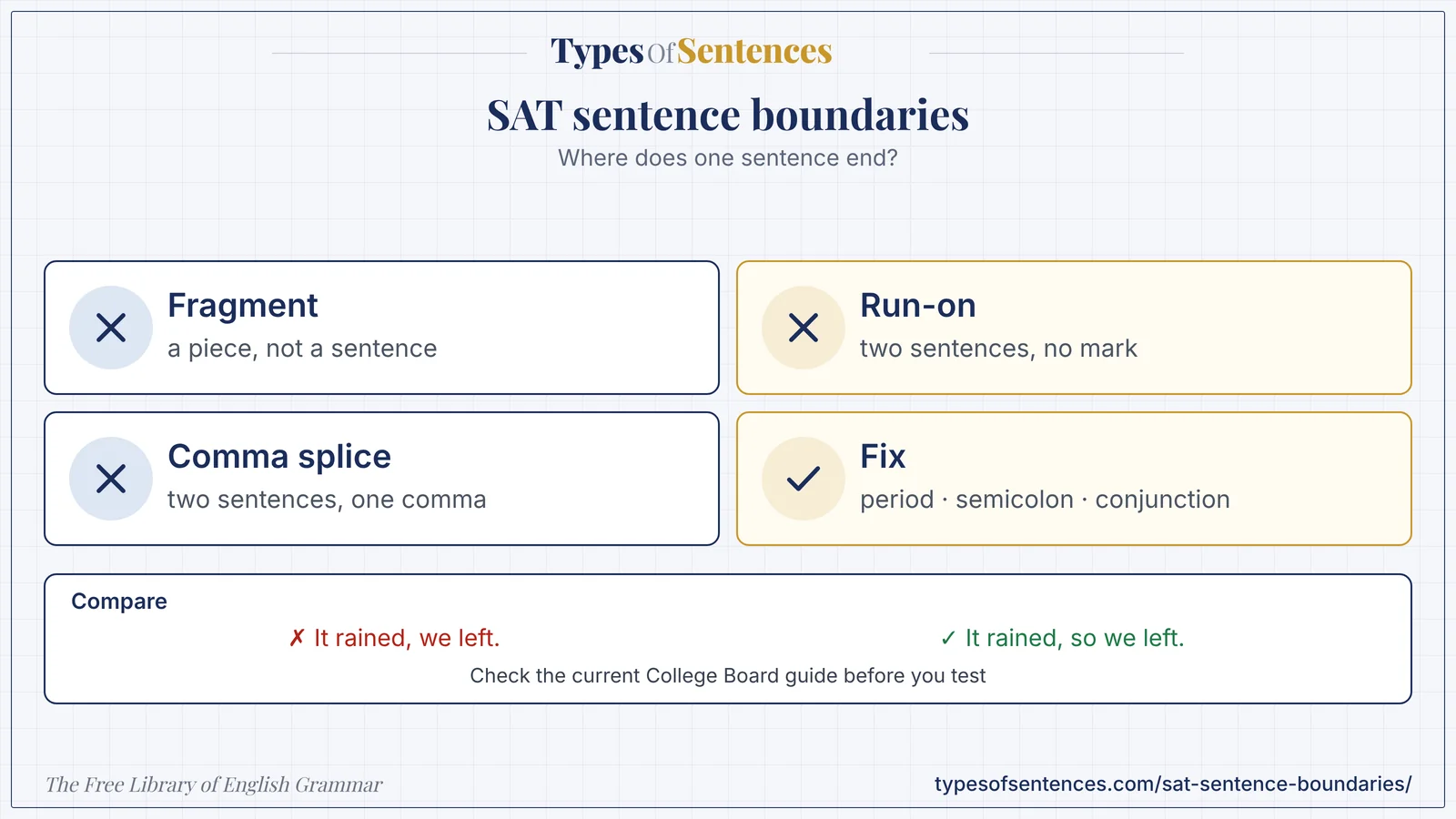
A sentence boundary is the line between one complete thought and the next. Every complete thought needs its own sentence, or a proper connector.
Why it matters: Test each side of the punctuation. If both sides can stand alone, a comma is not enough. If one side cannot, a period or semicolon is wrong.
Summary: A complete sentence (an independent clause) has a subject, a finite verb, and a complete thought. A fragment lacks one of these: Because it rained. A run-on joins two independent clauses with nothing: It rained we stayed home. A comma splice joins them with only a comma: It rained, we stayed home. Fix a boundary error in one of five ways: a period, a semicolon, a comma plus a coordinating conjunction (for, and, nor, but, or, yet, so), a subordinating conjunction, or (after a complete clause) a colon or a dash. The SAT tests this in the Boundaries skill: check whether the words on each side of the punctuation are independent clauses.
- Complete = subject + finite verb + whole thought.
- Comma alone cannot join two clauses.
- Fix: period, semicolon, comma + and/but, subordinator.
- Test each side of the punctuation.
What You’ll Learn
- 1. SAT Sentence Boundaries: The Short Answer
- 2. What a Complete Sentence Needs
- 3. SAT Sentence Fragments: Four Kinds
- 4. SAT Run-On Sentences and the SAT Comma Splice
- 5. Five Correct Ways to Join or Separate Clauses
- 6. A Five-Step Method for SAT Sentence Boundaries Questions
- 7. Common Mistakes on SAT Sentence Boundaries Questions
- 8. Exercises
- 9. Test Your Knowledge
- 10. Frequently Asked Questions
- 11. Conclusion
1. SAT Sentence Boundaries: The Short Answer
| Fact | Detail |
|---|---|
| where | the Standard English Conventions domain of the digital SAT Reading and Writing section |
| skill | Boundaries (the other skill in the domain is Form, Structure, and Sense) |
| share | Standard English Conventions is about 26 percent of the section, or 11 to 15 of 54 questions |
| format | a short text with a blank, and four choices that differ in punctuation or connecting words |
| how to check | official practice is in the Bluebook app; check satsuite.collegeboard.org for the current format |
| Error | What it is | Example | Fix |
|---|---|---|---|
| fragment | a group of words that cannot stand alone | *Because the road was icy. | Because the road was icy, the bus was late. |
| run-on (fused sentence) | two complete clauses with no punctuation or connector | *The road was icy the bus was late. | The road was icy; the bus was late. |
| comma splice | two complete clauses joined by a comma alone | *The road was icy, the bus was late. | The road was icy, so the bus was late. |
The College Board figures were taken from its published specifications and checked in November 2026; the test can change, so check satsuite.collegeboard.org before you rely on them. The punctuation marks themselves are covered in the guide to SAT punctuation rules, and the other conventions are in the complete guide to SAT grammar rules.
2. What a Complete Sentence Needs
| Part | Meaning | Example |
|---|---|---|
| subject | who or what the sentence is about | The bus was late. |
| finite verb | a verb with a tense, not an -ing or to form alone | The bus was late. |
| complete thought | it does not leave the reader waiting | The bus was late. (not Because the bus was late.) |
A group of words with all three parts is an independent clause. A group with a subject and a verb that begins with a word such as because, although, if, or when is a dependent clause and cannot stand alone. Clauses are explained in the guide to independent and dependent clauses.
3. SAT Sentence Fragments: Four Kinds
| Kind of fragment | Example (error) | Correct version |
|---|---|---|
| no subject | *Ran to the store. | She ran to the store. |
| no finite verb | *The old house on the hill. | The old house on the hill is empty. |
| a dependent clause alone | *Although it was late. | Although it was late, we kept working. |
| a participial or infinitive phrase alone | *Hoping to finish early. | Hoping to finish early, she worked fast. |
On the SAT, a fragment often appears as a choice that puts a period after a dependent clause (…the results were clear. Although the sample was small.). The fix is to join the fragment to the sentence next to it, usually with a comma.
4. SAT Run-On Sentences and the SAT Comma Splice
| Error | Example (error) | Why it is wrong |
|---|---|---|
| run-on (fused) | *The test was hard I finished early. | two clauses with nothing between them |
| comma splice | *The test was hard, I finished early. | a comma alone is too weak to join two clauses |
| comma splice with a conjunctive adverb | *The test was hard, however, I finished early. | however is not a conjunction; it needs a semicolon before it |
| comma splice with then | *She opened the box, then she screamed. | then is not a coordinating conjunction |
The comma splice is explained in its own chapter: comma splice. The words that look like conjunctions but are not, such as however and therefore, are described in the guide to conjunctive adverbs.
5. Five Correct Ways to Join or Separate Clauses
| Way | Pattern | Example |
|---|---|---|
| 1 a period | clause. Clause. | The road was icy. The bus was late. |
| 2 a semicolon | clause; clause. | The road was icy; the bus was late. |
| 3 a comma and a coordinating conjunction | clause, and/but/so/or/yet/for/nor clause. | The road was icy, so the bus was late. |
| 4 a subordinating conjunction | dependent clause, independent clause. | Because the road was icy, the bus was late. |
| 5 a colon or a dash after a complete clause | clause: explanation. | The reason was simple: the road was icy. |
| Pair of choices that you may see | Verdict |
|---|---|
| clause, clause | wrong: comma splice |
| clause clause | wrong: run-on |
| clause; clause | correct |
| clause, and clause | correct |
| clause; and clause | usually wrong: a semicolon does not go with and here |
| clause; however, clause | correct |
| clause, however, clause | wrong: comma splice |
| clause: clause | correct only if the second explains the first |
| clause. Dependent clause. | wrong: fragment |
The coordinating conjunctions are explained in the guide to the coordinating conjunction. A semicolon joins two independent clauses that are closely related; if either side cannot stand alone, a semicolon is wrong.
6. A Five-Step Method for SAT Sentence Boundaries Questions
| Step | Do this | Why |
|---|---|---|
| 1 find the punctuation or break | look at the period, comma, semicolon, colon, or dash at the blank | the boundary is there |
| 2 test the left side | can it stand alone as a sentence? | finds the first clause |
| 3 test the right side | can it stand alone as a sentence? | finds the second clause |
| 4 match the pattern | two complete clauses need a period, semicolon, or comma plus a conjunction; a clause and a fragment need a comma or none | the pattern decides |
| 5 read the whole sentence | read it with your choice, including the next sentence | your ear catches a splice |
| Trap | What it looks like | The cure |
|---|---|---|
| the long subject | a long phrase before the verb hides the clause | find the verb, then its subject |
| the transition word | however or therefore after a comma | these words need a semicolon or period before them |
| the dependent clause | a clause that begins with because or although followed by a period | join it to the main clause |
| the colon rule | a colon after an incomplete clause | a colon needs a complete clause before it |
| the smooth wrong choice | a comma splice that reads naturally | test both sides for a complete sentence |
Which choice completes the text? The library extended its hours ___ more students came to study. (A) hours more students came (B) hours, more students came (C) hours; more students came (D) hours; and more students came
- Find the break: after hours.
- Left side: The library extended its hours is a complete clause. Right side: more students came to study is also a complete clause.
- Two complete clauses: (A) has nothing between them (run-on); (B) has a comma alone (comma splice).
- (D) puts a semicolon and a conjunction together, which is not the standard pattern.
- (C) a semicolon between two complete clauses is correct: hours; more students came. The question is my own.
7. Common Mistakes on SAT Sentence Boundaries Questions
| Mistake | What happens | Better habit |
|---|---|---|
| choosing the smoothest reading | a comma splice is chosen | test each side for a complete sentence |
| assuming a comma is always safe | two clauses are joined by a comma alone | a comma needs a conjunction between clauses |
| treating however as a conjunction | , however, between clauses is chosen | use a semicolon before however |
| ignoring long subjects | a clause is missed | find the verb first |
| using a semicolon with a fragment | one side cannot stand alone | both sides must be complete |
| adding a conjunction without a comma | The road was icy so the bus was late | put a comma before the conjunction between clauses |
Recap in 12 seconds
Watch the lesson build itself: SAT sentence boundary questions test fragments, run-ons, and comma splices, fixed with a period, a semicolon, or a comma and a conjunction. The video has no sound.
Exercises
Part A: Complete or Not? (Exercises 1–10)
Exercise 1: Is this a complete sentence? Because the road was icy.
Show Answer
Answer: No: a dependent clause.
Exercise 2: Is this a complete sentence? The bus was late.
Show Answer
Answer: Yes.
Exercise 3: Is this a complete sentence? Ran to the store.
Show Answer
Answer: No: no subject.
Exercise 4: Is this a complete sentence? The old house on the hill.
Show Answer
Answer: No: no verb.
Exercise 5: Is this a complete sentence? She smiled.
Show Answer
Answer: Yes.
Exercise 6: Is this a complete sentence? Hoping to finish early.
Show Answer
Answer: No: a participial phrase.
Exercise 7: Is this a complete sentence? Although it was late.
Show Answer
Answer: No: a dependent clause.
Exercise 8: Is this a complete sentence? Stop.
Show Answer
Answer: Yes (the subject you is understood).
Exercise 9: Is this a complete sentence? To win the race.
Show Answer
Answer: No: an infinitive phrase.
Exercise 10: Is this a complete sentence? The rain fell all night.
Show Answer
Answer: Yes.
Part B: Name the Error (Exercises 11–20)
Exercise 11: The test was hard I finished early.
Show Answer
Answer: run-on.
Exercise 12: The test was hard, I finished early.
Show Answer
Answer: comma splice.
Exercise 13: The test was hard, however, I finished early.
Show Answer
Answer: comma splice.
Exercise 14: Although the sample was small. The results were clear.
Show Answer
Answer: fragment (the first part).
Exercise 15: She opened the box, then she screamed.
Show Answer
Answer: comma splice.
Exercise 16: The road was icy; the bus was late.
Show Answer
Answer: correct.
Exercise 17: The road was icy, so the bus was late.
Show Answer
Answer: correct.
Exercise 18: Because the road was icy, the bus was late.
Show Answer
Answer: correct.
Exercise 19: He wanted to go, but she wanted to stay.
Show Answer
Answer: correct.
Exercise 20: The reason was simple: the road was icy.
Show Answer
Answer: correct.
Part C: Fix the Sentence (Exercises 21–26)
Exercise 21: Fix: *It rained we stayed home.
Show Answer
Answer: It rained, so we stayed home. (or a semicolon or a period)
Exercise 22: Fix: *It rained, we stayed home.
Show Answer
Answer: It rained; we stayed home.
Exercise 23: Fix: *The test was hard, however, I finished early.
Show Answer
Answer: The test was hard; however, I finished early.
Exercise 24: Fix: *Because it rained. (join to We stayed home.)
Show Answer
Answer: Because it rained, we stayed home.
Exercise 25: Fix: *She opened the box, then she screamed.
Show Answer
Answer: She opened the box, and then she screamed. (or a semicolon before then)
Exercise 26: Fix: *She loves music, she plays three instruments.
Show Answer
Answer: She loves music; she plays three instruments.
Part D: Explain (Exercises 27–30)
Exercise 27: What three things does a complete sentence need?
Show Answer
Answer: A subject, a finite verb, and a complete thought.
Exercise 28: Why can a comma alone not join two independent clauses?
Show Answer
Answer: It is too weak; it needs a conjunction, or a semicolon or period must be used.
Exercise 29: What goes before however between two clauses?
Show Answer
Answer: A semicolon (or a period).
Exercise 30: Name two of the five ways to join clauses.
Show Answer
Answer: For example, a semicolon, and a comma with a coordinating conjunction.
Test Your Knowledge
Ready to check what you learned? Answer all 10 questions, then submit. You need 80% (8 of 10) to pass. Your answers are not stored.
View correct answers and explanations
Question 1: A fragment is
✓ Correct Answer: B – a group of words that cannot stand alone
It cannot stand alone.
Question 2: A comma splice joins two independent clauses with
✓ Correct Answer: C – a comma alone
A comma alone.
Question 3: Which is a run-on?
✓ Correct Answer: D – The test was hard I finished early.
No punctuation.
Question 4: A semicolon joins
✓ Correct Answer: A – two independent clauses
Two clauses.
Question 5: The test was hard, however, I finished early. is
✓ Correct Answer: B – a comma splice
However needs a semicolon.
Question 6: The SAT skill for sentence boundaries is called
✓ Correct Answer: C – Boundaries
Boundaries.
Question 7: Although it was late. is
✓ Correct Answer: D – a fragment
A dependent clause.
Question 8: A coordinating conjunction between clauses is preceded by
✓ Correct Answer: A – a comma
A comma.
Question 9: A colon needs
✓ Correct Answer: B – a complete clause before it
A complete clause.
Question 10: The first step in the method is to
✓ Correct Answer: C – find the punctuation or break
Find the boundary.
Frequently Asked Questions
What are SAT sentence boundaries questions?
They are digital SAT items that test where a sentence ends: whether the words on each side of the punctuation form complete sentences. They belong to the Boundaries skill in the Standard English Conventions domain.
What is a sentence fragment on the SAT?
It is a group of words that cannot stand alone, such as a dependent clause (Although it was late.) or a phrase without a verb. The fix is to join it to a complete sentence.
What is a run-on sentence?
A run-on (or fused sentence) joins two independent clauses with no punctuation or conjunction. The fix is a period, a semicolon, or a comma with a conjunction.
What is a comma splice?
A comma splice joins two independent clauses with only a comma. A comma needs a coordinating conjunction after it; otherwise use a semicolon or a period.
Can I use a comma before however?
Not between two clauses. However needs a semicolon or period before it: It was hard; however, I finished. A comma can follow however.
When can I use a colon?
After a complete clause, to introduce an explanation, a list, or a quotation. The part before the colon must be able to stand alone.
Where can I practice real SAT boundaries questions?
The College Board offers official practice in its Bluebook app. The questions on this page are original and are for practice only.
Conclusion
You now know how SAT sentence boundaries questions work: test each side of the punctuation for a complete sentence, and match the pattern to one of five correct ways to join clauses. You have seen the fragment, the run-on, and the comma splice.
Practice by testing every comma you read: can both sides stand alone? That one habit answers most digital SAT boundaries items. Next, study the other conventions the SAT and ACT test, such as the ACT punctuation rules.
- College Board. The Digital SAT Suite of Assessments Specifications.: the content domains and the Standard English Conventions skills (figures checked via web search in November 2026; the official page was not opened).
- Garner, Bryan A. Garner’s Modern English Usage. 5th ed. Oxford University Press, 2022.: the entries on comma splice, run-on sentences, and sentence fragments.
- Strunk, William, Jr., and E. B. White. The Elements of Style. 4th ed. Longman, 1999.: the rule on joining independent clauses.
- Merriam-Webster Dictionary: sentence fragment: the dictionary entry (not opened when this page was written).
Last reviewed: October 29, 2026. How it was made: drafted with AI assistance, then checked with automated tests (structure, links, answer keys, spelling) and against the sources above. A person has not yet read this chapter line by line. Found a mistake? Report it.