The seven basic sentence patterns are the skeletons on which every English clause is built. Each one is a fixed arrangement of subject, verb, and the elements the verb requires: S-V, S-V-O, S-V-IO-DO, S-V-PA, S-V-PN, S-V-O-OC, and S-V-O-A. Once you know the basic sentence patterns, you can see the structure under any sentence, however long it is.
This chapter gives the sentence formulas for the seven patterns, with an example, a verb type, and a test for each. You will learn how to identify a pattern, how verbs move between patterns, how patterns expand with modifiers and clauses, and how questions, passives, and other changes affect them. Thirty exercises and a quiz follow.
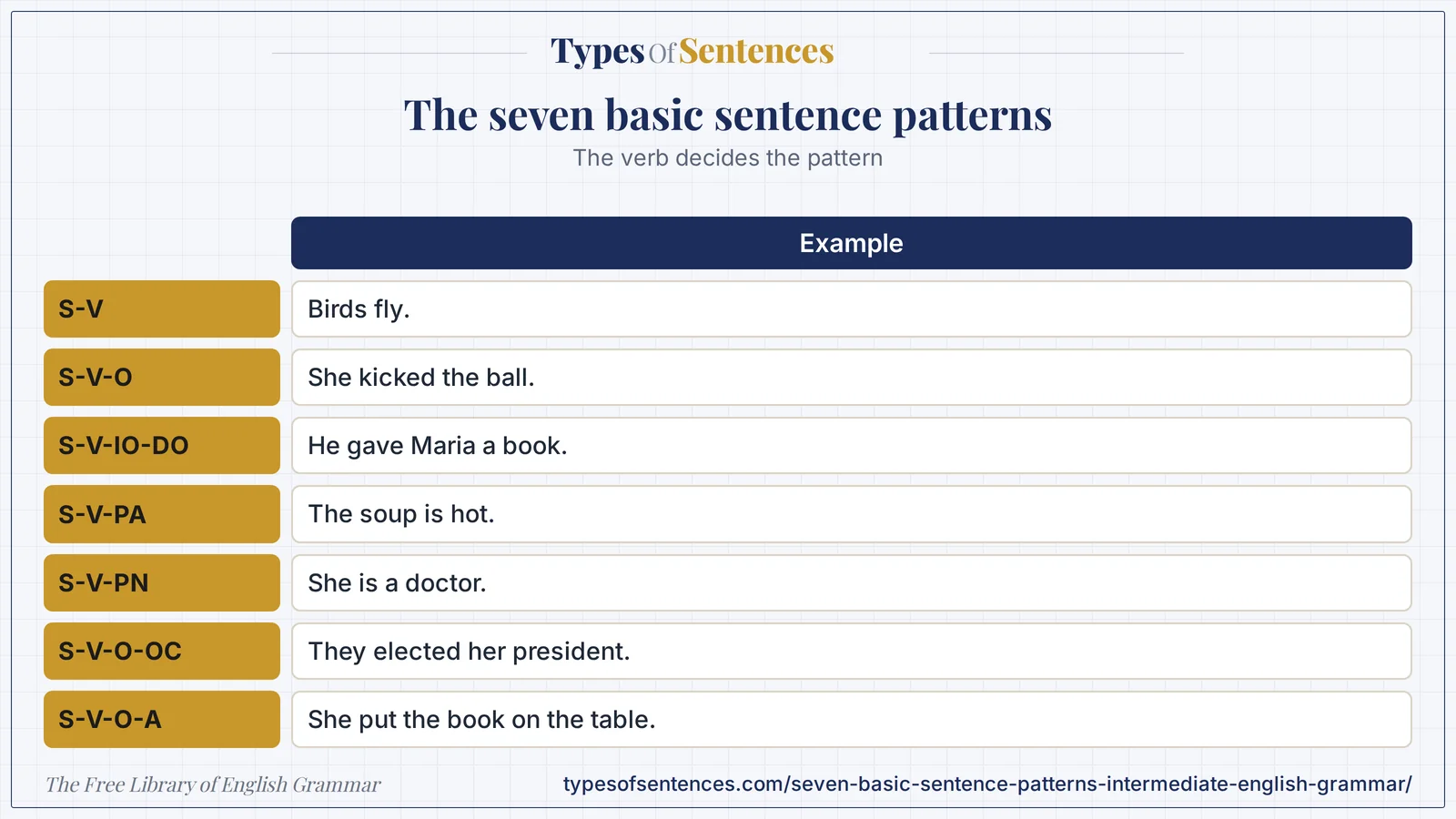
Think of the patterns as seven templates. The verb picks the template: a verb like sleep uses the shortest one, a verb like give uses one with two objects, and a verb like become uses one with a complement.
Why it matters: If you can name the pattern of a sentence, you know what the verb needs and what a missing element would be.
Summary: The seven patterns are S-V (Birds fly), S-V-O (She kicked the ball), S-V-IO-DO (He gave Maria a book), S-V-PA (The soup is hot), S-V-PN (She is a doctor), S-V-O-OC (They elected her president), and S-V-O-A (She put the book on the table). S-V is the simplest and S-V-O is the most common.
- S = subject, V = verb, O = direct object, IO = indirect object, PA = predicate adjective, PN = predicate nominative, OC = object complement, A = adverbial.
- The verb decides the pattern.
- Patterns expand with modifiers, phrases, and clauses without changing.
- Some verbs fit more than one pattern.
What You’ll Learn
- 1. The Seven Basic Sentence Patterns: An Overview
- 2. Pattern 1: S-V (Subject-Verb)
- 3. Pattern 2: S-V-O (Subject-Verb-Object)
- 4. Pattern 3: S-V-IO-DO (Subject-Verb-Indirect Object-Direct Object)
- 5. Pattern 4: S-V-PA (Subject-Verb-Predicate Adjective)
- 6. Pattern 5: S-V-PN (Subject-Verb-Predicate Nominative)
- 7. Pattern 6: S-V-O-OC (Subject-Verb-Object-Object Complement)
- 8. Pattern 7: S-V-O-A (Subject-Verb-Object-Adverbial)
- 9. Identifying Patterns
- 10. Verbs in More Than One Pattern
- 11. Expanding the Basic Patterns
- 12. How Questions, Passives, and Commands Affect Patterns
- 13. Exercises
- 14. Test Your Knowledge
- 15. Frequently Asked Questions
- 16. Conclusion
1. The Seven Basic Sentence Patterns: An Overview
Every clause is built from subject (S), verb (V), and the elements the verb requires. The seven basic sentence patterns cover most of English, and these sentence structure patterns are the basis of sentence analysis. This table lists the sentence formulas for each, with an example and the kind of verb that uses it.
| # | Pattern | Formula | Example | Verb type |
|---|---|---|---|---|
| 1 | S-V | Subject + Verb | Birds fly. | intransitive |
| 2 | S-V-O | Subject + Verb + Object | She kicked the ball. | transitive |
| 3 | S-V-IO-DO | Subject + Verb + Indirect Object + Direct Object | He gave Maria a book. | ditransitive |
| 4 | S-V-PA | Subject + Verb + Predicate Adjective | The soup is hot. | linking |
| 5 | S-V-PN | Subject + Verb + Predicate Nominative | She is a doctor. | linking |
| 6 | S-V-O-OC | Subject + Verb + Object + Object Complement | They elected her president. | complex transitive |
| 7 | S-V-O-A | Subject + Verb + Object + Adverbial | She put the book on the table. | transitive + adverbial |
The verb types are in the chapter on types of verbs. The patterns are the sentence-level view of the same distinctions.
Grammars count patterns differently. Quirk and others list seven patterns as S-V, S-V-O, S-V-C, S-V-A, S-V-O-O, S-V-O-C, and S-V-O-A. The list here divides the S-V-C pattern into predicate adjective and predicate nominative, and treats the S-V-A pattern (They live in Paris) with the adverbial section below. Both lists describe the same grammar.
2. Pattern 1: S-V (Subject-Verb)
The simplest pattern has a subject and an intransitive verb. The verb needs nothing after it to be complete.
| Sentence | S | V |
|---|---|---|
| Birds fly. | Birds | fly |
| The baby slept. | The baby | slept |
| Prices rose. | Prices | rose |
| The train arrived. | The train | arrived |
The pattern can carry optional adverbials without changing: The baby slept soundly in the crib all night. Those extras are not part of the pattern. Verbs used in this pattern are intransitive, such as sleep, arrive, fall, happen, and go.
3. Pattern 2: S-V-O (Subject-Verb-Object)
The most common pattern has a transitive verb followed by a direct object. The object receives the action.
| Sentence | S | V | O |
|---|---|---|---|
| She kicked the ball. | She | kicked | the ball |
| Tom reads books. | Tom | reads | books |
| The company hired new workers. | The company | hired | new workers |
| I like her. | I | like | her |
4. Pattern 3: S-V-IO-DO (Subject-Verb-Indirect Object-Direct Object)
A ditransitive verb has two objects: an indirect object (the recipient) and a direct object (the thing). The indirect object comes first.
| Sentence | S | V | IO | DO |
|---|---|---|---|---|
| He gave Maria a book. | He | gave | Maria | a book |
| She sent her friend a letter. | She | sent | her friend | a letter |
| The teacher showed us the results. | The teacher | showed | us | the results |
| Dad bought me a bicycle. | Dad | bought | me | a bicycle |
The same meaning can be expressed with a prepositional phrase after the direct object: He gave a book to Maria, Dad bought a bicycle for me. In that case the pattern is S-V-O-A. Verbs that use both are give, send, show, tell, offer, buy, and make.
5. Pattern 4: S-V-PA (Subject-Verb-Predicate Adjective)
A linking verb connects the subject to an adjective that describes it. The adjective is the predicate adjective, a kind of subject complement.
| Sentence | S | V | PA |
|---|---|---|---|
| The soup is hot. | The soup | is | hot |
| She seems happy. | She | seems | happy |
| The milk turned sour. | The milk | turned | sour |
| The music sounds beautiful. | The music | sounds | beautiful |
6. Pattern 5: S-V-PN (Subject-Verb-Predicate Nominative)
A linking verb connects the subject to a noun phrase that renames it. The noun is the predicate nominative, also a kind of subject complement.
| Sentence | S | V | PN |
|---|---|---|---|
| She is a doctor. | She | is | a doctor |
| Tom became a teacher. | Tom | became | a teacher |
| The winner remained the champion. | The winner | remained | the champion |
| It was I. | It | was | I (formal) |
The nominative and the subject refer to the same person or thing (She = a doctor). Formal English uses the subject form of a pronoun after be (It was I); everyday English accepts It was me. The complements are the subject of the chapter on subject and object complements.
7. Pattern 6: S-V-O-OC (Subject-Verb-Object-Object Complement)
A complex transitive verb takes an object and a complement that describes or renames the object. Verbs of choosing, naming, making, and thinking use it.
| Sentence | S | V | O | OC |
|---|---|---|---|---|
| They elected her president. | They | elected | her | president |
| The news made him angry. | The news | made | him | angry |
| We consider the plan a success. | We | consider | the plan | a success |
| She painted the door blue. | She | painted | the door | blue |
The object complement and the object refer to the same thing: her = president. Compare She gave him a book (S-V-IO-DO: two different things) with She called him a hero (S-V-O-OC: him = a hero). If you can insert to be between the two, it is a complement: We consider the plan (to be) a success.
8. Pattern 7: S-V-O-A (Subject-Verb-Object-Adverbial)
Some transitive verbs require an adverbial of place or direction after the object. Without it, the sentence is incomplete.
| Sentence | S | V | O | A |
|---|---|---|---|---|
| She put the book on the table. | She | put | the book | on the table |
| He placed the vase on the shelf. | He | placed | the vase | on the shelf |
| They kept the children indoors. | They | kept | the children | indoors |
| I sent the package to London. | I | sent | the package | to London |
The adverbial in this pattern is obligatory. In She put the book yesterday, yesterday is an optional adverbial, but on the table is required. A related pattern with no object is S-V-A: They live in Paris, She went to school. Both patterns show that not all adverbials are optional; see the previous chapter on the elements of a sentence.
9. Identifying Patterns
- Find the verb and the subject.
- Check the verb: is it a linking verb (be, become, seem, look, taste)? If so, the pattern is S-V-PA or S-V-PN.
- If not, ask what? or whom?. No answer: S-V.
- One answer: S-V-O. If the object is followed by a describing word or phrase that renames it: S-V-O-OC. If it is followed by a place word that is required: S-V-O-A.
- Two answers (the recipient and the thing): S-V-IO-DO.
Identify the pattern: The manager considers the proposal a good idea.
- Verb: considers. Not a linking verb.
- Ask considers what? the proposal: an object.
- a good idea renames the proposal: an object complement.
- Pattern: S-V-O-OC.
| Sentence | Pattern |
|---|---|
| The dog barked. | S-V |
| Maria wrote a letter. | S-V-O |
| Maria wrote her mother a letter. | S-V-IO-DO |
| The letter was long. | S-V-PA |
| Maria is a writer. | S-V-PN |
| Her mother thought it a surprise. | S-V-O-OC |
| Maria put the letter in the mailbox. | S-V-O-A |
10. Verbs in More Than One Pattern
Many verbs can appear in more than one pattern, and the pattern changes the meaning.
| Verb | Pattern A | Pattern B |
|---|---|---|
| run | S-V: She runs every morning. | S-V-O: She runs a small company. |
| grow | S-V: The plant grows. | S-V-PA: The plant grows tall. |
| feel | S-V-PA: I feel tired. | S-V-O: I felt the wall. |
| call | S-V-O: She called him. | S-V-O-OC: She called him a hero. |
| make | S-V-O: She made a cake. | S-V-IO-DO: She made me a cake. / S-V-O-OC: She made me happy. |
| leave | S-V: He left. | S-V-O: He left the room. |
11. Expanding the Basic Patterns
The patterns stay the same as sentences grow. Modifiers, phrases, and clauses add to the elements without changing the pattern.
| Step | Sentence | Pattern |
|---|---|---|
| basic | Dogs bark. | S-V |
| add adjective | Large dogs bark. | S-V |
| add adverbial | Large dogs bark loudly at night. | S-V |
| add object | Large dogs chase cats. | S-V-O |
| add phrase | Large dogs in our neighborhood chase cats in the yard. | S-V-O |
| add clause | Large dogs that live nearby chase the cats because they are playful. | S-V-O |
Each expansion adds a modifier or a clause to an element, so the pattern is still the same. The name of the sentence type (simple, compound, complex) depends on the number and kind of clauses; see the chapter on simple sentences.
12. How Questions, Passives, and Commands Affect Patterns
| Change | Example | Effect on the pattern |
|---|---|---|
| Question | Did she kick the ball? | the auxiliary moves before the subject; still S-V-O |
| Passive | The ball was kicked (by her). | the object becomes the subject; pattern S-V (+A) |
| Command | Close the door. | the subject you is understood; V-O |
| There-sentence | There is a book on the table. | dummy subject; the real subject follows the verb |
| Negative | She did not kick the ball. | did not before the main verb; still S-V-O |
The passive changes the pattern because the object moves into the subject position. See the chapter on passive voice for details. In all cases, the underlying pattern remains the basis for analysis.
Recap in 12 seconds
Watch the lesson build itself: Seven patterns: S-V, S-V-O, S-V-IO-DO, S-V-PA, S-V-PN, S-V-O-OC, and S-V-O-A, each with an example. The video has no sound.
Exercises
Part A: Name the Elements (Exercises 1–6)
Exercise 1: Subject and verb: Birds fly.
Show Answer
Answer: Birds; fly.
Exercise 2: Object: She kicked the ball.
Show Answer
Answer: the ball.
Exercise 3: Indirect object: He gave Maria a book.
Show Answer
Answer: Maria.
Exercise 4: Predicate adjective: The soup is hot.
Show Answer
Answer: hot.
Exercise 5: Predicate nominative: She is a doctor.
Show Answer
Answer: a doctor.
Exercise 6: Object complement: They elected her president.
Show Answer
Answer: president.
Part B: Identify the Pattern (Exercises 7–14)
Exercise 7: Pattern: The baby slept.
Show Answer
Answer: S-V.
Exercise 8: Pattern: Tom reads books.
Show Answer
Answer: S-V-O.
Exercise 9: Pattern: She sent her friend a letter.
Show Answer
Answer: S-V-IO-DO.
Exercise 10: Pattern: She seems happy.
Show Answer
Answer: S-V-PA.
Exercise 11: Pattern: Tom became a teacher.
Show Answer
Answer: S-V-PN.
Exercise 12: Pattern: The news made him angry.
Show Answer
Answer: S-V-O-OC.
Exercise 13: Pattern: She put the book on the table.
Show Answer
Answer: S-V-O-A.
Exercise 14: Pattern: Prices rose.
Show Answer
Answer: S-V.
Part C: Tests (Exercises 15–19)
Exercise 15: Which test separates S-V-PA from S-V-O?
Show Answer
Answer: Replace the verb with be: The soup is hot works (S-V-PA); She is the ball does not.
Exercise 16: Is tastes linking or action in The soup tastes good?
Show Answer
Answer: Linking.
Exercise 17: Is tasted linking or action in She tasted the soup?
Show Answer
Answer: Action (S-V-O).
Exercise 18: Can you insert to be: We consider the plan (to be) a success?
Show Answer
Answer: Yes, so it is an object complement (S-V-O-OC).
Exercise 19: Which is S-V-IO-DO: She made me a cake or She made me happy?
Show Answer
Answer: She made me a cake. The other is S-V-O-OC.
Part D: Verbs in Several Patterns (Exercises 20–24)
Exercise 20: Pattern: She runs every morning.
Show Answer
Answer: S-V (with an optional adverbial).
Exercise 21: Pattern: She runs a small company.
Show Answer
Answer: S-V-O.
Exercise 22: Pattern: I feel tired.
Show Answer
Answer: S-V-PA.
Exercise 23: Pattern: I felt the wall.
Show Answer
Answer: S-V-O.
Exercise 24: Pattern: She called him a hero.
Show Answer
Answer: S-V-O-OC.
Part E: Expanding and Changing (Exercises 25–28)
Exercise 25: Pattern after expanding: Large dogs in our neighborhood chase cats.
Show Answer
Answer: S-V-O (unchanged).
Exercise 26: Rewrite as a question: She kicked the ball.
Show Answer
Answer: Did she kick the ball?
Exercise 27: Rewrite as a passive: She kicked the ball.
Show Answer
Answer: The ball was kicked by her.
Exercise 28: Rewrite as a command: You close the door.
Show Answer
Answer: Close the door.
Part F: Fix and Build (Exercises 29–30)
Exercise 29: Add the required element: She put the book.
Show Answer
Answer: She put the book on the table.
Exercise 30: Build an S-V-IO-DO sentence with offered.
Show Answer
Answer: Sample: The manager offered Tom a job.
Test Your Knowledge
Ready to check what you learned? Answer all 10 questions, then submit. You need 80% (8 of 10) to pass. Your answers are not stored.
View correct answers and explanations
Question 1: Which is the simplest basic sentence pattern?
✓ Correct Answer: A – S-V
S-V has only a subject and an intransitive verb.
Question 2: Which is the most common pattern?
✓ Correct Answer: B – S-V-O
S-V-O is the most common.
Question 3: Which is an S-V-IO-DO sentence?
✓ Correct Answer: C – He gave Maria a book.
Gave has two objects.
Question 4: Which pattern is The soup is hot?
✓ Correct Answer: D – S-V-PA
Hot is a predicate adjective.
Question 5: Which pattern is She is a doctor?
✓ Correct Answer: B – S-V-PN
A doctor is a predicate nominative.
Question 6: Which pattern is They elected her president?
✓ Correct Answer: A – S-V-O-OC
President is an object complement.
Question 7: Which pattern is She put the book on the table?
✓ Correct Answer: C – S-V-O-A
The adverbial on the table is required.
Question 8: Which verb is linking?
✓ Correct Answer: B – become
Become links the subject to a complement.
Question 9: What does the verb decide?
✓ Correct Answer: D – The pattern
The verb decides which elements are required.
Question 10: Which pattern changes when a sentence is made passive?
✓ Correct Answer: C – The object moves to subject position
The object becomes the subject.
Frequently Asked Questions
What are the seven basic sentence patterns?
The seven basic sentence patterns are S-V, S-V-O, S-V-IO-DO, S-V-PA, S-V-PN, S-V-O-OC, and S-V-O-A. Each combines the subject and verb with the elements that the verb requires.
What are basic sentence patterns?
Basic sentence patterns are the fixed arrangements of subject, verb, and required elements on which English clauses are built. Every clause fits one of them, however it is expanded.
What are sentence structure patterns used for?
Sentence structure patterns help you analyze sentences, see what the verb requires, spot a missing element, and build longer sentences without changing the basic structure.
What are the seven patterns English uses?
The seven patterns English uses are listed here as S-V, S-V-O, S-V-IO-DO, S-V-PA, S-V-PN, S-V-O-OC, and S-V-O-A. Other grammars list S-V-C, S-V-A, S-V-O-O, S-V-O-C, and S-V-O-A as seven; the lists describe the same grammar.
What are sentence formulas?
Sentence formulas are the letter codes for the patterns: S for subject, V for verb, O for object, IO for indirect object, DO for direct object, PA for predicate adjective, PN for predicate nominative, OC for object complement, and A for adverbial.
How do I find the pattern of a sentence?
Find the verb and subject. If the verb is linking, the pattern is S-V-PA or S-V-PN. Otherwise ask what? or whom? to find objects, and check for a complement or a required adverbial.
Can a verb belong to more than one pattern?
Yes. Run is S-V (She runs) and S-V-O (She runs a company); call is S-V-O and S-V-O-OC. The meaning decides the pattern.
Conclusion
You now know the seven basic sentence patterns: S-V, S-V-O, S-V-IO-DO, S-V-PA, S-V-PN, S-V-O-OC, and S-V-O-A. You can read their formulas, identify the pattern of a sentence, see how verbs move between patterns, and expand a pattern without changing it.
Practice by naming the pattern of every sentence in a paragraph. Next, you will study objects in detail.
- Merriam-Webster Dictionary: predicate nominative: the dictionary definition of a predicate nominative.
- Purdue Online Writing Lab: Grammar: reference section on sentence structure.
- Quirk, Randolph, et al. A Comprehensive Grammar of the English Language. Longman, 1985.: the seven clause types (SV, SVO, SVC, SVA, SVOO, SVOC, SVOA).
- Huddleston, Rodney, and Geoffrey K. Pullum. The Cambridge Grammar of the English Language. Cambridge University Press, 2002.: complements and clause structure.
Last reviewed: October 29, 2026. How it was made: drafted with AI assistance, then checked with automated tests (structure, links, answer keys, spelling) and against the sources above. A person has not yet read this chapter line by line. Found a mistake? Report it.