The types of adverbs are sorted by the question they answer: how, where, when, how often, and how much. An adverb can modify a verb, an adjective, another adverb, or a whole sentence, which is why the same word can sit in different places and do different jobs. Fortunately at the start of a sentence works very differently from carefully at the end.
This chapter covers the adverb types, how adverbs are formed, adverb position and order, frequency and degree adverbs, comparative and superlative adverbs, sentence adverbs, and the most common mistakes. You will learn the order of manner, place, time and why She always is late is wrong. Thirty exercises and a quiz follow.
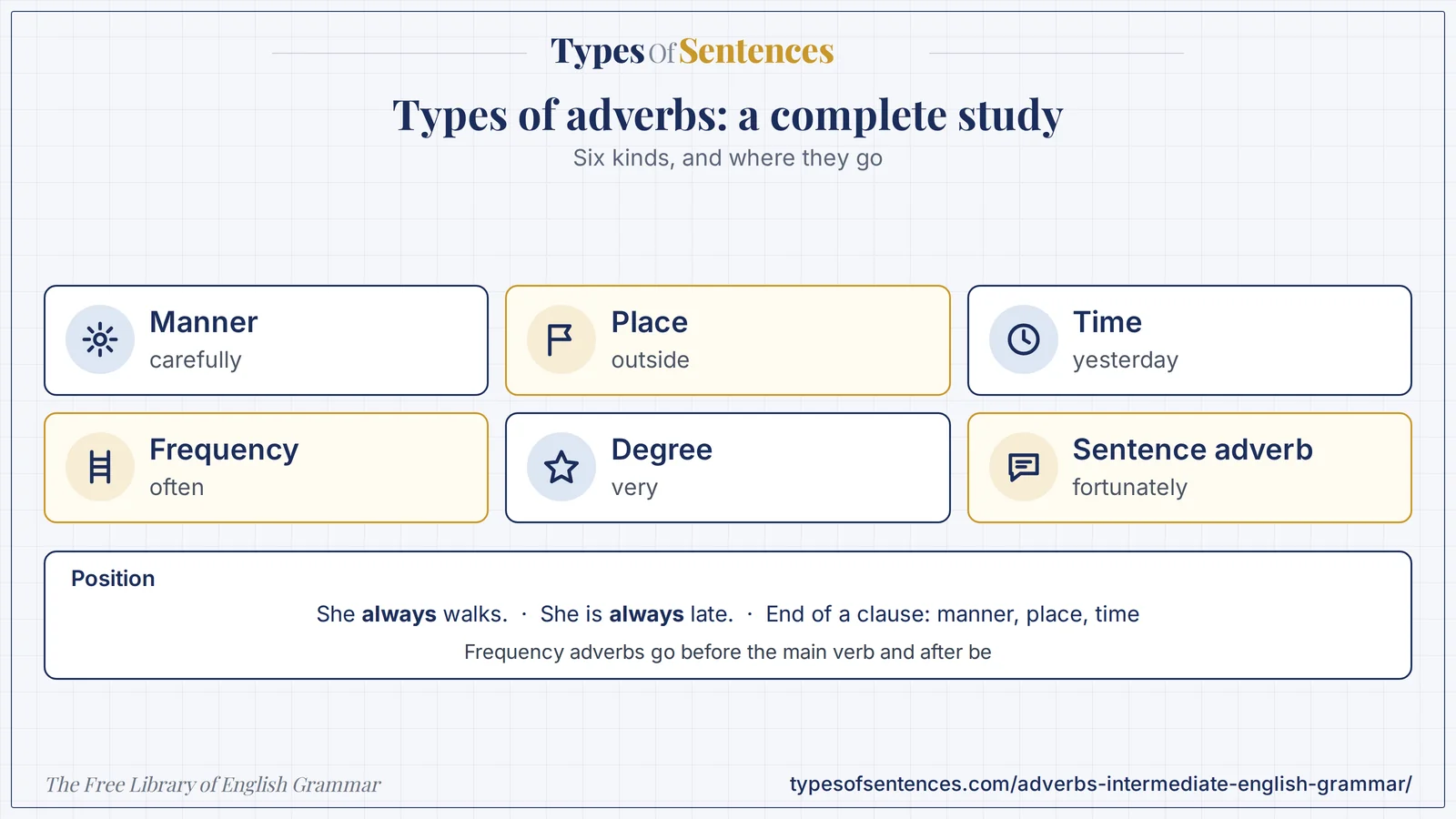
Adverbs add information about an action or a quality: how it happens, where, when, how often, or how much. Because they can modify almost anything, their position matters a great deal.
Why it matters: Many adverb errors come from putting a word in the wrong place or choosing an adjective where an adverb is needed. A few clear rules solve most of them.
Summary: Adverbs are classified as manner, place, time, frequency, degree, and sentence adverbs. Many end in -ly, but not all do. Frequency adverbs go before the main verb, manner adverbs usually come after the verb or object, and several adverbs at the end follow the order manner, place, time.
- Manner: carefully; place: outside; time: yesterday; frequency: often; degree: very.
- Mid-position: She always walks; after be: She is always late.
- End position order: manner, place, time.
- Comparatives: faster, more carefully; irregular: well, better, best.
What You’ll Learn
- 1. Types of Adverbs: What Is an Adverb? A Review
- 2. The Main Types of Adverbs
- 3. Formation of Adverbs
- 4. Position of Adverbs
- 5. Order of Adverbs: Manner, Place, Time
- 6. Adverbs of Frequency
- 7. Degree Adverbs
- 8. Comparative and Superlative Adverbs
- 9. Sentence Adverbs
- 10. Choosing Adverbs with Precision
- 11. Common Adverb Mistakes
- 12. Exercises
- 13. Test Your Knowledge
- 14. Frequently Asked Questions
- 15. Conclusion
1. Types of Adverbs: What Is an Adverb? A Review
An adverb is a word that modifies a verb, an adjective, another adverb, or a whole clause. Most answer the questions How?, Where?, When?, How often?, and How much?.
| It modifies | Example |
|---|---|
| a verb | She sings beautifully. |
| an adjective | The test was extremely hard. |
| another adverb | He finished very quickly. |
| a whole sentence | Fortunately, nobody was hurt. |
Because adverbs describe actions, the review in the Basic chapter on adverbs introduced them mainly with verbs. At this level, all four jobs matter. Adverbs can also be whole clauses, as in the chapter on adverb clauses.
2. The Main Types of Adverbs
These are the adverb types you need to know. The most important are manner, place, time, frequency, and degree.
| Type | Answers | Examples | Sentence |
|---|---|---|---|
| Manner | How? | quickly, carefully, well, hard, fast | She drove carefully. |
| Place | Where? | here, there, outside, upstairs, everywhere | The children are outside. |
| Time | When? | now, yesterday, soon, already, later | We left yesterday. |
| Frequency | How often? | always, usually, often, sometimes, never, daily | He often reads at night. |
| Degree | How much? | very, quite, too, almost, extremely | It is very cold. |
| Focus | which part? | only, just, even, also, especially | Only Tom came. |
| Sentence (viewpoint) | what the speaker thinks | fortunately, obviously, honestly, frankly | Obviously, she was upset. |
| Linking | connects sentences | however, therefore, then, moreover | It was late; therefore, we left. |
| Interrogative and relative | asks or joins | when, where, why, how | Where do you live? |
The linking adverbs are covered in the guide to conjunctive adverbs, and the relative adverbs where, when, and why in the guide to relative adverbs.
3. Formation of Adverbs
Many adverbs of manner are formed by adding -ly to an adjective. Some spelling changes apply.
| Adjective ending | Rule | Adjective | Adverb |
|---|---|---|---|
| most adjectives | add -ly | quick, careful | quickly, carefully |
| consonant + y | change y to i, add -ly | happy, easy | happily, easily |
| -le | drop e, add -y | gentle, simple | gently, simply |
| -ue | drop e, add -ly | true | truly |
| -ll | add only -y | full | fully |
| -ic | add -ally | basic, tragic | basically, tragically |
I. Adverbs with the same form as the adjective
A group of common words is both adjective and adverb: fast, hard, late, early, daily, high, straight, right, long. (a fast train, The train goes fast).
II. Adverbs with two forms and different meanings
| Form without -ly | Form with -ly |
|---|---|
| She worked hard. (with effort) | She hardly worked. (almost not at all) |
| He came late. | I haven’t seen him lately. (recently) |
| The plane flew high. | It is highly recommended. (very) |
| Stand near. | It is nearly finished. (almost) |
Some adjectives end in -ly (friendly, lovely, lonely, elderly), and they have no adverb. Use a phrase: She spoke in a friendly way. After a linking verb (see types of verbs), use an adjective, not an adverb.
4. Position of Adverbs
Adverb position depends on the type of adverb. There are three main positions: front, mid, and end.
| Position | Typical adverbs | Example |
|---|---|---|
| Front (before the subject) | time and sentence adverbs, linking adverbs | Yesterday, we visited Rome. Fortunately, it did not rain. |
| Mid (between the subject and the main verb, or after be and the first auxiliary) | frequency, focus, some degree and time adverbs | She always walks. She is always late. She has never been there. |
| End (after the verb and object) | manner, place, and time adverbs | She sang beautifully. They live nearby. We met yesterday. |
A frequency adverb goes after the verb be and before other main verbs.
Position can also change meaning, especially with only, almost, and just. Put them directly before the word they modify: She only ate the apples (she did nothing else with them) is different from She ate only the apples (nothing but the apples).
5. Order of Adverbs: Manner, Place, Time
When two or three adverbials come at the end of a clause, the usual order is manner, place, time.
| Manner | Place | Time | Example |
|---|---|---|---|
| beautifully | in the hall | last night | She sang beautifully in the hall last night. |
| carefully | at the office | every day | He works carefully at the office every day. |
| — | to Paris | yesterday | We flew to Paris yesterday. |
With verbs of movement (go, come, fly), place usually comes before manner: He went to Paris by car. The best advice is to put the most important information last, and to move a long adverbial to the front to avoid a heavy ending: Last night, in the crowded hall, she sang beautifully.
6. Adverbs of Frequency
Frequency adverbs tell how often something happens. They can be placed on a scale.
| Percent | Adverb | Example |
|---|---|---|
| 100% | always | I always brush my teeth. |
| about 90% | usually, normally | She usually walks. |
| about 70% | often, frequently | We often eat out. |
| about 50% | sometimes | He sometimes forgets. |
| about 20% | occasionally | I occasionally cook. |
| about 10% | rarely, seldom | They rarely complain. |
| almost 0% | hardly ever | She hardly ever calls. |
| 0% | never | He is never late. |
- Mid-position is usual: She usually walks; He is never late; I have always liked tea.
- Some frequency adverbs can also go at the start or end for emphasis: Sometimes I walk; I walk sometimes.
- Adverbs of definite frequency go at the end: She exercises daily, twice a week, every morning.
- Never and hardly ever are negative, so do not add another negative: I never go (not I don’t never go).
Questions about frequency begin with How often: How often do you exercise?
7. Degree Adverbs
Degree adverbs tell how much or how strongly. They modify adjectives, adverbs, and sometimes verbs.
| Strength | Adverbs | Example |
|---|---|---|
| Weaker | slightly, a little, fairly, rather, quite | The soup is fairly hot. |
| Strong | very, really, extremely, so | It is extremely cold. |
| Too much | too | It is too hot to drink. |
| Enough (after the adjective) | enough | It is cool enough to drink. |
| Almost | almost, nearly | The cup is almost empty. |
8. Comparative and Superlative Adverbs
Adverbs, like adjectives, can be compared. One-syllable adverbs usually take -er and -est, and adverbs ending in -ly take more and most.
| Adverb | Comparative | Superlative |
|---|---|---|
| fast | faster | fastest |
| hard | harder | hardest |
| early | earlier | earliest |
| carefully | more carefully | most carefully |
| quickly | more quickly | most quickly |
| well | better | best |
| badly | worse | worst |
| far | farther / further | farthest / furthest |
- She runs faster than I do.
- He drives more carefully than his brother.
- Of all the students, she works hardest.
Use only one comparative marker. Better is already the comparative of well.
9. Sentence Adverbs
A sentence adverb (also called a disjunct) does not describe the verb. It shows the speaker’s attitude toward the whole statement. It is usually set off with a comma.
| Type | Examples | Sentence |
|---|---|---|
| Attitude | fortunately, unfortunately, surprisingly, luckily | Fortunately, nobody was hurt. |
| Certainty | obviously, certainly, probably, undoubtedly | Probably, they left early. |
| Manner of speaking | honestly, frankly, briefly | Frankly, I disagree. |
The sentence adverb hopefully (Hopefully, it will not rain) is widely used and accepted in most current usage guides, though some writers avoid it. Use I hope that if you want to avoid any objection.
10. Choosing Adverbs with Precision
Skilled writers use adverbs deliberately. An adverb is most useful when it adds information that the verb or adjective does not already carry, and least useful when it props up a weak word. Compare She walked slowly with She trudged: the second sentence says the same thing with one stronger verb.
| Weak combination | Stronger choice | Why it works |
|---|---|---|
| ran quickly | raced, sprinted, dashed | the verb carries the manner |
| spoke softly | whispered, murmured | one precise verb |
| very tired | exhausted, worn out | the adjective is already extreme |
| really good | excellent, outstanding | a stronger adjective replaces the intensifier |
| looked carefully | studied, examined, inspected | the verb says how |
- Keep an adverb when it changes the meaning: He nearly fell and He fell are different events.
- Cut an adverb that repeats the verb: shouted loudly, smiled happily, whispered quietly.
- Watch intensifiers such as very, really, and extremely. Used too often, they lose force.
- Choose the position on purpose. An adverb at the start of a sentence (Suddenly, Fortunately) comments on the whole sentence; an adverb near the verb describes the action.
11. Common Adverb Mistakes
| Mistake | Fix | Why |
|---|---|---|
| He runs quick. | He runs quickly. | a verb needs an adverb |
| She did good on the test. | She did well on the test. | well is the adverb of good |
| I feel badly. | I feel bad. | after a linking verb, use an adjective |
| It is real cold. | It is really cold. | real is an adjective |
| She speaks fluently English. | She speaks English fluently. | do not split the verb and its object |
| I don’t never go. | I never go. (or I don’t ever go.) | double negative |
A few style points are debated. A split infinitive (to boldly go) is accepted in modern usage, and many editors prefer to go boldly only when the sentence sounds better. Do not let an old rule stop you from putting the adverb where it reads best.
Where does never go: He is never late or He never is late?
Reveal answer
He is never late. Frequency adverbs follow the verb be.
Recap in 12 seconds
Watch the lesson build itself: Adverbs are classified as manner, place, time, frequency, degree, and sentence adverbs, with rules for their position. The video has no sound.
Exercises
Part A: Types (Exercises 1–6)
Exercise 1: Type: carefully
Show Answer
Answer: Manner.
Exercise 2: Type: outside
Show Answer
Answer: Place.
Exercise 3: Type: yesterday
Show Answer
Answer: Time.
Exercise 4: Type: often
Show Answer
Answer: Frequency.
Exercise 5: Type: extremely
Show Answer
Answer: Degree.
Exercise 6: Type: fortunately
Show Answer
Answer: Sentence (attitude).
Part B: Formation (Exercises 7–11)
Exercise 7: Adverb from happy:
Show Answer
Answer: happily.
Exercise 8: Adverb from gentle:
Show Answer
Answer: gently.
Exercise 9: Adverb from true:
Show Answer
Answer: truly.
Exercise 10: Adverb from basic:
Show Answer
Answer: basically.
Exercise 11: Explain: She worked hard. and She hardly worked.
Show Answer
Answer: The first means she worked with effort; the second means she almost did not work.
Part C: Position (Exercises 12–17)
Exercise 12: Fix it: She always is late.
Show Answer
Answer: She is always late.
Exercise 13: Fix it: She speaks fluently English.
Show Answer
Answer: She speaks English fluently.
Exercise 14: Place never: He has been there.
Show Answer
Answer: He has never been there.
Exercise 15: Place often: They visit us.
Show Answer
Answer: They often visit us.
Exercise 16: Place usually: I am tired at night.
Show Answer
Answer: I am usually tired at night.
Exercise 17: Explain the difference: She only ate the apples. and She ate only the apples.
Show Answer
Answer: The first means she did nothing else with them; the second means she ate nothing but the apples.
Part D: Order and Frequency (Exercises 18–22)
Exercise 18: Order: last night / beautifully / in the hall (She sang …)
Show Answer
Answer: She sang beautifully in the hall last night.
Exercise 19: Order: every day / carefully / at the office (He works …)
Show Answer
Answer: He works carefully at the office every day.
Exercise 20: Fix the double negative: I don’t never go.
Show Answer
Answer: I never go. (or I don’t ever go)
Exercise 21: Where does a definite frequency adverb such as daily go?
Show Answer
Answer: At the end: She exercises daily.
Exercise 22: Complete: ___ do you exercise? (frequency question)
Show Answer
Answer: How often.
Part E: Degree and Comparatives (Exercises 23–27)
Exercise 23: Choose: I am (very/absolutely) exhausted.
Show Answer
Answer: absolutely.
Exercise 24: Place enough: It is (enough cool/cool enough) to drink.
Show Answer
Answer: cool enough.
Exercise 25: Comparative of carefully:
Show Answer
Answer: more carefully.
Exercise 26: Comparative and superlative of well:
Show Answer
Answer: better, best.
Exercise 27: Fix it: She sings more better than me.
Show Answer
Answer: She sings better than I do.
Part F: Sentence Adverbs and Errors (Exercises 28–30)
Exercise 28: Punctuate: Fortunately nobody was hurt.
Show Answer
Answer: Fortunately, nobody was hurt.
Exercise 29: Fix it: She did good on the test.
Show Answer
Answer: She did well on the test.
Exercise 30: Fix it: It is real cold.
Show Answer
Answer: It is really cold.
Test Your Knowledge
Ready to check what you learned? Answer all 10 questions, then submit. You need 80% (8 of 10) to pass. Your answers are not stored.
View correct answers and explanations
Question 1: What does a manner adverb tell?
✓ Correct Answer: C – How
A manner adverb tells how an action is done.
Question 2: Where does always go in She is late?
✓ Correct Answer: A – She is always late.
A frequency adverb follows the verb be.
Question 3: Which is the usual order at the end of a clause?
✓ Correct Answer: D – manner, place, time
The usual order is manner, place, time.
Question 4: Which is correct?
✓ Correct Answer: B – She speaks English fluently.
Do not put an adverb between a verb and its object.
Question 5: Which is correct?
✓ Correct Answer: C – I never go.
Avoid double negatives.
Question 6: Which is the comparative of carefully?
✓ Correct Answer: A – more carefully
Adverbs ending in -ly take more and most.
Question 7: Which is correct?
✓ Correct Answer: C – She did well.
Well is the adverb.
Question 8: Which adverb type is fortunately in Fortunately, nobody was hurt?
✓ Correct Answer: D – Sentence adverb
It shows the speaker’s attitude toward the whole sentence.
Question 9: Which is correct?
✓ Correct Answer: A – It is cool enough.
Enough follows an adjective.
Question 10: Which adjective has no -ly adverb?
✓ Correct Answer: B – friendly
Friendly has no adverb form; use in a friendly way.
Frequently Asked Questions
What are the types of adverbs?
The types of adverbs are manner, place, time, frequency, degree, focus, sentence adverbs, linking adverbs, and interrogative and relative adverbs. Each answers a question such as how, where, when, how often, or how much.
What are adverb types and examples?
Manner: quickly; place: here; time: yesterday; frequency: always; degree: very; sentence: fortunately. These adverb types often appear together in one sentence.
What is adverb position?
Adverb position is where an adverb goes in a sentence. Time and sentence adverbs often go at the front, frequency adverbs in mid-position, and manner, place, and time adverbs at the end.
What is the order manner, place, time?
When several adverbs come at the end of a clause, the usual order is manner first, then place, then time: She sang beautifully in the hall last night.
What are frequency adverbs?
Frequency adverbs tell how often something happens: always, usually, often, sometimes, rarely, never. They usually go before the main verb and after be.
Do all adverbs end in -ly?
No. Many do, but fast, hard, late, very, here, and never do not. And some words that end in -ly, such as friendly, are adjectives.
Is hopefully correct at the start of a sentence?
It is widely used and accepted in most current usage guides, though a few writers avoid it. If you want no objection, write I hope that instead.
Conclusion
You now know the types of adverbs, how they are formed, where they go, and in what order. You can use frequency and degree adverbs correctly, compare adverbs, recognize sentence adverbs, and avoid the common mistakes.
When you edit, check each adverb for its type and its position. Next, you will study the types of prepositions.
- Merriam-Webster Dictionary: adverb: the dictionary definition of an adverb.
- Purdue Online Writing Lab: Grammar: reference section on adverbs.
- Quirk, Randolph, et al. A Comprehensive Grammar of the English Language. Longman, 1985.: classification of adverbials and adverb position.
- Huddleston, Rodney, and Geoffrey K. Pullum. The Cambridge Grammar of the English Language. Cambridge University Press, 2002.: adverbs and their modification.
Last reviewed: October 29, 2026. How it was made: drafted with AI assistance, then checked with automated tests (structure, links, answer keys, spelling) and against the sources above. A person has not yet read this chapter line by line. Found a mistake? Report it.