Advanced adverb concepts start from a surprising fact: “adverb” is the most mixed word class in English. It includes quickly, very, however, frankly, only, and there, and these words do very different jobs. Some modify a verb, some an adjective, some a whole sentence, and some link one sentence to another. These complex adverbs can be moved around a clause in ways that change meaning, which makes position the central problem of this chapter.
You will study the four roles that adverbs play (adjunct, subjunct, disjunct, and conjunct), the formation of adverbs and the flat adverbs, the types of adverbs by meaning, position and order, adverbs of frequency, degree adverbs, comparison, sentence adverbs and the argument about hopefully, focusing adverbs such as only, and the common mistakes. Treating these adverb complexities is the way to expert adverbs and clear, well-ordered sentences. Thirty editing exercises and a quiz follow.
An adverb tells how, when, where, how often, how much, or what the speaker thinks. Because adverbs can sit in several places in a clause, the writer decides where to put them, and the position can change the meaning.
Why it matters: Most adverb problems come from three causes: using an adjective where an adverb is needed, putting the adverb in a place where it modifies the wrong word, and confusing adverbs that look alike (hard and hardly).
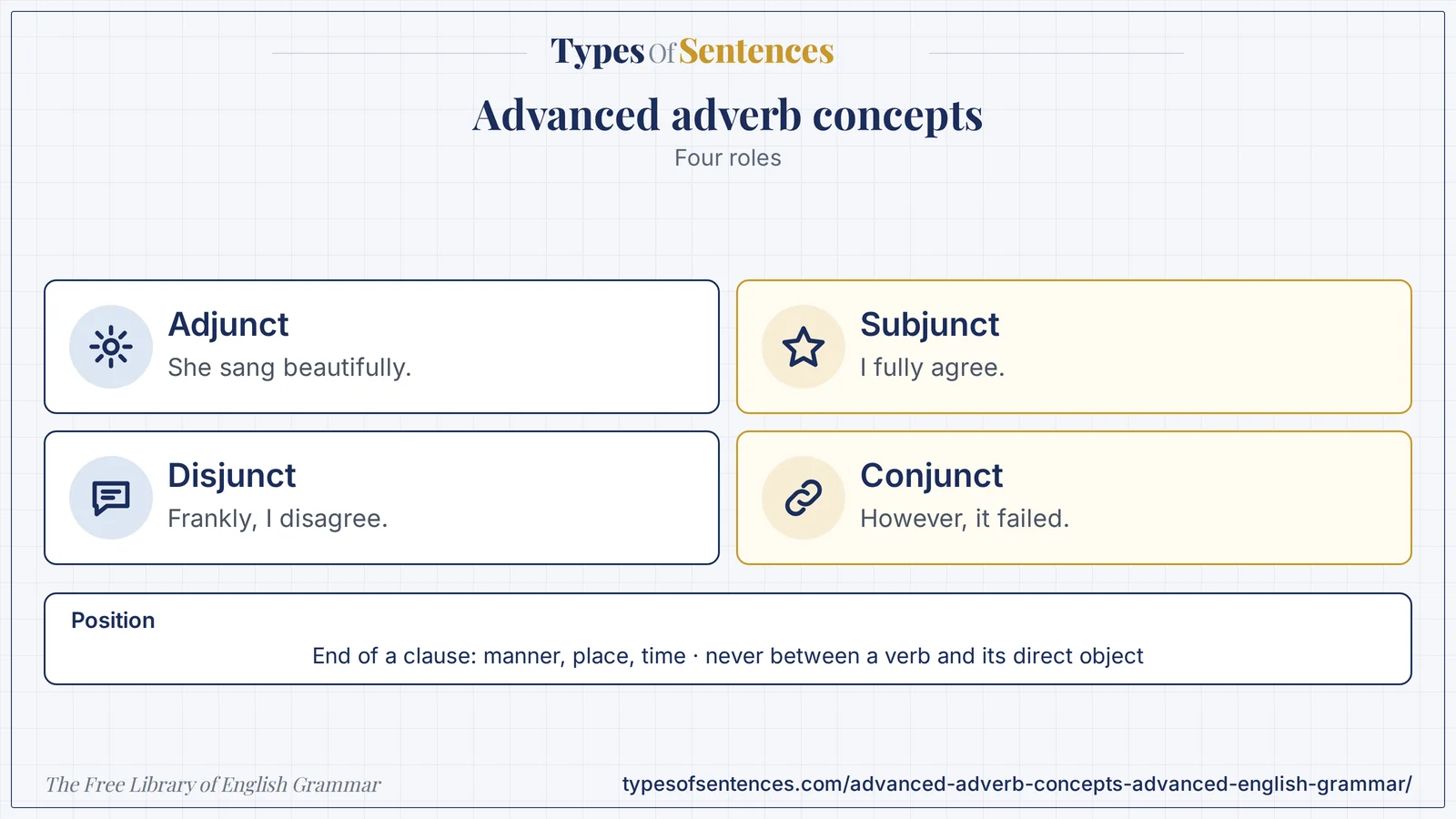
Summary: Adverbs have four main roles. Adjuncts are integrated into the clause (She sang beautifully); subjuncts are subordinate (I fully agree); disjuncts comment on the clause (Frankly, I disagree); conjuncts link clauses (However, it failed). Adverbs are formed with -ly or have the same form as an adjective (flat adverbs). They have three usual positions (initial, medial, and final), a typical order in end position (manner, place, time), and special rules for frequency, degree, and focusing adverbs.
- Four roles: adjunct, subjunct, disjunct, conjunct.
- Medial position: after be and the first auxiliary, before the main verb.
- End position order: manner, place, time (a tendency).
- Never put an adverb between a verb and its direct object.
What You’ll Learn
- 1. Advanced Adverb Concepts: The Four Roles of Adverbs
- 2. Formation of Adverbs and Flat Adverbs
- 3. Types of Adverbs by Meaning
- 4. Position of Adverbs
- 5. Order of Adverbs
- 6. Adverbs of Frequency
- 7. Degree Adverbs: Amplifiers and Downtoners
- 8. Comparison of Adverbs
- 9. Sentence Adverbs, Disjuncts, and Hopefully
- 10. Focusing Adverbs and Conjuncts
- 11. Common Adverb Mistakes
- 12. Exercises
- 13. Test Your Knowledge
- 14. Frequently Asked Questions
- 15. Conclusion
1. Advanced Adverb Concepts: The Four Roles of Adverbs
Following Quirk and his colleagues, grammarians distinguish four grammatical roles. The same word can play different roles in different sentences.
| Role | What it does | Example | Test |
|---|---|---|---|
| adjunct | is part of the clause structure; modifies the verb or the whole predicate | She sang beautifully. They arrived yesterday. | it can be the focus of a question (How did she sing?) |
| subjunct | is subordinate to the verb or clause, adding emphasis, degree, or viewpoint | I fully agree. She just left. | it is less integrated; often intensifies |
| disjunct | is peripheral to the clause; comments on what is said or how it is said | Frankly, I disagree. Fortunately, nobody was hurt. | it applies to the whole sentence |
| conjunct | links the sentence to what came before | It was cheap; however, it broke. | it shows a logical relation |
A single form can serve several roles: Honestly is an adjunct in She answered honestly (in an honest way) and a disjunct in Honestly, I don’t know (I am being honest in saying this). Adverbials also include prepositional phrases (in the morning), noun phrases (last week), and clauses; see the chapter on advanced adverbial clauses.
2. Formation of Adverbs and Flat Adverbs
| Pattern | Examples | Spelling rule |
|---|---|---|
| adjective + -ly | quick → quickly, careful → carefully | add -ly |
| adjective in -y | happy → happily, easy → easily | y → i |
| adjective in -le | gentle → gently, simple → simply | drop e |
| adjective in -ic | basic → basically, tragic → tragically | add -ally (exception: publicly) |
| adjective in -ll | full → fully, dull → dully | drop one l |
| other suffixes | -wise (clockwise), -ward(s) (homeward), -ways (sideways) | -wise also means “regarding” (informal) |
| Word | Adjective | Flat adverb | Adverb in -ly (different meaning) |
|---|---|---|---|
| hard | a hard test | She works hard. | hardly (barely): He hardly works. |
| late | a late train | He arrived late. | lately (recently): I haven’t seen him lately. |
| near | a near miss | Come near. | nearly (almost): nearly finished |
| high | a high wall | He jumped high. | highly (very): highly recommended |
| free | free tickets | Kids eat free. | freely (without limits): speak freely |
| close | a close friend | Stay close. | closely (carefully): watch closely |
| wide | a wide road | Open wide. | widely (generally): widely known |
| fast | a fast car | She drives fast. | — |
| early | an early bird | She left early. | — |
| right / wrong | a wrong answer | You guessed wrong. | wrongly (in error) |
3. Types of Adverbs by Meaning
| Type | Answers | Examples |
|---|---|---|
| manner | how? | quickly, carefully, well, badly, together |
| place | where? | here, there, upstairs, abroad, nearby |
| direction | which way? | forward, back, upward, away |
| time (point) | when? | now, yesterday, soon, already, then |
| time (duration) | how long? | briefly, temporarily, all day, since |
| frequency | how often? | always, often, sometimes, never, daily |
| degree and intensity | how much? | very, quite, almost, completely, too |
| focusing | what is singled out? | only, even, just, also, merely, especially |
| viewpoint | from what angle? | technically, politically, morally |
| comment and attitude (disjunct) | what does the speaker think? | fortunately, obviously, surprisingly, unfortunately |
| linking (conjunct) | how does it connect? | however, therefore, moreover, otherwise |
4. Position of Adverbs
| Position | Typical adverbs | Example |
|---|---|---|
| initial | time, comment, linking, some place | Yesterday we left. Fortunately, it was fine. However, we stayed. |
| medial (mid) | frequency, probability, focus, some degree and manner | She often works late. He has already left. They never complain. |
| final (end) | manner, place, time, duration | She sang beautifully. We met there. They left yesterday. |
| Medial position rule | Example |
|---|---|
| before the main verb, when there is no auxiliary | She always works. He quickly left. |
| after the first auxiliary | She has always worked. They will soon arrive. |
| after be as a main verb | She is always late. He was probably tired. |
| before the contracted negative or after not depending on meaning | He probably won’t come. He will not always come. |
| before an emphatic auxiliary | She really does work hard. |
| Misplaced | Corrected | Why |
|---|---|---|
| She only has two dollars. | She has only two dollars. | only belongs before the word it limits |
| I almost ate the whole cake. | I ate almost the whole cake. | almost next to what it limits |
| He nearly lost all his money. | He lost nearly all his money. | if he did lose it, the first is false |
| They said on Friday they would come. | They said they would come on Friday. | ambiguity: what is on Friday? |
| She told him quietly to leave. | She told him to leave quietly. | who is quiet? the telling or the leaving? |
5. Order of Adverbs
When several adverbials come at the end of a clause, the usual order is manner, then place, then time (MPT). It is a tendency with exceptions, and the weight of the phrase also matters: longer or heavier phrases go last.
| Order | Example |
|---|---|
| manner + place + time | She worked hard in the garden yesterday. |
| manner + time | He spoke clearly last night. |
| place + time | They met at the station on Friday. |
| place before manner with verbs of motion | She went home quickly. (place before manner) |
| time before place for emphasis or in formal style | On Friday, at the station, they met. |
| several time adverbs: from small to large (or specific before general) | We left at 8 a.m. on Monday in June. |
| heavy last | She spoke clearly to the whole assembly of students who had gathered in the hall. |
Adverbs of different types are sorted by position: frequency and probability adverbs are medial, manner and place are final, and sentence adverbs are initial. If a sentence is overloaded, move one adverbial to the start for variety.
6. Adverbs of Frequency
| Frequency | Adverbs | Typical position |
|---|---|---|
| 100% | always, constantly, invariably | medial |
| about 90% | usually, normally, generally | medial or initial |
| about 70% | often, frequently | medial, final (very often) |
| about 50% | sometimes, occasionally | initial, medial, final |
| about 10% | rarely, seldom | medial |
| 0% | never | medial |
| specific frequency | daily, weekly, once a week, every day | final |
- Negative frequency adverbs (never, seldom, rarely, hardly ever) are already negative: She never goes, not She doesn’t never go.
- At the start of a clause, they trigger inversion in formal or literary style: Never have I seen such a sight. Rarely does she complain. This is treated in the chapter on inversion.
- Ever is used in questions, conditionals, and negatives: Have you ever been there? I haven’t ever been there.
- Hardly ever and almost never are near-negatives.
7. Degree Adverbs: Amplifiers and Downtoners
| Type | Meaning | Adverbs | Example |
|---|---|---|---|
| maximizers (amplifiers) | the highest degree | completely, absolutely, totally, entirely, utterly, perfectly | absolutely essential |
| boosters (amplifiers) | a high degree | very, extremely, highly, deeply, awfully, terribly, really, so | extremely important |
| compromisers (downtoners) | a moderate degree | fairly, rather, quite (British), pretty, somewhat | fairly good |
| diminishers (downtoners) | a small degree | slightly, a little, partly, mildly | slightly damp |
| minimizers (downtoners) | almost none | hardly, barely, scarcely, little | barely audible |
| approximators | near a limit | almost, nearly, virtually, practically | almost finished |
Degree adverbs are choosy: they combine with some adjectives and verbs and not with others, a matter of collocation. We say deeply grateful, bitterly cold, highly unlikely, perfectly clear, fully aware, utterly ridiculous, but not *highly grateful or *perfectly cold. See the chapter on collocation. Very is not used with non-gradable adjectives (*very impossible) or extreme adjectives (*very terrible), as in the previous chapter on adjectives.
Quite has different meanings. In American English, quite usually means “very” or “completely” (quite good, quite right), while in British English it often means “fairly” (quite good, but not great). This is a frequent source of misunderstanding between speakers of the two varieties, and context or intonation decides.
| Other degree words | Pattern | Example |
|---|---|---|
| enough | adjective or adverb + enough | She is tall enough. He ran fast enough. |
| too | too + adjective (+ to-infinitive) | too hot to drink |
| so … that | so + adjective + that-clause | so tired that she fell asleep |
| such (with a noun) | such + (a) + adjective + noun | such a long day |
8. Comparison of Adverbs
| Type | Comparative | Superlative | Example |
|---|---|---|---|
| short and flat adverbs: -er / -est | faster, harder, sooner, later | fastest, hardest, soonest, latest | She runs faster than he does. |
| adverbs in -ly: more / most | more quickly, more carefully | most quickly, most carefully | He drives more carefully now. |
| irregular | better, worse, further/farther, less, more | best, worst, furthest/farthest, least, most | She sings best. |
| equative | as + adverb + as | — | as quickly as possible |
| correlative comparison | the + comparative, the + comparative | — | The sooner, the better. |
Remember that well has the comparative better, and badly has worse, and that adverbs, like adjectives, do not take two markers: more faster and most quickest are errors. See the chapter on adjectives for the same rule.
9. Sentence Adverbs, Disjuncts, and Hopefully
| Kind of disjunct | Meaning | Examples |
|---|---|---|
| style (how I say this) | the speaker’s manner of speaking | frankly, honestly, briefly, simply, bluntly, strictly speaking |
| attitude (what I think of this) | evaluation of the content | fortunately, unfortunately, surprisingly, sadly, curiously, regrettably |
| certainty | how sure the speaker is | obviously, clearly, probably, perhaps, possibly, certainly |
| viewpoint | the area concerned | politically, technically, economically |
Sentence adverbs are common in writing, and they are part of the stance of hedging and attitude described in the chapter on hedging. They are normally set off by commas at the start of a sentence: Fortunately, nobody was hurt. A comma is not needed in the medial position, where the adverb modifies the verb phrase: She is probably right.
Hopefully as a sentence adverb (Hopefully, the rain will stop, meaning “I hope that the rain will stop”) was widely criticized in the twentieth century, though it follows the same pattern as fortunately and thankfully. Some usage guides now accept it, and others still advise caution in formal writing. If you want to avoid the objection, write I hope that the rain will stop, and use hopefully as a manner adverb (She waited hopefully).
10. Focusing Adverbs and Conjuncts
| Focusing adverbs | Examples | Notes |
|---|---|---|
| restrictive | only, just, merely, simply, solely, purely | Only Maria called. (nobody else) |
| additive | also, too, as well, even, either (negative), likewise | Even Tom was late. |
| particularizing | especially, particularly, mainly, mostly, notably | He likes fruit, especially mangoes. |
| Sentence | Meaning (the focus changes with position) |
|---|---|
| Only Maria called me. | nobody but Maria |
| Maria only called me. | she did nothing but call |
| Maria called only me. | she called nobody else |
| Maria called me only on Monday. | on no other day |
Only is the classic example of a misplaced modifier: in speech it is placed before the verb whatever it modifies, and intonation clarifies. In writing, place it next to the word it limits. Conjuncts (however, therefore, moreover, nevertheless) link sentences, and their punctuation is treated in the guide to transition words and connectors.
11. Common Adverb Mistakes
| Error | Correction | Rule |
|---|---|---|
| She sings good. | She sings well. | well is the adverb |
| It is real good. | It is really good. | adverb modifying an adjective |
| Drive careful. | Drive carefully. | manner adverb |
| He ate quickly his lunch. | He ate his lunch quickly. | no adverb between verb and object |
| I only have two dollars. | I have only two dollars. | focusing adverb placement |
| She is taller more than he. | She is taller than he. | comparative construction |
| He doesn’t never call. | He never calls. | double negative |
| The soup smells badly. | The soup smells bad. | linking verb takes an adjective |
| more faster | faster | one comparative marker |
| I can’t hardly see. | I can hardly see. | hardly is negative |
| Firstly … secondly … lastly (inconsistent) | First … second … third | be consistent in sequence words |
| Hopefully the rain will stop. (formal) | I hope that the rain will stop. | avoid a disputed use in formal writing |
Edit: He only quickly ate his lunch real fast, and he didn’t never answer good, but hopefully he drives more careful than he speaks.
- only quickly ate: the focus is unclear: He ate only his lunch, or He ate his lunch quickly.
- real fast: really fast (and fast is a flat adverb).
- didn’t never answer good: never answered well.
- hopefully (formal): I hope he drives.
- more careful: more carefully.
- Result: He ate his lunch very quickly, and he never answered well, but I hope that he drives more carefully than he speaks.
Recap in 12 seconds
Watch the lesson build itself: Adverbs act as adjuncts, subjuncts, disjuncts, or conjuncts, and each has its usual position. The video has no sound.
Exercises
Part A: Roles and Formation (Exercises 1–7)
Exercise 1: Name the role: Frankly, I disagree. (Frankly)
Show Answer
Answer: Disjunct.
Exercise 2: Name the role: I fully agree. (fully)
Show Answer
Answer: Subjunct.
Exercise 3: Name the role: It was cheap; however, it broke. (however)
Show Answer
Answer: Conjunct.
Exercise 4: Form the adverb: happy
Show Answer
Answer: happily.
Exercise 5: Form the adverb: basic
Show Answer
Answer: basically.
Exercise 6: Choose: She works (hard/hardly). (with great effort)
Show Answer
Answer: hard.
Exercise 7: Choose: I haven’t seen him (late/lately).
Show Answer
Answer: lately.
Part B: Types and Position (Exercises 8–14)
Exercise 8: Type of adverb: yesterday
Show Answer
Answer: Time.
Exercise 9: Type of adverb: upstairs
Show Answer
Answer: Place.
Exercise 10: Place the adverb: She works late. (always)
Show Answer
Answer: She always works late.
Exercise 11: Place the adverb: He has left. (already)
Show Answer
Answer: He has already left.
Exercise 12: Place the adverb: She is late. (always)
Show Answer
Answer: She is always late.
Exercise 13: Edit: He ate quickly his lunch.
Show Answer
Answer: He ate his lunch quickly.
Exercise 14: Edit: She only has two dollars.
Show Answer
Answer: She has only two dollars.
Part C: Order, Frequency, Degree (Exercises 15–21)
Exercise 15: Order (manner, place, time): yesterday / in the garden / hard with She worked
Show Answer
Answer: She worked hard in the garden yesterday.
Exercise 16: Edit: He doesn’t never call.
Show Answer
Answer: He never calls.
Exercise 17: Invert: I have never seen such a sight. (start with Never)
Show Answer
Answer: Never have I seen such a sight.
Exercise 18: Classify: absolutely
Show Answer
Answer: Maximizer (amplifier).
Exercise 19: Classify: slightly
Show Answer
Answer: Diminisher (downtoner).
Exercise 20: Choose: It was (very/absolutely) terrible.
Show Answer
Answer: absolutely.
Exercise 21: Explain the American and British difference in quite good.
Show Answer
Answer: American: very good; British: fairly good.
Part D: Comparison and Sentence Adverbs (Exercises 22–26)
Exercise 22: Comparative of quickly:
Show Answer
Answer: more quickly.
Exercise 23: Comparative of well:
Show Answer
Answer: better.
Exercise 24: Edit: more faster
Show Answer
Answer: faster.
Exercise 25: Name the type of disjunct: Fortunately, nobody was hurt.
Show Answer
Answer: Attitude disjunct.
Exercise 26: Rewrite to avoid hopefully: Hopefully, the rain will stop.
Show Answer
Answer: I hope that the rain will stop.
Part E: Focus and Errors (Exercises 27–30)
Exercise 27: Explain: Maria called only me.
Show Answer
Answer: She called nobody else.
Exercise 28: Explain: Only Maria called me.
Show Answer
Answer: Nobody else called me.
Exercise 29: Edit: It is real good.
Show Answer
Answer: It is really good.
Exercise 30: Edit: The soup smells badly.
Show Answer
Answer: The soup smells bad.
Test Your Knowledge
Ready to check what you learned? Answer all 10 questions, then submit. You need 80% (8 of 10) to pass. Your answers are not stored.
View correct answers and explanations
Question 1: Which role does however play in It was cheap; however, it broke?
✓ Correct Answer: D – conjunct
However links the clauses.
Question 2: Which is a flat adverb?
✓ Correct Answer: C – fast
Fast has the same form as the adjective.
Question 3: Which is correct?
✓ Correct Answer: B – He ate his lunch quickly.
No adverb between a verb and its object.
Question 4: Which is the usual order at the end of a clause?
✓ Correct Answer: C – manner, place, time
The tendency is manner, place, time.
Question 5: Which is correct?
✓ Correct Answer: C – She sings well.
Well is the adverb.
Question 6: Which is correct?
✓ Correct Answer: D – He never calls.
No double negatives.
Question 7: Which adverb means “almost not”?
✓ Correct Answer: A – hardly
Hardly is a minimizer.
Question 8: Which is a disjunct?
✓ Correct Answer: A – fortunately
Fortunately comments on the whole clause.
Question 9: Where should only go to say “she has nothing more than two dollars”?
✓ Correct Answer: B – She has only two dollars.
Place it next to the word it limits.
Question 10: Which is a maximizer?
✓ Correct Answer: B – completely
Completely is a maximizer.
Frequently Asked Questions
What are advanced adverb concepts?
Advanced adverb concepts are the finer points of the adverb: its four roles, formation and flat adverbs, types by meaning, position and order, frequency and degree adverbs, comparison, sentence adverbs, and focusing adverbs.
What are complex adverbs?
Complex adverbs are adverbs whose behavior is not simple: flat adverbs (fast), pairs such as hard and hardly, sentence adverbs (fortunately), focusing adverbs (only), and conjuncts (however).
What are adverb complexities in position?
The main adverb complexities are the choice among initial, medial, and final position, the rule that an adverb does not separate a verb from its object, and the way that only and almost change meaning with position.
What is advanced adverb usage in order?
Advanced adverb usage in order follows the tendency of manner, place, then time at the end of a clause, with heavier phrases last and frequency adverbs in medial position.
What are expert adverbs?
Expert adverbs are adverbs used with full control: the right form, the right position, no misplaced modifiers, and degree adverbs that fit the word they modify.
Is “hopefully” a correct sentence adverb?
It follows the pattern of fortunately, and many usage guides now accept it. Some still advise caution in formal writing, where you can write I hope that ….
What is the difference between hard and hardly?
Hard is both an adjective and an adverb meaning “with effort” (She works hard). Hardly means “almost not” (She hardly works).
Conclusion
You now have a deep study of the adverb: its four roles, formation, types, position, order, frequency, degree, comparison, sentence adverbs, and focusing adverbs. You can place adverbs with control and avoid the common mistakes.
When you edit, check the position of every adverb and ask what it modifies. Next, you will study advanced preposition concepts.
- Quirk, Randolph, et al. A Comprehensive Grammar of the English Language. Longman, 1985.: the source of the terms adjunct, subjunct, disjunct, and conjunct.
- Huddleston, Rodney, and Geoffrey K. Pullum. The Cambridge Grammar of the English Language. Cambridge University Press, 2002.: the reference analysis of adverbs and adverbials.
- Garner, Bryan A. Garner’s Modern English Usage, 5th ed. Oxford University Press, 2022.: usage guidance on hopefully, only, and flat adverbs.
- Biber, Douglas, et al. Longman Grammar of Spoken and Written English. Longman, 1999.: corpus evidence on adverbial position and frequency.
- Merriam-Webster Dictionary: adverb: the dictionary definition.
Last reviewed: October 29, 2026. How it was made: drafted with AI assistance, then checked with automated tests (structure, links, answer keys, spelling) and against the sources above. A person has not yet read this chapter line by line. Found a mistake? Report it.