Editing and proofreading are the processes by which a draft becomes a finished text. They are not the same thing, and they are not done in one pass. Editing improves the writing: its organization, its ideas, its sentences, its words. Proofreading removes the last errors from a text that is already final. A writer who proofreads before editing wastes effort on sentences that will be cut; a writer who edits only at the sentence level may polish a paragraph that should not be there at all. The rule of this chapter, and of the profession, is to work from the large to the small: edit for content, then for style, then for correctness, and proofread last.
You will study the differences between the stages (content editing, line editing, copyediting, and proofreading), what to look for at each stage, the strategies that make self-editing effective (reading aloud, letting the draft rest, making several targeted passes), a checklist of common errors to check (agreement, comma splices, pronoun reference, modifiers, parallelism, apostrophes, and confusable words), how editing differs for academic, business, digital, and creative texts, and how to work with an editor. A full multi-pass example shows the stages at work. These are the techniques of editing writing, improving writing, and the proofreading techniques that catch what is left. Thirty editing exercises and a quiz follow.
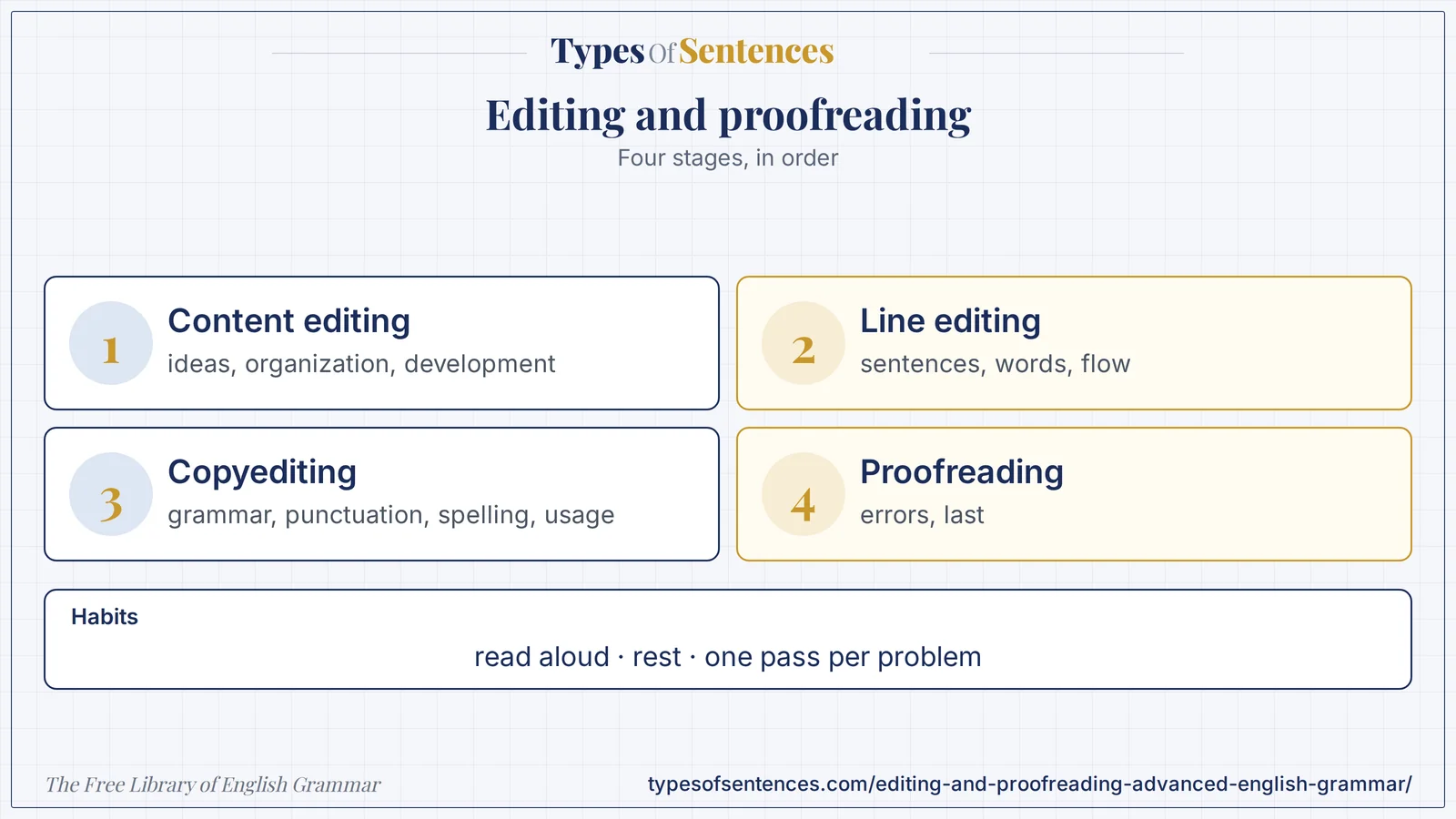
Editing is making the text better; proofreading is making sure nothing in it is wrong. You edit a draft, probably several times. You proofread the final version, once or twice, when nothing else will change.
Why it matters: Most writers cannot see their own mistakes, because the brain reads what it expects to see. The cure is distance and method: leave the text for a while, change the way you view it, and look for one kind of problem at a time.
Summary: Editing has levels: content (developmental) editing for ideas, organization, and development; line editing for sentences, words, and flow; copyediting for grammar, punctuation, spelling, usage, and consistency; and proofreading for typos and formatting errors in the final proof. Work from large to small, never the reverse. Effective strategies include reading aloud, leaving time between drafts, using a reverse outline, making separate passes for separate problems, using a style sheet, and keeping a personal error log. Spelling and grammar checkers help but miss real-word errors and context. Common errors to check include subject–verb agreement, comma splices and run-ons, fragments, pronoun reference, misplaced and dangling modifiers, faulty parallelism, tense shifts, apostrophes, and confusable words.
- Edit for content first; proofread for errors last.
- Stages: content, line, copy, proof.
- Read aloud; rest; one pass per problem.
- Check agreement, splices, pronouns, modifiers, parallelism, apostrophes.
What You’ll Learn
- 1. Editing and Proofreading: Different Stages, Different Focus
- 2. Content Editing: Organization, Development, and Clarity
- 3. Line Editing: Sentences, Words, and Flow
- 4. Copyediting: Grammar, Punctuation, and Consistency
- 5. Proofreading: The Final Check
- 6. Editing Strategies: Reading Aloud, Fresh Eyes, and Multiple Passes
- 7. Common Errors to Check
- 8. Editing for Different Kinds of Writing
- 9. Working with an Editor and Editing Others
- 10. A Complete Multi-Pass Example
- 11. Exercises
- 12. Test Your Knowledge
- 13. Frequently Asked Questions
- 14. Conclusion
1. Editing and Proofreading: Different Stages, Different Focus
| Stage | Focus | Typical questions | When |
|---|---|---|---|
| content (developmental, substantive) editing | ideas, purpose, audience, organization, development, completeness | Does the text say what it should? Is the order logical? Is anything missing or unnecessary? | first; after the first full draft |
| line (stylistic) editing | sentences, paragraphs, words, flow, tone, clarity, concision | Is each sentence clear and well built? Does the paragraph flow? Is the voice right? | second |
| copyediting | grammar, punctuation, spelling, usage, consistency, style guide, facts and references | Is it correct and consistent? Does it follow the style guide? | third; when the text is stable |
| proofreading | typos, spacing, formatting, page layout, last errors in the proof | Does the final proof match the approved text? Is anything wrong or missing? | last; on the final layout |
| Level of edit | Meaning |
|---|---|
| light | corrects errors and obvious problems only |
| medium | corrects errors and improves clarity and consistency of expression |
| heavy | rewrites and reorganizes to improve the text substantially |
| Mistake | Why it fails |
|---|---|
| proofreading a draft that will be revised | the corrections will be lost when the text changes |
| line editing before the structure is settled | polished sentences may be cut |
| correcting commas while the argument is incomplete | effort in the wrong place |
| changing text at the proof stage | new errors, cost, and delay |
| editing only on screen without a break | familiarity hides errors |
The order follows a simple principle: work on the biggest problems first, and the smaller ones when the larger ones are solved. For academic work, this order applies to the argument of the essay (see the chapter on academic writing) before the grammar of its sentences. Editing the work of others adds a further duty: to preserve the writer’s voice and meaning, to explain changes, and to query what is unclear instead of guessing.
2. Content Editing: Organization, Development, and Clarity
| Question | What to check |
|---|---|
| purpose | What is the text for? Does every part serve it? |
| audience | Who is the reader? What do they know and need? |
| thesis or main point | Is it clear, specific, and stated early? |
| organization | Is the order logical? Could any section move? |
| development | Is each point supported by evidence or explanation? |
| completeness | Is anything the reader needs missing? |
| relevance | Is anything off topic or repeated? |
| balance | Do the parts have the right proportion? |
| openings and endings | Does the introduction engage and orient? Does the conclusion conclude? |
| cohesion | Do the paragraphs link? (see the chapter on cohesion and coherence) |
| sources and accuracy | Are claims supported and facts correct? |
- Read the whole text before changing anything.
- Make a reverse outline: write the main point of each paragraph in a margin, and read the list as an argument.
- Check the thesis against the conclusion.
- Mark paragraphs that are off topic, thin, or repeated.
- Move, cut, and add at the level of sections and paragraphs.
- Write transitions where the logic jumps.
- Reread after the changes, as a reader.
| Content problem | Symptom | Fix |
|---|---|---|
| no clear point | the reader cannot summarize the text | write a one-sentence main point; revise around it |
| buried point | the main idea appears on page two | move it to the opening |
| repetition | the same idea appears in several places | combine and cut |
| thin development | claims with no support | add evidence and explanation |
| digression | a section that does not serve the point | cut or move to a note |
| wrong order | background after the argument, or steps out of sequence | reorder |
| missing context | jargon or assumptions the reader lacks | add definitions and background |
| unbalanced length | a long introduction and a short argument | redistribute |
3. Line Editing: Sentences, Words, and Flow
| Technique | Before | After |
|---|---|---|
| find the actor and the action; make the actor the subject | The implementation of the policy by the department resulted in a reduction of costs. | The department implemented the policy and reduced costs. |
| turn a nominalization into a verb | We made a decision to conduct an investigation of the matter. | We decided to investigate the matter. |
| cut padding | It is important to note that the results were, in fact, rather significant. | The results were significant. |
| prefer the active voice (where the actor matters) | The report was written by the committee. | The committee wrote the report. |
| put old information first, new last | A new model was proposed. The model has three stages. | A new model was proposed. It has three stages. |
| combine short, choppy sentences | He was late. He was tired. He missed the train. | Tired and late, he missed the train. |
| split a long sentence | a sentence of 60 words with three ideas | three sentences, one idea each |
| use parallel structure | She likes to swim, hiking, and to ride a bike. | She likes swimming, hiking, and cycling. |
| replace vague words | a lot of things happened | three things happened: … |
| strengthen the verb | He walked slowly and quietly. | He crept. |
| cut repetition | free gift; end result; past history | gift; result; history |
| vary sentence openings and length | a run of sentences that begin with the subject | vary them (see the chapter on sentence variety) |
| replace the cliché | at the end of the day | finally; or delete |
| check the tone | a slangy word in a formal text | a formal word |
| make the paragraph flow | missing links | add transitions and repeat key terms |
| Word-level problem | Example | Fix |
|---|---|---|
| wrong register | The results were kind of awful. | The results were poor. |
| vague word | thing, stuff, nice, good | a precise word |
| weak intensifier | very important | essential (or just important) |
| stacked hedges | may possibly perhaps suggest | may suggest |
| jargon | leverage synergies | work together |
| redundant pair | each and every; first and foremost | each; first |
| wrong word | The affect of the policy was large. | The effect of the policy was large. |
| unnecessary adverb | He shouted loudly. | He shouted. |
| inflated phrase | at this point in time; due to the fact that | now; because |
Choosing words precisely is the subject of the chapter on diction, and the parallel arrangement of items is treated in the chapter on parallel structure. Line editing is the stage at which the writer’s style is shaped, and it is the most personal of the stages; an editor of someone else’s text should make the writing better in the author’s own manner and not substitute their own.
4. Copyediting: Grammar, Punctuation, and Consistency
| Area | Check | Example |
|---|---|---|
| grammar | agreement, tense, pronouns, modifiers, articles | The data show (not shows) |
| punctuation | commas, apostrophes, quotation marks, hyphens, dashes, semicolons, colons | its / it’s; a comma after an introductory clause |
| spelling | including names, technical terms, and homophones | separate; definitely; received |
| usage | confusable words and idioms | affect/effect; fewer/less; who/whom |
| capitalization | titles, headings, proper nouns | sentence case or title case: one style |
| numbers | words or numerals; consistent ranges | five samples; 12 samples; 10–20 |
| dates and times | one format | 15 March 2024; 3 p.m. |
| abbreviations and acronyms | define at first use; consistent | World Health Organization (WHO) |
| spelling variety | one variety throughout | American or British, not both |
| hyphenation and compounds | by the dictionary and style guide | well-known author; the author is well known |
| lists and headings | parallel form; consistent punctuation | — |
| cross-references | figure, table, page, and section numbers | Table 2 (not Table 3) |
| citations and references | match the text and the list; one style | (Smith, 2020) in the list |
| facts | names, dates, figures, quotations | flag for checking |
| style guide | house style rules | AP, APA, MLA, Chicago, or in-house |
| Consistency item | Decide once, then apply | Examples |
|---|---|---|
| serial comma | use it or not | red, white, and blue / red, white and blue |
| spelling variety | American or British | the same variety throughout the document |
| capitalization of headings | sentence or title case | Using Punctuation Correctly / Using punctuation correctly |
| quotation marks | double or single (for the main quotation) | “…” / ‘…’ |
| numerals | the threshold | spell out one to nine |
| abbreviations | with or without periods | U.S. / US |
| terms | one name for one thing | email / e-mail: one |
| bulleted lists | full sentences with periods, or fragments without | — |
| date format | — | 15 March 2024 / March 15, 2024 |
| Common proofreading symbol (conceptual) | Meaning |
|---|---|
| a caret (^) with the addition in the margin | insert text |
| a line through text and a delete sign in the margin | delete |
| “stet” in the margin | let it stand; ignore the change |
| a curved line between letters or words | transpose |
| a circle around an abbreviation | spell out |
| “cap” or underlines | capitalize |
| a slash through a capital | lowercase |
| “#” in the margin | insert a space |
| “¶” | start a new paragraph |
| “no ¶” | no new paragraph |
| “sp” in a circle | spelling error |
A style sheet is a record of the decisions made about spelling, capitalization, hyphenation, abbreviations, and special terms in a document, so that the copyeditor and the proofreader apply them consistently. On a long text, the style sheet is as important as the edit itself. The differences between American and British conventions, which are a common source of inconsistency, are treated in the chapter on British vs American English.
5. Proofreading: The Final Check
| What to check | Examples |
|---|---|
| typos and spelling | teh, recieve, a wrong but real word (form for from) |
| repeated or missing words | the the; a missing not |
| spacing | double spaces; missing space after a period; spaces before punctuation |
| punctuation | missing closing quotation marks, brackets, or parentheses; stray commas |
| capitalization | a sentence that begins with a lowercase letter; inconsistent heading case |
| numbers and names | digits transposed; a name spelled two ways |
| formatting | fonts, sizes, bold and italic, heading levels, bullets, alignment |
| layout | page numbers, headers, footers, a heading alone at the foot of a page, a single line of a paragraph (widow or orphan) |
| figures, tables, and captions | numbered in order; match the text |
| links and cross-references | working links; correct page references |
| against the source | the final proof matches the approved copy |
| contact and legal details | phone numbers, addresses, dates, prices |
| Technique | How it helps |
|---|---|
| read aloud, slowly | the ear catches missing and repeated words |
| read backward, sentence by sentence or word by word | breaks the meaning so that you see words, not sense |
| use a ruler or a finger or a cursor | slows the eye to one line |
| print the text, or change the font and size | makes it look new |
| leave a gap of hours or days | distance from the draft |
| proofread for one type of error at a time | focus |
| check numbers, names, dates, and headings separately | these are easy to overlook |
| use a checklist | consistency |
| read a second time after corrections | corrections create new errors |
| ask someone else to read | a fresh pair of eyes |
| use spell-check, but do not trust it | it misses real-word errors and context |
| Spell-check misses | Example | Correct |
|---|---|---|
| homophone | The weather was to hot. | too |
| a real word that is wrong | He lost the form of the money. | from |
| a missing word | The results were conclusive. (the writer meant not conclusive) | insert not |
| a name | Smth (2020) | Smith (2020) |
| a wrong plural or possessive | the childrens toys | the children’s toys |
| spelling variety mix | a text that mixes American and British spellings | one variety |
| a wrong technical term | — | check the term |
| repeated word across a line break | the / the | delete one |
Proofreading is a distinct skill from reading for sense: proofreaders read slowly, one word at a time, and read what is on the page and not what they expect. Most people overlook their own errors, because the brain fills in what it knows should be there, so a pause before proofreading is more valuable than any tool.
6. Editing Strategies: Reading Aloud, Fresh Eyes, and Multiple Passes
| Strategy | How to do it | What it catches |
|---|---|---|
| read aloud | read the text slowly, in full, in a clear voice | awkward rhythm, missing words, long sentences, tone |
| fresh eyes | leave the text for a day or at least an hour | blind spots |
| multiple passes | one pass per problem: structure; paragraphs; sentences; words; grammar; punctuation; typos | a thorough check |
| targeted search | search for very, really, that, there is/are, -ly adverbs, is/was, passives, a favorite phrase | habits |
| reverse outline | list the point of each paragraph | structural problems |
| read the first sentence of each paragraph | read only the topic sentences | a weak argument or a gap |
| change the format | print it; change the font; read on a different screen | visual blindness |
| text-to-speech | listen to the text read aloud | awkward sentences, errors |
| checklists | list your own most frequent errors | repeated mistakes |
| peer review | ask a reader to mark confusing places | what you cannot see |
| style sheet and style guide | look up the rule; record the decision | consistency |
| timing | plan time for each stage | rushed errors |
| Tool | Use | Limit |
|---|---|---|
| spell-checker | typos and many spelling errors | misses real-word errors; may suggest a wrong word |
| grammar checker | flags possible errors and style issues | makes false alarms and misses; does not know your meaning |
| style and readability tools | sentence length, passives, adverbs | guides, not judges |
| dictionary and thesaurus | meaning, spelling, usage | check a thesaurus word in the dictionary |
| style guide (AP, APA, MLA, Chicago) | rules for citations and conventions | — |
| track changes and comments | record edits and queries | keep a clean copy |
| find and replace | fix a repeated error everywhere | check each change (global replace can introduce errors) |
- Keep a personal error log. Most writers repeat the same few errors (for example its/it’s, comma splices, dangling modifiers). Know yours, and search for them.
- Do not edit while you draft. Mixing the two slows both.
- Edit with a purpose. Before you edit, decide what the text must do and for whom.
- Accept that editing means cutting. Many drafts improve by 10 percent or more by cutting.
- Know when to stop. Endless polishing is a form of avoidance; use the deadline and the checklist.
7. Common Errors to Check
| Subject–verb agreement trap | Incorrect | Correct |
|---|---|---|
| a phrase between subject and verb | The list of items are long. | The list of items is long. |
| collective noun (as a unit) | The committee are meeting today. | The committee is meeting today. (American; British often accepts plural) |
| each, every, everyone | Each of the students have a book. | Each of the students has a book. |
| either … or, neither … nor (verb agrees with the nearer subject) | Neither the teacher nor the students was ready. | Neither the teacher nor the students were ready. |
| compound subject with and | The manager and the clerk is late. | The manager and the clerk are late. |
| there is/are (agrees with what follows) | There is two reasons. | There are two reasons. |
| a number of / the number of | A number of students was absent. / The number of students are small. | A number of students were absent. / The number of students is small. |
| data, criteria | The data shows … | The data show … (formal) |
| relative clause | He is one of the men who works here. | He is one of the men who work here. |
| uncountable noun | The information are useful. | The information is useful. |
| Sentence boundary error | Incorrect | Correction |
|---|---|---|
| comma splice | The test was long, it lasted three hours. | The test was long; it lasted three hours. / The test was long. It lasted three hours. / The test was long, and it lasted three hours. |
| run-on (fused sentence) | The test was long it lasted three hours. | The test was long, and it lasted three hours. |
| fragment | Because the test was long. | Because the test was long, many students left early. |
| splice with a conjunctive adverb | The test was long, however, we finished. | The test was long; however, we finished. |
| fragment beginning with which | The test was long. Which surprised us. | The test was long, which surprised us. |
| Pronoun and modifier error | Incorrect | Correct |
|---|---|---|
| ambiguous pronoun | Priya told Maya that she was late. | Priya told Maya, “You are late.” (or) Priya told Maya that Maya was late. |
| this without a noun | This shows that … | This result shows that … |
| pronoun agreement | Everyone should bring their book. (formal) | Everyone should bring a book. (or their, now widely accepted) |
| case | Me and him went. / between you and I | He and I went. / between you and me |
| dangling modifier | Walking home, the rain started. | As I walked home, the rain started. |
| misplaced modifier | She nearly drove 200 miles. | She drove nearly 200 miles. |
| squinting modifier | Reading often improves vocabulary. | Reading improves vocabulary often. (or) Reading improves vocabulary; do it often. |
| who/whom, who/that | The man that called … | The man who called … |
| Parallelism, tense, and apostrophe error | Incorrect | Correct |
|---|---|---|
| faulty parallelism | She likes to swim, hiking, and to ride. | She likes swimming, hiking, and riding. |
| tense shift | He opened the door and sees the room. | He opened the door and saw the room. |
| its / it’s | The dog wagged it’s tail. | The dog wagged its tail. |
| plural with apostrophe | Apple’s for sale | Apples for sale |
| possessive plural | the childrens’ toys | the children’s toys |
| possessive of a name ending in s | James book | James’s book (or James’ book, by style) |
| you’re / your | Your late. | You’re late. |
| their / there / they’re | Their going over there. | They’re going over there. |
| Punctuation and word-choice error | Incorrect | Correct |
|---|---|---|
| missing comma after an introductory clause | When the rain stopped we left. | When the rain stopped, we left. |
| comma between subject and verb | The students in the hall, were noisy. | The students in the hall were noisy. |
| non-restrictive clause without commas | My brother who lives in Pune is a doctor. (only one brother) | My brother, who lives in Pune, is a doctor. |
| affect / effect | The policy effected the result. | The policy affected the result. |
| than / then | Bigger then I thought. | Bigger than I thought. |
| fewer / less | less mistakes | fewer mistakes |
| lie / lay | He lay the book down. | He laid the book down. |
| double negative | I don’t have no time. | I don’t have any time. |
| redundancy | return back; in my personal opinion | return; in my opinion |
| article | She is engineer. | She is an engineer. |
| Further errors to check | Incorrect | Correct |
|---|---|---|
| agreement after here / there | Here is the books. | Here are the books. |
| agreement with fractions | Two-thirds of the cake were eaten. | Two-thirds of the cake was eaten. |
| agreement with each … and | Each man and woman have a seat. | Each man and woman has a seat. |
| who / whom | To who did you give it? | To whom did you give it? |
| pronoun for a company (American) | The company announced their results. | The company announced its results. |
| reflexive for object | Please contact myself. | Please contact me. |
| comma after an introductory phrase | After the meeting we left. | After the meeting, we left. |
| comma between clauses joined by and | He called and she answered. | He called, and she answered. |
| commas for a nonessential clause | Dr. Rao who teaches physics won. | Dr. Rao, who teaches physics, won. |
| semicolon after a subordinate clause | Although it rained; we went. | Although it rained, we went. |
| colon after a verb | The kit includes: a map and a compass. | The kit includes a map and a compass. |
| apostrophe in a decade | the 1990’s | the 1990s |
| hyphen in a compound modifier | a well known author | a well-known author |
| period inside the quotation marks (American) | She said “go”. | She said “go.” |
| capital for a title before a name | Professor rao | Professor Rao |
| double negative | He can’t hardly see. | He can hardly see. |
| unneeded preposition | We discussed about the plan. | We discussed the plan. |
| conditional with would in the if-clause | If I would know, I would tell you. | If I knew, I would tell you. |
| uncountable noun with an | He gave me an advice. | He gave me some advice. |
| uncountable noun with many | many informations | much information |
| alot | alot of time | a lot of time |
| wrong participle | He has went home. | He has gone home. |
| participial fragment | Walking down the street. She saw a dog. | Walking down the street, she saw a dog. |
These are the errors that most often survive to the final draft. Further treatment of the grammar behind them is found in the chapters on agreement, pronouns, modifiers, and punctuation earlier in this course, and the relation of editing to style is discussed in the later chapters of this part. Check for them in separate passes, because it is hard to see agreement errors and comma errors at the same time.
8. Editing for Different Kinds of Writing
| Kind of writing | Edit for | Particular checks |
|---|---|---|
| academic essay or paper | argument, evidence, structure, formality, citation | thesis; topic sentences; hedging; reference list against in-text citations; formal register |
| business document | purpose, action, tone, concision | subject line; deadline; courtesy; names and figures; plain words |
| technical document | accuracy, completeness, consistency | steps in order; terms consistent; units; figure references |
| scientific paper | precision, objectivity, structure | units; tense; abbreviations defined; figures and tables referred to |
| news story | accuracy, concision, attribution | names, numbers, quotations; the lead; headline |
| fiction | voice, pacing, character, dialogue | showing; point of view; tense; repetition; clichés |
| digital content | scannability, accessibility, keywords | headings; link text; alt text; readability |
| legal document | precision and unambiguity | defined terms; modals; cross-references; numbers |
| clarity and tone | recipient; attachment; subject line; reply-all |
The conventions of each kind are described in the chapters on readability and in the earlier chapters of this part, on academic, business, technical, legal, scientific, journalistic, creative, and digital writing. A good editor knows the genre and the reader before editing.
9. Working with an Editor and Editing Others
| Guideline | Practice |
|---|---|
| understand the writer’s goals and the reader | ask before editing |
| preserve the writer’s voice and meaning | change what needs changing, not what you would have said |
| explain important changes | a short comment helps the writer learn |
| query, do not assume | ask where meaning is unclear |
| keep a record | use track changes and comments; keep the original |
| use the style guide and a style sheet | apply the rules consistently |
| be respectful and specific | not “awkward” but “the pronoun it is unclear: the report or the plan?” |
| know the level of the edit | do not rewrite when a light edit is asked for |
| respect confidentiality | — |
| as an author: respond to every query and accept or reject changes with reasons | — |
| Unhelpful comment | Helpful comment |
|---|---|
| Unclear. | Which dataset does this refer to? Please name it. |
| Awkward. | This sentence has three clauses. Could it be split after “however”? |
| Bad paragraph. | This paragraph makes two points. Consider separating them. |
| Wrong. | The figure in the text (12 percent) differs from Table 2 (14 percent). Which is correct? |
10. A Complete Multi-Pass Example
| Stage | Text (invented) |
|---|---|
| original draft | Teh city council have decided to build a new library, in my opinion this is a very good idea, since libraries are important and the old library is old, there is many reasons why the council should of did this. First, the amount of books is not enough. Second, young people needs a place to study, they does not have no quiet place at home. Also the council spent alot of money on roads last year. In conclusion, the library is a good idea. |
| after content editing | The city council has decided to build a new library. The decision is sound for three reasons. First, the old library does not hold enough books. Second, young people need a quiet place to study. Third, a library serves the whole community at a low cost per user. (the point of the road-spending sentence was not developed; it is cut, and a third reason is supplied) |
| after line editing | The city council has decided to build a new library, and the decision is sound for three reasons. The old library cannot hold enough books, young people need a quiet place to study, and a library serves the whole community at a low cost per user. |
| after copyediting | The city council has decided to build a new library, and the decision is sound for three reasons. The old library cannot hold enough books; young people need a quiet place to study; and a library serves the whole community at a low cost per user. (consistent verb forms, agreement, spelling, punctuation) |
| after proofreading | (checked against the approved text: spelling of “library”, no repeated words, one space after each period, correct heading) No change needed. |
| Errors found in the original | Stage | Fix |
|---|---|---|
| teh | proofread/copyedit | the |
| The city council have decided | copyedit | has decided (or have in British English, by style) |
| comma splice (… library, in my opinion …) | copyedit | a new sentence or a conjunction |
| in my opinion this is a very good idea | line edit | cut; the argument shows the opinion |
| libraries are important and the old library is old | content/line | vague and repetitive: replace with reasons |
| there is many reasons … should of did | copyedit | there are many reasons … should have done |
| young people needs | copyedit | young people need |
| they does not have no quiet place | copyedit | they do not have a quiet place |
| alot | copyedit | a lot (and the sentence was cut) |
| Also the council spent … roads | content | off topic: cut |
| In conclusion, the library is a good idea. | content/line | repeats the opening; replace with a synthesis or cut |
Notice that the first edit changed the content (the text had no real argument), the second changed the sentences, the third corrected the grammar and punctuation, and the last confirmed that nothing was wrong. If the corrections had been made in the opposite order, most of the proofreading effort would have been wasted on sentences that did not survive.
Recap in 12 seconds
Watch the lesson build itself: Editing has content, line, copy, and proofreading stages, and proofreading comes last. The video has no sound.
Exercises
Part A: Stages (Exercises 1–6)
Exercise 1: Name the four stages of editing and proofreading.
Show Answer
Answer: Content, line, copyediting, proofreading.
Exercise 2: Which stage comes last?
Show Answer
Answer: Proofreading.
Exercise 3: Which stage deals with the organization of ideas?
Show Answer
Answer: Content editing.
Exercise 4: Which stage checks grammar and consistency?
Show Answer
Answer: Copyediting.
Exercise 5: Why not proofread first?
Show Answer
Answer: The text will change and the corrections will be lost.
Exercise 6: Define a style sheet.
Show Answer
Answer: A record of the decisions on spelling, capitalization, and terms.
Part B: Content and Line Editing (Exercises 7–14)
Exercise 7: What is a reverse outline?
Show Answer
Answer: Writing the main point of each paragraph beside it, to check the argument.
Exercise 8: Nominalization to verb: make a decision to conduct an investigation
Show Answer
Answer: decide to investigate.
Exercise 9: Cut padding: It is important to note that the results were significant.
Show Answer
Answer: The results were significant.
Exercise 10: Active: The report was written by the committee.
Show Answer
Answer: The committee wrote the report.
Exercise 11: Parallel: She likes to swim, hiking, and to ride.
Show Answer
Answer: She likes swimming, hiking, and riding.
Exercise 12: Cut the redundancy: free gift
Show Answer
Answer: gift.
Exercise 13: Replace due to the fact that:
Show Answer
Answer: because.
Exercise 14: Combine: He was late. He was tired. He missed the train.
Show Answer
Answer: Tired and late, he missed the train.
Part C: Copyediting and Proofreading (Exercises 15–21)
Exercise 15: Name three things a copyeditor checks.
Show Answer
Answer: Grammar, punctuation, spelling, consistency, style guide.
Exercise 16: Name a proofreading technique.
Show Answer
Answer: Read aloud, read backward, use a ruler, change the font, wait.
Exercise 17: Which error does spell-check miss: to hot or teh?
Show Answer
Answer: to hot (a real word).
Exercise 18: Fix: the childrens toys
Show Answer
Answer: the children’s toys.
Exercise 19: What is a widow or orphan?
Show Answer
Answer: A stray line of a paragraph at the top or foot of a page.
Exercise 20: Why proofread numbers and names separately?
Show Answer
Answer: They are easy to overlook.
Exercise 21: Why leave a gap before proofreading?
Show Answer
Answer: To gain distance from the text.
Part D: Common Errors (Exercises 22–28)
Exercise 22: Correct: The list of items are long.
Show Answer
Answer: The list of items is long.
Exercise 23: Correct: Each of the students have a book.
Show Answer
Answer: Each of the students has a book.
Exercise 24: Correct the comma splice: The test was long, it lasted three hours.
Show Answer
Answer: The test was long; it lasted three hours.
Exercise 25: Correct: Walking home, the rain started.
Show Answer
Answer: As I walked home, the rain started.
Exercise 26: Correct: The dog wagged it’s tail.
Show Answer
Answer: The dog wagged its tail.
Exercise 27: Correct: She likes to swim, hiking, and to ride.
Show Answer
Answer: She likes swimming, hiking, and riding.
Exercise 28: Correct: The policy effected the result.
Show Answer
Answer: The policy affected the result.
Part E: Strategies (Exercises 29–30)
Exercise 29: Name two editing strategies.
Show Answer
Answer: Read aloud; leave time; make separate passes; keep an error log.
Exercise 30: Why use multiple passes?
Show Answer
Answer: It is hard to see all kinds of error at once.
Test Your Knowledge
Ready to check what you learned? Answer all 10 questions, then submit. You need 80% (8 of 10) to pass. Your answers are not stored.
View correct answers and explanations
Question 1: Which stage comes first?
✓ Correct Answer: A – content editing
Work from large to small.
Question 2: Which stage comes last?
✓ Correct Answer: B – proofreading
Proofreading.
Question 3: Which stage checks grammar and consistency?
✓ Correct Answer: C – copyediting
Copyediting.
Question 4: Which is a comma splice?
✓ Correct Answer: D – The test was long, it lasted three hours.
Two independent clauses joined by a comma.
Question 5: Which is correct?
✓ Correct Answer: C – The list of items is long.
The subject is list.
Question 6: Which is correct?
✓ Correct Answer: A – The dog wagged its tail.
Its is possessive.
Question 7: Which is a dangling modifier?
✓ Correct Answer: D – Walking home, the rain started.
The rain was not walking.
Question 8: Which does spell-check often miss?
✓ Correct Answer: C – a real word used wrongly, such as form for from
Real-word errors.
Question 9: What is a reverse outline?
✓ Correct Answer: B – a list of the main point of each paragraph written after drafting
A revision tool.
Question 10: Which proofreading technique helps most?
✓ Correct Answer: B – read slowly, aloud or backward, after a pause
Slow and distanced reading.
Frequently Asked Questions
What is the difference between editing and proofreading?
Editing improves a text’s content, organization, sentences, and words, over several stages; proofreading is the last check for errors in a text that is final. Editing is for improvement; proofreading is for correction.
What is editing writing?
Editing writing is the process of improving a draft: checking the ideas and structure, then the sentences and words, then the grammar, punctuation, and consistency.
What are good proofreading techniques?
Leave a gap, read slowly and aloud, read backward, use a finger or ruler, change the font, check numbers and names separately, and use a checklist. These proofreading techniques catch what the eye skips.
What are revision strategies?
Revision strategies include making a reverse outline, checking the thesis against the conclusion, cutting and reordering, making separate passes for separate problems, and getting feedback.
How can I improve my writing by editing?
Improving writing by editing means working from large to small: first the argument and structure, then the sentences and words, then correctness. Cut padding, use strong verbs, and read aloud.
Should I trust spell-check and grammar checkers?
Use them as aids, not as authorities. They catch many typos but miss real-word errors and context, and they give false alarms.
How many times should I edit?
As many times as the text needs: usually at least one pass for content, one for style, one for correctness, and one for proofreading, with breaks between.
Conclusion
You now have a deep study of editing and proofreading: the stages and their order, content editing, line editing, copyediting, proofreading, strategies, a checklist of common errors, editing for different kinds of writing, working with an editor, and a full multi-pass example. You can improve a text systematically and finish it cleanly.
When you edit, ask what the text should do before asking whether it is correct. Next, you will study conciseness and wordiness.
- Einsohn, Amy, and Marilyn Schwartz. The Copyeditor’s Handbook. 4th ed. University of California Press, 2019.: the practice of copyediting and the style sheet.
- Butcher, Judith, Caroline Drake, and Maureen Leach. Butcher’s Copy-editing. 4th ed. Cambridge University Press, 2006.: editing and proofreading practice.
- Williams, Joseph M., and Joseph Bizup. Style: Lessons in Clarity and Grace. 12th ed. Pearson, 2017.: line editing for clarity.
- Garner, Bryan A. Garner’s Modern English Usage. 5th ed. Oxford University Press, 2022.: usage questions for copyediting.
- Merriam-Webster Dictionary: edit: the dictionary entry.
Last reviewed: October 29, 2026. How it was made: drafted with AI assistance, then checked with automated tests (structure, links, answer keys, spelling) and against the sources above. A person has not yet read this chapter line by line. Found a mistake? Report it.