Functional grammar asks what a piece of language is used to do. The sentence Can you open the window? has the form of a question, but its function is a request. The sentence You should see a doctor has the form of a statement, but its function is advice. Learning grammar for communication means learning both the forms and the jobs they do.
This chapter is a guide to grammar for communication. You will see the difference between form and function, then study polite requests, giving advice, expressing obligation and necessity, offers and invitations, the levels of politeness and tone, the modal functions, and practical dialogues for everyday situations. Thirty exercises and a quiz follow.
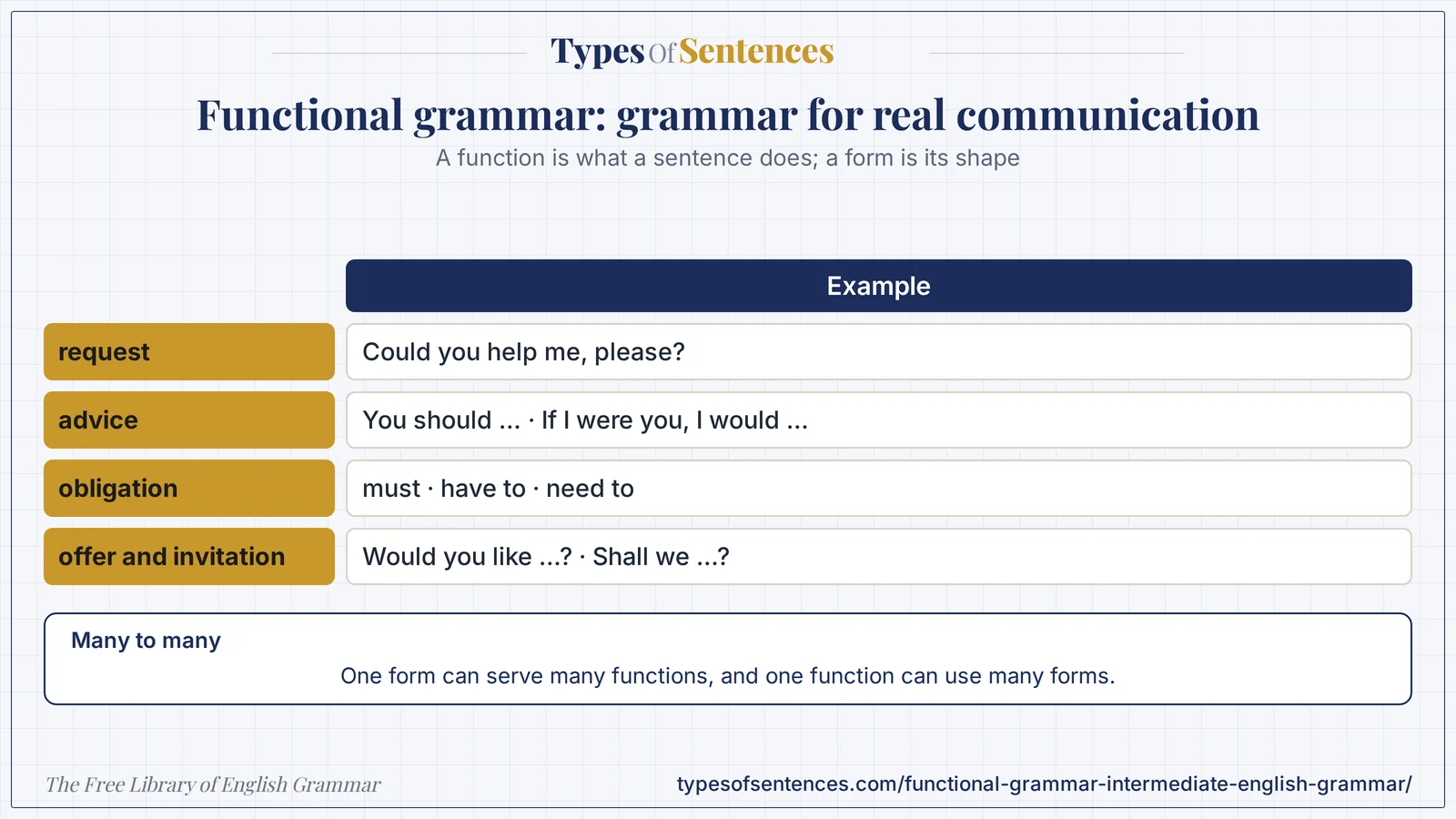
Grammar is not only rules about right and wrong. It is also a set of tools for getting things done: asking, advising, offering, refusing, thanking, apologizing.
Why it matters: The same job can be done in many forms, from blunt to very polite. Choosing the right form for the person and the situation is part of knowing a language.
Summary: A function is what a sentence does (request, advice, offer, invitation, obligation); a form is its grammatical shape (question, statement, imperative). One form can serve many functions and one function can use many forms. Modals (can, could, would, should, must) are the main tools, and the choice of form sets the level of politeness.
- Request: Could you help me, please?
- Advice: You should …, If I were you, I would …
- Obligation: must, have to, need to.
- Offer and invitation: Would you like …?, Shall we …?
What You’ll Learn
- 1. What Is Functional Grammar? Form vs. Function
- 2. Making Requests: Polite Requests, Could You Help Me, Please?
- 3. Giving Advice: You Should, Ought To
- 4. Expressing Obligation and Necessity
- 5. Offering and Inviting: Would You Like To …? Shall We …?
- 6. Politeness Levels and Tone
- 7. Modal Functions: A Summary
- 8. Practical Dialogues for Daily Use
- 9. Common Errors in Functional Language
- 10. Exercises
- 11. Test Your Knowledge
- 12. Frequently Asked Questions
- 13. Conclusion
1. What Is Functional Grammar? Form vs. Function
Form is the grammatical shape of a sentence; function is its purpose in communication. Functional grammar looks at the purpose first.
| Sentence | Form | Function |
|---|---|---|
| Can you open the window? | interrogative (question) | a request |
| You should see a doctor. | declarative (statement) | advice |
| Why don’t we go out? | interrogative | a suggestion |
| Would you like some tea? | interrogative | an offer |
| I’d love to come. | declarative | accepting an invitation |
| It’s cold in here. | declarative | a hint or request to close the window |
| Close the door. | imperative | an order, or an instruction |
| Mind the gap! | imperative | a warning |
The sentence functions of statement, question, command, and exclamation are the forms studied in the chapter on sentence types; this chapter is about the communicative jobs. The modal verbs that do most of the work are described in the chapter on uses of modal verbs.
2. Making Requests: Polite Requests, Could You Help Me, Please?
A request asks someone to do something. The more polite the form, the more indirect and the longer it tends to be.
| Level | Form | Example |
|---|---|---|
| direct (informal) | imperative | Open the window. (with a friend, add please) |
| neutral | Can/Will you …? | Can you open the window? |
| polite | Could/Would you …? | Could you open the window, please? |
| very polite | Would you mind + -ing? | Would you mind opening the window? |
| indirect | I was wondering if you could … | I was wondering if you could open the window. |
| formal | I would be grateful if you could … | I would be grateful if you could open the window. |
| Response | Example |
|---|---|
| agree | Of course. Certainly. Sure, no problem. Yes, I’d be happy to. |
| agree with a condition | I can, but only for a few minutes. |
| refuse politely | I’m afraid I can’t. I’m sorry, but I’m busy right now. |
| refuse and offer something else | I can’t today, but I could do it tomorrow. |
3. Giving Advice: You Should, Ought To
Advice tells someone what is a good thing to do. The choice of form shows how strongly you are advising.
| Strength | Form | Example |
|---|---|---|
| mild | Maybe you could …; You might want to …; Why don’t you …? | Why don’t you talk to your teacher? |
| moderate | You should …; You ought to … | You should see a doctor. |
| personal | If I were you, I would …; I’d … | If I were you, I would apologize. |
| strong | You had better …; You must … | You had better leave now, or you will miss the train. |
| negative | You shouldn’t …; You’d better not … | You shouldn’t eat so fast. |
| asking for advice | What should I do? What would you do? | What would you do in my place? |
The pattern If I were you is the second conditional, described in the chapter on the second conditional. Advice that is too strong can sound rude, so a close friend may say You must try this, and a stranger more likely says You might like to try this.
4. Expressing Obligation and Necessity
| Function | Form | Example |
|---|---|---|
| strong obligation (speaker’s authority) | must | You must wear a seat belt. |
| obligation from rules or circumstances | have to / has to | I have to work on Saturday. |
| necessity | need to | You need to sign here. |
| prohibition | must not / can’t | You mustn’t smoke here. You can’t park here. |
| no necessity | don’t have to / needn’t | You don’t have to come. |
| obligation in the past | had to | I had to leave early. |
| expectation or duty | be supposed to / should | You are supposed to arrive by nine. |
| polite instruction | Please … / You will need to … | Please take a seat. You will need to fill in this form. |
The differences between must, have to, mustn’t, and don’t have to are the subject of the chapter on modals of obligation. In public notices and workplace writing, the passive or the polite please form is often used: Visitors are required to sign in.
5. Offering and Inviting: Would You Like To …? Shall We …?
| Function | Form | Example |
|---|---|---|
| offering help | Can I …? Shall I …? Let me … I’ll … | Shall I carry that for you? |
| offering something | Would you like …? Do you want …? | Would you like some tea? |
| inviting | Would you like to …? Why don’t you …? How about …-ing? | Would you like to come to dinner on Friday? |
| suggesting joint action | Shall we …? Let’s … Why don’t we …? | Shall we go for a walk? |
| accepting | Yes, please. I’d love to. That would be great. Thank you. | I’d love to. What time? |
| declining politely | No, thank you. I’m afraid I can’t. That’s very kind, but … | That’s very kind, but I’m busy on Friday. |
| asking for permission | May I …? Could I …? Is it all right if I …? | Is it all right if I open the window? |
Permission requests are described in the chapter on modals of permission. When declining an invitation, a reason and an alternative keep the tone friendly: I’d love to, but I have a class that evening. How about Saturday?
6. Politeness Levels and Tone
Politeness is created by form, by tone, and by situation. A form that is polite to a stranger may be too stiff for a friend.
| Tool | Effect | Example |
|---|---|---|
| past modal forms (could, would) | add distance and politeness | Could you help? (more polite than Can you help?) |
| please and thank you | show courtesy | Could you send the file, please? Thank you. |
| hedges (maybe, perhaps, I think, a bit) | soften a statement | Perhaps we could meet earlier. |
| indirect forms (I was wondering if …) | avoid a direct demand | I was wondering if you had a minute. |
| apologies (sorry to bother you, excuse me) | show respect for the other person’s time | Sorry to bother you, but could you help me? |
| giving a reason | makes the request reasonable | Could you move? I can’t see the board. |
| tag questions | invite agreement | It’s a bit cold in here, isn’t it? |
| softening negative statements (I’m afraid, unfortunately) | cushion bad news | I’m afraid the meeting is canceled. |
| Register | Features | Example |
|---|---|---|
| informal (friends, family) | contractions, short forms, imperatives, slang | Pass the salt, will you? |
| neutral (colleagues, shops) | modals, please, full sentences | Could you pass the salt, please? |
| formal (strangers, letters, authorities) | complex forms, full words, no contractions | Would you be so kind as to pass the salt? |
What counts as polite differs between languages, regions, and relationships. A form that is polite in one country may sound too indirect or too direct in another. The forms in this chapter are common in standard English; listen to the people around you and adjust.
7. Modal Functions: A Summary
| Function | Modals and forms | Example | Chapter |
|---|---|---|---|
| ability | can, could, be able to | She can swim. | modals of ability |
| permission | can, could, may | May I come in? | modals of permission |
| possibility | may, might, could | It may rain. | modals of possibility |
| obligation and necessity | must, have to, should, need to | You must register. | modals of obligation |
| deduction | must, can’t, should | She must be at home. | modals of deduction |
| requests, offers, suggestions | can, could, will, would, shall | Shall I help? | uses of modal verbs |
| advice | should, ought to, had better | You should rest. | modals of obligation |
| habits and willingness | would, will | He will talk for hours. | uses of modal verbs |
These modal functions were studied in the Modal Verbs chapters of this level. The same modal can serve several functions (can: ability, permission, possibility), and the context decides which one is meant.
8. Practical Dialogues for Daily Use
| Situation | Dialogue | Functions |
|---|---|---|
| at a shop | A: Excuse me, could you help me? B: Of course. What are you looking for? A: I’m looking for a blue jacket. B: Shall I show you the new ones? | request, offer |
| asking for advice | A: I can’t decide between two jobs. What would you do? B: If I were you, I would take the one with more training. A: That’s a good point. Thanks. | asking for advice, giving advice, thanking |
| at work | A: Would you mind sending me the report by Friday? B: I’m afraid I can’t do Friday, but I could send it on Monday morning. A: That’s fine. Thank you. | polite request, polite refusal and alternative, accepting |
| inviting a friend | A: Would you like to come to my house on Saturday? B: I’d love to, but I have a class. How about Sunday? A: Sunday is perfect. | invitation, polite refusal, suggestion, acceptance |
| at school | A: May I leave the room? B: Yes, but you must be back in five minutes. A: Thank you. I won’t be long. | permission, obligation, promise |
| on the phone | A: Hello. Could I speak to Mr. Rao, please? B: I’m sorry, he’s in a meeting. Can I take a message? A: Yes, please. Could you ask him to call me back? | request, offer, acceptance, request |
Read each dialogue aloud and change the details. Then try changing the politeness level: make the request more direct for a friend or more formal for a stranger. This is the best way to feel the difference.
9. Common Errors in Functional Language
| Error | Better | Note |
|---|---|---|
| Give me a pen. | Could you give me a pen, please? | too direct to a stranger |
| I want a coffee. | I’d like a coffee, please. | I want sounds blunt |
| May you help me? | Could you help me? | may is for I and we |
| You must to see a doctor. | You should see a doctor. | no to; advice, not a command |
| You don’t must come. | You don’t have to come. / You mustn’t come. | choose by meaning |
| Would you like that I help you? | Would you like me to help you? | verb + object + to |
| Let’s to go. | Let’s go. | bare infinitive |
| Do you can help me? | Can you help me? | no do with a modal |
| Yes, I can’t. (to “Can you?”) | No, I can’t. / I’m afraid I can’t. | agree or refuse clearly |
| Why you don’t come? | Why don’t you come? | word order |
Recap in 12 seconds
Watch the lesson build itself: Functions such as requests, advice, obligation, offers, and invitations can each be expressed in several forms. The video has no sound.
Exercises
Part A: Form and Function (Exercises 1–5)
Exercise 1: What is the function of Can you open the window?
Show Answer
Answer: A request.
Exercise 2: What is the form of You should see a doctor?
Show Answer
Answer: A statement (declarative); its function is advice.
Exercise 3: What is the function of Why don’t we go out?
Show Answer
Answer: A suggestion.
Exercise 4: What is the function of Would you like some tea?
Show Answer
Answer: An offer.
Exercise 5: What might It’s cold in here mean?
Show Answer
Answer: A hint or request to close the window.
Part B: Requests (Exercises 6–11)
Exercise 6: Order from direct to polite: Would you mind …?, Can you …?, Could you …?
Show Answer
Answer: Can you …?, Could you …?, Would you mind …?
Exercise 7: Make polite: Give me a pen.
Show Answer
Answer: Could you give me a pen, please?
Exercise 8: Make very polite: Help me.
Show Answer
Answer: Would you mind helping me?
Exercise 9: Refuse politely: Can you work on Friday?
Show Answer
Answer: I’m afraid I can’t work on Friday.
Exercise 10: Fix it: May you help me?
Show Answer
Answer: Could you help me?
Exercise 11: Fix it: I want a coffee.
Show Answer
Answer: I’d like a coffee, please.
Part C: Advice and Obligation (Exercises 12–17)
Exercise 12: Mild advice: You (could/must) talk to your teacher.
Show Answer
Answer: could (or might want to).
Exercise 13: Personal advice: If I ___ you, I would apologize.
Show Answer
Answer: were.
Exercise 14: Strong warning: You ___ leave now.
Show Answer
Answer: had better.
Exercise 15: Prohibition: You ___ smoke here.
Show Answer
Answer: mustn’t.
Exercise 16: No necessity: You ___ come.
Show Answer
Answer: don’t have to.
Exercise 17: Fix it: You must to see a doctor.
Show Answer
Answer: You should see a doctor. (or You must see a doctor.)
Part D: Offers and Invitations (Exercises 18–23)
Exercise 18: Offer help with shall: carry your bag.
Show Answer
Answer: Shall I carry your bag?
Exercise 19: Invite: Would you like ___ to dinner on Friday?
Show Answer
Answer: to come.
Exercise 20: Suggest: go for a walk (shall).
Show Answer
Answer: Shall we go for a walk?
Exercise 21: Accept: Would you like some tea?
Show Answer
Answer: Yes, please. (or That would be great.)
Exercise 22: Decline politely and offer an alternative: Come on Saturday?
Show Answer
Answer: I’d love to, but I have a class. How about Sunday? (sample)
Exercise 23: Fix it: Would you like that I help you?
Show Answer
Answer: Would you like me to help you?
Part E: Politeness and Modal Functions (Exercises 24–30)
Exercise 24: Which is more polite: Can you help? or Could you help?
Show Answer
Answer: Could you help?
Exercise 25: Name two politeness tools.
Show Answer
Answer: Please and a past modal (also hedges, apologies, giving a reason).
Exercise 26: Soften: The meeting is canceled.
Show Answer
Answer: I’m afraid the meeting is canceled.
Exercise 27: Register: Pass the salt, will you?
Show Answer
Answer: Informal.
Exercise 28: Function of must in You must register:
Show Answer
Answer: Obligation.
Exercise 29: Function of must in She must be at home:
Show Answer
Answer: Deduction.
Exercise 30: Fix it: Do you can help me?
Show Answer
Answer: Can you help me?
Test Your Knowledge
Ready to check what you learned? Answer all 10 questions, then submit. You need 80% (8 of 10) to pass. Your answers are not stored.
View correct answers and explanations
Question 1: What does functional grammar study?
✓ Correct Answer: C – What language is used to do
It looks at the purpose of language.
Question 2: What is the function of Could you open the window?
✓ Correct Answer: C – A request
It is a polite request.
Question 3: Which is the most polite?
✓ Correct Answer: D – Would you mind opening the window?
Would you mind … is very polite.
Question 4: Which gives advice?
✓ Correct Answer: C – If I were you, I would apologize.
If I were you … gives advice.
Question 5: Which means “it is forbidden”?
✓ Correct Answer: D – You mustn’t smoke.
Mustn’t means forbidden.
Question 6: Which means “not necessary”?
✓ Correct Answer: B – You don’t have to come.
Don’t have to means not necessary.
Question 7: Which is an invitation?
✓ Correct Answer: A – Would you like to come to dinner on Friday?
Would you like to … invites.
Question 8: Which is a polite refusal?
✓ Correct Answer: B – I’m afraid I can’t.
I’m afraid … softens a refusal.
Question 9: Which is correct?
✓ Correct Answer: B – Could you help me?
Could you … is correct.
Question 10: Which tool makes a request more polite?
✓ Correct Answer: A – Using a past modal and please
Past modals and please add politeness.
Frequently Asked Questions
What is functional grammar?
Functional grammar studies grammar in terms of what language is used to do, such as requesting, advising, offering, and inviting, and not only the forms of sentences. It explains how the same form can serve different functions.
What is grammar for communication?
Grammar for communication is the use of grammatical forms to get things done in real situations: to ask, advise, offer, refuse, thank, and apologize. It stresses choosing the right form for the person and context.
How do I make polite requests?
For polite requests, use Could you …? or Would you …?, add please, give a reason, and thank the person. For very polite requests, use Would you mind …-ing? or I was wondering if you could ….
How do I give advice in English?
For giving advice, use You should …, You ought to …, If I were you, I would …, or, for a strong warning, You had better …. Use could or might for mild suggestions.
What are modal functions?
Modal functions are the jobs that modal verbs do: ability, permission, possibility, obligation, deduction, requests, offers, suggestions, advice, and habits. The same modal can have several functions.
How do I decline an invitation politely?
Thank the person, say you cannot come, give a short reason, and offer an alternative if you can: That’s very kind, but I have a class on Friday. How about Saturday?
Why does the same sentence sometimes mean different things?
Because form and function are not the same. It’s cold in here is a statement in form, but it may function as a request. The situation and the tone show which is meant.
Conclusion
You now know how functional grammar connects form and function. You can make polite requests, give advice, express obligation and necessity, offer and invite, adjust the level of politeness, recall the main functions of modals, and use practical dialogues for daily situations.
Choose the form that fits the person and the situation, not only the rule. Next, you will study prefixes and suffixes.
- Halliday, M. A. K., and Christian M. I. M. Matthiessen. Halliday’s Introduction to Functional Grammar. 4th ed. Routledge, 2014.: the functional approach to grammar.
- Merriam-Webster Dictionary: pragmatics: the dictionary entry for pragmatics.
- Quirk, Randolph, et al. A Comprehensive Grammar of the English Language. Longman, 1985.: directives, offers, and modal meanings.
- Huddleston, Rodney, and Geoffrey K. Pullum. The Cambridge Grammar of the English Language. Cambridge University Press, 2002.: clause types and illocutionary force.
Last reviewed: October 29, 2026. How it was made: drafted with AI assistance, then checked with automated tests (structure, links, answer keys, spelling) and against the sources above. A person has not yet read this chapter line by line. Found a mistake? Report it.