Stylistic grammar is the study of how the choices a writer makes among grammatical alternatives add up to a style. English offers many ways to say nearly the same thing: The committee rejected the plan, The plan was rejected by the committee, The plan was rejected, The rejection of the plan by the committee. The statements have the same core meaning, but they have different emphases, different tones, and different voices. A writer who habitually chooses the active voice, short sentences, concrete verbs, and the first person writes in a different style from one who habitually chooses the passive, long sentences, nominalizations, and the third person. Style is the sum of such choices.
This chapter draws together the grammar of the whole course to show how it works as style. You will study the idea of grammar as a style tool, the choices between active and passive, simple and complex sentences, formal and informal grammar, noun style and verb style, and personal and impersonal style; the classical distinction of plain, middle, and grand styles; how style varies by genre; and how to examine and develop a personal style. The study of grammar style, of the stylistic choices behind it, and of grammar for effect, gives a writer the means to choose consciously, and a reader the means to read style analytically. Thirty editing exercises and a quiz follow.
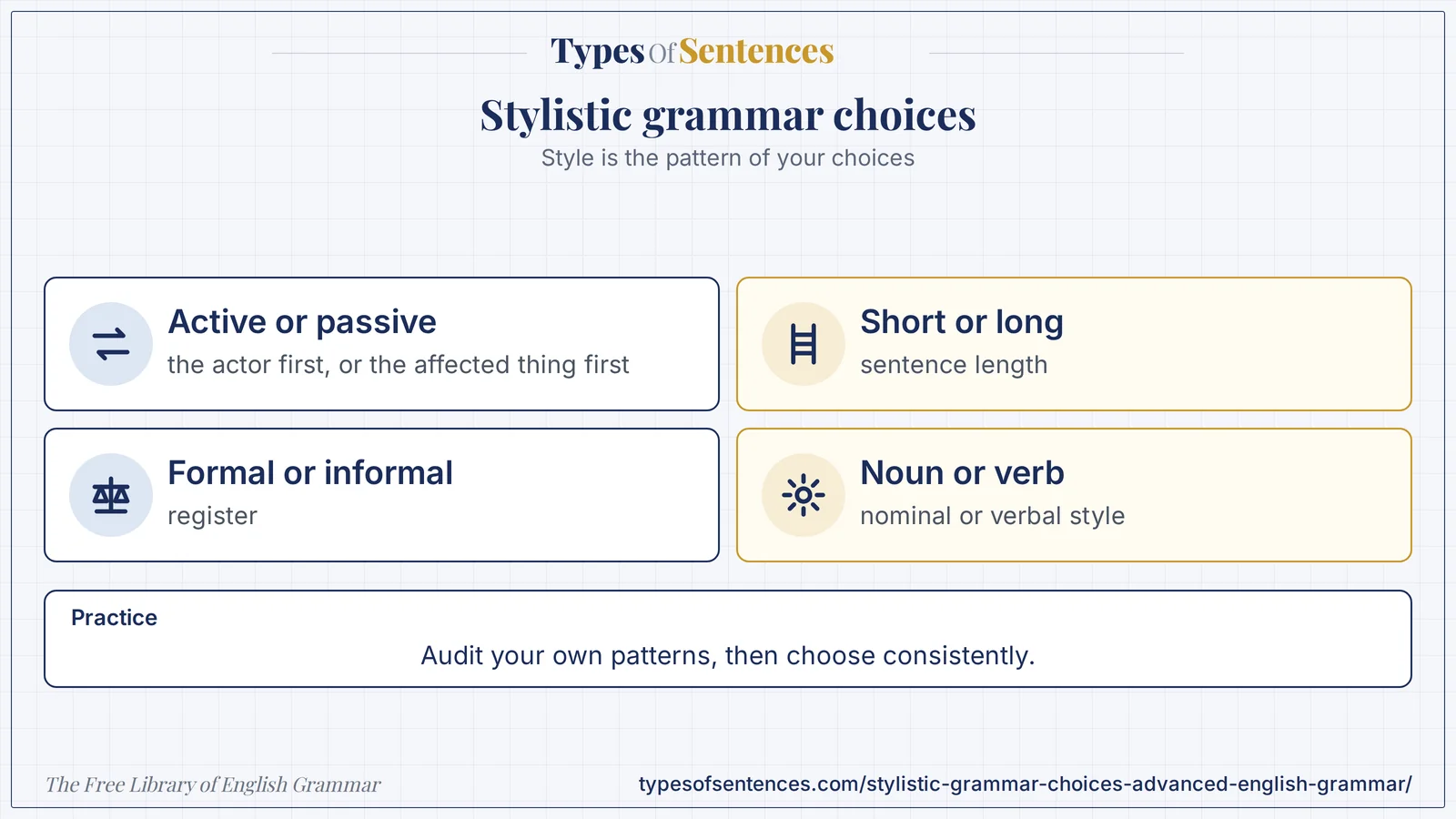
Style is not decoration added at the end. It is made of the grammar choices you make all the way through: which voice, how long a sentence, which verb, which pronoun, how formal. Two writers can say the same thing in different styles by choosing differently.
Why it matters: If you can see your choices, you can change them. If you know what each choice does, you can choose the one that fits your reader and your purpose.
Summary: Style is the pattern of a writer’s choices among grammatical alternatives. Active voice puts the actor first and is direct; the passive puts the affected thing first, hides or delays the agent, and suits processes and impersonal writing. Short sentences are plain and forceful; long sentences are elaborate and allow reasoning; a mixture gives rhythm. Formal grammar (no contractions, fronted prepositions, nominalizations, subjunctives) differs from informal grammar (contractions, phrasal verbs, fragments). A verb style puts action in verbs with clear actors; a noun (nominal) style compresses action into nouns and long noun phrases. Personal style uses I and you; impersonal style uses the third person and abstract subjects. Cicero distinguished plain, middle, and grand styles. Style varies by genre. A writer can audit sentence length, voice, nominalizations, and openings, and then choose consistently.
- Style = the pattern of grammatical choices.
- Active/passive; short/long; formal/informal; noun/verb; personal/impersonal.
- Match style to reader and purpose.
- Audit your own patterns, then choose consistently.
What You’ll Learn
- 1. Stylistic Grammar: Grammar as a Style Tool
- 2. Active vs Passive Style: When to Choose Each
- 3. Simple vs Complex Sentences: Stylistic Effects
- 4. Formal vs Informal Grammar: Register Choices
- 5. Noun Style vs Verb Style: Nominalization and Verbs
- 6. Personal vs Impersonal Style: First Person and Third Person
- 7. Style by Genre: The Grammar Profile of Each Kind of Writing
- 8. Plain, Middle, and Grand Style in Practice: Rules of Thumb and Their Limits
- 9. Developing a Personal Style: Consistent Choices and Voice
- 10. Common Faults of Style and a Worked Example
- 11. Exercises
- 12. Test Your Knowledge
- 13. Frequently Asked Questions
- 14. Conclusion
1. Stylistic Grammar: Grammar as a Style Tool
| Dimension of style | One pole | Other pole | Grammar choices that create it |
|---|---|---|---|
| formality | formal | informal | contractions, phrasal verbs, fronted prepositions, whom, nominalizations |
| personal versus impersonal | personal (I, you) | impersonal (third person, abstract subjects) | pronouns, the passive, it is constructions |
| abstract versus concrete | abstract nouns, nominalizations | concrete nouns, action verbs | noun versus verb style |
| dense versus sparse | compact noun phrases, long sentences | short sentences, simple clauses | phrasal complexity, subordination |
| static versus dynamic | be verbs, states, nouns | action verbs, processes | verb choice, voice |
| direct versus indirect | active, imperative, declarative | passive, modal, hedged, interrogative | voice, mood, modality |
| plain versus ornate | short words, simple sentences | figures, long periodic sentences | vocabulary, rhetoric (see the previous chapter) |
| oral versus literate | fragments, repetition, discourse markers | complex noun phrases, subordination | clause types and connectives |
| tentative versus assertive | hedges (may, suggests) | boosters (clearly, must) | modal verbs, adverbs |
| narrative versus expository | past tense, sequence | present tense, logic | tense and connectors |
| Grammar choice | Typical stylistic effect | Treated in |
|---|---|---|
| active versus passive | directness versus focus and distance | the chapter on voice |
| sentence length | pace and complexity | sentence variety; complex sentence architecture |
| subordination versus coordination | reasoning versus parataxis | coordination and subordination |
| nominalization | abstraction, formality, compression | conciseness and wordiness |
| contractions | informality | register and style |
| modal verbs | certainty and politeness | modality |
| hedging | caution | hedging |
| tense and aspect | time frame and closeness | tense and aspect |
| fronting and inversion | emphasis and literary tone | fronting; inversion |
| ellipsis | economy and speech-like tone | ellipsis and substitution |
| parallel structure | balance and rhythm | parallel structure |
| pronouns | intimacy or distance | reference and deixis |
| questions | engagement | question formation |
| punctuation | pace and clarity | — |
| vocabulary and register | formality and tone | diction |
| figures of speech | vividness and persuasion | rhetoric and grammar |
The idea that style is choice goes back to classical rhetoric and was developed in modern stylistics, for example in Geoffrey Leech and Mick Short’s Style in Fiction (1981), which treats style as the selection of linguistic options at all levels. Practical guides such as Joseph Williams and Joseph Bizup’s Style: Lessons in Clarity and Grace make the same point for non-fiction. The aim of this chapter is to make the options visible so that they can be chosen.
2. Active vs Passive Style: When to Choose Each
| Version | Effect | Example |
|---|---|---|
| active | direct; actor first; emphasizes responsibility; energetic | The committee rejected the plan. |
| passive with agent | topic is the affected thing; agent is placed last for end-focus | The plan was rejected by the committee. |
| passive without agent (agentless) | focus on the result; agent unknown, unimportant, or concealed | The plan was rejected. |
| get-passive | informal; adversative or unexpected events | The plan got rejected. |
| nominalized passive | abstract, impersonal | The rejection of the plan took place on Friday. |
| stative passive | a state, not an event | The door is closed. |
| impersonal it-passive | objective, distanced claims | It was decided that the plan be rejected. |
| middle voice | a property of the subject | The plan rejects easily. (rare) |
| passive in processes | the process matters, not the person | The samples were heated to 80 degrees. |
| Passive useful | Passive weak |
|---|---|
| the agent is unknown: My bike was stolen. | the agent is known and important: The decision was made by the CEO. → The CEO decided. |
| the agent is obvious or unimportant: The road was repaired. | it hides responsibility: Mistakes were made. |
| the affected thing is the topic: The treaty was signed in 1648. | it makes the sentence wordy: It was found by the researchers that … |
| a description of a method: Samples were collected … | it produces a chain of passives: It was decided that it be done that … |
| end-focus on a new agent: The report was written by a former minister. | it prevents a clear actor from appearing |
| tact: The invoice has not been received. | it makes instructions unclear: The button should be pressed. → Press the button. |
| Genre | Typical use of the passive |
|---|---|
| scientific methods | frequent (many fields now accept active forms with we) |
| academic writing | moderate; the passive for methods; the active for argument |
| news | active for events; passive for victims (A man was shot) |
| business | active preferred; passive for tact |
| technical instructions | imperative active; passive for descriptions |
| legal | mixed; the agent should be named for duties |
| fiction | mostly active; passive for effect |
| speech | mostly active |
- Use the active voice by default, because it is shorter and clearer.
- Use the passive when it serves a purpose: focus, flow (old information first), agent unknown or unimportant, or tact.
- Do not use the passive to hide responsibility if the reader needs to know who acted.
- Do not mechanically convert every passive. A grammar checker that flags passives is a prompt, not a verdict.
- Mix voices for flow (the chapter on voice and the chapter on information structure explain why).
- Check consistency within a section: a procedure written half in the imperative and half in the passive is jarring.
The grammar of voice is treated in the chapter on voice and the effects on meaning in the chapter on grammar and meaning. The stylistic point is that voice is a lever of tone: the active sounds accountable and direct; the passive sounds objective and distant.
3. Simple vs Complex Sentences: Stylistic Effects
| Style of sentence | Features | Effect | Example (original) |
|---|---|---|---|
| plain (short, simple) | one idea; few clauses | clarity, force, a conversational or instructional tone | The bus was late. We waited. It rained. |
| middle (varied) | a mixture of lengths | natural, adaptable, the usual style of exposition | The bus was late, so we waited in the rain until it came. |
| grand (long, periodic, balanced) | several clauses, parallelism, subordination | dignity, persuasion, eloquence | Although the rain fell and the road was long, we waited, for we had no other way home. |
| stringy (coordination) | many ands | a child’s or oral narrative | The bus was late and we waited and it rained and … |
| staccato (fragments) | very short pieces | tension or irritation | Late. Again. Rain. |
| cumulative | main clause then modifiers | natural flow, detail | We waited at the stop, soaked, watching the road. |
| periodic | main clause last | suspense, climax | After an hour in the rain, tired and cold, we saw the bus. |
| balanced | parallel clauses | rhythm, reasoning | The bus was late; the rain was heavy. |
| phrasal-dense | long noun phrases, few clauses | academic or journalistic compression | the late arrival of the evening bus in heavy rain |
| Sentence-length profile (typical, not rules) | Style |
|---|---|
| mostly under 15 words | plain, instructional, conversational |
| 15 to 25 words with some variation | general exposition, news, business |
| mixed, with some over 30 words | academic, essayistic, literary |
| very long sentences with controlled structure | legal, literary, rhetorical |
| mostly very short, with fragments | advertising, digital, some fiction |
| Plain version | Middle version | Grand version |
|---|---|---|
| The council met. It debated. It decided. | The council met, debated the plan for two hours, and decided to approve it. | After two hours of debate in which every objection had been raised and answered, the council, by a narrow margin, approved the plan. |
| Rain fell. The river rose. The village flooded. | The rain fell all night, the river rose, and by morning the village was flooded. | As the rain fell through the night without pause, the river, swollen beyond its banks, took the village. |
The classical rhetoricians distinguished three levels of style: the plain style for teaching and explaining, the middle style for pleasing and for most purposes, and the grand style for moving an audience. Cicero’s account of the three styles (in Orator) has been influential. A modern writer will mostly use the plain and middle styles and the grand style on rare occasions. The structure of long sentences is discussed in the chapter on sentence variety and on complex sentence architecture.
4. Formal vs Informal Grammar: Register Choices
| Feature | Formal choice | Informal choice |
|---|---|---|
| contractions | do not, cannot | don’t, can’t |
| phrasal verbs | investigate, tolerate | look into, put up with |
| prepositions | fronted: about which we spoke | stranded: which we spoke about |
| relative pronoun | whom | who or none |
| subjunctive | If I were; I insist that he be | If I was; I insist that he is |
| nominalization | the implementation of the policy | implementing the policy |
| pronouns | impersonal; no you | you, we |
| coordination at the start | avoided: However | But, And, So |
| fragments | avoided | common |
| questions | indirect: I wonder whether | direct: Is it? |
| quantifiers | numerous, a large number of | a lot of, lots of |
| intensifiers | extremely, highly | really, super |
| negation | not with the verb | ain’t, double negatives (dialect) |
| comparatives | more than | way more |
| modals | may, might | can, gonna |
| conjunctions | moreover, nevertheless | plus, still |
| ellipsis | minimal | extensive |
| tag questions | rare | common |
| passive | common in some fields | less common |
| sentence length | longer | shorter |
| vocabulary | Latinate | Germanic and slang |
| emoticons and abbreviations | none | common |
| Mixing registers (a fault) | Consistent |
|---|---|
| The committee deliberated and then, like, decided to approve it. | The committee deliberated and decided to approve it. |
| Hey, I am writing to request your esteemed attention to the matter. | Dear Dr. Rao, I am writing to ask for your attention to the matter. |
| It is requested that you hurry up, mate. | Please send the file as soon as you can. |
Register is treated at length in the chapter on register and style. The point here is that every grammatical feature of the table is a stylistic resource, and a text is formal or informal to the extent that its choices point one way. A writer should choose the register for the reader and the occasion and keep it steady.
5. Noun Style vs Verb Style: Nominalization and Verbs
| Noun (nominal) style | Verb style |
|---|---|
| The implementation of the policy by the department resulted in a reduction of costs. | The department implemented the policy and reduced costs. |
| We conducted an investigation of the matter. | We investigated the matter. |
| The expansion of the city has led to an increase in congestion. | The city has expanded, and traffic has increased. |
| There was a failure of communication between the teams. | The teams failed to communicate. |
| The utilization of the system by users is dependent on its accessibility. | Users use the system if they can access it. |
| The occurrence of the fire was the cause of the evacuation. | The fire caused the evacuation. |
| An examination of the data reveals a decline. | When we examine the data, we see a decline. |
| His arrival at the airport was followed by a long delay. | He arrived at the airport and waited a long time. |
| Her rapid promotion was a source of resentment among colleagues. | Her colleagues resented her rapid promotion. |
| The destruction of the forest by the company was the subject of protest. | Residents protested when the company destroyed the forest. |
| Feature | Noun style | Verb style |
|---|---|---|
| actors | often hidden in genitives or by phrases | subjects of verbs |
| actions | nouns (implementation) | verbs (implemented) |
| sentence shape | long noun phrases; few clauses | several clauses; more verbs |
| typical genre | academic, scientific, administrative, legal | journalistic, narrative, conversational, plain-language |
| effect | abstract, compact, authoritative, impersonal | concrete, dynamic, personal, readable |
| risk | heavy and opaque; hides agency | may be too informal or wordy for dense information |
| grammar | nominalization, prepositional chains, of-phrases | active verbs, subordinate clauses |
| Use nominal style when | Use verb style when |
|---|---|
| the process is the topic and the agent is irrelevant | the actors matter |
| you need to compress information for expert readers | readers are general or novice |
| you need a noun to refer back to a previous clause (this decision) | you want energy and clarity |
| the genre expects compression (abstracts, headlines) | you write instructions or narrative |
| you name concepts that will be used as terms | you want to avoid abstraction |
The preference for verbs with clear subjects is the main teaching of Williams and Bizup, and the effect of nominalization on readability and wordiness is treated in the chapters on conciseness and wordiness and on readability. Nominalization is not a fault in itself: it is a stylistic resource that creates abstraction and cohesion (This decision surprised many), and the skill is to know when to use it.
6. Personal vs Impersonal Style: First Person and Third Person
| Style | Features | Example | Typical genre |
|---|---|---|---|
| personal (first person) | I, we, my; direct address with you; active voice | I argue that the plan fails. | letters, essays, blogs, memoirs, speeches |
| inclusive we | shared purpose | We must act. | speeches, editorials |
| second person | you, imperatives | You should check the results. | instructions, advertising, advice |
| impersonal (third person) | abstract subjects, passives, it is constructions | It is argued that the plan fails. | scientific and traditional academic writing, reports |
| abstract-subject style | the work or the study as subject | This paper argues that the plan fails. | academic writing |
| agentless style | no actor named | The plan was found to fail. | official and legal text |
| authorial we (plural of modesty) | a single author uses we | We show that … | scientific papers |
| third-person narration | he, she, they | She argued that the plan failed. | fiction, biography, news |
| Choice | Effect on the reader |
|---|---|
| I in an argument | shows ownership; the writer takes responsibility |
| we (inclusive) | builds solidarity |
| you | engages and instructs; can sound presumptuous |
| impersonal passives | suggest objectivity; may seem evasive |
| abstract subjects (the study shows) | compact; objective in tone |
| first person in methods and discussion | clarity about who did what |
| the same style in one document | consistency |
- Follow the conventions of the field. Many current style guides (including APA) accept I and we where the writer’s role matters; some fields and journals still prefer the impersonal.
- Do not use we if only one person wrote the text, unless the genre expects it.
- Avoid a false impersonality (the author believes for I believe) that creates distance without gain.
- Use the second person for instructions and for direct address, not for general claims (you can see that …).
- Do not switch person without a reason.
Personal and impersonal choices are part of voice, tone, and register, as discussed in the chapters on tone and voice in writing and on academic writing. A writer should know both, and use the one that suits the occasion.
7. Style by Genre: The Grammar Profile of Each Kind of Writing
| Genre | Typical grammar profile | Characteristic choices |
|---|---|---|
| academic prose | noun-dense; moderate passives; hedged; formal | nominalization, long noun phrases, impersonal or limited first person, hedges |
| scientific writing | precise, objective; past tense in methods; present in discussion | passives in methods, numbers and units, hedged interpretation |
| business writing | direct, courteous, plain; active; short | imperatives and modals for requests, positive wording, lists |
| technical writing | imperative, consistent, exact | numbered steps, one action per step, defined terms |
| legal writing | long, structured, precise | modal verbs, conditions, defined terms, lists |
| journalism | plain, concise, attributed; past tense | inverted pyramid, short sentences, attribution |
| fiction | varied; voice-driven | point of view, dialogue, cumulative and periodic sentences |
| persuasive and rhetorical writing | balanced, repetitive, emphatic | schemes of balance and repetition, rhetorical questions |
| digital and web writing | short, scannable, front-loaded | direct address, short paragraphs, lists |
| conversation and informal writing | fragmentary, clausal, interactive | contractions, discourse markers, ellipsis |
| Linked chapters | Topic |
|---|---|
| the academic writing chapter | formal, hedged, noun-dense style |
| the business writing chapter | plain, courteous, direct style |
| the technical writing chapter | imperative, consistent style |
| the legal writing chapter | precise, structured style |
| the journalistic writing chapter | concise, attributed style |
| the creative writing chapter | voice-driven style |
| the digital media chapter | scannable style |
Each genre’s style is a set of conventions that experienced readers expect. Violating them (a legal text in a chatty voice, a news story in a grand style) signals a writer who has not learned the genre. Style is therefore partly social: it is the way that a community of readers and writers does its work.
8. Plain, Middle, and Grand Style in Practice: Rules of Thumb and Their Limits
| Rule of thumb (a paraphrase of familiar advice) | Source | Use and limit |
|---|---|---|
| avoid stale figures of speech that you have seen too often in print | George Orwell, “Politics and the English Language” (1946) | good against cliché; a good writer sometimes uses a stock phrase deliberately |
| use the short word where it will do | Orwell | plain style; a technical word may be needed |
| cut a word if you can | Orwell; Strunk and White | tight writing; do not cut needed qualifications |
| prefer the active to the passive where you can | Orwell | a default, not a law |
| avoid foreign phrases and jargon where an everyday word exists | Orwell | clarity for general readers |
| break any of these rules sooner than say anything barbarous | Orwell | the last rule: judgment comes before rules |
| omit needless words | Strunk and White, The Elements of Style | concision, with the same limit |
| put the emphatic words at the end | Strunk and White | end-focus |
| use definite, specific, concrete language | Strunk and White | vividness |
| write clearly and leave the clutter out | William Zinsser, On Writing Well | clutter is the enemy; clarity requires thought |
| Limit of the rules | Explanation |
|---|---|
| rules of thumb are not laws | they describe tendencies that serve clarity |
| they assume a plain style | a grand or literary style may break them on purpose |
| they differ by genre | a legal or scientific text has its own norms |
| they can conflict | concision versus clarity; voice versus formality |
| evidence matters | research shows that some “rules” (for example never to use the passive) do not hold in all genres |
| judgment is the rule | the last rule of Orwell’s list is the one that matters |
9. Developing a Personal Style: Consistent Choices and Voice
| Step | Action | What to look for |
|---|---|---|
| 1 collect a sample | choose 500 to 1,000 words of your writing | a representative sample |
| 2 measure sentence length | count words per sentence; note the shortest and longest | the average and the range |
| 3 measure voice | count passives (roughly) per 100 words | the share of agentless passives |
| 4 measure nominalizations | count nouns in -tion, -ment, -ance, -ity per 100 words | heavy noun style |
| 5 look at openings | note the first word of each sentence | repetitive openings |
| 6 look at pronouns | count I, we, you, and impersonal subjects | personal or impersonal |
| 7 look at connectives | list the connectors you use most | overused transitions |
| 8 look at verbs | list the verbs that you use most (be, have, make) | weak verbs |
| 9 look at modifiers | count adverbs and intensifiers | overuse |
| 10 compare with your aim | is this the style your reader needs? | choose what to change |
| Illustrative style profiles (invented) | Writer A (plain) | Writer B (ornate) |
|---|---|---|
| average sentence length | 14 words | 31 words |
| passives per 100 words | 1 | 5 |
| nominalizations per 100 words | 2 | 9 |
| first person | frequent | none |
| sample | I tested the new bus route. It saves ten minutes, and passengers like it. | The testing of the newly established route has demonstrated a saving of ten minutes, a benefit that has been warmly welcomed by passengers. |
- Read widely and notice how writers you admire make their choices.
- Imitate a passage (pastiche): rewrite your own content in another writer’s pattern, to learn the technique.
- Keep what suits you and drop what does not.
- Be consistent within a text: a style that wavers weakens the voice.
- Adapt to the genre without losing your own habits of clarity and honesty.
- Use a style sheet for decisions of spelling, punctuation, terms, and person.
- Revise by reading aloud: a style is a sound.
A personal style develops through practice and reading, and is an effect of choices made again and again. The tone, voice, and register of a writer are discussed in the chapters on register and style and on tone and voice; here the emphasis is on the grammar of those choices, which is what a writer can change on purpose.
10. Common Faults of Style and a Worked Example
| Fault | Example | Repair |
|---|---|---|
| inconsistent person | We found that the author believes and I think … | We found that the author believes … and we think … |
| inconsistent register | The results were, like, significant, and the data therefore necessitate consideration. | The results were significant, and the data deserve consideration. |
| monotonous sentence length | all sentences of ten words | vary lengths |
| monotonous openings | The … The … The … | vary the openings |
| overuse of the passive | It was found that it was concluded that … | We found … and concluded … |
| overuse of nominalizations | The implementation of the utilization of … | We implemented … |
| hedging every sentence | It might perhaps seem that … | The data suggest that … |
| false formality | utilize; commence | use; begin |
| false informality | a casual tone in a serious letter | a courteous tone |
| stringy sentences | and … and … and … | subordinate and split |
| pompous abstraction | the operationalization of synergistic paradigms | the plan to work together |
| rule-worship | refusing every passive | use the passive where it helps |
| style over substance | a flourish with no point | cut it |
| style mismatch with genre | a lyrical style in a manual | plain style |
| unconscious imitation | copying another writer’s tics | find your own pattern |
Write the same content in three styles. Content: The council decided on Tuesday to approve the housing plan because the residents had demanded it; the mayor signed it on Wednesday; building will begin in March.
- Plain, verb style (for a notice to residents): The council approved the housing plan on Tuesday. You asked for it, and the mayor signed it on Wednesday. Building starts in March.
- Academic, nominal style (for a journal article): The council’s approval of the housing plan on Tuesday, following sustained resident demand, was ratified by the mayor’s signature on Wednesday; the commencement of construction is scheduled for March.
- Journalistic style (for a news story): The city council approved a housing plan on Tuesday after residents demanded it, and the mayor signed it on Wednesday. Construction will begin in March.
- What changed: the plain version uses short active sentences and you; the academic version nominalizes (approval, commencement), subordinates, and uses a passive (was ratified); the news version uses the inverted pyramid with attribution-free facts and the active voice.
- Choice: the content is the same; the style is chosen for the reader and the genre. (the council and the plan are invented)
Recap in 12 seconds
Watch the lesson build itself: Style is the pattern of choices among grammatical alternatives: voice, length, formality, and nouns or verbs. The video has no sound.
Exercises
Part A: Style as Choice (Exercises 1–6)
Exercise 1: Define style in terms of grammar.
Show Answer
Answer: The pattern of a writer’s choices among grammatical alternatives.
Exercise 2: Name a dimension of style.
Show Answer
Answer: Formal versus informal; personal versus impersonal; abstract versus concrete; plain versus ornate.
Exercise 3: Who wrote Style in Fiction (1981)?
Show Answer
Answer: Geoffrey Leech and Mick Short.
Exercise 4: Name a choice that affects tone.
Show Answer
Answer: Voice, modality, hedging, pronouns, contractions.
Exercise 5: Can the same content be written in different styles?
Show Answer
Answer: Yes.
Exercise 6: Is style only decoration?
Show Answer
Answer: No; it is built from grammar choices.
Part B: Active and Passive (Exercises 7–12)
Exercise 7: Make active: The plan was rejected by the committee.
Show Answer
Answer: The committee rejected the plan.
Exercise 8: Name a good use of the passive.
Show Answer
Answer: Agent unknown or unimportant; focus on the affected thing; description of a process; tact.
Exercise 9: Why avoid Mistakes were made?
Show Answer
Answer: It hides responsibility.
Exercise 10: Make it direct: The button should be pressed.
Show Answer
Answer: Press the button.
Exercise 11: Which genre uses the passive in methods?
Show Answer
Answer: Scientific writing.
Exercise 12: Is a passive flagged by a grammar checker always wrong?
Show Answer
Answer: No.
Part C: Sentences and Register (Exercises 13–19)
Exercise 13: Name the three classical styles.
Show Answer
Answer: Plain, middle, grand.
Exercise 14: Who described them (in Orator)?
Show Answer
Answer: Cicero.
Exercise 15: What does a short sentence suit?
Show Answer
Answer: Plain style, force, instruction.
Exercise 16: What does a periodic sentence suit?
Show Answer
Answer: Suspense, climax, grand style.
Exercise 17: Formal for look into:
Show Answer
Answer: investigate.
Exercise 18: Formal for If I was:
Show Answer
Answer: If I were.
Exercise 19: Name a mixed-register fault.
Show Answer
Answer: The committee, like, decided to approve it.
Part D: Noun/Verb and Personal/Impersonal (Exercises 20–26)
Exercise 20: Verb style: We conducted an investigation of the matter.
Show Answer
Answer: We investigated the matter.
Exercise 21: Verb style: The expansion of the city has led to an increase in congestion.
Show Answer
Answer: The city has expanded, and traffic has increased.
Exercise 22: When is nominal style appropriate?
Show Answer
Answer: For compression and abstraction in expert writing; to refer back with this + noun.
Exercise 23: Impersonal: I think the plan fails.
Show Answer
Answer: It is argued that the plan fails. / This paper argues that the plan fails.
Exercise 24: Personal: It is argued that the plan fails.
Show Answer
Answer: I argue that the plan fails.
Exercise 25: Name a use of inclusive we.
Show Answer
Answer: Speeches and editorials: shared purpose.
Exercise 26: Should you switch person without a reason?
Show Answer
Answer: No.
Part E: Developing Style (Exercises 27–30)
Exercise 27: Name two measures in a style audit.
Show Answer
Answer: Sentence length; passives; nominalizations; openings; pronouns.
Exercise 28: What is pastiche?
Show Answer
Answer: Imitating a writer’s style as an exercise.
Exercise 29: What is a style sheet?
Show Answer
Answer: A record of style decisions for consistency.
Exercise 30: Name the last of Orwell’s rules.
Show Answer
Answer: Break any rule sooner than say anything barbarous.
Test Your Knowledge
Ready to check what you learned? Answer all 10 questions, then submit. You need 80% (8 of 10) to pass. Your answers are not stored.
View correct answers and explanations
Question 1: Grammar choices are
✓ Correct Answer: A – style choices
Style is the pattern of choices.
Question 2: Which sentence is in the active voice?
✓ Correct Answer: B – The team wrote the report.
Subject acts.
Question 3: What is nominal style?
✓ Correct Answer: C – a style that favors nouns and nominalizations
Noun-heavy style.
Question 4: Which is impersonal?
✓ Correct Answer: D – It is believed that the plan fails.
Impersonal passive.
Question 5: Which is formal?
✓ Correct Answer: C – investigate
Investigate.
Question 6: Plain, middle, and grand styles were distinguished by
✓ Correct Answer: A – classical rhetoricians such as Cicero
Cicero.
Question 7: A verb style is characterized by
✓ Correct Answer: D – actions expressed by verbs with clear actors
Actors and verbs.
Question 8: Which is a way to develop a personal style?
✓ Correct Answer: C – audit your own sentence patterns and choose consistently
Audit and choose.
Question 9: Which genre has many passives?
✓ Correct Answer: B – scientific methods sections
Methods.
Question 10: What is a style sheet used for?
✓ Correct Answer: B – to record style decisions for consistency
Consistency.
Frequently Asked Questions
What is stylistic grammar?
Stylistic grammar is the study of how grammatical choices (voice, sentence length, register, nominalization, person) combine into a style. Stylistic grammar treats grammar as a set of options.
What is grammar style?
Grammar style is the style produced by a writer’s habitual grammar choices: the kinds of sentences, voice, formality, and pronouns that they use. Grammar style can be analyzed and changed.
What are stylistic choices?
Stylistic choices are the options that a writer selects among alternatives of similar meaning: active or passive, short or long, formal or informal. Stylistic choices create tone and voice.
What does grammar for effect mean?
Grammar for effect means choosing structures for their impact on the reader: emphasis, rhythm, clarity, tone. Grammar for effect is the basis of rhetorical and literary style.
What is style grammar?
Style grammar is grammar considered as a resource for style, with attention to the effects of each form. Style grammar sits between correctness and rhetoric.
How do I find my own style?
Audit a sample of your writing (sentence length, voice, nominalizations, openings, pronouns), compare it with the style your reader needs, and make consistent choices, reading widely and revising aloud.
Is the passive voice always bad?
No. It is useful when the agent is unknown or unimportant, or when the focus belongs on the affected thing. It is weak when it hides responsibility or makes sentences wordy.
Conclusion
You now have a study of stylistic grammar: style as the pattern of choices, active and passive, simple and complex sentences, formal and informal grammar, noun and verb style, personal and impersonal style, style by genre, the rules of thumb and their limits, and a method for auditing and developing a style. You can choose grammar for the effect you want.
When you write, ask which grammatical choice says what you mean in the voice your reader needs. Next, you will study grammar in literature.
- Leech, Geoffrey N., and Michael H. Short. Style in Fiction. Longman, 1981.: the stylistic analysis of linguistic choices.
- Williams, Joseph M., and Joseph Bizup. Style: Lessons in Clarity and Grace. 12th ed. Pearson, 2017.: style as choice and the verb-and-actor principle.
- Orwell, George. “Politics and the English Language.” Horizon 13 (1946): 252–265.: a famous essay on plain style and its rules of thumb.
- Strunk, William, Jr., and E. B. White. The Elements of Style. 4th ed. Longman, 2000.: classic advice on concise style.
- Merriam-Webster Dictionary: style: the dictionary entry.
Last reviewed: October 29, 2026. How it was made: drafted with AI assistance, then checked with automated tests (structure, links, answer keys, spelling) and against the sources above. A person has not yet read this chapter line by line. Found a mistake? Report it.