What are concrete and abstract nouns? A concrete noun names something you can perceive with at least one of the five senses: you can see, hear, smell, taste, or touch a dog, an apple, thunder, or a table. An abstract noun names an idea, a quality, a feeling, or a state that you cannot perceive with the senses: freedom, honesty, love, courage. In The dog showed great courage, dog is a concrete noun and courage is an abstract noun.
This page explains concrete nouns and abstract nouns with the five senses test, gives word lists in groups, and shows abstract nouns examples and concrete noun examples in 50 sentences. It covers the nouns that sit between the two kinds, the suffixes that make abstract nouns, and the common mistakes. It ends with 30 exercises and a 10-question quiz.
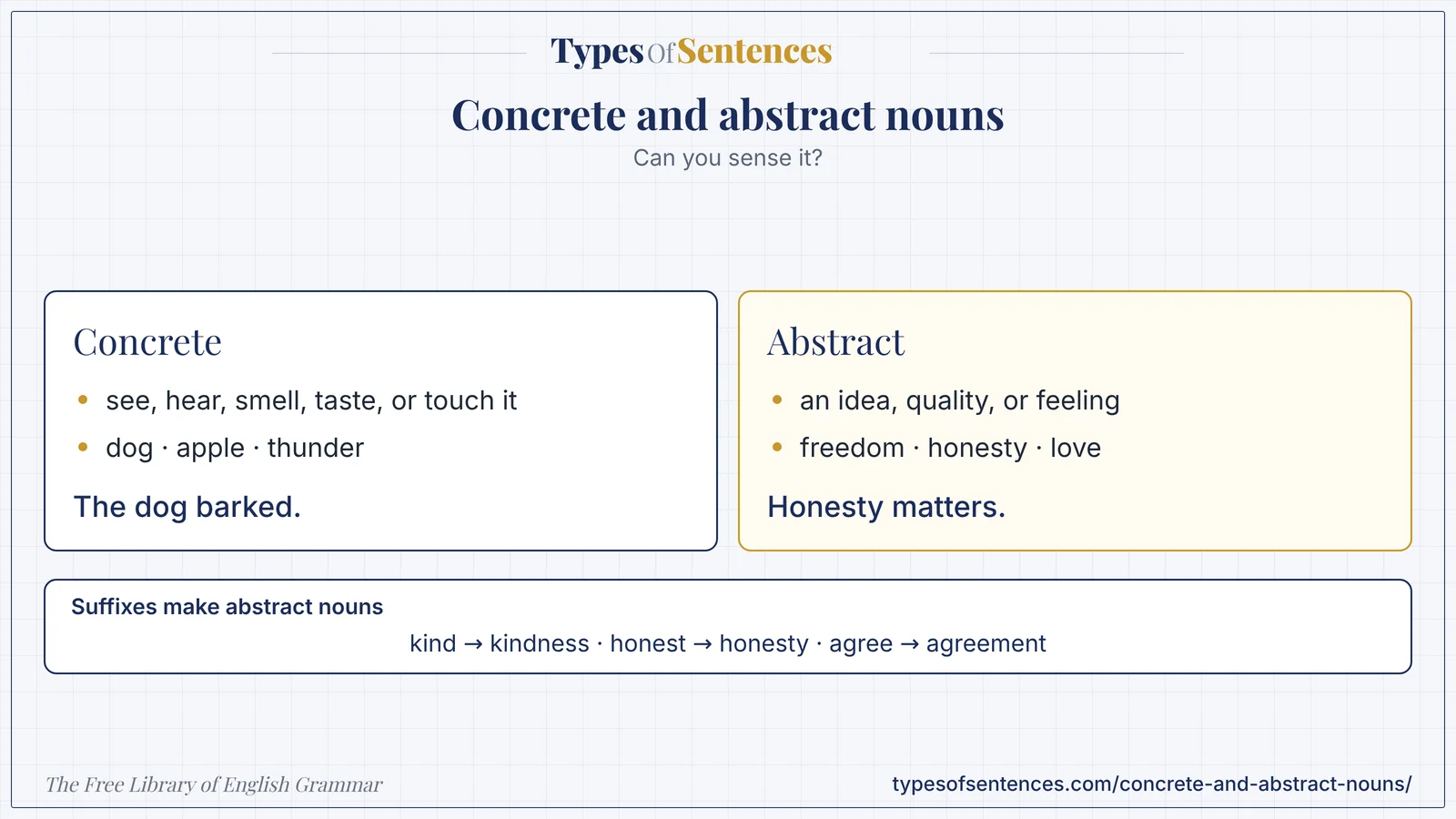
A concrete noun is something you can point to. An abstract noun is something you can think about but not point to.
Why it matters: Ask: can I see, hear, smell, taste, or touch it? If yes, it is concrete. If no, it is abstract.
Summary: A concrete noun names a physical thing that can be perceived by the senses (dog, apple, thunder, perfume). An abstract noun names an idea, quality, feeling, or state (freedom, honesty, love). The test: can you see, hear, smell, taste, or touch it? Many abstract nouns are formed from adjectives or verbs with suffixes: kind → kindness, honest → honesty, agree → agreement. Most abstract nouns are uncountable (courage, wisdom), but some are countable (an idea, a fear, two beliefs). A few nouns are borderline (music, time, wind). Concrete nouns make writing vivid; abstract nouns make it general.
- Concrete = sensed by the five senses.
- Abstract = idea, quality, feeling.
- Suffixes: -ness, -ity, -ship, -ment.
- Borderline: music, time, wind.
What You’ll Learn
- 1. Concrete and Abstract Nouns: The Short Answer
- 2. Concrete Nouns: List and 25 Examples
- 3. Abstract Nouns List: 25 Examples of Ideas and Feelings
- 4. How to Tell Concrete Nouns From Abstract Nouns
- 5. How Abstract Nouns Are Formed: Common Suffixes
- 6. Using Concrete and Abstract Nouns in Writing
- 7. Common Mistakes With Concrete and Abstract Nouns
- 8. Exercises
- 9. Test Your Knowledge
- 10. Frequently Asked Questions
- 11. Conclusion
1. Concrete and Abstract Nouns: The Short Answer
| Kind | Names | Test | Examples |
|---|---|---|---|
| concrete noun | physical things, people, places, substances, sounds | you can see, hear, smell, taste, or touch it | dog, apple, table, river, thunder, perfume |
| abstract noun | ideas, qualities, feelings, states, concepts | you cannot sense it directly | freedom, honesty, love, courage, time, justice |
| Feature | Concrete nouns | Abstract nouns |
|---|---|---|
| perceived by the senses | yes | no |
| usually countable | yes (two dogs), except substances (sand, water) | mostly not (courage), but some are (an idea) |
| effect in writing | vivid and specific | general and conceptual |
| often formed with a suffix | rarely | often (-ness, -ity, -ment) |
| example sentence | The dog barked. | Honesty matters. |
Both kinds can be common nouns (a city, a feeling) or proper nouns (Mumbai, Christmas). The difference between common and proper nouns is a separate classification, covered in the Basic and Intermediate chapters on nouns. Possession works for both kinds, as explained in the guide to possessive nouns: the dog’s bowl, the nation’s freedom.
2. Concrete Nouns: List and 25 Examples
| Group | Concrete nouns |
|---|---|
| people | teacher, doctor, baby, farmer, mayor, neighbor, child |
| animals | dog, bird, horse, fish, elephant, ant, cow |
| places | kitchen, school, river, mountain, harbor, garden, stadium |
| objects | table, phone, jacket, umbrella, bell, suitcase, glass |
| food and drink | apple, bread, milk, soup, tomato, sandwich, garlic |
| substances and weather | sand, snow, rain, smoke, wind, water, ice |
| sounds you can hear | thunder, whistle, siren, bark, buzz |
| Concrete nouns in a sentence | Concrete nouns |
|---|---|
| The dog barked at the mailman. | dog, mailman |
| She put the apple on the table. | apple, table |
| The river flows past the old bridge. | river, bridge |
| He wore a red jacket. | jacket |
| The bakery smells of fresh bread. | bakery, bread |
| A cold wind shook the windows. | wind, windows |
| The teacher wrote on the board. | teacher, board |
| I heard thunder in the distance. | thunder |
| She poured milk into the glass. | milk, glass |
| The children built a castle of sand. | children, castle, sand |
| He carried a heavy suitcase. | suitcase |
| The soup tastes of garlic. | soup, garlic |
| A bird sang from the roof. | bird, roof |
| The kitchen was full of smoke. | kitchen, smoke |
| She held the baby in her arms. | baby, arms |
| The coins rattled in the jar. | coins, jar |
| The mountain was covered in snow. | mountain, snow |
| He rang the bell. | bell |
| The stadium roared when the team scored. | stadium, team |
| Rain tapped on the umbrella. | rain, umbrella |
| The curtains felt soft and heavy. | curtains |
| She planted tomatoes in the garden. | tomatoes, garden |
| The ship left the harbor at dawn. | ship, harbor |
| He ate a sandwich. | sandwich |
| The phone buzzed on the desk. | phone, desk |
A concrete noun need not be solid: smoke, steam, perfume, and thunder can be sensed, so they are concrete. Substances such as sand and milk are concrete but uncountable; the choice of fewer or less with such nouns is explained in the guide to fewer vs less.
3. Abstract Nouns List: 25 Examples of Ideas and Feelings
| Group | Abstract nouns |
|---|---|
| feelings | love, joy, fear, anger, pride, delight, sorrow |
| qualities and virtues | honesty, courage, kindness, patience, wisdom, loyalty |
| ideas and concepts | freedom, justice, equality, truth, beauty, democracy |
| states and conditions | poverty, health, childhood, friendship, danger, silence |
| mental activity | knowledge, intelligence, memory, belief, doubt, opinion |
| events and actions seen as ideas | education, decision, movement, agreement, success |
| Abstract nouns in a sentence | Abstract nouns |
|---|---|
| Honesty is the best policy. | honesty |
| She faced the storm with courage. | courage |
| Freedom matters to everyone. | freedom |
| His kindness surprised us. | kindness |
| The team showed great determination. | determination |
| Love is stronger than fear. | love, fear |
| I admire her wisdom. | wisdom |
| They share a deep friendship. | friendship |
| The company values loyalty. | loyalty |
| Education opens many doors. | education |
| He felt a sudden joy. | joy |
| Justice must be fair to all. | justice |
| Her patience was tested. | patience |
| There is no substitute for experience. | experience |
| The speech was full of hope. | hope |
| Their trust grew over time. | trust, time |
| She admires his intelligence. | intelligence |
| The movie is about betrayal. | betrayal |
| He answered with great politeness. | politeness |
| The children laughed with delight. | delight |
| Poverty is a global problem. | poverty |
| She was filled with pride. | pride |
| We believe in equality. | equality |
| The knowledge was passed down. | knowledge |
| Beauty is in the eye of the beholder. | beauty |
These abstract nouns examples are mine, not taken from a published source. Most are uncountable (courage, wisdom), so they take no a and no plural. Some become countable when they mean a particular case: an education, a fear, two beliefs, many freedoms.
4. How to Tell Concrete Nouns From Abstract Nouns
| Test | How it works | Example |
|---|---|---|
| the five senses test | can you see, hear, smell, taste, or touch it? | perfume (smell) → concrete · kindness → abstract |
| the picture test | can you draw or photograph it? | a bridge → concrete · justice → abstract (a symbol, not the thing) |
| the plural test | does it have an ordinary plural? | dogs → concrete · courages → abstract (no plural) |
| the suffix test | does it end in -ness, -ity, -ship, -ment? | friendship → abstract |
| Borderline noun | Why it is hard | Usual classification |
|---|---|---|
| music | you hear it, but it is also an art and an idea | concrete when it means the sound, abstract as an art |
| time | you cannot sense it, but clocks measure it | abstract |
| wind | you feel its effect | concrete |
| silence | the absence of sound | abstract |
| air | you feel it, but cannot see it | concrete |
| heat | you can feel it | concrete (sensed by touch) in most uses |
| idea | a thought | abstract |
| team | people, but a single group | concrete (a collective noun) |
Dictionaries and grammar books do not always agree about borderline cases, so I give the most common classification, not a rule. The categories matter most for style and for teaching, not for correctness. Words for groups such as team and flock are collective nouns, which are listed in a separate page of this series.
5. How Abstract Nouns Are Formed: Common Suffixes
| Suffix | What it adds to | Examples |
|---|---|---|
| -ness | from adjectives | kind → kindness, happy → happiness, dark → darkness |
| -ity | from adjectives | honest → honesty, able → ability, real → reality |
| -ship | state or relationship | friend → friendship, member → membership |
| -ment | from verbs | agree → agreement, move → movement |
| -tion / -sion | from verbs | educate → education, decide → decision |
| -dom | state or realm | free → freedom, wise → wisdom |
| -hood | a period or state | child → childhood, neighbor → neighborhood |
| -th | from adjectives | strong → strength, wide → width, deep → depth |
| -ance / -ence | from verbs or adjectives | important → importance, differ → difference |
| -ism | a belief or practice | hero → heroism, tourist → tourism |
Many abstract nouns are made from adjectives and verbs in this way. Prefixes and suffixes are covered in the Intermediate chapter on prefixes and suffixes and in the advanced chapter on morphology. A writer who changes a verb into an abstract noun (decide → make a decision) is using a process called nominalization, which makes writing more formal and often more wordy.
6. Using Concrete and Abstract Nouns in Writing
| Goal | Choose | Example |
|---|---|---|
| make writing vivid | concrete nouns | The kettle hissed and the toast burned. |
| state a general idea | abstract nouns | Patience is a virtue. |
| support an abstract claim | add a concrete example | Her kindness showed when she shared her lunch with a stranger. |
| avoid vagueness | replace a general noun with a specific one | vehicle → red van |
| write formally | abstract nouns are common | The implementation of the policy improved efficiency. |
Good writers pair the two: an abstract noun to say what the point is, and a concrete noun to show it. If a paragraph has only abstract nouns, readers lose the picture; if it has only concrete nouns, they lose the point.
7. Common Mistakes With Concrete and Abstract Nouns
| Mistake | Example | Correction |
|---|---|---|
| plural of an uncountable abstract noun | *She gave me good advices. | She gave me good advice. |
| a with an uncountable abstract noun | *He showed a courage. | He showed courage. |
| the where the idea is general | *The honesty is important. | Honesty is important. |
| confusing a noun with its adjective | *She is full of kind. | She is full of kindness. |
| confusing a noun with the verb | *His decide was fast. | His decision was fast. |
| calling a quality concrete | *Courage is a concrete noun. | Courage is an abstract noun. |
| calling a substance abstract | *Water is an abstract noun. | Water is a concrete (uncountable) noun. |
| wrong suffix | *the happyness of the child | the happiness of the child |
| piling up abstract nouns | *The utilization of the implementation of the plan | Using the plan |
Classify each noun in The farmer showed great courage when the river flooded his field and his friendship with the neighbors helped him.
- farmer: a person you can see, so concrete.
- courage: a quality, so abstract.
- river, field: things you can see, so concrete.
- friendship: a relationship, so abstract.
- neighbors: people, so concrete.
- Result: concrete: farmer, river, field, neighbors; abstract: courage, friendship. (the sentence is invented)
Recap in 12 seconds
Watch the lesson build itself: A concrete noun can be sensed and an abstract noun names an idea, quality, or feeling; suffixes such as -ness, -ity, and -ment make abstract nouns. The video has no sound.
Exercises
Part A: Concrete or Abstract? (Exercises 1–10)
Exercise 1: table
Show Answer
Answer: concrete.
Exercise 2: freedom
Show Answer
Answer: abstract.
Exercise 3: river
Show Answer
Answer: concrete.
Exercise 4: kindness
Show Answer
Answer: abstract.
Exercise 5: apple
Show Answer
Answer: concrete.
Exercise 6: love
Show Answer
Answer: abstract.
Exercise 7: thunder
Show Answer
Answer: concrete (you can hear it).
Exercise 8: courage
Show Answer
Answer: abstract.
Exercise 9: suitcase
Show Answer
Answer: concrete.
Exercise 10: wisdom
Show Answer
Answer: abstract.
Part B: Find the Nouns (Exercises 11–20)
Exercise 11: Name the abstract noun: The dog showed great loyalty.
Show Answer
Answer: loyalty (dog is concrete).
Exercise 12: Name the concrete noun: Honesty is stronger than a lock.
Show Answer
Answer: lock (honesty is abstract).
Exercise 13: Name the abstract noun: She smiled with delight.
Show Answer
Answer: delight.
Exercise 14: Name the concrete noun: The bridge was built with great skill.
Show Answer
Answer: bridge (skill is abstract).
Exercise 15: Name the abstract noun: Poverty affects many families.
Show Answer
Answer: poverty (families is concrete).
Exercise 16: Make an abstract noun from kind.
Show Answer
Answer: kindness.
Exercise 17: Make an abstract noun from honest.
Show Answer
Answer: honesty.
Exercise 18: Make an abstract noun from agree.
Show Answer
Answer: agreement.
Exercise 19: Make an abstract noun from strong.
Show Answer
Answer: strength.
Exercise 20: Make an abstract noun from friend.
Show Answer
Answer: friendship.
Part C: Tests and Borderline Cases (Exercises 21–25)
Exercise 21: Which test asks whether you can see, hear, smell, taste, or touch the thing?
Show Answer
Answer: the five senses test.
Exercise 22: Is time usually concrete or abstract?
Show Answer
Answer: abstract.
Exercise 23: Is wind usually concrete or abstract?
Show Answer
Answer: concrete (you feel and hear it).
Exercise 24: Is water concrete or abstract, and is it countable?
Show Answer
Answer: concrete and uncountable.
Exercise 25: Which suffix makes an abstract noun from friend?
Show Answer
Answer: -ship.
Part D: Correct the Errors (Exercises 26–30)
Exercise 26: Correct: *She gave me good advices.
Show Answer
Answer: She gave me good advice.
Exercise 27: Correct: *He showed a courage.
Show Answer
Answer: He showed courage.
Exercise 28: Correct: *The honesty is important.
Show Answer
Answer: Honesty is important.
Exercise 29: Correct: *His decide was fast.
Show Answer
Answer: His decision was fast.
Exercise 30: Correct: *the happyness of the child
Show Answer
Answer: the happiness of the child
Test Your Knowledge
Ready to check what you learned? Answer all 10 questions, then submit. You need 80% (8 of 10) to pass. Your answers are not stored.
View correct answers and explanations
Question 1: A concrete noun names something you can
✓ Correct Answer: B – perceive with the senses
Sensed.
Question 2: Which is an abstract noun?
✓ Correct Answer: C – courage
A quality.
Question 3: Which is a concrete noun?
✓ Correct Answer: D – thunder
You can hear it.
Question 4: The suffix in friendship is
✓ Correct Answer: A – -ship
-ship.
Question 5: An abstract noun from kind is
✓ Correct Answer: B – kindness
Kindness.
Question 6: Which sentence is correct?
✓ Correct Answer: C – She gave me good advice.
Advice is uncountable.
Question 7: Which is borderline?
✓ Correct Answer: D – music
It can be sound or art.
Question 8: Most abstract nouns are
✓ Correct Answer: A – uncountable
Uncountable.
Question 9: The five senses test asks whether you can
✓ Correct Answer: B – see, hear, smell, taste, or touch it
The test.
Question 10: Water is
✓ Correct Answer: C – a concrete noun
Concrete and uncountable.
Frequently Asked Questions
What are concrete and abstract nouns?
Concrete nouns name things that can be perceived with the five senses (dog, apple, thunder). Abstract nouns name ideas, qualities, and feelings (freedom, honesty, love).
How do I know if a noun is concrete or abstract?
Ask whether you can see, hear, smell, taste, or touch it. If you can, it is concrete. If not, it is abstract.
Are abstract nouns countable?
Most are uncountable (courage, wisdom), but some are countable when they mean a particular case: an idea, a fear, two beliefs.
Is “time” a concrete or abstract noun?
Usually abstract, because you cannot sense time directly. Clocks and calendars measure it, but the noun names an idea.
Can a noun be both concrete and abstract?
Some nouns have both uses: music can mean the sound (concrete) or the art (abstract), and business can mean a shop (concrete) or an activity (abstract).
How are abstract nouns formed?
Many are made from adjectives or verbs with suffixes such as -ness (kindness), -ity (honesty), -ship (friendship), and -ment (agreement).
Which kind of noun is better in writing?
Neither is better. Concrete nouns make writing vivid and specific, and abstract nouns state general ideas. Good writing uses both, with a concrete example to support each abstract claim.
Conclusion
You now know what concrete and abstract nouns are, the five senses test, the word lists, the suffixes that make abstract nouns, and the borderline cases. Remember the test: if you can sense it, it is concrete.
Next, study the other lists in this series, such as the collective nouns, which are concrete nouns that name groups.
- Quirk, Randolph, et al. A Comprehensive Grammar of the English Language. Longman, 1985.: the classification of nouns, including concrete and abstract nouns.
- Huddleston, Rodney, and Geoffrey K. Pullum. The Cambridge Grammar of the English Language. Cambridge University Press, 2002.: the discussion of nouns and countability.
- Swan, Michael. Practical English Usage. 4th ed. Oxford University Press, 2016.: the entries on countable and uncountable nouns.
- Merriam-Webster Dictionary: abstract noun: the dictionary entry (not opened when this page was written).
Last reviewed: October 29, 2026. How it was made: drafted with AI assistance, then checked with automated tests (structure, links, answer keys, spelling) and against the sources above. A person has not yet read this chapter line by line. Found a mistake? Report it.