Morphology in English is the study of how words are built. The word unhappiness is not one unit but three: un- (not), happy (the base), and -ness (a state). Once you can see such parts, you can understand words you have never met (unforgettable, deforestation), build new ones (to podcast, a doomscroller), and explain why -ize makes verbs and -less makes adjectives. English word formation is one of the engines of the vocabulary, and advanced readers and writers need to know how it works.
You will study the basic units (morphemes, free and bound, roots and affixes), the difference between inflectional and derivational morphology, prefixes and suffixes and their meanings, the way that suffixes change word class, compounding and its types, conversion (to email), abbreviation and clipping, blending (brunch, smog), back-formation, borrowing, and productivity. The chapter shows how word building makes English vocabulary systematic, and how to use prefixes and suffixes to read and write with precision. Thirty editing exercises and a quiz follow.
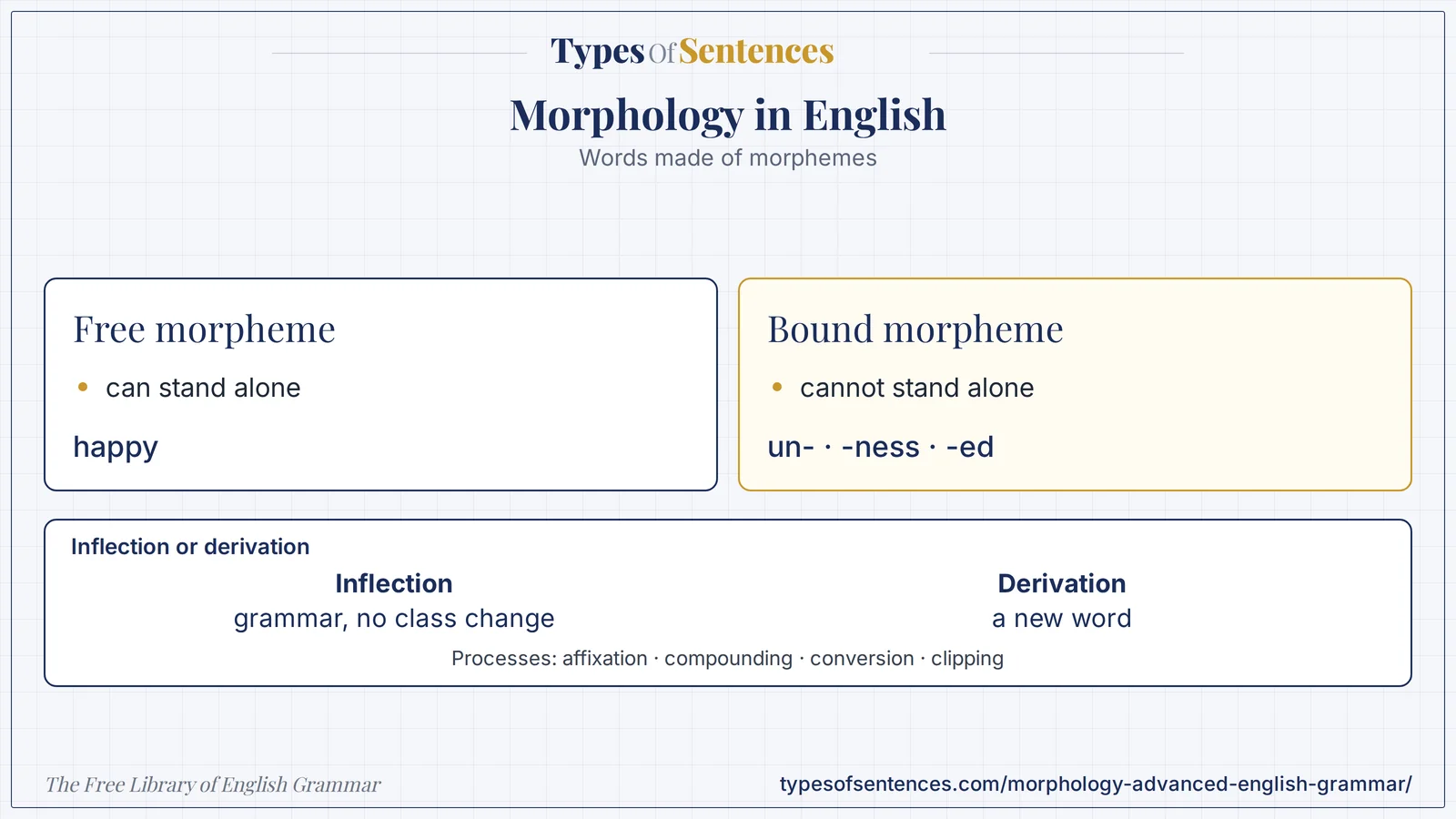
A word often has parts. Prefixes come before a base and suffixes come after it; together with the base they build new words. Knowing the common parts is like having a kit that opens thousands of words.
Why it matters: English also builds words by joining whole words (toothbrush), by changing the class of a word without changing its form (a text, to text), by shortening (flu), and by blending (brunch). These processes are alive: new words appear every year.
Summary: Morphology analyzes words into morphemes, the smallest units of meaning or grammar. A free morpheme can stand alone (happy); a bound morpheme cannot (un-, -ness, -ed). Inflection adds grammatical information without changing the word class (walks, walked, walking, walker’s); derivation creates new words, often changing the class (happy → unhappy → unhappiness). Other processes are compounding (toothbrush), conversion (to email), clipping (exam), blending (brunch), acronyms (NASA), back-formation (edit from editor), and borrowing. Productive processes keep creating new words.
- Morpheme = smallest meaningful unit; free or bound.
- Inflection: grammar, no class change; derivation: new words, often a new class.
- Processes: affixation, compounding, conversion, clipping, blending, acronyms, back-formation, borrowing.
- Use prefixes, suffixes, and roots to decode and build words.
What You’ll Learn
- 1. Morphology in English: What Is Morphology?
- 2. Inflection vs. Derivation
- 3. Prefixes
- 4. Suffixes: Derivational Word Building
- 5. Compounding
- 6. Conversion (Zero Derivation)
- 7. Abbreviation, Clipping, Blending, and Other Processes
- 8. Productivity and Constraints in Word Formation
- 9. Using Morphology to Decode and Build Vocabulary
- 10. Common Errors with Word Formation
- 11. Exercises
- 12. Test Your Knowledge
- 13. Frequently Asked Questions
- 14. Conclusion
1. Morphology in English: What Is Morphology?
| Term | Meaning | Example |
|---|---|---|
| morpheme | the smallest unit of meaning or grammatical function | un-, happy, -ness |
| free morpheme | can stand alone as a word | happy, book, run, the |
| bound morpheme | cannot stand alone; attaches to others | un-, -ness, -ed, -s, re-, -tion |
| root | the core of a word that cannot be analyzed further | port in transport, import |
| base (or stem) | the form to which an affix is added | happy in unhappy; unhappy in unhappiness |
| affix | a bound morpheme: prefix (before), suffix (after), infix (inside; rare in English) | un-, -ness; abso-bloody-lutely (an expressive infix) |
| allomorph | a variant form of a morpheme | plural /s/, /z/, /ɪz/ in cats, dogs, buses; in-, im-, il-, ir- |
| lexeme | a word in the dictionary sense, with all its forms | walk: walks, walked, walking |
| Word | Analysis | Types |
|---|---|---|
| unhappiness | un- + happy + -ness | prefix + free root + suffix |
| internationalization | inter- + nation + -al + -ize + -ation | prefix + root + three suffixes |
| unforgettable | un- + forget + -able | — |
| reappearance | re- + appear + -ance | — |
| cats | cat + -s | free + inflectional suffix |
| blackboard | black + board | compound of two free morphemes |
| biology | bio + -logy | neoclassical combining forms |
| disestablishment | dis- + establish + -ment | — |
Morphemes are not the same as syllables: happy has two syllables and one morpheme, while cats has one syllable and two morphemes. To segment a word, ask which parts have a meaning or function that recurs in other words (un- in unhappy, unfair, undo). The parts of speech to which the products belong are described in the chapters on advanced noun concepts, advanced verb concepts, advanced adjective concepts, and advanced adverb concepts.
2. Inflection vs. Derivation
| Inflectional suffix | Function | Example |
|---|---|---|
| -s | plural noun | cats |
| -’s | possessive | the cat’s tail |
| -s | third-person singular present | she walks |
| -ed | past tense | walked |
| -ing | present participle or gerund | walking |
| -en / -ed | past participle | written; walked |
| -er | comparative | taller |
| -est | superlative | tallest |
| Test | Inflection | Derivation |
|---|---|---|
| changes the word class? | no | often (happy → happiness) |
| creates a new dictionary entry? | no | yes |
| regular and productive? | yes (apart from irregular forms) | less regular; limited by the base |
| position | outermost: friend-ship-s | inner: friend-ship |
| obligatory by grammar? | yes (a verb needs tense) | no |
| meaning change | grammatical only | lexical |
| number in English | eight suffixes | many prefixes and suffixes |
Derivation comes before inflection in a word: friend + ship + s, not friend + s + ship. English has few inflections compared with many languages, and a very large derivational system. Irregular inflections (men, went, better) are the survivors of older patterns; borrowed words keep foreign plurals in some cases (data, criteria, analyses, cacti).
3. Prefixes
| Meaning | Prefixes | Examples |
|---|---|---|
| not, opposite | un-, in- (im-, il-, ir-), non-, dis-, a- | unhappy, impossible, illegal, irregular, nonsense, disagree, atypical |
| reversal | un-, de-, dis- | undo, defrost, disconnect |
| wrong, badly | mis-, mal- | misunderstand, malfunction |
| again | re- | rewrite, rebuild |
| before, after | pre-, fore-, post-, ex- | prepare, foresee, postpone, ex-president |
| over, under, beyond | over-, under-, out-, super-, ultra-, hyper-, sur- | overwork, underestimate, outlive, supernatural, ultramodern, hyperactive |
| small, large | mini-, micro-, macro-, mega- | miniskirt, microscope, macroeconomics, megastar |
| together, with | co-, com- (con-), syn- | cooperate, combine, synchronize |
| against, for | anti-, counter-, pro- | antibody, counteract, pro-democracy |
| across, between, within | trans-, inter-, intra-, extra- | transport, international, intranet, extraordinary |
| under, below | sub-, infra- | subway, infrared |
| number | uni-, mono-, bi-, di-, tri-, multi-, poly-, semi- | unify, monologue, bicycle, triangle, multilingual, polygon, semicircle |
| self, by itself | self-, auto- | self-control, automatic |
| make, cause to be | en- (em-), be- | enrich, embody, befriend, bedazzle |
| half, partly | semi-, demi-, hemi- | semicolon |
| mixed or new technology | e-, cyber-, bio-, eco-, tele- | email, cyberspace, biofuel, eco-friendly, telephone |
| Rule | Example |
|---|---|
| most prefixes do not change the word class | happy → unhappy (both adjectives); write → rewrite (both verbs) |
| a few prefixes make verbs from nouns and adjectives | en- (enrich, enable, encourage), be- (befriend, belittle), de- (debug, defrost) |
| in- changes by assimilation | in-possible → impossible; in-legal → illegal; in-regular → irregular; in-mortal → immortal |
| hyphen with self-, ex-, all-, and before a capital or a vowel when needed | self-confident; ex-wife; anti-American; co-operate (also cooperate) |
| stress | prefixes are usually unstressed in verbs and adjectives; in- and un- carry the stress with some words (unHAPPy; REwrite as a noun, reWRITE as a verb) |
| origin | Latin (pre-, sub-), Greek (anti-, poly-), Germanic (un-, over-, under-, out-) |
Prefixes add meaning but usually leave the word class and the grammar alone, which makes them easy to apply. Productive prefixes in modern English include un-, re-, de-, mis-, non-, e-, and cyber-: to unfriend, to repost, to deplatform. Hyphenation follows a dictionary or style guide.
4. Suffixes: Derivational Word Building
| Resulting class | Suffixes | Examples (base → derived) |
|---|---|---|
| noun (state, quality) | -ness, -ity, -ness, -ence/-ance, -ship, -dom, -hood, -th | happy → happiness; able → ability; important → importance; friend → friendship; free → freedom; child → childhood; strong → strength |
| noun (action, process) | -tion/-sion, -ment, -al, -age, -ing, -ure | educate → education; achieve → achievement; refuse → refusal; use → usage; fail → failure |
| noun (person) | -er/-or, -ist, -ant/-ent, -ee, -ian, -eer | teach → teacher; act → actor; art → artist; assist → assistant; employ → employee; library → librarian |
| noun (belief, theory) | -ism, -ology | social → socialism; bio- → biology |
| verb | -ize (-ise), -ify, -ate, -en | modern → modernize; simple → simplify; active → activate; wide → widen |
| adjective | -able/-ible, -al, -ful, -less, -ous, -ive, -ic, -ish, -y, -ly, -some, -like, -worthy | read → readable; nation → national; help → helpful (helpless); danger → dangerous; act → active; hero → heroic; child → childish; rain → rainy; friend → friendly; trouble → troublesome; trust → trustworthy |
| adverb | -ly, -wise, -ward(s) | quick → quickly; clock → clockwise; home → homeward |
| Change | Example | Rule |
|---|---|---|
| drop the final e before a vowel suffix | create → creative, creation; hope → hoping | — |
| keep the e before a consonant suffix | hope → hopeful; arrange → arrangement | exceptions: argument, judgment (judgement in British) |
| double the final consonant | run → running; big → bigger; occur → occurrence | stressed short vowel + one consonant |
| change y to i | happy → happiness; carry → carried | — |
| stress shift | PHOtograph → phoTOGraphy → photoGRAPHic | suffixes such as -ic, -ity, -ion attract the stress |
| vowel change | divine → divinity; serene → serenity; profound → profundity | — |
| -ize (American) and -ise (British) | organize / organise | this course uses the American spelling |
Suffixes usually change the word class, which is how English moves between the parts of speech: decide (verb) → decision (noun) → decisive (adjective) → decisively (adverb). Suffixes can be added in a chain (nation + al + ize + ation), with the earlier ones next to the base. Latinate suffixes such as -ity and -ation attach mainly to Latinate bases (curiosity but not goodity), while Germanic suffixes such as -ness and -less attach to bases of any origin. The style of nominalization, in which verbs become nouns through -tion and -ment, is treated in the chapter on diction.
5. Compounding
| Type | Pattern | Examples |
|---|---|---|
| noun + noun | N + N | toothbrush, bookshelf, school bus, police station, olive oil, notebook |
| adjective + noun | Adj + N | blackboard, greenhouse, hotdog, highway, software, smartphone |
| verb + noun | V + N (exocentric) | pickpocket, breakfast, scarecrow, killjoy, spoilsport |
| noun + verb (+ er/-ing) | N + V | haircut, sunrise, handmade, heartbreaking, truck driver |
| verb + particle | V + P | breakdown, makeup, takeaway, lookout, setback |
| particle + verb | P + V | outcome, input, overthrow, uptake, downfall |
| adjective + adjective | Adj + Adj | bittersweet, deaf-mute, icy cold |
| adjective + noun + -ed | Adj + N + -ed | blue-eyed, kind-hearted, short-sighted |
| noun + adjective | N + Adj | sky blue, user-friendly, waterproof, carsick |
| phrase compounds | longer units | mother-in-law, man-of-war, jack-of-all-trades, forget-me-not |
| neoclassical compounds | Greek or Latin combining forms | biology, telephone, photograph, television, psychology, astronaut |
| Feature | Rule | Example |
|---|---|---|
| head | in English the rightmost word is the head: it gives the word class and the basic meaning | a toothbrush is a kind of brush |
| endocentric | the compound is a kind of its head | a bookshelf is a shelf |
| exocentric | the head is not inside the compound | a redhead is a person (not a head); a pickpocket is a person |
| copulative (both parts equal) | both parts describe the whole | singer-songwriter; bittersweet; a poet-priest |
| inflection | on the head, usually the last word | toothbrushes; but mothers-in-law, passers-by, attorneys general |
| spelling | closed (notebook), hyphenated (well-known), or open (school bus); consult a dictionary | email / e-mail; website; web page |
| stress | compound: stress on the first part; phrase: on the second | a BLACKboard (compound) / a black BOARD (phrase) |
| meaning relation | varies and must be learned | olive oil (made from), baby oil (for), body oil (applied to) |
A compound is a single word, with a meaning that is often not predictable (a hotdog is not a hot dog). Compounds can be long: a federal student loan repayment plan is a chain of noun compounds, whose structure is discussed in the chapter on complex noun phrases. Whether to write a compound as one word, two, or with a hyphen depends on the dictionary and the style guide; the trend is toward closed forms as words become familiar (e-mail → email).
6. Conversion (Zero Derivation)
| From → to | Examples | Notes |
|---|---|---|
| noun → verb | to email, to google, to bottle, to butter, to table, to network, to medal, to friend, to text, to chair, to ship | the most productive type |
| verb → noun | a run, a walk, a guess, a drink, a find, a must, a hope, a cry, a swim | — |
| adjective → verb | to empty, to clean, to calm, to dry, to open, to slow | — |
| adjective → noun | the rich, the poor, a regular, a daily, an official | — |
| adverb or preposition → verb | to down a drink, to up the price, to out someone | informal |
| phrase → noun | a has-been, a must-have, a don’t-know | — |
| Stress shift in conversion | Noun | Verb |
|---|---|---|
| record | REcord | reCORD |
| present | PREsent | preSENT |
| object | OBject | obJECT |
| contract | CONtract | conTRACT |
| permit | PERmit | perMIT |
| increase | INcrease | inCREASE |
| Test | Example | Result |
|---|---|---|
| inflection shows the new class | He googled it. (verb) | googled shows a verb |
| an irregular noun gives a regular verb | a fly → he flied out (baseball) | verbs from nouns are regular |
| syntax shows the class | I have a text. / I will text you. | determiner versus auxiliary |
Conversion is the creation of a word of one class from a word of another with no change in form. It is so productive that English speakers create new verbs from nouns without noticing (to ghost someone, to trend). The conversion is shown by the grammar of the word in its new use, for instance by taking -ed or -ing, and not by a suffix. Some conversions are regional: to table a motion means to postpone it in American English and to bring it up for discussion in British English.
7. Abbreviation, Clipping, Blending, and Other Processes
| Process | Description | Examples |
|---|---|---|
| acronym | initials pronounced as a word | NASA, NATO, laser, radar, scuba, UNESCO, AIDS |
| initialism | initials pronounced letter by letter | BBC, FBI, USA, CEO, DVD, FAQ |
| clipping (back) | shorten at the end | ad, exam, lab, gym, photo, info, memo |
| clipping (fore) | shorten at the start | bus (omnibus), phone (telephone), plane (airplane) |
| clipping (both) | — | flu (influenza), fridge (refrigerator) |
| blending | parts of two words merged | smog (smoke + fog), brunch, motel, Brexit, spork, infotainment, webinar, podcast, emoji (borrowed + blend) |
| back-formation | a shorter word made by removing a supposed affix | edit (from editor), burgle (burglar), enthuse (enthusiasm), babysit (babysitter), donate (donation) |
| eponym | a word from a person’s name | sandwich, cardigan, boycott, diesel, nicotine |
| onomatopoeia | imitates a sound | buzz, bang, meow, splash, hiss |
| reduplication | repeated or varied elements | bye-bye, wishy-washy, hip-hop, zigzag, tick-tock |
| coinage | a completely new word | googol, Kodak, Xerox (brand names) |
| borrowing (loanword) | a word taken from another language | kindergarten (German), café (French), karaoke (Japanese), tsunami (Japanese), algebra (Arabic), tycoon (Japanese) |
| semantic shift | new meaning for an old form | mouse (computer), cloud, surf, tweet |
| Borrowed from languages of the Indian subcontinent | Source | Meaning |
|---|---|---|
| pajamas (pyjamas) | Hindi and Urdu | loose trousers; sleepwear |
| shampoo | Hindi | massage; hair wash |
| bungalow | Hindi (Bengal) | a one-story house |
| jungle | Hindi | forest; wilderness |
| juggernaut | Sanskrit (Jagannath) | an overwhelming force |
| avatar | Sanskrit | a god’s descent; an online persona |
| karma | Sanskrit | action and its consequences |
| yoga | Sanskrit | a discipline of body and mind |
| bandana | Hindi | a scarf |
| loot | Hindi | plunder |
| veranda | Hindi/Portuguese | a roofed porch |
| thug | Hindi | a violent criminal |
The shortening processes are the most visible signs of the lexicon in change. New blends and acronyms appear every year, and dictionaries add them when they are widely used. Borrowing has enlarged English since its earliest days: a large part of the vocabulary comes from Latin and French, and many words came in through trade and empire from Arabic, the languages of India, and others. The words of Indian origin in the table are those that dictionaries record as borrowed into English; the dates and exact routes vary.
8. Productivity and Constraints in Word Formation
| Concept | Meaning | Example |
|---|---|---|
| productive affix | used freely to form new words | un-, re-, -ness, -able, -er, -ize, -ish |
| unproductive affix | found in old words but not used now | -th (growth, strength), -ment (rarely new) |
| hapax legomenon | a word that occurs once in a corpus | — |
| blocking | an existing word blocks a regular one | thief blocks stealer (in the usual sense); glory blocks gloriosity |
| lexical gap | a possible word that does not exist | unpossible (non-standard); *goodity |
| semantic drift | derived words acquire special meanings | awful (inspiring awe → very bad) |
| level ordering | Latinate affixes attach before Germanic ones | un-happi-ness; un-grace-ful-ness |
| neologism | a new word | doomscroll, selfie, blockchain, unfriend |
Not every combination is possible. A derivational affix usually attaches to a base of a certain class and origin (-able to verbs, -ity to Latinate adjectives). Even when a derived word is possible, speakers may prefer the existing word (blocking). Productive processes are limited by the needs of the speakers: words that fill a gap are accepted, and others fade.
9. Using Morphology to Decode and Build Vocabulary
| Root | Meaning | Examples |
|---|---|---|
| bene | good | benefit, benevolent, beneficial |
| mal | bad | malice, malfunction, malnutrition |
| port | carry | transport, import, portable, support |
| spect | look | inspect, spectator, perspective, respect |
| dict | say | dictate, predict, contradiction, verdict |
| scrib / script | write | describe, manuscript, prescription, scribble |
| graph | write; draw | autograph, photograph, graphic |
| log / logy | word; study | dialogue, biology, logical, analogy |
| vid / vis | see | video, visible, evidence, revise |
| duc / duct | lead | educate, produce, conduct, introduction |
| mit / miss | send | submit, transmit, mission, permission |
| tele | far | telephone, telescope, television |
| chron | time | chronology, synchronize, chronic |
| aud | hear | audience, audible, auditorium |
| cred | believe | credible, incredible, credit |
- Break the word into prefix, root, and suffix: unforgettable = un + forget + able.
- Think of the meaning of each part and combine them: not + forget + able to be = cannot be forgotten.
- Check the context to confirm.
- Check the word class from the suffix: -ize (verb), -ness (noun), -ous (adjective).
- Build word families: decide, decision, decisive, decisively, indecision.
- Beware of false friends: reinforce is not re-in-force in the sense of “force again”; unloose means loosen.
In writing, word-building suffixes allow nominalization (decide → decision), which makes a text compact and formal but can also make it heavy. Verbs derived by -ize are common in business and academic English (prioritize, operationalize), and some readers dislike them: use is better than utilize. Choosing between a derived word and a plain one is a matter of style.
10. Common Errors with Word Formation
| Error | Correction | Rule |
|---|---|---|
| unpossible | impossible | in- before a labial consonant (im-) |
| irregardless | regardless | a blend of irrespective and regardless; nonstandard |
| informations | information | uncountable |
| criterias | criteria (plural); criterion (singular) | Greek plural |
| peoples (meaning humans) | people | — |
| more bigger | bigger | no double comparative |
| goed, runned | went, ran | irregular forms |
| begining | beginning | double the consonant |
| occurence | occurrence | double the consonant |
| hopeing | hoping | drop the e |
| happyness | happiness | y → i |
| analyse (American) | analyze | American -yze |
| judgement (American) | judgment | American spelling |
| an informationful text | an informative text | wrong suffix |
| disinterested (meaning uninterested) | uninterested | distinct meanings: unbiased vs not interested |
| unhelpfull | unhelpful | -ful has one l |
Edit: The informations are unpossible, irregardless of the criterias, because she goed to the begining, and happyness is more bigger than occurence.
- informations: information (uncountable): The information is …
- unpossible: impossible.
- irregardless: regardless.
- criterias: criteria.
- goed: went.
- begining: beginning.
- happyness: happiness.
- more bigger: bigger.
- occurence: occurrence.
- Result: The information is impossible, regardless of the criteria, because she went to the beginning, and happiness is bigger than occurrence. (the sentence makes little sense; a better edit would rewrite it)
Recap in 12 seconds
Watch the lesson build itself: Morphemes are free or bound; inflection adds grammar and derivation makes new words. The video has no sound.
Exercises
Part A: Morphemes (Exercises 1–7)
Exercise 1: Divide into morphemes: unhappiness
Show Answer
Answer: un- + happy + -ness.
Exercise 2: Divide into morphemes: reappearance
Show Answer
Answer: re- + appear + -ance.
Exercise 3: Free or bound: -ness
Show Answer
Answer: Bound.
Exercise 4: Free or bound: book
Show Answer
Answer: Free.
Exercise 5: How many morphemes in cats?
Show Answer
Answer: Two (cat + -s).
Exercise 6: Name the allomorphs of the plural.
Show Answer
Answer: /s/, /z/, /ɪz/.
Exercise 7: Name the allomorphs of in-.
Show Answer
Answer: im-, il-, ir-.
Part B: Inflection vs. Derivation (Exercises 8–12)
Exercise 8: Inflection or derivation: -ed
Show Answer
Answer: Inflection.
Exercise 9: Inflection or derivation: -ness
Show Answer
Answer: Derivation.
Exercise 10: Inflection or derivation: -er in taller
Show Answer
Answer: Inflection (comparative).
Exercise 11: Inflection or derivation: -er in teacher
Show Answer
Answer: Derivation.
Exercise 12: Which comes first: inflection or derivation?
Show Answer
Answer: Derivation (inflection is outermost).
Part C: Prefixes and Suffixes (Exercises 13–19)
Exercise 13: Add a prefix for not: possible
Show Answer
Answer: impossible.
Exercise 14: Add a prefix for again: write
Show Answer
Answer: rewrite.
Exercise 15: Add a prefix for wrong: understand
Show Answer
Answer: misunderstand.
Exercise 16: Make a noun from happy:
Show Answer
Answer: happiness.
Exercise 17: Make a verb from simple:
Show Answer
Answer: simplify.
Exercise 18: Make an adjective from danger:
Show Answer
Answer: dangerous.
Exercise 19: Make a noun (person) from teach:
Show Answer
Answer: teacher.
Part D: Other Processes (Exercises 20–26)
Exercise 20: Name the process: toothbrush
Show Answer
Answer: Compounding.
Exercise 21: Name the process: to email
Show Answer
Answer: Conversion.
Exercise 22: Name the process: flu
Show Answer
Answer: Clipping.
Exercise 23: Name the process: brunch
Show Answer
Answer: Blending.
Exercise 24: Name the process: NASA
Show Answer
Answer: Acronym.
Exercise 25: Name the process: edit (from editor)
Show Answer
Answer: Back-formation.
Exercise 26: Give the plural of mother-in-law:
Show Answer
Answer: mothers-in-law.
Part E: Errors (Exercises 27–30)
Exercise 27: Edit: unpossible
Show Answer
Answer: impossible.
Exercise 28: Edit: informations
Show Answer
Answer: information.
Exercise 29: Edit: begining
Show Answer
Answer: beginning.
Exercise 30: Edit: more bigger
Show Answer
Answer: bigger.
Test Your Knowledge
Ready to check what you learned? Answer all 10 questions, then submit. You need 80% (8 of 10) to pass. Your answers are not stored.
View correct answers and explanations
Question 1: What is a morpheme?
✓ Correct Answer: A – the smallest unit of meaning or grammar
A morpheme is the smallest meaningful unit.
Question 2: Which is a bound morpheme?
✓ Correct Answer: B – -ness
It cannot stand alone.
Question 3: Which is inflectional?
✓ Correct Answer: B – -ed
-ed marks past tense.
Question 4: Which is derivational?
✓ Correct Answer: C – -ness
-ness forms nouns.
Question 5: How many morphemes are in unhappiness?
✓ Correct Answer: C – three
un-, happy, -ness.
Question 6: Which is a compound?
✓ Correct Answer: D – toothbrush
Two free morphemes.
Question 7: Which is conversion?
✓ Correct Answer: C – to email (from the noun)
The class changes with no affix.
Question 8: Which is a blend?
✓ Correct Answer: D – smog
Smoke + fog.
Question 9: Which is back-formation?
✓ Correct Answer: A – edit (from editor)
A shorter word from a longer one.
Question 10: Which is correct?
✓ Correct Answer: B – information
Information is uncountable.
Frequently Asked Questions
What is morphology in English?
Morphology in English is the study of how words are built from morphemes: roots, prefixes, and suffixes, and by processes such as compounding, conversion, clipping, and blending.
What is English word formation?
English word formation is the set of processes that create words: affixation (derivation), compounding, conversion, clipping, blending, acronyms, back-formation, and borrowing.
What are prefixes suffixes?
Prefixes suffixes are affixes: a prefix comes before a base (un-, re-) and a suffix after it (-ness, -able). Prefixes suffixes of this kind add meaning or change the word class.
What is word building?
Word building is the creation of new words from existing parts. Word building uses affixes, compounds, and other processes, and it is how the vocabulary of English grows.
What is derivational morphology?
Derivational morphology is the creation of new words by adding affixes, often changing the word class (decide → decision → decisive), unlike inflection, which only adds grammatical information.
What is the difference between inflection and derivation?
Inflection adds grammatical information without changing the word class (walk → walked), while derivation creates a new word, often of a different class (happy → happiness).
How can I use morphology to learn vocabulary?
Break unknown words into prefix, root, and suffix, learn common Latin and Greek roots, build word families, and check the meaning in context.
Conclusion
You now have a deep study of morphology: morphemes and their types, inflection and derivation, prefixes and suffixes, compounding, conversion, abbreviation, blending, back-formation, borrowing, productivity, and the use of word structure to decode and build vocabulary. You can analyze any English word and build new ones.
When you meet an unknown word, break it into its parts. Next, you will study lexical relations.
- Huddleston, Rodney, and Geoffrey K. Pullum. The Cambridge Grammar of the English Language. Cambridge University Press, 2002.: the chapter on inflectional morphology and word formation.
- Bauer, Laurie. English Word-Formation. Cambridge University Press, 1983.: the standard introduction to English word formation.
- Plag, Ingo. Word-Formation in English. 2nd ed. Cambridge University Press, 2018.: a modern account of productivity and processes.
- Quirk, Randolph, et al. A Comprehensive Grammar of the English Language. Longman, 1985.: the appendix on word formation.
- Merriam-Webster Dictionary: morpheme: the dictionary entry.
Last reviewed: October 29, 2026. How it was made: drafted with AI assistance, then checked with automated tests (structure, links, answer keys, spelling) and against the sources above. A person has not yet read this chapter line by line. Found a mistake? Report it.