What are stative verbs? Stative verbs describe a state: something that simply is, rather than something that happens. Know, love, own, seem, and belong are stative verbs. I know the answer describes a mental state; I run every morning describes an action, and run is a dynamic verb. The difference matters because stative verbs are normally not used in the continuous (-ing) tenses: we say I know the answer, not I am knowing the answer.
This page gives a list of stative verbs in four groups, with 50 example sentences, and then compares stative and dynamic verbs. It explains the rule about the continuous tenses, the dual-meaning verbs that can be both (think, have, see, taste), and the informal uses that bend the rule. It ends with 30 exercises and a 10-question quiz. The word stative comes from state; some books call these state verbs.
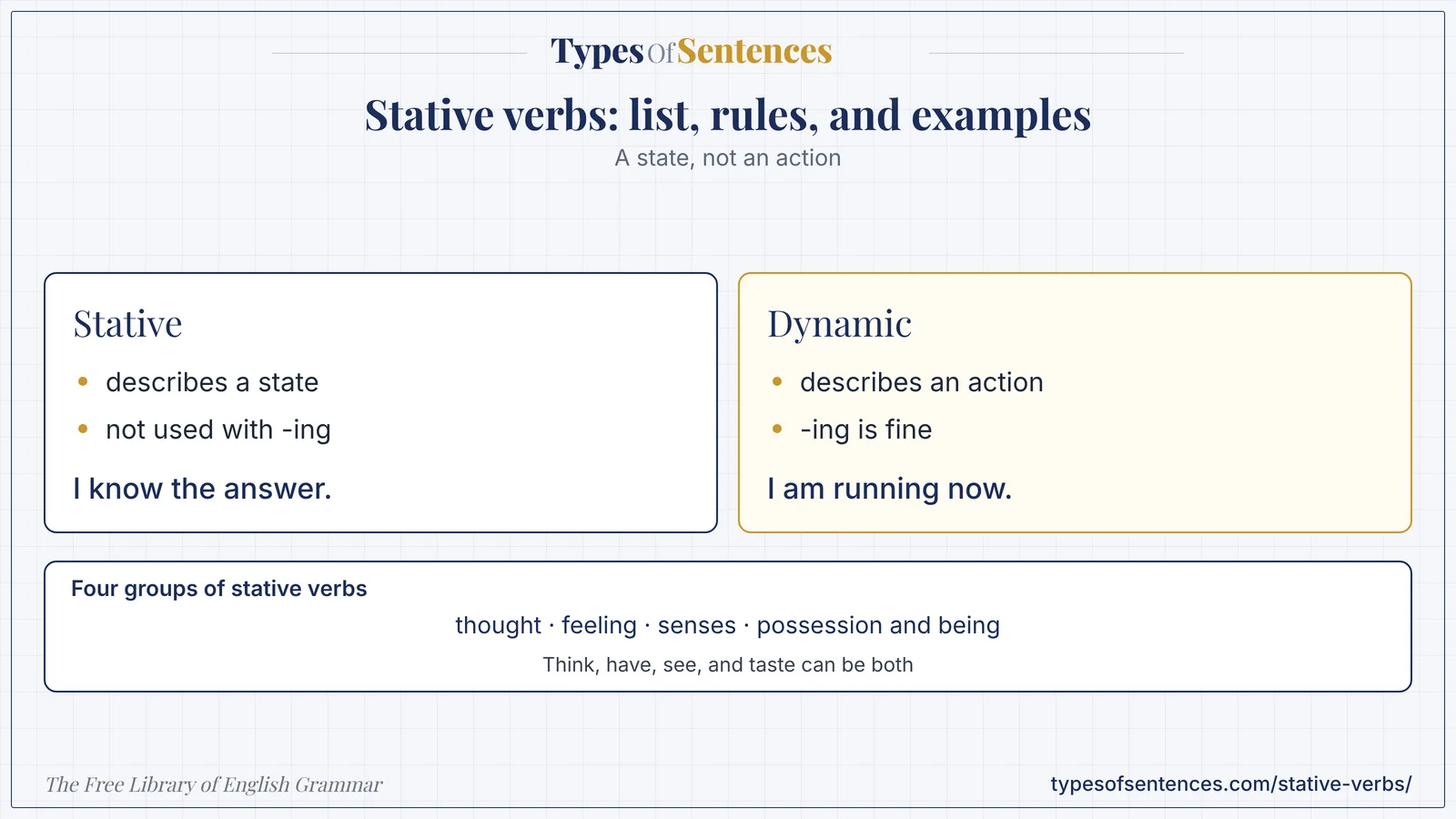
A stative verb tells you how things are. A dynamic verb tells you what someone does. You can watch a person run, but you cannot watch a person know.
Why it matters: Try the -ing test. If I am ___ing right now sounds odd (I am knowing, I am owning), the verb is probably stative.
Summary: Stative verbs describe states: thoughts and opinions (know, believe, understand), feelings and wishes (love, hate, want, prefer), the senses and appearance (seem, appear, sound, smell), and possession and being (have, own, belong, contain, cost, weigh). Dynamic verbs describe actions and events (run, write, build). Most stative verbs are not used in the continuous tenses: I know, not I am knowing. Some verbs have both a stative and a dynamic meaning: I think it is wrong (opinion) and I am thinking about it (mental activity). Informal speech sometimes uses an -ing form for effect (I’m loving it), but careful writing keeps the rule.
- Stative = a state; dynamic = an action.
- Do not use -ing with most stative verbs.
- Think, have, see, taste can be both.
- Test: does the verb fit I am ___ing now?
What You’ll Learn
- 1. Stative Verbs: The Short Answer
- 2. Stative Verbs List With Examples: Thought, Feeling, Senses, and Possession
- 3. Stative and Dynamic Verbs: The Continuous-Tense Rule
- 4. Dual-Meaning Verbs: Stative in One Sense, Dynamic in Another
- 5. When the Rule Bends: I’m Loving It and Other Uses
- 6. Common Mistakes With Stative Verbs
- 7. Exercises
- 8. Test Your Knowledge
- 9. Frequently Asked Questions
- 10. Conclusion
1. Stative Verbs: The Short Answer
| Group | What the verbs describe | Examples |
|---|---|---|
| thought and opinion | what the mind holds | know, believe, understand, doubt, remember, suppose, realize, recognize, forget, agree |
| feeling and wish | emotions and desires | love, hate, like, dislike, want, prefer, need, wish, appreciate, mind |
| senses and appearance | how something seems or is sensed | seem, appear, look, sound, smell, taste, feel, hear, see |
| possession and being | having, containing, measuring, existing | have, own, belong, possess, contain, cost, weigh, consist, exist, mean, matter |
| Stative verbs | Dynamic verbs |
|---|---|
| describe a state or condition | describe an action, process, or event |
| I know the answer. | I run every morning. |
| not normally used in the continuous tenses | freely used in the continuous tenses |
| *I am knowing the answer. | I am running now. |
| no imperative in most cases (*Know the answer!) | imperative is natural (Run!) |
The idea is explained in more detail in the advanced chapter on tense and aspect. A related group of state verbs, the linking verbs, has its own page: see the linking verbs list.
2. Stative Verbs List With Examples: Thought, Feeling, Senses, and Possession
This list of stative verbs has four groups of ten example sentences each, and a fifth group of other state verbs. These stative verbs examples all use the simple present because the sentence describes a state that exists now. Stative verbs examples like these are my own.
| Thought and opinion | Verb |
|---|---|
| I know the answer. | know |
| She believes in hard work. | believe |
| We understand the problem. | understand |
| He doubts that it will work. | doubt |
| They remember the day well. | remember |
| I suppose you are right. | suppose |
| She realizes her mistake. | realize |
| He recognizes your voice. | recognize |
| I forget his name. | forget |
| We agree with the plan. | agree |
| Feeling and wish | Verb |
|---|---|
| I love this song. | love |
| She hates waiting. | hate |
| We like the new house. | like |
| He wants a glass of water. | want |
| They prefer tea to coffee. | prefer |
| I need more time. | need |
| She wishes you well. | wish |
| He dislikes loud noise. | dislike |
| We appreciate your help. | appreciate |
| I mind the heat. | mind |
| Senses and appearance | Verb |
|---|---|
| The soup smells wonderful. | smell |
| The cake tastes sweet. | taste |
| That sounds like a good idea. | sound |
| She seems tired today. | seem |
| He appears calm. | appear |
| The room feels cold. | feel |
| You look happy. | look |
| I hear a noise. | hear |
| I can see the mountains. | see |
| The fabric feels soft. | feel |
| Possession and being | Verb |
|---|---|
| She has a red bicycle. | have |
| He owns two shops. | own |
| The book belongs to me. | belong |
| They possess a large library. | possess |
| This bag contains my laptop. | contain |
| The box weighs ten kilos. | weigh |
| The ticket costs five dollars. | cost |
| The team consists of eight players. | consist |
| The river exists only in the rainy season. | exist |
| This word means “happy.” | mean |
| Other state verbs | Verb |
|---|---|
| It matters to me. | matter |
| She resembles her mother. | resemble |
| The bottle holds a liter. | hold |
| He lacks confidence. | lack |
| That depends on the weather. | depend |
| The tower stands near the river. | stand |
| The plan involves three steps. | involve |
| I owe you an apology. | owe |
| Fish need water. | need |
| This suits you. | suit |
This is not a complete list of stative verbs in English; no list can be, because many verbs are stative in one meaning and dynamic in another. The complete verb inventory by type is in the list of verbs.
3. Stative and Dynamic Verbs: The Continuous-Tense Rule
The key rule for stative and dynamic verbs is this: a stative verb is normally used in the simple tenses, not in the continuous (progressive) tenses. A continuous tense shows an action in progress, and a state is not in progress; it just exists.
| Tense | Stative verb (correct) | Error to avoid |
|---|---|---|
| present | She owns a house. | *She is owning a house. |
| past | We knew the answer. | *We were knowing the answer. |
| present perfect | I have loved this song for years. | *I have been loving this song. (rare in careful writing) |
| future | He will want more time. | *He will be wanting more time. |
| present, a feeling | I like your idea. | *I am liking your idea. |
| present, belonging | This pen belongs to Ravi. | *This pen is belonging to Ravi. |
The simple tenses are explained in the Basic chapter on the present tense and in the Intermediate chapter on the present tenses. The forms of the most common state verb of all, be, are in the page on to be verbs.
4. Dual-Meaning Verbs: Stative in One Sense, Dynamic in Another
Many common verbs have two meanings. In one meaning the verb is stative and avoids -ing; in the other it is dynamic and takes -ing freely. The meaning decides the tense, not the spelling of the verb.
| Verb | Stative meaning | Stative example | Dynamic meaning | Dynamic example |
|---|---|---|---|---|
| think | opinion (stative) | I think it is a good idea. | mental activity (dynamic) | I am thinking about the offer. |
| have | possession (stative) | She has a car. | experience, eat, hold (dynamic) | She is having lunch. |
| see | perceive (stative) | I see the bird. | meet, date, visit (dynamic) | I am seeing the doctor. |
| taste | have a flavor (stative) | The soup tastes salty. | test the flavor (dynamic) | The chef is tasting the soup. |
| smell | have a smell (stative) | The roses smell sweet. | sniff (dynamic) | He is smelling the roses. |
| feel | have a quality (stative) | The silk feels smooth. | touch to find out (dynamic) | She is feeling the fabric. |
| look | seem (stative) | You look tired. | direct your eyes (dynamic) | He is looking at the map. |
| appear | seem (stative) | He appears calm. | perform, come into view (dynamic) | She is appearing in a play. |
| weigh | have a weight (stative) | The bag weighs five kilos. | measure the weight (dynamic) | The clerk is weighing the bag. |
| be | exist (stative) | He is polite. | behave in a way (dynamic) | He is being polite today. |
| expect | believe (stative) | I expect it will rain. | wait for (dynamic) | She is expecting a guest. |
| consider | hold an opinion (stative) | I consider it a mistake. | think carefully (dynamic) | We are considering your offer. |
A quick check: if you can replace the verb with seem, be, or have (a state), keep the simple form. If you can replace it with an action verb such as test, meet, or consider carefully, the continuous form is possible.
5. When the Rule Bends: I’m Loving It and Other Uses
| Use | Example | Comment |
|---|---|---|
| temporary or changing state | You are being silly. | be is dynamic here: it means “behaving” |
| a feeling that is growing | I am liking this book more and more. | acceptable in informal English; a change over time makes it an event |
| informal emphasis | I’m loving it. | a slogan style that is common in speech and advertising; careful writing prefers I love it |
| polite or tentative speech | I was wondering if you could help. | the continuous makes the request softer |
| the verb understand in progress | I am beginning to understand. | the progress is in begin, so the sentence is natural |
| hope, wonder, wish | I am hoping to see you soon. | common and polite; the progressive softens the wish |
Grammar books describe these as exceptions or as shifts of meaning, and usage guides differ in how strict they are. I have not checked every dictionary for each example, so treat the table as a description of how English is commonly used, and follow the style of your teacher, editor, or exam in formal writing.
6. Common Mistakes With Stative Verbs
| Mistake | Example | Correction |
|---|---|---|
| -ing with know | *I am knowing the answer. | I know the answer. |
| -ing with want | *She is wanting a new phone. | She wants a new phone. |
| -ing with belong | *This book is belonging to me. | This book belongs to me. |
| -ing with understand | *I am understanding the lesson. | I understand the lesson. |
| -ing with have (possession) | *He is having a car. | He has a car. |
| -ing with cost | *The ticket is costing ten dollars. | The ticket costs ten dollars. |
| -ing with seem | *He is seeming angry. | He seems angry. |
| wrong meaning of see | *I am seeing the mountains. | I see the mountains. |
| no -ing with a dynamic meaning | *I think about the offer now. (in progress) | I am thinking about the offer. |
| an imperative of a state verb | *Know the answer! | Learn the answer! |
Fix: I am understanding the lesson now, and I am wanting to learn more, but this book is belonging to my sister and she is having it today.
- I am understanding: understand is a state of mind, so I understand.
- I am wanting: a wish is a state, so I want.
- is belonging: possession is a state, so belongs.
- she is having it today: have here means “possess,” so she has it today.
- Result: I understand the lesson now, and I want to learn more, but this book belongs to my sister and she has it today. (the sentence is invented)
Recap in 12 seconds
Watch the lesson build itself: Stative verbs describe states and are not normally used in the continuous tenses; dynamic verbs describe actions. The video has no sound.
Exercises
Part A: Stative or Dynamic? (Exercises 1–10)
Exercise 1: know
Show Answer
Answer: stative.
Exercise 2: run
Show Answer
Answer: dynamic.
Exercise 3: own
Show Answer
Answer: stative.
Exercise 4: build
Show Answer
Answer: dynamic.
Exercise 5: love
Show Answer
Answer: stative.
Exercise 6: write
Show Answer
Answer: dynamic.
Exercise 7: belong
Show Answer
Answer: stative.
Exercise 8: jump
Show Answer
Answer: dynamic.
Exercise 9: seem
Show Answer
Answer: stative.
Exercise 10: cook
Show Answer
Answer: dynamic.
Part B: Choose the Correct Form (Exercises 11–20)
Exercise 11: She (knows / is knowing) the answer.
Show Answer
Answer: knows.
Exercise 12: I (am running / run) in the park now.
Show Answer
Answer: am running (an action in progress).
Exercise 13: This book (belongs / is belonging) to Ravi.
Show Answer
Answer: belongs.
Exercise 14: They (want / are wanting) a bigger house.
Show Answer
Answer: want.
Exercise 15: He (is building / builds) a shed this week.
Show Answer
Answer: is building.
Exercise 16: The soup (tastes / is tasting) salty.
Show Answer
Answer: tastes (it has a flavor).
Exercise 17: The chef (tastes / is tasting) the soup.
Show Answer
Answer: is tasting (an action).
Exercise 18: I (see / am seeing) the mountains.
Show Answer
Answer: see.
Exercise 19: I (see / am seeing) the doctor tomorrow.
Show Answer
Answer: am seeing (meaning “meeting”).
Exercise 20: We (understand / are understanding) the rule.
Show Answer
Answer: understand.
Part C: Dual-Meaning Verbs (Exercises 21–25)
Exercise 21: Which is stative: I think it is wrong or I am thinking about it?
Show Answer
Answer: I think it is wrong (an opinion).
Exercise 22: Which is dynamic: She has a car or She is having lunch?
Show Answer
Answer: She is having lunch.
Exercise 23: Which is correct: He is being rude or He is rude? Which describes behavior now?
Show Answer
Answer: He is being rude describes behavior at the moment; He is rude describes his character.
Exercise 24: Why is The bag is weighing five kilos wrong?
Show Answer
Answer: Weigh is stative here (it has a weight), so The bag weighs five kilos.
Exercise 25: Which is correct for a flavor: It tastes sweet or It is tasting sweet?
Show Answer
Answer: It tastes sweet.
Part D: Correct the Errors (Exercises 26–30)
Exercise 26: Correct: *I am knowing her.
Show Answer
Answer: I know her.
Exercise 27: Correct: *She is wanting some tea.
Show Answer
Answer: She wants some tea.
Exercise 28: Correct: *He is owning two shops.
Show Answer
Answer: He owns two shops.
Exercise 29: Correct: *The ticket is costing ten dollars.
Show Answer
Answer: The ticket costs ten dollars.
Exercise 30: Correct: *They are preferring tea.
Show Answer
Answer: They prefer tea.
Test Your Knowledge
Ready to check what you learned? Answer all 10 questions, then submit. You need 80% (8 of 10) to pass. Your answers are not stored.
View correct answers and explanations
Question 1: A stative verb describes
✓ Correct Answer: A – a state
A state.
Question 2: Which verb is stative?
✓ Correct Answer: B – know
Know.
Question 3: Most stative verbs are not used in the
✓ Correct Answer: C – continuous tenses
Continuous tenses.
Question 4: Which sentence is correct?
✓ Correct Answer: D – She owns a house.
Own is stative.
Question 5: I am thinking about the offer uses think as
✓ Correct Answer: A – a dynamic verb
Mental activity.
Question 6: The soup tastes salty uses taste as
✓ Correct Answer: B – a stative verb
It has a flavor.
Question 7: I am seeing the doctor uses see to mean
✓ Correct Answer: C – meet
Meet.
Question 8: Which verb group is stative?
✓ Correct Answer: D – love, hate, want
Feelings and wishes.
Question 9: The sentence I’m loving it is best described as
✓ Correct Answer: A – informal use that bends the rule
Informal.
Question 10: Another name for stative verbs is
✓ Correct Answer: B – state verbs
State verbs.
Frequently Asked Questions
What are stative verbs?
Stative verbs describe a state, such as a thought, a feeling, a possession, or a condition, rather than an action. Know, love, own, seem, and belong are stative verbs.
What is the difference between stative and dynamic verbs?
Dynamic verbs describe actions and events (run, write, build) and can be used in the continuous tenses. Stative verbs describe states and are normally used in the simple tenses.
Can stative verbs be used in the continuous tenses?
Usually not: I am knowing is wrong. But some verbs have a dynamic meaning too (I am thinking, She is having lunch), and informal English uses a few -ing forms for effect, such as I’m loving it.
Is “be” a stative verb?
Mostly yes: He is tall describes a state. In the continuous it describes behavior: He is being silly means he is acting silly now.
Is “have” stative or dynamic?
Both. In the sense of possession, it is stative (I have a car). In the sense of eat, experience, or hold, it is dynamic (I am having lunch).
Is there a complete list of stative verbs?
No list is complete, because many verbs have both a stative and a dynamic meaning. The groups on this page (thought, feeling, senses, and possession and being) cover the most common stative verbs.
Why do learners find stative verbs difficult?
Many languages use a continuous form for states, so learners say I am knowing or I am wanting. Learning the groups, and checking the meaning of the verb, is the best cure.
Conclusion
You now know what stative verbs are, the four groups, the rule about the continuous tenses, the dual-meaning verbs, and the informal uses that bend the rule. Remember the test: if the verb names a state, use the simple form.
Next, study the other lists in this series, such as the linking verbs and the forms of to be, which are among the most common state verbs.
- Swan, Michael. Practical English Usage. 4th ed. Oxford University Press, 2016.: the entries on verbs not used in the continuous tenses and on verbs with two meanings.
- Huddleston, Rodney, and Geoffrey K. Pullum. The Cambridge Grammar of the English Language. Cambridge University Press, 2002.: the discussion of states, events, and the progressive.
- Biber, Douglas, et al. Longman Grammar of Spoken and Written English. Longman, 1999.: the discussion of verb meaning classes and the progressive.
- Merriam-Webster Dictionary: stative: the dictionary entry (not opened when this page was written).
Last reviewed: October 29, 2026. How it was made: drafted with AI assistance, then checked with automated tests (structure, links, answer keys, spelling) and against the sources above. A person has not yet read this chapter line by line. Found a mistake? Report it.