Conciseness and wordiness are two sides of one question: how many words does it take to say what you mean? A concise sentence gives the reader exactly what they need and nothing else; a wordy sentence makes the reader work through padding to find the point. Wordiness is rarely one big fault. It is made of small habits: a phrase where a word would do, a noun where a verb would do, a sentence opener that says nothing, a pair of words that mean the same. Each costs the reader a moment, and together they make a text tiring, vague, and less credible.
You will study why concise writing matters, how to identify wordiness, techniques for cutting words (before-and-after examples for each), nominalizations and the verbs that replace them, empty phrases, redundancy, and how to be concise without losing meaning, since cutting is not the same as shortening. The aim is tight writing, and avoiding wordiness without losing meaning: not short for its own sake, but with every word doing a job. The chapter also covers eliminating redundancy at the level of single phrases; the wider theory of economy in language is the subject of a later chapter. Thirty editing exercises and a quiz follow.
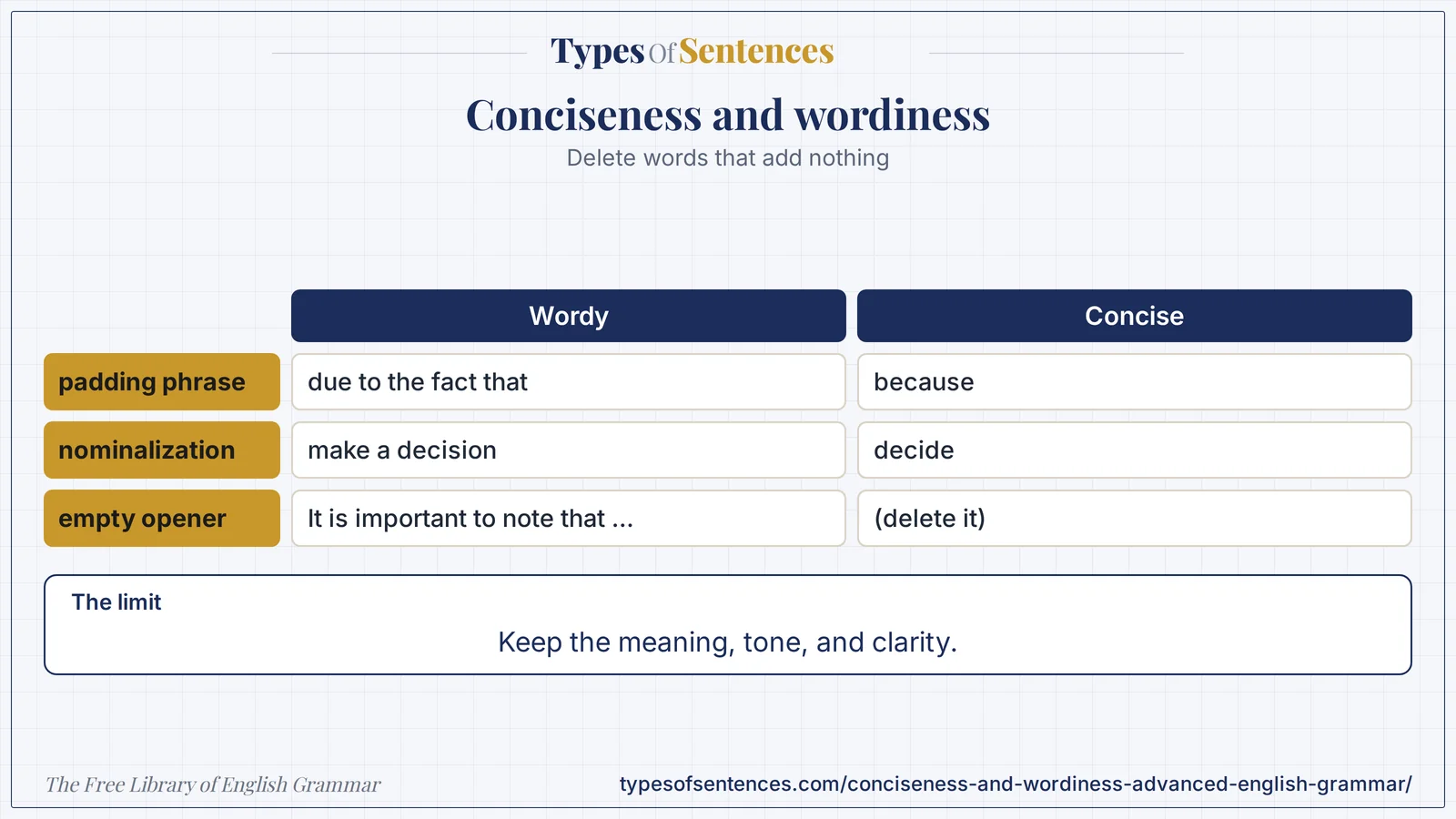
A concise text says what it has to say in the fewest words that still say it clearly. It does not leave out meaning; it leaves out noise: words that repeat, fill, or delay.
Why it matters: The test for every word is simple: if you delete it, does the reader lose anything? If not, delete it. If the meaning becomes unclear, put back what is needed and no more.
Summary: Wordiness has recognizable forms: padding phrases (due to the fact that), nominalizations (make a decision), weak verbs with abstract nouns, empty openers (There is … that, It is important to note that), compound prepositions (with regard to), qualifiers and intensifiers, redundant pairs (added bonus), repetition, and long relative clauses. Techniques for cutting include deleting, replacing a phrase with a word, turning a clause into a phrase or a phrase into a word, using the active voice, choosing strong verbs, and combining sentences. Concise is not the same as short: do not remove articles, connectors, or necessary qualifications, and keep the meaning, tone, and courtesy the text requires.
- Delete words that add nothing.
- Replace phrases with words; nominalizations with verbs.
- Cut empty openers and redundant pairs.
- Keep the meaning, tone, and clarity.
What You’ll Learn
- 1. Conciseness and Wordiness: Why Conciseness Matters
- 2. Identifying Wordiness
- 3. Cutting Unnecessary Words: Techniques and Before-and-After Examples
- 4. Nominalizations: Replace “Make a Decision” with “Decide”
- 5. Empty Phrases and Padding
- 6. Redundancy: Saying the Same Thing Twice
- 7. Being Concise Without Losing Meaning
- 8. Concision in Different Kinds of Writing
- 9. A Process for Editing for Concision
- 10. Common Errors in Concision
- 11. Exercises
- 12. Test Your Knowledge
- 13. Frequently Asked Questions
- 14. Conclusion
1. Conciseness and Wordiness: Why Conciseness Matters
| Reason | Explanation | Example |
|---|---|---|
| respect for the reader | readers have limited time and attention | A short email is read; a long one is postponed. |
| clarity | fewer words leave less room for ambiguity | The committee approved the plan. (not The plan was given approval by the committee) |
| credibility | padding looks like a lack of ideas | a confident sentence is direct |
| professionalism | workplaces value efficiency | a report that gets to the point |
| space limits | word counts, slides, screens, abstracts | a 250-word abstract |
| emphasis | important words stand out when others are cut | — |
| readability | shorter sentences are easier to process | see the chapter on readability |
| Wordy | Concise | Words saved |
|---|---|---|
| In my personal opinion, I am of the view that it would be a good idea for us to hold a meeting at the earliest possible opportunity. | We should meet soon. | 21 → 4 |
| The reason why the project failed was due to the fact that there was a lack of funding. | The project failed because it lacked funding. | 16 → 7 |
| It is a fact that the majority of the students in the class are in possession of a laptop computer. | Most students have a laptop. | 19 → 5 |
| At this point in time, we are in the process of conducting a review of the procedures. | We are reviewing the procedures. | 16 → 5 |
Concise is not the same as short. A long report can be concise if every sentence carries information, and a short note can be wordy if it circles the point. The measure is the proportion of meaning to words. Equally, concision is not telegraphic style: leaving out articles and connectors can make a sentence shorter and harder to read. The discussion of exactness in the chapter on vagueness and precision is the other half of the same discipline.
2. Identifying Wordiness
| Sign of wordiness | Example | What to do |
|---|---|---|
| padding phrase | due to the fact that; in order to; at this point in time | replace with a word: because; to; now |
| nominalization (a verb turned into a noun) | make a decision; conduct an investigation | use the verb: decide; investigate |
| weak verb + abstract noun | give consideration to; have a discussion about | use a strong verb: consider; discuss |
| empty opener | There is a reason why …; It is important to note that … | begin with the real subject |
| compound preposition | with regard to; in relation to; in connection with | about; on; of |
| qualifiers and intensifiers | very, really, quite, rather, somewhat, basically, actually | delete or use a precise word |
| stacked hedges | may possibly perhaps suggest | keep one hedge |
| redundant pair or phrase | added bonus; past history | delete the repeated idea |
| repetition of an idea | the same point in two sentences | keep one |
| passive voice without a reason | The report was written by the team. | The team wrote the report. |
| long relative clauses | The man who is standing at the door | The man standing at the door |
| sentence that restates the question | The question of cost is a question that matters. | Cost matters. |
| meta-discourse (writing about the writing) | As mentioned above; It should be noted that; In this section I will discuss | delete or shorten |
| unneeded that and which | He said that he would go. | He said he would go. |
| doubled negatives or hedges | not unlikely; not without difficulty | likely; difficult |
- Count the words and the ideas. If a sentence has 30 words and one idea, it is probably wordy.
- Search for your habits: very, that, of, in order to, there is/are, it is, the fact that, -tion nouns.
- Find the actor and the action. Make the actor the subject and the action the verb.
- Read aloud. You will hear padding that you cannot see.
3. Cutting Unnecessary Words: Techniques and Before-and-After Examples
| Technique | Before | After |
|---|---|---|
| delete the unnecessary word | The final outcome was totally unexpected. | The outcome was unexpected. |
| replace a phrase with a word | He arrived at the conclusion that the plan was unworkable. | He concluded that the plan was unworkable. |
| replace a clause with a phrase | The man who was standing at the door was my uncle. | The man standing at the door was my uncle. |
| replace a clause with a word | The students who are absent will be marked. | Absent students will be marked. |
| replace a phrase with a word | a report that is of great length | a long report |
| use a possessive for a phrase | the policy of the company | the company’s policy |
| use the active voice | The data were analyzed by the researchers. | The researchers analyzed the data. |
| use a strong verb instead of verb + adverb | He walked quickly. | He hurried. |
| use a verb instead of be + adjective | She is supportive of the plan. | She supports the plan. |
| cut the empty opener | There are many students who prefer online classes. | Many students prefer online classes. |
| cut it is … that | It was in 2019 that the company moved. | The company moved in 2019. |
| reduce a prepositional chain | the implementation of the strategy for the improvement of the quality of service | implementing the strategy to improve service quality |
| combine sentences | We tested the device. The device was new. The test was in May. | We tested the new device in May. |
| use an appositive | Dr. Rao is the head of the department. She spoke first. | Dr. Rao, head of the department, spoke first. |
| cut repeated information | The report is long and detailed, and it contains many details. | The report is long and detailed. |
| cut the qualifier | It is very important and quite essential. | It is essential. |
| delete that | He said that he would come. | He said he would come. |
| use a participle phrase | Because he was tired, he went to bed. | Tired, he went to bed. |
| replace there is/are with a real verb | There is a need for more data. | We need more data. |
| replace a negative with a positive | He did not remember the date. | He forgot the date. |
| turn a list of verbs into one | She looked at and examined the sample. | She examined the sample. |
| cut meta-discourse | In this section, I will discuss the results. | (begin with the results) |
| Wordy paragraph | Edited |
|---|---|
| It is of the utmost importance that all employees should make sure that they are in possession of the relevant documentation prior to the commencement of the training session which will take place on Monday morning. | All employees must bring the relevant documents to Monday’s training. |
| In the event that the system should fail to function in a manner that is correct, the user should make an attempt to restart the system. | If the system fails, restart it. |
Many of these techniques are the reverse of the nominalizing, passive, and subordinating habits of formal prose, and they overlap with the principles of the chapters on voice and complex noun phrases. A short sentence is not always better; the aim is the sentence with no waste.
4. Nominalizations: Replace “Make a Decision” with “Decide”
| Wordy (verb + nominalization) | Concise verb |
|---|---|
| make a decision | decide |
| conduct an investigation of | investigate |
| give consideration to | consider |
| provide assistance to | help |
| perform an analysis of | analyze |
| reach a conclusion | conclude |
| make an assumption | assume |
| have a discussion about | discuss |
| take action | act |
| make an improvement in | improve |
| make a suggestion | suggest |
| give an explanation of | explain |
| make a comparison of | compare |
| make a recommendation | recommend |
| place emphasis on | emphasize |
| make an attempt to | try |
| carry out an evaluation of | evaluate |
| come to an agreement | agree |
| is in violation of | violates |
| has an effect on | affects |
| make use of | use |
| give approval to | approve |
| make a payment | pay |
| reach a settlement | settle |
| conduct a survey of | survey |
| draw a distinction between | distinguish |
| is a reflection of | reflects |
| come to a realization | realize |
| perform a review of | review |
| make an announcement | announce |
| When nominalization is useful | Example |
|---|---|
| to name a process as an abstract subject or topic | The investigation revealed several errors. |
| to refer back to what was just said (cohesion) | The committee decided to close the office. This decision surprised many staff. |
| for technical terms | population growth; heat transfer |
| to compress a clause into a noun phrase in dense academic text | the rapid expansion of the city |
| when the agent is unknown and the process is the topic | the destruction of the forest |
Nominalization is not always a fault: it is a feature of formal and academic writing and it creates the “this + noun” links that give a text cohesion (see the chapter on cohesion and coherence). The fault is the weak verb with a nominalization as its object (make + decision) where a single strong verb would do. Writers should test each nominalization: Is there a simple verb? Does the noun serve as a topic? Is the sentence stiff?
5. Empty Phrases and Padding
| Empty phrase | Concise | Example |
|---|---|---|
| the fact that | delete or recast | Despite the fact that it rained → Although it rained |
| due to the fact that; owing to the fact that | because; since | Because the road was closed, … |
| in spite of the fact that | although; though | — |
| in order to | to | He left early to catch the train. |
| it is important to note that | delete | (begin with the point) |
| needless to say | delete | If it is needless, do not say it. |
| as a matter of fact | in fact; delete | — |
| at this point in time; at the present time | now; currently | — |
| for all intents and purposes | virtually; essentially | — |
| in the event that | if | — |
| in the near future | soon | — |
| with regard to; with respect to; in relation to | about; on; for | — |
| the reason why | the reason; why | — |
| has the ability to; is able to | can | — |
| a number of | several; many; some | — |
| in terms of | delete or recast | In terms of cost, the plan is cheap. → The plan is cheap. |
| on a daily basis | daily | — |
| of a technical nature | technical | — |
| the question as to whether | whether | — |
| whether or not | whether (usually) | — |
| all of the | all the | — |
| each and every | each; every | — |
| by means of | by; with | — |
| in close proximity to | near | — |
| for the purpose of | for; to | — |
| prior to; subsequent to | before; after | — |
| until such time as | until | — |
| in the majority of cases | usually; often | — |
| it is a fact that | delete | — |
| it goes without saying that | delete | — |
| When “in order to” and similar phrases are fine | Example |
|---|---|
| to avoid ambiguity with a following infinitive of purpose | He saved money in order to buy a house, to travel, and to retire. |
| with a negative purpose | We left early in order not to miss the train. (or so as not to) |
| for rhythm or emphasis in formal speech | — |
| a legal or technical phrase with a fixed meaning | pursuant to; subject to |
Empty phrases creep in when we write the way we speak at our slowest, thinking as we go. They are easy to find and easy to cut, and removing them is the quickest way to improve a draft. But check each cut: a phrase that seems empty may be doing a job, for instance marking a hedge or a courtesy (I would like to ask whether in a polite request).
6. Redundancy: Saying the Same Thing Twice
| Redundant | Concise | Why redundant |
|---|---|---|
| added bonus | bonus | a bonus is already added |
| absolutely essential | essential | essential is absolute |
| advance planning | planning | planning is done in advance |
| basic fundamentals | fundamentals | fundamentals are basic |
| close proximity | proximity; near | proximity means closeness |
| completely finished | finished | finished is complete |
| end result; final outcome | result; outcome | a result comes at the end |
| free gift | gift | a gift is free |
| future plans | plans | plans are for the future |
| join together; combine together | join; combine | join includes together |
| past history | history | history is past |
| repeat again | repeat | repeat means again |
| unexpected surprise | surprise | a surprise is unexpected |
| very unique | unique | unique is absolute |
| true fact | fact | a fact is true |
| sum total | total | — |
| circle around | circle | — |
| new innovation | innovation | an innovation is new |
| each and every | each; every | — |
| first and foremost | first | — |
| various different | various; different | — |
| mutual cooperation | cooperation | — |
| exact same | same | — |
| consensus of opinion | consensus | consensus means general agreement of opinion |
| return back; revert back | return; revert | return includes back |
| the reason is because | the reason is that | the reason and because duplicate each other (usage debated) |
| ATM machine; PIN number | ATM; PIN | the abbreviation already contains the noun (a style choice) |
| whether or not | whether | often |
| close together | together (or close) | — |
| ask the question | ask | — |
| Redundancy that serves a purpose | Example |
|---|---|
| legal doublets (precision and tradition) | null and void; terms and conditions |
| emphasis in speech or rhetoric | Never, ever, again. |
| clarity for listeners | the 10 o’clock hour; the PIN number |
| educational definitions | a “fiction” (invented story) |
| redundancy in instructions and safety warnings | Do not touch. Do not touch the red wire. |
| idioms with a fixed form | safe and sound; part and parcel |
Redundancy (pleonasm) is the use of more words than needed to convey the meaning. Some redundancy is useful: language is redundant by design, so that a message survives noise, and writers repeat to emphasize. The task in editing is to remove the redundancy that does no work, and to keep the redundancy that serves the reader. The phrase revert back, for example, is common in some varieties of English and can be replaced by return or reply for international readers. The theory of linguistic economy is discussed in a later chapter, on redundancy and economy.
7. Being Concise Without Losing Meaning
| Danger of over-cutting | Example | Fix |
|---|---|---|
| losing a needed qualification | Cut: The drug cures cancer. (the original: in some mice, in some conditions) | restore the qualification |
| removing articles and connectors (telegraphic style) | Council approve plan, residents oppose | Council approved the plan, but residents opposed it. |
| ambiguity from compression | Replace the filter and gasket if worn. | Replace the filter. Replace the gasket if it is worn. |
| stacked noun phrases | university student housing policy committee review report | the report of the committee reviewing the university’s student-housing policy |
| losing courtesy and tone | Send the report. | Could you send the report by Friday? |
| losing the logic | dropping because or therefore | keep the links that show reasoning |
| cutting examples that make a point concrete | — | keep the one that helps |
| cutting definitions the reader needs | — | define the term |
| unreadable density | a paragraph of long, packed sentences | split for readability |
| Original | Over-cut | Balanced |
|---|---|---|
| I am writing to ask whether you would be able to send me the report, because I need it for the meeting on Friday. | Send report. Meeting Friday. | Could you send me the report? I need it for Friday’s meeting. |
| The results suggest that the treatment may reduce symptoms in some patients, although further research is needed. | Treatment reduces symptoms. | The treatment may reduce symptoms in some patients; more research is needed. |
- Cut padding, not content. If you are unsure, restore the word and see whether the meaning changes.
- Keep needed qualifications and hedges. Accuracy comes before economy.
- Keep the tone. A request needs courtesy; a condolence needs warmth.
- Respect the genre. Legal and technical documents may need words that look redundant.
- Do not cut so far that the reader must guess.
- Test: give the text to a reader, or read it after a break. Is anything missing?
8. Concision in Different Kinds of Writing
| Genre | Concision means | Example |
|---|---|---|
| academic writing | precise, compact noun phrases and no padding; hedges are kept | The data suggest a decline. (not It would appear that the data may perhaps suggest …) |
| business writing | purpose and action first; short paragraphs | Please approve the budget by Friday. |
| technical writing | one action per step; no filler | Remove the cover. |
| legal writing | exact words; avoid unnecessary doublets but keep necessary precision | The Tenant must pay rent on the first day of each month. |
| digital writing | front-loaded; scannable | Download the guide. |
| journalism | the lead has the point; no clichés | The council approved the budget on Tuesday. |
| creative writing | every word earns its place; but rhythm may need extra words | — |
| speech | some repetition helps listeners | — |
The relation of concision to other genres is discussed in the chapters on business writing and writing for digital media. Concision is a value in each, but the amount of cutting that is right depends on the reader and the purpose.
9. A Process for Editing for Concision
- Cut at the structural level first: whole paragraphs and sentences that repeat or do not serve the point.
- Cut at the sentence level: combine, reduce clauses, remove openers.
- Cut at the word level: padding phrases, nominalizations, redundant pairs, qualifiers.
- Replace weak verbs and passives (where the actor matters).
- Check the meaning against the original: nothing needed should be lost.
- Read aloud for rhythm and to catch over-cutting.
- Proofread (see the chapter on editing and proofreading).
| Search term | Look for |
|---|---|
| very, really, quite, rather, somewhat | delete or replace with a precise word |
| that, which | delete if the sentence reads well without it |
| there is, there are, it is | replace with the real subject and verb |
| of the | shorten the noun phrase |
| in order to | to |
| -tion, -ment, -ance | nominalizations |
| to be + past participle | passives |
| and … and … and | combine or restructure |
| the fact that | recast |
| as mentioned, it should be noted | delete |
Many editors suggest that most first drafts can lose a tenth or more of their words without any loss of meaning. This is a rough guide only, not a rule, and the aim is always the clearest text, not a target number.
10. Common Errors in Concision
| Error | Example | Fix |
|---|---|---|
| padding phrase | due to the fact that | because |
| nominalization | We made a decision to conduct an investigation. | We decided to investigate. |
| empty opener | There are many reasons why people migrate. | People migrate for many reasons. |
| redundant pair | added bonus; past history | bonus; history |
| qualifier overuse | very, really, quite, rather | delete |
| doubled hedges | may possibly perhaps | may |
| passive without a reason | Mistakes were made by us. | We made mistakes. |
| redundant restatement | The report is long, and it is lengthy. | The report is long. |
| meta-discourse | In this section, we will now discuss … | (begin) |
| over-cutting articles | Council approve plan | The council approved the plan. |
| over-cutting hedges | The drug cures cancer. | The drug may help some patients. |
| stacked nouns | university student housing policy | the university’s housing policy for students |
| cutting courtesy | Send it. | Could you send it, please? |
| unnecessary that | He said that he would go. | He said he would go. |
| long relative clause | The man who is standing at the door | The man standing at the door |
| wordy comparison | as compared to; in comparison with | compared with; than |
Edit: It is a fact that, due to the fact that there are a large number of students who make use of the library on a daily basis, the library management has come to the decision to make a conduct of an investigation into the possibility of the extension of its hours, which is very, very important and absolutely essential, and in the near future a new added bonus will be given to each and every user.
- It is a fact that, due to the fact that there are a large number of students who make use of: padding, empty opener, and weak verb: Many students use.
- on a daily basis: daily.
- has come to the decision to make a conduct of an investigation into the possibility of the extension of its hours: nominalizations: has decided to investigate extending its hours.
- which is very, very important and absolutely essential: intensifiers and redundancy: (delete; or: which is essential).
- in the near future: soon.
- a new added bonus will be given to each and every user: redundancy and passive: users will receive a bonus.
- Result: Many students use the library daily, so the library management has decided to investigate extending its hours. Users will soon receive a bonus. (the library is invented; 77 words become 25)
Recap in 12 seconds
Watch the lesson build itself: Wordiness takes recognizable forms: padding phrases, nominalizations, and empty openers. The video has no sound.
Exercises
Part A: Why and Identifying (Exercises 1–6)
Exercise 1: Is concise the same as short?
Show Answer
Answer: No.
Exercise 2: Name three signs of wordiness.
Show Answer
Answer: Padding phrases, nominalizations, empty openers, redundancy, qualifiers.
Exercise 3: What is a nominalization?
Show Answer
Answer: A verb turned into a noun.
Exercise 4: What is meta-discourse?
Show Answer
Answer: Writing about the writing (As mentioned above …).
Exercise 5: What is the test for each word?
Show Answer
Answer: Does the reader lose anything if it is deleted?
Exercise 6: Why read aloud?
Show Answer
Answer: To hear padding and over-cutting.
Part B: Cutting Techniques (Exercises 7–13)
Exercise 7: Cut: The final outcome was totally unexpected.
Show Answer
Answer: The outcome was unexpected.
Exercise 8: Replace the clause: The students who are absent will be marked.
Show Answer
Answer: Absent students will be marked.
Exercise 9: Cut the opener: There are many students who prefer online classes.
Show Answer
Answer: Many students prefer online classes.
Exercise 10: Active: The data were analyzed by the researchers.
Show Answer
Answer: The researchers analyzed the data.
Exercise 11: Combine: We tested the device. The device was new.
Show Answer
Answer: We tested the new device.
Exercise 12: Use a possessive: the policy of the company
Show Answer
Answer: the company’s policy.
Exercise 13: Reduce: The man who was standing at the door
Show Answer
Answer: The man standing at the door.
Part C: Nominalizations and Empty Phrases (Exercises 14–22)
Exercise 14: Verb for make a decision:
Show Answer
Answer: decide.
Exercise 15: Verb for conduct an investigation of:
Show Answer
Answer: investigate.
Exercise 16: Verb for give consideration to:
Show Answer
Answer: consider.
Exercise 17: Verb for provide assistance to:
Show Answer
Answer: help.
Exercise 18: Replace due to the fact that:
Show Answer
Answer: because.
Exercise 19: Replace in order to:
Show Answer
Answer: to.
Exercise 20: Replace at this point in time:
Show Answer
Answer: now.
Exercise 21: Replace in the event that:
Show Answer
Answer: if.
Exercise 22: Replace has the ability to:
Show Answer
Answer: can.
Part D: Redundancy (Exercises 23–27)
Exercise 23: Cut the redundancy: added bonus
Show Answer
Answer: bonus.
Exercise 24: Cut: past history
Show Answer
Answer: history.
Exercise 25: Cut: very unique
Show Answer
Answer: unique.
Exercise 26: Cut: return back
Show Answer
Answer: return.
Exercise 27: Name a useful redundancy.
Show Answer
Answer: Legal doublets, emphasis, warnings, instructions for clarity.
Part E: Balance (Exercises 28–30)
Exercise 28: Why not cut articles to save space?
Show Answer
Answer: It makes the text telegraphic and harder to read.
Exercise 29: What may over-cutting lose?
Show Answer
Answer: Qualifications, courtesy, logic, clarity.
Exercise 30: Balanced version: I am writing to ask whether you would be able to send me the report.
Show Answer
Answer: Could you send me the report?
Test Your Knowledge
Ready to check what you learned? Answer all 10 questions, then submit. You need 80% (8 of 10) to pass. Your answers are not stored.
View correct answers and explanations
Question 1: Which is the concise form of due to the fact that?
✓ Correct Answer: A – because
Because.
Question 2: Which verb replaces make a decision?
✓ Correct Answer: B – decide
Decide.
Question 3: Which is redundant?
✓ Correct Answer: C – added bonus
Added bonus.
Question 4: Which is a nominalization?
✓ Correct Answer: D – conduct an investigation
A noun from a verb with a weak verb.
Question 5: Which is the concise form?
✓ Correct Answer: C – Many students prefer online classes.
Direct.
Question 6: Which is concise and keeps the meaning?
✓ Correct Answer: A – The outcome was unexpected.
Outcome.
Question 7: Which risks over-cutting?
✓ Correct Answer: D – Council approve plan
Telegraphic style.
Question 8: Which replaces in order to?
✓ Correct Answer: C – to
To.
Question 9: Which is a sign of wordiness?
✓ Correct Answer: B – empty openers
Empty openers.
Question 10: Which redundancy can serve a purpose?
✓ Correct Answer: B – null and void
A legal doublet.
Frequently Asked Questions
What is the difference between conciseness and wordiness?
Conciseness is saying what is needed in the fewest words that remain clear; wordiness is the use of more words than needed. Conciseness and wordiness are matters of the proportion of meaning to words.
What is concise writing?
Concise writing gives the reader what they need without padding: strong verbs, precise nouns, and no empty phrases or redundancy. Concise writing is not the same as short writing.
How do I avoid wordiness?
Cut empty phrases, replace nominalizations with verbs, remove empty openers, avoid redundant pairs, and use the active voice. Avoiding wordiness starts with finding your own habits.
What is tight writing?
Tight writing is writing in which every word does a job: nothing is repeated, filled, or delayed. Tight writing keeps the meaning and removes the noise.
How do I eliminate redundancy?
Look for words that repeat an idea already in the sentence (added bonus, past history) and delete one. Eliminating redundancy also means checking which repetition serves emphasis or safety, and keeping that.
Can writing be too concise?
Yes. Cutting articles, connectors, qualifications, or courtesy can make a text unclear, abrupt, or inaccurate. Check that the meaning and the tone survive.
What is a nominalization?
A nominalization is a noun made from a verb or adjective, such as decision from decide. Weak verbs with nominalizations (make a decision) are a common cause of wordiness.
Conclusion
You now have a deep study of conciseness and wordiness: why concision matters, the signs of wordiness, techniques for cutting, nominalizations, empty phrases, redundancy, and the limits of cutting. You can edit a draft for economy without losing meaning.
When you edit, delete a word and ask whether the reader will miss it. Next, you will study diction and precise word choice.
- Strunk, William, Jr., and E. B. White. The Elements of Style. 4th ed. Longman, 2000.: the classic advice to omit needless words.
- Williams, Joseph M., and Joseph Bizup. Style: Lessons in Clarity and Grace. 12th ed. Pearson, 2017.: nominalization, actors, and actions.
- Garner, Bryan A. Garner’s Modern English Usage. 5th ed. Oxford University Press, 2022.: usage entries on redundancy and wordy phrases.
- Zinsser, William. On Writing Well. 30th anniversary ed. Harper, 2006.: clutter and simplicity.
- Merriam-Webster Dictionary: concise: the dictionary entry.
Last reviewed: October 29, 2026. How it was made: drafted with AI assistance, then checked with automated tests (structure, links, answer keys, spelling) and against the sources above. A person has not yet read this chapter line by line. Found a mistake? Report it.