Prefixes and suffixes are the building blocks of English vocabulary. A prefix is added to the beginning of a word (un- + happy = unhappy), and a suffix is added to the end (happy + -ness = happiness). Together they are called affixes. Knowing a few dozen of them lets you work out the meaning of hundreds of words and build new ones.
This chapter covers the word formation basics. You will see how English creates new words overall, study the common prefixes and suffixes, learn the spelling rules for adding them, and see how conversion (to email), compounding (blackboard), and blending (brunch) work. You will also study word roots and root words and affixes in families (act, action, active, activity) and how affixes change meaning, word class, and stress. Thirty exercises and a quiz follow.
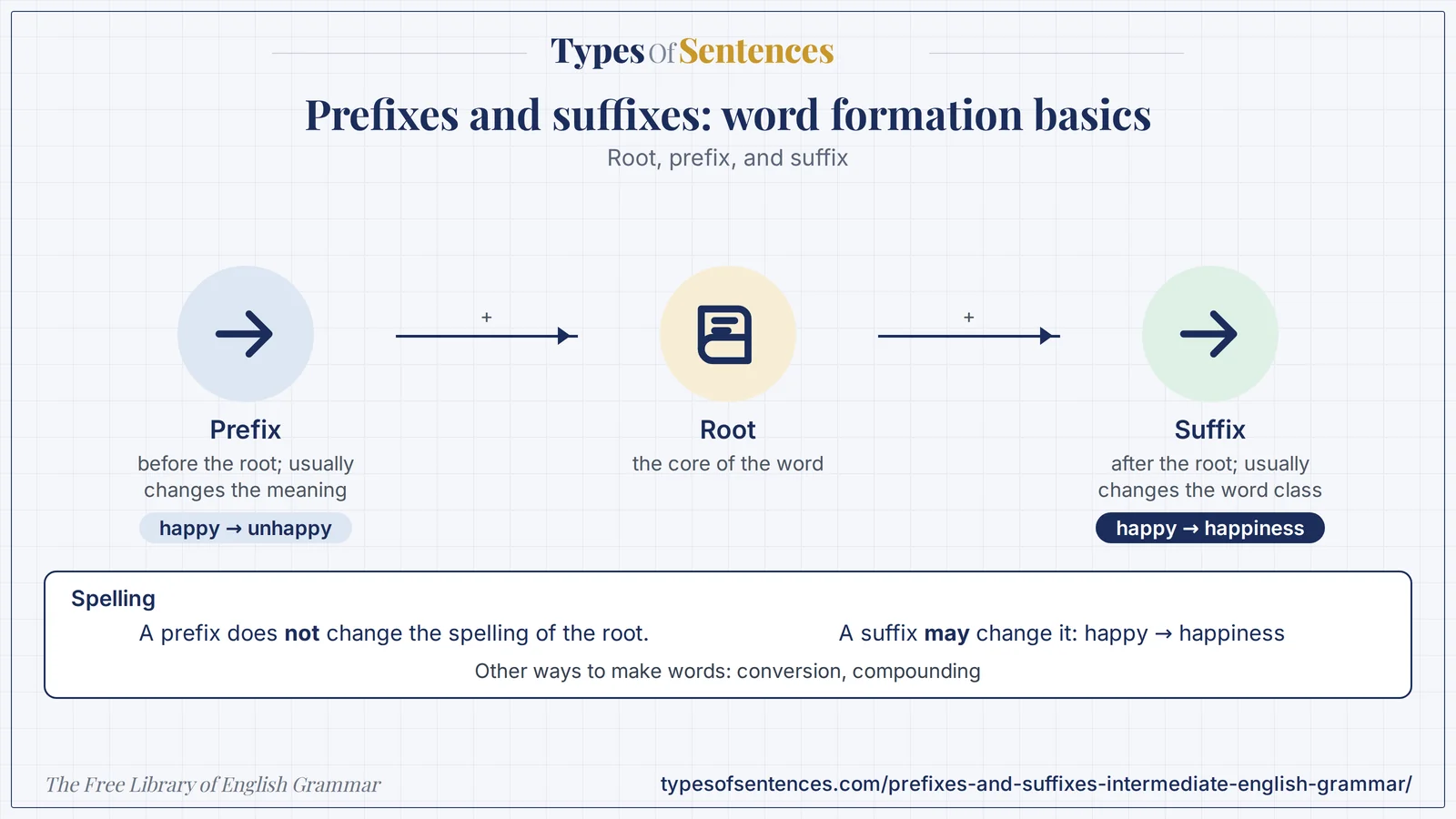
A word often has parts. In unhappiness, the root is happy, un- makes it negative, and -ness turns the adjective into a noun. If you know the parts, you can guess the meaning of new words.
Why it matters: Affixes also tell you the part of speech: -tion and -ness make nouns, -able and -ful make adjectives, -ize makes verbs, and -ly makes adverbs.
Summary: A prefix goes before a root and usually changes its meaning (happy → unhappy); a suffix goes after and usually changes its word class (happy → happiness). Other ways to make words are conversion (changing the class without changing the form), compounding (joining words), blending, clipping, and acronyms. Words can be grouped in families by their roots (act, action, active).
- Prefix = before; suffix = after; root = the core.
- Most prefixes change meaning; most suffixes change word class.
- Adding a prefix does not change the spelling of the root.
- Adding a suffix may change the spelling (happy → happiness).
What You’ll Learn
- 1. Prefixes and Suffixes: How English Creates New Words
- 2. Prefixes: Un-, Re-, Pre-, Mis-, Dis-, Over-
- 3. Suffixes: -ness, -ment, -tion, -able, -ful
- 4. Spelling Rules for Suffixes
- 5. Conversion: Changing Word Class
- 6. Compounding and Blending: Blackboard, Toothpaste, Brunch
- 7. Word Roots: Root Words and Affixes in Families
- 8. How Affixes Change Meaning, Word Class, and Stress
- 9. Common Errors with Prefixes and Suffixes
- 10. Exercises
- 11. Test Your Knowledge
- 12. Frequently Asked Questions
- 13. Conclusion
1. Prefixes and Suffixes: How English Creates New Words
English makes new words in several ways. Affixation, the addition of prefixes and suffixes, is the most productive. The other main processes are in the table.
| Process | What it does | Example |
|---|---|---|
| affixation | adds a prefix or suffix to a base | happy → unhappy, happiness |
| conversion | changes the word class with no change in form | email (noun) → to email (verb) |
| compounding | joins two or more words | blackboard, toothpaste, mother-in-law |
| blending | joins parts of two words | brunch (breakfast + lunch), smog (smoke + fog) |
| clipping | shortens a word | phone (telephone), exam (examination) |
| acronyms and initialisms | forms a word from initial letters | NASA, laser; ATM, FBI |
| back-formation | makes a shorter word from a longer one | edit (from editor), enthuse (from enthusiasm) |
| borrowing | takes a word from another language | pizza, kindergarten, bungalow |
| coinage | invents a new word | google (as a verb) |
| Term | Meaning | Example |
|---|---|---|
| morpheme | the smallest unit of meaning | un-, happy, -ness |
| root | the core of a word, which carries its main meaning | act in action |
| base (stem) | the form to which an affix is added | happy in unhappy |
| affix | a prefix or suffix | un-, -ness |
| derived word | a word made with affixes | unhappiness |
2. Prefixes: Un-, Re-, Pre-, Mis-, Dis-, Over-
A prefix is added to the beginning of a word. It changes the meaning and, in most cases, not the word class: happy and unhappy are both adjectives. Adding a prefix does not change the spelling of the base.
| Meaning | Prefixes | Examples |
|---|---|---|
| not (negative) | un-, in-, im-, il-, ir-, non-, dis-, a- | unhappy, incorrect, impossible, illegal, irregular, nonstop, dislike, atypical |
| the opposite action (reversal) | un-, de-, dis- | undo, defrost, disconnect |
| again | re- | redo, rewrite, rebuild |
| before | pre-, fore-, ante- | preview, foresee, antechamber |
| after | post- | postwar, postpone |
| wrongly | mis- | misunderstand, misspell |
| too much, above | over-, super-, hyper- | overwork, superhuman, hyperactive |
| too little, below | under-, sub-, infra- | underpaid, submarine, infrared |
| with, together | co-, com-, con- | cooperate, combine, connect |
| between | inter- | international, interact |
| across, through | trans- | transport, translate |
| one, two, three, many | uni-, bi-, tri-, multi- | unicycle, bicycle, triangle, multicolor |
| half | semi-, demi-, hemi- | semicircle |
| against | anti-, counter- | antiwar, counterclaim |
| out, beyond | out-, ex- | outgrow, export |
| self | auto- | autobiography |
| Negative prefix | Rule of thumb | Examples |
|---|---|---|
| un- | the most common; with adjectives, participles, and verbs | unhappy, unknown, undo |
| in- (il-, im-, ir-) | from Latin; il- before l, im- before b, m, p, ir- before r | inactive, illegal, impossible, irregular |
| dis- | opposite or removal | disagree, disappear |
| non- | simple negation, often hyphenated before a capital letter | nonfiction, non-English |
| a- | without (Greek) | atypical, amoral |
The negative prefixes are not interchangeable: it is impossible but unlikely, illegal but unfair. No rule predicts which one a word takes, so check a dictionary when you are unsure.
3. Suffixes: -ness, -ment, -tion, -able, -ful
A suffix is added to the end of a word. Most suffixes change the word class: a noun suffix makes a noun, an adjective suffix makes an adjective, and so on.
| Makes | Suffixes | Examples |
|---|---|---|
| nouns (from verbs) | -tion, -sion, -ment, -ance, -ence, -al, -er, -or, -ing | action, decision, movement, performance, arrival, teacher, actor, building |
| nouns (from adjectives) | -ness, -ity, -ism, -dom | happiness, ability, realism, freedom |
| nouns (people) | -er, -or, -ist, -ian, -ant, -ee | teacher, actor, artist, musician, assistant, employee |
| nouns (state or group) | -hood, -ship, -dom | childhood, friendship, kingdom |
| adjectives | -able, -ible, -ful, -less, -ous, -ive, -al, -ic, -y, -ish, -ary | readable, flexible, helpful, careless, famous, active, national, basic, rainy, childish, ordinary |
| verbs | -ize (-ise), -ify, -en, -ate | modernize, simplify, widen, activate |
| adverbs | -ly, -ward, -wise | quickly, homeward, clockwise |
| Suffix | Meaning | Examples |
|---|---|---|
| -ful | full of | careful, helpful, joyful |
| -less | without | careless, helpless, homeless |
| -able / -ible | can be, able to be | readable, comfortable; flexible, visible |
| -ness | state or quality | kindness, darkness |
| -ment | result or action | agreement, movement |
| -tion / -sion | action or result | creation, decision |
| -er / -or | one who does | teacher, visitor |
| -ist | a person who practices | artist, scientist |
| -ly | in a way | slowly, happily |
These word-class changes are the basis of the parts of speech: for example, a noun from a verb (teach → teacher) or an adverb from an adjective (quick → quickly). See the chapters on nouns, adjective types, and adverbs.
4. Spelling Rules for Suffixes
| Rule | Example |
|---|---|
| drop a silent e before a suffix that begins with a vowel | make → making, hope → hoping, create → creation |
| keep the e before a suffix that begins with a consonant | hope → hopeful, move → movement, care → careless |
| keep e to keep a soft c or g sound | notice → noticeable, courage → courageous |
| change y to i after a consonant (before most suffixes) | happy → happiness, happily, beauty → beautiful |
| keep y before -ing | carry → carrying |
| double the final consonant (one-syllable words and stressed final syllables, consonant–vowel–consonant) | run → running, begin → beginning, stop → stopped |
| do not double after two consonants or an unstressed syllable | help → helped, open → opening |
| -ful loses one l | careful, not carefull |
| -ly after -ic becomes -ically | basic → basically |
| -ly after -le loses the e | gentle → gently |
Add the suffix: (a) happy + -ness, (b) hope + -ing, (c) begin + -ing, (d) love + -ly, (e) basic + -ly.
- (a) happiness (y changes to i).
- (b) hoping (drop the silent e).
- (c) beginning (double n; stressed final syllable).
- (d) lovely (keep e before a consonant suffix).
- (e) basically (-ic + -ally).
5. Conversion: Changing Word Class
Conversion is the change of a word’s class with no change in form. It is very common in English because the language has few inflections.
| From | To | Examples |
|---|---|---|
| noun → verb | verb | to email, to text, to bottle, to chair a meeting, to google |
| verb → noun | noun | a run, a walk, a swim, a cry, a find |
| adjective → verb | verb | to clean, to empty, to calm |
| adjective → noun | noun | the poor, the young, a regular |
| phrase → noun | noun | a must-have, a has-been |
Some converted pairs differ in stress: the noun is stressed on the first syllable and the verb on the second: a REcord / to reCORD, a PERmit / to perMIT, an INcrease / to inCREASE. Verbs such as run and walk as nouns are often used with a light verb: take a walk, have a swim.
6. Compounding and Blending: Blackboard, Toothpaste, Brunch
| Type | Form | Examples |
|---|---|---|
| closed compound | one word | blackboard, toothpaste, notebook, sunflower |
| hyphenated compound | joined by a hyphen | mother-in-law, well-known, long-term |
| open compound | two words | ice cream, post office, high school |
| blend | parts of two words | brunch, smog, motel, infotainment, spork |
| clipped compound | a shortened word plus a word | sitcom, e-mail |
- The last part usually names the kind of thing (a blackboard is a board; a bookshop is a shop). This part is the head.
- The first part is stressed in many compounds: BLACKboard (a classroom board), versus the phrase black BOARD (a board that is black).
- The plural is made on the head: toothbrushes, mothers-in-law (the head comes first here).
- Dictionaries disagree on whether a compound is open, hyphenated, or closed; check a current dictionary. Over time, many compounds move from open to hyphenated to closed.
| Clipping and acronym | Full form |
|---|---|
| phone | telephone |
| exam | examination |
| gym | gymnasium |
| NASA | National Aeronautics and Space Administration |
| laser | light amplification by stimulated emission of radiation |
| ATM | automated teller machine (spoken as letters) |
7. Word Roots: Root Words and Affixes in Families
Many English words come from Latin and Greek roots. Knowing a root unlocks a whole family of words.
| Root | Meaning | Family |
|---|---|---|
| act (Latin agere) | do, drive | act, action, active, activity, actor, react, enact |
| port | carry | transport, import, export, portable, porter, support |
| dict | say | dictate, predict, contradict, dictionary, verdict |
| spect | look | inspect, spectator, respect, perspective, expect |
| scrib / script | write | describe, prescription, manuscript, script, subscribe |
| struct | build | structure, construct, destroy, instruct |
| vis / vid | see | vision, visit, video, evidence, invisible |
| bio | life | biology, biography, antibiotic |
| graph | write, draw | photograph, autograph, graphic |
| phon | sound | telephone, microphone, phonetics |
| tele | far | television, telescope, telephone |
| aud | hear | audio, audience, audible |
- act → action → active → activity → activate one root, many words
- port → transport → transportation → portable prefix and suffix on a root
- spect → inspect → inspector → inspection a family by suffix
8. How Affixes Change Meaning, Word Class, and Stress
| Change | Example | Note |
|---|---|---|
| meaning only (prefix) | happy → unhappy | the class stays the same |
| word class only (suffix) | teach → teacher (verb → noun) | meaning is related |
| meaning and class | unhappy → unhappiness | both change |
| stress moves with some suffixes | PHOtograph → phoTOgrapher → photoGRAPHic | suffixes such as -ic, -ion, -ity pull the stress |
| stress stays with others | HAPpy → HAPpiness | suffixes such as -ness, -ful, -ly do not move it |
| spelling and pronunciation change | decide → decision, divide → division | the final consonant changes |
There are two main kinds of suffix. Inflectional suffixes mark grammar and do not change the word class: -s (plural, third person), -ed, -ing, -er/-est. Derivational suffixes build new words: -ness, -ment, -able. Inflection is studied in the chapter on verbs and nouns, and both kinds are described in the chapter on morphology at the Advanced level.
9. Common Errors with Prefixes and Suffixes
| Error | Correction | Rule |
|---|---|---|
| inpossible | impossible | im- before p |
| unregular | irregular | ir- before r |
| dislegal | illegal | il- before l |
| happyness | happiness | y changes to i |
| carefull | careful | -ful has one l |
| writting | writing | no doubling after a silent-e drop |
| begining | beginning | double the final consonant (stressed syllable) |
| definately | definitely | -ite + -ly |
| basicly | basically | -ic + -ally |
| misspel | misspell | mis- + spell (two l’s) |
Irregardless is widely considered nonstandard because ir- and -less both mean “without”. Use regardless.
Careful: flammable and inflammable mean the same thing (in- here is an intensifier, not a negative). Safety labels use flammable to avoid confusion. This is one reason to check a dictionary before you trust a prefix.
Recap in 12 seconds
Watch the lesson build itself: A prefix goes before a root and changes meaning; a suffix goes after and usually changes the word class. The video has no sound.
Exercises
Part A: Terms and Processes (Exercises 1–6)
Exercise 1: Define prefix.
Show Answer
Answer: An affix added to the beginning of a word.
Exercise 2: Define suffix.
Show Answer
Answer: An affix added to the end of a word.
Exercise 3: Name the root of unhappiness.
Show Answer
Answer: happy.
Exercise 4: Which process: brunch?
Show Answer
Answer: Blending.
Exercise 5: Which process: to email?
Show Answer
Answer: Conversion (noun to verb).
Exercise 6: Which process: phone from telephone?
Show Answer
Answer: Clipping.
Part B: Prefixes (Exercises 7–14)
Exercise 7: Opposite of happy with a prefix:
Show Answer
Answer: unhappy.
Exercise 8: Add a prefix meaning “again”: ___ write
Show Answer
Answer: re- (rewrite).
Exercise 9: Add a prefix meaning “wrongly”: ___ understand
Show Answer
Answer: mis- (misunderstand).
Exercise 10: Add a prefix meaning “before”: ___ view
Show Answer
Answer: pre- (preview).
Exercise 11: Choose: (in/im)possible
Show Answer
Answer: impossible.
Exercise 12: Choose: (il/ir)regular
Show Answer
Answer: irregular.
Exercise 13: Choose: (il/im)legal
Show Answer
Answer: illegal.
Exercise 14: What does over- mean in overwork?
Show Answer
Answer: Too much.
Part C: Suffixes and Word Class (Exercises 15–20)
Exercise 15: Make a noun: kind + -ness
Show Answer
Answer: kindness.
Exercise 16: Make an adjective: help + -ful
Show Answer
Answer: helpful.
Exercise 17: Make an adjective meaning “without care”:
Show Answer
Answer: careless.
Exercise 18: Make a verb: modern + -ize
Show Answer
Answer: modernize.
Exercise 19: Make an adverb: quick + -ly
Show Answer
Answer: quickly.
Exercise 20: What word class does -tion usually make?
Show Answer
Answer: Noun.
Part D: Spelling (Exercises 21–25)
Exercise 21: Add -ing: hope
Show Answer
Answer: hoping.
Exercise 22: Add -ness: happy
Show Answer
Answer: happiness.
Exercise 23: Add -ing: begin
Show Answer
Answer: beginning.
Exercise 24: Add -ly: basic
Show Answer
Answer: basically.
Exercise 25: Add -ful: care
Show Answer
Answer: careful (one l).
Part E: Compounds, Roots, Errors (Exercises 26–30)
Exercise 26: Closed, hyphenated, or open: blackboard
Show Answer
Answer: Closed.
Exercise 27: Plural of mother-in-law:
Show Answer
Answer: mothers-in-law.
Exercise 28: Name two words from the root port.
Show Answer
Answer: transport, import (also export, portable, support).
Exercise 29: Fix it: happyness
Show Answer
Answer: happiness.
Exercise 30: Fix it: irregardless
Show Answer
Answer: regardless.
Test Your Knowledge
Ready to check what you learned? Answer all 10 questions, then submit. You need 80% (8 of 10) to pass. Your answers are not stored.
View correct answers and explanations
Question 1: What is a prefix?
✓ Correct Answer: C – An affix at the beginning of a word
A prefix goes at the beginning.
Question 2: What is a suffix?
✓ Correct Answer: B – An affix at the end of a word
A suffix goes at the end.
Question 3: Which is correct?
✓ Correct Answer: B – impossible
Im- before p.
Question 4: Which is correct?
✓ Correct Answer: D – happiness
Y changes to i.
Question 5: Which is a blend?
✓ Correct Answer: C – brunch
Brunch is breakfast + lunch.
Question 6: Which is a clipped word?
✓ Correct Answer: D – phone
Phone is clipped from telephone.
Question 7: What does the suffix -less mean?
✓ Correct Answer: A – without
-less means without.
Question 8: What does the prefix mis- mean?
✓ Correct Answer: A – wrongly
Mis- means wrongly.
Question 9: What is the plural of mother-in-law?
✓ Correct Answer: B – mothers-in-law
The plural is made on the head.
Question 10: What does the root port mean?
✓ Correct Answer: C – carry
Port means carry.
Frequently Asked Questions
What are prefixes and suffixes?
Prefixes and suffixes are affixes. A prefix is added to the beginning of a word and usually changes its meaning (unhappy); a suffix is added to the end and usually changes its word class (happiness).
What are word formation basics?
The word formation basics are the main ways English makes new words: affixation (prefixes and suffixes), conversion, compounding, blending, clipping, acronyms, back-formation, and borrowing.
What are word roots?
Word roots are the core parts of words that carry the main meaning, often from Latin or Greek: act in action, port in transport, dict in predict.
What is compounding?
Compounding is the joining of two or more words to make a new word, such as blackboard, toothpaste, or mother-in-law. A compound may be closed, hyphenated, or open.
What are root words and affixes?
Root words and affixes are the parts of derived words: the root carries the core meaning, and the affixes (prefixes and suffixes) add meaning or change the word class, as in un-happi-ness.
How do spelling rules change when I add a suffix?
Often the final letter of the base changes: drop a silent e before a vowel suffix (making), change y to i (happiness), and double a final consonant after a short stressed vowel (beginning).
How can prefixes and suffixes help me with vocabulary?
Learn the common affixes and roots, and break unfamiliar words into parts to guess their meaning: un- + predict + -able means “cannot be predicted.” Then confirm with the context and a dictionary.
Conclusion
You now know the basics of word formation: how English makes new words, the common prefixes and suffixes, the spelling rules for suffixes, conversion, compounding, blending, clipping, root families, and how affixes change meaning, word class, and stress. You can break down unfamiliar words and avoid the common errors.
Choose five new words you meet this week and divide each into root, prefix, and suffix. Next, you begin the last part of the Intermediate level: common errors and review.
- Merriam-Webster Dictionary: prefix: the dictionary definition of a prefix.
- Purdue Online Writing Lab: Grammar: reference sections on words and spelling.
- Quirk, Randolph, et al. A Comprehensive Grammar of the English Language. Longman, 1985.: word-formation (affixation, conversion, compounding).
- Huddleston, Rodney, and Geoffrey K. Pullum. The Cambridge Grammar of the English Language. Cambridge University Press, 2002.: inflection and derivation.
Last reviewed: October 29, 2026. How it was made: drafted with AI assistance, then checked with automated tests (structure, links, answer keys, spelling) and against the sources above. A person has not yet read this chapter line by line. Found a mistake? Report it.