Irregular plural nouns are nouns whose plural does not end in the regular -s or -es. The plural of child is children, the plural of mouse is mice, and the plural of sheep is sheep. English has a small group of these nouns, but they are among the most common words, so every learner must know them.
This page gives a list of irregular plural nouns grouped by rule: 150 words in twelve groups. The irregular plural nouns examples cover the common words and the Latin and Greek plurals that appear in school and academic writing; the list is not every rare word in the language. The page also shows nouns with two plurals, the exceptions to the -ves rule, the common mistakes, 30 exercises, and a 10-question quiz.
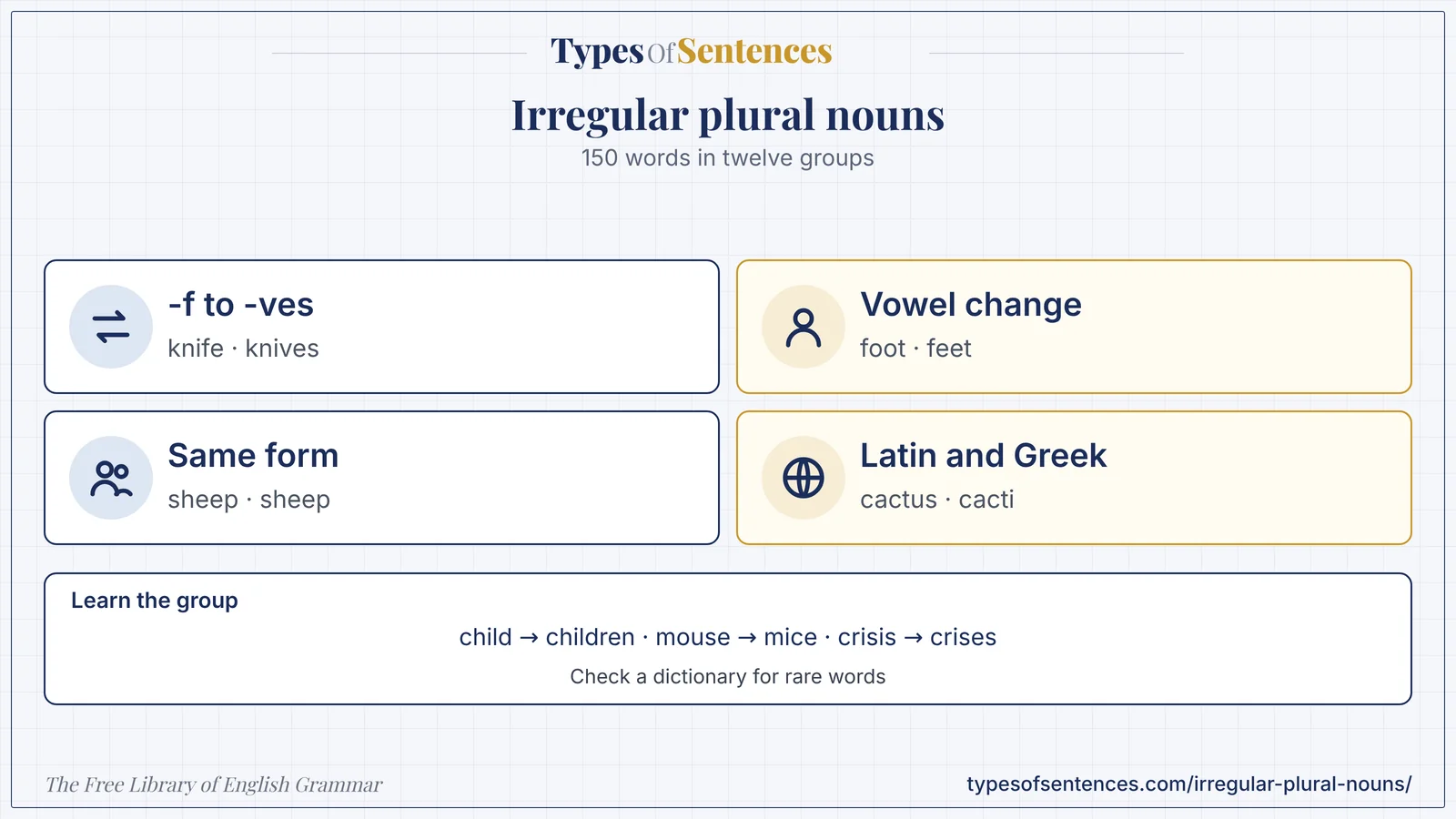
Most nouns add -s in the plural. Some do not. You have to learn these.
Why it matters: Groups help: many nouns that end in -f take -ves, and many Latin words keep their Latin plural.
Summary: Irregular plural nouns do not form the plural with -s. They follow patterns: -f/-fe to -ves (knife, knives), a vowel change (foot, feet), -en (child, children), no change (sheep), and Latin or Greek endings (cactus, cacti; datum, data; crisis, crises; appendix, appendices). Some nouns have two plurals (index, indexes or indices), and some are used only in the plural (scissors). When in doubt, check a current dictionary.
- -f to -ves: knife, knives.
- Vowel change: foot, feet.
- Same form: sheep.
- Latin and Greek: crisis, crises.
What You’ll Learn
- 1. Irregular Plural Nouns: The Short Answer
- 2. List of Irregular Plural Nouns by Rule
- 3. Nouns With Two Plurals
- 4. Nouns That Keep -s After -f
- 5. Nouns Ending in -o
- 6. Irregular Plural Nouns in Sentences: 20 Examples
- 7. Common Mistakes With Irregular Plurals
- 8. Exercises
- 9. Test Your Knowledge
- 10. Frequently Asked Questions
- 11. Conclusion
1. Irregular Plural Nouns: The Short Answer
| Group | Pattern | Example |
|---|---|---|
| -f or -fe | change to -ves | knife, knives |
| vowel change | change the vowel | foot, feet |
| -en | add or change | child, children |
| same form | no change | sheep, sheep |
| Latin -us | change to -i | cactus, cacti |
| Latin -a | change to -ae | larva, larvae |
| Latin -um | change to -a | datum, data |
| Greek -is | change to -es | crisis, crises |
| -ix, -ex | change to -ices | index, indices |
| plural only | no singular form | scissors |
The regular plural is explained in the chapters linked above. In this page the term irregular means that the plural does not follow the regular rule.
2. List of Irregular Plural Nouns by Rule
This list of irregular plural nouns has 150 words in twelve groups. Each group has one rule, so you can learn the pattern and not only the words.
1. Change -f or -fe to -ves (13 words)
| Singular | Plural |
|---|---|
| calf | calves |
| elf | elves |
| half | halves |
| knife | knives |
| leaf | leaves |
| life | lives |
| loaf | loaves |
| self | selves |
| sheaf | sheaves |
| shelf | shelves |
| thief | thieves |
| wife | wives |
| wolf | wolves |
2. Change the vowel (20 words)
| Singular | Plural |
|---|---|
| businesswoman | businesswomen |
| chairwoman | chairwomen |
| congressman | congressmen |
| craftsman | craftsmen |
| fireman | firemen |
| foot | feet |
| gentleman | gentlemen |
| goose | geese |
| horseman | horsemen |
| louse | lice |
| man | men |
| mouse | mice |
| nobleman | noblemen |
| policeman | policemen |
| postman | postmen |
| salesman | salesmen |
| spokesman | spokesmen |
| sportsman | sportsmen |
| tooth | teeth |
| woman | women |
3. Add -en or change the whole word (6 words)
| Singular | Plural |
|---|---|
| brother | brethren |
| child | children |
| die | dice |
| ox | oxen |
| penny | pence |
| person | people |
4. The singular and plural are the same (22 words)
| Singular | Plural |
|---|---|
| aircraft | aircraft |
| barracks | barracks |
| bison | bison |
| cod | cod |
| crossroads | crossroads |
| deer | deer |
| elk | elk |
| fish | fish |
| headquarters | headquarters |
| hovercraft | hovercraft |
| means | means |
| moose | moose |
| offspring | offspring |
| reindeer | reindeer |
| salmon | salmon |
| series | series |
| sheep | sheep |
| spacecraft | spacecraft |
| species | species |
| squid | squid |
| swine | swine |
| trout | trout |
5. Latin nouns ending in -us change to -i (12 words)
| Singular | Plural |
|---|---|
| alumnus | alumni |
| bacillus | bacilli |
| cactus | cacti |
| focus | foci |
| fungus | fungi |
| hippopotamus | hippopotami |
| locus | loci |
| nucleus | nuclei |
| radius | radii |
| stimulus | stimuli |
| syllabus | syllabi |
| terminus | termini |
6. Latin nouns ending in -a change to -ae (8 words)
| Singular | Plural |
|---|---|
| alga | algae |
| alumna | alumnae |
| amoeba | amoebae |
| antenna | antennae |
| formula | formulae |
| larva | larvae |
| nebula | nebulae |
| vertebra | vertebrae |
7. Latin nouns ending in -um change to -a (16 words)
| Singular | Plural |
|---|---|
| addendum | addenda |
| aquarium | aquaria |
| bacterium | bacteria |
| candelabrum | candelabra |
| curriculum | curricula |
| datum | data |
| erratum | errata |
| maximum | maxima |
| medium | media |
| memorandum | memoranda |
| millennium | millennia |
| ovum | ova |
| spectrum | spectra |
| stadium | stadia |
| stratum | strata |
| symposium | symposia |
8. Greek and Latin nouns ending in -is change to -es (16 words)
| Singular | Plural |
|---|---|
| analysis | analyses |
| axis | axes |
| basis | bases |
| crisis | crises |
| diagnosis | diagnoses |
| ellipsis | ellipses |
| emphasis | emphases |
| hypothesis | hypotheses |
| neurosis | neuroses |
| oasis | oases |
| paralysis | paralyses |
| parenthesis | parentheses |
| prognosis | prognoses |
| synopsis | synopses |
| synthesis | syntheses |
| thesis | theses |
9. Nouns ending in -ix or -ex change to -ices (8 words)
| Singular | Plural |
|---|---|
| apex | apices |
| appendix | appendices |
| codex | codices |
| helix | helices |
| index | indices |
| matrix | matrices |
| vertex | vertices |
| vortex | vortices |
10. Greek nouns ending in -on change to -a (5 words)
| Singular | Plural |
|---|---|
| automaton | automata |
| criterion | criteria |
| ganglion | ganglia |
| phenomenon | phenomena |
| polyhedron | polyhedra |
11. French nouns ending in -eau add -x or -s (6 words)
| Singular | Plural |
|---|---|
| bureau | bureaux |
| chateau | chateaux |
| gateau | gateaux |
| plateau | plateaux |
| tableau | tableaux |
| trousseau | trousseaux |
12. Nouns that are used only in the plural (18 words)
| Singular | Plural |
|---|---|
| belongings | belongings |
| binoculars | binoculars |
| cattle | cattle |
| clothes | clothes |
| glasses | glasses |
| goods | goods |
| jeans | jeans |
| outskirts | outskirts |
| pajamas | pajamas |
| pants | pants |
| pliers | pliers |
| police | police |
| savings | savings |
| scissors | scissors |
| shorts | shorts |
| thanks | thanks |
| trousers | trousers |
| tweezers | tweezers |
3. Nouns With Two Plurals
| Singular | Plurals |
|---|---|
| cactus | cacti or cactuses |
| formula | formulae or formulas |
| index | indices or indexes |
| appendix | appendices or appendixes |
| syllabus | syllabi or syllabuses |
| focus | foci or focuses |
| bureau | bureaux or bureaus |
| hoof | hooves or hoofs |
| scarf | scarves or scarfs |
| dwarf | dwarfs or dwarves |
| fungus | fungi or funguses |
| antenna | antennae or antennas |
| shrimp | shrimp or shrimps |
| fish | fish or fishes |
| buffalo | buffalo or buffaloes |
| zero | zeros or zeroes |
In many of these pairs the Latin plural is more common in academic writing, and the regular plural is more common in everyday writing: indices in mathematics, indexes in a book. Use the form that fits your readers and keep to it throughout a text. A dictionary lists which form it prefers.
4. Nouns That Keep -s After -f
Not every noun ending in -f changes to -ves. These nouns add only -s:
| Singular | Plural |
|---|---|
| roof | roofs |
| chief | chiefs |
| belief | beliefs |
| cliff | cliffs |
| safe | safes |
| gulf | gulfs |
| proof | proofs |
| chef | chefs |
| handkerchief | handkerchiefs |
| reef | reefs |
| Singular | Plural | Rule |
|---|---|---|
| leaf | leaves | change to -ves |
| roof | roofs | add -s |
| life | lives | change to -ves |
| belief | beliefs | add -s |
There is no rule that predicts which group a word is in, so learn the common exceptions. If the singular ends in -ff (cliff, staff), the plural usually adds -s.
5. Nouns Ending in -o
| Singular | Plural |
|---|---|
| potato | potatoes |
| tomato | tomatoes |
| hero | heroes |
| echo | echoes |
| veto | vetoes |
| torpedo | torpedoes |
| piano | pianos |
| photo | photos |
| radio | radios |
| video | videos |
| kilo | kilos |
| zoo | zoos |
Nouns ending in -o are a separate problem. Potato, tomato, hero, echo, and veto add -es. Words for music, short forms, and words that come from other languages (piano, photo, kilo, radio) usually add -s. Nouns where a vowel comes before the -o add -s (zoo, zoos; video, videos). These are tendencies, not rules without exceptions, so check a dictionary.
6. Irregular Plural Nouns in Sentences: 20 Examples
| # | Sentence |
|---|---|
| 1 | The children played with the mice. |
| 2 | Two women and three men waited. |
| 3 | She lost three teeth. |
| 4 | The geese flew over the fields. |
| 5 | The farmer keeps sheep and oxen. |
| 6 | The wolves howled at night. |
| 7 | The shelves hold many knives. |
| 8 | Both wives told stories about their lives. |
| 9 | The data are in the appendix. |
| 10 | The criteria for the prize are clear. |
| 11 | The analyses showed two main causes. |
| 12 | These phenomena are rare. |
| 13 | The bacteria multiply quickly. |
| 14 | The alumni gave money to the school. |
| 15 | We studied the stimuli in the experiment. |
| 16 | The crises ended in May. |
| 17 | The cacti grow slowly in the desert. |
| 18 | The media report the news. |
| 19 | The deer ran into the woods. |
| 20 | The scissors are on the desk. |
Look at the verb after each plural noun. A noun like data or media may be treated as plural or as a group noun depending on the style guide. The rules for choosing a verb are in the Basic chapter on subject-verb agreement, and the plural of a possessive is covered in the guide to possessive nouns. The related topic of determiners (these phenomena, this phenomenon) matters here as well.
7. Common Mistakes With Irregular Plurals
| Mistake | Example | Correction |
|---|---|---|
| adding -s to an irregular plural | *childrens | children |
| adding -s to a plural that already shows the plural | *mices, *peoples (for a group of persons) | mice; people |
| regular plural of man or woman | *mans, *womans | men, women |
| regular plural of foot or tooth | *foots, *tooths | feet, teeth |
| -ves where it does not belong | *rooves, *chieves | roofs, chiefs |
| singular form for a plural | *These criterion are clear. | These criteria are clear. |
| plural used as singular | *This phenomena is rare. | This phenomenon is rare. |
| wrong Latin ending | *two cactusi | two cacti (or cactuses) |
| adding -s to an unchanged plural | *sheeps, *deers | sheep, deer |
| apostrophe in a plural | *the childrens’ toys | the children’s toys |
Fix: The childs saw three mouses, two sheeps, and a dozen knifes, and the datas about the bacterias were in two appendixs.
- childs: an irregular plural, so children.
- mouses: so mice.
- sheeps: the plural is unchanged, so sheep.
- knifes: the -fe changes to -ves, so knives.
- datas: data is already plural, so data; bacterias becomes bacteria; appendixs becomes appendices (or appendixes).
- Result: The children saw three mice, two sheep, and a dozen knives, and the data about the bacteria were in two appendices. (the sentence is invented)
Recap in 12 seconds
Watch the lesson build itself: Irregular plural nouns do not add -s; they follow patterns such as -ves, a vowel change, no change, and Latin or Greek endings. The video has no sound.
Exercises
Part A: Give the Plural (Exercises 1–10)
Exercise 1: child
Show Answer
Answer: children.
Exercise 2: mouse
Show Answer
Answer: mice.
Exercise 3: knife
Show Answer
Answer: knives.
Exercise 4: foot
Show Answer
Answer: feet.
Exercise 5: sheep
Show Answer
Answer: sheep.
Exercise 6: woman
Show Answer
Answer: women.
Exercise 7: wolf
Show Answer
Answer: wolves.
Exercise 8: tooth
Show Answer
Answer: teeth.
Exercise 9: life
Show Answer
Answer: lives.
Exercise 10: goose
Show Answer
Answer: geese.
Part B: Latin and Greek Plurals (Exercises 11–20)
Exercise 11: cactus
Show Answer
Answer: cacti (or cactuses).
Exercise 12: crisis
Show Answer
Answer: crises.
Exercise 13: datum
Show Answer
Answer: data.
Exercise 14: analysis
Show Answer
Answer: analyses.
Exercise 15: bacterium
Show Answer
Answer: bacteria.
Exercise 16: criterion
Show Answer
Answer: criteria.
Exercise 17: phenomenon
Show Answer
Answer: phenomena.
Exercise 18: alumnus
Show Answer
Answer: alumni.
Exercise 19: larva
Show Answer
Answer: larvae.
Exercise 20: thesis
Show Answer
Answer: theses.
Part C: Choose the Correct Form (Exercises 21–25)
Exercise 21: The roofs/rooves are red.
Show Answer
Answer: roofs.
Exercise 22: Two potatos/potatoes
Show Answer
Answer: potatoes.
Exercise 23: These criterion/criteria are clear.
Show Answer
Answer: criteria.
Exercise 24: Three sheep/sheeps
Show Answer
Answer: sheep.
Exercise 25: The pianos/pianoes
Show Answer
Answer: pianos.
Part D: Correct the Errors (Exercises 26–30)
Exercise 26: Correct: *two mans
Show Answer
Answer: two men
Exercise 27: Correct: *the childrens toys
Show Answer
Answer: the children’s toys
Exercise 28: Correct: *three mouses
Show Answer
Answer: three mice
Exercise 29: Correct: *This phenomena is rare.
Show Answer
Answer: This phenomenon is rare.
Exercise 30: Correct: *two knifes
Show Answer
Answer: two knives
Test Your Knowledge
Ready to check what you learned? Answer all 10 questions, then submit. You need 80% (8 of 10) to pass. Your answers are not stored.
View correct answers and explanations
Question 1: The plural of child is
✓ Correct Answer: D – children
Irregular.
Question 2: The plural of sheep is
✓ Correct Answer: A – sheep
Unchanged.
Question 3: The plural of cactus can be
✓ Correct Answer: B – cacti
Latin plural.
Question 4: The singular of criteria is
✓ Correct Answer: C – criterion
Greek.
Question 5: The plural of knife is
✓ Correct Answer: D – knives
-fe to -ves.
Question 6: The plural of roof is
✓ Correct Answer: A – roofs
Add -s.
Question 7: The plural of crisis is
✓ Correct Answer: B – crises
-is to -es.
Question 8: Which noun is used only in the plural?
✓ Correct Answer: C – scissors
Plural only.
Question 9: The plural of woman is
✓ Correct Answer: D – women
Vowel change.
Question 10: The plural of potato is
✓ Correct Answer: A – potatoes
Add -es.
Frequently Asked Questions
What are irregular plural nouns?
Irregular plural nouns are nouns that form the plural in a way other than adding -s or -es, such as child, children and mouse, mice.
How many irregular plurals are there in English?
There is no single agreed number, because it depends on what a writer counts as irregular. This page lists 150 words in twelve groups; the common ones are a small set, but many words from Latin and Greek are less common.
Is there a list of irregular plural nouns?
Yes. This page gives a list of irregular plural nouns by rule, with examples. For every word not on the list, check a current dictionary.
Which irregular plural nouns have no change?
Nouns such as sheep, deer, fish, moose, series, and species have the same singular and plural form.
Is “data” singular or plural?
Data is the plural of datum. Many writers now use it as a singular group noun, and style guides differ, so follow the guide your teacher or publisher uses.
Why do some words have two plurals?
Some nouns came from Latin or Greek, and English also gave them a regular plural. Indexes and indices are both correct, but they are used in different contexts.
What is the plural of a word ending in -f?
Many nouns change -f or -fe to -ves (leaf, leaves), but some add only -s (roof, roofs). Learn the exceptions.
Conclusion
You now know the main groups of irregular plural nouns and the exceptions. You have seen 150 words in twelve groups, the nouns with two plurals, and the common mistakes.
Use the irregular plural nouns examples above as a model, learn the groups first, check a dictionary for rare words, and use one form throughout a text. Next, study the other lists in this series, such as the collective nouns.
- Quirk, Randolph, et al. A Comprehensive Grammar of the English Language. Longman, 1985.: the account of irregular plurals.
- Huddleston, Rodney, and Geoffrey K. Pullum. The Cambridge Grammar of the English Language. Cambridge University Press, 2002.: the chapter on nouns and number.
- Garner, Bryan A. Garner’s Modern English Usage. 5th ed. Oxford University Press, 2022.: the entries on plurals, data, and Latin forms.
- Merriam-Webster Dictionary: plural: the dictionary entry (not opened when this page was written). The word lists were written from general knowledge and not checked word by word against a dictionary.
Last reviewed: October 29, 2026. How it was made: drafted with AI assistance, then checked with automated tests (structure, links, answer keys, spelling) and against the sources above. A person has not yet read this chapter line by line. Found a mistake? Report it.