What are compound nouns? A compound noun is a noun made of two or more words that work together as one noun with one meaning: toothbrush, mother-in-law, and ice cream are compound nouns. The words can be joined (a closed compound), joined with hyphens (a hyphenated compound), or written separately (an open compound). The meaning is often more than the sum of the parts: a blackboard need not be black, and a hot dog is not a hot animal.
This page lists 200 compound nouns examples in three groups (80 closed, 40 hyphenated, and 80 open) and explains the types of compound nouns by pattern. It shows how to form the plural and the possessive, why the spelling of a compound varies, and the common mistakes. It ends with 30 exercises and a 10-question quiz. The classification is a teaching grouping; dictionaries sometimes list a word in a different form.
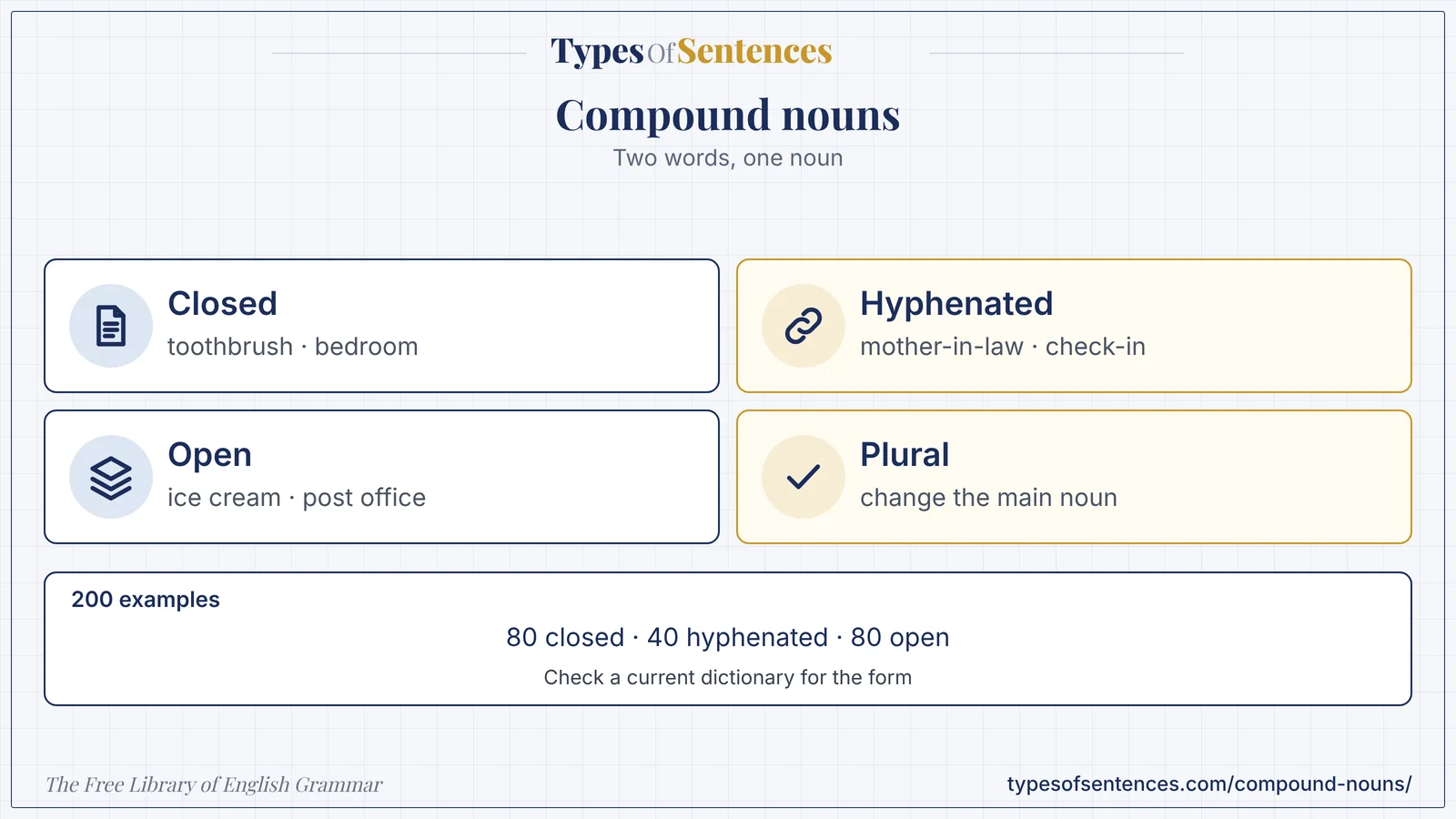
A compound noun is two words that have become one name. A sunflower is not just a sun and a flower; it is one kind of plant.
Why it matters: The last word is usually the main noun. A toothbrush is a kind of brush, a bookshop is a kind of shop.
Summary: A compound noun combines two or more words into one noun. There are three written forms: closed (toothbrush), hyphenated (mother-in-law), and open (ice cream). Common patterns: noun + noun (bedroom), adjective + noun (blackboard), verb + noun (pickpocket), noun + verb (sunrise), and noun + prepositional phrase (editor-in-chief). To form the plural, change the main noun: toothbrushes, mothers-in-law, ice creams, but passersby. The form of a compound can change over time and differs between dictionaries, so check a current dictionary.
- Closed: toothbrush.
- Hyphenated: mother-in-law.
- Open: ice cream.
- Plural: change the main noun.
What You’ll Learn
- 1. Compound Nouns: The Short Answer
- 2. Closed Compound Nouns: 80 Examples
- 3. Hyphenated Compound Nouns: 40 Examples
- 4. Open Compound Nouns: 80 Examples
- 5. Types of Compound Nouns by Pattern
- 6. Plurals and Possessives of Compound Nouns
- 7. Compound Nouns in Sentences: 20 Examples
- 8. Common Mistakes With Compound Nouns
- 9. Exercises
- 10. Test Your Knowledge
- 11. Frequently Asked Questions
- 12. Conclusion
1. Compound Nouns: The Short Answer
| Form | How it is written | Examples | Number in this list |
|---|---|---|---|
| closed compound nouns | one word | toothbrush, bedroom, notebook | 80 |
| hyphenated compound nouns | words joined by hyphens | mother-in-law, check-in, T-shirt | 40 |
| open compound nouns | separate words | ice cream, post office, swimming pool | 80 |
| Test | How it works | Example |
|---|---|---|
| the one-meaning test | the words name one thing that has its own meaning | a hot dog (a food, not a hot animal) |
| the stress test | the first word is stressed more in a compound | BLACKbird (a kind of bird) vs black BIRD (any bird that is black) |
| the head noun test | the last word is the main noun and takes the plural | toothbrushes |
| the dictionary test | the correct form is the one in a current dictionary | website or web site: check it |
The plural of a compound follows the rules for plural nouns, explained in the Basic chapter on singular and plural nouns. The ways in which words and prefixes combine are covered in the Intermediate chapter on prefixes and suffixes.
2. Closed Compound Nouns: 80 Examples
These closed compound nouns are written as one word. They are the most common type in modern English, and many began as open or hyphenated forms.
| Pattern | Closed compound nouns | Number |
|---|---|---|
| noun + noun | toothbrush, bedroom, notebook, sunlight, football, airport, bookshop, classroom, homework, rainbow, toothpaste, keyboard, bathroom, fireplace, handbag, raincoat, snowman, earring, eyebrow, fingerprint, headache, lighthouse, newspaper, postman, pancake, shoelace, skateboard, sunflower, tablespoon, teacup, teapot, thunderstorm, toothache, waterfall, wallpaper, wheelchair, windmill, workshop, backpack, bathtub, bookcase, doorbell, dishwasher, flashlight, hairbrush, handshake, mailbox, seafood, goldfish, bookmark | 50 |
| adjective + noun | blackboard, greenhouse, highway, bluebird, sweetheart, whiteboard, grandmother, shortcut, quicksand, software | 10 |
| noun + verb (an event) | haircut, sunrise, sunset, daybreak, heartbeat, rainfall, snowfall, landslide, nightfall, sundown | 10 |
| verb + noun | pickpocket, breakfast, playground, scarecrow, washcloth, daredevil, killjoy, spoilsport, turnstile, cutthroat | 10 |
Words such as grandmother, highway, and software show how a pair of words can take a new meaning: software is not soft ware but the programs that run on a computer.
3. Hyphenated Compound Nouns: 40 Examples
These hyphenated compound nouns are joined by hyphens. Many are phrases that were made into nouns, such as mother-in-law and check-in.
| Pattern | Hyphenated compound nouns | Number |
|---|---|---|
| noun + prepositional phrase | mother-in-law, father-in-law, sister-in-law, brother-in-law, son-in-law, daughter-in-law, editor-in-chief, jack-in-the-box, merry-go-round, forget-me-not | 10 |
| verb or noun + particle | check-in, check-out, follow-up, break-in, drive-in, stand-in, cover-up, hand-me-down, runner-up, passer-by | 10 |
| prefix or letter + noun | ex-wife, ex-husband, T-shirt, X-ray, vice-president, great-grandfather, great-grandmother, self-esteem, well-being, by-product | 10 |
| other patterns | six-pack, no-show, spin-off, sit-in, tune-up, trade-off, mix-up, round-trip, free-for-all, know-how | 10 |
Hyphens are common in nouns made from a phrase (merry-go-round), in nouns with a particle (check-in), and with the prefixes ex-, vice-, great-, and self-. Some of these also appear closed in some dictionaries (makeup, takeoff); check the dictionary you follow.
4. Open Compound Nouns: 80 Examples
These open compound nouns are written as separate words, but each pair is one noun with one meaning. The first word usually describes the second.
| Pattern | Open compound nouns | Number |
|---|---|---|
| noun + noun | ice cream, post office, bus stop, credit card, fire station, police officer, school bus, traffic light, washing machine, bank account, birthday party, car park, city hall, dinner party, gas station, golf course, hot dog, peanut butter, polar bear, real estate, rush hour, shopping mall, soccer ball, space station, tennis court, train station, video game, water bottle, wedding dress, web page, weather forecast, time zone, tea bag, sleeping bag, shower curtain, sports car, soap opera, science fiction, report card, remote control, prime minister, pen friend, paper clip, night club, news agency, movie theater, mobile phone, life jacket, ice cube, hair dryer | 50 |
| adjective or gerund + noun | swimming pool, living room, dining table, coffee shop, high school, full moon, driving license, guest house, grand piano, fish tank, fast food, dog food, desk lamp, cell phone, bus driver, book club, blood pressure, apple pie, air conditioner, alarm clock, answering machine, art gallery, basketball court, boarding school, bottle opener, bubble gum, cash register, parking lot, ceiling fan, school uniform | 30 |
Because open compounds look like an adjective and a noun, they are the hardest to spot. The test is meaning: a high school is a kind of school, not a school that is high.
5. Types of Compound Nouns by Pattern
| Pattern | Meaning of the parts | Examples |
|---|---|---|
| noun + noun | the first noun tells the type or use of the second | bedroom, bookshop, ice cream |
| adjective + noun | the adjective describes the noun | blackboard, greenhouse, high school |
| verb + noun | the verb tells what the noun does or is used for | pickpocket, breakfast, washing machine |
| noun + verb | an event or action | sunrise, haircut, rainfall |
| gerund + noun | the -ing word tells the use | swimming pool, living room, dining table |
| verb + particle | a phrasal verb made into a noun | check-in, follow-up, breakdown |
| noun + prepositional phrase | a noun with a phrase attached | mother-in-law, editor-in-chief |
| prefix or letter + noun | a short element before a noun | ex-wife, T-shirt, X-ray |
These types of compound nouns are a teaching classification. A few words fit more than one pattern, and a gerund + noun compound may also be described as a noun + noun compound. The names of the patterns matter less than the main idea: the last word is the head.
6. Plurals and Possessives of Compound Nouns
| Compound | Plural | Rule |
|---|---|---|
| toothbrush | toothbrushes | closed: change the end |
| ice cream | ice creams | open: change the last word |
| mother-in-law | mothers-in-law | phrase: change the main noun |
| editor-in-chief | editors-in-chief | phrase: change the main noun |
| runner-up | runners-up | change the noun, not the particle |
| passer-by | passersby (also passers-by) | the main noun is the first word |
| check-in | check-ins | no clear head noun: add -s to the end |
| spoonful | spoonfuls | closed with -ful: change the end |
| policeman | policemen | the man changes to men |
| T-shirt | T-shirts | change the end |
| Singular possessive | Plural possessive | Comment |
|---|---|---|
| my mother-in-law’s car | my mothers-in-law’s cars | the apostrophe goes after the last word; the plural possessive is rare and awkward |
| the editor-in-chief’s desk | the editors-in-chief’s desks | same rule |
| the post office’s hours | the post offices’ hours | an open compound is treated as one word |
The full rules for possessives are in the guide to possessive nouns. Compound nouns can be concrete (toothbrush) or abstract (well-being), as explained in the guide to concrete and abstract nouns. The study of how words are built is covered in the advanced chapter on morphology.
7. Compound Nouns in Sentences: 20 Examples
| Sentence | Form |
|---|---|
| She bought a new toothbrush. | closed |
| The bedroom faces the garden. | closed |
| Please open your notebook. | closed |
| We watched the sunrise from the hill. | closed |
| The newspaper arrived late. | closed |
| He caught a goldfish at the fair. | closed |
| My mother-in-law lives nearby. | hyphenated |
| The editor-in-chief approved the story. | hyphenated |
| Please complete the check-in form. | hyphenated |
| She wore a white T-shirt. | hyphenated |
| The doctor ordered an X-ray. | hyphenated |
| The vice-president spoke first. | hyphenated |
| We ordered ice cream after dinner. | open |
| The post office closes at five. | open |
| Wait at the bus stop. | open |
| The swimming pool opens at six. | open |
| She works at a coffee shop. | open |
| He keeps a credit card in his wallet. | open |
| The prime minister gave a speech. | open |
| The passersby stopped to look. | closed or hyphenated |
8. Common Mistakes With Compound Nouns
| Mistake | Example | Correction |
|---|---|---|
| wrong plural of a phrase compound | *two mother-in-laws | two mothers-in-law |
| splitting a closed compound | *a tooth brush | a toothbrush |
| joining an open compound | *an icecream | an ice cream |
| noun form as a verb | *Please checkup the system. | Please check up on the system. (the noun is checkup) |
| verb form as a noun | *I have a doctor check up. | I have a doctor’s checkup. |
| everyday for every day | *I run everyday. | I run every day. (everyday is an adjective) |
| login or log in | *Please login to the site. (as a verb) | Please log in to the site. (the noun is login) |
| no hyphen in a phrase compound | *a mother in law | a mother-in-law |
| inconsistent forms in one text | *website … web site | use one form throughout |
| apostrophe in a plural | *two toothbrush’s | two toothbrushes |
Fix: My mother-in-laws have two tooth brushes each, and every day they login to the website to book a check up at the post-office.
- mother-in-laws: the main noun is mother, so mothers-in-law.
- tooth brushes: a closed compound, so toothbrushes.
- they login: a verb needs two words, so they log in.
- check up as a noun: a checkup.
- post-office: an open compound, so post office.
- Result: My mothers-in-law have two toothbrushes each, and every day they log in to the website to book a checkup at the post office. (the sentence is invented)
Recap in 12 seconds
Watch the lesson build itself: A compound noun is two or more words that make one noun; it can be closed, hyphenated, or open, and the plural changes the main noun. The video has no sound.
Exercises
Part A: Name the Form (Exercises 1–10)
Exercise 1: toothbrush
Show Answer
Answer: closed.
Exercise 2: mother-in-law
Show Answer
Answer: hyphenated.
Exercise 3: ice cream
Show Answer
Answer: open.
Exercise 4: bedroom
Show Answer
Answer: closed.
Exercise 5: check-in
Show Answer
Answer: hyphenated.
Exercise 6: post office
Show Answer
Answer: open.
Exercise 7: sunrise
Show Answer
Answer: closed.
Exercise 8: T-shirt
Show Answer
Answer: hyphenated.
Exercise 9: swimming pool
Show Answer
Answer: open.
Exercise 10: newspaper
Show Answer
Answer: closed.
Part B: Name the Pattern (Exercises 11–20)
Exercise 11: bookshop
Show Answer
Answer: noun + noun.
Exercise 12: blackboard
Show Answer
Answer: adjective + noun.
Exercise 13: pickpocket
Show Answer
Answer: verb + noun.
Exercise 14: haircut
Show Answer
Answer: noun + verb (an event).
Exercise 15: editor-in-chief
Show Answer
Answer: noun + prepositional phrase.
Exercise 16: swimming pool
Show Answer
Answer: gerund + noun.
Exercise 17: follow-up
Show Answer
Answer: verb + particle.
Exercise 18: ex-wife
Show Answer
Answer: prefix + noun.
Exercise 19: greenhouse
Show Answer
Answer: adjective + noun.
Exercise 20: fire station
Show Answer
Answer: noun + noun.
Part C: Plurals (Exercises 21–25)
Exercise 21: Plural of toothbrush.
Show Answer
Answer: toothbrushes.
Exercise 22: Plural of mother-in-law.
Show Answer
Answer: mothers-in-law.
Exercise 23: Plural of runner-up.
Show Answer
Answer: runners-up.
Exercise 24: Plural of ice cream.
Show Answer
Answer: ice creams.
Exercise 25: Plural of policeman.
Show Answer
Answer: policemen.
Part D: Correct the Errors (Exercises 26–30)
Exercise 26: Correct: *two mother-in-laws
Show Answer
Answer: two mothers-in-law
Exercise 27: Correct: *a tooth brush
Show Answer
Answer: a toothbrush
Exercise 28: Correct: *I run everyday.
Show Answer
Answer: I run every day.
Exercise 29: Correct: *Please login to the site.
Show Answer
Answer: Please log in to the site.
Exercise 30: Correct: *an icecream
Show Answer
Answer: an ice cream
Test Your Knowledge
Ready to check what you learned? Answer all 10 questions, then submit. You need 80% (8 of 10) to pass. Your answers are not stored.
View correct answers and explanations
Question 1: A compound noun is
✓ Correct Answer: D – two or more words that make one noun
One noun.
Question 2: Which is a closed compound noun?
✓ Correct Answer: A – toothbrush
One word.
Question 3: Which is hyphenated?
✓ Correct Answer: B – mother-in-law
Hyphens.
Question 4: Which is open?
✓ Correct Answer: C – ice cream
Two words.
Question 5: The plural of mother-in-law is
✓ Correct Answer: D – mothers-in-law
Change the main noun.
Question 6: The last word in a compound noun is usually
✓ Correct Answer: A – the head noun
The head.
Question 7: blackboard is
✓ Correct Answer: B – adjective + noun
Adjective + noun.
Question 8: The noun for a medical visit is
✓ Correct Answer: C – checkup
Dictionaries vary; checkup is common.
Question 9: The verb form is
✓ Correct Answer: D – log in
Two words.
Question 10: The plural of toothbrush is
✓ Correct Answer: A – toothbrushes
Add -es.
Frequently Asked Questions
What are compound nouns?
Compound nouns are nouns made of two or more words that work as one noun with one meaning, such as toothbrush, mother-in-law, and ice cream.
What are the types of compound nouns?
By form there are closed (bedroom), hyphenated (check-in), and open (post office) compounds. By pattern they include noun + noun, adjective + noun, verb + noun, noun + verb, and noun + prepositional phrase.
How do I form the plural of a compound noun?
Change the main noun, usually the last word (toothbrushes, ice creams). For a phrase compound, the main noun is the first word (mothers-in-law).
How do I know whether a compound is closed, hyphenated, or open?
Check a current dictionary. The form changes over time and differs between dictionaries and style guides, so choose one source and be consistent.
Are compound nouns one word or two?
Either. A closed compound is one word, an open compound is written as two words, and a hyphenated compound uses hyphens; all three are one noun in meaning.
Why is “a mother-in-law” hyphenated?
It is a noun made from a phrase, and the hyphens show that the words work together as one noun. The plural puts the s on mother.
What is the difference between a compound noun and an adjective plus a noun?
In a compound noun the two words form one unit with its own meaning and stress on the first word: a BLACKbird is a kind of bird. In an adjective plus noun, each word keeps its own meaning: a black BIRD is any bird that is black.
Conclusion
You now know what compound nouns are, the three forms, the types by pattern, the plural and possessive rules, and the common mistakes. You have seen 200 compound nouns examples: 80 closed, 40 hyphenated, and 80 open.
Check a current dictionary for the form, change the main noun to make the plural, and use one form throughout a text. Next, study the other lists in this series, such as the irregular plural nouns.
- Quirk, Randolph, et al. A Comprehensive Grammar of the English Language. Longman, 1985.: the discussion of compounds.
- Huddleston, Rodney, and Geoffrey K. Pullum. The Cambridge Grammar of the English Language. Cambridge University Press, 2002.: the chapters on word formation and compounds.
- Garner, Bryan A. Garner’s Modern English Usage. 5th ed. Oxford University Press, 2022.: the entries on compound words, hyphens, and plurals.
- Merriam-Webster Dictionary: compound noun: the dictionary entry (not opened when this page was written). The forms of the 200 examples were chosen from general knowledge and were not checked word by word against a dictionary.
Last reviewed: October 29, 2026. How it was made: drafted with AI assistance, then checked with automated tests (structure, links, answer keys, spelling) and against the sources above. A person has not yet read this chapter line by line. Found a mistake? Report it.