Regular verbs are verbs that form the past tense and the past participle by adding -ed (or -d) to the base form: walk, walked, walked. The rule is the same for thousands of verbs, so regular verbs are the easiest verbs to learn. Verbs that follow no such rule are irregular, like go, went, gone.
This page gives the rule for regular verbs, the spelling changes (-d, -ied, doubled consonants), the three sounds of -ed, and a regular verbs list with 300 examples sorted by spelling pattern. It shows how to tell a regular verb from an irregular one, and lists the common mistakes. The page ends with 30 exercises and a 10-question quiz.
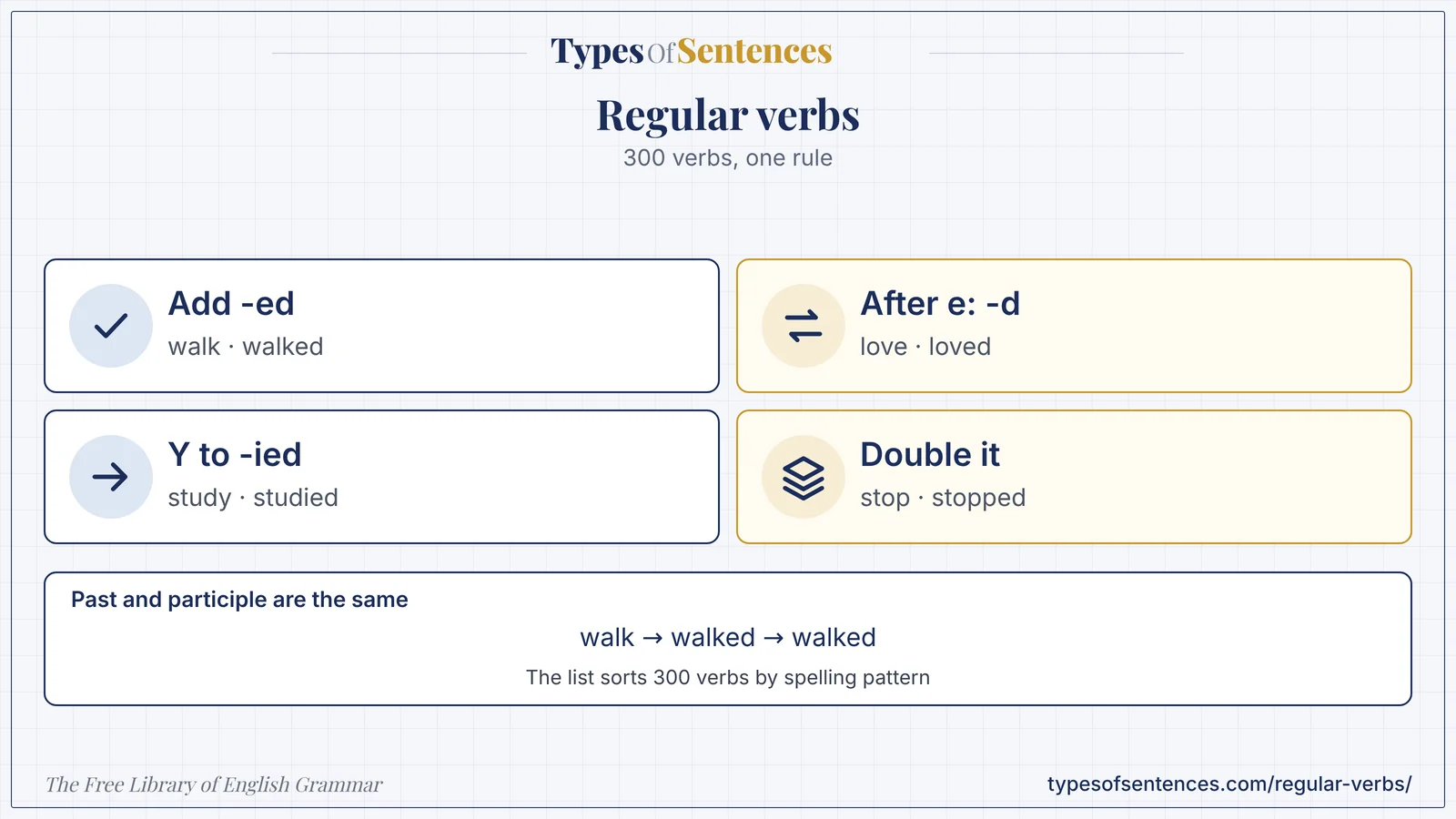
A regular verb follows one rule: add -ed for the past.
Why it matters: Walk becomes walked, and walked is also the past participle: I have walked.
Summary: Regular verbs form the simple past and the past participle by adding -ed: walk, walked, walked. Spelling rules: add only -d after a final e (love, loved); change a consonant + y to -ied (study, studied); double the final consonant of a short stressed syllable (stop, stopped); add -ked after c (panic, panicked). In the third person singular, add -s or -es (walks, studies). The -ed ending is pronounced /t/, /d/, or /ɪd/ depending on the last sound of the base.
- Past: add -ed.
- After e: add -d.
- Consonant + y: -ied.
- Short stressed syllable: double the consonant.
What You’ll Learn
- 1. Regular Verbs: The Short Answer
- 2. Regular Verb Rules: Spelling and Sound
- 3. List of Regular Verbs: Add -ed (141 verbs)
- 4. List of Regular Verbs: Add -d After e (78 verbs)
- 5. List of Regular Verbs: Y to -ied (30 verbs)
- 6. List of Regular Verbs: Double the Consonant (48 verbs)
- 7. Verbs That Take -ked (3 verbs)
- 8. Regular Verbs Examples in Sentences: 20 Examples
- 9. Regular or Irregular? How to Tell
- 10. Common Mistakes With Regular Verbs
- 11. Exercises
- 12. Test Your Knowledge
- 13. Frequently Asked Questions
- 14. Conclusion
1. Regular Verbs: The Short Answer
| Base ends in | Rule | Example |
|---|---|---|
| most consonants or vowels | add -ed | walk, walked |
| e | add -d | love, loved |
| consonant + y | change y to -ied | study, studied |
| vowel + y | add -ed | play, played |
| one vowel + one consonant, stressed | double the consonant | stop, stopped |
| c that sounds like /k/ | add -ked | panic, panicked |
| Test | How it works | Example |
|---|---|---|
| the -ed test | the past tense ends in -ed, and so does the participle | walked, walked |
| the have test | the form after have is the same as the past form | I have walked; I walked |
| the irregular test | if the past form is not on this pattern, the verb is irregular | go, went, gone |
Verbs that do not follow the rule are listed in the chapter on irregular verbs, and the forms they take as a participle are explained in the guide to the past participle.
2. Regular Verb Rules: Spelling and Sound
| Rule | Explanation | Examples |
|---|---|---|
| 1. add -ed | most verbs | walk, walked; help, helped |
| 2. add -d | a verb that ends in e | like, liked; move, moved |
| 3. y to -ied | a consonant before the y | try, tried; carry, carried |
| 4. keep y | a vowel before the y | stay, stayed; enjoy, enjoyed |
| 5. double the consonant | one syllable, or the stress on the last syllable, with a vowel + consonant ending | plan, planned; admit, admitted |
| 6. do not double | a final w, x, or y; or the stress is not on the last syllable | snow, snowed; fix, fixed; open, opened |
| 7. add -ked | a verb that ends in c | picnic, picnicked |
| Last sound of the base | -ed is pronounced | Examples |
|---|---|---|
| voiceless (p, k, f, s, sh, ch) | /t/ | walked, helped, laughed, passed |
| voiced (b, g, v, z, m, n, l, r, vowels) | /d/ | played, loved, cleaned, called |
| t or d | /ɪd/ (a new syllable) | wanted, needed, started |
| Form | Rule | Example |
|---|---|---|
| third person singular | add -s | walks |
| after s, x, z, ch, sh | add -es | passes, fixes, watches |
| consonant + y | -ies | studies, carries |
| -ing form | add -ing; drop a final silent e; double the consonant as above | walking, loving, stopping |
| ie ending | change to -ying | tie, tying |
Spelling changes follow the same logic as other suffixes, as shown in the Intermediate chapter on prefixes and suffixes. The present-tense forms are explained in the chapter on the simple present tense.
3. List of Regular Verbs: Add -ed (141 verbs)
These regular verbs add -ed with no other change. The past form and the past participle are the same.
| Base | Past and participle | Base | Past and participle | Base | Past and participle |
|---|---|---|---|---|---|
| walk | walked | talk | talked | work | worked |
| play | played | jump | jumped | look | looked |
| help | helped | want | wanted | need | needed |
| start | started | open | opened | ask | asked |
| call | called | cook | cooked | clean | cleaned |
| climb | climbed | count | counted | cross | crossed |
| cough | coughed | crash | crashed | deliver | delivered |
| destroy | destroyed | enjoy | enjoyed | stay | stayed |
| obey | obeyed | delay | delayed | employ | employed |
| annoy | annoyed | display | displayed | convey | conveyed |
| answer | answered | appear | appeared | attack | attacked |
| attend | attended | bark | barked | belong | belonged |
| burn | burned | contain | contained | collect | collected |
| connect | connected | consider | considered | correct | corrected |
| depend | depended | descend | descended | discover | discovered |
| dismiss | dismissed | end | ended | enter | entered |
| exist | existed | expect | expected | fix | fixed |
| follow | followed | fold | folded | form | formed |
| gather | gathered | grant | granted | guard | guarded |
| hand | handed | happen | happened | heat | heated |
| hunt | hunted | insist | insisted | install | installed |
| join | joined | kick | kicked | knock | knocked |
| lack | lacked | land | landed | learn | learned |
| lift | lifted | lock | locked | mark | marked |
| mention | mentioned | miss | missed | mix | mixed |
| mount | mounted | order | ordered | paint | painted |
| pass | passed | perform | performed | pick | picked |
| plant | planted | point | pointed | polish | polished |
| post | posted | pour | poured | printed | |
| protect | protected | pull | pulled | push | pushed |
| rain | rained | reach | reached | record | recorded |
| remain | remained | remind | reminded | repeat | repeated |
| report | reported | rest | rested | roll | rolled |
| rush | rushed | search | searched | seem | seemed |
| shout | shouted | sound | sounded | spell | spelled |
| stress | stressed | stretch | stretched | suggest | suggested |
| support | supported | thank | thanked | touch | touched |
| track | tracked | train | trained | travel | traveled |
| treat | treated | trust | trusted | turn | turned |
| visit | visited | wait | waited | warn | warned |
| wash | washed | watch | watched | wonder | wondered |
| yell | yelled | accept | accepted | act | acted |
| add | added | allow | allowed | bend | bended |
| blend | blended | boil | boiled | borrow | borrowed |
| brush | brushed | check | checked | chew | chewed |
| claim | claimed | comment | commented | complain | complained |
| consist | consisted | crawl | crawled | dream | dreamed |
4. List of Regular Verbs: Add -d After e (78 verbs)
These regular verbs end in e, so they add only -d.
| Base | Past and participle | Base | Past and participle | Base | Past and participle |
|---|---|---|---|---|---|
| like | liked | love | loved | dance | danced |
| move | moved | use | used | live | lived |
| hope | hoped | smile | smiled | change | changed |
| close | closed | arrive | arrived | receive | received |
| believe | believed | decide | decided | describe | described |
| divide | divided | escape | escaped | examine | examined |
| force | forced | gaze | gazed | imagine | imagined |
| invite | invited | joke | joked | judge | judged |
| manage | managed | name | named | notice | noticed |
| observe | observed | operate | operated | phone | phoned |
| place | placed | practice | practiced | prepare | prepared |
| produce | produced | promise | promised | provide | provided |
| raise | raised | realize | realized | refuse | refused |
| relate | related | remove | removed | replace | replaced |
| rescue | rescued | retire | retired | save | saved |
| score | scored | share | shared | shape | shaped |
| smoke | smoked | solve | solved | state | stated |
| taste | tasted | tie | tied | type | typed |
| voice | voiced | wave | waved | waste | wasted |
| whistle | whistled | wipe | wiped | advise | advised |
| agree | agreed | amuse | amused | argue | argued |
| bake | baked | behave | behaved | blame | blamed |
| breathe | breathed | abuse | abused | care | cared |
| cause | caused | celebrate | celebrated | chase | chased |
| collide | collided | compare | compared | complete | completed |
| create | created | curse | cursed | dare | dared |
5. List of Regular Verbs: Y to -ied (30 verbs)
These regular verbs end in a consonant + y, so the y becomes -ied. The third person form is -ies: he tries.
| Base | Past and participle | Base | Past and participle | Base | Past and participle |
|---|---|---|---|---|---|
| cry | cried | try | tried | study | studied |
| carry | carried | copy | copied | hurry | hurried |
| worry | worried | marry | married | reply | replied |
| deny | denied | apply | applied | bury | buried |
| empty | emptied | fry | fried | dry | dried |
| spy | spied | rely | relied | supply | supplied |
| satisfy | satisfied | identify | identified | multiply | multiplied |
| qualify | qualified | terrify | terrified | verify | verified |
| notify | notified | modify | modified | justify | justified |
| clarify | clarified | magnify | magnified | occupy | occupied |
6. List of Regular Verbs: Double the Consonant (48 verbs)
These regular verbs double the final consonant before -ed. Most are short verbs, or verbs with the stress on the last syllable (admit, prefer).
| Base | Past and participle | Base | Past and participle | Base | Past and participle |
|---|---|---|---|---|---|
| stop | stopped | plan | planned | drop | dropped |
| hug | hugged | beg | begged | nod | nodded |
| rub | rubbed | plug | plugged | trim | trimmed |
| tap | tapped | jog | jogged | chat | chatted |
| clap | clapped | grab | grabbed | hop | hopped |
| pat | patted | pin | pinned | plot | plotted |
| rob | robbed | scrub | scrubbed | skip | skipped |
| slip | slipped | snap | snapped | spot | spotted |
| step | stepped | stir | stirred | strap | strapped |
| strip | stripped | swap | swapped | tag | tagged |
| trap | trapped | wrap | wrapped | zip | zipped |
| admit | admitted | commit | committed | occur | occurred |
| prefer | preferred | regret | regretted | refer | referred |
| permit | permitted | control | controlled | equip | equipped |
| submit | submitted | omit | omitted | transmit | transmitted |
| drag | dragged | flip | flipped | grin | grinned |
7. Verbs That Take -ked (3 verbs)
A verb that ends in c adds k so that the c keeps the /k/ sound.
| Base | Past and participle | Base | Past and participle | Base | Past and participle |
|---|---|---|---|---|---|
| picnic | picnicked | panic | panicked | mimic | mimicked |
8. Regular Verbs Examples in Sentences: 20 Examples
| # | Sentence |
|---|---|
| 1 | She walked to school yesterday. |
| 2 | They have worked here for years. |
| 3 | We played football after lunch. |
| 4 | He loved the film. |
| 5 | The baby cried all night. |
| 6 | I studied for two hours. |
| 7 | The bus stopped at the corner. |
| 8 | She has planned the trip. |
| 9 | He admitted his mistake. |
| 10 | They danced until midnight. |
| 11 | The dog barked at the mailman. |
| 12 | We have decided to stay. |
| 13 | The teacher explained the rule. |
| 14 | She carried the box upstairs. |
| 15 | The rain stopped at noon. |
| 16 | I have visited Paris twice. |
| 17 | He enjoyed the book. |
| 18 | The plane landed safely. |
| 19 | The shop opened at nine. |
| 20 | She picnicked by the lake. |
The verb forms in these regular verbs examples follow the rules above. For a longer list of verbs of every type, see the guide to the list of verbs.
9. Regular or Irregular? How to Tell
| Sign | Regular | Irregular |
|---|---|---|
| past form | walked | went |
| participle | walked | gone |
| how many | thousands; new verbs are regular | about 200 common verbs |
| new verbs | text, texted; google, googled | almost never |
| same past and participle | always | sometimes (said, said) and sometimes not (sang, sung) |
Every new verb that enters English is regular, which is why regular verbs are the majority. A small group of verbs have both forms: learned or learnt, dreamed or dreamt. Many writers in the United States prefer the -ed form.
10. Common Mistakes With Regular Verbs
| Mistake | Example | Correction |
|---|---|---|
| forgetting -ed | *Yesterday I walk to school. | Yesterday I walked to school. |
| forgetting -ed after have | *I have walk there. | I have walked there. |
| adding -ed to an irregular verb | *goed, *taked | went, took |
| double e | *lovedd, *likeed | loved, liked |
| not changing y | *studyed, *cryed | studied, cried |
| changing a vowel + y | *playied, *stayied | played, stayed |
| not doubling | *stoped, *planed | stopped, planned |
| doubling when the stress is not final | *openned, *visitted | opened, visited |
| -ed after did | *Did you walked? | Did you walk? |
| no k after c | *panicced | panicked |
Fix: Yesterday she stoped at the shop, studyed the list, and have carryed the bags home, but she did not walked.
- stoped: a short stressed syllable doubles, so stopped.
- studyed: a consonant + y becomes -ied, so studied.
- have carryed: the participle of a consonant + y verb is carried.
- did not walked: after did the verb is in the base form, so did not walk.
- Result: Yesterday she stopped at the shop, studied the list, and carried the bags home, but she did not walk. (the sentence is invented)
Recap in 12 seconds
Watch the lesson build itself: Regular verbs add -ed for the past tense and the past participle, with four spelling changes. The video has no sound.
Exercises
Part A: Give the Past Tense (Exercises 1–10)
Exercise 1: walk
Show Answer
Answer: walked.
Exercise 2: love
Show Answer
Answer: loved.
Exercise 3: study
Show Answer
Answer: studied.
Exercise 4: stop
Show Answer
Answer: stopped.
Exercise 5: play
Show Answer
Answer: played.
Exercise 6: carry
Show Answer
Answer: carried.
Exercise 7: plan
Show Answer
Answer: planned.
Exercise 8: like
Show Answer
Answer: liked.
Exercise 9: open
Show Answer
Answer: opened.
Exercise 10: panic
Show Answer
Answer: panicked.
Part B: Regular or Irregular? (Exercises 11–20)
Exercise 11: walk
Show Answer
Answer: regular.
Exercise 12: go
Show Answer
Answer: irregular.
Exercise 13: help
Show Answer
Answer: regular.
Exercise 14: take
Show Answer
Answer: irregular.
Exercise 15: visit
Show Answer
Answer: regular.
Exercise 16: see
Show Answer
Answer: irregular.
Exercise 17: dance
Show Answer
Answer: regular.
Exercise 18: write
Show Answer
Answer: irregular.
Exercise 19: enjoy
Show Answer
Answer: regular.
Exercise 20: speak
Show Answer
Answer: irregular.
Part C: Pronounce the -ed (Exercises 21–25)
Exercise 21: walked
Show Answer
Answer: /t/.
Exercise 22: played
Show Answer
Answer: /d/.
Exercise 23: wanted
Show Answer
Answer: /ɪd/.
Exercise 24: helped
Show Answer
Answer: /t/.
Exercise 25: needed
Show Answer
Answer: /ɪd/.
Part D: Correct the Errors (Exercises 26–30)
Exercise 26: Correct: *Yesterday I walk to school.
Show Answer
Answer: Yesterday I walked to school.
Exercise 27: Correct: *She studyed all night.
Show Answer
Answer: She studied all night.
Exercise 28: Correct: *He stoped the car.
Show Answer
Answer: He stopped the car.
Exercise 29: Correct: *Did you walked home?
Show Answer
Answer: Did you walk home?
Exercise 30: Correct: *They have play all day.
Show Answer
Answer: They have played all day.
Test Your Knowledge
Ready to check what you learned? Answer all 10 questions, then submit. You need 80% (8 of 10) to pass. Your answers are not stored.
View correct answers and explanations
Question 1: The past tense of a regular verb ends in
✓ Correct Answer: C – -ed
-ed.
Question 2: The past tense of study is
✓ Correct Answer: A – studied
-ied.
Question 3: The past tense of stop is
✓ Correct Answer: B – stopped
Doubling.
Question 4: The past tense of love is
✓ Correct Answer: D – loved
Add -d.
Question 5: Which verb is regular?
✓ Correct Answer: C – walk
Walk.
Question 6: The past tense of play is
✓ Correct Answer: A – played
Vowel + y.
Question 7: Walked ends with the sound
✓ Correct Answer: B – /t/
Voiceless.
Question 8: Wanted ends with the sound
✓ Correct Answer: D – /ɪd/
After t.
Question 9: The past participle of a regular verb is
✓ Correct Answer: C – the same as the past tense
Same form.
Question 10: The past tense of panic is
✓ Correct Answer: A – panicked
Add k.
Frequently Asked Questions
What are regular verbs?
Regular verbs are verbs that form the past tense and the past participle by adding -ed (or -d) to the base form, such as walk, walked, walked.
What are the regular verb rules?
Add -ed; add only -d after e; change a consonant + y to -ied; double the final consonant of a short stressed syllable; add -ked after c.
Is there a list of regular verbs?
Yes. This page gives a list of regular verbs with 300 examples, sorted by spelling pattern. It is not every regular verb, because new regular verbs are added to the language all the time.
How can I tell a regular verb from an irregular verb?
Look at the past form. If it is the base plus -ed (or -d), the verb is regular. If it is different (went, took), the verb is irregular.
How is the -ed ending pronounced?
It is /t/ after voiceless sounds (walked), /d/ after voiced sounds (played), and /ɪd/ after t or d (wanted).
Do regular verbs have the same past tense and past participle?
Yes. For every regular verb, the simple past and the past participle are the same form: I walked and I have walked.
Why do some verbs double the final consonant?
Doubling keeps the vowel short. In stop, stopped, the doubled p shows that the vowel is short; in hope, hoped, the single p after a long vowel shows the vowel is long.
Conclusion
You now know the rule for regular verbs, the spelling changes, the three sounds of -ed, and the common mistakes. You have seen a list of regular verbs with 300 examples sorted by spelling pattern.
Add -ed, apply one of the four spelling changes, and check a dictionary for any verb you are not sure of. Use the regular verbs list above as a model. Next, study the other lists in this series, such as the possessive adjectives.
- Quirk, Randolph, et al. A Comprehensive Grammar of the English Language. Longman, 1985.: the account of regular verb inflection.
- Huddleston, Rodney, and Geoffrey K. Pullum. The Cambridge Grammar of the English Language. Cambridge University Press, 2002.: the chapter on verb inflection.
- Garner, Bryan A. Garner’s Modern English Usage. 5th ed. Oxford University Press, 2022.: the entries on verb forms and spelling.
- Merriam-Webster Dictionary: regular verb: the dictionary entry (not opened when this page was written). The 300 verbs were chosen from general knowledge, the spelling rule for each group is asserted by the build, and the forms were not checked word by word against a dictionary.
Last reviewed: October 29, 2026. How it was made: drafted with AI assistance, then checked with automated tests (structure, links, answer keys, spelling) and against the sources above. A person has not yet read this chapter line by line. Found a mistake? Report it.