Voice shows whether the subject of a sentence does the action or receives it. In the active voice, the subject is the doer: The chef cooked the meal. In the passive voice, the subject receives the action: The meal was cooked by the chef. The passive voice is formed with a form of be and the past participle, and it lets you put the receiver of the action first or leave out the doer.
This chapter explains the active voice meaning and the structure of the passive. You will see passive voice examples in all tenses and with modals, when the passive is the right choice, how to use by and the agent, how to handle sentences with two objects, the get passive, verbs that cannot be passive, and the usual errors. Thirty exercises and a quiz follow.
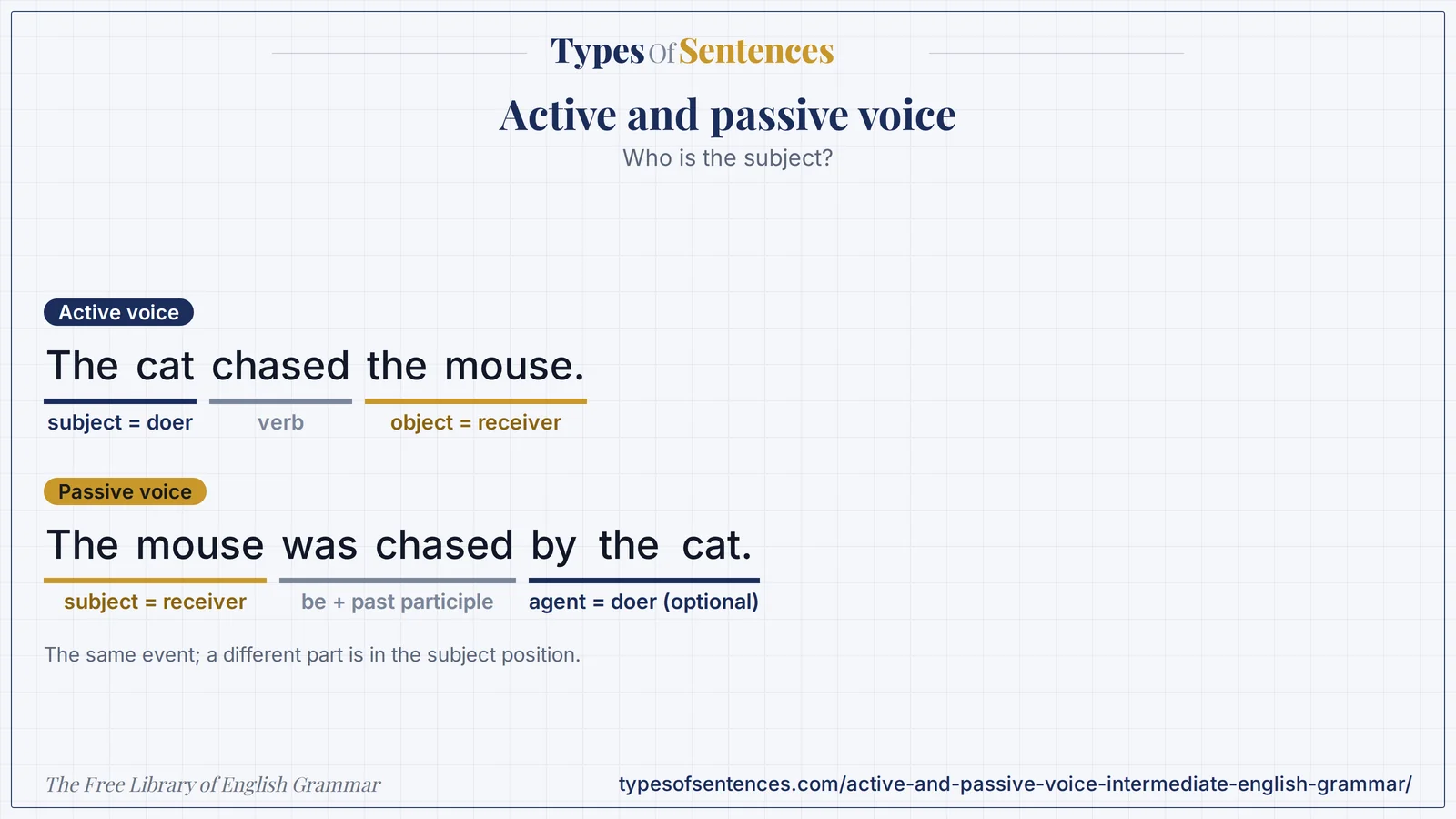
In the active voice, you say who does what. In the passive voice, you say what happens to something, and the doer may be left out. Both describe the same event from a different point of view.
Why it matters: The passive is useful when the doer is unknown, unimportant, or obvious, or when you want to focus on the receiver. It is overused in some writing, so it is worth knowing when to avoid it.
Summary: Active voice: subject + verb + object (The chef cooked the meal). Passive voice: the object becomes the subject, the verb becomes be + past participle, and the original subject becomes an optional by-phrase (The meal was cooked by the chef). Only transitive verbs have a passive. The tense is carried by be.
- Passive = form of be + past participle.
- The tense of the active verb becomes the tense of be.
- Use by + agent only when the doer is important.
- Intransitive and most stative verbs cannot be passive.
What You’ll Learn
- 1. Active Voice: What Is Active Voice?
- 2. Passive Voice: What Is Passive Voice?
- 3. Forming the Passive Voice
- 4. The Passive Voice in All Tenses
- 5. The Passive with Modals
- 6. When to Use the Passive
- 7. By + Agent
- 8. Passive with Two Objects and Phrasal Verbs
- 9. The Get-Passive and Stative Passive
- 10. Verbs That Cannot Be Passive
- 11. Common Errors with the Passive Voice
- 12. Exercises
- 13. Test Your Knowledge
- 14. Frequently Asked Questions
- 15. Conclusion
1. Active Voice: What Is Active Voice?
In the active voice, the subject performs the action of the verb. This is the normal, direct way to make a statement. The active voice meaning is simple: the doer comes first.
| Active sentence | Subject (doer) | Verb | Object (receiver) |
|---|---|---|---|
| The chef cooked the meal. | the chef | cooked | the meal |
| Maria wrote the report. | Maria | wrote | the report |
| The storm damaged the roof. | the storm | damaged | the roof |
| Millions of people watch the game. | millions of people | watch | the game |
Active sentences use a verb that can have an object, a transitive verb; see the chapter on types of verbs and the chapter on direct and indirect objects. Intransitive verbs have no object, so they have no passive: The baby slept.
2. Passive Voice: What Is Passive Voice?
In the passive voice, the receiver of the action becomes the subject. The doer is either dropped or placed in a by-phrase.
| Active | Passive |
|---|---|
| The chef cooked the meal. | The meal was cooked by the chef. |
| Maria wrote the report. | The report was written by Maria. |
| The storm damaged the roof. | The roof was damaged by the storm. |
| Someone stole my bike. | My bike was stolen. |
| They are building a bridge. | A bridge is being built. |
Compare the focus: The chef cooked the meal is about the chef; The meal was cooked by the chef is about the meal. The passive voice examples above show the same pattern: the object moves to the front.
3. Forming the Passive Voice
- Take the object of the active sentence and make it the subject.
- Use a form of be in the same tense as the active verb.
- Add the past participle of the main verb.
- Move the original subject to the end as by + agent, or drop it.
| Step | Active: The chef cooked the meal. | Passive |
|---|---|---|
| 1 | object: the meal | The meal … |
| 2 | tense: simple past | … was … |
| 3 | past participle: cooked | … was cooked … |
| 4 | subject: the chef | … was cooked by the chef. |
The past participles are in the guide to the past participle and to irregular verbs. The auxiliary be carries the tense and agrees with the new subject: The report is written, The reports are written.
4. The Passive Voice in All Tenses
The tense of the passive is shown by the form of be. The verb phrases are in the chapter on verb phrases and the tenses in the chapter on verb tenses.
| Tense | Active | Passive |
|---|---|---|
| simple present | They make cars. | Cars are made. |
| present continuous | They are making cars. | Cars are being made. |
| present perfect | They have made cars. | Cars have been made. |
| simple past | They made cars. | Cars were made. |
| past continuous | They were making cars. | Cars were being made. |
| past perfect | They had made cars. | Cars had been made. |
| simple future (will) | They will make cars. | Cars will be made. |
| future (going to) | They are going to make cars. | Cars are going to be made. |
| future perfect | They will have made cars. | Cars will have been made. |
- The perfect continuous tenses are rarely used in the passive, because the forms are awkward (has been being made). Use another construction.
- Use the same be + past participle in the infinitive (to be made) and gerund (being made): She wants to be promoted, I hate being told what to do.
5. The Passive with Modals
| Pattern | Example |
|---|---|
| modal + be + past participle | The work must be finished. The window can be opened. |
| modal + have been + past participle (past) | The report should have been sent. The letter may have been lost. |
| semi-modal | The rules have to be followed. The form is supposed to be signed. |
| negative | The door can’t be opened. The letters were not delivered. |
| question | Can the work be finished? When was the report written? |
The modal verbs are in the chapter on modal verbs. Modal passives are common in rules, instructions, and formal writing: Applications must be submitted by Friday.
6. When to Use the Passive
| Reason | Example |
|---|---|
| the doer is unknown | My bike was stolen. |
| the doer is unimportant | The bridge was built in 1990. |
| the doer is obvious | The thief was arrested. (by the police) |
| the receiver is the topic | The Mona Lisa was painted by Leonardo. It is displayed in Paris. |
| a formal, impersonal tone (science, reports) | The samples were heated to 100 degrees. |
| avoiding blame or naming the doer | Mistakes were made. |
| news and headlines | Three people were injured in the crash. |
| rules and notices | Smoking is not permitted. |
Use the active voice when the doer is important or when you want a direct, vigorous style: The committee rejected the plan is clearer than The plan was rejected by the committee. Many style guides advise using the active voice for most sentences, and the passive when there is a reason.
Style advice about the passive varies. Some writers avoid it as weak, and scientific and legal writing use it deliberately to focus on the action and not on the actor. Judge each sentence by clarity and emphasis, not by a rule against the passive.
7. By + Agent
The agent is the doer of the action. In a passive sentence, the agent appears in a by-phrase only when it is important, new, or surprising.
| Include the agent | Leave it out |
|---|---|
| The Mona Lisa was painted by Leonardo da Vinci. | The window was broken. (we do not know who, or it does not matter) |
| The novel was written by a teenager. | English is spoken all over the world. |
| The election was won by a small margin. | The package was delivered yesterday. |
The by-phrase is also used for the instrument or the cause: The roof was damaged by the storm. For a tool, use with: The door was opened with a key.
If the agent is the same throughout, the active voice is simpler. Use the passive only when it helps.
8. Passive with Two Objects and Phrasal Verbs
A verb with an indirect and a direct object (give, send, show, tell) has two possible passives.
| Active | Passive (indirect object first) | Passive (direct object first) |
|---|---|---|
| They gave Maria a prize. | Maria was given a prize. | A prize was given to Maria. |
| She sent him a letter. | He was sent a letter. | A letter was sent to him. |
| The teacher showed us the results. | We were shown the results. | The results were shown to us. |
The first form, with the person as the subject, is more common. Phrasal verbs keep the particle in the passive: They turned down the offer becomes The offer was turned down.
9. The Get-Passive and Stative Passive
| Type | Example | Note |
|---|---|---|
| get passive (informal) | He got fired. The window got broken. | informal; often shows an event that is unexpected or unwelcome |
| stative passive (a state) | The door is closed. The shop is open. | a state resulting from an action, not an action |
| dynamic passive (an event) | The door was closed by the guard. | an action |
Compare The shop is closed (a state: it is not open now) with The shop was closed by the owner at six (an action). A participle can also act as an adjective: I am tired, She is married. The test is whether you can add very (very tired): if so, it is an adjective.
10. Verbs That Cannot Be Passive
| Kind | Examples | Why |
|---|---|---|
| intransitive verbs | arrive, happen, sleep, die, go, come | no object to move |
| stative verbs of having and measuring | have (possess), fit, suit, resemble, lack, cost, weigh, equal | no true action |
| reflexive and reciprocal | They washed themselves. | the object is the subject |
| verbs with a cognate object | She sang a song. | usually active |
Happen is intransitive. It has no passive.
Other verbs are transitive, but their passive is rare or odd: The shirt is fitted by me is wrong because fit in the sense of size is stative.
11. Common Errors with the Passive Voice
| Error | Correction | Rule |
|---|---|---|
| The book was wrote by Tom. | The book was written by Tom. | past participle, not past form |
| The car was stole. | The car was stolen. | past participle |
| The meeting was happened yesterday. | The meeting happened yesterday. | no passive for intransitive verbs |
| English speaks here. | English is spoken here. | the subject receives the action |
| The cake is bake by Maria. | The cake is baked by Maria. | past participle |
| The report has been write. | The report has been written. | past participle after been |
| The work must finished. | The work must be finished. | modal + be + participle |
| I was given a book by she. | I was given a book by her. | object form after by |
| The window broke by the boy. | The window was broken by the boy. | be is required |
| The house is being build. | The house is being built. | participle after being |
Fix: The report was wrote by the team, and it have been send to the manager, who was happened to be away, so the work must finished by Friday by they.
- was wrote: was written.
- have been send: has been sent (agrees with it).
- was happened: happened to be (intransitive).
- must finished: must be finished.
- by they: by them (or drop the agent).
- Result: The report was written by the team, and it has been sent to the manager, who happened to be away, so the work must be finished by Friday.
Recap in 12 seconds
Watch the lesson build itself: The same event in the active and in the passive voice. The video has no sound.
Exercises
Part A: Active or Passive? (Exercises 1–6)
Exercise 1: Active or passive: The chef cooked the meal.
Show Answer
Answer: Active.
Exercise 2: Active or passive: The meal was cooked by the chef.
Show Answer
Answer: Passive.
Exercise 3: Active or passive: My bike was stolen.
Show Answer
Answer: Passive (no agent).
Exercise 4: Active or passive: Millions watch the game.
Show Answer
Answer: Active.
Exercise 5: Name the receiver in The roof was damaged by the storm.
Show Answer
Answer: the roof.
Exercise 6: Name the agent in The roof was damaged by the storm.
Show Answer
Answer: the storm.
Part B: Forming the Passive (Exercises 7–14)
Exercise 7: Passive: Maria wrote the report.
Show Answer
Answer: The report was written by Maria.
Exercise 8: Passive: They make cars.
Show Answer
Answer: Cars are made.
Exercise 9: Passive: They are building a bridge.
Show Answer
Answer: A bridge is being built.
Exercise 10: Passive: They have finished the work.
Show Answer
Answer: The work has been finished.
Exercise 11: Passive: They will announce the winner.
Show Answer
Answer: The winner will be announced.
Exercise 12: Passive: Someone stole my bike.
Show Answer
Answer: My bike was stolen.
Exercise 13: Passive: They had cleaned the room.
Show Answer
Answer: The room had been cleaned.
Exercise 14: Passive: She was writing a letter.
Show Answer
Answer: A letter was being written.
Part C: Modals and Infinitives (Exercises 15–19)
Exercise 15: Passive: You must finish the work.
Show Answer
Answer: The work must be finished.
Exercise 16: Passive: They should have sent the report.
Show Answer
Answer: The report should have been sent.
Exercise 17: Passive: You can open the window.
Show Answer
Answer: The window can be opened.
Exercise 18: Complete: She wants to (promote) soon.
Show Answer
Answer: be promoted.
Exercise 19: Complete: I hate (tell) what to do.
Show Answer
Answer: being told.
Part D: Two Objects and Agents (Exercises 20–24)
Exercise 20: Passive (person first): They gave Maria a prize.
Show Answer
Answer: Maria was given a prize.
Exercise 21: Passive (thing first): She sent him a letter.
Show Answer
Answer: A letter was sent to him.
Exercise 22: Should the agent be included: The Mona Lisa was painted ___.
Show Answer
Answer: Yes: by Leonardo da Vinci (the agent is important).
Exercise 23: Should the agent be included: The window was broken ___.
Show Answer
Answer: No (the doer is unknown).
Exercise 24: Which preposition for a tool: The door was opened (by/with) a key.
Show Answer
Answer: with.
Part E: Errors and Limits (Exercises 25–30)
Exercise 25: Fix it: The book was wrote by Tom.
Show Answer
Answer: The book was written by Tom.
Exercise 26: Fix it: The meeting was happened yesterday.
Show Answer
Answer: The meeting happened yesterday.
Exercise 27: Fix it: The work must finished.
Show Answer
Answer: The work must be finished.
Exercise 28: Can arrive be passive?
Show Answer
Answer: No. It is intransitive.
Exercise 29: State or action: The shop is closed.
Show Answer
Answer: A state (stative passive).
Exercise 30: Informal passive: He was fired.
Show Answer
Answer: He got fired.
Test Your Knowledge
Ready to check what you learned? Answer all 10 questions, then submit. You need 80% (8 of 10) to pass. Your answers are not stored.
View correct answers and explanations
Question 1: In the passive voice, the subject…
✓ Correct Answer: B – receives the action
The subject of a passive sentence receives the action.
Question 2: How is the passive formed?
✓ Correct Answer: A – be + past participle
The passive uses be plus the past participle.
Question 3: Which is the passive of Maria wrote the report?
✓ Correct Answer: C – The report was written by Maria.
Past tense be plus the past participle.
Question 4: Which is correct?
✓ Correct Answer: D – The car was stolen.
Use the past participle stolen.
Question 5: Which is correct?
✓ Correct Answer: A – The meeting happened.
Intransitive verbs have no passive.
Question 6: Which is the passive of They are building a bridge?
✓ Correct Answer: C – A bridge is being built.
Present continuous passive: is being built.
Question 7: Which is correct with a modal?
✓ Correct Answer: D – The work must be finished.
Modal + be + past participle.
Question 8: When is it best to include the agent?
✓ Correct Answer: B – When the doer is important
Include the agent when it is important or new.
Question 9: Which is a stative passive?
✓ Correct Answer: B – The door is closed.
It describes a state.
Question 10: Which verb cannot be passive?
✓ Correct Answer: C – arrive
Arrive is intransitive.
Frequently Asked Questions
What is the passive voice?
The passive voice is a sentence pattern in which the subject receives the action. It is formed with a form of be and the past participle: The meal was cooked by the chef.
What is the active voice meaning?
The active voice meaning is that the subject performs the action of the verb: The chef cooked the meal. It is the usual, direct way to make a statement.
What is the difference between active and passive voice?
In the active voice the subject is the doer; in the passive voice the subject is the receiver of the action. The passive lets you put the receiver first or leave out the doer.
What are passive voice examples in different tenses?
Cars are made (present), Cars were made (past), Cars will be made (future), Cars have been made (present perfect), and Cars are being made (present continuous).
When should I use the passive voice?
Use the passive when the doer is unknown, unimportant, or obvious, when the receiver is the topic, or in formal and scientific writing. Use the active when the doer matters or when you want a direct style.
Which verbs cannot be used in the passive?
Intransitive verbs (arrive, happen, sleep) and most stative verbs of having and measuring (have, fit, resemble) have no passive.
What is the get passive?
The get passive uses get instead of be (He got fired). It is informal and often shows an unexpected or unwelcome event.
Conclusion
You now know the active voice and the passive voice. You can form the passive in every tense and with modals, use it for the right reasons, decide when to include the agent, handle sentences with two objects, and avoid the common errors.
Choose the voice according to what you want the reader to focus on. Next, you will study reported speech.
- Merriam-Webster Dictionary: passive voice: the dictionary definition of the passive voice.
- Purdue Online Writing Lab: Grammar: reference section on active and passive voice.
- Quirk, Randolph, et al. A Comprehensive Grammar of the English Language. Longman, 1985.: the passive and its agent.
- Huddleston, Rodney, and Geoffrey K. Pullum. The Cambridge Grammar of the English Language. Cambridge University Press, 2002.: the passive clause.
Last reviewed: October 29, 2026. How it was made: drafted with AI assistance, then checked with automated tests (structure, links, answer keys, spelling) and against the sources above. A person has not yet read this chapter line by line. Found a mistake? Report it.