English verb tenses show when an action happens and how it relates to time. The Basic level taught three tenses: past, present, and future. The complete system has twelve: three times (past, present, future) in four aspects (simple, continuous, perfect, and perfect continuous). The 12 verb tenses let you say not only when something happens but also whether it is finished, in progress, or connected to another time.
This chapter is an overview of all English tenses. It reviews the three simple tenses, explains the difference between time, tense, and aspect, shows the grid of the 12 tenses with forms and examples, compares the simple, continuous, perfect, and perfect continuous aspects, and gives timelines and time expressions. The next three chapters study the present, past, and future tenses in detail. Thirty exercises and a quiz follow.
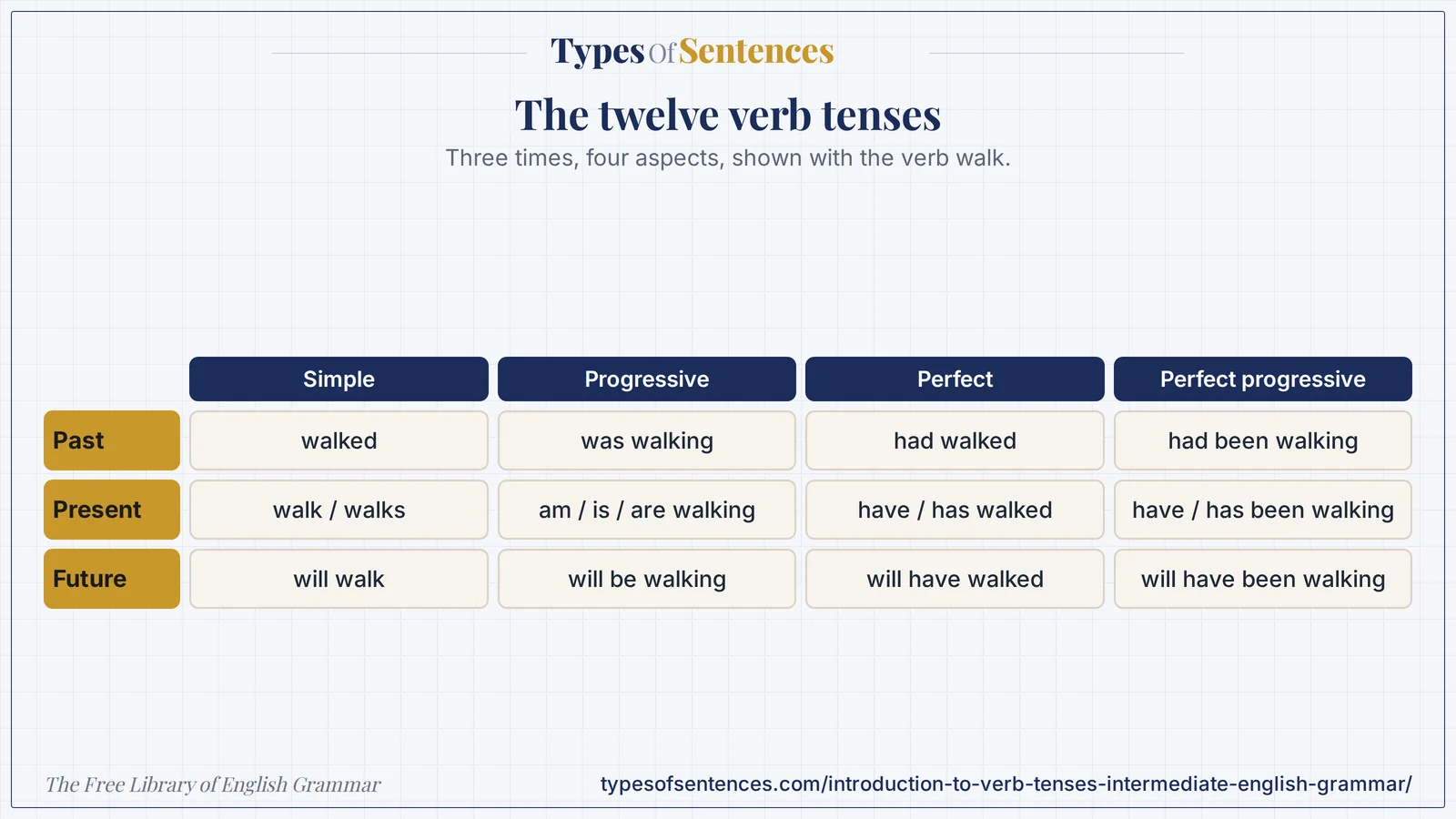
A tense is a verb form that places an action in time. Aspect adds a point of view: is the action seen as a whole, as in progress, as completed, or as having lasted for a while?
Why it matters: If you remember “3 times × 4 aspects = 12 tenses,” you can build any tense from the same pieces: the verb be, the verb have, and the -ing and past participle forms.
Summary: There are 12 tenses: for each of the three times (past, present, future) there are four aspects: simple (a fact or a completed action), continuous (in progress), perfect (completed before another time, with a connection to it), and perfect continuous (in progress up to another time). The forms use be + -ing for the continuous and have + past participle for the perfect.
- Simple: I work, I worked, I will work.
- Continuous: be + -ing. Perfect: have + past participle. Perfect continuous: have + been + -ing.
- The first auxiliary carries the tense and agrees with the subject.
- Stative verbs rarely take the continuous: I know, not I am knowing.
What You’ll Learn
- 1. Verb Tenses: A Review of the Basic Three Tenses
- 2. Time, Tense, and Aspect
- 3. The 12 Verb Tenses Overview
- 4. Simple vs. Perfect vs. Continuous
- 5. Timeline Visualization
- 6. Time Expressions
- 7. Stative Verbs and Future Forms
- 8. Forming Tenses: Negatives, Questions, and Irregular Forms
- 9. Choosing the Right Tense
- 10. Common Tense Errors
- 11. Exercises
- 12. Test Your Knowledge
- 13. Frequently Asked Questions
- 14. Conclusion
1. Verb Tenses: A Review of the Basic Three Tenses
At the Basic level you learned three simple tenses.
| Tense | Form | Use | Example |
|---|---|---|---|
| simple present | base verb; add -s for he, she, it | habits, facts, schedules | She works every day. |
| simple past | -ed or an irregular form | finished actions | She worked yesterday. |
| simple future | will + base verb; be going to + base verb | future events and plans | She will work tomorrow. |
These are the foundation, and they remain the most frequent tenses. In this chapter, each of them gains three partners: the continuous, perfect, and perfect continuous forms. The three simple tenses were introduced in the chapter on introduction to verb tenses in the Basic level.
2. Time, Tense, and Aspect
Three ideas about English verb tenses are easy to confuse. Time is a point in reality: past, present, or future. Tense is the grammatical form of the verb. Aspect is the speaker’s view of the action: complete, ongoing, or related to another time.
| Aspect | The action is seen as… | Form | Example |
|---|---|---|---|
| simple | a fact, a habit, or a completed whole | base verb; -ed; will + verb | I work. |
| continuous (progressive) | in progress at a given time | be + -ing | I am working. |
| perfect | completed before a given time, with a link to it | have + past participle | I have worked. |
| perfect continuous | in progress for a time up to a given point | have + been + -ing | I have been working. |
Time and tense do not always match. The present continuous can refer to the future (I am leaving tomorrow), and the simple present can refer to the future (The train leaves at six). The tenses are labels for forms; the meaning depends on context.
3. The 12 Verb Tenses Overview
This grid shows all 12 verb tenses with the verb work. The columns are the three times and the rows are the four aspects.
| Aspect | Present | Past | Future |
|---|---|---|---|
| Simple | I work / she works | I worked | I will work |
| Continuous | I am working / she is working | I was working | I will be working |
| Perfect | I have worked / she has worked | I had worked | I will have worked |
| Perfect continuous | I have been working / she has been working | I had been working | I will have been working |
| Tense | Form | Example |
|---|---|---|
| simple present | base / -s | She works. |
| present continuous | am/is/are + -ing | She is working. |
| present perfect | have/has + past participle | She has worked. |
| present perfect continuous | have/has been + -ing | She has been working. |
| simple past | V-ed / irregular | She worked. |
| past continuous | was/were + -ing | She was working. |
| past perfect | had + past participle | She had worked. |
| past perfect continuous | had been + -ing | She had been working. |
| simple future | will + base | She will work. |
| future continuous | will be + -ing | She will be working. |
| future perfect | will have + past participle | She will have worked. |
| future perfect continuous | will have been + -ing | She will have been working. |
Each tense is a verb phrase built from the pieces in the chapter on verb phrases: the auxiliaries will, have, and be, and the verb forms listed in the chapter on types of verbs. The first auxiliary carries the tense and agrees with the subject.
4. Simple vs. Perfect vs. Continuous
| Aspect | Question it answers | Present example | Past example | Future example |
|---|---|---|---|---|
| simple | What happens? What happened? | She works at a bank. | She worked at a bank. | She will work at a bank. |
| continuous | What is in progress? | She is working now. | She was working when I called. | She will be working at six. |
| perfect | What is complete, with a link to another time? | She has worked here for years. | She had worked there before she moved. | She will have worked here ten years by June. |
| perfect continuous | How long has it been in progress? | She has been working all day. | She had been working for hours when he arrived. | She will have been working for ten hours by midnight. |
- Simple presents the action as a whole, a habit, or a fact.
- Continuous shows the action in progress at a particular time, and often temporary: I live in Dallas (permanent) but I am living in Dallas this year (temporary).
- Perfect links two times: the action is complete before a reference point, and the result or relevance continues.
- Perfect continuous stresses the duration of an action up to a reference point.
5. Timeline Visualization
A timeline helps you see how the tenses relate. In each row, the arrow shows time moving from left (past) to right (future), and NOW marks the present.
| Tense | Timeline | Example |
|---|---|---|
| simple past | ▪ past action ········· NOW ········· | I visited Paris in 2019. |
| past continuous | ▬▬▬ in progress then ····· NOW ········· | I was sleeping at midnight. |
| past perfect | ▪ earlier ▪ later ········ NOW ········· | I had left before she arrived. |
| simple present | ········· NOW (habit or fact) ········· | I work here. |
| present continuous | ········· ▬▬ NOW ▬▬ ········· | I am working now. |
| present perfect | ▪▪▪▪▪▪▪▪ → NOW (link) ········· | I have lived here since 2020. |
| present perfect continuous | ▬▬▬▬▬▬▬ → NOW (still going) ········· | I have been waiting for an hour. |
| simple future | ········· NOW ········· ▪ future | I will call you tomorrow. |
| future continuous | ········· NOW ········· ▬▬▬ then | I will be working at six. |
| future perfect | ········· NOW ····· ▪ done ▪ by then | I will have finished by Friday. |
The timelines show that the perfect tenses look at one time from another: the present perfect looks back from now, the past perfect from a past point, and the future perfect from a future point. The continuous tenses show an action stretching over a moment, and the simple tenses treat the action as a whole.
6. Time Expressions
Certain words signal certain tenses. They are guides, and the meaning decides.
| Tense | Typical time expressions | Example |
|---|---|---|
| simple present | always, usually, every day, never, on Mondays | She usually walks to work. |
| present continuous | now, at the moment, today, this week, currently | She is walking now. |
| present perfect | already, yet, just, ever, never, for, since, so far, recently | She has just left. I have lived here for years. |
| present perfect continuous | for, since, all day, lately, how long | I have been waiting since noon. |
| simple past | yesterday, last week, in 2019, ago, then | She left an hour ago. |
| past continuous | while, when, at 6 p.m. yesterday | I was cooking when you called. |
| past perfect | before, after, by the time, already | She had left before I arrived. |
| simple future | tomorrow, next week, soon, in a year | I will call tomorrow. |
| future perfect | by then, by Friday, by the time | I will have finished by Friday. |
The choice between the present perfect and the simple past depends on whether a finished time is stated. Use the simple past with a finished time (yesterday, in 2019, ago) and the present perfect without one (I have seen it). The tenses are studied in the chapters on the present, past, and future tenses, and the sequence between them in the chapter on tense consistency and sequence.
7. Stative Verbs and Future Forms
Stative verbs describe states (know, love, want, belong, seem), and they are rarely used in the continuous tenses: I know the answer, not I am knowing. See the chapter on types of verbs.
| Way of expressing the future | Example | Use |
|---|---|---|
| will + verb | I will call you. | promises, predictions, decisions made now |
| be going to + verb | I am going to call you. | plans and evidence |
| present continuous | I am calling her tomorrow. | arranged plans |
| simple present | The train leaves at six. | timetables |
Linguists describe the English tense system in different ways. The traditional scheme in this chapter lists twelve tenses. Many modern grammars say that English has only two tenses, present and past, formed by inflection, and express the future with will, be going to, and the present tense. Both descriptions cover the same forms; the Advanced level discusses tense and aspect separately.
8. Forming Tenses: Negatives, Questions, and Irregular Forms
| Tense | Negative | Question |
|---|---|---|
| simple present | She does not work. | Does she work? |
| present continuous | She is not working. | Is she working? |
| present perfect | She has not worked. | Has she worked? |
| simple past | She did not work. | Did she work? |
| past perfect | She had not worked. | Had she worked? |
| simple future | She will not work. | Will she work? |
| future perfect | She will not have worked. | Will she have worked? |
The simple present and simple past use do to form negatives and questions. All other tenses put the first auxiliary before the subject in a question and not after the first auxiliary in a negative. The irregular past and participle forms are listed in the guide to irregular verbs.
| Verb | Past | Past participle |
|---|---|---|
| go | went | gone |
| see | saw | seen |
| write | wrote | written |
| take | took | taken |
| be | was / were | been |
| have | had | had |
9. Choosing the Right Tense
- Decide the time: is it past, present, or future?
- Decide the aspect: is the action a whole fact, in progress, complete with a link, or in progress for a duration?
- Check for a reference point: is another time or event involved?
- Check for a time expression: does it signal a tense?
- Build the form and check agreement.
Choose the tense: By next June, she (work) at the company for ten years.
- Time: future (by next June).
- Aspect: the action has lasted a duration up to a future point: perfect or perfect continuous.
- for ten years stresses duration; both are possible.
- Answer: will have worked (or will have been working).
Choose the tense: I (wait) for an hour when the bus finally (arrive).
- The waiting started in the past and continued up to another past event: had been waiting.
- The arrival is a completed past event: arrived.
- Answer: I had been waiting for an hour when the bus finally arrived.
10. Common Tense Errors
| Error | Correction | Rule |
|---|---|---|
| I have seen him yesterday. | I saw him yesterday. | a finished time needs the simple past |
| I am knowing the answer. | I know the answer. | stative verbs avoid the continuous |
| I am here since Monday. | I have been here since Monday. | since needs a perfect tense |
| When I will arrive, I will call. | When I arrive, I will call. | no will in a time clause |
| She works here for five years. | She has worked here for five years. | a duration up to now needs the perfect |
| I live here since 2020. | I have lived here since 2020. | since with a perfect tense |
| If I will see him, I will tell him. | If I see him, I will tell him. | no will in an if clause |
| She has went home. | She has gone home. | perfect uses the past participle |
The next three chapters study each time in detail: the present tenses in the next chapter, the past tenses in past tenses, and the future tenses in future tenses.
Recap in 12 seconds
Watch the lesson build itself: The twelve tenses: past, present, and future in the simple, progressive, perfect, and perfect progressive aspects. The video has no sound.
Exercises
Part A: Name the Tense (Exercises 1–8)
Exercise 1: Tense: She works.
Show Answer
Answer: Simple present.
Exercise 2: Tense: She is working.
Show Answer
Answer: Present continuous.
Exercise 3: Tense: She has worked.
Show Answer
Answer: Present perfect.
Exercise 4: Tense: She has been working.
Show Answer
Answer: Present perfect continuous.
Exercise 5: Tense: She had worked.
Show Answer
Answer: Past perfect.
Exercise 6: Tense: She was working.
Show Answer
Answer: Past continuous.
Exercise 7: Tense: She will have worked.
Show Answer
Answer: Future perfect.
Exercise 8: Tense: She will be working.
Show Answer
Answer: Future continuous.
Part B: Forms (Exercises 9–14)
Exercise 9: Form the present perfect of write for he.
Show Answer
Answer: has written.
Exercise 10: Form the past continuous of sleep for they.
Show Answer
Answer: were sleeping.
Exercise 11: Form the past perfect continuous of wait for I.
Show Answer
Answer: had been waiting.
Exercise 12: Form the future perfect of finish for she.
Show Answer
Answer: will have finished.
Exercise 13: Make negative: She has left.
Show Answer
Answer: She has not left.
Exercise 14: Make a question: She will have finished.
Show Answer
Answer: Will she have finished?
Part C: Choosing the Tense (Exercises 15–21)
Exercise 15: Choose: I (have seen/saw) him yesterday.
Show Answer
Answer: saw.
Exercise 16: Choose: I (have lived/lived) here since 2020.
Show Answer
Answer: have lived.
Exercise 17: Choose: I (am knowing/know) the answer.
Show Answer
Answer: know.
Exercise 18: Choose: When she (arrives/will arrive), we will eat.
Show Answer
Answer: arrives.
Exercise 19: Choose: I (was cooking/cooked) when you called. (in progress)
Show Answer
Answer: was cooking.
Exercise 20: Choose: She (left/had left) before I arrived.
Show Answer
Answer: had left.
Exercise 21: Choose: I (wait/have been waiting) since noon.
Show Answer
Answer: have been waiting.
Part D: Meaning and Timelines (Exercises 22–26)
Exercise 22: Which aspect shows an action in progress?
Show Answer
Answer: Continuous.
Exercise 23: Which aspect shows an action completed before a reference time, with a link to it?
Show Answer
Answer: Perfect.
Exercise 24: Which aspect stresses duration up to a reference point?
Show Answer
Answer: Perfect continuous.
Exercise 25: Name the tense: I have lived here for ten years.
Show Answer
Answer: Present perfect.
Exercise 26: How many tenses does the traditional scheme list, and why?
Show Answer
Answer: Twelve: 3 times × 4 aspects.
Part E: Errors (Exercises 27–30)
Exercise 27: Fix it: I have seen him yesterday.
Show Answer
Answer: I saw him yesterday.
Exercise 28: Fix it: I am here since Monday.
Show Answer
Answer: I have been here since Monday.
Exercise 29: Fix it: She has went home.
Show Answer
Answer: She has gone home.
Exercise 30: Fix it: If I will see him, I will tell him.
Show Answer
Answer: If I see him, I will tell him.
Test Your Knowledge
Ready to check what you learned? Answer all 10 questions, then submit. You need 80% (8 of 10) to pass. Your answers are not stored.
View correct answers and explanations
Question 1: How many tenses are in the traditional scheme?
✓ Correct Answer: C – Twelve
Three times in four aspects give twelve.
Question 2: Which is the present perfect?
✓ Correct Answer: B – She has worked.
Have/has plus the past participle.
Question 3: Which is the past continuous?
✓ Correct Answer: A – She was working.
Was/were plus -ing.
Question 4: Which is the future perfect?
✓ Correct Answer: B – She will have worked.
Will have plus the past participle.
Question 5: Which aspect shows an action in progress?
✓ Correct Answer: C – Continuous
Continuous tenses show action in progress.
Question 6: Which is correct?
✓ Correct Answer: B – I saw him yesterday.
A finished time needs the simple past.
Question 7: Which is correct?
✓ Correct Answer: D – I know the answer.
Know is a stative verb.
Question 8: Which is correct?
✓ Correct Answer: C – I have been here since Monday.
Since needs a perfect tense.
Question 9: Which is the past perfect continuous?
✓ Correct Answer: A – She had been working.
Had been plus -ing.
Question 10: Which is correct?
✓ Correct Answer: D – When she arrives, we will eat.
Use the present in a future time clause.
Frequently Asked Questions
What are verb tenses?
Verb tenses are the verb forms that show when an action happens and how it relates to time. English has twelve in the traditional scheme: three times (past, present, future) in four aspects.
What are the 12 verb tenses?
The 12 verb tenses are the simple, continuous, perfect, and perfect continuous forms of the present, past, and future: for example, works, is working, has worked, has been working, and the matching past and future forms.
What are English verb tenses used for?
English verb tenses place an action in time, show whether it is complete or in progress, and connect it to another time or event.
What is a verb tenses overview?
A verb tenses overview is a summary of all the tenses: their forms, their meanings, the time expressions that go with them, and how they relate on a timeline.
What are all English tenses?
All English tenses are present simple, present continuous, present perfect, present perfect continuous, past simple, past continuous, past perfect, past perfect continuous, future simple, future continuous, future perfect, and future perfect continuous.
What is aspect?
Aspect is the way the action is viewed: as a whole (simple), in progress (continuous), complete with a link to another time (perfect), or in progress up to another time (perfect continuous).
Which tense do I use with since and for?
Use the present perfect or present perfect continuous with since and for when the action continues up to now: I have lived here since 2020; I have been waiting for an hour.
Conclusion
You now have an overview of the verb tenses: the review of the three simple tenses, the idea of time, tense, and aspect, the grid of the 12 tenses with their forms, the meaning of each aspect, timelines, time expressions, and the common errors.
Keep the grid and the formulas at hand as you read the next chapters. Next, you will study the four present tenses in detail.
- Merriam-Webster Dictionary: tense: the dictionary definition of tense.
- Purdue Online Writing Lab: Grammar: reference section on verb tenses.
- Quirk, Randolph, et al. A Comprehensive Grammar of the English Language. Longman, 1985.: tense, aspect, and time.
- Huddleston, Rodney, and Geoffrey K. Pullum. The Cambridge Grammar of the English Language. Cambridge University Press, 2002.: the analysis of tense and aspect, including the two-tense view.
Last reviewed: October 29, 2026. How it was made: drafted with AI assistance, then checked with automated tests (structure, links, answer keys, spelling) and against the sources above. A person has not yet read this chapter line by line. Found a mistake? Report it.