The four present tenses describe habits, facts, actions in progress, and the connection between the past and now: the simple present (I work), the present continuous (I am working), the present perfect (I have worked), and the present perfect continuous (I have been working). Together they are the most used English grammar tenses, and the choice between them depends on how you see the action.
This chapter studies each tense in turn: its form, its uses, and its common time expressions. You will compare the simple present, continuous, and perfect, see when the present perfect and present perfect continuous differ, learn which verbs rarely take the continuous, and meet the usual errors. Thirty exercises and a quiz follow.
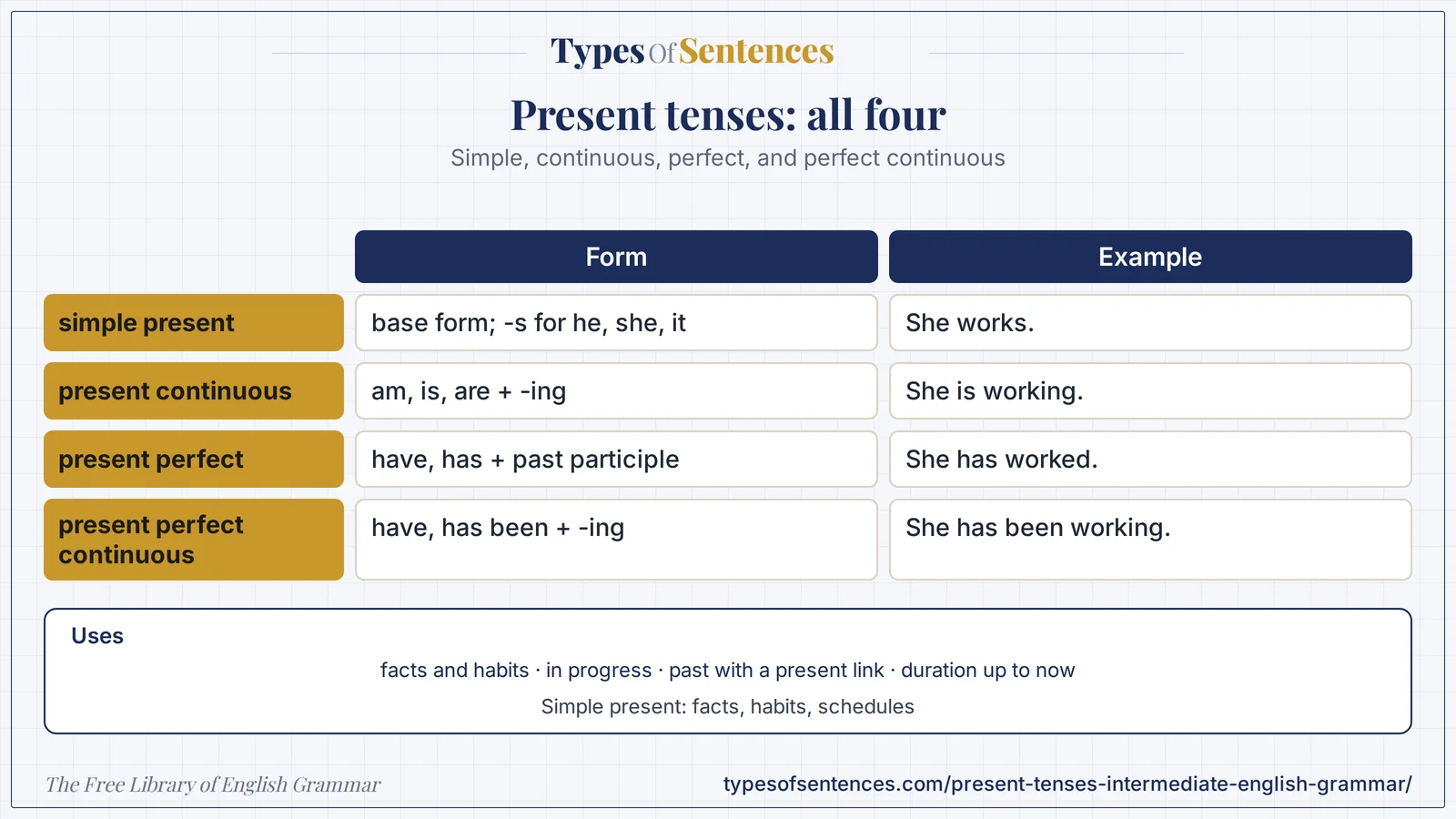
All four present tenses connect to now, but in different ways. The simple present states a fact or habit; the continuous shows something happening around now; the perfect links the past to the present; the perfect continuous stresses how long.
Why it matters: If you ask three questions (Is it a habit or fact? Is it in progress now? Does it connect past and present?), you can choose the right tense almost every time.
Summary: Simple present: facts, habits, schedules (She works). Present continuous: actions in progress and temporary situations (She is working). Present perfect: past actions with a present link, experience, and unfinished time (She has worked here for years). Present perfect continuous: duration up to now or recent activity (She has been working all day).
- Simple present: base form; add -s for he, she, it.
- Present continuous: am/is/are + -ing.
- Present perfect: have/has + past participle.
- Present perfect continuous: have/has been + -ing.
What You’ll Learn
- 1. Present Tenses: The Simple Present
- 2. Present Continuous (Progressive)
- 3. Present Perfect
- 4. Present Perfect Continuous
- 5. Comparing the Four: Simple Present, Continuous, and Perfect
- 6. Stative Verbs
- 7. Time Expressions with the Present Tenses
- 8. Common Errors with the Present Tenses
- 9. Exercises
- 10. Test Your Knowledge
- 11. Frequently Asked Questions
- 12. Conclusion
1. Present Tenses: The Simple Present
The simple present uses the base form of the verb, with -s or -es added for he, she, and it. Spelling follows the usual rules: works, watches, studies, goes.
| Form | Example |
|---|---|
| affirmative | I work. / She works. |
| negative | I do not (don’t) work. / She does not (doesn’t) work. |
| question | Do you work? / Does she work? |
| be | I am / you are / she is; negative: She is not; question: Is she? |
| Use | Example |
|---|---|
| habits and routines | She walks to work every day. |
| general facts and truths | Water boils at 100 degrees Celsius. |
| permanent situations | He lives in Dallas. |
| schedules and timetables | The train leaves at six. |
| instructions and directions | You turn left at the bank. |
| stories, jokes, commentary | So he opens the door, and there stands a lion. |
| feelings and states (stative verbs) | I know the answer. She loves music. |
Typical time expressions are always, usually, often, sometimes, never, every day, and on Mondays. The frequency adverbs go before the main verb and after be: She always walks; She is always late. This is the first of the 12 tenses introduced in the previous chapter.
2. Present Continuous (Progressive)
The present continuous uses am, is, or are plus the -ing form. Spelling follows the rules: make → making, run → running, lie → lying.
| Form | Example |
|---|---|
| affirmative | I am working. / She is working. / They are working. |
| negative | She is not (isn’t) working. |
| question | Is she working? / What are you doing? |
| Use | Example |
|---|---|
| action in progress now | I am writing an email. She is talking on the phone. |
| temporary situation | I am living with my parents this year. |
| changing or developing situation | The weather is getting colder. Prices are rising. |
| arranged future plan | I am meeting Tom tomorrow. |
| repeated annoying habit (with always) | He is always losing his keys. |
Time expressions include now, at the moment, today, this week, currently, and these days. Compare I live in Dallas (permanent) with I am living in Dallas this year (temporary).
3. Present Perfect
The present perfect uses have or has plus the past participle. For irregular participles, see the guide to irregular verbs.
| Form | Example |
|---|---|
| affirmative | I have worked. / She has worked. |
| negative | She has not (hasn’t) worked. |
| question | Have you worked? / Has she worked? |
| Use | Example | Typical words |
|---|---|---|
| unfinished time up to now | I have lived here for ten years. | for, since, so far, this week |
| life experience | I have visited Paris. Have you ever eaten sushi? | ever, never, before |
| recent action with a present result | She has lost her keys. (She still has none.) | just, already, yet, recently |
| change over time | Prices have risen sharply. | over the years, lately |
| repeated actions up to now | I have seen that film three times. | twice, many times |
| Have gone | Have been |
|---|---|
| She has gone to Paris. (She is there now.) | She has been to Paris. (She visited and came back.) |
American English often uses the simple past with already, yet, and just (Did you eat yet?, I already ate), while British English prefers the present perfect (Have you eaten yet?). Both are accepted; choose one pattern in a document.
4. Present Perfect Continuous
The present perfect continuous uses have or has plus been plus the -ing form.
| Form | Example |
|---|---|
| affirmative | I have been working. / She has been working. |
| negative | She has not (hasn’t) been working. |
| question | Has she been working? / How long have you been waiting? |
| Use | Example |
|---|---|
| duration up to now | I have been waiting for an hour. |
| recent activity with a visible result | You look tired. Have you been running? |
| an action that may continue | She has been studying since morning. |
| repeated recent activity | He has been calling me all week. |
Typical words are for, since, all day, lately, and how long. Compare the two perfect tenses: the present perfect stresses the result or the number (I have written five emails), and the present perfect continuous stresses the activity or the duration (I have been writing emails all morning).
5. Comparing the Four: Simple Present, Continuous, and Perfect
Choose among the tenses by asking what you want to say about the action.
| Question | Tense | Example |
|---|---|---|
| Is it a habit, fact, or schedule? | simple present | She works at a bank. |
| Is it in progress now or temporary? | present continuous | She is working now. |
| Is it complete, with a link to now? | present perfect | She has worked here for years. |
| How long has it been in progress? | present perfect continuous | She has been working all day. |
| Simple present | Present continuous | Present perfect | Present perfect continuous |
|---|---|---|---|
| I teach English. | I am teaching English this term. | I have taught English for ten years. | I have been teaching all morning. |
| permanent job | temporary or now | experience and duration | duration and activity |
Choose the tense: I (live) in Dallas since 2020, but I (stay) with a friend this month while my apartment (be) painted.
- since 2020 starts in the past and continues: have lived.
- this month is temporary: am staying.
- The passive form of a process in progress: is being painted.
- Result: I have lived in Dallas since 2020, but I am staying with a friend this month while my apartment is being painted.
6. Stative Verbs
Stative verbs describe states, not actions, and they are rarely used in the continuous tenses.
| Kind | Verbs | Correct | Incorrect |
|---|---|---|---|
| thought | know, believe, understand, remember | I know the answer. | I am knowing the answer. |
| feeling | love, like, hate, want, prefer | She loves music. | She is loving music. |
| possession | own, belong, have (possess) | He owns a house. | He is owning a house. |
| senses and appearance | seem, appear, sound, smell | It seems good. | It is seeming good. |
| Verb | Stative (simple) | Dynamic (continuous) |
|---|---|---|
| think | I think it is good. (opinion) | I am thinking about it. (process) |
| have | She has a car. (possess) | She is having lunch. (eat) |
| see | I see a bird. (perceive) | I am seeing the doctor. (meet) |
| taste | It tastes sweet. | She is tasting the soup. |
The types of verbs are explained in the chapter on types of verbs, and the verb phrases that make these tenses in the chapter on verb phrases.
7. Time Expressions with the Present Tenses
| Tense | Time expressions | Example |
|---|---|---|
| simple present | always, usually, often, every day, on Sundays, never | She usually walks. |
| present continuous | now, at the moment, today, this week, these days, currently | She is walking now. |
| present perfect | for, since, already, yet, just, ever, never, so far, recently, this week | She has just left. |
| present perfect continuous | for, since, all day, lately, recently, how long | She has been waiting since noon. |
- For a length of time: for ten years. Since a starting point: since 2020.
- Yet goes in negatives and questions, at the end: Has she left yet? Already goes in affirmatives: She has already left.
- This week and today can go with the present perfect when the period is unfinished: I have seen him today.
8. Common Errors with the Present Tenses
| Error | Correction | Rule |
|---|---|---|
| She work every day. | She works every day. | add -s for he, she, it |
| I am knowing the answer. | I know the answer. | stative verbs avoid the continuous |
| I have seen him yesterday. | I saw him yesterday. | a finished time needs the simple past |
| I am here since Monday. | I have been here since Monday. | since needs a perfect tense |
| She is work now. | She is working now. | be + -ing |
| I live here for five years. | I have lived here for five years. | duration up to now needs a perfect tense |
| He have finished. | He has finished. | has with he, she, it |
| Did you ever see it? (British writing) | Have you ever seen it? | present perfect for life experience |
| I am wanting some tea. | I want some tea. | stative verb |
Fix: I am knowing her since 2018, and she work in a bank for ten years. Yesterday I have met her and we are talking about it all morning.
- am knowing … since 2018: stative verb with a duration: have known her since 2018.
- she work … for ten years: she has worked in a bank for ten years.
- Yesterday I have met: finished time: I met her yesterday.
- we are talking … all morning: a duration up to now (or a past activity): we talked about it all morning.
- Result: I have known her since 2018, and she has worked in a bank for ten years. Yesterday I met her, and we talked about it all morning.
Recap in 12 seconds
Watch the lesson build itself: The four present tenses with their forms, examples, and uses. The video has no sound.
Exercises
Part A: Simple Present (Exercises 1–5)
Exercise 1: Complete: She (work) at a bank.
Show Answer
Answer: works.
Exercise 2: Complete: He (study) every night.
Show Answer
Answer: studies.
Exercise 3: Make negative: She works here.
Show Answer
Answer: She does not work here.
Exercise 4: Make a question: He lives in Dallas.
Show Answer
Answer: Does he live in Dallas?
Exercise 5: Complete: The train (leave) at six.
Show Answer
Answer: leaves (a schedule).
Part B: Present Continuous (Exercises 6–10)
Exercise 6: Complete: I (write) an email now.
Show Answer
Answer: am writing.
Exercise 7: Complete: It (get) colder these days.
Show Answer
Answer: is getting.
Exercise 8: Make a question: They are working.
Show Answer
Answer: Are they working?
Exercise 9: Spelling: run + -ing
Show Answer
Answer: running.
Exercise 10: Complete (plan): I (meet) Tom tomorrow.
Show Answer
Answer: am meeting.
Part C: Present Perfect (Exercises 11–16)
Exercise 11: Complete: I (live) here for ten years.
Show Answer
Answer: have lived.
Exercise 12: Complete: She (just/leave).
Show Answer
Answer: has just left.
Exercise 13: Fix it: I have seen him yesterday.
Show Answer
Answer: I saw him yesterday.
Exercise 14: Explain: She has gone to Paris. and She has been to Paris.
Show Answer
Answer: The first means she is there now; the second means she visited and returned.
Exercise 15: Choose: Have you (ever) (eat/eaten) sushi?
Show Answer
Answer: eaten.
Exercise 16: Choose: I have lived here (for/since) 2020.
Show Answer
Answer: since.
Part D: Present Perfect Continuous (Exercises 17–21)
Exercise 17: Complete: I (wait) for an hour.
Show Answer
Answer: have been waiting.
Exercise 18: Complete: She (study) since morning.
Show Answer
Answer: has been studying.
Exercise 19: Make a question: You have been waiting. (how long)
Show Answer
Answer: How long have you been waiting?
Exercise 20: Choose: I have (written/been writing) five emails. (number)
Show Answer
Answer: written.
Exercise 21: Choose: I have (written/been writing) emails all morning. (duration)
Show Answer
Answer: been writing.
Part E: Choosing and Stative Verbs (Exercises 22–26)
Exercise 22: Choose: I (know/am knowing) the answer.
Show Answer
Answer: know.
Exercise 23: Choose: She (has/is having) lunch right now.
Show Answer
Answer: is having.
Exercise 24: Choose: I (think/am thinking) it is good. (opinion)
Show Answer
Answer: think.
Exercise 25: Which tense: She works at a bank.
Show Answer
Answer: Simple present.
Exercise 26: Which tense: She has been working all day.
Show Answer
Answer: Present perfect continuous.
Part F: Errors (Exercises 27–30)
Exercise 27: Fix it: I am here since Monday.
Show Answer
Answer: I have been here since Monday.
Exercise 28: Fix it: She work every day.
Show Answer
Answer: She works every day.
Exercise 29: Fix it: I am wanting some tea.
Show Answer
Answer: I want some tea.
Exercise 30: Fix it: I live here for five years.
Show Answer
Answer: I have lived here for five years.
Test Your Knowledge
Ready to check what you learned? Answer all 10 questions, then submit. You need 80% (8 of 10) to pass. Your answers are not stored.
View correct answers and explanations
Question 1: Which tense is She works at a bank?
✓ Correct Answer: B – Simple present
It states a habit or fact.
Question 2: Which tense shows an action in progress now?
✓ Correct Answer: C – Present continuous
The present continuous shows action in progress.
Question 3: Which is correct?
✓ Correct Answer: D – I saw him yesterday.
A finished time needs the simple past.
Question 4: Which is correct?
✓ Correct Answer: C – I have been here since Monday.
Since needs a perfect tense.
Question 5: Which stresses duration up to now?
✓ Correct Answer: A – Present perfect continuous
The present perfect continuous stresses duration.
Question 6: Which verb avoids the continuous?
✓ Correct Answer: B – know
Know is stative.
Question 7: Which is correct?
✓ Correct Answer: A – She works every day.
Add -s for she.
Question 8: Which is the present perfect?
✓ Correct Answer: C – She has worked.
Has plus the past participle.
Question 9: What does She has gone to Paris mean?
✓ Correct Answer: B – She is in Paris now
Have gone means she is there.
Question 10: Which time word goes with the present perfect?
✓ Correct Answer: D – already
Already goes with the present perfect.
Frequently Asked Questions
What are the four present tenses?
The four present tenses are the simple present (I work), present continuous (I am working), present perfect (I have worked), and present perfect continuous (I have been working).
What are English grammar tenses and which are the present ones?
English grammar tenses place an action in time. The present ones are the four described here, and they all connect the action to now in different ways.
What is the present perfect?
The present perfect uses have or has plus the past participle. It links the past to the present: unfinished time (for ten years), experience (I have been to Paris), and recent actions with results (She has lost her keys).
What is the difference between the simple present and continuous?
The simple present states habits and facts (She works at a bank); the continuous shows an action in progress or a temporary situation (She is working now). Compare the simple present, continuous, and perfect in the table above.
What is the present perfect continuous?
The present perfect continuous uses have or has plus been plus -ing. It stresses duration up to now (I have been waiting for an hour) or a recent activity with a visible result.
Why can I not say I am knowing?
Know is a stative verb. Stative verbs describe states, not actions in progress, so they rarely take the continuous: I know the answer.
When do I use for and since?
Use for with a length of time (for ten years) and since with a starting point (since 2020). Both go with the present perfect or present perfect continuous.
Conclusion
You now know the four present tenses: the simple present for habits and facts, the present continuous for actions in progress, the present perfect for the link between past and present, and the present perfect continuous for duration and recent activity. You can choose among them, use the right time expressions, handle stative verbs, and avoid the common errors.
Use the three questions to choose the tense. Next, you will study the four past tenses.
- Merriam-Webster Dictionary: present tense: the dictionary definition of the present tense.
- Purdue Online Writing Lab: Grammar: reference section on verb tenses.
- Quirk, Randolph, et al. A Comprehensive Grammar of the English Language. Longman, 1985.: the present and the perfect and progressive aspects.
- Huddleston, Rodney, and Geoffrey K. Pullum. The Cambridge Grammar of the English Language. Cambridge University Press, 2002.: the present tense and the perfect.
Last reviewed: October 29, 2026. How it was made: drafted with AI assistance, then checked with automated tests (structure, links, answer keys, spelling) and against the sources above. A person has not yet read this chapter line by line. Found a mistake? Report it.