Advanced relative clauses go well beyond the man who called. At this level a relative clause can drop its relative word, shrink into a phrase, stand without a noun to describe, or comment on an entire sentence, and each choice changes meaning, punctuation, or tone.
This chapter assumes you know the basics from the Intermediate lesson. It covers the restrictive and non-restrictive contrast in depth, the choice between that and which, prepositions with whom and which, free relative clauses, sentential relative clauses, reduced relative clauses, and the structures that make complex relative clauses hard to read. It closes with 30 editing-focused exercises and a quiz.
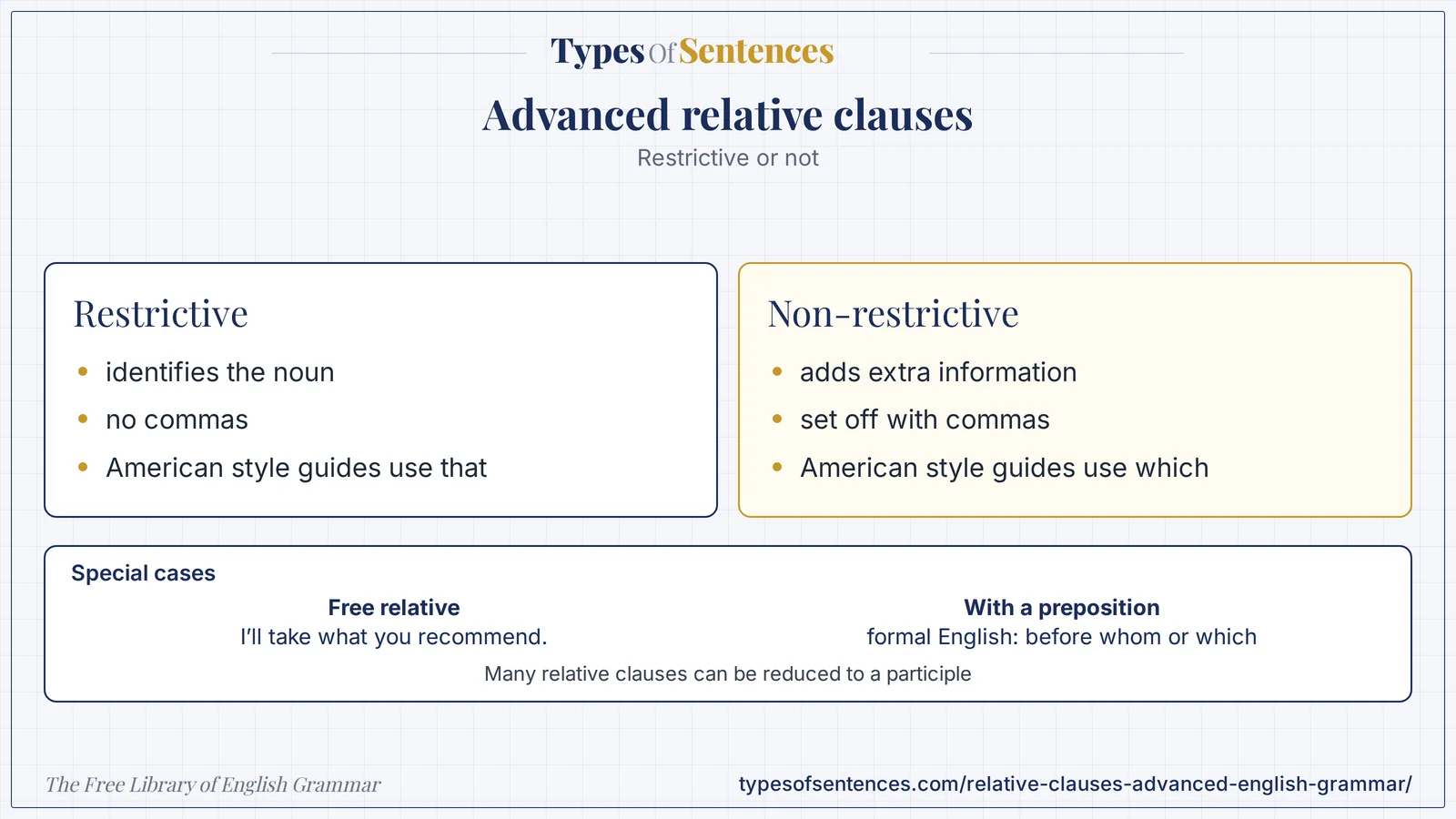
A relative clause adds information about a noun. The advanced questions are all about control: should the clause be set off with commas, which relative word fits, and can the clause be shortened or attached to something other than a noun?
Why it matters: These choices decide whether a sentence is precise or ambiguous, formal or casual. Editors correct them constantly, and writers who control them write sentences that read smoothly even when they carry a lot of detail.
Summary: A relative clause modifies a noun (its antecedent) and begins with who, whom, whose, which, that, a relative adverb, or nothing at all. Restrictive clauses identify the noun and take no commas; non-restrictive clauses add extra information and are set off by commas.
- American style guides use that for restrictive clauses and which, with commas, for non-restrictive ones; that never follows a preposition or a comma.
- With a preposition, formal English puts it before whom or which (to whom, in which); informal English leaves it at the end.
- A free relative clause has no antecedent (I’ll take what you recommend); a sentential relative clause with which comments on a whole clause.
- Many relative clauses can be reduced to a participle, an adjective, or a prepositional phrase (the man standing there).
What You’ll Learn
- 1. Advanced Relative Clauses: A Short Foundation
- 2. Restrictive and Non-Restrictive Clauses
- 3. Choosing the Relative Word: Who, Whom, Whose, and That
- 4. Prepositions and Relative Clauses
- 5. Free Relative Clauses
- 6. Sentential Relative Clauses
- 7. Reduced Relative Clauses
- 8. Complex Relative Clauses
- 9. Style, Ambiguity, and Editing
- 10. Exercises
- 11. Test Your Knowledge
- 12. Frequently Asked Questions
- 13. Conclusion
1. Advanced Relative Clauses: A Short Foundation
A relative clause is a dependent clause that modifies a noun or pronoun, called its antecedent. In the book that I bought, the antecedent is book and the clause is that I bought. The relative word does two jobs: it links the clause to the antecedent, and it plays a role inside the clause (here, direct object of bought).
| Relative word | Typical antecedent | Role inside the clause | Example |
|---|---|---|---|
| who | a person | subject | the author who wrote it |
| whom | a person | object | the author whom I met |
| whose | a person or thing | possessor | the author whose book sold |
| which | a thing or whole clause | subject or object | the book which I read |
| that | a person or thing | subject or object | the book that I read |
| (none) | a person or thing | object only | the book I read |
Relative adverbs (where, when, why) stand for a place, time, or reason; they are treated in the chapter on relative adverbs, and the pronouns in the chapter on relative pronouns. Everything below builds on these two.
2. Restrictive and Non-Restrictive Clauses
The most important distinction is between a clause that identifies and a clause that adds. A restrictive clause tells you which noun is meant; take it away and the meaning changes. A non-restrictive clause gives extra information about a noun that is already identified; take it away and the sentence still points to the same thing.
- Students who study pass the exam. restrictive: only those who study
- The students, who study, pass the exam. non-restrictive: all of them study
- The report that she wrote was long. restrictive
- The report, which she wrote in May, was long. non-restrictive
Writers often make the choice without noticing, but readers notice. Compare My brother who lives in Dallas is a pilot with My brother, who lives in Dallas, is a pilot. The first implies that you have more than one brother and identifies the one in Dallas. The second assumes you have one brother and tells us where he lives.
I. The punctuation test
Three questions settle most cases. First, does the clause identify the noun or merely describe it? Second, could you delete it without changing which person or thing is meant? Third, is the antecedent a proper name or a unique thing? A name is already identified, so a clause after it is almost always non-restrictive (Paris, which I visited in May, was crowded).
II. That and which
In American usage the two relative words divide the work. That introduces restrictive clauses and never takes commas. Which introduces non-restrictive clauses, always with commas, and may also appear in restrictive clauses when a preposition comes first (the house in which she lives).
| Clause type | Preferred word | Example |
|---|---|---|
| Restrictive | that (or none) | The car that I bought broke down. |
| Restrictive after a preposition | which, whom | The company for which I work is large. |
| Non-restrictive | which, who | The car, which I bought in May, broke down. |
That or which? The Chicago Manual of Style and the AP Stylebook both recommend that for restrictive clauses and which, with commas, for non-restrictive ones. Merriam-Webster’s usage notes point out that writers have used which in restrictive clauses for centuries, and British guides are more relaxed, so the American rule is a house-style convention rather than a law of the language. If you write for an American publisher or a university style sheet, follow the rule.
That does not take commas. If the information is only extra, use which with commas; if it identifies the company, drop the commas and use that.
This distinction is also the key to punctuating relative clauses correctly, which the chapter on advanced punctuation covers in more detail.
3. Choosing the Relative Word: Who, Whom, Whose, and That
Use who and whom for people, which for things, and whose for either. That works for things and, in American English, also for people in restrictive clauses (the man that called), although many editors prefer who for people.
I. Who and whom
The form depends on the pronoun’s job inside its own clause. If it is the subject, use who; if it is the object of a verb or preposition, formal writing uses whom. A quick test is to rebuild the clause as a statement: I met him (so whom I met) but she called (so who called).
- The candidate who won the vote thanked her team. subject
- The candidate whom the voters chose thanked her team. object
- The candidate that the voters chose thanked her team. restrictive, informal
In conversation and in much published writing, who has replaced whom when the pronoun is not next to a preposition (the person who I met). In formal prose, careful editors still correct it.
II. Whose with things
Whose is the possessive form of both who and which, so it is correct with things: a house whose roof leaks. Some writers avoid it for inanimate nouns and use of which (a house the roof of which leaks), but that version sounds stiff and is rarely better.
4. Prepositions and Relative Clauses
When the relative word is the object of a preposition, English gives you a choice. You can move the preposition to the front of the clause, which is formal, or leave it at the end, which is natural in speech and most writing.
| Formal (preposition first) | Informal (preposition last) | Shortest form |
|---|---|---|
| the person to whom I spoke | the person who I spoke to | the person I spoke to |
| the house in which she lives | the house that she lives in | the house she lives in |
| the committee for which I worked | the committee which I worked for | the committee I worked for |
That cannot come directly after a preposition. Choose which (preposition first) or keep the preposition at the end.
I. Quantifiers with whom and which
A formal pattern combines a quantifier, of, and a relative pronoun: some of whom, all of which, neither of whom, many of which. The clause is nearly always non-restrictive and set off by a comma.
- She has three sons, all of whom are doctors.
- The report cites ten studies, several of which contradict each other.
- The two candidates, neither of whom had experience, lost.
Can a clause end with a preposition? Usage guides, including The Chicago Manual of Style and Garner’s Modern English Usage, treat the old ban on ending a sentence or clause with a preposition as a superstition, not a rule. They advise writing what sounds natural and avoiding awkward constructions such as the person to whom I gave the book to, which doubles the preposition.
5. Free Relative Clauses
A free relative clause has no antecedent. The relative word, usually what, whoever, whatever, or where, includes the noun inside it, so the clause behaves like a noun phrase. I’ll take what you recommend means I’ll take the thing that you recommend.
- She eats what he cooks. object
- Whoever finishes first wins. subject
- Put it where you can see it. adverbial
- He is what we call a perfectionist. complement
Free relative clauses look like noun clauses introduced by a question word, and the two overlap. The test is the meaning of the sentence. In I ate what she cooked, what she cooked stands for a thing, so it is a free relative. In I know what she cooked, it is an embedded question (what is the answer?). Most speakers never need to tell them apart, but editors do when they decide between whom and who in whomever clauses.
The whoever and whomever choice depends on the job inside the free clause, not on the word before it. In Give it to whoever asks, the pronoun is the subject of asks, so whoever is correct even though a preposition precedes it. In Give it to whomever you choose, it is the object of choose, so whomever is the formal form.
6. Sentential Relative Clauses
Most relative clauses describe a noun. A sentential relative clause instead comments on a whole clause or an idea. It begins with which, is always set off by a comma, and refers to everything that came before it.
- She passed the exam, which surprised everyone. the whole event surprised them
- He said he was tired, which was true. what he said was true
- The train was late again, which meant that we missed the meeting.
Only which works here. That is not possible, and the clause cannot be restrictive. It is useful for adding a judgment or a consequence without starting a new sentence.
7. Reduced Relative Clauses
Many relative clauses can be shortened by removing the relative word and a form of be. What remains is a phrase: a participle phrase, an adjective phrase, or a prepositional phrase. Reduced relative clauses make writing compact, and they are common in news and academic prose.
| Full clause | Reduced form | Pattern |
|---|---|---|
| the man who is standing by the door | the man standing by the door | present participle |
| the book that was written by Orwell | the book written by Orwell | past participle |
| the cake that is on the table | the cake on the table | prepositional phrase |
| a person who is afraid of heights | a person afraid of heights | adjective phrase |
The same shortening works for non-restrictive clauses, which keep their commas: Orwell, born in India, wrote about Burma. When the verb is not a form of be, a participle can still replace the clause if the sense is the same: students who live abroad becomes students living abroad. You can study the participles themselves in the chapter on non-finite verbs.
I. Dropping the relative word
When the relative word is the object of its clause, you can leave it out completely in a restrictive clause: the woman whom I met becomes the woman I met. You cannot drop it when it is the subject (the woman who called cannot become the woman called).
A reduced relative needs a participle that fits the noun: the report is written by the committee, so the past participle is correct.
8. Complex Relative Clauses
Complex relative clauses pack one clause inside another or add several relative clauses to one noun. They are easy to write and hard to read, so they deserve extra care.
I. Embedded clauses and long-distance relatives
A relative word can belong to a clause buried deeper than the one that follows it. In the person that I think you should hire, the word that is the object of hire, not of think. In the book that the professor who I met recommended, one relative clause sits inside another.
- The candidate whom I believe the committee will choose is Ms. Lee. whom is the object of choose
- The book that the professor who I met recommended is out of print. two clauses, one inside the other
Two embedded clauses are the practical limit for readers. If you need a third, break the sentence in two.
II. Stacked and coordinated clauses
Two relative clauses can modify the same noun. A restrictive one comes first and a non-restrictive one follows: The students who passed, who were mostly seniors, celebrated. Avoid piling up several restrictive clauses (the students who passed who were absent), and join coordinated clauses with and or but instead: the students who passed and who were absent.
III. When that is preferred
That is usually the better choice after superlatives, all, everything, only, first, and same: the best film that I saw, everything that she said, the only person that knew. After it was … that, you have a cleft sentence, not a relative clause, which is covered in the chapter on cleft sentences.
Long relative clauses can bury the main verb. In The report that the committee that the board appointed in January wrote was long, the reader loses track of who did what. Split such sentences, or reduce one clause (the committee appointed in January).
9. Style, Ambiguity, and Editing
Because relative clauses attach to the nearest noun, the antecedent can be unclear. In the sister of my friend who lives in Boston, who lives in Boston: the sister or the friend? Put the clause next to the noun it modifies, or rephrase.
| Problem | Example | Fix |
|---|---|---|
| Unclear antecedent | The sister of my friend who lives in Boston called. | My friend’s sister, who lives in Boston, called. |
| Missing commas | My mother who grew up in Ohio loves snow. | My mother, who grew up in Ohio, loves snow. |
| Misused that | The company, that I joined in 2019, grew. | The company, which I joined in 2019, grew. |
| Vague which | He left early, which was rude. | He left early without saying goodbye, which was rude. |
Recap in 12 seconds
Watch the lesson build itself: Restrictive relative clauses identify the noun and take no commas; non-restrictive clauses add information and take commas. The video has no sound.
Exercises
Part A: Restrictive or Non-Restrictive? (Exercises 1–6)
Exercise 1: Restrictive or non-restrictive? The students who finished early left.
Show Answer
Answer: Restrictive. The clause tells which students left.
Exercise 2: Restrictive or non-restrictive? My brother, who lives in Dallas, is a pilot.
Show Answer
Answer: Non-restrictive. It adds extra information, so it takes commas.
Exercise 3: Restrictive or non-restrictive? The report that she wrote was long.
Show Answer
Answer: Restrictive. It identifies which report.
Exercise 4: Restrictive or non-restrictive? Paris, which I visited in May, was crowded.
Show Answer
Answer: Non-restrictive. A proper name is already identified.
Exercise 5: Restrictive or non-restrictive? Any employee who is late must sign in.
Show Answer
Answer: Restrictive. Without the clause, the rule would apply to all employees.
Exercise 6: Restrictive or non-restrictive? Dr. Alvarez, whose book won an award, will speak.
Show Answer
Answer: Non-restrictive. It adds information about an identified person.
Part B: Choose the Correct Form (Exercises 7–12)
Exercise 7: Which is correct? (a) the house in that she lived (b) the house in which she lived
Show Answer
Answer: (b). That cannot follow a preposition.
Exercise 8: Which is correct? (a) the person to whom I spoke (b) the person to who I spoke
Show Answer
Answer: (a). After a preposition, formal English requires whom.
Exercise 9: Which is correct? (a) a consultant whom was recommended (b) a consultant who was recommended
Show Answer
Answer: (b). The pronoun is the subject of was recommended, so it takes who.
Exercise 10: Which is correct? (a) The company, that was founded in 1990, closed. (b) The company, which was founded in 1990, closed.
Show Answer
Answer: (b). A clause set off by commas takes which.
Exercise 11: Which is correct? (a) three brothers, all of whom are doctors (b) three brothers, all of who are doctors
Show Answer
Answer: (a). Of is a preposition, so the pronoun is whom.
Exercise 12: Which is preferred in American style? (a) the only book that I own (b) the only book which I own
Show Answer
Answer: (a). That is the usual choice in restrictive clauses, especially after only.
Part C: Punctuate (Exercises 13–18)
Exercise 13: Add commas if needed: My mother who grew up in Ohio loves winter.
Show Answer
Answer: My mother, who grew up in Ohio, loves winter. The clause is non-restrictive.
Exercise 14: Add commas if needed: People who talk during movies annoy me.
Show Answer
Answer: No commas. The clause identifies which people.
Exercise 15: Add commas if needed: The Eiffel Tower which opened in 1889 is in Paris.
Show Answer
Answer: The Eiffel Tower, which opened in 1889, is in Paris. A unique name needs commas.
Exercise 16: Add commas if needed: Houses that face the lake cost more.
Show Answer
Answer: No commas. The clause limits which houses.
Exercise 17: Add commas if needed: She failed the test which surprised her teacher.
Show Answer
Answer: She failed the test, which surprised her teacher. The clause comments on the whole event, so it takes a comma.
Exercise 18: Add commas if needed: Our dog Rex who is ten still runs daily.
Show Answer
Answer: Our dog Rex, who is ten, still runs daily. A name makes the clause non-restrictive.
Part D: Reduce the Clause (Exercises 19–24)
Exercise 19: Reduce: The man who is standing by the door is my uncle.
Show Answer
Answer: The man standing by the door is my uncle.
Exercise 20: Reduce: The book that was written by Orwell is a classic.
Show Answer
Answer: The book written by Orwell is a classic.
Exercise 21: Reduce: Students who are living abroad need visas.
Show Answer
Answer: Students living abroad need visas.
Exercise 22: Reduce: The cake that is on the table is for you.
Show Answer
Answer: The cake on the table is for you.
Exercise 23: Reduce: Orwell, who was born in India, wrote about Burma.
Show Answer
Answer: Orwell, born in India, wrote about Burma. The commas stay because the clause is non-restrictive.
Exercise 24: Drop the relative word: The woman whom I met yesterday is a judge.
Show Answer
Answer: The woman I met yesterday is a judge. The relative word is an object, so it can be omitted.
Part E: Transform (Exercises 25–27)
Exercise 25: Rewrite with a free relative clause: I’ll take the thing that you recommend.
Show Answer
Answer: I’ll take what you recommend.
Exercise 26: Rewrite with the preposition first: This is the committee I wrote to.
Show Answer
Answer: This is the committee to which I wrote.
Exercise 27: Combine with a sentential relative clause: He was late again. This annoyed everyone.
Show Answer
Answer: He was late again, which annoyed everyone.
Part F: Review and Edit (Exercises 28–30)
Exercise 28: Review (Chapter 14, Intermediate): underline the relative clause in The book that I read was long.
Show Answer
Answer: that I read. It modifies book.
Exercise 29: Review (Chapter 13, noun clauses): is that he left in She said that he left a relative clause? Explain.
Show Answer
Answer: No. It is a noun clause (the object of said), and that is a conjunction that does no job inside the clause.
Exercise 30: Edit: My sister that lives in Boston, who I visit often, has a house which roof leaks.
Show Answer
Answer: My sister, who lives in Boston and whom I visit often, has a house whose roof leaks. That cannot take commas, whom is the object of visit, and whose is the possessive.
Test Your Knowledge
Ready to check what you learned? Answer all 10 questions, then submit. You need 80% (8 of 10) to pass. Your answers are not stored.
View correct answers and explanations
Question 1: Which sentence contains a non-restrictive relative clause?
✓ Correct Answer: D – My sister, who lives in Ohio, called.
The commas show that the clause adds extra information about an already identified sister. In the other three, the clause identifies which students, car, or person is meant.
Question 2: Which relative word cannot follow a preposition directly?
✓ Correct Answer: B – that
That cannot be the object of a preposition: you say the house in which she lives, not the house in that she lives. Whom and which can follow a preposition.
Question 3: In She passed the exam, which surprised everyone, what does which refer to?
✓ Correct Answer: A – The whole clause: her passing the exam
A sentential relative clause refers back to a whole idea. Here, her passing the exam is what surprised everyone, not the exam itself.
Question 4: What is the reduced form of the students who are waiting outside?
✓ Correct Answer: C – the students waiting outside
Remove the relative word and the form of be, leaving the participle phrase waiting outside. The other options change the verb form or keep the full clause.
Question 5: Which sentence contains a free relative clause?
✓ Correct Answer: D – I ate what she cooked.
What she cooked has no antecedent: what includes the noun, meaning the thing that she cooked. The other clauses either modify a noun or are noun clauses.
Question 6: Which sentence uses commas correctly?
✓ Correct Answer: B – My only brother, who lives in Dallas, is a pilot.
A person with only one brother is already identified, so the clause is non-restrictive and needs commas on both sides. A single comma, or none, is incorrect.
Question 7: Which phrase is a correct use of whose with a thing?
✓ Correct Answer: C – a house whose roof leaks
Whose is the possessive relative word for people and things alike. The other options use incorrect forms.
Question 8: In American style, which relative word is usually chosen for a restrictive clause?
✓ Correct Answer: A – that
The Chicago Manual of Style and the AP Stylebook recommend that for restrictive clauses. Which with commas is for non-restrictive ones.
Question 9: Which is correct?
✓ Correct Answer: B – three sons, all of whom are doctors
After the preposition of, formal English uses whom. The quantifier pattern all of whom is typically non-restrictive.
Question 10: Which is a correct reduced form of the woman who is sitting by the window?
✓ Correct Answer: C – the woman sitting by the window
The relative word and is are removed, leaving the participle phrase sitting by the window. The other options change the verb form incorrectly.
Frequently Asked Questions
What are advanced relative clauses?
Advanced relative clauses are relative clauses that go beyond the basic the man who called pattern. They include non-restrictive clauses, clauses with prepositions and whom, free relative clauses, sentential relative clauses, reduced relative clauses, and clauses embedded inside other clauses.
Can I put commas around a clause that begins with that?
No. That introduces restrictive clauses, which never take commas. If you want commas, the information is non-restrictive, and you should use which (for things) or who (for people).
When must I use whom?
Use whom when the pronoun is the object of a verb or of a preposition that comes first, such as to whom or all of whom. In informal writing, who is often accepted when the pronoun is separated from the preposition.
Is it wrong to end a relative clause with a preposition?
No. Phrases such as the person I spoke to are standard English, and major usage guides call the ban a superstition. Put the preposition first only when you want a formal tone, and avoid doubling it.
What is the difference between a free relative clause and a noun clause?
A free relative clause stands for a thing or person and has no antecedent: I ate what she cooked. A noun clause after a question word reports a question: I know what she cooked. The two look alike, so check whether the clause means the thing that or the answer to the question.
Can which refer to a whole sentence?
Yes. A sentential relative clause with which comments on everything that came before it: He was late, which annoyed us. Make sure the reference is clear, and rewrite with a noun if a reader could misunderstand it.
How do I reduce a relative clause?
Remove the relative pronoun and a form of be when the pronoun is the subject, leaving a participle, adjective, or prepositional phrase: the man who is standing there becomes the man standing there. If the relative word is an object, you can often drop it: the woman I met.
Conclusion
Advanced relative clauses reward careful choices. You now know how to decide between restrictive and non-restrictive clauses and punctuate them, how to choose that, which, who, whom, and whose, and how to place prepositions. You have also met free, sentential, and reduced relative clauses and the limits of embedding.
Use the editing order from the last section the next time you revise a long sentence: antecedent, commas, relative word, case, preposition. It will catch most of the errors that readers notice.
- Huddleston, Rodney, and Geoffrey K. Pullum. The Cambridge Grammar of the English Language. Cambridge University Press, 2002.: the detailed reference analysis of relative constructions, including free and sentential relatives.
- Quirk, Randolph, et al. A Comprehensive Grammar of the English Language. Longman, 1985.: classic description of restrictive and non-restrictive relative clauses.
- Garner, Bryan A. Garner’s Modern English Usage, 5th ed. Oxford University Press, 2022.: usage guidance on that and which, whom, and prepositions at the end of clauses.
- The Chicago Manual of Style, 17th edition, chapter 5 (Grammar and Usage): American publishing conventions for relative clauses.
Last reviewed: October 29, 2026. How it was made: drafted with AI assistance, then checked with automated tests (structure, links, answer keys, spelling) and against the sources above. A person has not yet read this chapter line by line. Found a mistake? Report it.