The four future tenses let you talk about what will happen, what will be in progress at a future time, what will be complete by a future time, and how long something will have lasted: the simple future (I will work), the future continuous (I will be working), the future perfect (I will have worked), and the future perfect continuous (I will have been working). English also expresses the future with going to and with the present tenses, so choosing among the forms matters.
This chapter covers each of the four future tenses, with its form and uses. You will compare will and going to, see how the present simple and continuous refer to the future, study the simple future, continuous, and perfect forms side by side, and learn the common errors. Thirty exercises and a quiz follow.
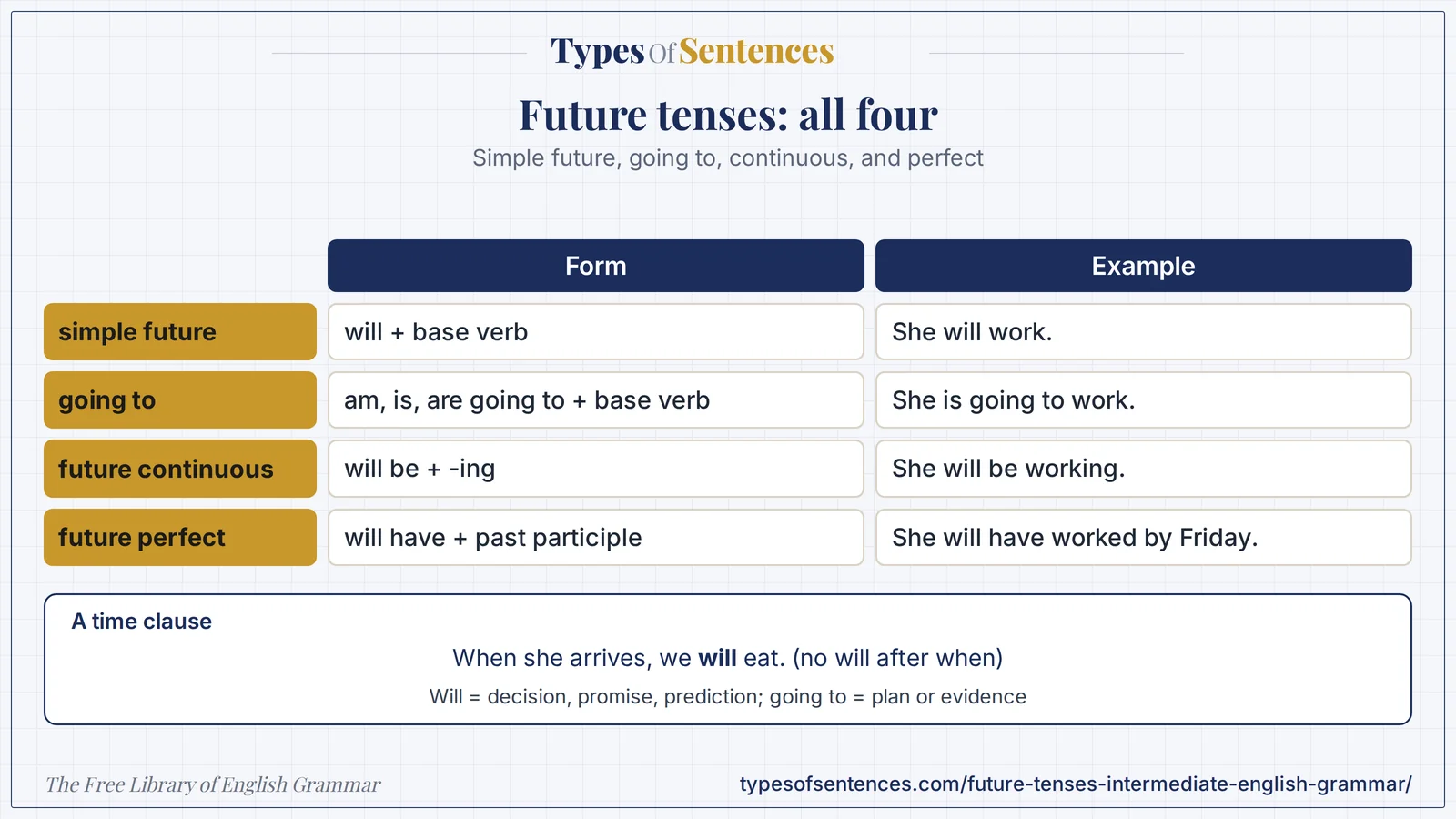
The future has no single form in English. You choose among will, be going to, the present continuous, and the present simple, depending on whether the future is a decision, a plan, an arrangement, or a schedule.
Why it matters: The three other future tenses use the same pieces as the other aspects: be + -ing, have + past participle, and both together.
Summary: Simple future: will + base verb (decisions, predictions, promises). Going to: plans and evidence. Future continuous: will be + -ing (in progress at a future time). Future perfect: will have + past participle (complete by a future time). Future perfect continuous: will have been + -ing (duration up to a future time).
- Will = instant decision, promise, prediction; going to = plan or evidence.
- Present continuous for arrangements; present simple for timetables.
- Future perfect always looks back from a future point: by Friday.
- No will in time and if clauses: When she arrives, we will eat.
What You’ll Learn
- 1. Future Tenses: The Simple Future with Will
- 2. Future with Going To
- 3. Will vs. Going To
- 4. Future Continuous
- 5. Future Perfect
- 6. Future Perfect Continuous
- 7. Present Tenses for the Future
- 8. Simple Future, Continuous, and Perfect Compared
- 9. Common Errors with the Future Tenses
- 10. Exercises
- 11. Test Your Knowledge
- 12. Frequently Asked Questions
- 13. Conclusion
1. Future Tenses: The Simple Future with Will
The simple future uses will plus the base form. It is the same for all persons. In American English, shall is used mainly in questions and offers (Shall we go?) and in formal writing.
| Form | Example |
|---|---|
| affirmative | I will work. / I’ll work. / She will work. |
| negative | She will not (won’t) work. |
| question | Will she work? / What will you do? |
| Use | Example |
|---|---|
| a decision made at the moment of speaking | The phone is ringing. I’ll answer it. |
| a prediction based on opinion | I think it will rain tomorrow. |
| a promise or offer | I will help you. I’ll carry your bag. |
| a threat or warning | I will tell your parents. |
| a fact about the future | Tomorrow will be Friday. |
| a request | Will you open the door, please? |
Typical words are tomorrow, next week, soon, in a year, I think, probably, and perhaps. The modal will is introduced in the chapter on modal verbs.
2. Future with Going To
The future with going to uses am, is, or are plus going to plus the base form. In speech, going to often becomes gonna, which is informal.
| Form | Example |
|---|---|
| affirmative | I am going to work. / She is going to work. |
| negative | She is not (isn’t) going to work. |
| question | Is she going to work? / What are you going to do? |
| Use | Example |
|---|---|
| a plan or intention made before speaking | I am going to study medicine. |
| a prediction based on present evidence | Look at those clouds. It is going to rain. |
| something about to happen | Careful! You are going to fall. |
3. Will vs. Going To
| Will | Going to | |
|---|---|---|
| decision | made now, at the moment of speaking | made before, a plan |
| prediction | opinion or belief: I think it will rain | evidence: it is going to rain (clouds) |
| promises and offers | yes: I’ll help you | no |
| plans | not usual | yes: We are going to move in June |
| formal writing | yes | less common |
- A: The phone is ringing. B: I will answer it. a decision at the moment
- I am going to call my mother this evening. a plan I already made
- I think Spain will win the match. an opinion
- Spain are going to win. They are four goals ahead. evidence
4. Future Continuous
The future continuous uses will be plus the -ing form.
| Form | Example |
|---|---|
| affirmative | I will be working. / She will be working. |
| negative | She will not (won’t) be working. |
| question | Will she be working? / What will you be doing? |
| Use | Example |
|---|---|
| an action in progress at a future time | At six o’clock tomorrow, I will be flying to London. |
| two actions in progress together in the future | While you are sleeping, I will be working. |
| an event that will happen as a matter of course | I will be seeing him tomorrow anyway. |
| a polite question about plans | Will you be using the car tonight? |
The future continuous asks politely about plans without asking directly for something: Will you be using the car? is more polite than Will you use the car?
5. Future Perfect
The future perfect uses will have plus the past participle.
| Form | Example |
|---|---|
| affirmative | I will have finished. / She will have left. |
| negative | She will not (won’t) have finished. |
| question | Will she have finished? / How much will you have done? |
| Use | Example |
|---|---|
| an action completed before a future time | By Friday, I will have finished the report. |
| an action completed before another future action | When you arrive, I will have cooked dinner. |
| a deduction about the present or past (modal use) | It’s late. She will have gone home by now. |
Typical words are by, by the time, by then, and before. The future perfect always looks back from a point in the future: By next June, we will have lived here for ten years.
6. Future Perfect Continuous
The future perfect continuous uses will have been plus the -ing form.
| Form | Example |
|---|---|
| affirmative | I will have been working. / She will have been waiting. |
| negative | She will not (won’t) have been working. |
| question | Will she have been working? / How long will you have been waiting? |
| Use | Example |
|---|---|
| duration up to a future point | By midnight, I will have been working for ten hours. |
| an activity that continues up to a future time | In June, she will have been teaching here for twenty years. |
This is the least common tense. It stresses how long an action will have lasted at a future time. Compare the future perfect, which stresses completion (She will have taught 2,000 classes), with the future perfect continuous, which stresses duration (She will have been teaching for twenty years).
7. Present Tenses for the Future
| Form | Use | Example |
|---|---|---|
| present continuous | a fixed arrangement | I am meeting Tom at six. We are leaving tomorrow. |
| simple present | a timetable or schedule | The train leaves at six. The film starts at eight. |
| present simple in time clauses | future time after when, before, after, until, as soon as | When she arrives, we will eat. |
| present simple in if clauses | a condition about the future | If it rains, we will stay home. |
| Other future forms | Example |
|---|---|
| be about to | The film is about to start. |
| be due to | The train is due to arrive at six. |
| be to (formal) | The president is to visit Japan next week. |
| be sure / certain to | She is sure to win. |
8. Simple Future, Continuous, and Perfect Compared
| Question | Form | Example |
|---|---|---|
| What will happen? | will + base | She will work. |
| What is planned? | going to | She is going to work. |
| What will be in progress at a future time? | future continuous | She will be working at six. |
| What will be complete by a future time? | future perfect | She will have finished by six. |
| How long will it have lasted by a future time? | future perfect continuous | She will have been working for eight hours by six. |
Choose the form: By the time you (arrive) tomorrow, I (work) for six hours, and I (finish) the report.
- By the time you arrive: a time clause, so the present: arrive.
- for six hours up to a future point: will have been working.
- finish the report: complete by then: will have finished.
- Result: By the time you arrive tomorrow, I will have been working for six hours, and I will have finished the report.
The four future tenses and the present forms can be listed together: simple future, going to, future continuous, future perfect, future perfect continuous, and the present continuous and simple present. The verb phrases are explained in the chapter on verb phrases.
9. Common Errors with the Future Tenses
| Error | Correction | Rule |
|---|---|---|
| When I will arrive, I will call. | When I arrive, I will call. | no will in a time clause |
| If it will rain, we will stay. | If it rains, we will stay. | no will in an if clause |
| I will to go. | I will go. | base form after will |
| She will goes. | She will go. | base form after will |
| I will have finished tomorrow. | I will have finished by tomorrow. | the future perfect needs a deadline |
| I am going to meeting him tomorrow. | I am meeting him tomorrow. / I am going to meet him tomorrow. | one future form, with the right verb form |
| I will see him yesterday. | I saw him yesterday. | a finished time needs a past tense |
| I think it is raining tomorrow. | I think it will rain tomorrow. | a prediction needs a future form |
Fix: When she will arrive tomorrow, I will to tell her that I am working here since eight and I am finishing by noon.
- When she will arrive: time clause: When she arrives.
- I will to tell: I will tell.
- am working here since eight: have been working here since eight (or will have been, by then).
- I am finishing by noon: deadline: I will have finished by noon.
- Result: When she arrives tomorrow, I will tell her that I have been working here since eight and will have finished by noon.
Recap in 12 seconds
Watch the lesson build itself: The future tenses with their forms, examples, and the rule that time and if clauses take no will. The video has no sound.
Exercises
Part A: Will and Going To (Exercises 1–7)
Exercise 1: Choose: The phone is ringing. I (will/am going to) answer it.
Show Answer
Answer: will (a decision at the moment).
Exercise 2: Choose: I (will/am going to) study medicine. (I decided last year)
Show Answer
Answer: am going to (a plan).
Exercise 3: Choose: Look at those clouds. It (will/is going to) rain.
Show Answer
Answer: is going to (evidence).
Exercise 4: Choose: I think it (will/is going to) rain tomorrow. (opinion)
Show Answer
Answer: will.
Exercise 5: Make negative: She will work.
Show Answer
Answer: She will not (won’t) work.
Exercise 6: Make a question: She is going to work.
Show Answer
Answer: Is she going to work?
Exercise 7: Which is a promise: I will help you or I am going to help you?
Show Answer
Answer: I will help you.
Part B: Future Continuous (Exercises 8–12)
Exercise 8: Complete: At six tomorrow, I (fly) to London.
Show Answer
Answer: will be flying.
Exercise 9: Complete: While you sleep, I (work).
Show Answer
Answer: will be working.
Exercise 10: Question (polite): Will you (use) the car tonight?
Show Answer
Answer: Will you be using the car tonight?
Exercise 11: Negative: She will be working.
Show Answer
Answer: She will not be working.
Exercise 12: Name the tense: I will be seeing him tomorrow.
Show Answer
Answer: Future continuous.
Part C: Future Perfect (Exercises 13–17)
Exercise 13: Complete: By Friday, I (finish) the report.
Show Answer
Answer: will have finished.
Exercise 14: Complete: When you arrive, I (cook) dinner.
Show Answer
Answer: will have cooked.
Exercise 15: Complete: By next June, we (live) here for ten years.
Show Answer
Answer: will have lived.
Exercise 16: Question: She will have finished.
Show Answer
Answer: Will she have finished?
Exercise 17: Which word often signals the future perfect?
Show Answer
Answer: by (by Friday, by then).
Part D: Future Perfect Continuous (Exercises 18–21)
Exercise 18: Complete: By midnight, I (work) for ten hours.
Show Answer
Answer: will have been working.
Exercise 19: Complete: In June, she (teach) here for twenty years.
Show Answer
Answer: will have been teaching.
Exercise 20: Question: You will have been waiting. (how long)
Show Answer
Answer: How long will you have been waiting?
Exercise 21: Choose: She will have (taught/been teaching) 2,000 classes. (number)
Show Answer
Answer: taught.
Part E: Present Tenses for the Future (Exercises 22–26)
Exercise 22: Choose: I (meet/will meet) Tom at six. (arrangement)
Show Answer
Answer: am meeting.
Exercise 23: Choose: The train (leaves/will leave) at six. (timetable)
Show Answer
Answer: leaves.
Exercise 24: Choose: When she (arrives/will arrive), we will eat.
Show Answer
Answer: arrives.
Exercise 25: Choose: If it (rains/will rain), we will stay home.
Show Answer
Answer: rains.
Exercise 26: Name another future form: The film is about to start.
Show Answer
Answer: be about to.
Part F: Errors (Exercises 27–30)
Exercise 27: Fix it: When I will arrive, I will call.
Show Answer
Answer: When I arrive, I will call.
Exercise 28: Fix it: I will to go.
Show Answer
Answer: I will go.
Exercise 29: Fix it: I will have finished tomorrow.
Show Answer
Answer: I will have finished by tomorrow.
Exercise 30: Fix it: I think it is raining tomorrow.
Show Answer
Answer: I think it will rain tomorrow.
Test Your Knowledge
Ready to check what you learned? Answer all 10 questions, then submit. You need 80% (8 of 10) to pass. Your answers are not stored.
View correct answers and explanations
Question 1: Which is the simple future?
✓ Correct Answer: C – She will work.
Will plus the base form.
Question 2: Which is a decision made now?
✓ Correct Answer: A – I will answer it.
Will is used for decisions at the moment of speaking.
Question 3: Which is based on present evidence?
✓ Correct Answer: B – It is going to rain.
Going to is used for predictions based on evidence.
Question 4: Which is the future continuous?
✓ Correct Answer: C – She will be working.
Will be plus -ing.
Question 5: Which is the future perfect?
✓ Correct Answer: A – She will have finished.
Will have plus the past participle.
Question 6: Which is correct?
✓ Correct Answer: B – When she arrives, we will eat.
Use the present in a time clause.
Question 7: Which stresses duration up to a future point?
✓ Correct Answer: D – Future perfect continuous
Will have been plus -ing.
Question 8: Which is correct?
✓ Correct Answer: C – I will go.
Use the base form after will.
Question 9: Which is a timetable use?
✓ Correct Answer: A – The train leaves at six.
The simple present is used for timetables.
Question 10: Which is correct for an arrangement?
✓ Correct Answer: D – I am meeting Tom at six.
The present continuous is used for arrangements.
Frequently Asked Questions
What are the four future tenses?
The four future tenses are the simple future (I will work), future continuous (I will be working), future perfect (I will have worked), and future perfect continuous (I will have been working).
What is the simple future continuous and perfect contrast?
The simple future states what will happen (She will work); the continuous shows what will be in progress at a future time (She will be working at six); and the perfect shows what will be complete by a future time (She will have finished by six).
What is the difference between will and going to?
Will is used for decisions made now, opinions, promises, and offers. Going to is used for plans made before and for predictions based on evidence.
What is the future perfect?
The future perfect uses will have plus the past participle. It shows an action that will be completed before a future time: By Friday, I will have finished the report.
What is the future perfect continuous?
The future perfect continuous uses will have been plus -ing. It shows how long an action will have been in progress at a future time: By midnight, I will have been working for ten hours.
Can I use the present tense for the future?
Yes. The present continuous expresses arrangements (I am meeting Tom at six), and the simple present expresses timetables (The train leaves at six) and future time in time and if clauses.
Is it shall or will?
In American English, will is the usual form for all persons. Shall is used mainly in questions and offers (Shall we go?) and in formal or legal writing.
Conclusion
You now know the four future tenses and the other ways to express the future: will, going to, the future continuous, the future perfect, the future perfect continuous, and the present tenses. You can choose among them by meaning, use the right time expressions, and avoid the common errors.
Think of the future as a set of choices, not one tense. Next, you will study tense consistency and the sequence of tenses.
- Merriam-Webster Dictionary: future tense: the dictionary definition of the future tense.
- Purdue Online Writing Lab: Grammar: reference section on verb tenses.
- Quirk, Randolph, et al. A Comprehensive Grammar of the English Language. Longman, 1985.: the expression of future time.
- Huddleston, Rodney, and Geoffrey K. Pullum. The Cambridge Grammar of the English Language. Cambridge University Press, 2002.: future time and the modal will.
Last reviewed: October 29, 2026. How it was made: drafted with AI assistance, then checked with automated tests (structure, links, answer keys, spelling) and against the sources above. A person has not yet read this chapter line by line. Found a mistake? Report it.