ACT English practice questions are the best way to learn how the ACT English section asks about grammar, punctuation, and style. This page gives 50 original ACT English practice questions in ten skill groups, each with four choices (the first is always NO CHANGE), the answer, and a short explanation. They copy the format of the test, but they are not real ACT questions.
Use this page as an ACT English practice test in short sets: do one group of five questions, check the answers, and write the rule behind each miss in a log. The page also explains how the section is built, gives a four-step method for ACT English practice problems, and ends with 30 exercises and a 10-question quiz. Check act.org for the current format before you test.
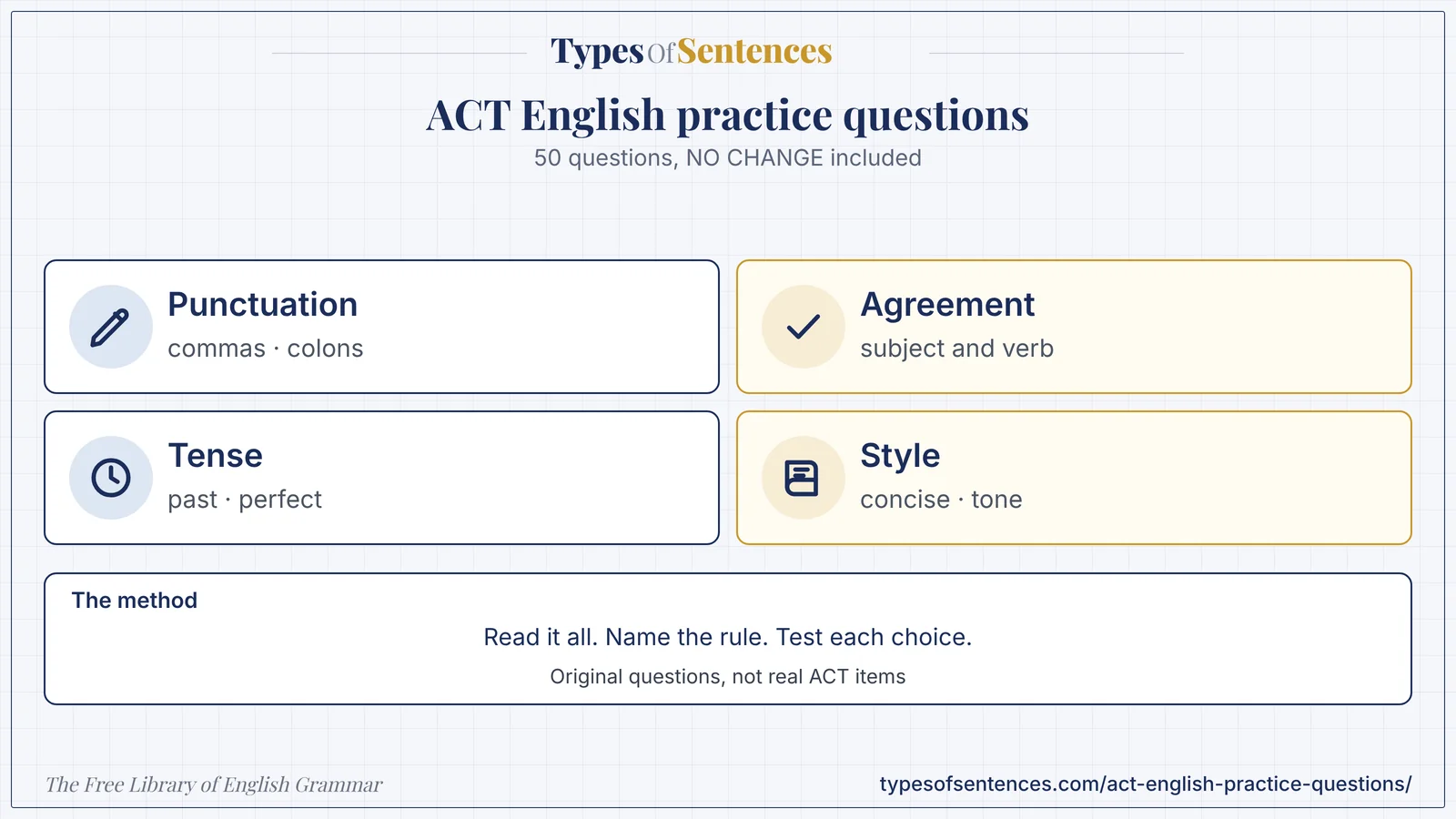
Each question shows a sentence with an underlined part. You choose whether to keep it or replace it.
Why it matters: NO CHANGE is a real answer. Choose it when the underlined part is already correct.
Summary: The Enhanced ACT English section has 50 questions in 35 minutes (a figure found by web search on 12 Nov 2026; confirm it at act.org). Each question shows an underlined part of a passage and four choices, the first of which is NO CHANGE. The questions test punctuation, sentence structure, agreement, tense, pronouns, modifiers, parallelism, concision, word choice, transitions, and purpose. This page gives 50 original questions with answers and explanations, five for each skill. Work in short sets, read the whole sentence, name the rule, and keep a log of the rules you miss.
- 50 questions, 10 skills.
- NO CHANGE can be right.
- Name the rule.
- Keep a log.
What You’ll Learn
- 1. ACT English Practice Questions: The Short Answer
- 2. Group 1: Commas (Questions 1 to 5)
- 3. Group 2: Semicolons and colons (Questions 6 to 10)
- 4. Group 3: Apostrophes (Questions 11 to 15)
- 5. Group 4: Sentence boundaries (Questions 16 to 20)
- 6. Group 5: Subject-verb agreement (Questions 21 to 25)
- 7. Group 6: Verb tense and form (Questions 26 to 30)
- 8. Group 7: Pronouns (Questions 31 to 35)
- 9. Group 8: Modifiers and parallel structure (Questions 36 to 40)
- 10. Group 9: Concision and redundancy (Questions 41 to 45)
- 11. Group 10: Transitions, word choice, and purpose (Questions 46 to 50)
- 12. A Four-Step Method and a Time Plan
- 13. Exercises
- 14. Test Your Knowledge
- 15. Frequently Asked Questions
- 16. Conclusion
1. ACT English Practice Questions: The Short Answer
| Group | Skill tested | Questions |
|---|---|---|
| 1 | Commas | 1 to 5 |
| 2 | Semicolons and colons | 6 to 10 |
| 3 | Apostrophes | 11 to 15 |
| 4 | Sentence boundaries | 16 to 20 |
| 5 | Subject-verb agreement | 21 to 25 |
| 6 | Verb tense and form | 26 to 30 |
| 7 | Pronouns | 31 to 35 |
| 8 | Modifiers and parallel structure | 36 to 40 |
| 9 | Concision and redundancy | 41 to 45 |
| 10 | Transitions, word choice, and purpose | 46 to 50 |
| Step | Action |
|---|---|
| 1 | read the whole sentence, not only the underlined part |
| 2 | name the rule being tested |
| 3 | test each choice in the sentence |
| 4 | choose NO CHANGE if the original is correct |
These are original practice items. The real ACT puts the same skills in passages. The rules are explained in the guides to ACT English grammar rules, ACT punctuation, and ACT rhetorical skills.
2. Group 1: Commas (Questions 1 to 5)
| # | Question and choices | Answer | Explanation |
|---|---|---|---|
| 1 | Paris the capital of France is a large city. A. NO CHANGE B. , the capital of France, C. the capital of France, D. , the capital of France |
B | Extra information takes a matching pair of commas. |
| 2 | We bought apples pears and plums at the market. F. NO CHANGE G. apples, pears and, plums H. apples, pears, and plums J. apples pears, and plums |
H | Commas separate the items in a list. |
| 3 | The students in the back row, were talking. A. NO CHANGE B. ; C. : D. DELETE the underlined portion. |
D | No mark separates a subject from its verb. |
| 4 | When the long game ended the players went home. F. NO CHANGE G. When the long game ended, H. When, the long game ended J. When the long game, ended |
G | A comma follows an introductory dependent clause. |
| 5 | It was a long, tiring, journey. A. NO CHANGE B. long tiring, journey C. long, tiring journey D. long, tiring; journey |
C | No comma goes between the last adjective and its noun. |
3. Group 2: Semicolons and colons (Questions 6 to 10)
| # | Question and choices | Answer | Explanation |
|---|---|---|---|
| 6 | The store was closed, however we found another. F. NO CHANGE G. , however, H. ; however J. ; however, |
J | A conjunctive adverb between two sentences takes a semicolon before it and a comma after it. |
| 7 | She packed three items; a map, a hat, and water. A. NO CHANGE B. : a map, a hat, and water C. ; and a map, a hat, and water D. . A map, a hat, and water |
B | A colon after a complete sentence introduces a list. |
| 8 | Her favorite subjects are: math, science, and art. F. NO CHANGE G. ; H. DELETE the underlined portion. J. — |
H | A colon must follow a complete sentence. |
| 9 | The shop opens at nine; it closes at five. A. NO CHANGE B. , it C. . it D. it |
A (NO CHANGE) | A semicolon joins two complete sentences. |
| 10 | He had one goal: to win the race. F. NO CHANGE G. ; to win the race H. and to win the race J. being to win the race |
F (NO CHANGE) | A colon after a complete sentence introduces the goal. |
The coordinating conjunctions that join sentences are listed in the guide to coordinating conjunctions.
4. Group 3: Apostrophes (Questions 11 to 15)
| # | Question and choices | Answer | Explanation |
|---|---|---|---|
| 11 | The childrens toys were everywhere. A. NO CHANGE B. childrens’ C. children’s D. childs |
C | The irregular plural children takes ’s in the possessive. |
| 12 | Both girl’s coats were wet. F. NO CHANGE G. girls H. girl’s’ J. girls’ |
J | Two girls: a plural possessive. |
| 13 | Its a beautiful day. A. NO CHANGE B. It’s C. Its’ D. Is |
B | It’s means it is. |
| 14 | The company announced its new policy. F. NO CHANGE G. it’s H. their J. its’ |
F (NO CHANGE) | The possessive its has no apostrophe. |
| 15 | My sisters new car is red. A. NO CHANGE B. sisters’ C. sister D. sister’s |
D | One sister owns the car. |
5. Group 4: Sentence boundaries (Questions 16 to 20)
| # | Question and choices | Answer | Explanation |
|---|---|---|---|
| 16 | It rained all day, we stayed inside. F. NO CHANGE G. ; we H. , we, J. we |
G | A comma alone cannot join two complete sentences. |
| 17 | Because the roads were icy. We stayed home. A. NO CHANGE B. Because the roads were icy; we stayed home. C. Because the roads were icy, we stayed home. D. Because the roads were icy we. Stayed home. |
C | A dependent clause must be joined to a main clause. |
| 18 | Maya studied hard. And passed the test. F. NO CHANGE G. . Also H. ; and J. and |
J | Passed the test has no subject, so it must be part of the first sentence. |
| 19 | The museum is free it is crowded on weekends. A. NO CHANGE B. free; it is C. free, it is D. free it, is |
B | Two complete sentences need a semicolon or a period. |
| 20 | While waiting for the bus. Sam read a book. F. NO CHANGE G. While waiting for the bus; Sam read a book. H. While waiting for the bus, Sam read a book. J. While waiting for the bus Sam. Read a book. |
H | The first part is a fragment. |
Comma splices and run-ons are explained in the guide to the comma splice and in the Intermediate chapter on run-on sentences.
6. Group 5: Subject-verb agreement (Questions 21 to 25)
| # | Question and choices | Answer | Explanation |
|---|---|---|---|
| 21 | The list of names are long. A. NO CHANGE B. were C. have been D. is |
D | The subject is list. |
| 22 | Neither the manager nor the workers was late. F. NO CHANGE G. were H. is J. has been |
G | The verb agrees with the nearer subject, workers. |
| 23 | Each of the boys has a ticket. A. NO CHANGE B. have C. are having D. were having |
A (NO CHANGE) | Each is singular. |
| 24 | There is three reasons for the delay. F. NO CHANGE G. was H. has been J. are |
J | The subject reasons is plural. |
| 25 | The team are ready for the final. A. NO CHANGE B. is C. were D. have been |
B | In American English a team acting as a unit takes a singular verb. |
7. Group 6: Verb tense and form (Questions 26 to 30)
| # | Question and choices | Answer | Explanation |
|---|---|---|---|
| 26 | By the time we arrived, the show already started. F. NO CHANGE G. has already started H. had already started J. already starts |
H | The past perfect shows an earlier past action. |
| 27 | She has wrote two books. A. NO CHANGE B. have wrote C. had wrote D. has written |
D | The present perfect uses the past participle. |
| 28 | If I was you, I would go. F. NO CHANGE G. were H. am J. be |
G | A hypothetical condition takes the subjunctive. |
| 29 | He lives in this city since 2015. A. NO CHANGE B. lived C. has lived D. is living |
C | Since with a continuing situation takes the present perfect. |
| 30 | Yesterday the committee approves the plan. F. NO CHANGE G. approving H. has approve J. approved |
J | The tense must be past. |
8. Group 7: Pronouns (Questions 31 to 35)
| # | Question and choices | Answer | Explanation |
|---|---|---|---|
| 31 | Maya and me went home. A. NO CHANGE B. I C. myself D. mine |
B | The pronoun is a subject. |
| 32 | The prize goes to the student whom scores highest. F. NO CHANGE G. whose H. who J. which |
H | The pronoun is the subject of scores. |
| 33 | The company changed its name. A. NO CHANGE B. their C. it’s D. they’re |
A (NO CHANGE) | A company is singular. |
| 34 | Between you and I, it is a secret. F. NO CHANGE G. me H. myself J. mine |
G | The pronoun is the object of a preposition. |
| 35 | He gave the books to Tom and she. A. NO CHANGE B. hers C. her D. herself |
C | The pronoun is the object of to. |
9. Group 8: Modifiers and parallel structure (Questions 36 to 40)
| # | Question and choices | Answer | Explanation |
|---|---|---|---|
| 36 | Walking to school, the rain began to fall. F. NO CHANGE G. Walking to school, it was raining H. While walking to school, the rain J. Walking to school, Maya felt the rain |
J | The person who walks must follow the opening phrase. |
| 37 | She likes hiking, swimming, and to bike. A. NO CHANGE B. biking C. bike D. bikes |
B | The items in a list share one form. |
| 38 | The job requires patience, creativity, and organization. F. NO CHANGE G. being organized H. to organize J. organize |
F (NO CHANGE) | The nouns match. |
| 39 | He promised to call, to write, and that he would visit. A. NO CHANGE B. visiting C. visit D. to visit |
D | Match the infinitives. |
| 40 | The cost of a bus ticket is lower than a train ticket. F. NO CHANGE G. the cost of a train ticket H. train tickets J. a train |
G | Compare a cost with a cost. |
10. Group 9: Concision and redundancy (Questions 41 to 45)
| # | Question and choices | Answer | Explanation |
|---|---|---|---|
| 41 | The design is very unique and one of a kind. A. NO CHANGE B. very unique C. unique D. one of a kind and unique |
C | Unique already means one of a kind. |
| 42 | Due to the fact that it rained, the game ended. F. NO CHANGE G. For the reason that H. On account of the fact that J. Because |
J | The shortest choice keeps the meaning. |
| 43 | She returned back to her office. A. NO CHANGE B. returned C. went back again D. came back again |
B | Return already means go back. |
| 44 | The meeting will begin at 9 a.m. in the morning. F. NO CHANGE G. at 9 a.m. in the morning hours H. at 9 a.m. J. in the morning at 9 a.m. sharp |
H | A.m. already means morning. |
| 45 | In my personal opinion, I think the plan is good. A. NO CHANGE B. In my opinion, I believe C. I personally think in my view D. I think |
D | The opening repeats an idea. |
11. Group 10: Transitions, word choice, and purpose (Questions 46 to 50)
| # | Question and choices | Answer | Explanation |
|---|---|---|---|
| 46 | The park is large. Therefore, it is free. F. NO CHANGE G. Moreover H. However J. Instead |
G | The second sentence adds a similar point. |
| 47 | The test was long. For example, most students finished early. A. NO CHANGE B. Similarly C. Even so D. In addition |
C | The ideas contrast. |
| 48 | It rained all day. However, the game was canceled. F. NO CHANGE G. Meanwhile H. For instance J. As a result |
J | The second sentence is the result. |
| 49 | The coach was notorious for her kindness. A. NO CHANGE B. famous C. infamous D. cunning |
B | Notorious means known for something bad. |
| 50 | Which sentence best introduces a paragraph about the benefits of sleep? F. NO CHANGE G. I went to bed at ten last night. H. Sleep affects health, mood, and learning. J. Some people drink coffee. |
H | The introduction states the paragraph’s main idea. |
12. A Four-Step Method and a Time Plan
| Step | Action | Example |
|---|---|---|
| 1 | read the whole sentence | the error may be outside the underline |
| 2 | find the subject and the verb | The list … is |
| 3 | name the rule | agreement |
| 4 | test the choices and pick one; keep NO CHANGE if correct | read each aloud |
| Plan | How to do it |
|---|---|
| pace | spend about 40 seconds on each question (35 minutes for 50 questions is 42 seconds) |
| order | answer the quick questions first and mark the hard ones |
| guess | do not leave a blank; there is no penalty for a wrong answer on the ACT |
| review | spend the last minutes on marked questions |
Recap in 12 seconds
Watch the lesson build itself: Fifty original ACT English practice questions with answers and explanations in ten skill groups. The video has no sound.
Exercises
Part A: Name the Error (Exercises 1–10)
Exercise 1: It rained, we left.
Show Answer
Answer: comma splice.
Exercise 2: Because it rained.
Show Answer
Answer: fragment.
Exercise 3: The list of names are long.
Show Answer
Answer: agreement.
Exercise 4: The boy in the hat, is my cousin.
Show Answer
Answer: comma between subject and verb.
Exercise 5: The company changed their name.
Show Answer
Answer: pronoun agreement.
Exercise 6: Walking home, the rain started.
Show Answer
Answer: dangling modifier.
Exercise 7: She likes to swim and biking.
Show Answer
Answer: parallelism.
Exercise 8: The childrens toys
Show Answer
Answer: apostrophe.
Exercise 9: He have finished.
Show Answer
Answer: verb form.
Exercise 10: Her goals are: to win.
Show Answer
Answer: misused colon.
Part B: Fix It (Exercises 11–20)
Exercise 11: It was late, we left.
Show Answer
Answer: It was late; we left.
Exercise 12: The team are ready.
Show Answer
Answer: The team is ready.
Exercise 13: Each of the boys have a bike.
Show Answer
Answer: Each of the boys has a bike.
Exercise 14: If I was you, I would go.
Show Answer
Answer: If I were you, I would go.
Exercise 15: She has wrote a letter.
Show Answer
Answer: She has written a letter.
Exercise 16: Between you and I
Show Answer
Answer: Between you and me
Exercise 17: The student who’s bag was lost
Show Answer
Answer: The student whose bag was lost
Exercise 18: It’s tail wagged.
Show Answer
Answer: Its tail wagged.
Exercise 19: Due to the fact that it rained
Show Answer
Answer: Because it rained
Exercise 20: She returned back.
Show Answer
Answer: She returned.
Part C: Choose the Mark (Exercises 21–25)
Exercise 21: The store opens at nine ___ it closes at five.
Show Answer
Answer: a semicolon.
Exercise 22: She needed one thing ___ sleep.
Show Answer
Answer: a colon.
Exercise 23: After the show ___ we went home.
Show Answer
Answer: a comma.
Exercise 24: The museum is free ___ however, it is crowded.
Show Answer
Answer: a semicolon.
Exercise 25: My sister ___ a nurse ___ works nights.
Show Answer
Answer: a pair of dashes.
Part D: Choose the Transition (Exercises 26–30)
Exercise 26: It was cold. ___ we stayed in.
Show Answer
Answer: As a result.
Exercise 27: The test was long. ___ it was fair.
Show Answer
Answer: However.
Exercise 28: The park is large. ___ it is free.
Show Answer
Answer: Moreover.
Exercise 29: Birds migrate. ___ geese fly south.
Show Answer
Answer: For example.
Exercise 30: He studied. ___ he passed.
Show Answer
Answer: Therefore.
Test Your Knowledge
Ready to check what you learned? Answer all 10 questions, then submit. You need 80% (8 of 10) to pass. Your answers are not stored.
View correct answers and explanations
Question 1: How many questions are in the Enhanced ACT English section?
✓ Correct Answer: B – 50
50, in 35 minutes (found by web search on 12 Nov 2026; confirm at act.org).
Question 2: The first choice in an ACT English question is usually
✓ Correct Answer: C – NO CHANGE
NO CHANGE.
Question 3: A semicolon joins
✓ Correct Answer: D – two complete sentences
Two sentences.
Question 4: Which is a comma splice?
✓ Correct Answer: A – It rained, we left.
One comma, two sentences.
Question 5: A colon must follow
✓ Correct Answer: B – a complete sentence
A complete sentence.
Question 6: Its is
✓ Correct Answer: C – possessive
Possessive.
Question 7: Returned back is
✓ Correct Answer: D – redundant
Redundant.
Question 8: The first thing to read is
✓ Correct Answer: A – the whole sentence
The whole sentence.
Question 9: If the sentence is already correct, choose
✓ Correct Answer: B – NO CHANGE
NO CHANGE.
Question 10: To improve fastest, you should
✓ Correct Answer: C – keep an error log
Error log.
Frequently Asked Questions
What are ACT English practice questions?
ACT English practice questions are questions in the format of the ACT English section: a passage with underlined parts and four choices, one of which is NO CHANGE. The ones on this page are original, not real test questions.
Is this an ACT English practice test?
It works as practice for the grammar and style rules: 50 questions in ten groups. It is not a full-length test with passages and a timer; use the free materials from act.org for that.
Where can I find ACT English questions with answers?
This page gives 50 ACT English questions with answers and explanations. For real questions, use the official materials from ACT, Inc.
How many ACT English practice problems should I do a day?
Five to fifteen, followed by a review of every miss. Short, regular sessions work better than one long one.
How long should I spend on each ACT English question?
The section gives about 40 seconds a question on average (35 minutes for 50 questions). Answer the quick ones first and return to the hard ones.
Is NO CHANGE ever the right answer?
Yes. In many questions the underlined part is already correct. Choose NO CHANGE when no other choice follows the rules better.
What are the most tested rules?
Commas and other punctuation, sentence boundaries, subject-verb agreement, verb tense, pronouns, modifiers, parallel structure, concision, and transitions.
Conclusion
You have now worked through 50 ACT English practice questions with answers and explanations, in ten groups, and a four-step method with a time plan. Each question tested one rule.
Do the groups in short sets, keep a log of the rules you miss, and redo the missed questions after a week. Next, review the matching rules in the ACT articles on this site.
- ACT, Inc. Preparing for the ACT and the ACT English test description.: the format of the English section (the number of questions and the time were found by web search on 12 Nov 2026; act.org was not opened when this page was written).
- Strunk, William, Jr., and E. B. White. The Elements of Style. 4th ed. Longman, 2000.: the rules for punctuation and usage.
- Garner, Bryan A. Garner’s Modern English Usage. 5th ed. Oxford University Press, 2022.: the entries on agreement, pronouns, and modifiers.
- Merriam-Webster Dictionary: semicolon: the dictionary entry (not opened when this page was written). All 50 questions were written for this page; they are not real ACT questions.
Last reviewed: October 29, 2026. How it was made: drafted with AI assistance, then checked with automated tests (structure, links, answer keys, spelling) and against the sources above. A person has not yet read this chapter line by line. Found a mistake? Report it.