What are the ACT English grammar rules? The ACT English grammar rules are the conventions of Standard English that the English test of the ACT checks. The ACT English section is a passage-based multiple-choice test. In the format that took effect with the 2025 changes, it has 50 questions (including some unscored field-test questions) to be answered in 35 minutes, and its questions are reported in three categories: Conventions of Standard English (38 to 43 percent), Production of Writing (38 to 43 percent), and Knowledge of Language (18 to 23 percent). The conventions questions are the grammar, punctuation, and sentence-structure questions.
This page explains how the ACT English test is built, lists the rules that the ACT grammar questions use with correct and incorrect examples, explains the questions on adjectives and adverbs, covers the questions on organization and word choice, and gives a method and the common traps. It ends with 30 original practice items (not taken from ACT, Inc.) and a 10-question quiz.
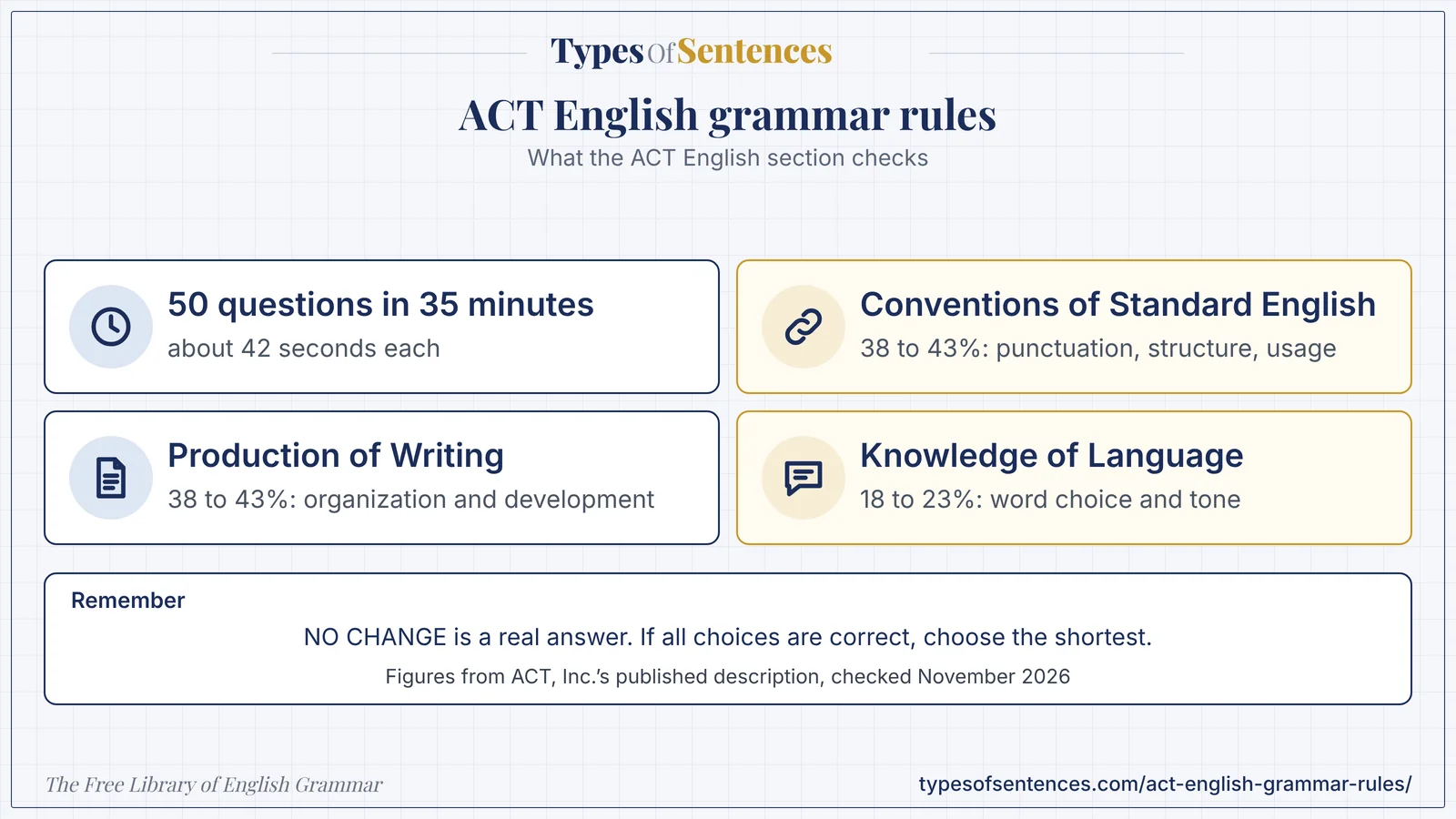
The ACT English section gives you a passage with parts underlined. For each underlined part you choose the best version, and the first choice is always “NO CHANGE”, meaning the original is correct. About half of the questions test grammar and punctuation, and the rest test how well the passage is organized and worded.
Why it matters: A few dozen rules cover nearly everything. Learn them once, learn to spot which rule an item is testing, and the English section becomes the most predictable part of the ACT.
Summary: The ACT English section has 50 questions in 35 minutes, which is about 42 seconds per question, and it reports three categories: Conventions of Standard English (sentence structure, punctuation, and usage), Production of Writing (topic development, organization, unity, and cohesion), and Knowledge of Language (word choice, style, and tone). The rules tested most often are: join clauses correctly, never split a subject from its verb, use apostrophes and commas by rule, make verbs and pronouns agree, use adjectives and adverbs correctly, keep lists parallel, place modifiers well, and choose the shortest answer when all choices are correct.
- 50 questions in 35 minutes.
- Three reporting categories.
- Conventions: punctuation, structure, usage.
- NO CHANGE is a real answer.
What You’ll Learn
- 1. ACT English Grammar Rules: The Short Answer
- 2. How the ACT English Test Is Built
- 3. ACT English Grammar Rules: Punctuation
- 4. ACT English Grammar Rules: Sentence Structure and Formation
- 5. ACT English Grammar Rules: Usage
- 6. ACT Adjective and Adverb Questions
- 7. Production of Writing and Knowledge of Language Questions
- 8. A Five-Step Method for the ACT English Test
- 9. Common Mistakes on the ACT English Test
- 10. Exercises
- 11. Test Your Knowledge
- 12. Frequently Asked Questions
- 13. Conclusion
1. ACT English Grammar Rules: The Short Answer
| Fact | Detail |
|---|---|
| test | the ACT English section (the first section of the ACT) |
| questions and time | 50 questions in 35 minutes (the format since the 2025 changes); the earlier format had 75 questions in 45 minutes |
| time per question | about 42 seconds |
| reporting category 1 | Conventions of Standard English: 38 to 43 percent |
| reporting category 2 | Production of Writing: 38 to 43 percent |
| reporting category 3 | Knowledge of Language: 18 to 23 percent |
| question form | a passage with underlined parts, four choices; the first choice is NO CHANGE |
| other sections | Math and Reading are required; Science and Writing are optional |
These figures are taken from ACT, Inc.’s published description of the enhanced ACT and were checked in November 2026. ACT, Inc. can change the test, so check act.org before you rely on them.
2. How the ACT English Test Is Built
| Category | What it tests | Typical items |
|---|---|---|
| Conventions of Standard English | sentence structure and formation, punctuation, and usage | commas, apostrophes, colons, agreement, verb tense, pronouns, adjectives and adverbs |
| Production of Writing | topic development; organization, unity, and cohesion | adding or deleting a sentence, reordering, transitions, introductions and conclusions |
| Knowledge of Language | precision, concision, style, and tone | wordiness, redundancy, the best word, a consistent tone |
| If the choices differ in… | The question is probably about… | Example |
|---|---|---|
| punctuation only | punctuation (commas, colons, dashes) | work, and / work; and / work and |
| verb forms | agreement or tense | The list of items (is/are) |
| a pronoun | case, number, or clear reference | (who/whom), (its/their) |
| an adjective and an adverb | adjective and adverb choice | felt (bad/badly) |
| length and wording | concision or tone | due to the fact that / because |
| a transition word | organization | however / therefore |
Because the first choice is NO CHANGE, about a quarter of the answers are correct as written. Do not change a sentence just because it looks unusual: change it only if you can name the rule it breaks.
3. ACT English Grammar Rules: Punctuation
| Rule | Correct example | Error |
|---|---|---|
| join two independent clauses with a period, a semicolon, or a comma and a conjunction | It rained, so we stayed in. | *It rained, we stayed in. |
| a colon follows a complete clause | She packed three things: a map, a compass, and water. | *She packed: a map and water. |
| a semicolon joins independent clauses (and only those) | It rained; we stayed in. | *We stayed in; because it rained. |
| commas around nonessential information | My cousin, who lives in Denver, called. | *My cousin, who lives in Denver called. |
| no comma between a subject and its verb | The girl in the red coat won. | *The girl in the red coat, won. |
| a comma after an introductory element | When it rained, we stayed in. | *When it rained we stayed in. |
| commas in a series | apples, pears, and plums | *apples pears and plums |
| an apostrophe for possession (not for plurals) | the dogs’ bowls · two dogs | *two dog’s |
| its and it’s | The dog wagged its tail. It’s late. | *The dog wagged it’s tail. |
| dashes and parentheses in pairs | My cousin — who lives in Denver — called. | *My cousin — who lives in Denver, called. |
The most common ACT punctuation questions involve commas, apostrophes, and the colon. The rules for joining clauses are explained in the Intermediate chapter on run-on sentences, and the other marks in the advanced chapter on advanced punctuation.
4. ACT English Grammar Rules: Sentence Structure and Formation
| Rule | Correct example | Error |
|---|---|---|
| every sentence needs a subject and a finite verb | The dog barked at the mailman. | *The dog barking at the mailman. |
| no fragments | Because it rained, we left. | *Because it rained. |
| no run-ons or comma splices | It rained; we left. | *It rained we left. |
| parallel structure in lists | swimming, running, and cycling | *swimming, running, and to cycle |
| modifiers beside what they modify | Walking home, she felt the rain begin. | *Walking home, the rain began. |
| consistent verb tense | She opened the door and walked in. | *She opened the door and walks in. |
| correct verb form after a helper | has eaten · had gone | *has ate · *had went |
| subordination for relationships | Although he was tired, he finished. | *Although he was tired, but he finished. |
Parallelism is covered in the advanced chapter on parallel structure.
5. ACT English Grammar Rules: Usage
| Rule | Correct example | Error |
|---|---|---|
| subject-verb agreement (find the real subject) | The list of names is long. | *The list of names are long. |
| pronoun-antecedent agreement | The company changed its policy. | *The company changed their policy. (in formal usage) |
| pronoun case | between you and me | *between you and I |
| who and whom | Whom did you meet? (formal) | *Whom is calling? |
| comparatives and superlatives | taller · the tallest of the three | *more taller · the taller of the three |
| idioms and prepositions | interested in · different from | *interested on |
| commonly confused words | affect (verb) · effect (noun) | *the affect of the storm |
| double negatives | I do not have any money. | *I do not have no money. |
The pairs most often confused (affect and effect, its and it’s, their and there) have their own guides in this series, such as the one on affect vs effect.
6. ACT Adjective and Adverb Questions
| Rule | Correct example | Error |
|---|---|---|
| an adjective modifies a noun or pronoun | a quick answer | *a quickly answer |
| an adverb modifies a verb, an adjective, or another adverb | She answered quickly. | *She answered quick. |
| linking verbs (feel, seem, look, smell) take adjectives | I feel bad. (I am sad.) | *I feel badly. (would mean my sense of touch is poor) |
| action verbs take adverbs | She plays well. | *She plays good. |
| good is an adjective; well is usually an adverb | a good player · plays well | *a well player (except for health: I am well) |
| comparatives: two things; superlatives: three or more | the taller of the two · the tallest of the three | *the tallest of the two |
| adjective before a noun, adverb before an adjective | a really tall tree | *a real tall tree (informal) |
Adjectives and adverbs are explained in the Basic chapters on adjectives and adverbs. The ACT adjective and adverb questions are among the most predictable on the test: check what the word modifies, and check whether the verb is a linking verb.
7. Production of Writing and Knowledge of Language Questions
| Question type | What to do | Example |
|---|---|---|
| transition | read the sentences before and after and name the relationship | The first test failed. ___, the team tried again. → Nevertheless |
| add or delete a sentence | ask whether it supports the paragraph’s main idea | a sentence about lunch inside a paragraph on climate |
| reorder sentences | find the topic sentence and the logical order | a sentence that begins with This cannot come first |
| introduction or conclusion | match the purpose of the passage | choose the choice that sets up the next point |
| concision | choose the shortest choice that keeps the meaning | due to the fact that → because |
| redundancy | cut repeated meaning | *past history → history |
| tone | match the register of the passage | formal: purchase; casual: buy |
| precise word | choose the exact meaning | reduce vs eliminate |
| Rule of thumb | Why it works |
|---|---|
| if all choices are grammatically correct, choose the shortest | the ACT rewards concision |
| do not add extra commas | a wrong comma is more common than a missing one |
| “NO CHANGE” is correct about one time in four | do not avoid it |
| read the sentence before and after | many questions depend on context |
8. A Five-Step Method for the ACT English Test
| Step | Do this | Why |
|---|---|---|
| 1 read | read the sentence containing the underlined part, and a sentence on each side if needed | context decides organization and tone questions |
| 2 name | look at how the choices differ and name the rule | a named rule narrows the choices |
| 3 find | find the real subject, the verb, the antecedent, or the clause boundary | traps hide in the words between them |
| 4 test | test each choice in the sentence and cross out those that break a rule | several choices often sound natural |
| 5 pace | keep to about 40 seconds per question | the section is short and fast |
Choose the best version of the underlined word is: The team of researchers, who published the report last year, is now preparing a second study. (A) NO CHANGE (B) are (C) were (D) have been
- Name the rule: the choices are verb forms, so this is agreement (and tense).
- Find the real subject: team, a singular collective noun treated as one unit. Of researchers and who published the report last year are interrupters.
- Test: The team … is now preparing agrees with the subject and with now. Are breaks agreement; were and have been break the present-time meaning of now.
- Answer: (A) NO CHANGE, because the original is correct. (The item is an original practice item, not taken from ACT, Inc.)
9. Common Mistakes on the ACT English Test
| Mistake | What happens | Better habit |
|---|---|---|
| changing a correct sentence | NO CHANGE is skipped | change only when you can name the broken rule |
| choosing a long, formal-sounding answer | a wordy choice wins by mistake | prefer the shortest correct choice |
| adding commas by “sound” | a comma splits a subject from its verb | test the rule |
| ignoring the real subject | the verb matches the nearest noun | cross out the interrupter |
| guessing adjective or adverb by ear | badly and bad are swapped | check whether the verb is linking |
| skipping the context | a transition or an addition is wrong | read the sentences around it |
| spending too long on one item | the section is 42 seconds per question | move on and return |
| leaving blanks | there is no penalty for a wrong answer | answer every question |
Recap in 12 seconds
Watch the lesson build itself: The ACT English section has 50 questions in 35 minutes and reports three categories: Conventions of Standard English, Production of Writing, and Knowledge of Language. The video has no sound.
Exercises
Part A: Punctuation (Exercises 1–10)
Exercise 1: Choose: It rained all day ___ we stayed in. (A) , (B) , so (C) ; (D) B or C
Show Answer
Answer: (D): a comma with so, or a semicolon, joins the two clauses. (original item)
Exercise 2: Choose: My cousin, who lives in Denver ___ called. (A) , (B) none
Show Answer
Answer: (A): a comma closes the nonessential phrase.
Exercise 3: Choose: The girl in the red coat ___ won the race. (A) , (B) none
Show Answer
Answer: (B): no comma between the subject and its verb.
Exercise 4: Choose: She packed three things ___ a map, a compass, and water. (A) , (B) : (C) none
Show Answer
Answer: (B): a colon after a complete clause.
Exercise 5: Choose: The two (dog’s/dogs’) bowls were empty.
Show Answer
Answer: dogs’.
Exercise 6: Choose: The dog wagged (its/it’s) tail.
Show Answer
Answer: its.
Exercise 7: Choose: When the bell rang ___ the students left. (A) , (B) none
Show Answer
Answer: (A): a comma after the introductory clause.
Exercise 8: Choose: apples ___ pears, and plums (A) , (B) none
Show Answer
Answer: (A).
Exercise 9: Choose: We stayed in ___ because it rained. (A) ; (B) , (C) none
Show Answer
Answer: (C): no punctuation before the dependent clause.
Exercise 10: Choose: The result was clear ___ the plan failed. (A) : (B) , (C) none
Show Answer
Answer: (A): a colon after a complete clause explains it.
Part B: Usage, Adjectives, and Adverbs (Exercises 11–20)
Exercise 11: Choose: The list of names (is/are) long.
Show Answer
Answer: is.
Exercise 12: Choose: The company changed (its/their) policy.
Show Answer
Answer: its.
Exercise 13: Choose: Between you and (I/me), it is fine.
Show Answer
Answer: me.
Exercise 14: Choose: She plays (good/well).
Show Answer
Answer: well.
Exercise 15: Choose: I feel (bad/badly) about the news.
Show Answer
Answer: bad (a linking verb).
Exercise 16: Choose: She answered (quick/quickly).
Show Answer
Answer: quickly.
Exercise 17: Choose: He is the (taller/tallest) of the three.
Show Answer
Answer: tallest.
Exercise 18: Choose: He is the (taller/tallest) of the two.
Show Answer
Answer: taller.
Exercise 19: Choose: We were interested (in/on) the offer.
Show Answer
Answer: in.
Exercise 20: Choose: I do not have (any/no) money.
Show Answer
Answer: any (avoid a double negative).
Part C: Sentence Structure and Organization (Exercises 21–26)
Exercise 21: Fix the fragment: Because it rained.
Show Answer
Answer: Because it rained, we stayed in.
Exercise 22: Choose the parallel form: swimming, running, and (to cycle/cycling)
Show Answer
Answer: cycling.
Exercise 23: Fix the modifier: Walking home, the rain began.
Show Answer
Answer: Walking home, she felt the rain begin.
Exercise 24: Choose the transition: The test was hard. ___, most students passed.
Show Answer
Answer: Nevertheless (or Still).
Exercise 25: Choose the transition: She studied hard. ___, she earned a high score.
Show Answer
Answer: As a result (or Therefore).
Exercise 26: A sentence about lunch appears in a paragraph about climate. Add, keep, or delete?
Show Answer
Answer: delete (it does not support the main idea).
Part D: Concision, Word Choice, and Errors (Exercises 27–30)
Exercise 27: Shorten: due to the fact that
Show Answer
Answer: because.
Exercise 28: Cut the redundancy: past history
Show Answer
Answer: history.
Exercise 29: Correct: *The affect of the storm was bad.
Show Answer
Answer: The effect of the storm was bad.
Exercise 30: Correct: *The dog wagged it’s tail.
Show Answer
Answer: The dog wagged its tail.
Test Your Knowledge
Ready to check what you learned? Answer all 10 questions, then submit. You need 80% (8 of 10) to pass. Your answers are not stored.
View correct answers and explanations
Question 1: The ACT English section has
✓ Correct Answer: A – 50 questions in 35 minutes
The enhanced format.
Question 2: The first choice in an English question is always
✓ Correct Answer: B – NO CHANGE
NO CHANGE.
Question 3: The three reporting categories are Conventions, Production of Writing, and
✓ Correct Answer: C – Knowledge of Language
Knowledge of Language.
Question 4: I feel ___ about the news.
✓ Correct Answer: D – bad
A linking verb.
Question 5: Which is correct?
✓ Correct Answer: A – She plays well.
An action verb takes an adverb.
Question 6: A colon must follow
✓ Correct Answer: B – a complete clause
A complete clause.
Question 7: If all choices are correct, choose
✓ Correct Answer: C – the shortest
The ACT rewards concision.
Question 8: The list of names ___ long.
✓ Correct Answer: D – is
The subject is list.
Question 9: Which comparison is correct for two things?
✓ Correct Answer: A – the taller
Comparative for two.
Question 10: The time per question on the English section is about
✓ Correct Answer: B – 42 seconds
35 minutes for 50 questions.
Frequently Asked Questions
What are the ACT English grammar rules?
They are the conventions of Standard English that the ACT English section checks: punctuation, sentence structure, and usage (including agreement, pronouns, and the choice of adjectives and adverbs), plus the choices that make a passage well organized and well worded.
How many questions are in the ACT English section?
In the format published by ACT, Inc. since the 2025 changes, the English section has 50 questions in 35 minutes (some are unscored field-test questions). The earlier format had 75 questions in 45 minutes. Check act.org for the current format.
What is tested on the ACT English test?
The ACT English test reports three categories: Conventions of Standard English (38 to 43 percent), Production of Writing (38 to 43 percent), and Knowledge of Language (18 to 23 percent). About 40 percent of the questions test grammar and punctuation directly.
What are ACT grammar questions like?
Each one shows a passage with an underlined part and four choices; the first is NO CHANGE. You pick the version that follows Standard English and fits the passage. The ACT grammar questions test punctuation, agreement, verb forms, pronouns, modifiers, and parallelism.
How do the ACT adjective and adverb questions work?
They test whether a word modifies a noun (use an adjective) or a verb, adjective, or adverb (use an adverb), and whether the verb is a linking verb (feel bad) or an action verb (plays well).
Should I choose NO CHANGE?
Yes, whenever you cannot name a rule that the original breaks. NO CHANGE is the correct answer about a quarter of the time, so do not avoid it.
How can I practice for the ACT English section?
Use ACT, Inc.’s own practice tests and sample questions at act.org, then work through the rules on this page. Practice items on this page are original and are not taken from ACT, Inc.
Conclusion
You now know the ACT English grammar rules: how the English section is built, the three reporting categories, the punctuation, sentence-structure, and usage rules, the adjective and adverb questions, and the questions on organization and word choice. You have also seen a five-step method and the common traps.
Name the rule before you look at the choices, keep to about 40 seconds per question, and remember that NO CHANGE is a real answer. For the digital SAT, which checks a similar set of rules in a different format, see the companion guide.
- ACT, Inc. The Enhanced ACT: K–12 FAQs and test descriptions. act.org.: the English section’s question count, time limit, and reporting categories (checked November 2026; ACT, Inc. can change them).
- ACT, Inc. ACT sample questions and practice tests. act.org.: official practice for the ACT.
- Garner, Bryan A. Garner’s Modern English Usage. 5th ed. Oxford University Press, 2022.: the rules of agreement, punctuation, and modifiers.
- Strunk, William, Jr., and E. B. White. The Elements of Style. 4th ed. Longman, 1999.: the elementary rules of usage and composition.
Last reviewed: October 29, 2026. How it was made: drafted with AI assistance, then checked with automated tests (structure, links, answer keys, spelling) and against the sources above. A person has not yet read this chapter line by line. Found a mistake? Report it.