SAT vs ACT grammar is a question that every student who takes both tests asks: are the rules the same? Mostly, yes. Both tests check Standard English: sentence boundaries, punctuation, agreement, verb tense, pronouns, modifiers, parallel structure, and transitions. What differs is the format of the questions, the share of the score that grammar carries, and the way the tests word their choices.
This page compares SAT or ACT grammar section by section: the number of questions, the reporting categories, the question styles, and the skills that matter more on one test than on the other. It then gives one study plan that works for both tests. It treats act vs sat grammar and sat vs act english as one question about format, and lists the SAT and ACT grammar differences in a table. The page ends with 30 exercises and a 10-question quiz. Test formats change, so check the College Board and ACT sites before you test.
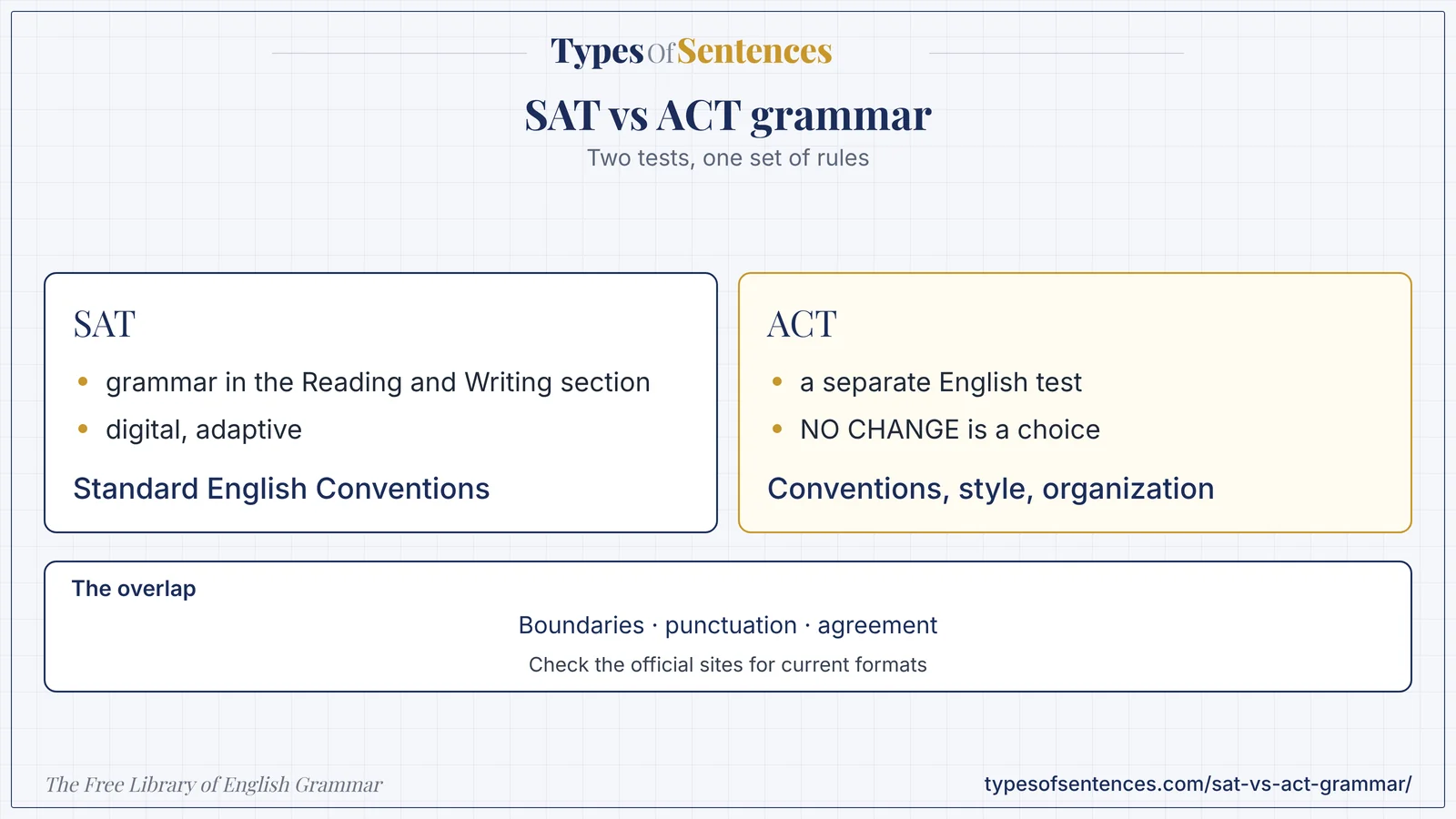
The grammar rules are almost the same on both tests. The way the questions look is different.
Why it matters: Learn the rules once, then practice each test’s format.
Summary: The digital SAT Reading and Writing section has 54 questions in two modules; Standard English Conventions is about 26 percent of them (about 11 to 15 questions) and Expression of Ideas about 20 percent. The Enhanced ACT English section has 50 questions in 35 minutes, reported in Conventions of Standard English (about 38 to 43 percent), Production of Writing (about 38 to 43 percent), and Knowledge of Language (about 18 to 23 percent). Both test the same core rules. The ACT puts underlined parts in a passage and offers NO CHANGE; the SAT gives a short text for each question. Learn the rules once, then practice the format of the test you will take.
- Same core rules.
- Different formats.
- ACT has NO CHANGE.
- One study plan covers both.
What You’ll Learn
1. SAT vs ACT Grammar: The Short Answer
| Feature | Digital SAT (Reading and Writing) | Enhanced ACT (English) |
|---|---|---|
| questions | 54 in two modules | 50 |
| time | set by module (check the College Board) | 35 minutes |
| grammar share | Standard English Conventions, about 26 percent | Conventions of Standard English, about 38 to 43 percent |
| style and organization | Expression of Ideas, about 20 percent | Production of Writing and Knowledge of Language, about 56 to 66 percent combined |
| question style | a short text and one question | a passage with underlined parts |
| NO CHANGE choice | no | yes, as the first choice |
| choices | four | four |
These figures come from a web search on 12 Nov 2026; the official College Board and ACT pages were not opened, so confirm them before you test. The SAT figure counts Reading and Writing together, so the grammar skills are only part of that section.
For the rules themselves, see the guides to SAT grammar rules and ACT English grammar rules.
2. What Both Tests Check
| Skill | On the SAT | On the ACT | Where to learn it |
|---|---|---|---|
| sentence boundaries | Boundaries | Conventions | the article on SAT sentence boundaries |
| punctuation | commas, colons, dashes, apostrophes | same | the guides to SAT punctuation and ACT punctuation |
| agreement | Form, Structure, and Sense | Conventions | the article on SAT subject-verb agreement |
| verb tense and form | Form, Structure, and Sense | Conventions | the SAT and ACT grammar guides |
| pronouns | Form, Structure, and Sense | Conventions | the SAT and ACT grammar guides |
| modifiers | Form, Structure, and Sense | Conventions | the SAT and ACT grammar guides |
| parallel structure | Form, Structure, and Sense (from memory) | Conventions | the SAT parallel structure article |
| transitions | Expression of Ideas (from memory) | Production of Writing | the SAT transition article |
| concision and style | Expression of Ideas | Knowledge of Language | the ACT rhetorical skills article |
The skill names for the SAT are the College Board’s: Boundaries and Form, Structure, and Sense for conventions, found by web search, and the placement of parallel structure and transitions is from memory, so check satsuite.collegeboard.org. The ACT guide to style and organization is in the article on ACT rhetorical skills.
3. SAT and ACT Grammar Differences
| Difference | Digital SAT | Enhanced ACT |
|---|---|---|
| format of a question | a short text with a blank or an underlined part, one question for each text | a longer passage with several underlined parts |
| NO CHANGE | not offered | always the first choice |
| weight of style questions | smaller | larger (Production of Writing and Knowledge of Language) |
| the questions ask for | the choice that follows Standard English | also “the most concise”, “best introduces”, “best accomplishes the goal” |
| mixed with other skills | vocabulary and reading questions in the same section | English is a section of its own |
| pace | set by module | about 42 seconds a question |
| Tendency | More on the SAT | More on the ACT |
|---|---|---|
| question wording | short, precise | longer, with a purpose |
| rhetorical goals | present, but fewer | frequent |
| punctuation | tested through boundaries and conventions | tested directly in many questions |
| transitions | a dedicated skill | part of organization |
These are tendencies, not rules. The tests are updated from time to time, and the two organizations do not publish the same level of detail. Use the current official guides as the final source.
4. One Study Plan for Both Tests
| Step | What to do | Why |
|---|---|---|
| 1. core rules | learn boundaries, punctuation, agreement, tense, pronouns, modifiers, parallelism | both tests use them |
| 2. format practice | do 5 to 10 questions a day in the format of your test | the format changes how you read |
| 3. error log | write the rule behind every miss | the same rules return |
| 4. style skills | add concision, word choice, and transitions | they carry more weight on the ACT |
| 5. timed sets | practice at test pace in the last weeks | pace is a real difference |
If you take both tests, the SAT or ACT grammar work overlaps by most of its content, so most of your preparation counts twice. A practice set for each is in the articles on SAT grammar practice questions and on ACT English practice questions.
5. Which Test Fits You?
| If you | Consider |
|---|---|
| prefer short, self-contained questions | the SAT |
| prefer a passage with several questions | the ACT |
| find style and organization easy | the ACT |
| want fewer questions on grammar rules alone | the SAT |
The choice depends on much more than grammar, and colleges set their own policies, so check the testing policy of each school on your list. This page compares only the grammar and writing sections.
6. Common Mistakes When Preparing for Both
| Mistake | Why it hurts | Fix |
|---|---|---|
| learning the rules twice | wastes time | learn the rules once |
| ignoring the format | the same rule looks different | practice both formats |
| skipping NO CHANGE | it is often correct on the ACT | test it like any other choice |
| over-studying style on the SAT | smaller weight | spend time on conventions first |
| using only one source | formats change | check the official guide |
Recap in 12 seconds
Watch the lesson build itself: The SAT and ACT test mostly the same grammar rules in different formats. The video has no sound.
Exercises
Part A: SAT, ACT, or Both? (Exercises 1–10)
Exercise 1: A question with NO CHANGE as the first choice
Show Answer
Answer: ACT.
Exercise 2: A short text with one question
Show Answer
Answer: SAT.
Exercise 3: The comma splice rule
Show Answer
Answer: both.
Exercise 4: Production of Writing
Show Answer
Answer: ACT.
Exercise 5: Standard English Conventions
Show Answer
Answer: SAT (the ACT uses Conventions of Standard English).
Exercise 6: Subject-verb agreement
Show Answer
Answer: both.
Exercise 7: Knowledge of Language
Show Answer
Answer: ACT.
Exercise 8: Expression of Ideas
Show Answer
Answer: SAT.
Exercise 9: Parallel structure
Show Answer
Answer: both.
Exercise 10: A passage with underlined parts
Show Answer
Answer: ACT.
Part B: Which Rule? (Exercises 11–20)
Exercise 11: It rained, we left.
Show Answer
Answer: comma splice (both).
Exercise 12: The list of names are long.
Show Answer
Answer: agreement (both).
Exercise 13: Due to the fact that it rained
Show Answer
Answer: concision (more on the ACT).
Exercise 14: Walking home, the rain started.
Show Answer
Answer: dangling modifier (both).
Exercise 15: She likes to swim and biking.
Show Answer
Answer: parallelism (both).
Exercise 16: The company changed their name.
Show Answer
Answer: pronoun agreement (both).
Exercise 17: Therefore where However is needed
Show Answer
Answer: transition (both).
Exercise 18: Her goals are: to win.
Show Answer
Answer: colon error (both).
Exercise 19: The childrens toys
Show Answer
Answer: apostrophe (both).
Exercise 20: Returned back
Show Answer
Answer: redundancy (more on the ACT).
Part C: Plan Your Study (Exercises 21–25)
Exercise 21: What should you learn first?
Show Answer
Answer: the core rules.
Exercise 22: What should you practice in the format of your test?
Show Answer
Answer: 5 to 10 questions a day.
Exercise 23: What should you keep after every miss?
Show Answer
Answer: an error log.
Exercise 24: What skills carry more weight on the ACT?
Show Answer
Answer: style, concision, and organization.
Exercise 25: What should you do in the last weeks?
Show Answer
Answer: timed sets.
Part D: True or False (Exercises 26–30)
Exercise 26: The SAT and ACT grammar rules are very different.
Show Answer
Answer: False: they overlap a great deal.
Exercise 27: NO CHANGE appears on the SAT.
Show Answer
Answer: False: it is an ACT feature.
Exercise 28: The ACT English section has 50 questions.
Show Answer
Answer: True (check act.org).
Exercise 29: Grammar is the only thing on the SAT Reading and Writing section.
Show Answer
Answer: False: it also tests vocabulary and reading.
Exercise 30: Check the official guides before you test.
Show Answer
Answer: True.
Test Your Knowledge
Ready to check what you learned? Answer all 10 questions, then submit. You need 80% (8 of 10) to pass. Your answers are not stored.
View correct answers and explanations
Question 1: Which test offers NO CHANGE as a choice?
✓ Correct Answer: B – ACT
ACT.
Question 2: The SAT Reading and Writing section has how many questions?
✓ Correct Answer: C – 54
54, in two modules.
Question 3: The ACT English section has how many questions?
✓ Correct Answer: D – 50
50 in 35 minutes.
Question 4: Which skill is on both tests?
✓ Correct Answer: A – subject-verb agreement
Agreement.
Question 5: Which test weighs style and organization more?
✓ Correct Answer: B – ACT
ACT.
Question 6: The best first step for both tests is
✓ Correct Answer: C – learn the core rules
Core rules.
Question 7: The SAT category for grammar is called
✓ Correct Answer: D – Standard English Conventions
Standard English Conventions.
Question 8: A question with a short text and one question is typical of the
✓ Correct Answer: A – SAT
SAT.
Question 9: The ACT category about word choice is
✓ Correct Answer: B – Knowledge of Language
Knowledge of Language.
Question 10: Where should you check the current format?
✓ Correct Answer: C – the official sites
Official sites.
Frequently Asked Questions
What is the difference between SAT and ACT grammar?
The rules are mostly the same. The differences are in the format (short texts on the SAT, passages with underlined parts and NO CHANGE on the ACT) and the weight of style and organization questions, which is larger on the ACT.
Is the grammar harder on the SAT or the ACT?
Neither is harder in general. The ACT has more questions on style and purpose; the SAT puts its grammar questions in a section with reading questions. It depends on your strengths.
Can I study SAT or ACT grammar once and use it for both?
Mostly yes. Learn the core rules once, then practice the format of each test. This is why SAT or ACT grammar preparation overlaps so much.
How many grammar questions are on each test?
The digital SAT Reading and Writing section has 54 questions, with Standard English Conventions at about 26 percent. The Enhanced ACT English section has 50 questions. Check the official sites for current figures.
Does the ACT have NO CHANGE?
Yes. In ACT English the first choice is usually NO CHANGE, and it is the right answer when the underlined part is already correct.
Where can I practice for each test?
Use the official free materials, and use the SAT and ACT articles on this site for rule-by-rule practice, such as the 50-question sets for each test.
Do colleges prefer the SAT or the ACT?
Colleges set their own policies, and many accept both. Check the policy of each school on your list.
Conclusion
You now know how SAT vs ACT grammar compares, or act vs sat grammar in the other order: the same core rules, different formats, and a different weight for style and organization. You have seen the question counts, the reporting categories, and a study plan for both tests.
Learn the rules once, practice the format of your test, keep an error log, and remember the sat and act grammar differences are mostly about format and style. The same holds for sat vs act english overall. Next, review the rules that appear most often on both tests.
- College Board. Digital SAT Suite of Assessments: Reading and Writing (test specifications).: the number of questions and the domains (found by web search on 12 Nov 2026; the page was not opened; please check satsuite.collegeboard.org).
- ACT, Inc. Preparing for the ACT and the ACT English test description.: the number of questions, time, and reporting categories (found by web search on 12 Nov 2026; act.org was not opened).
- Strunk, William, Jr., and E. B. White. The Elements of Style. 4th ed. Longman, 2000.: the rules both tests rely on.
- Merriam-Webster Dictionary: convention: the dictionary entry (not opened when this page was written). The comparison of question styles is my own summary and is not an official statement.
Last reviewed: October 29, 2026. How it was made: drafted with AI assistance, then checked with automated tests (structure, links, answer keys, spelling) and against the sources above. A person has not yet read this chapter line by line. Found a mistake? Report it.