Complex noun phrases are the largest building blocks of written English. A noun phrase can be as short as dogs, or as long as the three old wooden boats that my grandfather built on the shore of the lake before the war. Whatever its length, it has one central word, the head, and everything else modifies it. In academic, legal, and journalistic prose, noun phrases carry most of the information, so skilled readers and writers need to be able to see their structure.
This chapter studies advanced noun phrases: the structure around the head, multiple premodifiers (adjectives, nouns, and participles), multiple postmodifiers (prepositional phrases, relative clauses, participle phrases, and infinitives), complex appositives, nested noun phrases, and how to identify the head noun. You will also meet the problem of noun phrase complexity, and the methods for unpacking long noun strings, which is the skill behind expert noun phrases. Thirty editing exercises and a quiz follow.
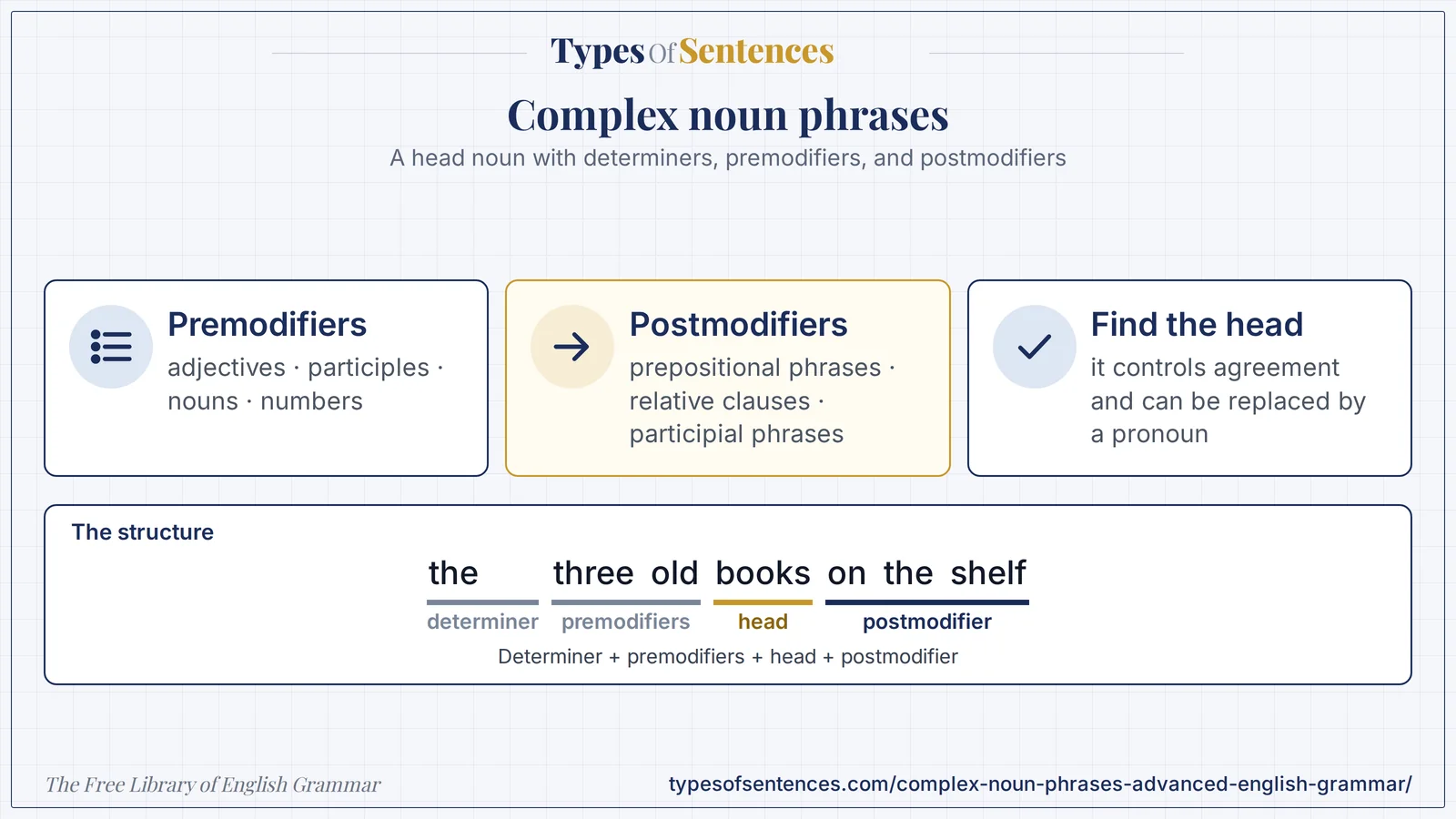
Every noun phrase is built around a head noun. The words before it (premodifiers) and the words after it (postmodifiers) add detail. A long noun phrase is easy to read when you can find the head and see what each part modifies.
Why it matters: Most writing problems with long noun phrases are about overloading: too many modifiers before the head, or too many phrases piled up after it, so that the reader cannot tell what belongs to what.
Summary: A noun phrase has a head noun (or pronoun), optional determiners and premodifiers before it, and optional postmodifiers after it. Premodifiers include adjectives, participles, nouns, and numbers. Postmodifiers include prepositional phrases, relative clauses, participle phrases, infinitive phrases, and appositives. Noun phrases can be nested inside one another. The head is the word that the verb agrees with and that a pronoun can replace.
- Structure: determiner + premodifiers + head + postmodifiers.
- Premodifiers: adjectives, participles, nouns, numbers.
- Postmodifiers: prepositional phrases, relative clauses, participle phrases, infinitives, appositives.
- Find the head: it controls agreement and can be replaced by a pronoun.
What You’ll Learn
- 1. Complex Noun Phrases: Structure Around the Head
- 2. Multiple Premodifiers: Stacking Adjectives and Noun Strings
- 3. Multiple Postmodifiers
- 4. Appositive Phrases and Complex Appositives
- 5. Nested Noun Phrases
- 6. Head Noun Identification
- 7. Functions of Noun Phrases
- 8. Style: When Long Noun Phrases Help and When They Hurt
- 9. Common Errors with Complex Noun Phrases
- 10. Exercises
- 11. Test Your Knowledge
- 12. Frequently Asked Questions
- 13. Conclusion
1. Complex Noun Phrases: Structure Around the Head
A noun phrase has up to four layers. The head is the only required element (and can be a pronoun or a proper name); everything else is optional.
| Layer | Name | Example |
|---|---|---|
| 1 | determiner (and predeterminer) | all the, my, those |
| 2 | premodifiers | three old wooden boats |
| 3 | head | boats |
| 4 | postmodifiers | boats that my grandfather built |
- the tall man determiner + premodifier + head
- the man with the hat determiner + head + prepositional postmodifier
- all the three old wooden boats that my grandfather built on the shore of the lake predeterminer, determiner, numeral, premodifiers, head, relative clause, prepositional phrases
- she a pronoun head alone
Noun phrases function as subjects, objects, complements, objects of prepositions, appositives, and, in some cases, adverbials (last year, every day, this morning). They are the units that the Intermediate chapter on noun phrases introduced; the determiners are treated in the chapter on advanced article usage.
2. Multiple Premodifiers: Stacking Adjectives and Noun Strings
| Premodifier | Examples | Notes |
|---|---|---|
| adjective | a tall man, an old wooden boat | order: opinion, size, age, shape, color, origin, material, purpose; see advanced adjective concepts |
| participle | a running tap, boiled eggs, a broken window | active (-ing) or passive (-ed) |
| noun (noun adjunct) | a stone wall, a chicken soup, a school bus | the first noun classifies the head |
| genitive | the doctor’s advice, my sister’s car | functions as a determiner |
| number | two cats, the first three chapters | a postdeterminer |
| adverb + adjective/participle | a very large house, a newly built bridge | the adverb modifies the premodifier |
| compound phrase | a never-ending story, a ten-year-old boy, an out-of-the-way place | hyphenated |
Several adjectives in a row follow the loose order of opinion, size, age, shape, color, origin, material, and purpose: a lovely old Italian marble fountain. Native speakers rarely use more than three or four before a noun. Noun strings are more common in news, science, and law, where several nouns pile up: a federal student loan repayment plan.
| Noun string | Unpacked |
|---|---|
| the financial services industry regulation reform committee | the committee on the reform of the regulation of the financial services industry |
| a university student mental health survey | a survey of the mental health of university students |
| climate change adaptation policy implementation | the implementation of policies for adapting to climate change |
| an employee performance evaluation form | a form for evaluating the performance of employees |
| the school bus driver safety training program | a program that trains school bus drivers in safety |
3. Multiple Postmodifiers
| Postmodifier | Examples | Notes |
|---|---|---|
| prepositional phrase | the book on the table; a man with a hat; the end of the story | the most common postmodifier |
| relative clause (finite) | the man who called; the book that I read | restrictive or non-restrictive; see advanced relative clauses |
| participle phrase (reduced relative) | the man standing at the door; the books written by her | -ing (active) or -ed (passive) |
| infinitive phrase | a chance to win; the first to arrive; nothing to eat | purpose or possibility |
| adjective phrase (postpositive) | something nice; a man happy to help; the people involved | with indefinite pronouns and heavy adjective phrases |
| appositive clause | the fact that he lied; the idea that we should leave | spells out the content of an abstract noun |
| adverb | the room upstairs; the people here; the day before | place or time |
| appositive noun phrase | my friend, a doctor; Maria, the new manager | a renaming phrase |
| Combined postmodifiers | Structure |
|---|---|
| the report of the committee on the reform of the system | head + PP + PP (+ PP) |
| the man standing at the door who called yesterday | head + participle phrase + relative clause |
| the chance to win a prize that nobody expected | head + infinitive phrase + relative clause |
| a book about grammar written by a linguist for general readers | head + PP + participle phrase + PP |
Each postmodifier can attach to the head or to a nearer noun, which produces ambiguity. In the idea of building a bridge across the river that flooded last year, the relative clause that flooded last year modifies river (the nearest noun), not bridge. Reading a long noun phrase means asking, for each phrase, “What does this modify?” The usual rule is that a modifier attaches to the nearest noun that makes sense.
4. Appositive Phrases and Complex Appositives
| Type | Example | Punctuation |
|---|---|---|
| nonessential noun phrase | My friend, a doctor, helped. | commas |
| essential (restrictive) | The poet Burns wrote it. My friend Tom called. | no commas |
| multiple appositives | Maria Gomez, a lawyer, the mother of two, spoke. | commas around the group |
| appositive with an introducer | Many fruits, such as mangoes, are sweet. The planets, namely Mars and Venus, … | commas |
| appositive clause | the fact that he lied | no commas (restrictive) |
| dash or colon for emphasis | She had one fear—heights. | dash or colon |
| appositive at the start | A gifted pianist, she played for hours. | comma after |
An appositive must be placed next to the noun it renames. An appositive at the start of a sentence needs a subject that matches: A gifted pianist, she played for hours, not A gifted pianist, the hall was full. Appositives were introduced in the chapter on appositive phrases; the clauses that function as appositives are covered in the chapter on nominal clauses.
5. Nested Noun Phrases
A noun phrase can contain another noun phrase, because a prepositional phrase inside it ends in a noun phrase, which may itself have a postmodifier. This is called nesting or recursion, and it explains how a single noun phrase can be very long.
- [the report [of the committee [on the reform [of the system]]]] four levels, each inside the previous
- [the idea [of building [a bridge [across the river [that flooded]]]]] five levels
- [the man [with the hat [that he bought [in Paris]]]] four levels
| Level | Phrase | Head |
|---|---|---|
| 1 (outer) | the report of the committee on the reform of the system | report |
| 2 | the committee on the reform of the system | committee |
| 3 | the reform of the system | reform |
| 4 (inner) | the system | system |
6. Head Noun Identification
The head is the word that determines the grammar of the whole phrase. Three tests find it.
| Test | Example | Result |
|---|---|---|
| agreement: the verb agrees with the head | The box of chocolates is on the table. | box (singular), not chocolates |
| pronoun replacement: the head can be replaced by a pronoun for the whole phrase | The tall man with the hat he arrived. | man |
| deletion: remove modifiers until the phrase is minimal | the old wooden boat that he built → boat | boat |
| Tricky structure | Head | Agreement |
|---|---|---|
| a lot of people | people (notionally) | A lot of people are waiting. The verb agrees with the noun after of |
| a number of students | students | A number of students were late. |
| the number of students | number | The number of students is growing. |
| one of the students | one | One of the students is absent. |
| a pair of shoes | pair | A pair of shoes is on the floor. |
| the majority of the voters | either | The majority of the voters are young. (plural, by sense) |
| the rest of the books | rest (notionally books) | The rest of the books are here. |
| the poor | poor (an adjective used as a noun) | The poor are suffering. |
| The Lord of the Rings | a title (singular) | The Lord of the Rings is a novel. |
| bread and butter | a unit (singular) | Bread and butter is simple fare. |
| the manager and the staff | two heads (plural) | The manager and the staff are late. |
When a noun phrase begins with a quantifier or measure noun followed by of (a lot of, a kind of, a number of, the majority of), the verb often agrees with the noun after of, a pattern known as notional agreement. Compare the singular a kind of fruit and the plural these kinds of fruit.
7. Functions of Noun Phrases
| Function | Example |
|---|---|
| subject | The tall man left. |
| direct object | She read the book that he recommended. |
| indirect object | She gave her youngest brother a present. |
| subject complement | He is a teacher of mathematics. |
| object complement | They elected her the president of the club. |
| object of a preposition | in the garden behind the house |
| appositive | Maria, my oldest friend, called. |
| adverbial | She left last year. He works every day. |
| vocative (direct address) | Mr. Chairman, I object. |
8. Style: When Long Noun Phrases Help and When They Hurt
| Helps | Hurts |
|---|---|
| compresses information: the rapid growth of urban populations instead of urban populations grew rapidly | piles up modifiers: the recently introduced new federal tax reporting requirements |
| allows abstract subjects and topics in academic writing | hides the actor: The implementation of the policy by the department |
| links ideas by repeating a noun phrase as a given topic | is ambiguous: the old men’s and women’s clothes |
| gives a formal, impersonal tone | forces the reader to hold many modifiers in memory |
- Keep the head near the start where possible, and put heavy postmodifiers last (end weight).
- Limit premodifiers to three or four, and noun strings to three nouns.
- Unpack with a verb. A noun phrase built from a nominalization (the investigation of the problem) can often become a clause (they investigated the problem). See the chapter on conciseness and wordiness.
- Hyphenate compound premodifiers to prevent misreading (a small-business owner), and use commas for nonessential postmodifiers.
- Check attachment. If a modifier could attach to two nouns, move it next to the one it modifies or rewrite.
Edit: The recently announced federal employee health insurance premium increase proposal for the next fiscal year that the committee reviewed has surprised the people.
- Head of the whole phrase: proposal.
- The noun string federal employee health insurance premium increase is too long.
- Unpack: an increase in the premiums for health insurance for federal employees.
- Rewrite as a clause: The committee reviewed a recently announced proposal to increase the health insurance premiums of federal employees next fiscal year, and it has surprised people.
9. Common Errors with Complex Noun Phrases
| Error | Correction | Rule |
|---|---|---|
| The box of chocolates are on the table. | The box of chocolates is on the table. | the verb agrees with the head |
| A number of students was late. | A number of students were late. | notional agreement |
| The number of students are growing. | The number of students is growing. | the number is singular |
| a student film society (ambiguous) | a film society for students / a society of student filmmakers | unpack the noun string |
| Walking home, the man’s hat blew off. | Walking home, he lost his hat. / As the man walked home, his hat blew off. | dangling participle |
| the book about grammar which she wrote it | the book about grammar that she wrote | no resumptive pronoun |
| the old men’s and women’s clothes (ambiguous) | the old clothes of the men and women | attachment |
| A gifted pianist, the hall was full. | A gifted pianist, she filled the hall. | an appositive must match the subject |
| the three first chapters | the first three chapters | order: ordinal before cardinal |
| an university student | a university student | a before a consonant sound |
| The reason of the delay | The reason for the delay | dependent preposition |
| the report’s of the committee | the committee’s report / the report of the committee | one genitive form |
Edit: The box of chocolates that she bought in Paris, a gift for her friend, who is a lawyer, are ready, and a number of students was invited to see the three first chapters of the book about grammar which she wrote it.
- The box … are ready: the head is box: is ready.
- a number of students was invited: were invited.
- three first chapters: first three chapters.
- which she wrote it: that she wrote.
- Result: The box of chocolates that she bought in Paris, a gift for her friend, who is a lawyer, is ready, and a number of students were invited to see the first three chapters of the book about grammar that she wrote.
Recap in 12 seconds
Watch the lesson build itself: A complex noun phrase has a head, determiners and premodifiers before it, and postmodifiers after it. The video has no sound.
Exercises
Part A: Structure and Head (Exercises 1–8)
Exercise 1: Find the head: the old wooden boat that he built
Show Answer
Answer: boat.
Exercise 2: Find the head: the box of chocolates
Show Answer
Answer: box.
Exercise 3: Choose: The box of chocolates (is/are) on the table.
Show Answer
Answer: is.
Exercise 4: Choose: A number of students (was/were) late.
Show Answer
Answer: were.
Exercise 5: Choose: The number of students (is/are) growing.
Show Answer
Answer: is.
Exercise 6: Name the layers: all the three old wooden boats
Show Answer
Answer: predeterminer, determiner, numeral, premodifiers, head.
Exercise 7: Name the function of last year: She left last year.
Show Answer
Answer: Adverbial noun phrase.
Exercise 8: Find the head: the poor
Show Answer
Answer: poor (an adjective used as a noun).
Part B: Premodifiers and Noun Strings (Exercises 9–14)
Exercise 9: Order: a (wooden/lovely/old) boat
Show Answer
Answer: a lovely old wooden boat.
Exercise 10: Find the head of the string: a university student mental health survey
Show Answer
Answer: survey (the last noun).
Exercise 11: Unpack: an employee performance evaluation form
Show Answer
Answer: a form for evaluating the performance of employees.
Exercise 12: Name the premodifier type: a stone wall
Show Answer
Answer: Noun adjunct.
Exercise 13: Name the premodifier type: a never-ending story
Show Answer
Answer: Compound phrase premodifier.
Exercise 14: Edit: the three first chapters
Show Answer
Answer: the first three chapters.
Part C: Postmodifiers and Attachment (Exercises 15–21)
Exercise 15: Name the postmodifier: the man standing at the door
Show Answer
Answer: Participle phrase.
Exercise 16: Name the postmodifier: a chance to win
Show Answer
Answer: Infinitive phrase.
Exercise 17: Name the postmodifier: the fact that he lied
Show Answer
Answer: Appositive (that-)clause.
Exercise 18: Name the postmodifier: something nice
Show Answer
Answer: Postpositive adjective.
Exercise 19: What does that flooded modify: the bridge across the river that flooded?
Show Answer
Answer: river (the nearest noun).
Exercise 20: Edit: the book about grammar which she wrote it
Show Answer
Answer: the book about grammar that she wrote.
Exercise 21: Name the problem: a student film society
Show Answer
Answer: Ambiguity of a noun string.
Part D: Appositives and Nesting (Exercises 22–26)
Exercise 22: Punctuate: My friend a doctor helped.
Show Answer
Answer: My friend, a doctor, helped.
Exercise 23: Punctuate: The poet Burns wrote it. (essential)
Show Answer
Answer: No commas.
Exercise 24: Fix: A gifted pianist, the hall was full.
Show Answer
Answer: A gifted pianist, she filled the hall.
Exercise 25: Count the levels: [the report [of the committee [on the reform]]]
Show Answer
Answer: Three levels.
Exercise 26: Rewrite with a verb: the report of the committee on the reform
Show Answer
Answer: The committee reported on the reform.
Part E: Style and Errors (Exercises 27–30)
Exercise 27: Unpack: climate change adaptation policy
Show Answer
Answer: a policy for adapting to climate change.
Exercise 28: Edit: The reason of the delay
Show Answer
Answer: The reason for the delay.
Exercise 29: Edit: an university student
Show Answer
Answer: a university student.
Exercise 30: Give one way to simplify a very long noun phrase.
Show Answer
Answer: Use a verb, unpack with prepositions, or split into two sentences.
Test Your Knowledge
Ready to check what you learned? Answer all 10 questions, then submit. You need 80% (8 of 10) to pass. Your answers are not stored.
View correct answers and explanations
Question 1: What is the head of the old wooden boat that he built?
✓ Correct Answer: C – boat
Boat is the head.
Question 2: Which verb agrees with The box of chocolates?
✓ Correct Answer: D – is
The head is box.
Question 3: Which is correct?
✓ Correct Answer: C – A number of students were late.
A number of takes a plural verb.
Question 4: What is the head of a noun string?
✓ Correct Answer: B – the last noun
The last noun is the head.
Question 5: Which is a postmodifier?
✓ Correct Answer: C – that he built
A relative clause follows the head.
Question 6: Which is a premodifier?
✓ Correct Answer: D – wooden
Wooden comes before the head.
Question 7: Which is correct?
✓ Correct Answer: B – the first three chapters
Ordinal before cardinal.
Question 8: Which appositive punctuation is correct?
✓ Correct Answer: B – My friend, a doctor, helped.
Commas around a nonessential appositive.
Question 9: What does nesting mean?
✓ Correct Answer: A – one phrase inside another
Nesting is a phrase within a phrase.
Question 10: Which unpacks a noun string?
✓ Correct Answer: A – a student loan repayment plan → a plan for repaying student loans
Unpacking uses prepositions.
Frequently Asked Questions
What are complex noun phrases?
Complex noun phrases are noun phrases with several modifiers before or after the head noun, or with phrases nested inside them: the report of the committee on the reform of the system.
What are advanced noun phrases?
Advanced noun phrases are noun phrases studied in depth: stacked premodifiers, noun strings, multiple postmodifiers, complex appositives, nested phrases, and the tests for the head.
What is noun phrase complexity?
Noun phrase complexity is the amount of structure in a noun phrase: the number of modifiers, the types of postmodifier, and the depth of nesting. It increases in academic and technical writing.
What is noun phrase structure advanced learners should know?
The structure that advanced learners should know is determiner, premodifiers, head, and postmodifiers, with the head as the controlling element. This noun phrase structure advanced readers use to analyze long sentences.
What are expert noun phrases?
Expert noun phrases are noun phrases built with control: a clear head, a limited number of premodifiers, postmodifiers attached to the right noun, and unpacking where the phrase would be too heavy.
How do I find the head noun?
Find the word that the verb agrees with and that a pronoun can replace: The box of chocolates is here has the head box, not chocolates. Delete modifiers to test.
How long should a noun phrase be?
There is no fixed limit, but readers struggle with more than three or four premodifiers, noun strings of more than three nouns, and nesting of more than three levels. Break long phrases into clauses.
Conclusion
You now have a deep study of the noun phrase: structure around the head, premodifiers and noun strings, postmodifiers, complex appositives, nested noun phrases, head identification, functions, and style. You can read and write complex noun phrases with expert control and avoid the usual errors.
When a noun phrase seems hard, find the head first and then ask what each modifier modifies. Next, you will study complex verb phrases.
- Huddleston, Rodney, and Geoffrey K. Pullum. The Cambridge Grammar of the English Language. Cambridge University Press, 2002.: the reference analysis of the noun phrase, its head, and its dependents.
- Quirk, Randolph, et al. A Comprehensive Grammar of the English Language. Longman, 1985.: the classic treatment of premodification and postmodification.
- Biber, Douglas, et al. Longman Grammar of Spoken and Written English. Longman, 1999.: corpus evidence on the complexity of noun phrases in academic prose.
- Garner, Bryan A. Garner’s Modern English Usage, 5th ed. Oxford University Press, 2022.: usage guidance on noun strings and agreement.
- The Chicago Manual of Style, 17th edition, chapter 5 (Grammar and Usage): American publishing conventions.
Last reviewed: October 29, 2026. How it was made: drafted with AI assistance, then checked with automated tests (structure, links, answer keys, spelling) and against the sources above. A person has not yet read this chapter line by line. Found a mistake? Report it.