Capitalization rules tell you which words begin with a capital letter. The basic rule is simple: capitalize the first word of a sentence and the names of specific people, places, and things. The difficulty is in the details, such as when a title is capitalized (President Lincoln but the president), whether a direction is capitalized (the South but drive south), and how to capitalize the title of a book.
This chapter is a capitalization guide. It gives the rules for capital letters, a clear answer to the question of when to use capital letters in English, and sections on names and titles, titles of works, geographic names, organizations and brands, history, languages, days and months, school subjects, directions, and family words. Proper capitalization follows a few principles, and the chapter ends with the common errors. Thirty exercises and a quiz follow.
A capital letter says, “This is a particular one.” River is a general word; the Ganges is a particular river. The same idea covers people, places, organizations, days, and languages.
Why it matters: When a word names a category (mountain, doctor, college), use lowercase. When it names one particular thing (Mount Everest, Dr. Rao, Yale College), use a capital.
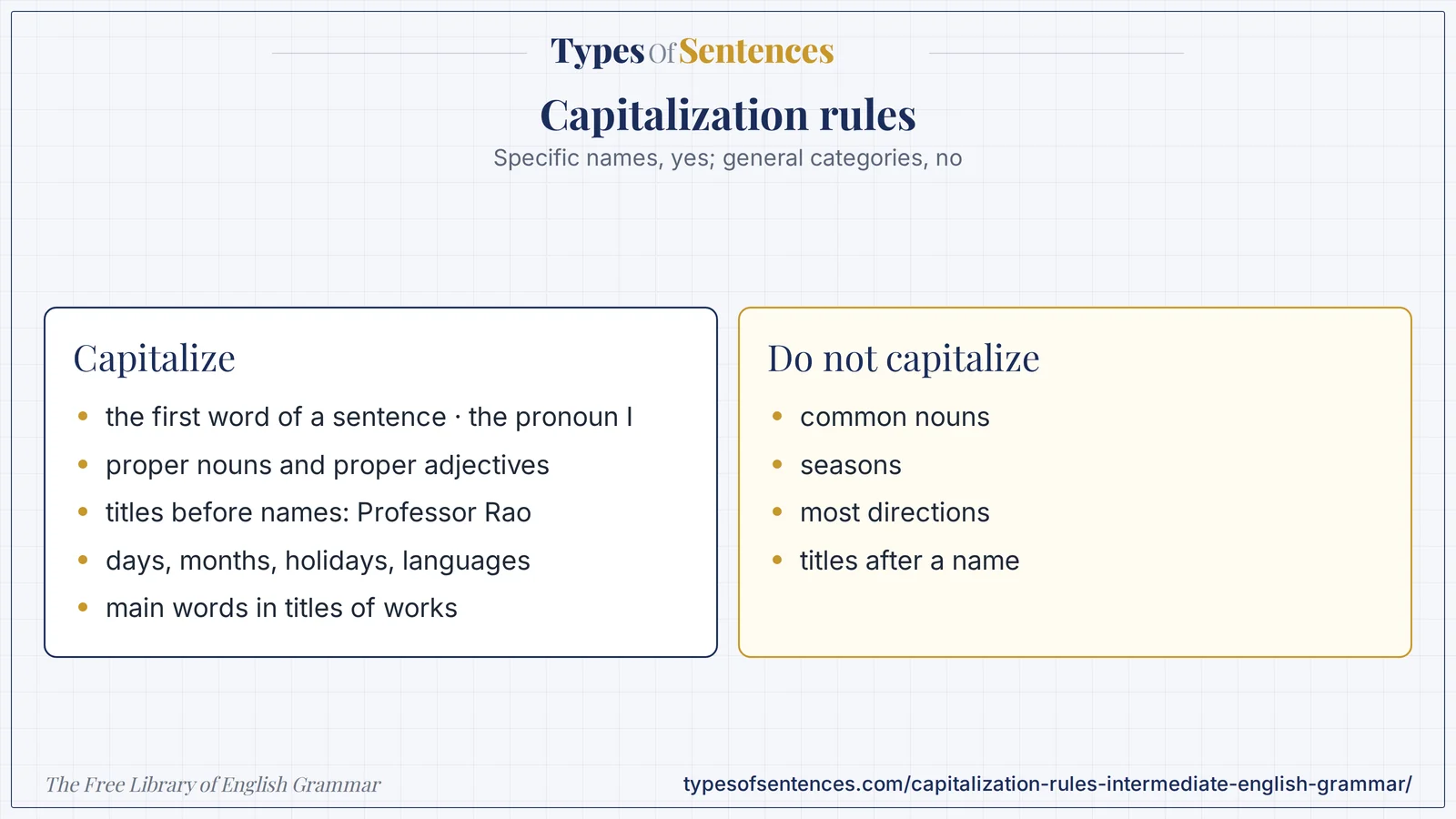
Summary: Capitalize the first word of a sentence, the pronoun I, proper nouns and proper adjectives, titles before names, days, months, holidays, languages, nationalities, and the main words in titles of works. Do not capitalize common nouns, seasons, most directions, school subjects (except languages), or titles that follow or replace a name in general use.
- Specific names are capitalized; general categories are not.
- Titles before a name are capitalized: Professor Rao; after or alone: the professor.
- Days, months, and holidays are capitalized; seasons are not.
- In titles of works, capitalize the first and last words and the major words.
What You’ll Learn
- 1. Capitalization Rules: Basic Capitalization (Review)
- 2. Rules for Capital Letters: Titles and Names
- 3. Titles of Works
- 4. Geographic Names
- 5. Organizations, Brands, and Institutions
- 6. Historical Periods, Days, Months, and Holidays
- 7. Languages, Nationalities, Religions, and School Subjects
- 8. Family Words, Directions in Titles, and Other Cases
- 9. Common Capitalization Errors
- 10. Exercises
- 11. Test Your Knowledge
- 12. Frequently Asked Questions
- 13. Conclusion
1. Capitalization Rules: Basic Capitalization (Review)
| Rule | Example |
|---|---|
| the first word of a sentence | The train arrives at six. |
| the first word of a quoted sentence | She said, “We are leaving.” |
| the pronoun I | Tom and I went home. |
| proper nouns (specific names) | Maria, Mumbai, Microsoft, the Nile |
| proper adjectives (from proper nouns) | American history, Shakespearean sonnets, Indian food |
| the first word after a colon (only if it begins a complete sentence, in Chicago style) | He had one rule: Never be late. |
| the first word in a line of traditional poetry (often) | Shall I compare thee to a summer’s day? |
| the first word of a salutation and closing | Dear Ms. Rao, / Sincerely yours, |
Proper nouns are the names of particular people, places, and things; see the chapter on nouns. A proper adjective, described with the other adjective types in the chapter on adjective types, is an adjective made from a proper noun: Spanish, Victorian, Newtonian. Common nouns are not capitalized unless they begin a sentence.
2. Rules for Capital Letters: Titles and Names
| Situation | Capitalize? | Example |
|---|---|---|
| title before a name | yes | President Lincoln, Dr. Rao, Professor Smith, Queen Elizabeth |
| title after a name or used alone in general | no | Lincoln, the president; Dr. Rao, a physician; the professor said |
| a title used in direct address | yes | Welcome, Doctor. Yes, Sir. |
| a high title used instead of a name (formal) | often yes | The President signed the bill. (the U.S. President); the president of the club (no) |
| a job description or common title | no | She is a doctor. Our manager called. |
| a title as part of a name in an official list | yes | Chairperson Maria Gomez |
| “Ms.,” “Mr.,” “Mrs.,” “Dr.” | yes | Mr. Smith, Ms. Rao |
The general rule is that a title is capitalized when it comes before a name and used as part of that name (Professor Rao), and not when it stands alone or follows the name. The treatment of high titles used alone (the President, the Queen) differs by style guide: Chicago style lowercases them, and many writers capitalize them in formal references to one office-holder.
| Wrong | Right |
|---|---|
| I met doctor Rao. | I met Dr. Rao. |
| The Doctor said I was fine. | The doctor said I was fine. |
| Professor smith teaches here. | Professor Smith teaches here. |
| Maria is the Manager. | Maria is the manager. |
3. Titles of Works
In titles of books, articles, films, songs, and other works, most style guides capitalize the first and last words and all the major words in between. These are the headline-style rules, also called title case.
| Capitalize | Do not capitalize (unless first or last) |
|---|---|
| nouns, pronouns, verbs, adjectives, adverbs | articles: a, an, the |
| subordinating conjunctions (because, although, if) | coordinating conjunctions: and, but, or, nor, for, yet, so |
| the first and last words, whatever they are | prepositions (Chicago: all prepositions; AP and others: short ones, three letters or fewer) |
| the second part of a hyphenated major word (Self-Made) | to in an infinitive (How to Write) |
- The Lord of the Rings article The first; of and the lowercase
- To Kill a Mockingbird To first, so capitalized
- “A Tale of Two Cities” of lowercase
- What We Talk About When We Talk About Love About and When capitalized in most styles
- Pride and Prejudice and lowercase
Style guides differ on the prepositions and conjunctions in titles. Chicago style lowercases all prepositions, regardless of length, and AP style capitalizes words of four or more letters (With, From, About). APA capitalizes words of four or more letters. Choose a style, and apply it consistently. Titles of long works are italicized; titles of short works go in quotation marks, as in the previous chapter on punctuation marks. Prepositions are described in the chapter on types of prepositions.
In sentence-style capitalization (common in APA references and some web headings), only the first word and proper nouns are capitalized: Capitalization rules in English writing.
4. Geographic Names
| Capitalize | Do not capitalize |
|---|---|
| names of continents, countries, states, cities: Asia, India, Texas, Mumbai | general terms: the continent, the country, the city |
| specific features: Mount Everest, the Pacific Ocean, Lake Superior, the Sahara | a mountain, an ocean, a lake, a desert |
| specific streets and parks: Oak Street, Central Park | the street, a park |
| regions as proper names: the Middle East, the Midwest, the South (of the U.S.) | directions: drive south, the south side of town |
| the in a name only if it is part of it: The Hague | the before most geographic names: the Nile (lowercase the) |
| Region (a place name) | Direction (a compass point) |
|---|---|
| She grew up in the South. | Drive south for two miles. |
| The Northeast has cold winters. | The wind came from the northeast. |
| He lives in the Midwest. | The town is west of the river. |
| Western Europe | the western side of the lake |
The articles that go with geographic names are described in the chapter on articles. Compound names keep the common word capitalized when it is part of the name: Mount Everest, Lake Superior, Oak Street. Plurals follow the rule that the common noun is lowercase when used for several: Lakes Michigan and Superior in some styles, lakes Michigan and Superior in others.
5. Organizations, Brands, and Institutions
| Capitalize | Do not capitalize |
|---|---|
| names of companies, organizations, and institutions: Microsoft, the United Nations, Yale University, the Supreme Court | general terms: the company, the university, the court, a bank |
| brand names: Coca-Cola, Toyota, Nike | generic product names: cola, car, shoes |
| products as brands: the iPhone, Windows 11 | kinds of products: a smartphone |
| government bodies: the U.S. Senate, Congress, the Department of Education | general uses: a senate, a department |
| specific school courses with names: Biology 101, Algebra II | general subjects: biology, algebra |
| trademarks as styled by the owner (iPhone, eBay) | — |
Some brands use unusual capital letters of their own (iPhone, eBay, YouTube). Follow the brand’s style, unless it begins a sentence, where many writers capitalize the first letter. The full name of an organization is capitalized, and later short references (the company, the university) are not.
6. Historical Periods, Days, Months, and Holidays
| Capitalize | Do not capitalize |
|---|---|
| specific events and wars: World War II, the French Revolution, the Battle of Plassey | general terms: the war, a revolution |
| named periods: the Middle Ages, the Renaissance, the Stone Age, the Great Depression | numbered centuries and decades: the twentieth century, the 1990s |
| days of the week: Monday, Friday | seasons: spring, summer, autumn, winter |
| months: January, August | general periods: today, tomorrow, last week, the weekend |
| holidays and special days: Thanksgiving, Diwali, Christmas Day, Earth Day | a holiday as a general idea: a national holiday |
| specific treaties and acts: the Treaty of Versailles, the Civil Rights Act | general documents: a treaty, an act |
Capitalize days and months, not seasons.
7. Languages, Nationalities, Religions, and School Subjects
| Capitalize | Do not capitalize |
|---|---|
| languages: English, Hindi, Spanish | school subjects (except languages): math, science, history, biology |
| nationalities and peoples: Indian, American, French | general adjectives of kind: a french fry (in some styles), a roman numeral (some styles) |
| religions and their followers: Christianity, Islam, Hindu, Buddhist | a god (lowercase, in general): a god; but God as a name |
| specific course names: Introduction to Biology; Algebra II | courses described generally: I am taking biology and algebra |
- She speaks French and studies biology. language capitalized; subject not
- He is taking History 201 and English this term. a named course and a language
- The Hindu festival of Diwali is in October or November. religion, holiday, months
8. Family Words, Directions in Titles, and Other Cases
| Capitalize | Do not capitalize |
|---|---|
| a family word used as a name or in direct address: Call Mom. I asked Dad. | a family word with a possessive or article: my mom, the dad |
| a relationship before a name: Aunt Rita, Uncle Raj | a relationship alone: my aunt, her uncle |
| the first word after a colon if it begins a full sentence (Chicago) | the first word after a colon that introduces a list or phrase |
| acronyms: NASA, UNESCO, FBI, PDF | words that look like acronyms but are not: laser, scuba (now words) |
| “Internet” and “Web” in older style | “internet” and “web” in current Chicago style (lowercase) |
| the first word of each item in a vertical list (in some styles) | items that complete a sentence run in a list (lowercase) |
- Emphasis. Do not capitalize whole words for emphasis in formal writing. Use italics instead: That is very important, not That is VERY IMPORTANT. All capitals read as shouting in messages.
- Abbreviations. Capitalize the abbreviation if the full term is capitalized: Mr., Dr., U.S., a.m. (lowercase).
- The word “I”. Always capitalize it, including in contractions: I’m, I’ll.
9. Common Capitalization Errors
| Error | Correction | Rule |
|---|---|---|
| i went to the market. | I went to the market. | the pronoun I and the first word |
| We visited the University. | We visited the university. (general) / We visited Yale University. | general versus specific |
| I met Doctor rao. | I met Dr. Rao. | title before a name; proper noun |
| She said that He was late. | She said that he was late. | no capital after that |
| Drive South for two miles. | Drive south for two miles. | a direction |
| We went in Winter. | We went in winter. | seasons are lowercase |
| I speak french. | I speak French. | a language |
| My Mother called. | My mother called. | a family word with my |
| the lord of the rings | The Lord of the Rings | title of a work |
| She is studying Biology. | She is studying biology. | a school subject |
Fix: my uncle raj lives in the south, where we visit him every summer to eat indian food and to speak hindi with Aunt Rita, who teaches History at the university.
- Start the sentence: My; a name after a relationship: Uncle Raj.
- the south (a region): the South.
- summer stays lowercase.
- indian food: Indian food; hindi: Hindi.
- History (a subject): history; the university (general) stays lowercase.
- Result: My Uncle Raj lives in the South, where we visit him every summer to eat Indian food and to speak Hindi with Aunt Rita, who teaches history at the university.
Recap in 12 seconds
Watch the lesson build itself: What takes a capital letter, from sentence openers to titles of works, and what does not. The video has no sound.
Exercises
Part A: Basics (Exercises 1–5)
Exercise 1: Capitalize: tom and i went home.
Show Answer
Answer: Tom and I went home.
Exercise 2: Capitalize: she said, “we are leaving.”
Show Answer
Answer: She said, “We are leaving.”
Exercise 3: Proper adjective from America:
Show Answer
Answer: American.
Exercise 4: Capitalize: we visited lake superior.
Show Answer
Answer: We visited Lake Superior.
Exercise 5: Capitalize if needed: I visited a lake.
Show Answer
Answer: No change. lake is a common noun here.
Part B: Titles and Names (Exercises 6–11)
Exercise 6: Capitalize: I met doctor rao.
Show Answer
Answer: I met Dr. Rao.
Exercise 7: Capitalize: The Doctor said I was fine. (general)
Show Answer
Answer: The doctor said I was fine.
Exercise 8: Capitalize: professor smith teaches here.
Show Answer
Answer: Professor Smith teaches here.
Exercise 9: Capitalize: Maria is the Manager.
Show Answer
Answer: Maria is the manager.
Exercise 10: Title after the name: Lincoln, the President
Show Answer
Answer: Lincoln, the president.
Exercise 11: Title in address: Welcome, doctor.
Show Answer
Answer: Welcome, Doctor.
Part C: Titles of Works (Exercises 12–16)
Exercise 12: Title case: the lord of the rings
Show Answer
Answer: The Lord of the Rings.
Exercise 13: Title case: pride and prejudice
Show Answer
Answer: Pride and Prejudice.
Exercise 14: Title case: to kill a mockingbird
Show Answer
Answer: To Kill a Mockingbird.
Exercise 15: Title case: how to write an essay
Show Answer
Answer: How to Write an Essay.
Exercise 16: Sentence case: Capitalization Rules In English Writing
Show Answer
Answer: Capitalization rules in English writing.
Part D: Places and Directions (Exercises 17–21)
Exercise 17: Capitalize: she grew up in the south. (a region)
Show Answer
Answer: She grew up in the South.
Exercise 18: Capitalize: drive South for two miles.
Show Answer
Answer: Drive south for two miles.
Exercise 19: Capitalize: he lives in the midwest.
Show Answer
Answer: He lives in the Midwest.
Exercise 20: Capitalize: we crossed the pacific ocean.
Show Answer
Answer: We crossed the Pacific Ocean.
Exercise 21: Capitalize if needed: the Country was poor. (general)
Show Answer
Answer: the country was poor.
Part E: Calendar, Language, and Subject (Exercises 22–26)
Exercise 22: Capitalize: we met on tuesday in march.
Show Answer
Answer: We met on Tuesday in March.
Exercise 23: Fix: We went in Winter.
Show Answer
Answer: We went in winter.
Exercise 24: Capitalize: she speaks french and studies biology.
Show Answer
Answer: She speaks French and studies biology.
Exercise 25: Capitalize: diwali is in october or november.
Show Answer
Answer: Diwali is in October or November.
Exercise 26: Capitalize: he is taking algebra ii. (course name)
Show Answer
Answer: He is taking Algebra II.
Part F: Family Words and Errors (Exercises 27–30)
Exercise 27: Choose: I called (Mom/mom). (as a name)
Show Answer
Answer: Mom.
Exercise 28: Choose: I called my (Mother/mother).
Show Answer
Answer: mother.
Exercise 29: Fix it: She said that He was late.
Show Answer
Answer: She said that he was late.
Exercise 30: Fix it: i went to the market.
Show Answer
Answer: I went to the market.
Test Your Knowledge
Ready to check what you learned? Answer all 10 questions, then submit. You need 80% (8 of 10) to pass. Your answers are not stored.
View correct answers and explanations
Question 1: Which word is always capitalized?
✓ Correct Answer: A – I
The pronoun I is always capitalized.
Question 2: Which is correct?
✓ Correct Answer: D – I met Dr. Rao.
A title before a name is capitalized.
Question 3: Which is correct?
✓ Correct Answer: C – Drive south for two miles.
A direction is lowercase.
Question 4: Which is correct?
✓ Correct Answer: A – She grew up in the South.
A region is a proper noun.
Question 5: Which is NOT capitalized?
✓ Correct Answer: C – winter
Seasons are lowercase.
Question 6: Which is correct?
✓ Correct Answer: C – I speak French.
Languages are capitalized.
Question 7: Which is correct?
✓ Correct Answer: B – She studies biology.
School subjects are lowercase, except languages.
Question 8: Which is correct for a title of a work?
✓ Correct Answer: D – The Lord of the Rings
The first word and major words are capitalized.
Question 9: Which is correct?
✓ Correct Answer: B – Call Mom.
A family word used as a name is capitalized.
Question 10: Which is correct?
✓ Correct Answer: B – My mother called.
A family word with my is lowercase.
Frequently Asked Questions
What are the capitalization rules?
The capitalization rules say to capitalize the first word of a sentence, the pronoun I, proper nouns and adjectives, titles before names, days, months, holidays, languages, and the main words of titles of works, and not common nouns, seasons, most directions, or school subjects.
What are the rules for capital letters in titles of works?
Capitalize the first and last words and all the major words (nouns, verbs, adjectives, adverbs, pronouns). Lowercase articles, coordinating conjunctions, and, depending on the style guide, prepositions: The Lord of the Rings.
When to use capital letters in English with titles of people?
Capitalize a title when it comes before a name (President Lincoln, Dr. Rao), and lowercase it when it follows a name or stands alone in general use (Lincoln, the president; the doctor).
Is there a capitalization guide for directions?
Capitalize a direction only when it names a region (the South, the Midwest), and use lowercase when it is a compass point (drive south, the south side of town).
What is proper capitalization for seasons and school subjects?
Seasons are not capitalized (spring, winter). School subjects are not capitalized except languages and named courses: biology, English, Algebra II.
Do I capitalize days and months?
Yes. Capitalize the days of the week, the months, and holidays: Monday, March, Thanksgiving.
Do style guides agree about capitalization?
Mostly, but not on every detail. They differ on prepositions in titles, on high titles used alone (the President), and on words such as internet. Choose a style and be consistent.
Conclusion
You now have a complete capitalization guide: the basic rules, titles and names, titles of works, geographic names, organizations and brands, history, calendar words, languages and subjects, family words, and the common errors. You can apply proper capitalization with confidence.
Ask whether a word names one particular thing before you capitalize it. Next, you begin the writing-skills chapters with paragraph writing.
- Purdue Online Writing Lab: Capitalization Rules: reference page on capital letters.
- The Chicago Manual of Style, 17th edition, chapter 8 (Names, Terms, and Titles of Works): reference for capitalization of titles, names, and terms.
- Strunk, William, Jr., and E. B. White. The Elements of Style. 4th ed. Longman, 2000.: short guidance on style and usage.
- Quirk, Randolph, et al. A Comprehensive Grammar of the English Language. Longman, 1985.: proper nouns and capitalization in writing.
Last reviewed: October 29, 2026. How it was made: drafted with AI assistance, then checked with automated tests (structure, links, answer keys, spelling) and against the sources above. A person has not yet read this chapter line by line. Found a mistake? Report it.